




Abstract
The paper focuses on severe housing deprivation and its components—overcrowding and housing conditions problems. It is based on the European Union Statistics on Income and Living Conditions (EU-SILC) 2019 survey data. The paper analyzes this data on households in Poland—a country with significant problems in terms of housing deprivation. Three dimensions of housing deprivation are examined: experiencing only overcrowding, experiencing only housing conditions problems, and being severely housing deprived. The study aims to investigate three-dimensional housing deprivation depending on the urbanization level of living places and other socioeconomic characteristics of Polish households. The multinomial logit model was used to assess relative risk ratios for explanatory variables to achieve these purposes. It was found that some socioeconomic characteristics significantly influenced one dimension but not another. Moreover, the relative risk ratios for given characteristics sometimes are greater than one for a particular dimension and less than one for another. Specifically, a significant difference in housing conditions problems between households living in towns and rural areas was found. However, there are no significant differences in overcrowding and severe housing deprivation, given that all other explanatory variables are fixed. Furthermore, considering the relative risk as a ratio of the probability of experiencing the given dimension of housing deprivation and the probability of not being housing deprived at all, households in cities compared with rural households were more likely to be overcrowded and to experience severe housing deprivation but less likely to have housing conditions problems.
Plain Language Summary
The paper focuses on severe housing deprivation and its components among households in Poland—a country with significant problems in terms of housing deprivation. It is based on the European Union Statistics on Income and Living Conditions (EU-SILC) 2019 survey data. The paper aims to investigate three-dimensional housing deprivation depending on the urbanization level of living places and other socioeconomic characteristics. The multinomial logit model was used to assess the impact of factors influencing housing deprivation. A significant difference was found in housing conditions problems between households living in towns and rural areas. However, there are no significant differences in overcrowding and severe housing deprivation, given that all other factors are fixed. Furthermore, households in cities compared with rural households were more likely to be overcrowded and to experience severe housing deprivation but less likely to have housing conditions problems. The study allows the most vulnerable groups of households to be recognized and specific implications for policy to be identified. Limitations of the study include the lack of the most recent data, which would enable the monitoring of current housing deprivation in Poland.
Keywords
Introduction
Satisfying basic human needs is of key importance for sustainable social development (Winston & Eastaway, 2008; Winston & Kennedy, 2019; Zumaya & Motlak, 2021), where housing needs have a special place (Smets & van Lindert, 2016). The use of a flat of an appropriate standard is one of the basic needs of a household (Hanusik & Łangowska-Szczęśniak, 2018), which determines the quality of life (Ibrahim, 2020; Matel & Marcinkiewicz, 2021; Rasnaca, 2017; Sikora-Fernandez, 2018; Zumaya & Motlak, 2021), the ability to participate in social life (Winston & Kennedy, 2019), determines human health (Carmona-Derqui et al., 2023) and affects all aspects of the well-being of the population (Chan & Adabre, 2019; Golubchikov & Badyina, 2012; Morris, 2018; Wong & Chan, 2019).
The problem of households with ensuring appropriate housing conditions, and equipping them with sanitary facilities, heating and lighting is one of the dimensions of poverty (Dewilde, 2022; Fecht et al., 2018; Winston & Kennedy, 2019). Housing poverty, also referred to as housing deprivation, means the inability to meet housing needs at a certain level (Kozera et al., 2017; Navarro & Ayala, 2008; Sikora-Fernandez, 2018; Ulman & Ćwiek, 2020, 2021). It is worth mentioning that housing deprivation may affect both individuals or households that do not have access to housing at all, as well as those who, despite having housing, suffer from deficiencies in terms of basic housing conditions. The essence of housing deprivation is the accumulation of certain deficiencies in basic housing conditions (Ayala & Navarro, 2007).
Different measures are used to determine the level of housing deprivation (Ayala & Navarro, 2007), which may result from diverse cultural and institutional contexts (Matel & Marcinkiewicz, 2021), as well as from the availability of data. Often the starting point for the analysis of housing deprivation is the approach proposed by Eurostat (2023c), where indicators of poor housing condition include, inter alia, leaking roofs, insufficient light, dampness, lack of toilets, bath or showers (Borg, 2015; Matel & Marcinkiewicz, 2021; Ulman & Ćwiek, 2020; Wojewódzka-Wiewórska & Dudek, 2023). Researchers emphasize the importance of considering various measures simultaneously when diagnosing the housing situation (Tomaszewski & Perales, 2014). In addition, the combination of objective measures, that is, the overcrowding index (the percentage of people living in overcrowded dwellings) with subjective measures, which include the way people perceive and assess the conditions around them, allows for a complete overview of the housing situation, including housing derivation. Sunega and Lux (2016) point out that the conclusions from the analysis of objective indicators may differ from those resulting from the study of subjective indicators describing housing deprivation.
Based on the analysis of the literature, it can be concluded that the level of provision of housing needs varies between countries and regions (Norris & Domański, 2009) depending on various factors, that is, the level of economic development, the welfare system, fiscal, financial and real estate policies, and also household income and family support (Tsenkova & Lowe, 2017; Winston & Kennedy, 2019). Existing studies on housing deprivation from a rural-urban perspective also reveal differences (Obaco et al., 2022; Olotuah & Bobadoye, 2009; Rasnaca, 2017). Moreover, the results depend on the type of housing indicators used in the study (Burke & Jones, 2019; Dewilde, 2022; Hick et al., 2022; Ulman & Ćwiek, 2021; Wojewódzka-Wiewórska & Dudek, 2023) and result from the definition of urban and rural areas used (Satsangi & Wilson, 2020; Ulman & Ćwiek, 2021). The analysis of housing deprivation in the rural-urban context seems particularly interesting given the researcher’s findings (Burke & Jones, 2019; Fecht et al., 2018) that the nature of deprivation in rural areas differs from that in the cities. In addition, it is worth noting that recently, due to the COVID-19 pandemic, there has been an increase in interest in the housing conditions of the population (Hick et al., 2022). New features and measures of housing deprivation gained importance, (Cermáková & Hromada, 2022), including an increasing emphasis on analyzing whether a dwelling is located in a densely populated area (Ayala et al., 2021, 2022). This also confirms the legitimacy of our research on severe housing deprivation from the rural-urban perspective.
Many studies in the literature analyze housing deprivation (Matel & Marcinkiewicz, 2021) or housing poverty (Ulman & Ćwiek, 2020, 2021). Researchers use various indicators to analyze these phenomena. Our study shows the accumulation of housing deprivation indicators, which is much less often analyzed by researchers (Matel & Marcinkiewicz, 2021; Nolan & Winston, 2011). We capture the full picture of housing deprivation focusing on the European Union’s (EU) severe housing deprivation indicator and its subcomponents—overcrowding and housing conditions problems. Thus, in terms of the selection of analyzed indicators, we use the approach of Hick et al. (2022). However, unlike these authors, who analyzed all households in the EU, we narrow our focus to Poland, which is an example of a post-communist country. Historical conditions, including the transition from a centrally planned economy to a market economy, have seriously affected housing in Poland (Stephens et al., 2015), where there is still a serious problem with the availability of housing (Salamon & Muzioł-Węcławowicz, 2015). Poland is one of the EU countries with the highest rate of overpopulation (Eurostat, 2023b) and large internal disparities in terms of the various aspects of poverty, especially visible at the rural-urban level (Dudek & Landmesser-Rusek, 2023; Kalinowski, 2020). Therefore, we conduct single-country research to capture the specifics of housing deprivation in Poland, mostly in the rural-urban context. Rural areas in Poland cover 93% of the territory and are inhabited by 40% of the population (Local Data Bank, 2022). They are less developed than urban areas, and they are characterized by high differentiation of the level of their socioeconomic development. The main problems include income disparity and unemployment higher than in cities, dependence on one economic activity (agriculture), infrastructure shortages, limited access to services, outflow of people to cities and depopulation (Wilkin & Hałasiewicz, 2020).
In our study, we apply the multinomial logit model, which differs from the binary logit model used by Hick et al. (2022) in that the comparisons are all estimated simultaneously within the same model. The multinomial logit model enables to identification of correlates of all dimensions of housing deprivation. It has been applied to various forms of deprivation such as income poverty and severe material deprivation (Verbunt & Guio, 2019), and food insecurity (Dudek et al., 2021). Such a model was used by Matel and Marcinkiewicz (2021) to study housing deprivation, but these authors analyzed average marginal effects for the probability of suffering from housing deprivation indicators. We, however, focusing on severe housing deprivation, interpret the results of the multinomial logit model in terms of relative-risk ratios.
This paper makes several significant contributions to the literature. Given the unique nature of the concept analyzed, we address a current gap by providing a comprehensive overview of severe housing deprivation in Poland. Additionally, we bridge a gap in the literature by offering a detailed analysis of housing deprivation at the household level, specifically from a rural-urban perspective, which has not yet been fully explored in Poland. Our findings, therefore, enrich the knowledge about the specifics and differences between rural and urban areas concerning housing deprivation. It is worth emphasizing that the strength of our research lies in the use of indicators recognized by Eurostat for assessing housing deprivation within the EU. Consequently, the selection of indicators is not arbitrary, as is often the case in other studies, but is aligned with the established standards set by Eurostat. This approach facilitates a meaningful comparison of housing deprivation across EU countries. The next contribution of the paper is to use a multinomial logit model to analyze composite sub-indicators of severe housing deprivation simultaneously, allowing for the observation of overlaps and distinct aspects. This analysis becomes particularly insightful when socioeconomic household characteristics are included as control variables. Additionally, we propose analyzing the estimated parameters of the multinomial logit model using the relative risk ratio approach—an intuitive method for interpreting the effects of socioeconomic characteristics on the relative risk of different outcome categories across various dimensions of housing poverty. Finally, it is important to note that since we utilize Eurostat data harmonized according to European Union legislation, our methodology can be readily applied to the analysis of other EU countries.
According to the EU definition (Borg & Guio, 2021; Eurostat, 2023c), a household is defined as experiencing severe housing deprivation if a household is living in a dwelling that is simultaneously overcrowded and experiences housing conditions problems.
A detailed explanation of the terms used in the measurement of housing deprivation can be found in the section “The Material.”
The 2019 EU Statistics on Income and Living Conditions (EU-SILC) data was used as the most up-to-date dataset providing comprehensive information on severe housing deprivation and its components. The selected time of the study identifies the situation before the COVID-19 pandemic, which, as research shows (Kocur-Bera, 2022), was of great importance for improving housing conditions in Poland. We consider three dimensions of housing deprivation: experiencing only overcrowding, experiencing only housing conditions problems, and being severely housing deprived.
The study aims to investigate dimensions of housing deprivation from a rural-urban perspective and to examine the extent to which they vary based on household features. More specifically, it seeks to answer the following research questions (RQ):
RQ1: What is the prevalence of overcrowding, housing condition problems, and severe housing deprivation in Poland?
RQ2: Are there housing deprivation differences in the rural-urban location of the households?
RQ3: What are the significant socioeconomic factors influencing severe housing deprivation and its components?
The following sections contain the research methodology focusing on used data and research methods; then, the research results are disclosed; finally, a discussion and conclusions are provided.
The Material
The study examines housing deprivation at the household level using the 2019 cross-sectional survey data from the EU-SILC survey data. EU-SILC adheres to mandatory European regulations, which is why the data is also termed official microdata. It primarily functions as a social policy tool, addressing the information needs of policymakers and enabling social monitoring at a European level. Additionally, it effectively serves researchers by offering a comprehensive repository for empirical research on various dimensions, encompassing different types of poverty, health, and well-being in the European Union (EU; Wirth & Pforr, 2022). EU-SILC consists of annual national representative sample surveys. Household units and all present household members serve as observation units. EU-SILC provides cross-sectional and longitudinal data derived from a rotating panel. Detailed information on the design and structure of EU-SILC is presented in numerous papers (e.g., Eurostat, 2019; Wirth & Pforr, 2022).
Our study uses 2019 data, which was dictated by the fact that the most recent year for which all sub-indicators of severe housing deprivation are available was 2019. Since 2020, the cross-sectional EU-SILC has not provided data on problems with darkness in dwellings, and since 2021, it has lacked data on other sub-indicators of housing condition problems.
The analyzed sample includes 19,874 Polish households. The study considers the data about overcrowding, housing conditions problems, severe housing deprivation, and socioeconomic characteristics of households. In our study, we do not address the issue of homelessness (which is an acute form of housing deprivation) due to the lack of data on this phenomenon in our database (similarly to Matel & Marcinkiewicz, 2021).
Our research used the Eurostat methodology to define urban and rural areas (Eurostat, 2023a). The Degree of urbanisation (DEGURBA) is a classification that indicates the character of an area. Based on the share of the local population living in urban clusters and urban centers, it classifies Local Administrative Units (LAU or communes) into three types: (1) Cities (densely populated areas)—at least 50% of the population lives in urban centers; (2) Towns and suburbs (intermediate density areas—at least 50% of the population lives in urban clusters and less than 50% of the population lives in urban centers; (3) Rural areas (thinly populated areas—at least 50% of the population lives in rural grid cells).
According to the Eurostat definition, it was assumed that a household is overcrowded if it does not have at its disposal a number of rooms equal to at least the sum of one room for the household, one room per couple in the household, one room for every single person aged 18 or more, one room per pair of single people of the same gender between 12 and 17 years of age, one room for every single person between 12 and 17 years of age and not included in the previous category or one room per pair of children under 12 years of age (Borg & Guio, 2021; Eurostat, 2023b). A household experiences housing conditions problems if it is deprived concerning at least one of the following three housing conditions:
(1) having a leaking roof, damp walls/floors/foundation, or rot in window frame/floor,
(2) having neither a bath nor a shower in their dwelling and not having an indoor flushing toilet in their household, and
(3) living in dark dwellings.
More specifically, the first indicator identifies households where the household reports any of the following issues in the dwelling: a leaking roof and/or damp ceilings, dampness in the walls, floors or foundation and/or rot in window frames and doors. Following Hick et al. (2022), it is worth noting that the bath & shower and toilet indicators are measured separately but counted as one item for the severe housing deprivation measure. Thus, a household is classified as deprived under this indicator only if it lacks both items. The third indicator identifies households reporting that their dwelling is too dark, meaning there is not enough daylight through the windows during the day. Furthermore, a household is defined as experiencing severe housing deprivation if it is living in a dwelling considered overcrowded while also exhibiting housing conditions problems.
As EU-SILC provides annual population-representative information on living conditions and a range of demographic and socioeconomic variables on EU residents, we try to identify factors influencing the analyzed phenomenon.
We consider various household features as explanatory variables in the models:
• Degree of urbanization (the variable with three categories: rural areas—thinly populated area, towns—intermediate area, cities—densely populated area),
• Tenure status (the variable with five categories: 1—outright owner, 2—owner paying the mortgage, 3—tenant or subtenant paying rent at prevailing or market rate, 4—accommodation is rented at a reduced rate (lower price than the market price), 5—accommodation is provided free),
• Dwelling type (the variable with four categories: 1—detached house, 2—semi-detached or terraced house, 3—apartment or flat in a building with less than 10 dwellings, 4—apartment or flat in a building with 10 or more dwellings),
• Household type (the variable with nine categories: 1—single-person, 2—two adults (both adults under 65 years), 3—two adults 65+ (at least one adult ≥65 years), 4—two adults with one dependent child, 5—two adults with two dependent children, 6—two adults with at least three dependent children, 7—single-parent, 8—other with dependent children, 9—other without dependent children),
• Income (annual equalized household disposable income in thousands of euros from the previous year),
• Unemployed (presence of unemployed in the household, binary variable),
• Disabled (presence of disabled in the household, binary variable),
• Education (highest education level of household members, the variable with three response categories: 1—lower than upper secondary, 2—upper secondary, 3—tertiary.
For a better understanding of the conditions of Polish households, basic statistics regarding the socioeconomic characteristics are provided in Table A1 in the Supplemental Appendix. Notably, based on the results obtained, it is worth noting that 40.6% of households resided in cities, 23.8% in towns, and 35.5% in rural areas. The average equivalent income in Polish households was EUR 7,951 per year. Regarding tenure status, the predominant type was dwellings owned outright (70.5%). Additionally, it’s noteworthy that 35% of households contained an individual with tertiary education. Single-person households comprised the largest group (24.2%) in terms of household type. Moreover, 37% of households included individuals with disabilities, while 8.7% housed unemployed individuals.
Method
Since the outcome variable is multi-categorical without any particular order, then we use a multinomial logit model. This model can be expressed as:

where P(y = j) is the probability of an outcome being in category j, j = 1, 2, …, m;
In this research, the analyzed outcome variable has four categories:
(1) denotes being not housing deprived at all,
(2) means experiencing only housing conditions problems,
(3) experiencing only overcrowding, and
(4) being severely housing deprived.
Thus, assuming the outcome of one as the base category, the predicted probabilities are calculated as (Hardin & Hilbe, 2018):

The unknown parameters αj and

where β jk is a parameter for the k-th explanatory variable (xk) corresponding to j-th outcome (category), K is the number of regressors included in model.
According to formula (3), the RRR measures the multiplicative effect of a unit change in k-th explanatory variable xk on the relative risk, holding all other regressors constant. What is important, this effect does not depend on the values of other variables in the model. Some researchers prefer to interpret the RRR in terms of a percentage change rather than a multiplicative change. If βχk is positive, the unit growth in χ k indicates an increase in the relative risk by (exp(βjk)−1)·100%. Likewise, if βχk is negative, the unit increase in χk denotes a decrease in the relative risk by (1−exp(βjk))·100%. Thus, RRRs allow a more straightforward interpretation of the multinomial logit model results.
Statistical analyses were performed using the Stata program. The EU-SILC post-stratification sampling weights have been applied to the survey data.
Results
The prevalence of four considered categories among Polish households in 2019 is presented in Figure 1. It can be noticed that there is a lack of full compliance between the considered indicators. As shown in Figure 1, 24% of households experienced only overcrowding, 8% of households experienced only housing conditions problems, and 7%—simultaneously experienced both symptoms, that is, severe housing deprivation.
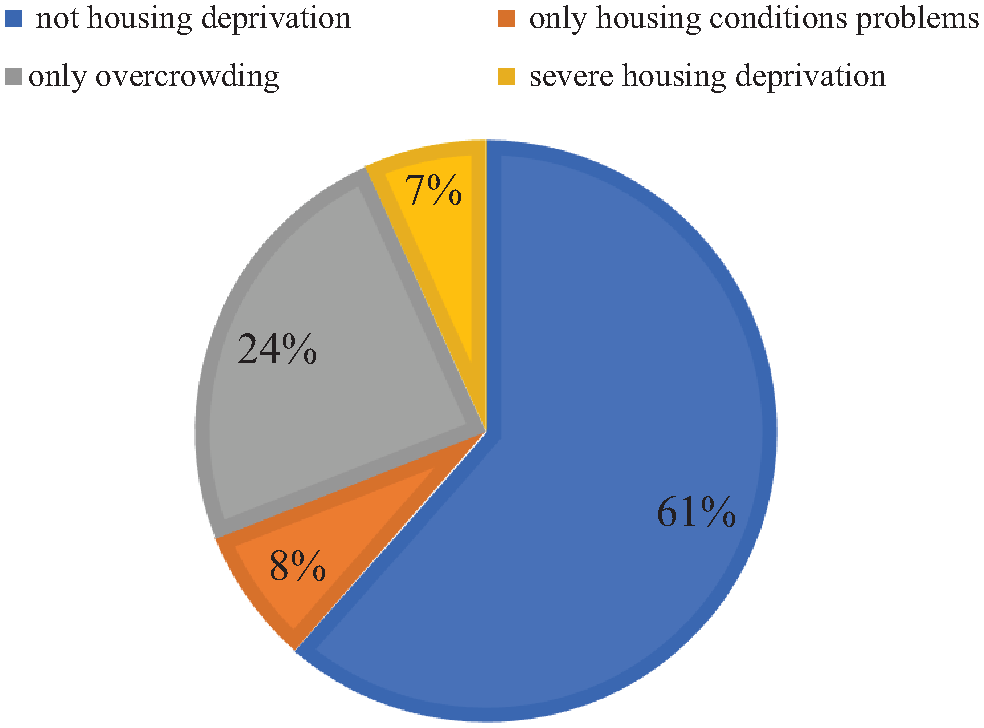
Prevalence of housing deprivation dimensions among Polish households (%).
To examine how different prevalence of housing deprivation dimensions depends on the degree of urbanization of the place of residence of households, we present Figure 2.
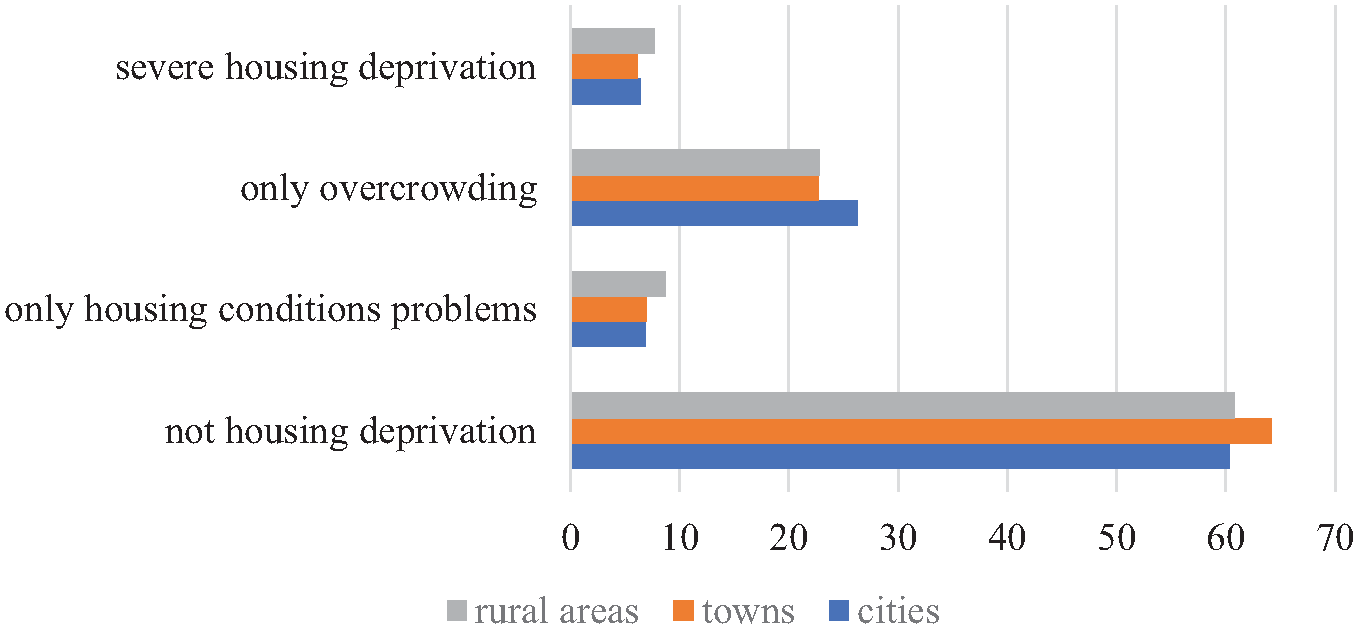
Polish households with different dimensions of housing deprivation by the degree of urbanization (%).
Figure 2 shows that the largest number of households that do not experience any housing deprivation are households living in towns (64%). The highest percentage (26%) of households living in overcrowded dwellings are in cities, while the highest percentages of households with housing conditions problems and severe housing deprivation are in rural areas (respectively 8% and 9%).
To gain a deeper insight into rural-urban differences under the ceteris paribus assumption, the parameters of the multinomial logit model are estimated. As our goal is to compare housing deprivation in rural and urban areas, we omit dwelling type as an explanatory variable in the model due to its significant association with the degree of urbanization (Pearson χ2(4) = 982.779, Cramer’s V = .390). Primarily, it should be noted that most rural households (72%) lived in detached houses, and in the cities, most households (71%) lived in apartments or flats in buildings with 10 or more dwellings.
The estimated RRRs are shown in Table 1 (Results for estimated parameters are in Table A2 in the Supplemental Appendix).
The Multinomial Logit Model Results—Relative Risk Ratios.

Source. Own calculations based on EU-SILC 2019 data.
Note. RRR are relative risk ratios; SE = standard errors; the numbers in italics denote a lack of statistical significance at a level of .05.
Table 1 presents intriguing findings. Firstly, it can be noticed that some socioeconomic characteristics significantly influenced one dimension but not another. For example, for the degree of urbanization, a significant difference exists between towns and rural areas for housing conditions problems. However, there are no significant differences regarding overcrowding and severe housing deprivation. Secondly, RRRs corresponding to given explanatory variables are sometimes greater than one for a particular dimension and less than one for another. Specifically, comparing cities and rural areas, RRR = 0.813 for housing conditions problems (i.e., for relative risk
Thus, RRR that is less than one indicates that there is a lower ratio of the probability of experiencing of “only housing conditions problems” and the probability of being not housing deprived for cities than for rural areas (for cities was 18.7% lower than for rural areas). However, taking into account the overcrowding and severe housing deprivation, the opposite conclusion can be drawn (RRR = 1.750 for overcrowding problems and RRR = 1.339 for severe housing conditions). This means that,
Summarizing the results from a rural and urban perspective (Table 1), it can be noted that, after other socioeconomic characteristics are controlled for, households in cities are in a better situation than rural households in terms of housing conditions problems but in a worse position due to overcrowding and severe housing deprivation. Furthermore, according to formula (3), increasing income and better education cause a decrease in considered RRRs. However, the presence of the unemployed and the disabled increases RRRs. Considering tenure status, there is no significant difference between the outright owners and the owners paying the mortgage. Nevertheless, tenants and households renting dwellings exhibited greater RRRs than outright owners.
Furthermore, considering household type, the statistically significant differences between single-person households and other types depend on the dimension of housing deprivation. For example, single-parent households do not differ significantly in “only housing conditions problems” but do this in “only overcrowding” and “severe housing deprivation.” Moreover, RRRs greater than one indicate a worse situation in single-parent households than single-person households.
In addition, it is interesting to note that for most household types with children, the Relative Risk Ratios (RRRs) for housing conditions are lower than one; however, they are greater than one for overcrowding and severe housing deprivation. This indicates better housing conditions, greater overcrowding, and severe housing deprivation in households with children compared to single-person households.
Discussion
Many authors have studied rural-urban differences in various fields, for example, in the economic activity (Landmesser, 2009), subjective quality of life (Sompolska-Rzechula & Kurdyś-Kujawska, 2020; Vaznonienė & Wojewódzka-Wiewiórska, 2021), material deprivation (Dudek & Landmesser-Rusek, 2023), and income inequalities (Wołoszyn & Wysocki, 2020). However, there is still a shortage of such research on housing deprivation among Polish households. Our study provides new results in this field focusing on severe housing deprivation and its components.
The researchers found generally poorer living conditions in rural areas compared to urban areas (Salamon & Muzioł-Węcławowicz, 2015) and the greatest risk of housing poverty for households living in rural areas (Ulman & Ćwiek, 2020). However, our study’s in-depth analysis of housing deprivation shows that rural households do not fare worse than urban households in all dimensions of housing deprivation. This aligns with research by Dewilde (2022), which found that urban households experience greater deprivation of living conditions than rural households in some aspects. Moreover, it depends on whether we compare rural households with households in cities or towns. For example, we found that more households living in overcrowded dwellings were in cities than in rural areas. However, there was no significant difference, in this respect, between rural households and households in towns. Furthermore, the results depend on the method applied. Specifically, for comparisons, we used both the simple summary presented in Figure 2 and the results based on the estimation of the multinomial logit model parameters shown in Table 1. Interestingly, the findings do not always coincide. In particular, comparing households living in towns and rural areas in severe housing deprivation, Figure 2 reveals the difference in this regard but the results of model parameters indicated in Table 1 do not. It should be noticed, however, that the results of the multinomial logit model are obtained after other socioeconomic characteristics are controlled for.
Our results are difficult to compare directly with those of other authors, as they often use different indicators of housing deprivation than we do and they do not always measure severe deprivation as we do. One of the few papers investigating severe housing deprivation and its components is Hick et al. (2022) research. The authors analyze 2016 EU-SILC data for 27 EU countries. It is noteworthy that in Poland, there were almost twice as many people experiencing severe housing deprivation compared to the EU average (Eurostat, 2023b). Specifically, in contrast to the average situation in the EU, approximately twice as many Poles live in overcrowded dwellings, while significantly fewer experience housing condition problems. However, our results largely align with Hick et al. (2022) results. Specifically, similarly to our findings, they discovered that, rural households frequently encountered housing conditions problems but seldom experienced overcrowding compared to households in cities. However, unlike us, they noted no statistically significant differences in severe housing deprivation in these two groups of households.
Moreover, Hick et al. (2022) noticed a lower risk of housing deprivation (in all dimensions) in households owning their home compared to tenants, which our research confirms. In addition, we corroborate their results regarding the problematic situation of households with children regarding overcrowding and severe housing deprivation.
It is worth mentioning that researchers point to the problem of measuring housing poverty and the selection of appropriate indicators (Ayala & Navarro, 2007). A universal research approach to this issue has not been developed (Hick et al., 2022; Navarro & Ayala, 2008). In our study, when measuring severe housing deprivation, we took into account its components—the problem of overcrowding and housing conditions problems. Our research revealed that these two components did not overlap. This proves the legitimacy of the analysis of housing poverty broken down into components. It should be noted that some researchers (Kozera et al., 2017; Ulman & Ćwiek, 2021) build a synthetic measure of housing poverty that takes into account many diagnostic variables. Such an approach allows a large number of variables of a quantitative and qualitative as well as objective and subjective nature to be included in the analysis (Ulman & Ćwiek, 2021). However, it may blur the real state of housing poverty, especially in relation to its components.
The issue of the accuracy of the selection of indicators describing housing deprivation is recognized in the literature (Hick et al., 2022; Matel & Marcinkiewicz, 2021). On the one hand, the use of the same indicators across the EU allows cross-country comparisons. For example, in this study, we have selected approved measures consistently across the EU to measure severe housing deprivation. On the other hand, however, it is important to take into account the individual context in the country under study. Knowledge about the subject of the research sometimes leads to the author’s selection of indicators of housing poverty. This enables the identification of the level of real inability to meet adequate housing needs and will provide a basis for policy action.
This paper adds to understanding the three-dimensional housing deprivation phenomenon among Polish households from rural-urban perspective. To our knowledge, this is the first study exploring severe housing deprivation focusing on households in Poland and differences in an urban-rural context. Therefore, our study fills a significant research gap in this area. The strengths of the EU-SILC data include the use of validated measures consistently across all the UE. The EU-SILC samples base on a nationally representative probability sample of the population residing in private households within the country, irrespective of language, nationality or legal residence status. This makes it possible to compare severe housing deprivation between EU countries. The advantage of our work is the use of indicators considered by Eurostat to monitor the living conditions in the aspect of housing deprivation in the EU. Therefore, the selection of indicators is not arbitrary, as is often the case in other studies, but aligned with established standards set by Eurostat.
Despite these strengths, certain limitations should be mentioned. First, we did not compare severe housing deprivation in 2019 with that during the COVID-19 pandemic. However, as we noted in the introduction to the paper, we used the most up-to-date severe housing deprivation data available for Poland. As we mentioned in “The Material” section, for 2020, the indicator related to living in dark dwellings is missing; what’s more for 2021, EU-SILC database does not include any of the indicators describing the “housing conditions problems” dimension. Therefore, due to the lack of complete data, it was impossible to compare the results obtained with those from the years of the COVID-19 pandemic.
Based on research by other authors, it can be assumed that the COVID-19 pandemic may have deepened the existing inequalities in housing conditions in EU countries (Ayala et al., 2022), including their overcrowding (Ayala et al., 2021). The intensive home use associated with the pandemic may result in different patterns of housing demand and slow changes in housing supply (Nanda et al., 2021). Moreover, during the post-pandemic period, new dwelling attributes have gained importance, that is, access to green spaces or a balcony (Nanda et al., 2021), access to information and telecommunications technologies, the presence of additional rooms, issues related to the availability of energy-saving solutions (Kocur-Bera, 2022), which may constitute a thread for future research on housing conditions.
In addition, an interesting issue would be the disclosure of changes in the housing market in Poland caused by the influx of refugees from Ukraine as a result of the armed conflict started in 2022 (Trojanek & Gluszak, 2022). Another issue as we mentioned before, is the fact that the homeless are not included in the research. These people usually live in very difficult conditions and experience acute housing deprivation. However, generally, the homeless are excluded from household surveys.
Our research on severe housing deprivation has significant implications for researchers, policymakers, and practitioners, which can be summarized as follows. First, by applying a multidimensional approach to studying housing deprivation in urban-rural contexts, we contribute new insights into this phenomenon in Poland. Second, our use of EU-based indicators enables their future application in both theoretical and practical contexts. It is important to emphasize that, unlike in most studies, the set of indicators used in our research was not arbitrarily selected by the authors. Instead, we utilized indicators endorsed by Eurostat for monitoring living conditions related to housing deprivation in the EU (Eurostat, 2023b). This ensures the potential for comparative analysis across different contexts. Our methodological approach can be applied to study housing deprivation in other countries and can also be used to monitor this phenomenon in subsequent years. In addition, our findings can strengthen housing policies by identifying groups at risk of housing deprivation in both rural and urban areas and by helping to prevent increasing inequalities in housing conditions. This is particularly important for designing housing and social policy tools to address the problem of housing deprivation and its various dimensions among households in Poland, especially in relation to overcrowding and severe housing deprivation in households with children. Finally, the results of our research in Poland contribute to the public debate by questioning whether rural households are generally more exposed to various dimensions of housing deprivation than urban households. These findings provide a starting point for similar discussions in other countries. This issue is crucial in the context of the social integration of European Union citizens and the effectiveness of cohesion policy actions aimed at reducing social inequalities.
Conclusions
The study examines severe housing deprivation and its two components—overcrowding and housing conditions problems. It was found that these two components did not fully overlap. Answering the first research question (RQ1) on the prevalence of housing deprivation dimensions, it was shown that 31% of households experienced overcrowding, 15%—housing conditions problems and 7%—both. Therefore, the study dissects three mutually exclusive dimensions of deprivation: experiencing only overcrowding, experiencing only housing conditions problems, and being severely housing deprived. It focuses on rural-urban differences in each of these dimensions. The multinomial logit model approach is used to investigate these differences after other socioeconomic characteristics are controlled for. It enables to express of rural-urban differences in relative risk ratios by comparing the probability of experiencing a given housing deprivation dimension and the probability of being not housing deprived at all. This approach made it possible to answer the second research question (RQ2) about housing deprivation from a rural-urban perspective. In particular, it is found that relative risk ratios for the dimension of “only housing conditions problems” for urban households were lower than for rural households. However, the opposite relationships was observed for the dimensions “only overcrowding” and “severe housing deprivation” between households living in cities and households in rural areas. Furthermore, when comparing relative risk ratios for towns and rural areas, no statistically significant differences were found in the aforementioned two dimensions.
Moreover, in response to the third research question (RQ3) regarding significant socioeconomic factors influencing housing deprivation, the study finds that increasing income and better education lead to a decrease in housing deprivation, while the presence of the unemployed and the disabled are associated with an increase of it. Furthermore, the experience of considered housing deprivation dimensions vary across tenure status and household type. Specifically, compared to single-person households, for most household types with children, the appropriate relative risk ratios for “only housing conditions problems” are lower than one, but they are greater than one for “only overcrowding” and “severe housing deprivation.” This indicates better housing conditions, greater overcrowding, and greater severe housing deprivation in households with children than in single-person households.
The findings obtained are particularly significant in the context of the COVID-19 pandemic, which forced many adults and children to work and learn remotely from their own homes (Kocur-Bera, 2022). It is essential to monitor the housing deprivation in the coming years to identify the most vulnerable groups of households and develop specific policy implications. A promising direction for future research involves conducting longitudinal studies that examine how housing deprivation evolves over time within the same households. This approach could provide valuable insights into the persistence of deprivation and the effectiveness of policies to alleviate it. However, such studies require access to panel data, which can be challenging to obtain. Another important research direction on housing deprivation is cross-country comparisons within the EU to understand regional disparities in housing deprivation. These comparisons could shed light on the effectiveness of different housing policies and social safety nets across member states. Additionally, taking into account the recent experiences of European countries, it would be valuable to investigate how periods of high inflation influence housing deprivation in different EU countries. Furthermore, it is crucial for future research to examine the impact of migration on housing deprivation, as migrants often face unique challenges in accessing adequate housing, which can exacerbate deprivation.
Supplemental Material
sj-docx-1-sgo-10.1177_21582440241293258 – Supplemental material for Dimensions of Housing Deprivation in Poland: A Rural-Urban Perspective
Supplemental material, sj-docx-1-sgo-10.1177_21582440241293258 for Dimensions of Housing Deprivation in Poland: A Rural-Urban Perspective by Hanna Dudek and Agnieszka Wojewódzka-Wiewiórska in SAGE Open
Footnotes
Acknowledgements
We thank Eurostat for accessing EU-SILC microdata (research proposal 38/2017-EU-SILC). The results and their interpretation are the authors’ responsibility.
Declaration of Conflicting Interests
The author(s) declared no potential conflicts of interest with respect to the research, authorship, and/or publication of this article.
Funding
The author(s) disclosed receipt of the following financial support for the research, authorship, and/or publication of this article: The article fee was financed by Warsaw University of Life Sciences from the science funding.

Data Availability Statement
Data sharing not applicable to this article as no datasets were generated or analyzed during the current study.
Supplemental Material
Supplemental material for this article is available online.
References
Supplementary Material
Please find the following supplemental material available below.
For Open Access articles published under a Creative Commons License, all supplemental material carries the same license as the article it is associated with.
For non-Open Access articles published, all supplemental material carries a non-exclusive license, and permission requests for re-use of supplemental material or any part of supplemental material shall be sent directly to the copyright owner as specified in the copyright notice associated with the article.
