




Abstract
China’s rich intangible cultural heritage (ICH) offers a unique context for examining the economic implications of cultural preservation. This study exploits the designation of National Representative ICH Items as a quasi-natural experiment and employs a difference-in-differences (DID) approach based on county-level data to assess the impact of ICH conservation on the urban–rural income gap. The results show that counties approved for the national ICH list experience, on average, a 2.4% smaller urban–rural income ratio than non-approved counties, suggesting that ICH protection contributes to narrowing income disparities. Mechanism analyses reveal that the promotion of new enterprise formation and the expansion of the service sector are key transmission channels. Heterogeneity analysis reveals that four categories of ICH items, including traditional dance, traditional music, folk art, and folk literature, and newly added ICH items exhibit more pronounced effects in reducing the urban–rural income gap. Complementary micro-level evidence demonstrates that ICH protection significantly raises rural residents’ wage, business, transfer, and property incomes, with stronger effects relative to their urban counterparts. These results highlight the potential of cultural heritage conservation as a pathway to inclusive and sustainable rural development.
Keywords
Introduction
As an important manifestation of human civilization, Intangible Cultural Heritage (ICH) plays a crucial role in promoting the sustainable development of the social economy. According to the data from The Business Research Company in 2025, the global cultural heritage tourism market size has increased from 606.57 billion US dollars in 2024 to 645.77 billion US dollars in 2025, with a compound annual growth rate (CAGR) of 6.5% (The Business Research Company, 2025). The United Nations Educational, Scientific and Cultural Organization (UNESCO) explicitly states that, in the Convention for the Safeguarding of the Intangible Cultural Heritage (UNESCO, 2003), the safeguarding mechanisms for ICH should achieve coordination among economic, social, and environmental dimensions to promote inclusive and sustainable development of ICH. However, the existing studies indicated that UNESCO’s top-down ICH safeguarding strategy may induce problems such as cultural conflicts, authenticity disputes, and development imbalances (Fallon, 2016; Hafstein, 2018; Lee, 2015; Wright & Eppink, 2016). Thus, the relationship between ICH safeguarding and socio-economic development has been re-examined by scholars.
Currently, China has 44 projects inscribed on the UNESCO Representative List of the Intangible Cultural Heritage of Humanity, with the highest in the world (UNESCO, 2025). As the country with the richest ICH resources in the world, the ways of ICH safeguarding and the practice in China show significant research value. China Industrial Research Institute (CIRN) has reported that the Chinese ICH industry recorded a total market size of 1.0983 trillion RMB in 2023 (CIRN, 2023). In the Cultural Tourism Industry Index Laboratory (China Tourism Press, TaoTian Group & Shanghai University, 2024) report, the transaction volume of ICH-related products on e-commerce platforms such as Tmall and Taobao exceeded 100 billion RMB for the first time, a year-on-year increase of 37.7%, with approximately 249 million consumers. These data show that China deeply integrates the protection of ICH with digitization and the rural revitalization strategy, and has also achieved significant economic benefits. However, there is still a notable income gap between urban and rural areas in China. According to China’s National Bureau of Statistics, the ratio of per capita disposable income of urban residents to rural residents reached 2.39:1 in 2023, observably higher than the average level of developed countries. This study will investigate whether inclusion in the national ICH representative list helps to narrow the income gap between Chinese urban and rural areas.
This study aims to fill the research gap of cultural factors in the field of income distribution. Scholars have generally believed that the ICH not only carries historical memory and cultural identity, but has also become an important driving force for rural revitalization and increasing residents’ income (Y. L. Huang, 2019; Qin & Xia, 2023; X. W. Su et al., 2019; Xu et al., 2022). However, systematic empirical research on whether national ICH accreditation can narrow the urban–rural income gap by promoting inclusive growth remains relatively insufficient. Based on empirical testing using county-level panel data, this study systematically reveals the economic impact mechanism of ICH safeguarding on the urban–rural income structure. Theoretically, this paper enriches the interdisciplinary research between cultural economics and inclusive growth theory. Drawing on the discussion between ICH and rural revitalization of Dang et al. (2021), this study constructs an alytical framework of “ICH safeguarding–industrial development–income distribution” from the view of cultural capital accumulation and economic vitality.
Literature Review
ICH and Its Socio-Economic Significance
In recent years, along with the forward of sustainable protection efforts for ICH, more and more scholars have begun to explore the cultural and economic effects of ICH. Existing researchers found that ICH not only promotes cultural heritage preservation, but also plays a positive role in job creation, industrial development, and regional economic growth (Bak et al., 2019; Petronela, 2016). Especially under the policy background of cultural and tourism integration, ICH has been generally regarded as an important driving force for related industrial chains (Tan et al., 2023).
Meanwhile, the development of ICH is considered to yield potential for inclusive growth. On the one hand, ICH can stimulate local cultural capital, attract investment and visitor numbers, and foster entrepreneurship and innovation (Rauniyar & Kanbur, 2010; Throsby, 2000). On the other hand, the employment and income growth driven by the ICH are particularly pronounced in rural areas, which helps to improve income distribution structures and enhance social cohesion (Starčević et al., 2022). However, some scholars also maintain cautious attitude to the economic ICH trend. Caust and Vecco (2017) indicated that the tangible and intangible cultural heritage registered by UNESCO usually has greater visibility, attracting more tourists. Yet, this way is often seen as a marketing tool and may lead to the destruction of the heritage, rather than a method of preservation. Other studies have also shown that over-tourism can disrupt local lifestyles and undermine the authenticity of cultural heritage as well as the natural environment (Khomsi et al., 2020; Kuščer & Mihalič, 2019; Seraphin et al., 2020). As discussed above, most studies have focused primarily on the symbolic value or tourism-related economic benefits of ICH. But the role of ICH in resource redistribution and its channels of economic impact remain unclear.
ICH Protection Policy
In the “Convention for the Safeguarding of the ICH,” UNESCO calls state parties to establish their own ICH inventories in accordance with national circumstances, forming an international safeguarding framework centered on the “Representative List.” Different state parties have developed diverse safeguarding approaches during implementation. The community-participatory ICH inventory system in Venezuela is regarded as a prime example of the spirit of the UNESCO Convention (Bortolotto & Severo, 2012). Japan and South Korea have adopted a typical bottom-up approach to ICH safeguarding. Both of them established an “inheritor system” that pays attention to the protection of local communities and individual inheritors (Aikawa-Faure, 2014). In France, the ICH inventory system has been integrated with cultural and creative industries and local tourism development, forming state-led conservation model that comprise cultural preservation and economic functionality (Bortolotto, 2012).
In addition, China has established an ICH safeguard system centered on government leadership, including four administrative tiers: national, provincial, municipal, and county. In 2005 and 2006, the State Council of the PRC successively issued “the Opinions on Strengthening the Protection of Intangible Cultural Heritage in China” and “the Interim Measures for the Application and Evaluation of National Representative Intangible Cultural Heritage Items” (The State Council of the PRC, 2005, 2006), which constitute the institutional foundation of ICH safeguarding in China. Subsequently, “the Law of the People’s Republic of China on Intangible Cultural Heritage” in 2011 established comprehensive framework of protection, including survey documentation, inventorying, and the recognition of representative projects and inheritors (The National People’s Congress, 2011). Until 2025, the State Council of China has announced 1,557 national-level representative projects of ICH in five batches (China Intangible Cultural Heritage Protection Center, 2025).
Overall, China’s ICH safeguarding system is different from other countries. The safeguarding system in China emphasizes state-led and top-down policy implementation. This model can ensure coverage area and operational efficiency. While it may also, to some extent, undermine the autonomy and diversity of local culture.
Determinants and Current Status of the Urban–Rural Income Gap
Generally, existing research thought that the urban–rural income gap is shaped by a variety of economic and social factors. Firstly, from the perspective of economic structure, the theory of the dual economy indicates that the migration of rural labor to urban centers is pivotal to narrowing income disparities (Lewis, 1954). Secondly, the policy also shows significant influence on the rural-urban income gap, such as the difference in fiscal and tax system and public services between urban and rural areas (Nie et al., 2023). Moreover, empirical research indicates that poverty alleviation policies show significant and structural influence on narrowing the urban–rural income gap, with particularly pronounced effects in less developed regions (Tang et al., 2022; Y. Zhou et al., 2023). Other factors also have impact on urban–rural income gap, such as urbanization (Y. G. Chen et al., 2020; Jiang et al., 2022; Zhao, 2024), industrial structure (D. D. Chen & Ma, 2022; Q. Y. Zhou & Li, 2021), transportation (Z. X. Huang et al., 2020; Li et al., 2020; Lu et al., 2022), climate change (Xie et al., 2023; M. Zhang et al., 2022), technical level (Dong et al., 2024; Peng & Dan, 2023), education level (Kan et al., 2022).
Along with the rapid economic growth of China, the problem of urban–rural income disparity has increasing drawn attention from both the public and academia (Hertz & Silva, 2020; Shucksmith et al., 2009; B. W. Su & Heshmati, 2013; C. W. Su et al., 2015; Thiede et al., 2020). The study by Ma et al. (2018) found that the cumulative income Gini coefficient has generally declined since Chinese reform and opening up. According to the “2024 Report on Household Income and Expenditure,” the per capita disposable income of Chinese urban residents reached ¥54,188, while the rural residents is ¥23,119 (National Bureau of Statistics, 2025). The income absolute difference between urban and rural areas in 2024 reached to ¥31,069 (Figure 1). While sustained elevation of residents’ income and consumption, the problems of regional unbalanced development and income disparity still exist, which may restrict the balanced and sustainable development of the economy.

Per capita disposable income of the whole country and urban and rural residents.
Theoretical Background and Hypotheses Development
Cultural Capital Theory and Inclusive Growth Theory
Throsby (2000) proposed that cultural capital is a productive resource, which can generate both cultural and economic value from a cultural economics perspective in the theory of cultural capital. The accumulation of cultural capital could facilitate economic growth, social inclusion, and the sustainable development of culture. Based on this foundation, the Organization for Economic Co-operation and Development (OECD) has proposed the theory of inclusive growth, emphasizing that the benefits of economic expansion should be distributed equitably across all levels of society (Boarini et al., 2015). Within the theoretical framework, the identification and safeguarding of ICH is a process of cultural capital accumulation that promotes inclusive development by stimulating local economic vitality, fostering social participation, and promoting employment growth. Moreover, Bak et al. (2019) also indicated that ICH effectively enhances the attraction to international visitors by eliminating information asymmetry within the tourism market. We proposed the following hypothesis:
Regional and Typological Heterogeneity: The Differentiated Economic Effects of ICH
Empirical studies by Tan et al. (2024) demonstrated that the economic impacts of ICH listings show heterogeneity across regions in China. The regions with higher cultural diversity tend to possess richer ICH resources and get greater tourism and economic benefits from national ICH policies. However, less-developed areas rely more heavily on ICH-driven cultural tourism and employment creation. In addition, different types of ICH exhibit huge differences in economic effects and social inclusion, such as performative and experiential ICH (traditional dance, music, and festivals) is the most prominent for promoting tourism and community income (Du et al., 2024; Tan et al., 2023). Moreover, Samuel et al. (2023) also argued that cultural heritage can promote local economic participation and social sharing through inclusive growth. By inclusive growth, the development of regions can achieve the dual goals of economic growth and social equity. Based on the above literature, the following hypotheses are proposed:
Mechanism of Action: Enterprise Entry and Service Industry Development
Petronela (2016) noted that the safeguarding and utilization of ICH can stimulate the entrepreneurial and employment to increase through craft production, cultural tourism, and knowledge transmission. Research by Qiu et al. (2024) indicated that the innovative integration of ICH elements with agritourism has effectively enhanced rural employment and income levels. These findings resonate with Rauniyar and Kanbur (2010) inclusive growth framework, which posits that economic growth should broaden entrepreneurial and employment opportunities, ensuring that the benefits are equitably shared among all social groups. On this basis, the following hypothesis is proposed:
Research Design
Database
After excluding the samples with missing values in the key variables, this study comprises 2676 county-level data from China in 2001 to 2022. All the county-data are sourced from the China Regional Economic Statistical Yearbook and the China County Statistical Yearbook. In addition, the data of the National ICH Representative Project Listing (National ICH Listing) were obtained from the China Intangible Cultural Heritage Network. The information of application regions in the National ICH Listing is matched with the county-level data. Depending on whether a national-level ICH project was approved during the research period, this study divided the research samples into the treatment group and the control group. The treatment group comprises counties that had at least one national-level intangible cultural heritage representative project approved during the sample period (2001–2022), while the control group consists of those with none.
Econometric Model
This study empirically examines the changes in the income gap between urban and rural areas after the approval of national-level ICH projects, to investigate the role of ICH protection in mitigating regional income disparities. Based on the practice of China’s national ICH projects, the following difference-in-difference methodology has been constructed:

The c and t represent county and year, respectively. The gapct is the urban–rural income gap of c county in t year. The ICHct is dummy variable, indicating whether a national ICH representative project has been approved: if c county has national ICH project approved in t year, the value for that year and subsequent is 1. Otherwise, the value is 0. Zct is the set of control variables, including total economic volume (lngdp), industrial structure (stru), fiscal expenditure (expend), population size (lnpopu), and market activity (lnfirms). In addition, this study also uses the cumulative number of approved national ICH representative projects (ICHnumct) as an explanatory variable to investigate the marginal effect of the approved number. To eliminate the influence of individual characteristics and macroeconomic factors that are constant over time, county-level fixed effects and time fixed effects were controlled in the model. The definition of variables above is presented in Table 1.
Definition of Variables.

Descriptive Statistics of Variables
Table 2 Panel A presents the descriptive statistical results of the main variables in this paper. Table 2 Panel B shows the descriptive statistical results of treatment group and control group, respectively. One group presents counties that have been approved of national ICH projects during the research period (treatment group). Another group presents counties without national ICH projects during the research period (control group). The two groups show few significant differences in the main macroeconomic variables.
Descriptive Statistics of Variables.

Empirical Results
Analysis of Basic Regression Result
The Table 3 is the baseline regression results by using model (1). The columns (1) to (2) show the regression results using the dummy variable ICH as the independent variable. The estimated coefficients of ICH are all significantly negative at the 1% level, whether considering the macroeconomic variables at the county level or not. The results reveal that the approval of the national ICH project can help to narrow the urban–rural income gap. The column (2) shows the ICH estimated coefficients of −0.058, which reveals that the county urban–rural income gap decreased by 2.4% relative to the average income gap after the county gained national ICH projects. The columns (3) to (4) show the estimated coefficients of −0.030 using the cumulative number of approved national ICH projects as the independent variable. It reveals that each additional national ICH project approved is associated with a 0.03-unit reduction in the urban–rural income gap, representing a 1.2% decrease relative to the sample average. The above empirical results indicate that the protection and inheritance of national ICH projects contribute to narrowing the income gap between urban and rural areas.
Baseline Regression Results.

Note. The values in parentheses represent heteroskedasticity-robust standard errors.
p < .01.
Parallel Trend Test
The premise of using the difference-in-difference (DID) method for data analysis in this paper is to satisfy the parallel trend hypothesis, that is, the treatment group and the control group show the same trend in the absence of policy shocks. In this study, we employ the event study method to test for parallel trends. The econometric model is constructed as follows:

Where

Parallel trend test.
Placebo Test
In order to demonstrate that our baseline results are not driven by confounding influences at the county or time level, we conducted a placebo test in which the timing and location of the intangible cultural-heritage recognition were randomly assigned. Specifically, we randomly allocated the designation year and county for the recognition event, with the number of “designated” counties in the placebo equal to the number of actual counties designated during the study period. We then re-estimated a two-way fixed-effects difference-in-differences model, recorded the coefficient on the interaction term, and repeated this procedure 1,000 times to generate 1,000 estimated coefficients. Figure 3 presents the kernel-density plot of these coefficients, revealing that they are approximately normally distributed with a mean of zero, and that their absolute values are all clearly smaller than the absolute value of the coefficient found in the baseline regression (≈0.06). The outcome of this placebo exercise indicates that randomly assigned recognition of intangible cultural heritage across counties and years does not exert a statistically significant effect on the urban–rural income gap. Thus, our findings suggest that the impact of cultural-heritage recognition on the income gap is unlikely to be driven by unobserved county- or time-specific confounders.

Placebo test.
Other Robustness Test
To further demonstrate the robustness of our estimates, we additionally controlled for the interaction fixed effects of province and year, thereby accounting for time-varying factors at the provincial level. The results reported in Table 4 show that, even after inclusion of these province–year interaction fixed effects, the estimated coefficient on the explanatory variable remains largely unchanged from that of our baseline specification.
Robustness Test.

Note. This table presents the results of the robustness check in which we further control for province × year interaction fixed effects. The control variables include lnGDP, stru, expend, lnpopu, and lnfirm. The values in parentheses represent heteroskedasticity-robust standard errors.
p < .01.
Mechanism Analysis
Previous empirical research based on the DID model has confirmed the role of ICH protection through the construction of national ICH in narrowing the urban–rural income gap. However, the mechanism influencing the income gap between urban and rural areas remains unclear. This section will explore the mechanism through which ICH protection affects the urban–rural income gap from the perspectives of new enterprise entry and service industry development.
ICH Protection and the Entry of New Enterprises
The entry of new enterprises can provide more non-farm jobs for rural residents, raising their income levels. For examining whether the protection of ICH can promote the entry of more enterprises, we conducted regression analysis by setting the number of newly registered enterprises and the number of newly registered enterprises per 10,000 people as the explained variables, respectively. Table 5 shows the regression results. The counties that have been approved as the national ICH projects show the significantly addition of newly registered enterprises. The phenomenon indicates that ICH safeguarding can promote entrepreneurship and the number of newly registered enterprises, bringing more job opportunities.
The Impact of ICH Protection on the Entry of New Enterprises.

Note. The values in parentheses represent heteroskedasticity-robust standard errors.
p < .1, ***p < .01.
ICH Protection and the Development of Service Industry
Since low employment threshold of service industry, rising proportion of the service industry has a greater effect on the income growth of rural residents, which is conducive to narrowing the urban–rural income gap. Table 6 shows the impact of ICH protection on the development of service industry. The level of the service industry is presented by the natural logarithm of tertiary-industry added value and the sector’s contribution to GDP. The result show that the tertiary-industry added value and the sector’s contribution to GDP get significantly increasing in the region that have been approved as the national ICH projects. The analysis result affirms that the promoting of service industry is an important way for ICH protection to reduce the urban–rural income gap.
The Impact of ICH Protection on the Development of Service Industry.

Note. The values in parentheses represent heteroskedasticity-robust standard errors.
p < .01.
Heterogeneity Analysis
Heterogeneity of National ICH Item Categories
As the differences in industrialization capacity, resource endowment, and labor absorption capacity of different ICH, the effects of different types of ICH projects on the urban–rural income gap may be heterogeneous. According to the classification of national ICH projects, including traditional sports, traditional medicine, traditional drama, traditional skills, traditional arts, traditional dance, traditional music, folk arts, folk customs, folk literature, this study sets different policy dummy variables for each category of projects, respectively, to examine the impact of narrowing the urban–rural income gap. Table 7 presents the results of the impact of different categories of ICH projects on the urban–rural income gap. The results show that only the protection of traditional dance, traditional music, folk arts and folk literature shows a positive effect of narrowing the urban–rural income gap.
Heterogeneity Analysis of Approved Project Categories.
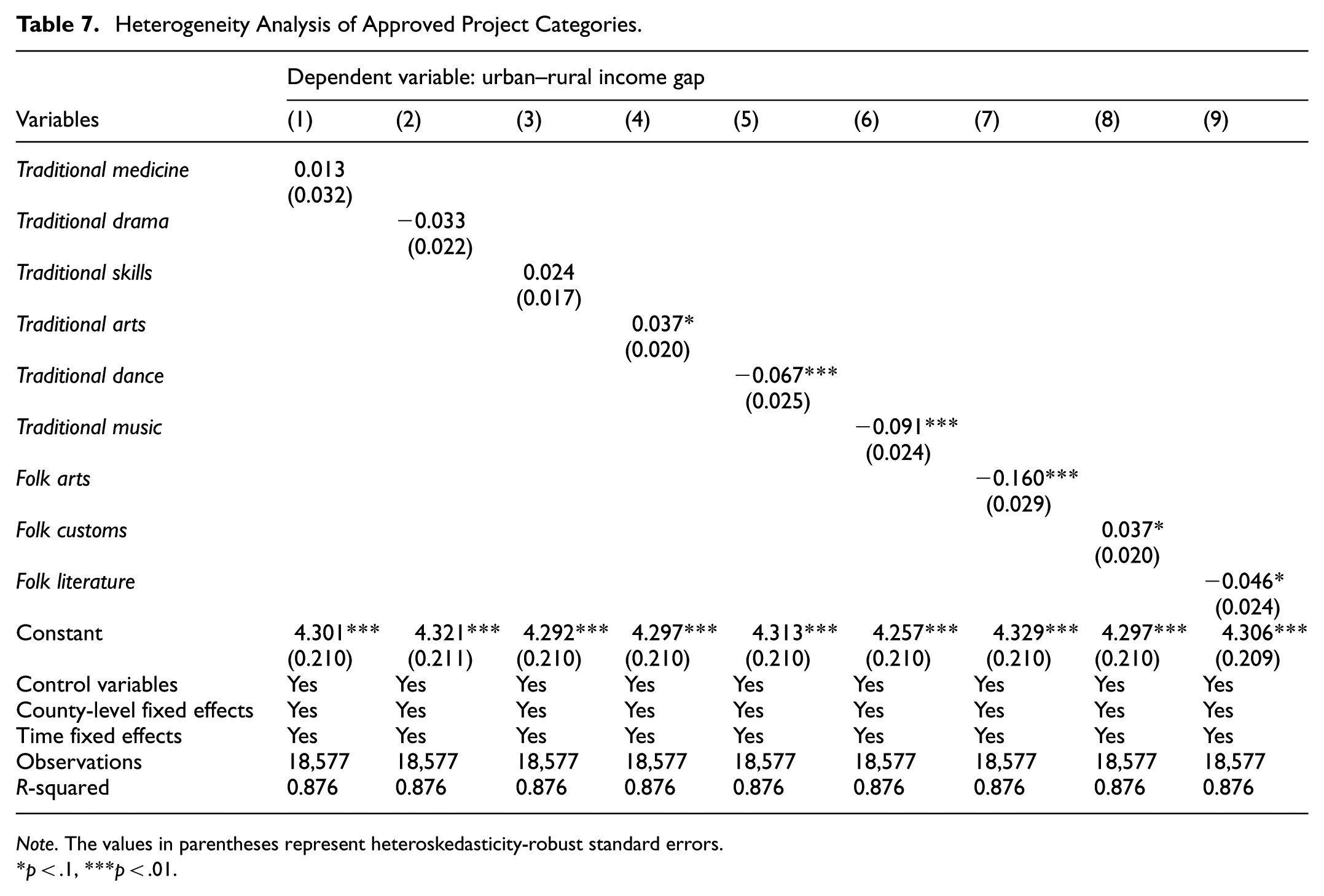
Note. The values in parentheses represent heteroskedasticity-robust standard errors.
p < .1, ***p < .01.
Heterogeneity of Newly Added and Extended ICH Projects
The addition and extension of ICH items constitute an essential component of cultural transmission. “Newly added items” refer to elements that are inscribed for the first time on national or international ICH lists, representing new forms of cultural expression being incorporated into the safeguarding framework. According to UNESCO’s Operational Directives for the Implementation of the Convention for the Safeguarding of the ICH (UNESCO, 2022), an “extended ICH project” refers to a formally approved expansion of an inscribed element, which may involve the inclusion of additional communities, the enlargement of its geographical scope, or the integration of new cultural expressions. In essence, extended projects serve as an extension and enrichment of existing listed items, broadening their cultural meaning and spatial representation. Compared with the extension projects, new projects create more jobs and better develop distinctive local industries, which is more conducive to increasing the income of rural residents and thereby reducing the urban–rural income gap. For testing the point view, this study sets the dummy variables XZICH and KZICH, representing the new national ICH items and the national ICH extension projects, respectively, to explore whether there are differences for two types of projects in narrowing urban–rural income gap. Table 8 shows the regression results. By analysis of the results, the approval of both types of projects can reduce urban–rural income gap. However, the counties that have been approved for new national ICH projects yield greater decline in the urban–rural income gap.
The Heterogeneity Analysis of New Projects and Expanded Projects.

Note. The values in parentheses represent heteroskedasticity-robust standard errors.
p < .01.
Heterogeneity of Economic Development
To investigate whether the impact of ICH protection on the urban–rural income gap is heterogeneous in different regions with different levels of economic development. This study divides the sample into two groups based on per capita GDP levels. The relatively developed regions are the counties with per capita GDP above the annual median. The relatively less developed regions are the counties with per capita GDP below the annual median. Table 9 shows the regression results. The results show that the absolute value of the variable ICH estimation coefficient is larger in the less developed region. The data indicate that after the approval of the national ICH projects, the urban–rural income gap with low development level has been significantly reduced. The reason may lie in the fact that the secondary and tertiary industries in less developed regions are weaker than the relatively developed regions. And ICH can be developed into distinctive industries on a large scale. Furthermore, unlike the diversified economies of developed regions, ICH-based economy has stronger income substitutability in less developed regions and can rapidly increase the income of rural residents. Therefore, the role of ICH protection in narrowing urban–rural income gap is more effective in less developed regions.
Heterogeneity Analysis of Economic Development.

Note. The values in parentheses represent robust standard errors.
p < .05, ***p < .01.
Further Analysis
In the preceding sections we verified, using county-level data in China, that the ICH policy is capable of narrowing the urban-rural income gap. In this part of the study, we are further interested in which specific income sources of rural or urban residents are affected by the ICH policy. Exploring this question can deepen our understanding of how the policy influences the urban-rural income gap and yield important policy implications.
Accordingly, we draw on the 2010 to 2018 waves of the China Family Panel Studies (CFPS) data to examine the effects of ICH policy on various income components of urban versus rural residents. The CFPS dataset is produced by the Institute of Social Science Survey, Peking University (ISSS) and covers 25 provinces (municipalities/autonomous regions) in China. The survey sample includes all members of the sampled households and provides detailed information on demographic characteristics as well as employment and economic activity status. We base our analysis on five waves of CFPS—2010, 2012, 2014, 2016, and 2018—after excluding observations for which the urban-rural classification is ambiguous or whose income variables take negative values.
Since the publicly released CFPS data provide only province-level identifiers, we structure the following model and conduct subgroup tests to evaluate the impact of the ICH protections on different income types for urban residents and rural residents respectively.

In the model,
Table 10 reports the estimation results of model (3). We find that ICH protection significantly increases the different income components of rural residents, but for urban residents its positive effect is limited to transfer income and property income. Among rural households, the largest effect of the ICH policy is on transfer income, followed by wage income and then operating income. A comparison of coefficient estimates across the urban and rural subsamples shows that for both transfer income and property income, the impact on rural residents is substantially larger. When total income is used as the dependent variable, the coefficient for ICH in the rural sample is clearly larger than in the urban sample, indicating a stronger positive effect of ICH protection on rural households’ overall income level. These findings provide micro-level empirical evidence on how ICH protection contributes to narrowing the urban–rural income gap by income source.
Further Analysis: Regression Results Using Micro-Level Survey Data.

Note. The values in parentheses represent robust standard errors.
p < .1, **p < .05, and ***p < .01.
Conclusion and Discussion
Main Conclusions
Based on county-level panel data from China (2001–2022), this study empirically examines the impact of the approval of national representative ICH projects on the urban–rural income gap using a difference-in-differences (DID) model. The findings show that national ICH designation significantly reduces the urban–rural income gap: the income ratio between urban and rural residents in counties with national ICH declined by 2.4% relative to counties without such projects. This result is consistent with previous studies on the economic value of cultural heritage (Ana & Olja, 2025; Liu & Qi, 2024). ICH safeguarding is not only vital for cultural inheritance, but also promotes social inclusion and balanced regional development, aligning with China’s strategic goals of “targeted poverty alleviation” and “rural revitalization.”
The analysis of reginal heterogeneity further enriches debates on uneven cultural resource endowments (Dippon & Moskaliuk, 2019). Different ICH projects exert varying degrees of influence on narrowing the urban–rural income gap. Performance- and experience-oriented ICH projects—such as traditional dance, traditional music, quyi, and folk literature—has a more pronounced effect, as these forms can more readily be transformed into cultural performances, festivals, cultural experiences, and creative products (Starčević et al., 2022). Newly added ICH projects are more effective than extended projects, especially in underdeveloped regions. These findings support the view that cultural policy interacts with local economic structures to produce differentiated redistribution outcomes (Dippon & Moskaliuk, 2019).
Mechanism analysis identifies two key pathways: facilitating the entry of new enterprises and fostering the service sector. Leveraging their unique cultural appeal and market potential, ICH projects lower barriers to entrepreneurship and attract investment, particularly in cultural tourism and related services. The expansion of non-agricultural activities creates employment, raises rural incomes, helping narrow the urban–rural income gap (L. Zhang & Wan, 2024). This process echoes Lewis (1954) theory that shifting rural labor to non-agricultural sectors is pivotal to reducing income inequality, and supports Hong and Zhang (2021). The structural transformation toward higher value-added industries thus aligns with the mechanism through which ICH contributes to reducing urban–rural income disparities. This study extends research on culture-driven economic transformation, which has largely emphasized tourism and branding by identifying the entry of new enterprises and the expansion of the service sector as key channels (X. Huang et al., 2025).
Theoretical Significance
This paper makes significant contributions to research on cultural heritage, the cultural economy, and urban–rural development. Drawing on cultural capital theory and inclusive growth theory (Boarini et al., 2015; Throsby, 2000), this study demonstrates that national-level ICH designation exerts a balancing effect on urban–rural income distribution. Whereas prior studies have largely emphasized the cultural, tourism, and symbolic value of ICH (Tan et al., 2023; 2024), the redistributive role of ICH safeguardingveJiang0" \ in relation to the urbaniondin income gapomeo received limited attention. Given the difficulty of accurately assessing the economic value of ICH, many projects and bearers remain undercompensated (Ana & Olja, 2025; Gao et al., 2022). This study provides empirical evidence that national ICH recognition significantly narrows the urban–rural income gap, thereby supporting the view that ICH protection can foster regional inclusive development.
Additionally, the analysis of regional heterogeneity indicates that local development level is an important moderating factor. Consistent with the notion that cultural resources are unevenly distributed across regions (Dippon & Moskaliuk, 2019), the findings reveal that underdeveloped areas benefit more from ICH protection through stimulated entrepreneurship, expanded service industries, and increased employment. This deepens understanding of how cultural policy interacts with local economic structures to produce differentiated redistributive outcomes and highlights the conditional nature of cultural heritage effects.
Lastly, this study enriches the research on cultural-driven economic transformation by identifying two key mechanisms: entrepreneurial activity and service-sector development. Existing study has primarily emphasized ICH branding and tourism pathway (X. Huang et al., 2025), while offering limited discussion of how ICH safeguarding reshapes income distribution. The findings show that national ICH recognition promotes new enterprises entry and service-sector expansion, thereby transforming local economic structures. These mechanisms deepen the theoretical understanding of cultural heritage as a driving force of inclusive growth and provide new conceptual support for cultural policy design.
Policy Implications
Building on these major findings, this study yields several policy implications. First, the strategic role of ICH safeguarding in coordinated regional development should be further strengthened. ICH protection needs to be embedded in national and local strategies for regional coordination and rural revitalization, with particular emphasis on increasing financial, technical, and policy support for underdeveloped regions to fully unlock the social and economic potential of ICH as cultural capital.
Second, it is essential to establish robust linkage mechanisms between ICH, entrepreneurship, and employment. Local government can cultivate distinctive local industries by leveraging ICH resources, while residents can engage in entrepreneurship and employment through heritage transmission, cultural and creative industries, tourism services, and homestay operations. Governments should develop ICH industrial incubation bases and provide skills training, digital empowerment, entrepreneurship guidance, as well as build “ICH e-commerce” platforms to expand local employment opportunities for rural residents.
Third, the integration of ICH industrial chains with the service industry should be deepened through models such as “ICH + cultural tourism,”“ICH + cultural and creative industries,” and “ICH + digital communication.” These can stimulate related service industries, including accommodation, catering, handicrafts, and cultural design, through festivals, brand operations, and immersive experiences, fostering an “ICH+” industrial ecosystem and enhancing rural competitiveness.
Finally, cost-benefit considerations should be incorporated when undertaking ICH protection work. Although this study indicates that performative and experiential ICH can generate more significant economic benefits in narrowing the urban–rural income gap. However, their maintenance costs are also comparatively higher. For instance, traditional dance and music typically require ongoing subsidies for training, professional rehearsal guidance, and venue facilities; whereas oral traditions such as folk literature entail lower preservation costs. Therefore, policymakers should carefully evaluate the marginal return per unit of ICH investment to ensure efficient and sustainable resource allocation. Recent research also indicates that the economic value of cultural heritage exhibits significant typological variations, with its revenue structure influenced by intangible attributes and management costs (Halkos et al., 2024). Based on these insights, a cross-category cost-benefit monitoring system may be established to periodically evaluate the economic and social returns of different ICH projects. This would enable the optimization of fiscal expenditure structures and enhance the long-term policy effectiveness of cultural heritage protection.
Limitations and Future Research Direction
Despite its theoretical and empirical contributions, this study has limitations. Firstly, the temporal and spatial have limitation in the data. The county-level panel from 2001 to 2022 cannot fully reflect the most recent policy dynamics or capture intra-county heterogeneity. Further research should use more fine-grained, up-to-date household or individual data to examine impacts of ICH safeguarding on employment structures and the income of different social group. Moreover, this paper focuses on national-level ICH projects; systematic analysis of provincial-, municipal-, and county-level ICH is still lacking. Comparative research across governance levels could reveal how differences in policy support, industrialization, and social influence shape the role of ICH in regional economies and income distribution. Finally, due to data limitations, this study has not yet systematically assessed the differences in implementation costs between various types of ICH projects. Future research may establish a more rigorous cost-benefit analysis framework by comparing the per capita income growth generated by different types of ICH project investments. Provide a more evidence-based rationale for resource allocation in policy formulation.
Footnotes
Acknowledgements
The authors would like to thank all the participants in this study for their time and willingness to share their experiences and feelings. We sincerely appreciate the reviewer’s valuable suggestions.

Ethical Considerations
This study does not involve animal or human clinical trials, so there are no ethical risks of this study.
Funding
The authors received no financial support for the research, authorship, and/or publication of this article.
Declaration of Conflicting Interests
The authors declared no potential conflicts of interest with respect to the research, authorship, and/or publication of this article.
Data Availability Statement
The datasets generated during and/or analyzed during the current study are available from the corresponding author* on reasonable request.