




Abstract
Previous studies have not adequately articulated the intergenerational differences in social identity of rural–urban migrants in China. Using survey data from Wuhan, China, the study tests three hypotheses on intergenerational differences in rural–urban migrants’ social identity based on first-generation and new-generation migrants’ attitudes toward rural and urban society. Results suggest that first-generation migrants are more likely to view themselves as rural rather than urban citizens. However, new-generation migrants tend to regard themselves as neither peasants nor urban citizens, which means that their identity reconstruction is at a stalled status. The identity perplexity of new-generation migrants suggests that they may be in danger of falling into the second-generation decline because there is a mismatch between their aspirations and the practical situation of their identity integration. This article highlights that when analyzing rural–urban migrants’ social identity, it is very important to consider the role of generation and rural–urban migrants’ attitudes toward their background society. Furthermore, the study suggests that in a rural–urban dichotomized society without institutional and social support, rural–urban migrants’ identity integration will not be achieved. Therefore, the Chinese government needs to build an institutionally and socially inclusive society.
Introduction
Rural–urban migrants in China refer to rural laborers who work in cities but retain a rural hukou status (household registration). 1 They are the principal part of internal migrants in China. In recent years, the social integration (urban integration) of rural–urban migrants has been an interest topic of many researchers (Y. Chen & Wang, 2015; Frenkel & Yu, 2014; W. W. Wang & Fan, 2012; Wong et al., 2007; Yue et al., 2013). There are many reasons for this. First, the magnitude of rural–urban migrants is very large. The number of cross-township rural–urban migrants has reached nearly 169 million in 2015 (National Bureau of Statistics of China, 2016). Second, rural–urban migrants are a significant component contributing toward the Chinese economy. It has been estimated that they have contributed about 16% of GDP growth in China over the past decades (“Migrant Workers Contribute 16% GDP Growth,” 2006). More specifically, approximately 30% of GDP in Beijing and 31% of GDP in Shanghai in 2007 were attributed to them (Chang et al., 2009). Third, rural–urban migrants have suffered institutional and social discrimination in urban areas, which is a big barrier to their urban integration (Fan, 2007; Li, 2006; Solinger, 1999; Zhan, 2011).
The origins of institutional and social discrimination against rural–urban migrants could be largely ascribed to the hukou system. This system was created in the 1950s, and it was first implemented in urban areas, and then extended to rural areas (K. W. Chan & Zhang, 1999; F.-L. Wang, 2005). It aimed not only to control and monitor rural to urban migration but also served multiple state interests, such as maintaining “unequal exchange” between the agricultural and industrial sectors to boost the development of industry and securing social and political stability (K. W. Chan & Zhang, 1999). F.-L. Wang (2005) suggested that the hukou system has both positive and negative effects on the Chinese society: on one hand, it has helped the rapid economic development and political order; on the other hand, it also has reinforced social stratification, exacerbated regional inequalities, and caused institutional and social exclusion and discrimination.
The negative effect of the hukou system is reflected by the fact that this system closely links to the livelihoods and well-being of Chinese people. This is a particular characteristic before the relaxation of hukou control since the economic reform in 1980s. For instance, the state once granted people with urban hukou free or subsidized food, housing, and health care, but such benefits were not provided to people with rural hukou (T. Cheng & Selden, 1994). In the era of hukou reform, the Chinese government gradually has eradicated the nationwide welfare system that secures all urban citizens. However, the welfare system in China has been featured by a noteworthy degree of decentralization. This leads to the fact that welfare benefits in cities are only elaborated for the locally born urban citizens while still excluding outsiders, for example, rural–urban migrants (Smart & Lin, 2007; Smart & Smart, 2001).
Since rural–urban migrants do not have urban hukou, they are still not treated as equally as urban citizens and not included into the local welfare system. Consequently, they cannot enjoy the same welfare entitlements as urban citizens. Except for the deprivation of welfare entitlements, rural–urban migrants are also in inferior status in the labor market. They are segmented from the urban labor market and cannot be employed in many formal sectors, may suffer wage arrears, and may be experienced physical and psychological harassment (Z. Cheng et al., 2015; Fan, 2002). As such, Roberts (1997) argued that rural–urban migrants in China are as that of undocumented immigrants from Mexico to the United States. They have received very limited policy support to integrate into the urban society. As a result, their livelihoods and well-being in urban areas are worse than the local residents.
In light of the poor social protection for rural–urban migrants, during the past decades, the Chinese government has been dedicating to reform the hukou system to fit the increasingly urbanization process in China. Due to these reforms, the role of hukou in determining people’s livelihoods and well-being has been declining (Zhan, 2011). This also has resulted in the consequence that the intention for rural–urban migrants to converse their rural hukou to urban hukou has been relatively low (C. Chen & Fan, 2016). However, hukou still plays a role in terms of housing security, social assistance, and children’s education (Lan, 2014; Tao, 2008), especially in large cities like Beijing, Shanghai, Guangzhou, and Shenzhen (C. Chen & Fan, 2016). Therefore, in the case of unfair welfare rights in urban areas, rural–urban migrants still have to confront with the challenges of social integration in the future.
Previous studies have paid close attention to macro-factors such as institutions, social condition, and the environment and micro-factors including income, education, and personal relationships which might influence the urban integration of rural–urban migrants (Y. Chen & Wang, 2015; Li, 2006; Solinger, 1999; W. W. Wang & Fan, 2012; Yang, 2013; Yue et al., 2013). Others have also examined the consequence of the urban integration of rural–urban migrants (Frenkel & Yu, 2014; Gui et al., 2012; Solinger, 1999). Unfortunately, generational differences in the urban integration of rural–urban migrants have not been fully articulated in previous studies. Particularly, to the best of our knowledge, no study has compared the intergenerational differences in the social identity of rural–urban migrants. Furthermore, because there is no precise definition or a consensus understanding of integration (Castles et al., 2002; Pillemer, 2000), integration is a concept used by many but understood differently (Robinson, 1998). Hence, studies on the urban integration of rural–urban migrants always come to diverse conclusions.
Using survey data from Wuhan, China, this research draws on social integration and social identity theories to test and compare the intergenerational differences in the social identity of rural–urban migrants. The reason focusing on only rural–urban migrants but excluding other internal migrants such as urban-urban migrants is that the latter basically have little or no rural life experience. However, in this study, we regard rural identity as a very important component of identity negotiation. Thus, we only include rural–urban migrants in this study.
This study has two main contributions. First, it regards generation as a vital factor influencing the social identity of rural–urban migrants and aims to test and compare the differences of the social identity between first-generation and new-generation migrants. Employing intergenerational perspective as a method to observe the social integration of migrants has been very pervasive in academia (Alba, 2005; Gans, 1992; Perlmann & Waldinger, 1997; Portes & Zhou, 1993; Zhou, 1997). The advantage of this perspective is that it can provide more straightforward results on migrants’ social integration than alternative methods which just compare what have changed among migrants in different ages. Second, while existing studies have only examined rural–urban migrants’ attitudes toward the urban society, this article considers their attitudes toward both their background society (rural society) and the host society (urban society). Because the hukou system divides the Chinese society into two separate parts, rural society and urban society (Whyte, 2010), rural–urban migrants have both a rural sense and an urban sense of belonging. Examining both rural and urban identity of rural–urban migrants can give a more comprehensive understanding of their identity integration. As such, this study sheds new light on understanding the trends and outcomes of identity negotiation of rural–urban migrants in an urban society.
The structure of this study is as follows. The “Literature Review” section gives a brief literature review on theories of social integration, followed by an introduction to the hypotheses of the article in section “Intergenerational Differences in the Social Identity of Rural–Urban Migrants.” Section “Data and Method” illustrates the research data and methods. Section “Results” presents the empirical findings, and section “Discussion and Conclusion” covers the discussion and conclusion of the article.
Literature Review
Social integration refers to the process for immigrants becoming an accepted part of society (Penninx, 2005) as well as participating in a wide range of social relations (Brissette et al., 2000). It is a multi-dimensional concept which includes acculturation, economic, political, and identity integration among others (Penninx, 2005; Yue et al., 2013). Traditionally, assimilation is thought to be the only outcome of the social integration of immigrants from developing countries to developed countries. According to this theory, immigrants will gradually abandon their original identity and will be assimilated into the mainstream of the host society (Gordon, 1964). However, empirical studies on the social integration of new generation of immigrants challenged the theory, as the new generation of immigrants often has even worse consequences of social integration than older generations (Gans, 1992). To explain this, the segmented assimilation theory and the bidirectional acculturation theory were proposed.
The segmented assimilation theory suggests that the social integration of immigrant can be understood from two dimensions: economic integration and acculturation (Portes & Zhou, 1993; Zhou, 1997). Based on this approach, there are three possible outcomes for the social integration of immigrants. Some immigrants integrate into the White middle-class, but others are opposite to the first group and are assimilated into the underclass. Still others integrate into the mainstream of the society only in economic dimension, but they deliberately preserve their original culture (Portes & Zhou, 1993; Zhou, 1997).
The bidirectional acculturation theory, however, distinguishes the acculturation of immigrants based on their attitudes toward the culture of the original society and the culture of the host society (Berry, 1997, 2005, 2008). According to this perspective, immigrants’ acculturation has four possible strategies: integration, separation, assimilation, and marginalization. The integration strategy indicates that immigrants are not only willing to maintain their original culture but also accept the culture of the host society. The separation strategy means that immigrants only wish to hold their original culture but reject the culture of the host society. The assimilation strategy asserts that immigrants wish to abandon their original culture but accept the culture of the receiving society. The marginalization strategy signifies that immigrants neither wish to hold their original culture nor accept the culture of the host society at the same time. Moreover, Berry (1997) suggests that immigrants who adopt the integration strategy have the best outcome of social adaptation, immigrants who adopt the assimilation and separation strategies have the suboptimal outcome, and those who adopt the marginalization strategy have the worst social adaptation outcome.
Except for the economic-based and culture-based measures, the political integration of immigrants also has received attention among researchers (Jacobs & Tillie, 2004; Tillie, 2004; Tillie & Slijper, 2006). Both individual-level factors, such as gender, ethnic membership, and social activities, and group-level factors, such as social capital in the ethnic community, are important factors influencing immigrants’ political integration to the host society (Tillie, 2004). In particular, the importance of social capital in determining the political integration of immigrants calls for more empirical tests in various national settings (Jacobs & Tillie, 2004).
Furthermore, in recent years, a large set of studies have utilized social identity as an indicator to measure the social integration of immigrants (Colic-Peisker & Walker, 2003; Pfeifer et al., 2007; Snel et al., 2006). Social identity is defined as the degree of people categorizing themselves as which social groups they belong to (Hogg & Abrams, 1988; Schwartz et al., 2006; Tajfel, 1981; Tajfel & Turner, 1986; Turner, 1985). This concept has made a remarkable contribution in explaining intergroup relations (Brown, 1999).
Upon entry into a new society, immigrants seek to rebuild their identity. The outcome of this reconstruction is determined by two groups of factors: attributes of immigrants and responses of the host society (Colic-Peisker & Walker, 2003). Personal characteristics which may affect immigrants’ identity rebuilding contain language, religious belief, ethnicity, human capital, and social capital (Colic-Peisker & Walker, 2003; Verkuyten & Martinovic, 2012). Responses of the host society like official policies toward immigration might also influence the process of identity reconstruction (Phinney et al., 2001). In addition, as some researchers suggested that individual factors and responses of the host society often interact with each other, this perspective is often used to explore how two different levels of factors act together in determining the identity reconstruction of immigrants (Colic-Peisker & Walker, 2003; Phinney et al., 2001).
Some studies have also employed social identity as an indicator to explore the urban integration of rural–urban migrants in China (C. Wang, 2001; W. W. Wang & Fan, 2012; Yuan et al., 2013). Unfortunately, these studies have not paid attention to the intergenerational differences in rural–urban migrants’ social identity. In addition, they have only examined rural–urban migrants’ attitudes toward the urban society but have neglected testing their attitudes toward the rural society. Rural identity refers to the degree to which rural–urban migrants identify themselves as rural residents, while urban identity refers to the degree to which rural–urban migrants identify themselves as urban residents. Examining the rural and urban identity of rural–urban migrants within the same research framework can give a more complete view of their identity integration.
Notably, although many theories regard identity as a core dimension of social integration, it is still debatable whether social identity can be used as an indicator to examine the social integration of migrants. For instance, while identity is viewed as a key dimension in the assimilation theory (Gordon, 1964), in other theories such as segmented assimilation and acculturation, immigrants may realize socioeconomic integration without changing their original identity. In this study, we do not intend to equate social identity with social integration. Instead, we argue that social identity can be employed as an indicator to reflect the social integration of rural–urban migrants in urban China. Immigrants in industrialized societies are often different from the natives in terms of religion, ethnicity, and cultures. However, this is not the case of rural–urban migrants in China. Rural–urban migrants share many similarities with urban locals in these aspects. On the contrary, they are in inferior conditions in terms of job opportunities, social welfare rights, and civic engagement in cities because they do not have an urban hukou status. Consequently, they are often viewed as the “outsiders” of the city (Du et al., 2018). Therefore, to what extent they view themselves as the “insiders” of the city can be regarded as a good indicator to represent their social integration in urban China.
Intergenerational Differences in the Social Identity of Rural–Urban Migrants
In general, rural–urban migrants in China can be divided into two generations: first generation and new generation. There are no criteria on how to divide first-generation and new-generation migrants (Pun & Lu, 2010). In academia, new-generation migrants refer to those who were born after 1980, raised up in either countryside or in cities, and registered as temporary residents in the host cities. They include but are not limited to children of first-generation migrants (Y. Liu et al., 2012). Since 1980s’ China has implemented extensive economic reforms, this has remarkably eliminated many potential barriers to economic development erected by socialist China (Pun, 2016). Therefore, rural–urban migrants who were born after 1980 experienced totally different social, economic, and political changes compared with those who were born earlier. As a result, rural–urban migrants are often categorized into two generations based on the above time frame (Hao & Tang, 2015; Y. Liu et al., 2012; Pun & Lu, 2010; Tang & Feng, 2015; X. Wang, 2008). Also, this categorization reflects the change of rural–urban migrants’ perception of capital, the state, and their social position (Pun & Lu, 2010).
It is worth noting that the concept of new-generation rural–urban migrants in China is different from the concept of second-generation migrants in western countries. New-generation migrants in China refer to rural–urban migrants who were born after 1980. They include but are not limited to children of first-generation migrants. Nevertheless, second-generation migrants used in the western countries only refer to children of first-generation migrants. Therefore, the terminology of new-generation of rural–urban migrants in China is a broader concept than the term used in western literature. However, we argue that it is reasonable to judge the social integration of rural–urban migrants by comparing the differences in social identity among first-generation migrants and new-generation migrants given that the two generations are so different regarding values and lifestyles. Such a categorization is more in line with the social and economic situation of China.
The underlying assumption of many studies is that new-generation migrants are more likely to identify themselves as urban citizens rather than rural citizens. This assumption relates to the characteristics of new-generation migrants who were born and raised in the political and economic reform period with better education and broader perspective (K. W. Chan, 2012; C. Wang, 2001; X. Wang, 2008). They have little or no experience in farming and therefore have a stronger desire to live in the city permanently (C. Wang, 2001, 2010; X. Wang, 2008). They have few or no siblings and have a higher aspiration for social mobility (X. Wang, 2008). They also have lower endurance for long-time physical work and a stronger proclivity for consumerism and individualism (K. W. Chan, 2010b; Y. Liu et al., 2012; Pun & Lu, 2010; C. Wang, 2001, 2010). These characteristics are completely different from the traits of first-generation migrants. For them, on the contrary, the aim of working in the city is mostly to earn money to support their families in the countryside; they basically have little or no intention to stay in the city permanently (Jacka, 2006; Pun, 2005; Pun & Lu, 2010). Due to these reasons, new-generation migrants are thought to identify themselves more as urban and less as rural citizens. Likewise, first-generation migrants are reckoned to view themselves as rural citizens and not as urban citizens.
However, other studies on new-generation migrants have provided a totally different story. The hukou system divides China into a rural and urban dichotomized society in which rural–urban migrants are deprived of many social welfare entitlements and are regarded as second-class citizens (K. W. Chan, 2010b; Solinger, 1999; Wong et al., 2007). The concept of “migrant worker” represents a quasi-identity status. For new-generation migrants, this status represents the unfinished process of proletarianization (Pun & Lu, 2010). Proletarianization refers to the phenomenon in western countries that with the urbanization and industrialization, the surplus labor force in the countryside gradually transits into the urban working class. Moreover, those new urban middle-class citizens integrate into the urban society also in cultural, political, and identity dimensions without experiencing great difficulties. However, the identity reconstruction of rural–urban migrants in the process of urbanization and industrialization of China is at a stalled status. The quasi-identity causes new-generation migrants to generate feelings of “having no future as a labor force in urban areas and no meaning to return to the village” (K. W. Chan, 2010b). The dilemma of identity reconstruction also leads to yielding anger, trauma, and feeling of profound unfairness (Pun & Lu, 2010). This desperation forces new-generation migrants to confront with the identity problem of “who I am.” This kind of perplexity in identity further generates some extreme resistance, such as suicidal behavior and collective actions against the government (J. Chan & Pun, 2010; Pun & Lu, 2010).
Therefore, there is a competing hypothesis on the social identity of new-generation migrants. They may be in the condition of identity perplexity, which means they regard themselves as neither urban nor rural citizens. If this were the case, new-generation migrants may have even more difficulties in the identity integration than the first-generation migrants because they may be marginalized from the urban and rural society simultaneously. Notably, this hypothesis is similar to the “second-generation decline” theory which is described as a mismatch of the aspirations of second-generation migrants and the real living conditions that they have (Gans, 1992; Perlmann & Waldinger, 1997). This theory has been widely used to examine the social integration of new-generation immigrants in developed countries (Alba, 2005; Waters, 1994; Zhou, 1997). Notably, this study judges the “second-generation decline” by comparing the differences in social identity between first-generation migrants and new-generation migrants, which is different from previous studies that have focused on the socioeconomic conditions of migrants. As described above, social identity is a good indicator to represent the social integration of rural–urban migrants in urban China. Thus, it is reasonable to use the terminology of “second-generation decline” in the present study.
Empirical studies have also revealed similar competing hypotheses. Some researchers have found that since the importance of hukou system has declined substantially (Zhan, 2011), rural–urban migrants are gradually transitioning into the urban middle class (Frenkel & Yu, 2014). By contrast, other researchers have suggested that because of the institutional and cultural exclusion associated with the hukou system in the urban society, rural–urban migrants are falling into the urban underclass (Solinger, 1999) and are becoming a marginalized group within the urban society (Wong et al., 2007). According to the former perspective, rural–urban migrants’ urban sense of belonging will accumulate with increasing time in the city because the economic integration will provide the foundation for rural–urban migrants to acquire a strong sense of urban belonging. Based on the latter perspective, rural–urban migrants’ identity negotiation will be stalled at a status no matter how long they stay in the city, as the institutional and cultural exclusion of urban society creates an invisible wall between rural–urban migrants and urban citizens. Rural–urban migrants will never have a strong sense of urban belonging so long as the institutional and cultural restrictions exist.
To recap, the hypotheses of the article can be formulated as follows:
However, the social identity of new-generation migrants may still be examined from another angle. In this case, since the experience of social and institutional exclusion in the urban society, they build their urban identity very slowly just like first-generation migrants. Under this situation, they may have identity perplexity. Thus, we posited the third hypothesis:
Data and Method
Data
The data utilized came from a survey in Wuhan, China. Wuhan is the largest urban area in the central area of China. The land area of Wuhan is 8,494.41 km2, with 13 urban districts. The economy of Wuhan is quite robust. In 2013, the GDP per capita of Wuhan was nearly 88,564 yuan (Wuhan Bureau of Statistics, 2014). Because of these reasons, Wuhan is a very popular destination for rural–urban migrants. Figure 1 shows the change of demographic structure of Wuhan from 1980 to 2014. It shows that the number of migrant population in Wuhan has been increasing since the economic reform in China in 1980s. Typically, after the global economic crisis in 2008, enormous factories moved from the eastern to central China, and Wuhan is a pervasive choice for the relocation of many factories. As a result, the migrant population in Wuhan has increased substantially. In 2014, there are over 2 million migrants (rural–urban migrants and urban–urban migrants) in Wuhan, accounting for nearly 20% of its total population.

Demographic structure of Wuhan city, 1980 to 2014.
Wuhan is a special region to study the social identity of rural–urban migrants for the reason that the proportion of migrant population in Wuhan is about 20% which is different from other megacities, such as Beijing, Shanghai, and Shenzhen where nearly half of the residents are migrants. In fact, investigating the social identity of rural–urban migrants in a society which is dominated by local residents can mirror the process of identity reconstruction of migrants better than the evidence from those so called “migrant cities.” Currently, these cities are struggling with the loss of local culture because of the influx of migrants. Therefore, on one hand, rural–urban migrants are assimilated into the mainstream of the society in these cities; on the other hand, local residents of these cities are also significantly influenced by “migrant culture.” Instead, the process of identity rebuilding of migrants in Wuhan is more comparable to immigrants in western countries who mostly seek to integrate into the host society because local residents account for the vast majority. Besides, previous studies on urban integration of rural–urban migrants generally based on data from the eastern area of China (Y. Chen & Wang, 2015; Yang, 2013; Yue et al., 2013), while less attention has been paid to cities located in the central area of China, except for a few cases (W. W. Wang & Fan, 2012). This study can enrich evidence from this area.
In the survey, we adopted the same definition as National Bureau of Statistics of China (2016) and defined rural–urban migrants as those who hold a rural hukou status but live in cities for at least 6 months. One of the biggest difficulties to survey rural–urban migrants in China is that there is no precise sampling frame. This is because many migrants are not registered in host cities’ population registration system. Consequently, traditional sampling method based on the population registration system often results in sample bias (Kong, 2010). To cope with this issue, we determined the sampling frame by referring to the industrial distribution of rural–urban migrants. The reason for this is that according to the national survey report Investigation Report on Rural–Urban Migrants 2013 (National Bureau of Statistics of China, 2014), rural–urban migrants are proportionally distributed in seven different industries. These industries include the following: (a) construction, (b) manufacturing, (c) wholesale and retail, (d) accommodation and catering, (e) transportation, warehousing and postal industry, (f) resident services and other services, and (g) other industries. In addition, the report distinguished the industrial distribution of rural–urban migrants in nationwide and different regions of China (Table 1). We assumed that our sample should be close to the industrial distribution of rural–urban migrants in the central area of China, because Wuhan is located in this region.
Distribution of Rural–Urban Migrants in Different Industries.
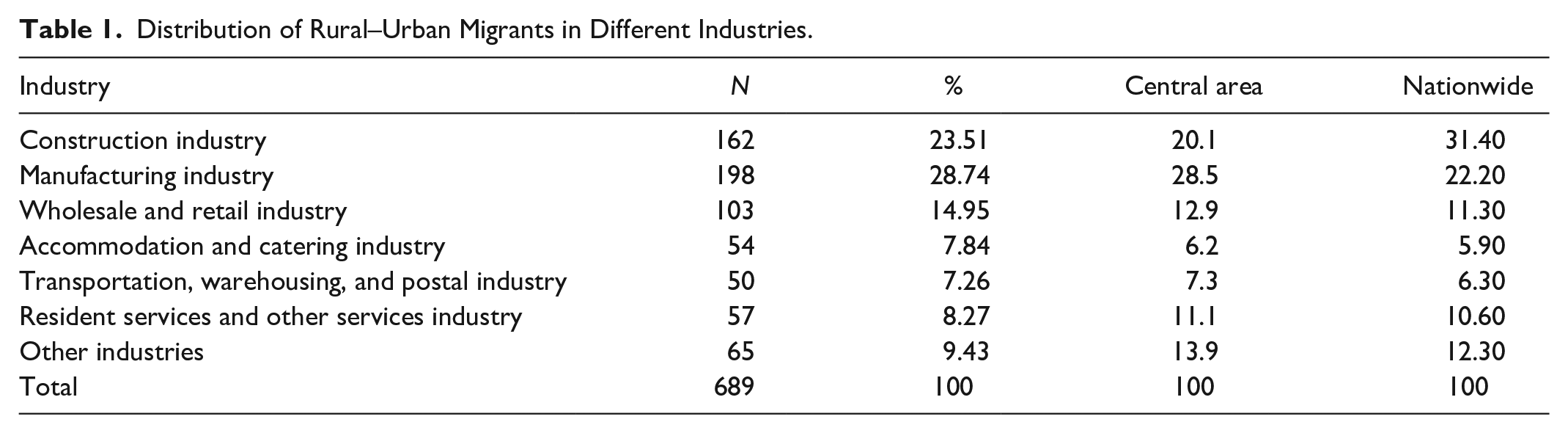
We collected the data in several stages. First, we randomly selected five urban districts in Wuhan. Next, based on the industrial distribution of rural–urban migrants, we randomly chose firms based on a name list of firms located in the selected five urban districts. We chose 25 firms in total. Of those, 21 accepted our request to be surveyed. With the help of personnel management department, we then had face-to-face interview on rural–urban migrants working in the selected firms. However, for rural–urban migrants distributed in wholesale and retail and other industries, most of them are self-employed, and thus not covered by the 21 selected firms. To balance the industrial distribution of rural–urban migrants in our sample, we also surveyed rural–urban migrants from wholesale and retail industry and other industries in the selected five urban districts as well. We randomly interviewed 104 and 88 migrants from these two sectors respectively. Besides, we controlled the quality of the survey by conducting a pilot study. In total, we issued 1,555 questionnaires. We collected 1,023 questionnaires back (response rate 66%), and of these questionnaires, 909 are valid. Before data analysis, we first deleted invalid cases with missing values in our sample, and got a sample with 835 cases. Since our research focuses on rural–urban migrants, we also deleted those migrants who have an urban hukou status (146 cases). Finally, 689 questionnaires were analyzed. Table 1 shows the industrial distribution of rural–urban migrants in our sample. The percentage of rural–urban migrants in the above mentioned seven industries is 23.51%, 28.74%, 14.95%, 7.84%, 7.26%, 8.27%, and 9.43% respectively.
Measure
We used dependent variables as the rural identity and urban identity of rural–urban migrants. In previous studies, W. W. Wang and Fan (2012) and Lin et al. (2016) used a binary variable to measure rural–urban migrants’ self-identity, while Yue et al. (2013) used a scale aggregating three observed variables to measure it. In this study, we referred to the measures of these studies. We used an ordinal variable to measure both dependent variables. Rural identity was measured by asking respondents “taking it by and large, I think I am a rural resident.” Urban identity was measured by asking respondents “taking it by and large, I think I am an urban resident.” For both responses, we used a 5-point Likert-type scale: “strongly disagree,” “disagree,” “so-so,” “agree,” and “strongly agree.”
Generation, which is our key independent variable, is a binary variable. In agreement with previous studies (Hao & Tang, 2015; Y. Liu et al., 2012; Pun & Lu, 2010; Tang & Feng, 2015; X. Wang, 2008), we divided rural–urban migrants into two generations: first generation and new generation. First-generation migrants are those who were born before 1980, and new-generation migrants are those who were born after 1980. In addition, we also controlled rural–urban migrants’ demographic characteristics, length of urban residence, socioeconomic traits, language proficiency, residential area, family tie, social tie with other rural–urban migrants, and social tie with local urban residents in data analysis.
Demographic characteristics include gender, place of birth, and marital status. Gender is a binary variable (0 = female, 1 = male). Place of birth was divided into two categories: city and countryside. Marital status was categorized into married and unmarried. Length of urban residence was measured according to the years that rural–urban migrants have lived in the city (both Wuhan and other cities). We divided it into three categories: less than 5 years, 5–10 years, and more than 10 years.
Socioeconomic traits include educational attainment, income, and occupation. Educational attainment of rural–urban migrants was measured by asking respondents “what is your educational background?” Responses include four options: primary education or below, middle school education, high school education, and university or above. Rural–urban migrants’ income was measured by asking them “how much is your monthly income?” We categorized it into three levels: below 2000 yuan, 2000 to 5,000 yuan, and above 5,000 yuan. Occupation of rural–urban migrants was measured with the question “what is your job?” Following the categorization method of Wu and Treiman (2007), we divided it into five types: professionals and managers, routine non-manual workers, small property owners, foreman and skilled workers, and semi and unskilled workers. 2
Language is an important determinant of the reconstruction of migrants’ identity (Colic-Peisker & Walker, 2003; Verkuyten & Martinovic, 2012). In this research, the language skill of rural–urban migrants was measured by asking them whether they can fluently speak mandarin and Wuhan local dialect. Both responses are binary variables (0 = poor, 1 = fluent).
Social ties have been identified as significant factors of the social integration of rural–urban migrants (Haug, 2008; Yue et al., 2013). In this study, the social ties of rural–urban migrants were measured by asking respondents “do you have often contact with local urban residents?” and “do you have often contact with other rural–urban migrants?” 3 Both responses include two options: “yes” and “no.” In addition, Fan (2011) suggested that how the family is split (e.g., single migrant, sole migrants, childless couple migrants, couple migrants, and family migrants) is a significant predictor of urban settlement of rural–urban migrants. Thus, we could predict that having family members in the city is positively related to their urban identity. The family tie of rural–urban migrants was measured with the question “do you live together with your family members in the working city?” The response is again binary (0 = no, 1 = yes).
L. Liu et al. (2017) found that the residential segregation tends to reinforce rural–urban migrants’ perceptions of social exclusion, which is a big challenge on their social integration. Therefore, we expect that there is a significant relationship between residential area and social identity of rural–urban migrants. The variable to measure the residential area of rural–urban migrants was measured by asking them “what is the type of community that you living place is located?” Responses include three types: communities dominated by urban residents, mixed areas, and migrant enclaves.
Methods
The baseline model in this study is ordered logistic regression. However, this model has the proportional odds assumption that the coefficients are the same for each value of dependent variable, which is often violated (Williams, 2006). To resolve this issue, some improved models, such as the heterogeneous choice model and generalized ordered logistic model, were proposed (Williams, 2006, 2009, 2010). Since Williams (2010) suggested that the heterogeneous choice model is a more attractive alternative to the generalized ordered logistic model for its simplicity, we used this model in this study. This model is expressed as follows:

where x is a vector of k values for the ith observation. The xs are the determinants of the dependent variable y which has m categories.

where the zs are groups with different error variances in the underlying variable, and the γs represent how the zs affect the variance.
We used Stata 14.0 to conduct data analysis. After performing the basic model, the
Results
Table 2 shows the descriptive statistics of independent variables. The percentage of male rural–urban migrants is 68.51%; the proportion of first-generation migrants is about 50%; nearly 98% of rural–urban migrants were born in the countryside; 28.16% of rural–urban migrants are unmarried. More than 62% of rural–urban migrants live with their family members in urban areas. As for the length of urban residence, nearly 70% of rural–urban migrants have less than 5 years, 20% of them have 5 to 10 years, and 10% of them have more than 10 years of urban residence. The majority of rural–urban migrants have junior high school or senior high school education, and only about 11% have university or above education. About 74% of rural–urban migrants’ income is in the range from 2000 to 5,000 yuan per month. The percentages of professionals and managers, routine non-manual workers, small property owners, foreman and skilled workers, and semi and unskilled workers are 6.97%, 11.32%, 19.59%, 40.49%, and 21.63%, respectively. Most rural–urban migrants live in migrant enclaves (46%), followed by mixed areas (38%) and communities dominated by urban residents (15%). Only a small proportion of them have often contact with urban residents (19%), but about half have often contact with other rural–urban migrants (52%). As for their language skills, nearly 85% expressed that they can speak fluent mandarin. On the contrary, only 13% stated that they can speak fluently the Wuhan local dialect.
Descriptive Statistics of Independent Variables.

Figure 2 shows that both first-generation and new-generation migrants have prominent differences in rural identity. More first-generation migrants tend to view themselves as rural citizens rather than new-generation migrants; 72% of first-generation migrants agree or strongly agree that they are rural residents, but only 17% of them disagree or strongly disagree that they are rural residents. On the contrary, only 30% of new-generation migrants agree or strongly agree that they are rural residents, and 25% are in an indeterminate state. Yet, as many as 44% disagree or strongly disagree that they are rural residents.

Distribution of rural identity of first-generation and new-generation migrants.
In contrast, the urban identity of first-generation and new-generation migrants shows no big differences. Figure 3 shows that the percentages of first-generation and new-generation migrants who agree or strongly agree that they are urban residents are 11% and 14%, respectively. On the contrary, the proportions of first-generation and new-generation migrants who disagree or strongly disagree that they are urban residents are 73% and 62%, respectively. This result means that both first-generation and new-generation migrants have a very weak sense of urban identity. Fan (2002) also suggested that rural–urban migrants tend to identify themselves as outsiders of cities.

Distribution of urban identity of first-generation and new-generation migrants.
Table 3 presents the association between generation and characteristics of rural–urban migrants based on the chi-square test. The results suggest that first-generation migrants and new-generation migrants have significant differences in marital status, place of birth, length of urban residence, educational attainment, occupational status, residential area, social tie with rural–urban migrants, and mandarin proficiency (p < .05). Nevertheless, there are no significant differences shown in gender, income, family tie, social tie with urban residents, and dialect proficiency among them (p > .05).
Chi-Square Test on the Association Between Generation and First-Generation and New-Generation Migrants’ Characteristics.

p < .01. ***p < .001.
The disparities in marital status and length of urban residence are more or less related to the age gap between two generations of rural–urban migrants. The significant higher proportion of new-generation migrants who were born in the city reflects that their childhood experience is different from the first-generation migrants. The divergences in educational attainment and mandarin proficiency mean that first-generation and new-generation migrants have great differences in personal traits. Other studies have also revealed that new-generation migrants have better education than first-generation migrants (C. Wang, 2001; X. Wang, 2008). In addition, the distinctions in occupational status, residential area, and social tie with other rural–urban migrants mirror that different generations of rural–urban migrants have distinctive preferences in jobs, living environments, and social relations. This result is in agreement with the finding that new-generation migrants prefer non-manual jobs and the urban lifestyle to manual jobs and the rural lifestyle (K. W. Chan, 2010b; Y. Liu et al., 2012; Pun & Lu, 2010; C. Wang, 2001, 2010). The diversities in personal traits and preferences may explain why first-generation and new-generation migrants exhibit very different attitudes toward rural social identity. Nonetheless, the insignificant discrepancy in income reflects that new-generation migrants do not have significant upward social mobility compared with first-generation migrants. Also, the insignificant difference in family tie, social tie with urban residents, and dialect proficiency embodies that new-generation migrants do not necessarily have better social capital than first-generation migrants in an urban society. This may reveal why rural–urban migrants have a weak sense of urban belonging.
Table 4 reports the results of the heterogeneous choice model on the rural identity of rural–urban migrants. The
Generalized Ordered Logistic Regression Results on the Rural Identity of Rural–Urban Migrants.

Note. Wald’s test of parallel-lines assumption for the final model indicates that the final model does not violate the proportional odds/parallel-lines assumption (p > .05). SE = standard error; LR = likelihood-ratio.
p < .1. *p < .05. **p < .01. ***p < .001.
Among demographic factors, unmarried status is negatively associated with rural–urban migrants’ rural identity. However, being male and being urban born are not significantly related to it. As for socioeconomic factors, having university or above education is negatively related to rural identity. This is also the case of the relationship between income and rural identity. On the contrary, occupational status is not significantly associated with it.
Residential area only shows no significant association with rural identity. That is, compared with those who live in migrant enclaves, rural–urban migrants live in the mixed communities and communities dominated by urban residents show no significant difference in rural identity. Furthermore, those rural–urban migrants who have social tie with other rural–urban migrants tend to more likely to view themselves as rural people. However, social ties with local urban citizens are not significantly related to rural identity. Considering that rural–urban migrants usually have more connections with other migrants than local urban citizens, the relationship between social ties with rural–urban migrants and rural identity means that frequent social contact with one social group may result in an “ingroup” categorization. While mandarin proficiency is negatively associated with rural–urban migrants’ rural identity, Wuhan dialect proficiency shows no significant relation to it. This result suggests that mandarin proficiency is more important than knowing a dialect in rebuilding rural–urban migrants’ rural identity. Finally, family social ties are not significantly related to rural identity.
Table 5 shows the results of the heterogeneous choice model on the urban identity of rural–urban migrants. The brant test shows that residential area, mandarin proficiency, and social ties with urban residents break the parallel-lines assumption of the ordered logistic model. Thus, we used the
Generalized Ordered Logistic Regression Results on the Urban Identity of Rural–Urban Migrants.

Note. Wald’s test of parallel-lines assumption for the final model indicates that the final model does not violate the proportional odds/parallel-lines assumption (p > .05). SE = standard error; LR = likelihood-ratio.
p < .1. *p < .05. **p < .01. ***p < .001.
Among demographic factors, the results suggest that males are less likely to view themselves as urban citizens than females, which is opposite to the positive correlation between gender and rural identity. Marital status and place of birth show no significant relation to rural–urban migrants’ urban identity. Some studies suggested that the duration of urban stay is not related to rural–urban migrants’ urban identity (W. W. Wang & Fan, 2012; Yue et al., 2013). Our study also shows the same result.
Regarding socioeconomic factors, education comes statistically insignificant. This is in line with other studies which suggest that education is not significantly associated with rural–urban migrants’ sense of urban belonging (Yue et al., 2013). Income is only weakly correlated to the urban identity (p < .1), that is, rural–urban migrants with a monthly income above 5,000 yuan are more likely to view themselves as urban citizens. W. W. Wang and Fan (2012) also reported that income only marginally influences the urban identity integration of rural–urban migrants. Occupational status, however, exhibits a significantly positive association with urban identity. Compared with semi-skilled and unskilled workers, professionals and managers, small property owners, and foreman and skilled workers are more likely to regard themselves as urban citizens. This result indicates that the significant role of occupational status, as an indicator of social mobility, is shaping rural–urban migrants’ urban identity.
Residential area is not significantly related to the urban identity of rural–urban migrants. However, the
Mandarin proficiency is only weakly related to rural–urban migrants’ urban identity (p < .1), but the
Discussion and Conclusion
Social identity is an important indicator in evaluating the social integration of migrants. However, generation, as a vital variable, has not received enough attention when analyzing factors influencing the social identity of rural–urban migrants in China. Moreover, previous studies have not taken into consideration of their attitudes toward rural society. Based on the survey data from Wuhan, we compared and tested the intergenerational differences in the social identity of rural–urban migrants.
The study supports our first hypothesis that first-generation migrants have a strong sense of rural identity. They are more likely to identify themselves as peasants rather than urban citizens. In our data, a large proportion of first-generation migrants agreed that they are rural citizens and disagree that they are urban citizens. Instead of supporting the second hypothesis, our study supports the third hypothesis that new-generation migrants’ social identity reconstruction is at a stalled status. That is, they identify themselves as neither rural nor urban people. Therefore, our study indicates that there are significant intergenerational differences in the social identity of rural–urban migrants.
Our results complement potential shortcomings of previous studies which have not considered the role of generation and rural–urban migrants’ attitudes toward rural society (W. W. Wang & Fan, 2012; Yuan et al., 2013). The original culture of immigrants is emphasized both in the segmented assimilation theory (Portes & Zhou, 1993; Zhou, 1997) and the acculturation theory (Berry, 1997, 2005, 2008). Likewise, our study also suggests that rural–urban migrants’ attitudes toward their background society cannot be neglected in the theoretical framework when analyzing their social identity. However, the present study is different from the segmented assimilation theory and the acculturation theory because the latter two theories are based on studies on international migrants. As Yang (2013) reports, our research also indicates that the identity integration of rural–urban migrants in different generations is not a linear pattern. New-generation migrants have a significant weaker sense of rural identity than first-generation migrants, while they show no significant stronger sense of urban identity than first-generation migrants. In other words, they tend to view themselves as neither rural residents nor urban residents. Therefore, their identity negotiation is at a stalled status.
Our results are consistent with existing studies where first-generation migrants show a strong sense of rural but a weak sense of urban identity (Jacka, 2006; Pun, 2005; Pun & Lu, 2010). This result is in line with the characteristics of first-generation migrants who have less desire to permanently stay in the city than new-generation migrants (Tang & Feng, 2015). In addition, there are strong pulling forces to maintain their rural identity such as family bonds and social networks in the countryside. For instance, W. W. Wang and Fan (2006) highlighted family obligations as important factors for rural–urban migrants to return to hometown. Nonetheless, the stalled identity negotiation of new-generation migrants means that although they express strong desires to permanently reside in cities rather than stay in the countryside, they are confronted with substantial difficulties to overcome the social and institutional constrains which hinder their urban integration.
The stalled identity negotiation suggests that new-generation migrants may be in danger of falling into the second-generation decline because there is a mismatch between their aspirations and the practical situation of their identity integration. Specifically, new-generation migrants do not wish to live in the countryside because they are used to the lifestyle of the city (K. W. Chan, 2010b; Y. Liu et al., 2012; Pun & Lu, 2010; C. Wang, 2001, 2010; X. Wang, 2008). That is why they do not view themselves as rural residents. However, the unequal job opportunities, welfare rights, and citizenship between them and urban locals hinder them to permanently reside in cities. Therefore, although many new-generation migrants do wish to settle in cities, they may be not able to realize the intention because of the social discrimination. That is why they do not view themselves as urban residents. As a result, there is a gap between their aspirations and the reality. Without radical reform the social and institutional constraints in the city, the mismatch between their aspirations and the practical situation of their identity integration will continue. Consequently, new-generation migrants are in danger of falling into the second-generation decline.
What factors cause rural–urban migrants in China to face the risk of falling into the second-generation decline? Theoretically, every country in the process of industrialization and urbanization is accompanied with internal population mobility from the less to more developed areas. Some classic theories, such as the making of working class (Thompson, 1963) and labor force supply (Lewis, 1954), hold that with the industrialization and urbanization of a country, the labor force will gradually move from the countryside to urban areas, forming an urban working middle class. However, none of these theories predicted that the new urban middle class will be confronted with difficulties of identity reconstruction. In this sense, our study challenges these theories. It provides evidence showing that under some specific social contexts, even if internal migrants in a country can successfully integrate into an urban society economically, their identity integration is not unproblematic.
Therefore, under various circumstances, rural–urban migrants’ identity rebuilding might have different possibilities. Phinney et al. (2001) suggests that when personal characteristics of immigrants interact with external factors of the host society such as policies and social values, they may have different patterns of identity negotiation. This argument may hint why rural–urban migrants face the risk of falling into the second-generation decline. Although new-generation migrants tend to become urban citizens, the construction of their urban identity is at a stalled status. Except for the obstructive factors such as occupational segmentation, language barriers, and residential areas, we should notice that the hukou system is a prominent barrier to their identity integration. In fact, the hukou system is a significant factor which causes cultural exclusion, labor market segmentation, social welfare exclusion, as well as social discrimination (K. W. Chan, 2009, 2010a, 2010b; Fan, 2002; Wong et al., 2007). Such exclusions considerably reduce their opportunities to acquire decent or well-paid jobs, prohibiting their upward social mobility, and leading them to be a marginalized group in the urban society (Fan, 2002; Wong et al., 2007; Wu & Treiman, 2007). Therefore, we argue that it is the interaction between obstructive factors at the individual level and the hukou system at a higher level that causes the identity negotiation of new-generation stalled.
Despite the fact that the Chinese government has pledged to reform the hukou system, the role of the hukou system in influencing rural–urban migrants’ urban identity indicates that it has become a kind of institutional symbol in Chinese society. Customarily, people tend to utilize the hukou system to categorize others as insiders or outsiders of urban society. That is why many researchers identify the hukou system as a significant factor which leads to identity discrimination against rural–urban migrants (Afridi et al., 2015; Zhang et al., 2014). To some extent, abolishing the hukou system is just one step to improve their identity integration. How to radically remove the institutional legacy of the hukou system is probably an even tougher task to deal with in the future.
The emergence of the second-generation decline in terms of identity integration challenges the viewpoint that rural–urban migrants will automatically integrate into the urban society with generational replacement during the process of industrialization and urbanization of China. This phenomenon indicates that in a rural–urban dichotomized society, without institutional support, although rural–urban migrants may integrate into the urban society economically, they may never achieve identity integration. Therefore, we argue that the identity integration of rural–urban migrants in China is not the necessary result of the industrialization and urbanization of China, and the institutional support also plays an important role as other factors like the socioeconomic factors. Thus, our research suggests that the Chinese government should reform the hukou system and eradicate its institutional legacy. This policy package is very important in creating an institutionally and socially inclusive society and prevents rural–urban migrants from falling into the second-generation decline.
To conclude, this study has three main contributions. First, it is very important to pay attention to the role of generation when analyzing the social integration of rural–urban migrants. Second, while previous studies on social identity of rural–urban migrants neglect the importance of migrants’ attitudes toward original society, this study indicates that when analyzing rural–urban migrants’ social identity, of great significance is to consider the influence of rural–urban migrants’ attitudes toward their background society. Third, this study suggests that in a rural–urban dichotomized society without institutional and social support, it is very difficult for rural–urban migrants to achieve social integration. Therefore, the Chinese government needs to build an institutionally and socially inclusive society.
This study also has several limitations. First, the data are only collected in one inland city of China, which has a significant regional characteristic. Hence, we should be careful to generalize the conclusions of this study. Second, the identity reconstruction of rural–urban migrants is a dynamic process, which means that longitudinal data could reflect the process better. However, we only used cross-sectional data to examine. Third, other factors such as the type of housing tenures might also influence the identity integration of rural–urban migrants. Nonetheless, these variables are not included in our data analysis, which may threaten the reliability of estimation results. Instead, this study demonstrates the differences in the social identity between first-generation and new-generation migrants. It may contribute to further understanding of their identity negotiation. Our future task is to expand this study and focus on exploring evidence from a national representative survey.
Footnotes
Declaration of Conflicting Interests
The author(s) declared no potential conflicts of interest with respect to the research, authorship, and/or publication of this article.
Funding
The author(s) disclosed receipt of the following financial support for the research, authorship, and/or publication of this article: This study was financially supported by the Humanities and Social Sciences Foundation of the Ministry of Education of China (MOE; Grant No. 19YJC840049) and self-determined research funds of CCNU from the colleges’ basic research and operation of MOE (Grant Nos CCNU19TD005 and CCNU19A03009).
