



Abstract
Property rights reform has been widely regarded as a powerful tool to narrow the urban-rural income gap (URIG). A recent nationwide property rights reform in China, namely, the rural collective property rights system reform (RCPRSR) was implemented in 2015, offering rural residents rights to rural collective assets, especially land assets. However, whether it can help to narrow URIG or not remains controversial. Based on 2,322 county-level big panel data in China from 2010 to 2019, this paper takes RCPRSR as a quasi-natural experiment and empirically evaluates its impact and mechanism on URIG by using a time-varying difference-in-differences (DID) model. The findings suggest that RCPRSR can decrease URIG by 4.2%, and this conclusion is still reliable after six robustness tests. Heterogeneity analysis shows that the positive effect of RCPRSR on narrowing URIG is significant in eastern and northeastern China, but not in central and western China. Mechanism analysis shows that RCPRSR can decrease URIG mainly through optimizing the industrial structure and improving the agricultural mechanization level. This study provides a reference on how to mitigate URIG through property rights reform in developing countries.
Keywords
Introduction
The massive urban-rural income gap (URIG) is a long-standing problem and has become an extraordinarily serious challenge for many developing and fast-growing countries (Carter, 1997; D. Chen & Ma, 2022). Being the world’s biggest developing nation, China confronts a growing URIG since its reform and opening up in 1978 due to its fast economic growth (Piketty et al., 2019). China’s URIG ranks as one of the highest worldwide, making China one of the most unequal countries (Q. Zhou & Shi, 2022). From 1985 to 2020, the difference between China’s rural and urban citizens’ per capita disposable income increased from 1.86 to 2.56, which is a 37.63% growth. Reducing inequality within countries is the main goal of the 2030 Sustainable Development Goals (SDGs) (Yao & Jiang, 2021). However, the high level of URIG has caused a succession of adverse effects on economic development (S. Wang et al., 2019), social stability (Yuan et al., 2020), and people’s welfare (Tang et al., 2022), which is a major threat to the accomplishment of 2030 SDGs. Therefore, there is an impelling requirement for a better understanding of how to reduce URIG and thus promote people’s welfare and realize sustainable development.
Since the 1980s, many studies have looked into the elements that affect URIG. Existing related literature has confirmed that industrial structure upgrades (D. Chen & Ma, 2022; Q. Zhou & Li, 2021), urbanization degree (Wan et al., 2022; Yuan et al., 2020), social security provision (M. Cai & Yue, 2020; L. Yu & Li, 2021), and financial development (Jung & Cha, 2021; G. Yu & Lu, 2021) are factors that affect URIG. Property rights reform in rural areas can alter rural residents’ socioeconomic environment and has been broadly considered an important contributor to narrowing URIG in China (Lin, 1988). Studies have explored the effects of various important property rights reforms on URIG, such as the household responsibility system reform (Gibson, 2020; Sun & Chen, 2020), the construction land reform (L. Huang, 2018; Jiao & Xu, 2022), the land titling reform (Bu & Liao, 2022; Cheng et al., 2021), and the land certification reform (Y. Guo & Liu, 2021; Xu & Du, 2022). However, research examining the impact of rural collective property rights system reform (RCPRSR)—a crucial property rights reform after the household responsibility system in rural China, on URIG is relatively scarce.
The purpose of this study is to fill the knowledge gap by exploring whether RCPRSR can contribute to URIG decline. RCPRSR implemented in 2015 aims to clarify the property rights of rural collective assets—rural resource assets, non-resource assets, and business assets that are collectively owned by all members of the township and village collectives, and thus promote the preservation and appreciation of collective assets. By the end of 2020, 530,874 villages in China had completed RCPRSR, representing 94.9% of the total national number of villages. In theory, RCPRSR can reduce URIG by increasing rural residents’ income. This is because RCPRSR can improve resource allocation efficiency by determining the property rights of collective assets such as land and rural business assets. Mitigating URIG is also the original purpose of RCPRSR (H. Y. Zhang et al., 2020). However, empirical proof of the effectiveness of RCPRSR on URIG is still controversial. Some scholars have certified that RCPRSR has successfully decreased URIG (Kan, 2016; Kong & Zhao, 2020; H. Y. Zhang et al., 2020). While other literature confirmed that RCPRSR has had little effect and even had a negative impact on narrowing URIG (Geng et al., 2021; X. M. Guo & Wang, 2020; J. K. Huang et al., 2019; H. Zhang et al., 2021). The reasons for the discrepancy in the above theoretical expectations and empirical results as to the impact of RCPRSR on reducing URIG may mainly arise from two aspects. First, the most existing literature is based on the survey data of several provinces, lacking a systematic study at the national level. Second, there are potential endogenous issues when evaluating the effect of RCPRSR on URIG, such as unobserved omitted variables that influence both RCPRSR on URIG and simultaneous causality, which could bring about biased estimation results (Richter & Schiersch, 2017). To address these shortcomings, based on county-scale big data, we treat RCPRSR as a natural experiment and employ the time-varying difference-in-differences (DID) model, to empirically examine whether RCPRSR can reduce URIG.
Our research enriches the relevant literature in three aspects. First, to our knowledge, this paper is the first to provide a rigorous quantitative estimation of the effect of RCPRSR on URIG based on large county-level data. The existing research is deficient due to the limitations of scale: most studies exploring the effect of RCPRSR on URIG are conducted at the provincial or prefectural level, with rare studies conducted at the county level. For instance, most studies on the influencing factors of URIG are supported by data from 31 Chinese provinces, and the existing research on the effectiveness of RCPRSR is also mostly based on provincial data or even national data. However, research by Pan et al. (2022) pointed out that the effect of RCPRSR may be more likely to occur at the micro-scale. Therefore, we use county-level big data to investigate the effect of RCPRSR on URIG. The merits of employing county-level data lie in the fact that a larger number of observations can be tracked and the dependent variables are more accurate compared with those at the provincial or prefectural level, which enables us to obtain more reliable results.
Second, we employ the time-varying DID model—a quasi-experimental identification strategy, to rigorously investigate the relationship between RCPRSR and URIG. A primary problem in capturing the effectiveness of RCPRSR is the endogeneity problem, such as omitted variables that have impacts on both RCPRSR and URIG and reverse causality. For instance, URIG may reduce due to the implementation of RCPRSR, but correspondingly, local governments may also implement RCPRSR based on their URIG performance. By applying the DID method, we can efficaciously overcome this endogeneity problem and get a less biased estimation of the effectiveness of RCPRSR on URIG, which has tremendous policy implications.
Third, we not only rigorously estimate the effect of RCPRSR on URIG, but also explore the theoretical mechanism channels through which the effectiveness of RCPRSR on URIG takes place. Existing work on RCPRSR has mostly concentrated on theoretical interpretations and exploratory proof of the policy implications and lacks empirical discussions of the mechanisms affecting that effect. We attempt to uncover the veil by looking at the mechanism of the relationship between RCPRSR and URIG. We verify that industrial structure optimization and agricultural mechanization improvement are two main mechanisms. Our results are an instrumental addition to the literature on RCPRSR and can supply empirical evidence of property rights reforms in other fields.
The organization of the rest of this framework is as shown below. Section “Literature Review and Policy Background” introduces China’s RCPRSR policy. Section “Theoretical Analysis” proposes the theoretical framework. Section “Methodology and Data” documents both data and method. Section “Results” provides the empirical estimation results, including the baseline findings, various robustness tests, the heterogeneity analysis, and the mechanism analysis of RCPRSR’s influence on URIG. Section “Conclusions and Policy Recommendations” concludes and gives policy recommendations.
Literature Review and Policy Background
Literature Review
Two strands of literature are related to our study: one is the influencing factor of URIG, and the other is the impact of RCPRSR on URIG.
The Influencing Factor of URIG
Numerous scholars have conducted extensive research on the factors influencing URIG. These factors include industrial structure upgrades, urbanization degree, social security provisions, and financial development.
Regarding industrial structure upgrades, Q. Zhou and Li (2021) demonstrated that industrial structure upgrades can significantly reduce URIG. However, D. Chen and Ma (2022) concluded that industrial structure upgrades might widen URIG. In terms of urbanization degree, Yuan et al. (2020) found uncertainty in the direction of the impact of urbanization degree on URIG, while Wan et al. (2022) believed that urbanization can help narrow the URIG. When it comes to social security provisions, M. Cai and Yue (2020) emphasized the positive influence of social security on income distribution, thereby alleviating URIG. However, L. Yu and Li (2021) discovered that social security provisions may, in the long run, expand URIG, although their impact is limited. In the realm of financial development, G. Yu and Lu (2021) argued that financial development could contribute to narrowing URIG, while Jung and Cha (2021) contended that financial development alone is insufficient to mitigate URIG.
Property rights reform in rural areas can alter rural residents’ socioeconomic environment and has been broadly considered an important contributor to narrowing URIG (Lin, 1988). Studies have explored the effects of various important property rights reforms on URIG in China, such as the household responsibility system reform (Gibson, 2020; Sun & Chen, 2020), the construction land reform (L. Huang, 2018; Jiao & Xu, 2022), the land titling reform (Bu & Liao, 2022; Cheng et al., 2021), and the land certification reform (Y. Guo & Liu, 2021; Xu & Du, 2022). However, research examining the impact of RCPRSR—a crucial property rights reform after the household responsibility system in rural China, on URIG is relatively scarce.
The Impact of RCPRSR on URIG
The empirical evidence regarding the efficacy of RCPRSR on URIG remains contentious. While some scholars have affirmed that RCPRSR has effectively reduced URIG, others hold differing viewpoints. For example, Kong and Zhao (2020) found that RCPRSR has increased rural residents’ income by innovating the collective economic operation model and promoting the high-quality development of agriculture. H. Y. Zhang et al. (2020) confirmed that RCPRSR can reduce URIG since it can upgrade the rural governance system and strengthen governments’ grassroots leadership. Kan (2016) also found that rural residents’ property income, non-agricultural income, and family business income have been increased through RCPRSR, and thus URIG has been alleviated. While other literature confirmed that RCPRSR has had little effect and even had a negative impact on narrowing URIG.
Conversely, additional scholarly works have corroborated that the impact of RCPRSR on URIG is insignificant, and in certain instances, even negative. For example, Geng et al. (2021) found that RCPRSR had an insignificant effect on reducing URIG because the collective economic organizations in rural China do not function well. H. Zhang et al. (2021) also pointed out that RCPRSR failed to promote rural residents’ income and narrow URIG because there was no comprehensive definition of the residual claim on rural collective assets, and RCPRSR was difficult to guarantee rural residents’ rights of property income. Based on survey data collected from 156 villages across nine Chinese provinces, J. K. Huang et al. (2019) also found that RCPRSR’s effect on reducing URIG is limited. X. M. Guo and Wang (2020) also pointed out that the average annual dividend for rural villages that implemented RCPRSR is only 315 RMB in 2019, which is very little and thus cannot reduce URIG.
By studying the aforementioned literature, this paper uncovered the following two flaws. First, most existing literature is based on the survey data of several provinces, lacking a systematic study at the national level. Second, there are potential endogenous issues when evaluating the effect of RCPRSR on URIG, such as unobserved omitted variables that influence both RCPRSR on URIG and simultaneous causality, which could bring about biased estimation results (Richter & Schiersch, 2017).
Compared with the existing literature, this paper offers a potential marginal contribution characterized by three primary facets. Firstly, this paper uses a wider range of county panel data to study the relationship between RCPRSR and URIG, which improves the accuracy of the results. Secondly, building upon a framework that addresses endogeneity concerns, this study employs a DID model to assess the influence of RCPRSR on URIG. This strategic approach contributes to bolstering the robustness and accuracy of the resulting conclusions. Thirdly, this paper extends beyond the mere assessment of the effects of RCPRSR on URIG. It delves deeper by dissecting the underlying mechanisms through which RCPRSR impacts the URIG, thereby augmenting the existing research.
Policy Background
The unclear property right of rural collective assets is a main impediment to farmers’ income improvement in rural China (Ma et al., 2019). Rural collective assets are seriously lost and farmers’ interests are severely violated due to the vague attribution of property rights, which forms a huge hidden barrier to long-term economic growth in rural China. Therefore, the Chinese government has given a high priority to clarifying the property rights of rural collective assets and launching a nationwide property rights reform in rural China—RCPRSR, to stimulate rural development and revitalization.
The RCPRSR refers to a series of reform initiatives to clearly define the actual property rights of the assets of rural collectives and then form a more efficient arrangement of the rural property rights system. The main contents of RCPRSR are as follows: liquidation and capital verification of rural collective assets, the identification of membership in rural collective economic organizations, and ensuring that rural collective assets are quantified in shares to members of collective economic organizations. The main goal of RCPRSR is to give farmers more property rights and increase their income. RCPRSR can clarify property rights, actively explore effective forms of rural collective ownership, continuously strengthen the collective economy, and increase farmers’ income.
RCPRSR was launched by the Chinese government in 2015. In 2016, the central government officially promulgated “Opinions on Steadily Promoting RCPRSR,” which is a comprehensive deployment for RCPRSR. According to the arrangement of this document, RCPRSR is not only conducive to safeguarding farmers’ property rights, but also revitalizing rural collective assets, increasing the total amount of collective assets, and making farmers share more collective economic benefits.
By the end of 2020, five batches of RCPRSR have been implemented. As can be seen from Figure 1, 530,874 villages completed RCPRSR in 2020, representing 94.9% of China’s villages in total, which is 86.5% higher than the number in 2017. However, there is a large regional disparity in the implementation process of RCPRSR. For instance, the number of villages that completed RCPRSR in 2020 is much higher in East China than in Northeast, Central, and Western China.

Villages that completed RCPRSR in 2020 in different regions.
In terms of the total amount of quantified rural collective assets brought by RCPRSR, as Figure 2 shows, RCPRSR has quantified rural collective assets with a total value of 2.98 trillion RMB, accounting for 38.7% of China’s total rural collective assets. From the geographical distribution, we can also find that the total amount of quantified assets in the East is significantly higher than that in the other three regions. Specifically, the total amount of quantified rural collective assets in East, Northeast, Central, and Western China is 1,933.32, 89.74, 496.38, and 462.81 billion RMB, respectively, accounting for 64.8%, 3%, 16.6%, and 15.5% of the total quantified assets.

Total amount of quantified rural collective assets in different regions brought by RCPRSR.
Theoretical Analysis
The Impact of RCPRSR on URIG
As we stated in the introduction section, two controversial views clarify the impact of RCPRSR on URIG. One is that RCPRSR has a positive effect on URIG (H. Y. Zhang et al., 2020) and the other is that RCPRSR does not affect URIG (J. K. Huang et al., 2019). However, based on the specific measures of RCPRSR, we tend to support that as a rural-oriented policy implemented by the government, RCPRSR can improve farmers’ income and help to narrow URIG, which is our Hypothesis 1. This is because RCPRSR can optimize the efficiency in allocating rural production factors and innovate the operation mode of the rural economy. The details are as follows.
First, RCPRSR can improve the efficiency of rural production elements allocation by clarifying the ownership of collective assets, thus improving farmers’ income and narrowing URIG. On the one hand, RCPRSR quantifies collective assets for households, grants farmers more comprehensive property rights, establishes a standardized property rights system and operational mechanism, promotes the integration of rural primary, secondary, and tertiary industries, and achieves the optimal allocation of a broader spectrum of rural resources. This ensures that farmers can effectively participate in the income dividends generated by industrial development and helps to narrow the URIG. On the other hand, RCPRSR has introduced some factors, for instance, human capital, agricultural technology, and capital, into the production of agriculture, which has enhanced the efficiency in allocating rural factors and thus promotes agricultural development and farmers’ income.
Second, RCPRSR can bring some innovative modes of rural economic operation, thus reducing URIG. Following the RCPRSR, some novel collective economic business models, such as collective economic associations and shareholding economic cooperatives, have consistently arisen, which are conducive to increasing farmers’ incomes. For example, A. Chen (2016) found that establishing a collective economic association during RCPRSR can enable members to fully enjoy the right of income distribution and improve their income. Kong and Zhao (2020) found that the establishment of stock economic cooperatives in the process of RCPRSR increased local employment and thus enhanced farmers’ income. X. M. Guo and Wang (2020) pointed out that farmers’ income can be improved by developing new collective economic operation modes such as agricultural enterprises or cooperatives. Moreover, the technical efficiency of rural collective economic organizations has witnessed enhancement, subsequently fostering the augmentation of farmers’ income and effectively diminishing URIG.
The Impact Mechanism of RCPRSR on URIG
In the previous section, we analyzed theoretically whether RCPRSR can reduce URIG, but what are the influence channels through which RCPRSR reduces URIG? Explaining this question is of great importance for URIG in developing countries such as China. Combined with previous research literature (Liu et al., 2021; Yi et al., 2019), we put forward our Hypothesis 2 that optimizing the industrial structure and improving the agricultural mechanization level are two main mechanisms of RCPRSR affecting URIG. Specific analyses are as follows.
First, RCPRSR reduces URIG by optimizing the industrial structure. On the one hand, RCPRSR has effectively utilized land resources by establishing precise definitions for assets and property rights. This has facilitated the emergence of novel industries and business models, characterized by rural leisure tourism and eco-agriculture, leading to the optimization of the local industrial structure. For example, after RCPRSR in 2017, the Ministry of Agriculture of China clearly stated that “rural collective economic organizations should be encouraged to establish rural tourism industry.” The emergence of new industries and forms of business resulting from the upgrade of the industrial structure has not only bolstered the non-agricultural sector’s labor-absorption capability, leading to an increase in employment opportunities and heightened agricultural production efficiency but has also elevated the overall efficiency of agricultural production (H. Y. Zhang et al., 2020). Consequently, this has substantially elevated farmers’ income levels, thereby contributing to the reduction of URIG. On the other hand, RCPRSR can optimize the industrial structure by extending the agricultural industrial chain, such as transforming the small-scale agricultural operation mode into a large-scale agricultural product processing mode, which creates favorable conditions for farmers’ income growth (Y. Zhou et al., 2020).
Second, RCPRSR narrows URIG by improving the agricultural mechanization level. Land fragmentation has long been considered a critical factor hindering agricultural mechanization improvement in China (Yi et al., 2019). However, RCPRSR can alleviate the adverse effects of land fragmentation by facilitating the large-scale operation of agriculture and making the scattered land be concentrated on a large scale through defined land property rights (Kong & Zhao, 2020). These measures can lead to an improvement in agricultural mechanization level, which can enhance the productivity of labor inputs, raise farmers’ agricultural income, and thus narrow URIG (Yi et al., 2019). Moreover, the improvement of the level of agricultural mechanization will lead to a large labor surplus. These farmers liberated from agricultural production can choose to go out for work, thereby increasing their wage income, and ultimately narrowing URIG (Van den Berg et al., 2007; X. Wang et al., 2016).
Methodology and Data
Methodology
The purpose of this research is to evaluate the effect of RCPRSR on URIG in the counties in China. To prevent some endogenous problems, such as omitted variables and measurement errors from interfering with the study results, this paper regards RCPRSR as a quasi-natural experiment and examines the impact of RCPRSR on URIG using a time-varying DID method. Compared to the regression method, the time-varying DID model can estimate the net impacts of ex-ante and ex-post policy implementation by eliminating the influence of individual heterogeneity bias and time variation factors. We adopt the following regression setup:

Where
Variables and Data Collection
Dependent Variable
According to X. Wang et al. (2019), the ratio of per capita disposable income between urban and rural residents is used to measure URIG. To eliminate the inflation effect, consumer price for the provinces based on the 2010 price level is used to calculate the real income.
Independent Variable
RCPRSR, the explanatory variable of our study, reveals whether a county has adopted RCPRSR in a specific year. Specifically, RCPRSR is assigned a value of 1 if RCPRSR has been implemented in a certain year in a certain county; otherwise, it is assigned a value of 0.
Control Variables
In addition to RCPRSR affecting URIG, many other factors will also affect URIG. Therefore, these external factors must also be controlled. We select the following five control variables:
(1) Agricultural development level. We use the value added of the primary sector as a share of GDP to determine this variable. Agricultural development level is an important factor in narrowing URIG. On the one hand, an elevated level of agricultural development can drive enhancements in the productivity of farmers engaged in the agricultural sector, thereby contributing to the mitigation of URIG (J. Huang & Yang, 2017). On the other hand, due to the higher level of agricultural development, some small farmers can transfer their land to other farmers and this part of farmers can go out to the cities to find employment opportunities and get high wages, which may also decrease URIG (Qi et al., 2018).
(2) Industrial development level. Determined by the value added of the secondary sector as a share of GDP. Academics are controversial concerning the effect of industrial development level on URIG. Some consider that the improvement in industrial development level will increase URIG. This is because high industrial development levels may lead to employment structure deviation, and the surplus rural labor force cannot be effectively allocated, which widens URIG (Q. Li et al., 2020). Others contend that the advancement of industrial development can play a role in narrowing URIG by furnishing improved employment opportunities for rural laborers and augmenting the overall rural income (Q. Zhou & Li, 2021).
(3) Urbanization level. Defined by the number of urban citizens as a share of the total population in a county. Uncertainty exists on how urbanization affects URIG. For one thing, the growing level of urbanization will result in URIG reduction, because it upgrades the overall productivity of the countryside, and promotes farmers’ income growth (Yuan et al., 2020). For another thing, urbanization may lead to a widening of URIG since most social welfare policies in China’s urbanization process exclude rural residents (F. Cai, 2007).
(4) Agricultural mechanization level. We express it in the logarithm of the total power of agricultural mechanization. Agricultural mechanization contributes to the reduction of URIG. This is because higher levels of mechanization can effectively decrease farmers’ expenditures in terms of time and capital, which can lead to enhanced production efficiency and the expansion of production scale (Xue & Pan, 2021; Yi et al., 2019).
(5) County scale. We measured it using the logarithm of the county’s population. Uncertainty exists on how the county scale affects URIG. For one thing, a county with a larger population will encourage its residents to shift from the agricultural sector which has a lower income to the urban industrial sector which has a higher income, and thus can reduce URIG (M. Zhang et al., 2021). Additionally, a county characterized by a larger population tends to exhibit higher levels of industrialization and urbanization, which is beneficial to the urban residents’ income growth and thus may hinder efforts to mitigate URIG (Hao et al., 2016).
Data Source
We select the first to fourth batches of RCPRSR implementation areas to be the treatment group, and other areas to be the control group. The list of RCPRSR implementation areas comes from the Ministry of Agriculture and Rural Affairs website. The other variables’ data are mainly derived from the China County Statistical Yearbook. We finally collected 2,322 county-level panel data from 2010 to 2019, including 1,847 counties of RCPRSR as the treatment group (21 counties in 2015, 79 counties in 2017, 704 counties in 2018, and 1,043 counties in 2019), and the remaining 475 non-RCPRSR areas as the control group. To avoid the impact of extreme values on the benchmark regression, we adjust the variables by 2% winsorzing.
Table 1 displays the descriptive statistics of the above variables. The data shows that the average URIG in China is 2.409, indicating that the income gap between urban and rural residents in China is still large. In terms of factors affecting URIG, the average agricultural development level and industrial development level are 0.172 and 0.441, respectively, which is consistent with the fact that the secondary sector is the main contributor to the Chinese economy. The average urbanization level is only 0.314, implying that there is still a large room for China to promote urbanization degree. The average agricultural mechanization level and county scale are 3.325, and 3.677, respectively, which is also in agreement with the basic condition in China.
Descriptive Statistical Analysis of Variables.

Results
In this part, this paper first employs the DID approach to assess the impact of RCPRSR on URIG, and then performs some robustness tests. Secondly, this paper evaluates the heterogeneous effects of RCPRSR on URIG. Finally, this paper validates the underlying mechanisms of RCPRSR on URIG.
Baseline Regression Results
Based on equation (1), we estimate the effect of RCPRSR on URIG, and the baseline estimation outcomes are displayed in Table 2. The outcomes with only RCPRSR as the explanatory variable are displayed in column (1), while the outcomes including control variables are shown in column (2).
Baseline Regression Results.

Note. The numbers in brackets are standard errors for clustering to the county level.
p < 0.1. **p < 0.05. ***p < 0.01.
The outcomes suggest that RCPRSR can narrow URIG. Specifically, in two regressions, the dummy variable RCPRSR all show a significantly negative influence on URIG at the 5% level. Column (1) results suggest that RCPRSR can reduce URIG by 7.3%. When controlling other factors, RCPRSR can also reduce URIG by 4.2% as column (2) shows. Considering that China’s URIG is 2.5 in 2021, a 4.2% decrease in URIG is a significant impact. The above results are consistent with our expectations, which support Hypothesis 1. This result is consistent with the findings of Kong and Zhao (2020) and H. Y. Zhang et al. (2020).
The effects of each control variable on URIG all pass the significance test and conform to the findings of previous literature. Specifically, agricultural development level has a narrowing effect on URIG and passes the 5% significance level test. This finding is consistent with the observations made by J. Huang and Yang (2017). Industrial development level also shows a significant negative influence on URIG. This indicates that the secondary industry, a pillar of economic development in China, raises farmers’ income and reduces URIG, consistent with the findings of Q. Zhou and Li (2021) and D. Chen and Ma (2022). Urbanization level has a negative coefficient and passes the 1% significance level test, indicating that urbanization level will lead to a decrease in URIG, which resembles the findings of Yuan et al. (2020). The possible reason is that urbanization can upgrade rural human capital level, and promote farmer’s income growth, thus reducing URIG, which resembles the discoveries of Su et al. (2015). Agricultural mechanization level reduces URIG and passes the 1% significance level test. This finding is consistent with the observations made by Xue and Pan (2021). The possible reason may be that the development of rural mechanization can improve labor production efficiency and increase farmers’ agricultural income. Moreover, it can also increase farmers’ non-farm employment time by saving agricultural labor input and thus increasing their non-farm income (Yi et al., 2019). County scale increases URIG, consistent with the findings of M. Zhang et al. (2021). This is perhaps because counties with large scales and large populations will absorb capital elements from rural areas and hinder the development of secondary and tertiary industries in rural areas due to suburbanization, thus negatively affecting farmers’ income and increasing URIG (Kan, 2016).
Robustness Checks
We additionally perform an array of robustness tests to verify the credibility of the above baseline findings. These specifically include the following six: a common trend test, a placebo test, using the propensity score matching and the difference-in-differences model (PSM-DID), excluding the samples belonging to the municipalities, removing the samples with the implementation time of RCPRSR in 2019, and changing the expression of URIG.
Common Trend Test
The premise of the DID counterfactual logic is that the experimental group and the control group meet the parallel trend hypothesis. In other words, a key assumption for applying the DID approach is that URIG in RCPRSR counties (treatment group) and non-RCPRSR counties (control group) have an identical trend or no discernible difference before the implementation of RCPRSR. Therefore, it is necessary to examine the common trend or pre-existing trend. Figure 3 provides the test results. We can find that the regression coefficient is not significant from 2 to 6 years before the implementation of RCPRSR. This demonstrates that RCPRSR and non-RCPRSR counties have an identical URIG trend before the implementation of RCPRSR. Therefore, the sample passes the common trend test.

Common trend test.
Placebo Test
Another concern regarding the DID approach is the potential impact of unobservable county features that evolve over time on the estimation results. Different counties possess a wide range of characteristics. While the influence of county characteristics that remain constant over time on URIG is mitigated through the utilization of fixed effects in the preceding section, certain characteristics might exert varying influences over time, thereby affecting the validity of the hypothesis. These influences are beyond the scope of control within the model presented in this research. As a result, this study initially controls for a set of significant observable county characteristics, such as urbanization level and county scale. Nonetheless, it is important to note that not all characteristics can be controlled for, particularly those that are not observable.
To preclude the effect of certain unobservable elements on the baseline results, we further perform a placebo test based on a fictitious treatment group. The placebo test is performed as follows. First, following P. Li et al. (2016), we chose 1,000 counties from our total sample of 2,322 as the “spurious” RCPRSR counties at random, and the rest of the samples are treated as non-RCPRSR counties. Then, we randomly select a year as the implementation time for the “spurious” RCPRSR counties. Third, we put the “spurious” RCPRSR dummy variable into equation (1) and re-run the regression. To improve its reliability, we duplicate the above-mentioned randomly chosen steps 500 times.
Figure 4 reports the probability density distribution of the estimated coefficient based on the spurious-RCPRS counties. We can notice that the estimated coefficients all have a concentrated spread in 0, whereas the baseline result (−0.042) is further away from the distribution at the center. This finding suggests that RCPRSR does lead to a reduction in URIG and other stochastic elements are less likely to compromise the basic conclusion.

Placebo test.
PSM-DID Method Test
The baseline results directly use the DID method to analyze the distinctions in URIG between RCPRSR and non-RCPRSR counties. However, there may be systematic differences between RCPRSR and non-RCPRSR counties before the implementation of RCPRSR, which could lead to the potential problem of sample selectivity bias. We apply the propensity score matching difference-in-difference method (PSM-DID) to conduct a rigorous robustness test. This approach can effectively address the potential bias stemming from sample selectivity, thereby yielding more precise estimation outcomes (Q. Zhang et al., 2019). Within both the RCPRSR and non-RCPRSR counties, we meticulously matched and screened covariates, selecting counties wherein comparable variable values were observed across the two groups. Building upon this foundation, we proceeded to reevaluate the DID. Specifically, the steps of PSM-DID are as follows.
First, the Logit model is employed to calculate the propensity score of RCPRSR implementation for each observational sample. This computation relies on logit regression coefficients, utilizing the RCPRSR dummy as the independent variable and incorporating five control variables as indicated in Table 1 as influential factors.
Second, RCPRSR counties are matched to non-RCPRSR counties by using the nearest neighbor matching method derived from the propensity scores obtained in the first step. In this step, a matching balance test should be carried out to ensure the reliability of the matching process. Figure 5 displays the balance test result. It can be found that all five control variables’ standardized deviations decrease significantly after matching than they are before, showing that the matching meets the balance test. This indicates that after the matching, the characteristics between RCPRSR counties and non-RCPRSR counties are very close, and the sample selection bias decreases. We also draw the density function graph of propensity score value to test the validity of matching. The test results are shown in Figure 6. In Figure 6b, the probability densities of the matched non-RCPRSR counties and the treated RCPRSR counties are relatively close, indicating the PSM-DID method is appropriate.

The balance test result.

Probability distribution density of propensity score values: (a) before the match and (b) after the match.
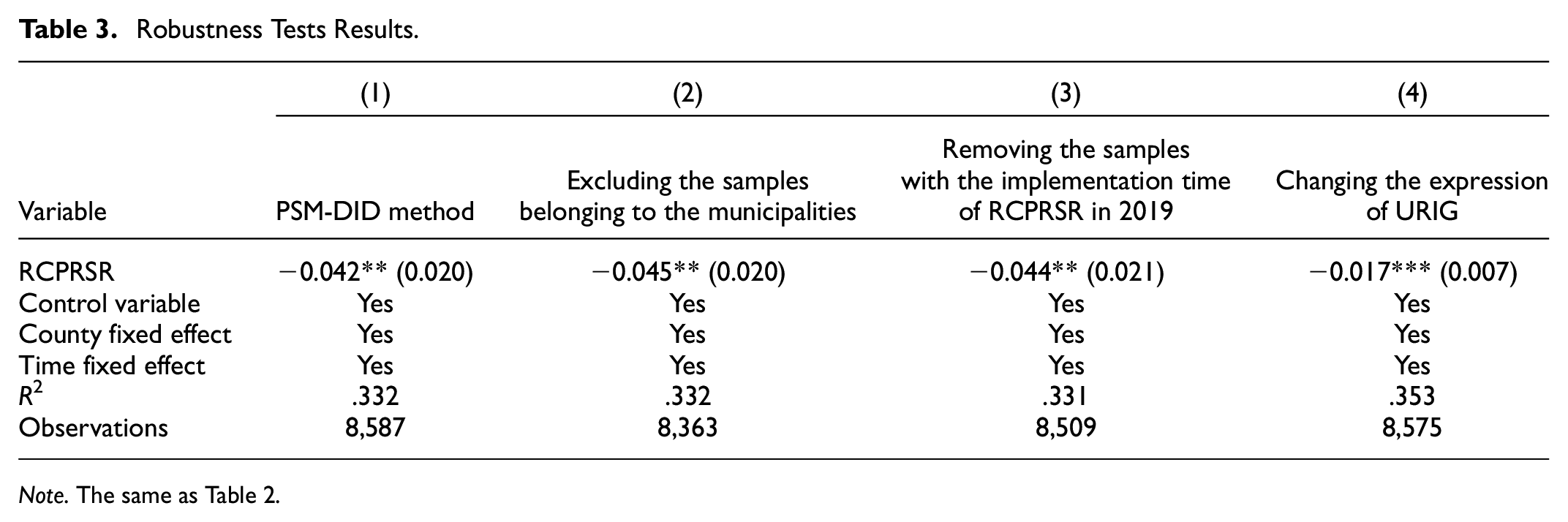
Finally, the DID model is used to re-estimate the policy effect. The regression findings in column (1) of Table 3 show that the coefficient of RCPRSR is significantly negative, which is identical to the above baseline estimation results. This provides further evidence that our baseline regression outcomes are robust, verifying that RCPRSR has a steady effect on narrowing URIG.
Robustness Tests Results.
Note. The same as Table 2.
Excluding the Samples Belonging to the Municipalities
There are several municipalities (such as Beijing, Shanghai, Tianjin, and Chongqing) in China. These municipalities are directly under the central government’s control and often enjoy advantages in terms of politics, economy, and transportation, so the impact of RCPRSR on URIG may be different in these municipalities than in other provinces. This situation could potentially introduce a selection bias in the sample and subsequently impact the study’s conclusions. Therefore, we remove the samples belonging to these municipalities to get a more accurate estimation of the net policy effect. The outcomes are displayed in column (2) of Table 3. It is discovered that the coefficient of RCPRSR remains statistically significantly negative, having high consistency with the baseline results.
Removing the Samples with the Implementation Time of RCPRSR in 2019
Due to the relatively short time frame for RCPRSR implementation in the 2019 pilot counties, including these counties in regression may bias the regression results. To enhance the credibility of the research findings, this paper undertook a sample modification. Specifically, the paper excluded pilot counties that underwent the rural collective property rights system reform in 2019 to mitigate their influence on the regression outcomes. Subsequently, a re-evaluation was conducted through regression analysis to assess the robustness of the results. Column (3) of Table 3 presents the regression results, which are almost identical to the baseline findings. It reveals that after eliminating these counties, RCPRSR can also narrow URIG, further providing proof of the reliability of our empirical findings.
Changing the Expression of URIG
In the baseline regression, we use the ratio of per capita disposable income between urban and rural residents to measure URIG. Here, we take the natural logarithm of urban per capita disposable income to rural per capita disposable income to measure URIG. The regression result is present in column (4) of Table 3. This result is the same as that in Table 2, which indicates that our baseline regression result is robust.
Heterogeneity Analysis
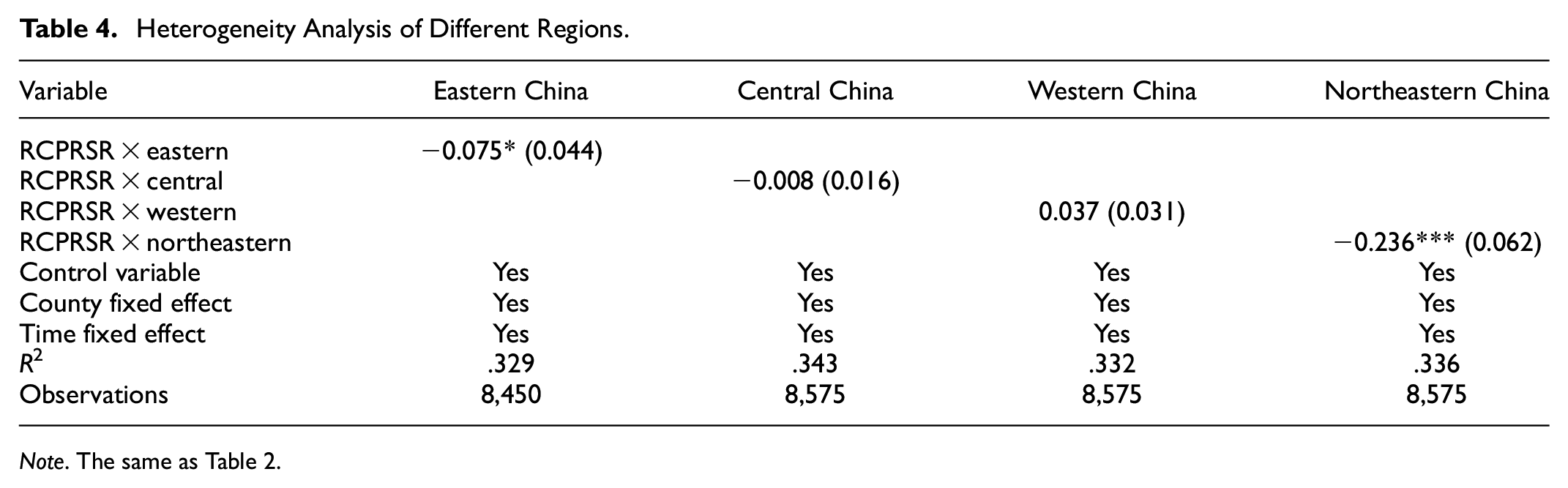
The resource endowment and economic conditions vary in different regions of China, and there are also significant differences in the formulation and implementation of RCPRSR in each region, which may lead to regional heterogeneity in the effect of RCPRSR on URIG. Based on this, we separate the sample into eastern, central, western, and northeastern regions and carry out a regional heterogeneity analysis on the impact of RCPRSR on URIG. The outcomes are presented in Table 4. It is evident that the influence of RCPRSR on URIG differs significantly by region. Specifically, RCPRSR does not considerably narrow URIG in the central, or western regions. Instead, it reduces URIG in the eastern and northeastern areas.
Heterogeneity Analysis of Different Regions.
Note. The same as Table 2.
The likely causes of this result are three aspects. First, the degree of RCPRSR is significantly higher in the eastern region than in the remaining region. For example, statistical data show that Beijing, Shanghai, Zhejiang, Guangdong, and Jiangsu are ranked top five in RCPRSR scores in 2019 and 2010, which are all eastern cities (X. Y. Chen et al., 2021). The rapid development of RCPRSR in the eastern region has raised farmers’ income, thus narrowing URIG. However, in central and western areas, RCPRSR is in the stage of development, and the effect of RCPRSR on narrowing URIG remains to be further demonstrated. Second, the rural collective economic foundation in Northeast China is relatively stable and the level of collective economic development is relatively high, which helps to promote the rapid growth of farmers’ operating income (Shen & Zhao, 2022). The RCPRSR in northeast China has promoted the increase of farmers’ income level and narrowing URIG. Third, compared to the central and western regions, the eastern region enjoys distinct geographical advantages, boasting markedly higher levels of marketization, technological innovation, and factor allocation These factors together create a more favorable environment for promoting the transformation and promotion of rural collective economy, especially the establishment of novel rural collective economic entities, which can result in a higher impact of RCPRSR on URIG.
Mechanism Analysis
According to the empirical analyses in the parts above, RCPRSR is efficient in narrowing URIG. However, what is the mechanism by which RCPRSR reduces URIG is a key question. Based on previous literature, the theoretical analysis part of this paper proposes that optimizing the industrial structure and improving the agricultural mechanization level are two main mechanisms of RCPRSR affecting URIG. According to Z. P. Huang (2018), we adopt the following equation to validate these two influential mechanisms:

Where
The outcomes are displayed in Table 5. For the mechanism of optimizing the industrial structure, we can notice that the coefficient of agricultural development level is significantly negative, while the coefficient of industrial development level is significantly positive, for the first year, the second year, the third year, and the fourth year after the implementation of RCPRSR. These results indicate that after RCPRSR implementation, the value added of the primary sector as a share of GDP is reduced, while the value added of the secondary sector as a share of GDP is enhanced, thus the industrial structure has been optimized due to the implementation of RCPRSR (Z. P. Huang, 2018). Therefore, optimizing industrial structure is one of the key mechanisms of RCPRSR affecting URIG. For the mechanism of improving the agricultural mechanization level, the significant positive coefficient of the agricultural mechanization level suggests that the total power of agricultural machinery has increased since the implementation of RCPRSR, implying agricultural mechanization is also one of the mechanisms.
The Mechanism Analysis of RCPRSR on URIG.

Note. The same as Table 2.
The above findings are in line with our expectations, and thus our Hypothesis 2 is verified.
Conclusions and Policy Recommendations
Conclusions
The impact of RCPRSR, a crucial property rights reform after the household responsibility system in rural China, on URIG is controversial. Based on 2,322 county-level panel data from 2010 to 2019 in China, this study explores the effect of RCPRSR on URIG using the time-varying DID method, and further investigates the heterogeneity effect and its mechanism. We find that: first, RCPRSR has a positive effect on narrowing URIG. Specifically, RCPRSR can lead to an average 4.2% decrease in URIG, and this effect remains robust after being verified by robustness tests. Second, heterogeneity analysis shows that RCPRSR only has a significant effect on narrowing URIG in eastern and northeastern China, while the effect on central and western China is not significant. Third, according to the mechanism analysis, optimizing the industrial structure and improving agricultural mechanization are two main mechanisms by which RCPRSR can reduce URIG.
Theoretical and Practical Contribution
The study’s findings have three contributions to the literature and practice. First, our paper presents a thorough quantitative assessment of the impact of RCPRSR on URIG based on extensive county-level data. Previous studies based on provincial or prefectural level data lack external validity in evaluating the performance of RCPRSR. Using county-level big data we are able to consider more observations and obtain more reliable results. Second, our paper contributes to understanding how RCPRSR influences URIG. We empirically investigate the role of RCPRSR in reducing URIG by analyzing the underlying mechanisms. The evidence shows that RCPRSR can reduce URIG by optimizing industrial institutions and enhancing agricultural mechanization levels. Third, our study provides insights for policymakers and researchers regarding how the implemented RCPRSR can contribute to decreasing URIG and also offers some practical suggestions for property rights reform in other fields.
Policy Recommendations
According to the above study, we offer relevant policy suggestions. First, RCPRSR should be implemented more vigorously to improve farmers’ income and thus reduce URIG. RCPRSR is considered a critical rural reform to promote rural revitalization in rural China. Currently, the first task of RCPRSR has been completed, that is, the property rights of rural collective assets have been clarified. In the next step, measures should be taken to consolidate and enhance the achievements of RCPRSR and better play its role in narrowing URIG. Specific measures may include: forming an effective operating mechanism and development environment for rural collective economic organizations, promoting the preservation and appreciation of collective assets, exploring new development modes for rural collective economy, such as outsourcing rural resource assets and involving land shares, and striving to build a reasonable and fair mechanism for distributing benefits.
Second, the government system in central and western regions needs to exert stronger efforts to implement RCPRSR. This is because our heterogeneity analysis shows that the impact of RCPRSR on URIG in China’s central and western regions is not significant. Drawing on the experience of the eastern and northeastern regions, the governments in these regions should keep promoting the implementation of RCPRSR vigorously to increase the positive effects of the policy. In the central region, priority should be given to enhancing the operational capacity of collective economic organizations and realizing the appreciation of collective assets’ value. In the western region, it is important to learn the reform experience from other regions, thus to define the specific direction of deepening reforms and stimulate the potential of reform in boosting collective economy development. For villages with obvious location advantages such as urban villages or suburbs, the development of the property leasing economy can be considered. For villages far away from urban areas but with better agricultural production conditions, the development of the rural collective economy in the form of agricultural land transfer intermediary services and agricultural industry chain services should be advanced. For villages with rich ecological resources, the development of the rural collective economy can be realized by the development of leisure agriculture or tourism.
Third, the Chinese government should take measures to further improve the industrial structure and increase the level of agricultural mechanization. This is because our mechanism analysis shows that RCPRSR narrows URIG mostly through the optimization of industrial structure and the improvement of agricultural mechanization. To this end, it is necessary to encourage rural collective economic organizations to participate in various forms of rural collective economy, such as the cultural industry, rural tourism industry, property leasing, and labor training, to boost industrial structure. Meanwhile, improving subsidies for purchasing agricultural machinery and providing farmers with training on machinery usage can serve as effective tools to elevate agricultural mechanization levels and reduce URIG.
Limitations and Future Research
This paper undertakes an empirical examination of the effects of RCPRSR on URIG through the utilization of the time-varying DID technique. While yielding valuable insights, the study does exhibit certain limitations that warrant subsequent attention. Firstly, the research sample in this paper is constrained by the available data, only encompassing county-level observations from 2010 to 2019. With the advancement of RCPRSR, the efficiency of resource allocation in rural areas may be further improved, which needs to be verified by the latest county-level data. Secondly, employing in-depth case analyses and conducting thorough investigations into relevant micro-contexts would enrich the analysis substantially, thus enhancing the precision of drawing insights into the effects of RCPRSR on URIG.
Footnotes
Declaration of Conflicting Interests
The author(s) declared no potential conflicts of interest with respect to the research, authorship, and/or publication of this article.
Funding
The author(s) disclosed receipt of the following financial support for the research, authorship, and/or publication of this article: This work was supported by the National Natural Science Foundation of China (No. 72363012; No. 71863016), National Social Science Foundation of China (No. 23FGLB006; No. 23&ZD110), Provincial Social Science Foundation of Jiangxi (No. 20YJ01).

Data Availability Statement
Data are available from the authors upon reasonable request.