



Abstract
We tested an assessment model, by which teacher self-efficacy, perceived school climate, and psychological wellbeing at work, might predict teaching enjoyment. We invited a convenience sample of 355 teachers of English as a foreign language (EFL) to respond to four online questionnaires. We used confirmatory factor analysis (CFA) to check the scales’ construct validity and structural equation modeling (SEM) to test associations among the variables. Our results showed that teacher self-efficacy, perceived school-climate, and psychological wellbeing were direct predictors of foreign language teaching-enjoyment (FLTE). Teacher self-efficacy affected FLTE indirectly, as induced by psychological well-being. School climate also indirectly influenced FLTE, as mediated by teacher self-efficacy and psychological wellbeing, with school climate a direct predictor of teacher self-efficacy and psychological wellbeing. Teacher self-efficacy directly affected psychological wellbeing. We discuss implications of these findings for teacher-education programs.
Keywords
Introduction
Before the emergence of positive psychology (PP) (Seligman & Csikszentmihalyi, 2000) in second and foreign language (L2/FL) research, the role of negative variables, such as anxiety, in L2 learning was in the spotlight (MacIntyre et al., 1997; Zhang, 2000; 2001). Nonetheless, inspired by PP principles and Fredrickson’s (2001) Broaden-and-Build Theory, L2/FL researchers and language educators have shifted their attention to positive emotions (see MacIntyre & Mercer, 2014; MacIntyre et al., 2019). Researchers’ holistic perspectives on learners’ positive emotions have led them to include both positive factors and negative variables in their research designs (Wang et al., 2021; Zhang & Tsung, 2021). It is critically important to shed more light on positive emotions, since they affect learners’ academic performance and subsequent learning behavior (Carmona-Halty et al., 2021; Wang et al., 2021), promote learning motivation (Pekrum, 2014), and even increase students’ wellbeing (Fredrickson, 2013). In addition, research on teachers’ positive emotions has gained momentum, as teachers with positive self-perceptions can help learners develop skills and improve academic achievement (Mercer & Gregersen, 2020). As Dreer (2022) suggested, teachers’ emotions and wellbeing have a salient influence on the optimal functioning of educational systems; this was also echoed in other studies (see Zhang et al., 2022).
In recent years, there has been a new line of research into foreign/second language (L2) teachers’ psychological functioning (De Costa et al., 2018; Liu & Chu, 2022; Xu, 2018). In this research, teaching has been seen as an emotional endeavor in which teachers’ emotions are associated with their quality of teaching and personal wellbeing (Bao et al., 2022; Dreer, 2022). This was confirmed by Fredrickson’s (2001) Broaden-and-Build Theory, suggesting that positive emotions might promote wellbeing. Enjoyment, one of the main positive emotions that teachers experience in their profession (Frenzel et al., 2009), is a determining factor for both instructors’ and learners’ wellbeing (Proietti Ergün & Dewaele, 2021). This is due to the fact that enjoyment is contagious and can be spread to learners by teachers (Frenzel et al., 2009; Liu et al., 2023; Talebzadeh et al., 2020), as it has been supported by Moskowitz and Dewaele (2021), who highlighted that students prefer being taught by happier teachers.
Given the significance of teacher emotions in general and foreign language teaching enjoyment (FLTE) in particular, very few investigators have explored this novel construct and its predictors (e.g., Derakhshan et al., 2022; Proietti Ergün & Dewaele, 2021). To contribute to this line of inquiry, we intended to test a hypothesized model of FLTE, based on teacher self-efficacy, school climate, and psychological wellbeing in an EFL context. This model is theoretically grounded in Bronfenbrenner’s (1979, 2005) ecological model of human development, which posits that outcome derives from the interaction with the immediate context. Accordingly, we hypothesized that school climate, as a contextual variable, directly and indirectly influences teachers’ enjoyment outcome (i.e., FLTE).
Literature Review
Foreign Language Teaching Enjoyment (FLTE)
Enjoyment, an alluring positive emotional construct experienced by L2 students and teachers, has been researched by several scholars in recent years (e.g., Derakhshan et al., 2022; Proietti Ergün & Dewaele, 2021; Li & Li, 2022). According to the Broaden-and-Build theory proposed by Fredrickson (2001), enjoyment, as a positive emotion, facilitates the process of language learning. This theory posits that enhancing persons’ thought–action repertoire will prompt their positive emotions to enable them to explore novel and unique actions, thoughts, and ideas, leading to building their personal resources. Also grounded in the control-value theory (Pekrun et al., 2007), enjoyment has a positive influence on learners’ academic achievement. Moreover, enjoyment encourages learners to delve deeper into the language, as it positively affects learners’ long-term hardiness and resilience (Dewaele et al., 2019).
Introduced by Dewaele and MacIntyre (2014), the concept of foreign language enjoyment (FLE) has been proven to help learners broaden their perspectives, enhance their learning engagement, and build resources to improve the language learning experience (see Jin & Zhang, 2019). The number of studies on FLE has sharply increased over the last decade (Fathi et al., 2023; MacIntyre & Dewaele, 2018; Proietti Ergün & Ersöz Demirdağ, 2022) due to its significant role in promoting learners’ wellbeing and facilitating language learning. The 21-item FLE Scale was originally designed and validated by Dewaele and MacIntyre (2014). The participants of their study were 1,742 students with 90 different nationalities from all around the globe. Later, Dewaele and MacIntyre (2016) reduced the scale to 14 items, including the two factors of FLE-Private and FLE-Social by using Dewaele and MacIntyre’s (2014) dataset. Recently, Botes, et al. (2021) introduced a short 9-item form of the FLE scale (see Dewaele & MacIntyre, 2014) with three lower order variables: Social Enjoyment, Teacher Appreciation, and Personal Enjoyment.
Dewaele et al. (2018) investigated how foreign language (FL) teachers affected their learners’ FLE. They found that various factors such as teachers’ frequent use of a FL, positive perceptions towards it, and a high proficiency level in it strongly predicted their FLE. Jiang and Dewaele (2019) also acknowledged the effect of teacher-related factors on FLE among Chinese EFL learners. In a similar vein, Dewaele et al. (2019) highlighted teachers’ friendliness as a variable in increasing learners’ FLE and teachers’ foreign accent in decreasing the level of FLE among EFL Spanish learners. Another study in this respect is Jin and Zhang (2021), who explored three dimensions of FLE: Enjoyment of Student Support, Enjoyment of FL Learning, and Enjoyment of Teacher Support. Jin and Zhang (2021) demonstrated that Enjoyment of Student Support and Enjoyment of Teacher Support had an indirect influence on language achievement through Enjoyment of Foreign Language Learning. Furthermore, enjoyment of Foreign Language Learning was directly related to learners’ mid-term scores.
In a study by Mierzwa (2019), where 89 Polish FL instructors were the participants, Dewaele and MacIntyre’s (2014) FLE scale was used to assess FLTE. Gender differences were observed, with female learners reporting higher enjoyment levels, while gender had no significant impact on teachers' enjoyment. Factors such as place of residence, school type, language taught, and years of teaching experience showed no correlation with enjoyment levels. Teachers' attitudes were seen as crucial in fostering learners' FL enjoyment. Proietti Ergün and Dewaele (2021) examined resilience and wellbeing in 174 Italian FL teachers, finding that resilience had a stronger influence on FLTE than teacher wellbeing. Khajavy et al. (2018) investigated sources of enjoyment among EFL teachers and identified motivated students, positive relationships with students, and students' progress as key sources. Xiao et al. (2022) discovered that teaching enjoyment and teacher self-efficacy significantly predicted EFL teachers' work engagement. Additionally, Derakhshan et al. (2022) highlighted the substantial effects of resilience, wellbeing, and L2 grit on teachers' FLTE.
Psychological Wellbeing at Work
Other researchers have shown that teachers are more prone to work-related tension, burnout, and psychological distress than are other career professionals (Stapleton et al., 2020). Garg and Rastogi (2009) defined psychological wellbeing as an individual’s level of satisfaction and happiness with their work, their physical/mental health, and their life. Psychological wellbeing at work, according to Dagenais-Desmarais and Savoie (2012), pertains to one’s subjective positive experience at work. Dagenais-Desmarais and Savoie (2012) designed a self-report scale for measuring psychological wellbeing at work; it was composed of five inter-related dimensions, namely thriving, desire for engagement, interpersonal fit, perceived recognition, and feeling of competency.
Teachers' mental health and psychological wellbeing have been investigated by researchers such as Manasia et al. (2020). They proposed a comprehensive model for Romanian teachers' wellbeing, considering factors such as job resources, job demands, subjective happiness, teaching emotions, and perceived self-efficacy. Their findings indicated that teaching enjoyment, influenced by job resources, played a role in teachers' subjective happiness. Job resources had a stronger impact than personal resources like self-efficacy. Helms-Lorenz et al. (2016) conducted a longitudinal study on beginning teachers, examining the associations between self-efficacy, job tension, job discontent, and causes of stress. They found that stress causes positively predicted job discontent and job tension, while class and school efficacy were negatively correlated with these outcomes. In another study, Adeyemo et al. (2008) suggested that emotional intelligence and self-efficacy of secondary school adolescents were predictors of psychological wellbeing.
This literature review has shown that several variables are correlated with psychological wellbeing, including work cognition (Joo et al., 2017), job performance, work engagement, and emotional intelligence (Çankir & Sahin, 2018). In conjunction with second/foreign language teaching, psychological wellbeing has been the subject of several studies (e.g., Greenier et al., 2021; Xiyun et al., 2022).
Teacher Self-Efficacy
Self-efficacy is related to an individual’s thoughts about their abilities to develop and perform the tasks which are necessary to generate specific attainments (see Bandura, 1997). Bandura (1997) postulated four sources of influence on self-efficacy: verbal persuasion, vicarious experiences, emotional and physical states, and mastery experiences. These sources (Bandura, 1997) have been investigated in several studies to date (e.g., Yada et al., 2019). As far as educational contexts are concerned, teacher self-efficacy relates to teachers’ belief in their own capability to affect student performance (Skaalvik & Skaalvik, 2007). Rooted in Bandura’s (1977, 1997) social cognitive theory, teacher self-efficacy is regarded as teachers’ perceptions of their ability to use instructional strategies and accomplish desirable learner outcomes, including engagement and learning. Tschannen-Moran and Hoy (2001) defined teacher self-efficacy as a multifaceted construct that included three elements of efficacy in using teaching strategies, classroom management, and student engagement.
To date, a cluster of studies have investigated the role of teacher self-efficacy in various contexts (Fackler et al., 2021; Perera et al., 2019; Skaalvik & Skaalvik, 2010). After reviewing previous research regarding the influences of teacher self-efficacy on both instructor and learner outcomes, Zee and Koomen (2016) revealed that efficacious teachers had higher job satisfaction and lower job stress. Teacher self-efficacy has been recognized as a key factor in shaping students’ academic achievement and motivation (Klassen & Tze, 2014). A high degree of teacher self-efficacy is associated with positive instructional behaviors, encompassing clear expectations, quality instruction, and exceptional classroom organization (Klassen & Tze, 2014). More efficacious teachers are less likely to quit their profession, as they have a higher degree of job satisfaction (Wang & Zhang, 2021; Zakariya, 2020).
Emerging evidence has also shown that teacher self-efficacy is inversely associated with job burnout (Aloe et al., 2014; Skaalvik & Skaalvik, 2010) and positively related to instructional quality (e.g., Klassen & Tze, 2014), and job satisfaction (Zee & Koomen, 2016). As far as EFL teaching is concerned, some research evidence has shown that teacher self-efficacy is a strong and negative predictor of teaching stress and job burnout (Bing et al., 2022; Li et al., 2021a; Li et al., 2021b). However, teacher self-efficacy is positively related to EFL teachers’ emotion regulation (Fathi et al., 2021), job performance (Soodmand Afshar & Moradifar, 2021), and self-regulation (Azari Noughabi & Amirian, 2021).
Perceived School Climate
The concept of school climate refers to the attitude and feelings of individuals who work at school (Gruenert, 2008). It is a significant part of effective schools and communities (Howard et al., 1987). In teaching contexts, positive school climate has a pivotal role in shaping instructors’ perceptions which, in turn, can influence student learning positively (Higgins-D’Alessandro, 2011). Clearly, a positive school climate has been found to decrease the levels of teachers'; emotional exhaustion, low personal accomplishment, and depersonalization (Grayson & Alvarez, 2008). The authors have asserted that when teachers receive support from both their peers and the principal, they show more commitment to their occupation (Singh & Billingsley, 1998). The role of school atmosphere is also valued as an influential source of teacher self-efficacy (Aldridge & Fraser, 2016), teacher burnout (e.g., Grayson & Alvarez, 2008; Malinen & Savolainen, 2016), and teachers’ job satisfaction (e.g., Katsantonis, 2019; Zakariya, 2020).
Collie et al. (2012) examined how teachers' attitudes towards school climate influenced job satisfaction, stress levels, and teaching efficacy. They found that teachers' attitudes towards student behavior and motivation significantly impacted teaching efficacy, job satisfaction, and stress levels. Perceived stress related to student behavior negatively predicted teaching efficacy, while perceived stress related to workload directly affected job satisfaction. Katsantonis (2019) confirmed the mediating role of teacher self-efficacy in the relationship between job satisfaction and school climate among teachers from multiple countries. Positive school climate has also been associated with teachers' wellbeing and mental health, while showing a negative correlation with emotional exhaustion (Gray et al., 2017; Yang et al., 2022). Recent research by Yang et al. (2022) revealed a positive correlation between perceived school climate and teachers' wellbeing. The relationship between school climate and job satisfaction has also been observed among EFL teachers in several studies (e.g., Oder & Eisenschmidt, 2018; Razavipour & Yousefi, 2017).
While school climate, psychological wellbeing, and teacher self-efficacy have been explored in recent empirical studies, no research has investigated their association with FLTE because FLTE is still is in infancy and its exploration is insufficient. To fill these research gaps, we attempted to test a model of FLTE among EFL teachers.
Theoretical Framework and Hypothesized Model
From a social psychology perspective, human behavior is context-sensitive (Deieso & Fraser, 2019) and influenced by both the environment and individuals themselves (Alansari & Rubie-Davies, 2020). According to an ecological view of L2 learning, each element in an L2 context is associated with other elements (Kramsch & Steffensen, 2008). Such an ecological perspective on L2 learning is concerned with how persons’ outcomes are affected by their contextual factors (Freeman & Cameron, 2008; Zhang, 2021). Likewise, this attitude is in line with Bronfenbrenner’s (1979) ecological view of human development which underscores the role of both person and context. From Bronfenbrenner’s (1979) ecological perspective, human development is viewed in terms of a number of interdependent systems known as ecosystems.
This model constitutes four layers: a microsystem, a mesosystem, an exosystem, and a macrosystem. As the innermost layer, the microsystem refers to the variables/individuals that an individual is directly in contact with. The mesosystem goes beyond such factors and refers to a constellation of individual and several microsystem elements. The exosystem includes variables that do not have direct contact with a person although they indirectly affect the person. These variables refer to cultural and societal factors. Finally, the macrosystem pertains to global factors that include a combination of the microsystem, mesosystem, exosystem, and macrosystem (Bronfenbrenner, 1979).
This study is grounded theoretically in Bronfenbrenner’s ecological system theory (1979, 2005), which examines the interactions between human beings and their context/environment. This is also in line with the “ecological turn” of the L2 research (Larsen-Freeman, 2016) that has prompted several researchers to adopt ecological perspectives in their L2 studies (e.g., Kramsch & Steffensen, 2008; Liu et al., 2022; Miller & Gkonou, 2018; Sparks, 2019). We adopted Bronfenbrenner’s ecological system to explore how different teacher-related factors in nested ecological systems interact to affect teacher outcome (i.e., FLTE). This theory encompasses interconnected systems: microsystem, mesosystem, exosystem, and macrosystem. The microsystem represents immediate interactions and constructs encountered by individuals (Bronfenbrenner, 1979). In our study, it includes teacher self-efficacy, psychological well-being at work, and teaching enjoyment, directly influencing the experiences and outcomes of foreign language teachers. The mesosystem explores connections between microsystem factors, such as the relationship between teacher self-efficacy and perceived school climate or the influence of psychological well-being at work on teaching enjoyment. Understanding these mesosystem factors provides insights into how interconnected elements shape the teaching experience. The exosystem comprises variables indirectly impacting individuals (Bronfenbrenner, 2005). In our study, cultural and societal factors influence the teaching experience, such as educational policies, community support, and resource availability. These exosystem variables indirectly affect teaching enjoyment and outcomes. Lastly, the macrosystem encompasses global factors, including broader educational systems, national policies, and cultural norms, shaping the teaching context. Examining the macrosystem helps understand how larger societal factors impact teaching experience and outcomes. By adopting Bronfenbrenner’s ecological system theory, our study investigates individual and environmental factors, such as self-efficacy, well-being, and school climate, to gain insights into their interplay across the ecological system layers, influencing teaching outcomes. Embracing a holistic framework, our study considers the intricate interplay between foreign language teachers and their teaching context, encompassing individual characteristics and environmental influences.
In addition, in line with this theoretical underpinning and based on the extant literature, we hypothesize a model of FLTE (see Figure 1) with the following hypotheses: The Hypothesized Model of FLTE.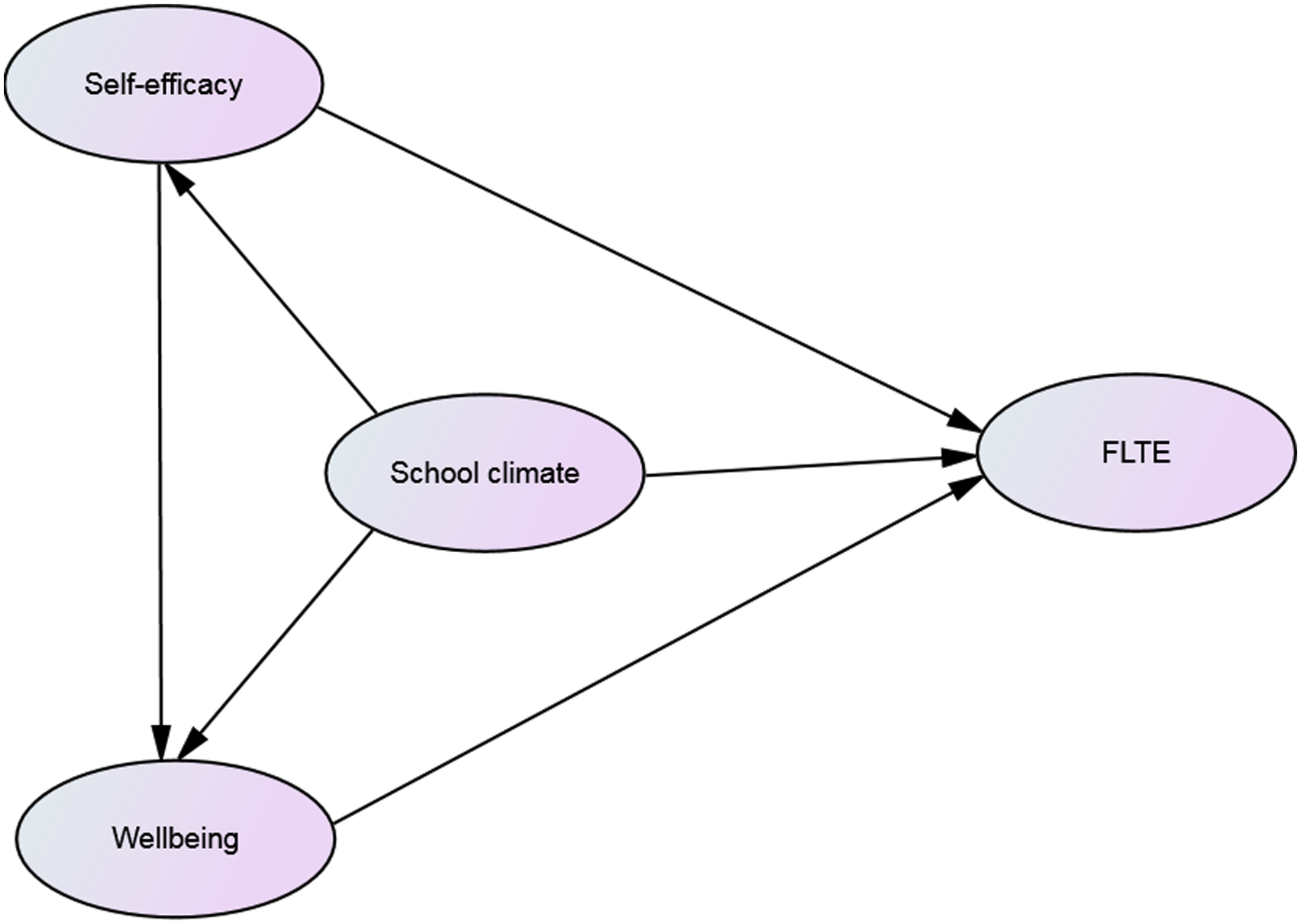
Perceived school climate positively influences FLTE. Perceived school climate has been identified as a significant construct associated with teachers' stress, efficacy perceptions, job satisfaction, wellbeing, and teacher retention (Ingersoll, 2001; Katsantonis, 2019; Kohl et al., 2013). Drawing from studies by Aldridge and Fraser (2016) and Oder and Eisenschmidt (2018) that reported the effect of school climate on job satisfaction and perceived teaching efficacy, we hypothesize a positive effect of school climate on FLTE.
Perceived school climate positively influences teacher self-efficacy. Building on the research by Collie et al. (2012), Malinen and Savolainen (2016), and Hu et al. (2019), we propose a path from school climate to teacher self-efficacy, suggesting that a positive school climate can enhance teachers' self-beliefs about their instructional abilities.
Perceived school climate positively influences teacher wellbeing. In line with studies by Gray et al. (2017) and Yang et al. (2022), we anticipate a link between school climate and teacher wellbeing, suggesting that a positive school climate is associated with higher levels of teacher wellbeing.
Teacher wellbeing positively influences FLTE. Drawing from research by Derakhshan et al. (2022), Dreer (2021), and Proietti Ergün and Dewaele (2021), we hypothesize a positive effect of teacher wellbeing on FLTE, suggesting that teachers who experience higher levels of wellbeing are more likely to enjoy their foreign language teaching.
Teacher self-efficacy positively influences FLTE. Consistent with the extant literature (e.g., Barr et al., 2022; Helms-Lorenz & Maulana, 2016; Zee & Koomen, 2016), we propose that teacher self-efficacy positively affects FLTE. Teachers who possess a stronger belief in their own capabilities are more likely to experience higher levels of teaching enjoyment.
Teacher self-efficacy positively influences FLTE. Finally, given the positive impact of teacher self-efficacy on job satisfaction, commitment, motivation, and teaching enjoyment (Burić & Moe, 2020; Canrinus et al., 2012; Demir, 2020; Lazarides et al., 2021; Skaalvik & Skaalvik, 2010; 2017; Xiao et al., 2022), we hypothesize that teacher self-efficacy affects FLTE positively.
Method
Participants
Our participants were 335 English teachers (147 males and 188 females) who were teaching English at different language institutes/schools in various provinces in Iran. They were selected based on convenience sampling principles. Their ages ranged from 20 to 41 (M = 26.18, SD = 4.54) with teaching experience that ranged from 5 months to 18 years (M = 9.07, SD = 2.13). All the teachers had been English majors in their university studies. Regarding their educational degrees, 22 teachers had a PhD degree, 146 teachers held an MA, and 156 teachers had a BA degree. Eleven teachers did not specify their educational degrees.
Measures
Foreign Language Teaching Enjoyment Scale
Participants’ teaching enjoyment was assessed with the Foreign Language Teaching Enjoyment Scale (FLTES) designed by Proietti Ergün and Dewaele (2021). They developed this questionnaire by modifying the scale that was originally developed by Botes, et al. (2021). FLTES is a 9-item self-report questionnaire that measures three sub-scales of (a) Personal Enjoyment (PE), (b) Student Appreciation (SA), and (c) Social Enjoyment (SE). The PE sub-scale assesses the extent to which teachers experience personal enjoyment in their role as language instructors. The SA sub-scale measures teachers' perceptions of the appreciation and positive responses received from their students. The SE sub-scale evaluates the enjoyment teachers derive from social interactions and relationships within the classroom context. Each item was assessed on a 5-point Likert scale ranging from 1 (strongly disagree) to 5 (strongly agree). In their study, Proietti Ergün and Dewaele (2021) found that the total reliability coefficient of FLTE was 0.857. In the present study, the scale demonstrated an internal consistency of 0.85.
Psychological Wellbeing at Work Scale
We measured EFL teachers’ level of psychological wellbeing by administering the Index of Psychological Well-Being at Work developed by Dagenais-Desmarais and Savoie (2012). This questionnaire includes 25 items which evaluate five underlying components: Desire for Involvement at Work (DIW), Interpersonal Fit at Work (IFW), Feeling of Competency at Work (FCW), Thriving at Work (TW), and Perceived Recognition at Work (PRW). The DIW component measures the extent to which teachers feel engaged and connected to their work, actively participating in their tasks and responsibilities. IFW assesses teachers' perception of positive and supportive relationships with colleagues and supervisors. The FCW sub-scale focuses on teachers' confidence and belief in their abilities to perform their job effectively. TW examines the sense of growth, development, and fulfillment experienced by teachers in their professional roles. Lastly, the PRW evaluates the extent to which teachers feel valued, acknowledged, and appreciated for their contributions in the workplace. The items are evaluated using a 6-point Likert scale from 0 (Strongly Disagree) to 6 (Strongly Agree). Dagenais-Desmarais and Savoie (2012) reported a Cronbach’s Alpha coefficient of 0.964 for the entire questionnaire, indicating high internal consistency. Previous studies (e.g., Sandilya & Shahnawaz, 2018) have also confirmed the validity of the scale. In this study, the scale demonstrated a composite reliability of 0.81.
Teacher Self-Efficacy Scale
To measure EFL teachers’ self-efficacy, we employed the Teachers’ Sense of Efficacy Scale (TSES) designed by Tschannen-Moran and Hoy (2001). This questionnaire contains 24 items that measure teachers’ perceptions on their competence in employing effective teaching strategies, student engagement, and classroom management. TSES examines teachers' beliefs and confidence in their ability to successfully perform their teaching responsibilities. It provides insights into their perceived capabilities and their sense of effectiveness in various aspects of their teaching practice. Each item is evaluated using a 5-point Likert scale varying from 1, “nothing”, to 5, “a great deal” Tschannen-Moran and Hoy (2001) reported strong reliability coefficients for the subscales of the TSES, with values of 0.91 for instruction, 0.90 for management, and 0.87 for engagement. The validity of the TSES scale was further confirmed by Klassen et al. (2009) in five different countries. In our study, the internal consistency of the scale was found to be 0.82.
School-Level Environnent Questionnaire (R-SLEQ)
We measured EFL instructors’ attitudes regarding their school climate with the School-Level Environment Questionnaire (R-SLEQ) developed by Johnson et al. (2007). This 21-item questionnaire evaluates teachers’ perceptions of five dimensions: (a) collaboration, (b) student relations, (c) school resources, (d) decision making, and (e) instructional innovation. The participants were requested to answer items on a 5-point scale, ranging from 1 (strongly disagree) to 5 (strongly agree). Collaboration assesses the cooperative atmosphere and teamwork among teachers. Student relations examines teachers' perceptions of their relationships with students, including trust, respect, and positive interactions. School resources evaluates the availability and adequacy of resources such as teaching materials, technology, and administrative support. Decision making explores teachers' involvement in school decisions related to curriculum and policies. Instructional innovation reflects teachers' perceptions of the level of creativity and support for new teaching approaches. R-SLEQ demonstrated high reliability with a reported coefficient of 0.90, ranging from 0.77 to 0.86 for the five factors, namely collaboration, decision-making, instructional innovation, student relations, and school resources (Johnson et al., 2007). Hosford and O'Sullivan (2016) have asserted the strong construct validity of this scale. In our study, the composite reliability or internal consistency of the entire scale was determined to be 0.79.
Data Collection
Data collection began in December 2021 and lasted about 8 weeks. This timeframe was chosen to provide an extended period for potential participants to access the survey and complete it at their convenience. We designed the electronic survey containing the self-report scales of the four variables with Google Forms and shared the link to the online survey on Telegram/WhatsApp channels to which EFL teachers from different parts of the country subscribed. In addition, some teacher educators/administers cooperated in the data collection process by sharing the link of the survey with their teachers. Before potential respondents completed the items, they were briefed on the research purpose and provided with an introductory explanation regarding the response process. The participation in the survey was voluntary, and we announced that data confidentiality would be assured. The Google Forms did not require participants to provide personal identification information, such as email or cell number. Participants were informed that providing an email address was optional, and they were assured that their responses would be kept confidential and would not be linked to their personal information. We emphasized that their email addresses would not be used to identify their responses or for any other purpose related to the research. The purpose of collecting email addresses, if provided, was solely for communication regarding informed consent and optional follow-up. Participants were encouraged to use a generic or pseudonymous email address to further protect their identity. We also assured participants that their data would be stored securely and accessible only to the research team. These measures were implemented to safeguard the privacy and anonymity of participants throughout the study.
Prior to answering the items, the respondents provided their informed consent. Upon completing the online survey, they were offered a form of informed consent and were asked to mark the box showing their voluntary or involuntary participation in the research. There was no deadline for completing the survey and the respondents were requested to answer items carefully at their convenient time. By not setting a strict deadline for completing the survey, we aimed to accommodate the diverse schedules of participants and provide them with the flexibility to respond when it was most convenient for them. Respondents were encouraged to carefully consider their responses and answer the survey items at a time and place that suited their preferences. The 8-week timeframe for data collection allowed for a substantial number of participants to contribute to the study, ensuring a representative sample for analysis. It also allowed us to maintain a reasonable timeframe for data processing and analysis, ensuring the timely completion of the research project.
Data Analyses
Number of Cases for Each Measure.
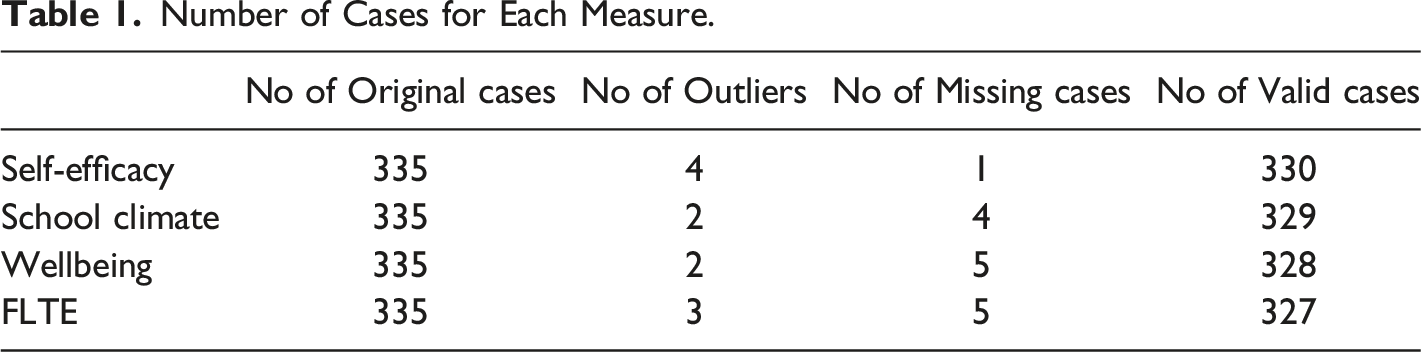
We examined convergent validity and reliability based on average variance extracted (AVE) and composite reliability (CR). The criteria of adequacy were set as AVE ≥0.50 and CR ≥0.70 (Kline, 2016). Furthermore, we used the bootstrapping method introduced by Shrout and Bolger (2002) to test the significance of indirect effects. As such, 1000 bootstraps were created and lower and upper limit confidence intervals were also considered (Hayes, 2013). Finally, we examined the common method variance with Harman’s single-factor test to ensure the validity of the results (Podsakoff et al., 2003).
Results
Descriptive Statistics, Correlations, Reliability, and Validity Analysis.
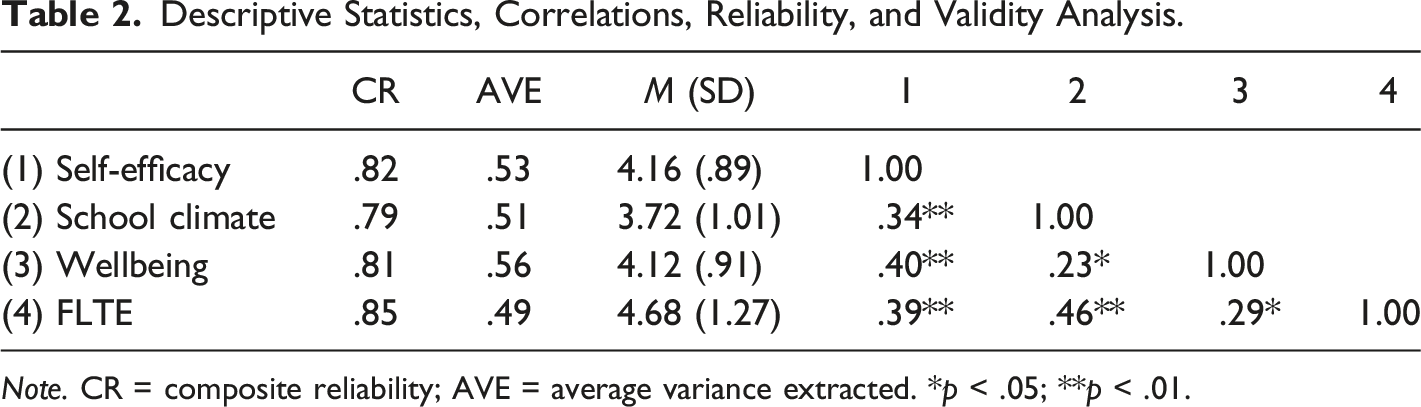
Note. CR = composite reliability; AVE = average variance extracted. *p < .05; **p < .01.
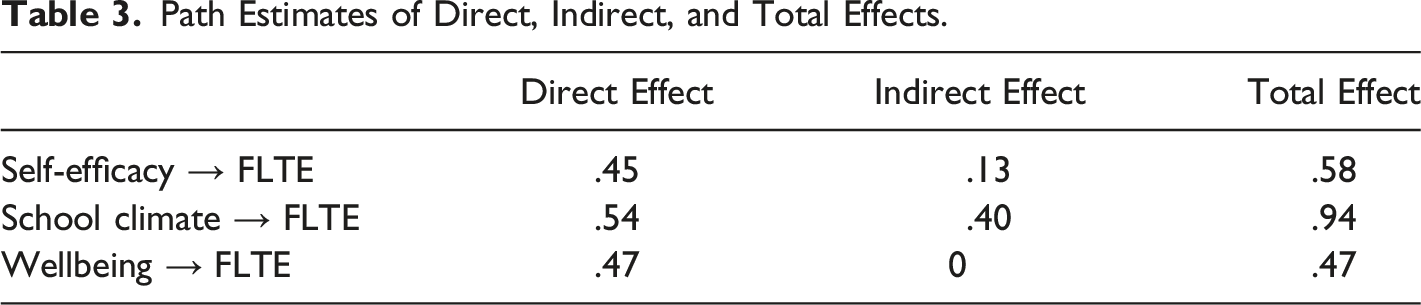
Then, regarding the structural model, using the maximum likelihood procedure and variance-covariance matrices as input, we tested the hypothesized model with AMOS. The obtained results revealed good fit for the hypothesized model (χ2 = 136.57, df = 72, p < .001; CFI = .968; TLI = .954; RMSEA = .034[90% CI from .033 to .049]). Therefore, as illustrated in Figure 2, all the hypothesized paths among the latent construct were statistically significant. The Final Model of FLTE. Note. *p < .05; **p < .01; ***p < .001.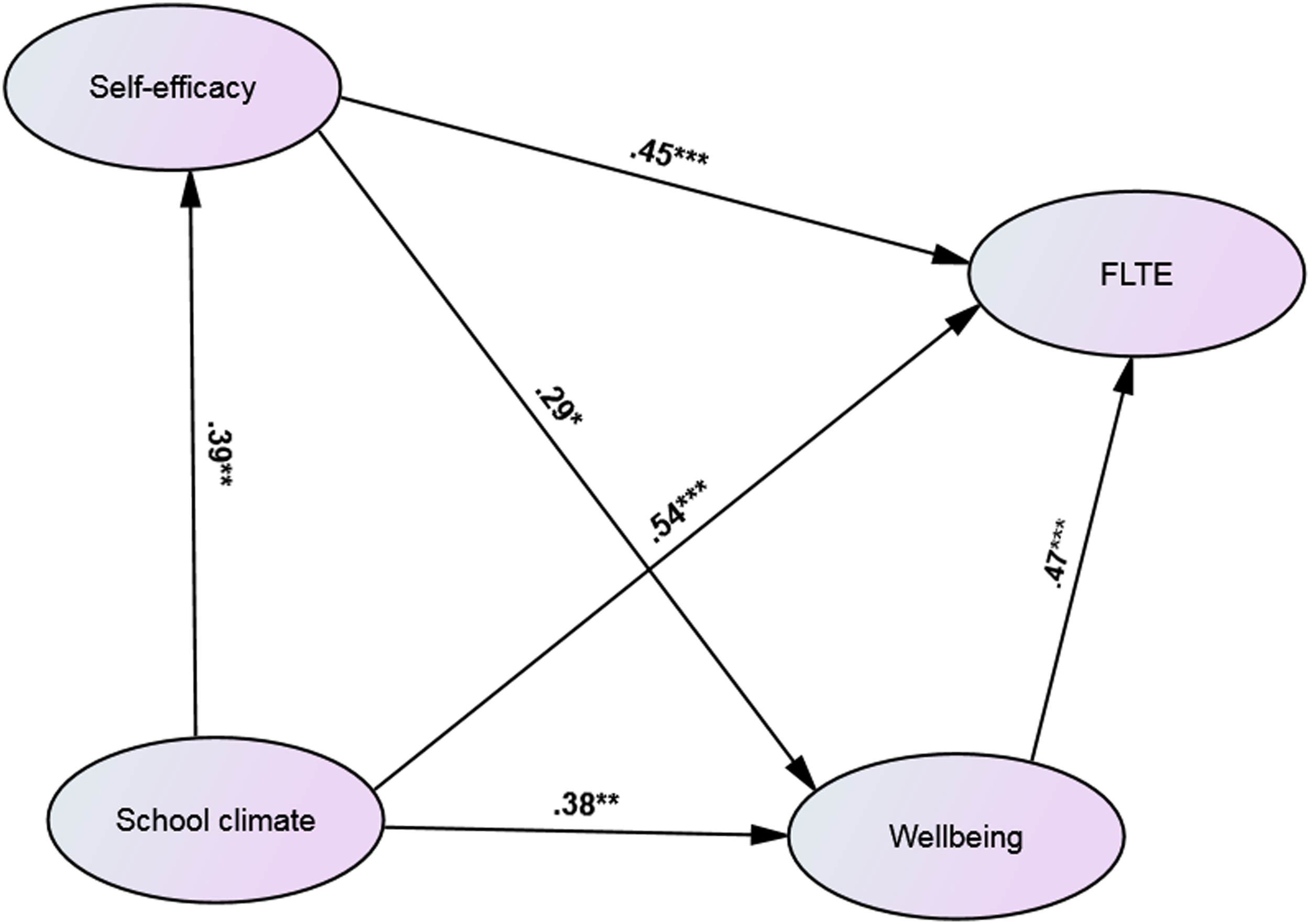
Path Estimates of Direct, Indirect, and Total Effects.
Bootstrapping Analyses of Results of Indirect Effects.
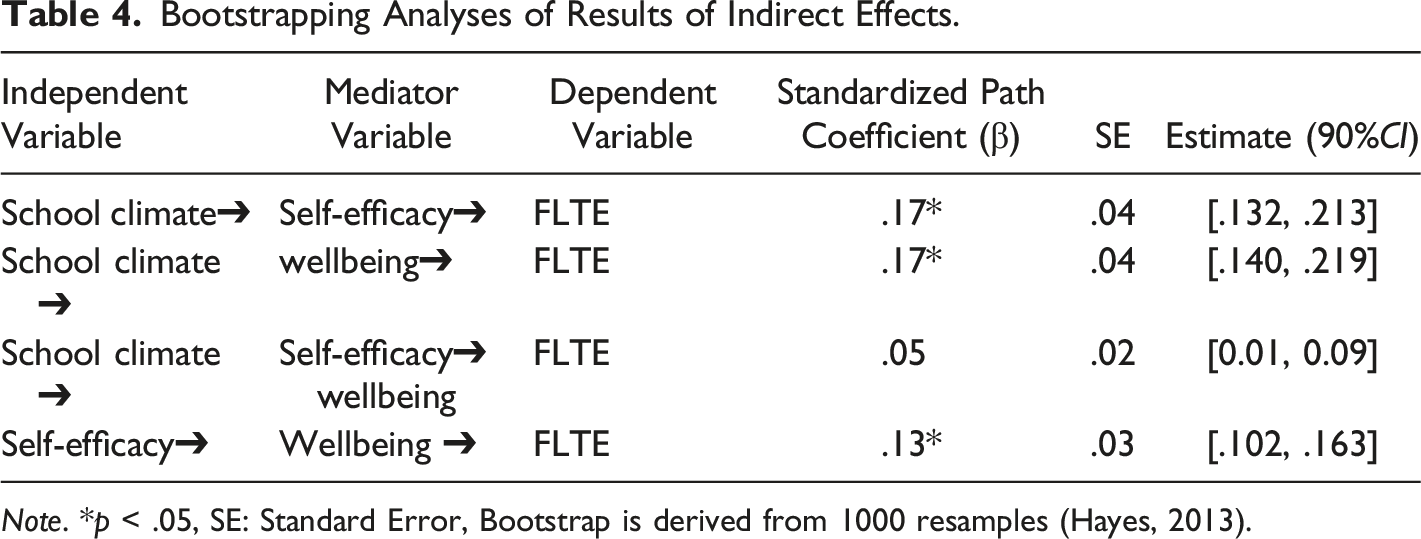
Note. *p < .05, SE: Standard Error, Bootstrap is derived from 1000 resamples (Hayes, 2013).
Ultimately, as approved by the outputs of the Harman’s single-factor test (χ2 = 858.364, df = 223, p < .001; CFI = .548; TLI = .512; RMSEA = .128 [90% CI from .122 to .134]), a single factor failed to explain the variance in the data, highlighting that common method variance bias was not a concern in the present study.
Discussion
In this study, we set out to test a model of FLTE based on teacher self-efficacy, perceived school climate, and psychological wellbeing at work among EFL teachers. The results of SEM revealed intriguing findings. First, teacher self-efficacy was one of the three direct and significant predictors of FLTE. This finding supports Xiao et al. (2022) who reported a significant association between teaching enjoyment and self-efficacy. This outcome also partially supports Burić and Moe (2020), who found an association between teacher self-efficacy and teaching enthusiasm.
Thus, the degree to which teachers believe they can successfully teach something, manage their classrooms effectively, engage their students, and foster their learning outcomes affected their level of teaching enjoyment. According to Bandura (1977), those who have higher degrees of self-efficacy are more persistent in their endeavors and hold positive perceptions of what they do. From this perspective, it can be argued that teachers’ positive beliefs in their teaching skills affect their work performance and motivation positively and lower the likelihood of their withdrawal from teaching. This outcome is supported by previous research, suggesting that high teacher self-efficacy is associated with better job performance (Jamil et al., 2012; Klassen & Tze, 2014; Song et al., 2018), job involvement, organizational commitment, and motivation (Canrinus et al., 2012; Demir, 2020; Skaalvik & Skaalvik, 2010; 2017). Subscribing to Fredrickson’s (2001) Broaden-and-Build theory, it might be argued that teachers with greater efficacy perceptions are more likely to broaden their affective and cognitive range of activities, which in turn enhances their intellectual resources and levels of engagement.
Also, teacher self-efficacy influenced FLTE via psychological wellbeing. This finding partially supports Derakhshan et al. (2022) and Proietti Ergün and Dewaele (2021) who revealed the positive effect of wellbeing on FLTE among EFL teachers. This finding can be interpreted in light of the key role of teacher self-efficacy in influencing teachers’ psychological wellbeing (Barr et al., 2022; Helms-Lorenz & Maulana, 2016; Zee & Koomen, 2016). Teacher self-efficacy is concerned with how teachers view their teaching ability, use of effective teaching strategies, and ability to engage students (Tschannen-Moran & Hoy, 2001), as well as their capability in making a difference regarding their learners’ academic performance (see Mok & Moore, 2019). Low teacher self-efficacy could lead to negative emotions such as anxiety and stress which might decrease the effectiveness of teaching. Therefore, poor teaching quality results in low job satisfaction and less enjoyment among EFL teachers, while high teacher self-efficacy is correlated with job satisfaction (Demir, 2020; Granziera & Perera, 2019; Zakariya, 2020), work engagement (Skaalvik & Skaalvik, 2014), and job performance (Song et al., 2018), all of which can contribute to enhancing teachers’ psychological wellbeing and thereby increasing their teaching enjoyment. This was supported by Bandura (1997), who believed that teacher self-efficacy could have a positive impact on teacher performance and motivation.
On the whole, teachers with high efficacy perceptions are more likely to show enhanced performance, since they work with higher intensity for longer periods and put more energy into task performance. As a result, as the teachers become more satisfied and engaged, their level of psychological wellbeing might increase. The strong correlation between psychological wellbeing and work engagement has been supported by prior research (Greenier et al., 2021; Rusu & Colomeischi, 2020; Zeng et al., 2019; Wang et al., 2022). Therefore, EFL teachers with greater efficacy perceptions might have a better mental health, which in turn might cause them to experience more enjoyment in their teaching activities (teacher self-efficacy → psychological wellbeing → high job satisfaction, work engagement, job performance → high teaching enjoyment).
Another key finding of this analysis was that perceived school climate was the strongest predictor of FLTE. This implies that those teachers who had positive perceptions of their workplace environment displayed more teaching enjoyment. This is in line with social-cognitive theory which suggests that individuals’ behaviors are affected by the organizational environment where they work but differ according to their unique characteristics (see Bandura, 1986). The term social refers to how one’s behavior is influenced by their work environment. This finding can be justified considering the significant association of school/organizational climate with job satisfaction and teacher self-efficacy (Aldridge & Fraser, 2016; Katsantonis, 2019; Malinen & Savolainen, 2016; Pan & Qin, 2007). Since a significant thread of research findings has documented the substantial impact of perceived school climate on teacher burnout (e.g., Fernet et al., 2012; Grayson & Alvarez, 2008) and teachers’ job satisfaction as well as effectiveness (Collie et al., 2012; Dickhäuser et al., 2021), it can be argued that a favorable school climate can foster teaching enjoyment by inculcating a sense of more satisfaction, less emotional exhaustion, and heighted perceived effectiveness in EFL teachers. In line with this, Zakariya (2020) reported that teachers are more likely to have high job satisfaction in a school with favorable climate where teachers have a friendly relationship with their students and are concerned about their wellbeing. Therefore, it can be argued that EFL teachers might show high levels of teaching enjoyment in a supportive and positive school climate.
As another finding of SEM results, perceived school climate indirectly affected FLTE through teacher self-efficacy. This finding indicates that school climate is intertwined with the effectiveness of teachers’ pedagogical tasks, which is tied to teachers’ ability to develop their pedagogical actions (Zhang & Zhang, 2020). This is consistent with that of Hosford and O'Sullivan (2016), suggesting that teachers’ attitudes of a supportive school climate were positively associated with their teaching efficacy and management of challenging behaviors in the inclusive classrooms. This finding also aligns with other studies that underscored the correlation between school climate and teacher self-efficacy (Aldridge & Fraser, 2016; Lacks & Watson, 2018). It can be speculated that in a school with strong supportive and collaborative community and supportive collegial relationships, teachers are more likely to believe in their competence in affecting their learners’ academic achievement and shaping their knowledge. In this case, EFL teachers would do their best to promote functional and active learning strategies in the classroom, use more effective teaching practices, and try to achieve the optimal learning outcome for their students. This was supported by Shen et al. (2012) who revealed that a communal school organization, orderly environment, and principal leadership were positively associated with teachers’ self-efficacy as well as their satisfaction with their occupation. As a result, EFL teachers who consider their school climate as cooperative and supportive tend to experience feelings of importance, inspiration, and encouragement in their career, which in turn leads to higher teaching enjoyment in the classroom.
Finally, we found that perceived school climate had an indirect impact on FLTE through psychological wellbeing. This means that teachers’ perceptions towards their school climate were correlated with their mental health. This finding aligns with Yang et al. (2022) and Gray et al. (2017) in verifying the role of school climate in affecting teachers’ wellbeing. Possibly, EFL teachers’ involvement in the process of decision making and school development, their cooperation with their colleagues in sharing experiences and providing emotional support in a pleasant work atmosphere created perceptions of an inspiring and motivating school climate that, in turn, enhanced their psychological wellbeing at work. This enhanced wellbeing positively contributes to teaching enjoyment because teachers might become joyfully and thoroughly immersed in their roles in a perceived school climate, in which they feel valued and have freedom to express their opinions/feelings. Thus, EFL teachers who are satisfied with their profession are more resilient and happier in the classroom and are more likely to show higher levels of wellbeing. This is supported by McInerney et al. (2018) who reported a positive association between job satisfaction and teacher wellbeing. The positive effect of psychological wellbeing on FLTE can also be explained by considering the impact of teachers’ psychological wellbeing on their mental health, work performance (Roffey, 2012), and work engagement (Greenier et al., 2021). Based on these results, it be can argued that teachers who are mentally healthy can better cope with job stressors, make contributions to their teaching community, and work productively. Therefore, a high level of job satisfaction and happiness with work conditions would create a sense of enjoyment among EFL teachers. Moreover, this finding can be interpreted with respect to Ryff’s (1989) model of psychological wellbeing. Teachers with mental wellbeing would attempt to improve their personal growth and sense of identity, regulate their behavior, and build a warm and friendly climate in the classroom. This might lead EFL teachers to become psychologically involved in and enjoy their teaching activities.
Overall, guided by Bronfenbrenner’s ecological systems theory, we explored the relational patterns between contextual and psychological factors associated with foreign language teachers' enjoyment. Our hypothesized model proposed that a contextual variable (i.e., school climate) could directly and indirectly (through self-efficacy and psychological wellbeing) influence EFL teachers’ enjoyment. In fact, we uncovered how an environmental variable (perceived school climate) and two individual (self-efficacy and psychological wellbeing) factors accounted for EFL teachers’ variance in teaching enjoyment. This finding verified that FLTE, as a person feature (Bronfenbrenner & Morris, 2006) is affected by complex interactions between individual and contextual influences. Thus, FLTE is not just a psychological construct, but it is affected by the ecological interaction between context and person, lending support to Bronfenbrenner’s co-constructive perspective (Tudge et al., 2009). As such, FLTE should be investigated from an eco-psychological perspective as a nested system, and it requires further empirical investigation by L2 researchers.
Limitations and Directions for Further Research
Among the limitations of this study, we focused on a relatively small sample of EFL instructors, who work in a unique teaching environment. Thus, our findings might not generalize well to other EFL teachers in different settings. Accordingly, similar research be undertaken in other EFL contexts to replicate and extend these findings. Exploring teacher variables such as gender, education instructional level, career stage, and years of teaching experience would refine the validity and accuracy of these results. Although demographic variables could potentially be used as control variables in our study, it is important to highlight that our research focused specifically on examining the relationship between perceived school climate, teacher self-efficacy and psychological well-being, and teaching enjoyment among foreign language teachers. As such, we did not collect information on additional demographic variables beyond those mentioned above. Likewise, in future studies, incorporating factors such as tenure (years of service) could provide valuable insights into how the organizational climate interacts with the professional growth and experiences of EFL teachers. Considering the influence of tenure on teachers' perceptions and experiences within the organizational climate may contribute to a more comprehensive understanding of the factors that impact teacher well-being and teaching enjoyment.
Also, we did not explore the impacts of perceived school climate within hierarchical/multilevel frameworks. Therefore, more studies should investigate perceived school climate from various perspectives, including nested designs, quasi-experimental and experimental designs, as well as qualitative analyses and case studies. Additionally, longitudinally examining school change across time would be key to understanding how to improve school processes. Equally meaningful future research might assess how EFL teachers perceive school life, including its norms and missions in different areas such as teaching relationships among the staff, institutional environment, and safety. Future studies could also explore the effect of other variables on teacher enjoyment, including teacher immunity, boredom, motivation, resilience, and burnout. Finally, FLTE should be studied empirically in different contexts.
Conclusion
The outcome of this study was that EFL teachers’ perceived school climate predicted FLTE, both directly and indirectly, through teacher self-efficacy and psychological wellbeing at work. We also revealed that teacher self-efficacy had a direct effect on FLTE and an indirect effect via psychological wellbeing. This was the first study to employ SEM to explore the associations between constructs of psychological wellbeing, teacher self-efficacy, teacher perceived school climate, and FLTE. Therefore, these results add new insights into EFL research. Moreover, our findings are of interest to school administrators and private English institution personnel who are interested in promoting teachers’ psychological wellbeing and teaching enjoyment.
In accordance with our findings, there are several implications. Given the pivotal effect of teacher self-efficacy on FLTE, teacher education programs should provide EFL teachers with constructive feedback and explicit support with respect to their teaching abilities. Since the perceived school climate is a strong predictor of FLTE, school principals have a significant role in promoting teachers’ wellbeing and teaching enjoyment. They can provide a relaxing and friendly atmosphere to facilitate interaction among teachers. Furthermore, enhancing support, collaboration, and cooperation among teachers can create an encouraging and favorable school environment for teaching EFL. Policy-makers might also want to offer courses for developing managerial strategies and tactics for school leaders. As Morris (2004) posited, the high quality of the teacher-principal relationship creates greater levels of job satisfaction and a higher degree of collaboration in teachers’ decision making, which lead, in turn, to teachers’ job satisfaction. If school principals build respectful, friendly, and collaborative links with teachers in a supportive climate, teachers may become more satisfied with their profession. A favorable working condition may lead to lower teacher fatigue but more job satisfaction. Practical reform in schools’ current policies can also play a leading role in boosting teachers’ wellbeing. As we showed, a wide range of variables, including school and classroom processes, and school climate parameters are needed when assessing EFL teachers’ enjoyment.
Our findings have implications for promoting teacher well-being, particularly in relation to co-workers. Peer support and collaboration play a vital role in creating a positive school climate, enhancing teachers' commitment to their profession and job satisfaction. As such, it is crucial for schools and educational institutions to foster a culture of collaboration and support among teachers. This can be achieved by encouraging regular peer interactions, facilitating collaboration opportunities, and promoting camaraderie among colleagues. Professional development programs should also be designed to equip teachers with skills and strategies to effectively support and uplift their colleagues. School principals and leaders are instrumental in creating a supportive and nurturing school environment. Having fostered respectful relationships with teachers and involving them in collaborative decision-making processes, principals can contribute to higher levels of job satisfaction and overall well-being among teachers. It is recommended that school leaders receive training and support in developing effective managerial strategies to promote a positive school climate. Policy-makers also have a crucial role in enhancing teacher well-being. Implementing practical reforms in school policies, such as optimizing school and classroom processes and addressing school climate parameters, can contribute to creating favorable working conditions for EFL teachers. These reforms should prioritize teachers' well-being and consider the multifaceted factors that influence their enjoyment, including school climate.
Footnotes
Declaration of Conflicting Interests
The author(s) declared no potential conflicts of interest with respect to the research, authorship, and/or publication of this article.
Funding
The author(s) received no financial support for the research, authorship, and/or publication of this article.
Consent to Participate
Informed consent was obtained from all the participants in this study.
Data Availability Statement
The raw data supporting the conclusions of this article will be made available by the authors, without undue reservation.
