



Abstract
This correlational study focuses on the influence of teacher-perceived school climate on the self-efficacy of teachers working in a culturally foreign environment. Bandura’s Social Cognitive Theory guides the study. Teachers who work in private and public schools in Abu Dhabi participated in the study. Teachers were surveyed using the School Climate Index to collect information about their perceptions of their school climate and the Teacher Sense of Efficacy Scale was used to gather information about their self-efficacy. The study found that there is a positive correlation between the overall school climate and teachers’ self-efficacy as well as between three dimensions of school climate (collegial leadership, teacher professionalism, and community engagement) and teachers’ self-efficacy. The results also found that outcome of teachers’ self-efficacy, which is the dependent variable, can be predicted by the overall school climate. However, only collegial leadership and teacher professionalism were significant predictors for teacher self-efficacy in a multiple regression analysis. It can also be noted that despite being added to the predictive model, the impact of community engagement and academic press is not statistically significant. Implications of the study for enhancing self-efficacy among culturally foreign teachers are discussed.
Keywords
Introduction
Teaching is a highly required profession, especially in an era of postmodernity and globalization when countries must compete internationally to offer the highest quality of education. Therefore, scarcities of teachers in both developing and developed countries have increased the need for foreign teachers, particularly teachers of the English language (Cruickshank, 2004; McKinnon et al., 2014; McNamara et al., 2004). Further, all employment sectors including education face revolutionary changes and high accountability rates which in turn influence the school climate in which teachers perform their duties. During the last couple of decades, the “Department of Education and Knowledge (ADEK)” and the Ministry of Education (MoE) in the United Arab Emirates have focused on raising the nation’s educational standards to a level that will allow the country’s school graduates to compete in the global market. There is no doubt that teachers are the most crucial influencers on student learning. In this context, Adu et al. (2012) found that there is a positive correlation between student achievement and teacher self-efficacy. Therefore, it is essential to understand which factors might help teachers to foster a positive attitude regarding their teaching abilities to improve student learning. In fact, “international schools in the Middle East, particularly in the UAE, hire the highest percentage of Western teachers in the world” (Gaskell, 2016). During the academic year 2017 to 2018, the MoE hired 3,340 non-Emirati teachers, including 1,500 westerners, in the public schools (Clarke, 2018). However, there is a shortage of investigation exploring the “effect of school climate on the self-efficacy of culturally foreign teachers” (McKinnon et al., 2014). Hence, this research explored the association between culturally foreign teachers’ perceived school climate and their self-efficacy within the context of a conceptual framework.
The aim of this study was to examine the influence of school climate as perceived by culturally foreign teachers on their self-efficacy. “The predictor variables were the overall school climate as well as its four subcategories of collegial leadership, teacher professionalism, academic press, and community engagement. Whereas the criterion variable was the teachers’ self-efficacy levels” (Lacks, 2016, p.13). The three main questions the study relied upon are: How do teachers rate their school climate and level of self-efficacy? Is there a relationship between teacher-perceived school climate and their self-efficacy and, if so, what is the nature of the relationship? Does teacher-perceived “school climate and its four dimensions: collegial leadership, teacher professionalism, academic press, and community engagement” significantly impact teacher self-efficacy?
When teachers have a positive mindset about their ability to provide quality teaching practices, they will have a positive influence on the students’ achievements (Adu et al., 2012). The following section discusses the factors that influence teachers’ sense of efficacy and the theoretical framework for this study. Former studies that studied the relationship between school climate and teacher self-efficacy are also reviewed.
Factors Influencing Teacher’s Self-Efficacy
As defined previously, self-efficacy is an individual’s faith of owning the capability to accomplish a professional task with precision (Page et al., 2014). Teacher self-efficacy is the teachers’ trust in their capability to foster students’ achievement and it encompasses teacher efficiency, persistence, and creativity (Klassen & Chiu, 2010). Klassen et al. (2009) conducted a study to compare teachers’ self-efficacy levels in Korea, Singapore, Canada, United Kingdom, and Cyprus and found that “beliefs about personal capabilities to teach appear to operate in similar ways across a diverse range of countries” (p. 75).
Teacher self-efficacy has found to be correlated to “teachers’ enthusiasm, commitment, persistence, and instructional behaviors, as well as students’ motivation, achievement, and self-efficacy beliefs” (Tschannen-Moran & Hoy, 2001, p.783).
Since teacher self-efficacy has evidenced to be sturdily associated to many significant educational outcomes, several studies have investigated the effect of multiple variables on teacher self-efficacy such as principals’ practices (Hunter-Boykin & Evans, 1995), collaboration among teachers (Devos et al., 2012), continuing professional development (Desimone et al., 2002), community engagement (Lacks, 2016), academic press (Gibney et al., 2017), mentors (Luft, 2007), and demographic variables such as gender (Odanga et al., 2015).
Theoretical Framework
This study applies Albert Bandura’s “social cognitive theory in which self-efficacy can be defined as beliefs in one’s capacity to organize and execute the courses of action required to produce given attainments” (Bandura, 1997, p. 3). Bandura (1977) proposed that there are two main aspects of self-efficacy: “efficacy expectation” which refers to one’s faith in his/her own competence to accomplish a chosen action, and “outcome expectancy” which means one’s belief that the chosen action will lead to a desired consequence. Hence, what matters is not the skills that one has, but one’s “judgments of what one can do with whatever skills one possesses” (Bandura, 1986, p. 391).
In this context, Peterson et al. (2011) argue that behavior can be predicted by an individual’s perceptions about his/her own aptitudes, rather than his/her actual capabilities in performing tasks. Since self-efficacy is the outcome of the interaction of the person’ beliefs, actual abilities, and his/her own environment, one can claim that it is related to school climate (Lacks, 2016). “School climate involves the values, norms, and organizational structures as well as the interpersonal relationships between teachers, students, administrators, staff, parents, community members, and authorities” (Lacks, 2016, p.38). Hence, school climate reflects the overall atmosphere in which these factors exist and how the practices of people involved influence the overall atmosphere (Wang & Degol, 2016).
School climate is generally referring to the atmosphere of the “school life, in which reflects values, norms, interpersonal relationships, teaching and learning practices, and organizational structures”(National School Climate Center, 2015), while teacher self-efficacy can be demarcated as the one’s beliefs about his/her capabilities to produce effects (Bandura, 1997).
Tschannen-Moran et al. (2006) argue that school climate consists of four dimensions. First dimension is collegial leadership which is determined by the conduct of the principal who is caring, considerate, and supportive. S/he sets clear goals and objectives, but at the same time remains open to change. S/he receives questions and acknowledges that divergent opinions exist. S/he considers the “classroom issues that are important to teachers as well” (subscale of the School Climate Index [SCI]). Second dimension is teacher professionalism and it means the teacher’s ability to involve and share with the students the teaching and learning process as well as showing respect and acknowledgment to their colleagues by cooperation and exchanging experiences through open communication (subscale of the SCI). Third dimension is academic press which means the extent to which the school is driven by a quest for distinction in which principals, administrators, and teachers work seriously and are focused on academics (subscale of the SCI). Fourth dimension is “community engagement which refers to the degree to which the school” has nurtured a fruitful and productive rapport with parents and other society members (subscale of the SCI).
As “regression analysis mathematically describes the relationship between a set of independent variables and a dependent variable,” it was carried out for the overall SCI as well as its four dimensions as predictor “variables and teacher’s self-efficacy as the dependent variable” (Gay et al., 2009, p. 345). Previous studies that investigated the correlation between school climate and teacher self-efficacy are discussed in the following paragraph.
School Climate and Teacher Self-Efficacy
Lacks (2016) conducted a quantitative study to explore the correlation between “school climate and teacher self-efficacy at two middle schools in the US” and found that results did not show indication of a significant correlation between the two factors; however, there was a positive correlation “in the relationship between teacher self-efficacy and community engagement” as one subcategory of school climate. Similarly, another study conducted in Iran found that “there was no relationship between school climate and teacher self-efficacy” (Jaafari et al., 2012).
On the other hand, Meristo and Eisenschmidt (2014) surveyed 112 beginning teachers in Estonia to investigate their perception of school climate as well as their self-efficacy. They found that “teachers who work with less than 250 students had the most positive perception of the school climate as well as the highest level of self-efficacy.” The authors concluded that a positive school climate significantly and positively influences beginning teachers’ self-efficacy.
Another study conducted in Australia with high school teachers found that teachers perceived school climate as related to both teacher self-efficacy and job satisfaction; further, there was a positive relationship between teacher self-efficacy and job satisfaction (Aldridge & Fraser, 2016). Likewise, Hosford and O’Sullivan (2016) found that there was a positive relationship between teachers’ perceived school climate and their self-efficacy in performing challenging tasks in inclusive classrooms. In a similar context, a recent study conducted by Wilson et al. (2020) in Scottish inclusive schools found that “school climate, collective efficacy, and mastery experiences were essential factors in predicting teachers’ self-efficacy.”
Most studies have examined the influence of school climate on the self-efficacy of teachers in their home countries. Therefore, there is a gap in the literature in examining the relationship between school climate and self-efficacy of culturally foreign teachers (McKinnon et al., 2014). An investigation of how well these teachers adapt to a new environment, mainly to their own school, is vital to help draw “the international teaching terrain” (Ferguson, 2011, as cited in McKinnon et al., 2014, p. 3). In this regard, McKinnon et al. (2014) examined the self-efficacy of culturally foreign teachers in Abu Dhabi schools, but their study did not investigate the influence of school climate on the teachers’ self-efficacy and it focused only on elementary science teachers. Hence, the present study explored the impact of school climate on the teachers’ self-efficacy. Furthermore, it included teachers of all subjects and who teach at all grade levels to gain greater insight and understanding of the factors influencing foreign teachers’ sense of efficacy.
Foreign Teachers and Cultural Adjustment
Gay (2010) argues that teachers who are culturally responsive are progressively demanded in schools globally. When the cultural gap between teachers and students is wide, then the teachers’ ability to design suitable activities and form high expectations about their students might be limited (Cushner et al., 2011). In contrast, culturally responsive teachers acknowledge the influence of culture on academic success and thereby apply appropriate teaching strategies and methods (Gay, 2010; Kambutu & Nganga, 2008). Furthermore, Gay (2010) argues that pedagogy should include a mixture of ethnic identities, languages, norms, values, and experiences of teachers and pupils for implementing effective teaching and learning. He argues that education needs a new paradigm which should be culturally responsive to multiple cultures and needs. Such paradigm helps students in “culturally pluralistic classrooms” to be developed academically, and psychologically through mastering educational standards, as well as acquiring high self-esteem, and high self-confidence. Therefore, it needs accurate knowledge of different ethnic groups to be incorporated through subject content and skills.
Hence, some researchers argue for the need to provide teachers with courses that prepare them for teaching in diverse environments. However, such preparation is not necessarily a determinant for the teachers’ behaviors in their classrooms later (Ferguson, 2011). On the other hand, self-efficacy can be considered as a determinant for the teachers’ future behaviors in their classrooms (McKinnon et al., 2014). Therefore, this paper measures teachers’ self-efficacy level and investigates the correlation between their perceived school climate and their self-efficacy.
Overview of Abu Dhabi’s Educational System
Working in Abu Dhabi schools is desirable for many teachers with different levels of experience, backgrounds, nationalities, and cultures. Previous studies have examined the relationship between the school climate and teachers’ self-efficacy within their own culture (see, e.g., Meristo & Eisenschmidt, 2014), but this is the first study of the relationship between teachers’ perceived school climate and their self-efficacy in a culturally foreign context, particularly within the UAE.
To gain employment in the Abu Dhabi educational sector, potential teachers should be highly qualified with a minimum of a bachelor’s degree in their specialization (UAE Ministry of Education, n.d.). English, math, and science are the subjects that need high proficiency in English, so most English medium teachers teach these subjects in the public sector (McKinnon et al., 2014). In the 2016 to 2017 school year, there were 441 schools in Abu Dhabi (Abu Dhabi Statistics Centre, 2017). Public schools represented 56.7% of that total number.
The number of students enrolled in both public and private schools was 373,586 in the 2016 to 2017 school year and 44.3% were Emirati students (Abu Dhabi Statistics Centre, 2017). The total number of teachers who work in the public sector is 5,274 and the rate of Emirati teaching staff is only 38.0% in the public sector (UAE Ministry of Education, n.d.), while 959 English medium teachers work at public schools in the Emirate of Abu Dhabi (UAE Ministry of Education, n.d.). On the other hand, the number of teachers who work in the private schools is 10,992 and only 0.3% of this number are Emirati (Abu Dhabi Statistics Centre, 2017).
Research Methods
This was a correlational cross-sectional study which investigated the relationship between teacher-perceived school climate and their self-efficacy. A conceptual framework for the study is presented in Figure 1. A questionnaire was used to test the social cognitive theory that predicts that school climate—as perceived by teachers—influences their self-efficacy.
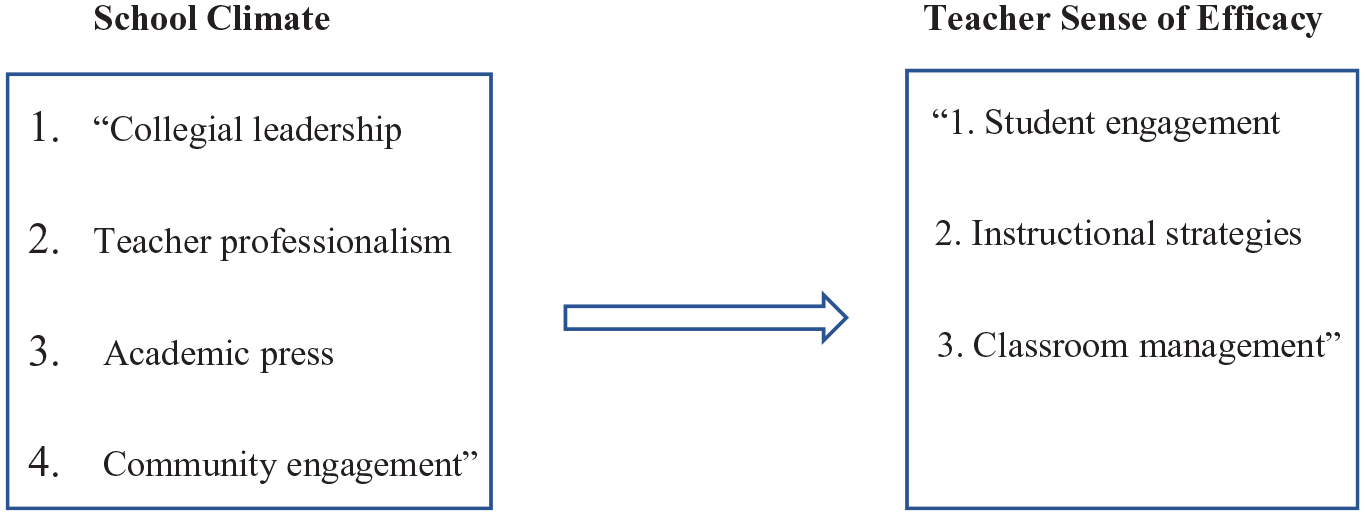
A conceptual framework for the study.
Participants were selected through random sampling. Teachers (N = 108) at elementary, middle, and high schools from both private and public schools in Abu Dhabi participated in the study. “Teachers were surveyed using the School Climate Index” (SCI) (Tschannen-Moran et al., 2006) to collect information about their perceptions of “their school climate as well as its four dimensions: collegial leadership, teacher professionalism, academic press, and community engagement. The SCI consists of 28 questions rated on a five-point Likert scale” (see Table 1 e.g., SCI statements). “For each statement, the possible answers were as follows: Very Frequently = 5, Often = 4, Sometimes = 3, Rarely = 2, and Never = 1. The higher the composite score of the responses meant the higher the teachers’ perception of his/her school climate.”
Examples of SCI Statements.

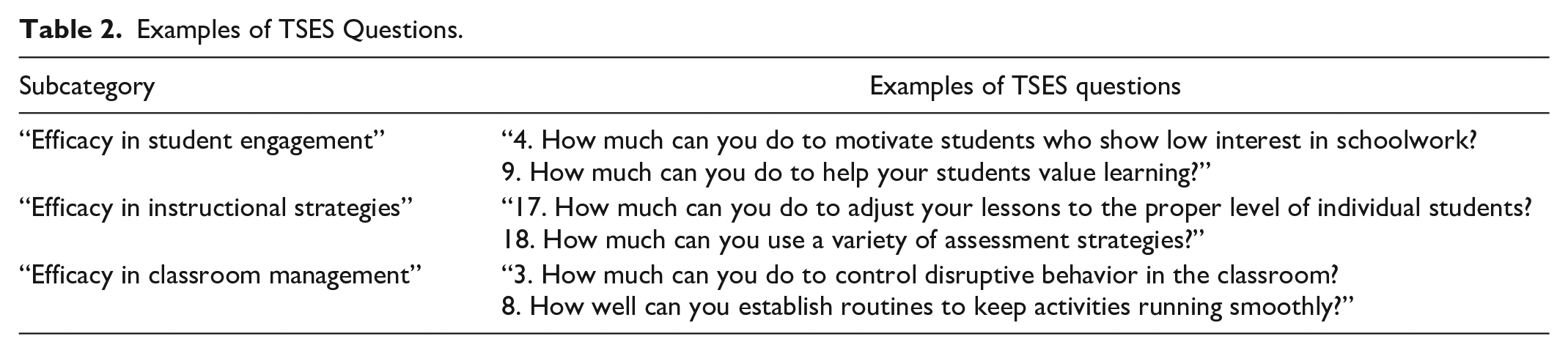
“The second instrument used in this study was Teacher Sense of Efficacy Scale (TSES)” (Tschannen-Moran & Hoy, 2001) was used to gather information about teachers’ perceptions of their self-efficacy. Tschannen-Moran and Hoy (2001) examine the previous measures that have been used to capture the teacher’s self-efficacy, remarking the troubles that have arisen with each. Hence, they propose a new measure for the construct along with the validity and reliability data from three separate studies. “TSES consists of twenty-four questions ranked on a nine-point Likert Scale. This scale consists of three subcategories: efficacy in student engagement, instructional strategies, and classroom management” (see Table 2 e.g., TSES questions). However, only the overall score of self-efficacies was considered in this study. “For each statement, the possible answers were as follows: A Great Deal = 9, Quite a Bit = 7, Some Degree = 5, Very Little = 3, and None at All = 1. The higher the composite score of the responses meant the higher the teachers’ perception of his/her sense of efficacy.” Furthermore, Cronbach’s Alpha was measured for the SCI and the TSES and was found to be 94.1% and 97.7%, respectively.
Examples of TSES Questions.
Procedures
The researcher obtained a letter authorizing the use of the SCI questionnaire as well as the TSES from the authors. The researcher also applied for the approval from ADEK to allow access to the schools for collecting data. The researcher then visited the schools and informed the principals about the nature and the purpose of the study. Similarly, teachers were informed about the study to understand the purpose as well as the procedures to be followed (Taylor et al., 2006). They were given written consent forms to sign if they agreed to participate in the study. Questionnaires were completed by the participants and collected by the researcher upon completion.
Data Analysis
The main purpose of this study was to investigate the impact of school climate as perceived by culturally foreign teachers on their self-efficacy. The researcher divides it into three parts. First, to scrutinize the teachers’ evaluation for their school climate and level of self-efficacy. Second, to explore the existence of correlations between teachers perceived “school climate, its four subcategories and their self-efficacy. Third, to examine the impact of teacher-perceived school climate and its four subcategories: collegial leadership, teacher professionalism, academic press, and community engagement” on their self-efficacy. Thus, the data were analyzed through descriptive statistics, Correlational analysis, and Regression analysis, respectively.
Quantitative data were analyzed using the Statistical Package for the Social Sciences (SPSS) program in order to calculate descriptive statistics and Pearson correlation coefficients were used to examine the relationship between school climate and teacher self-efficacy as well as between teachers’ self-efficacy and the four perceived “school climate factors, including collegial leadership, teacher professionalism, academic press, and community engagement.” Regression analyses were conducted to examine the extent to which school climate and its dimensions predicted teachers’ self-efficacy.
Results
Of the 108 participants, 71 (65.7%) were from public schools and 37 (34.3%) were from private schools. Majority of respondents (25.9%) were between 26 and 30 years of age, with the next most common age group being 31 to 35 years (24.1%). For both public and private schools, most respondents (38%) had between 6 and 10 years of teaching experience. The next most common level of teaching experience was 11 to 15 years (20.4%). All participants were non-Arabs, but their nationalities are not presented to maintain confidentiality.
Teachers’ Evaluation for Their School Climate and Level of Self-Efficacy
The overall SCI had a mean of 98.8 (SD = 16.91) and was measured by summing the scores on collegial leadership (M = 24.7, SD = 6.59), teacher professionalism (M = 29.5, SD = 6.42), community engagement (M = 22.6, SD = 5.85), and academic press (M = 22.0, SD = 3.81). The overall teacher self-efficacy score had a mean of 155.2 (SD = 32.76) which was calculated by summing the scores on its dimensions: self-efficacy in student engagement (M = 48.8, SD = 11.69), self-efficacy in instructional strategies (M = 55.1, SD = 10.83), and self-efficacy in classroom management (M = 51.4, SD = 11.59).
The Relationships between Teachers’ Perceived School Climate and their Self-Efficacy
Pearson’s correlation coefficients were used to examine the interrelationship between the SCI and TSES and the results are presented in Table 3. There is a significant correlation between overall school climate and overall self-efficacy (r = .687, p < .01). Similarly, collegial leadership as a dimension of SCI correlates significantly with the overall self-efficacy (r = .709, p < .01). The present findings also indicate that teacher professionalism correlates significantly with overall self-efficacy (r = .772, p < .01).
Pearson Correlations.

Note. N = 108.
p < .01.
Although, community engagement significantly correlates with overall self-efficacy (r = .253, p < .01), the magnitude of the correlation is weak. Furthermore, the results of the present study show that academic press does not correlate with overall self-efficacy (r = .131, p = .176).
The Impact of Teacher-Perceived School Climate and its Four Dimensions on their Self-Efficacy
Regression analysis was carried out for the overall SCI as the predictor and teacher’s self-efficacy as the dependent variable. As indicated in Table 4, it can be noted that the obtained R of.687 (p < .001) represents a moderate strength of the relationship between the variables. In addition, the R2 value of .472 means that 47.2% of the variance in this model can be explained by changes in SCI.
Regression Model Summary for Overall SCI and Overall Efficacy.
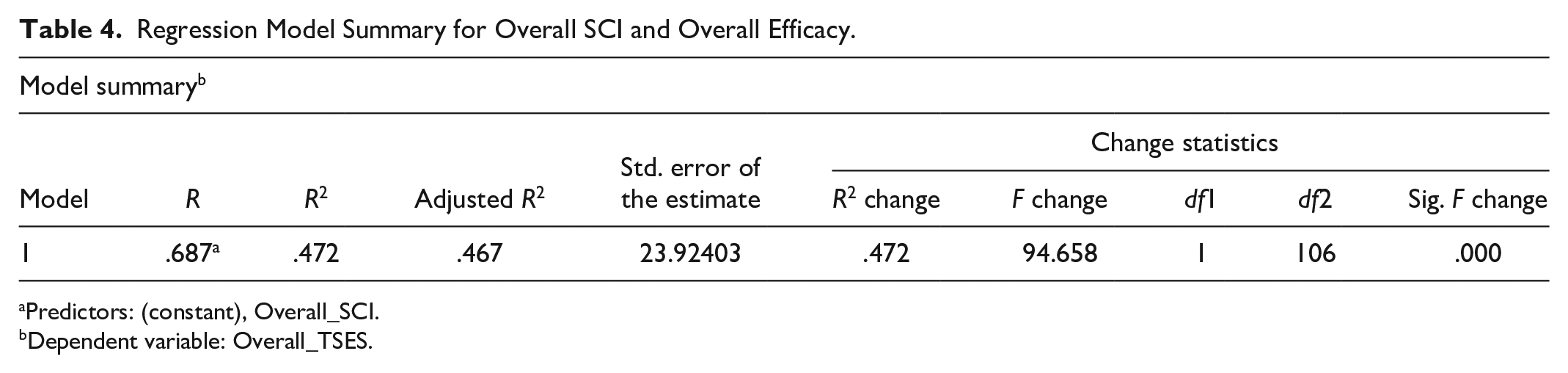
Predictors: (constant), Overall_SCI.
Dependent variable: Overall_TSES.
Table 5 presents the analysis of variance (ANOVA) for the regression model. As indicated by these data, the overall regression is highly significant with p < .001. In other words, it can be concluded that outcome of teachers’ self-efficacy, which is the dependent variable, can be predicted by the overall SCI. Therefore, the regression model significantly predicts teacher self-efficacy (F [1, 106] = 94.658, p < .001).
ANOVA for Overall SCI and Overall Efficacy.

Dependent variable: Overall_TSES.
Predictors: (constant), Overall_SCI.
After generating the coefficients for the regression model, the following regression equation can be generated:
Teacher Self-Efficacy = 23.684 + (1.331 × School Climate Index)
Strictly speaking, with a unit increase in the school climate, teacher’s belief in their self-efficacy increases by a factor of 1.331. Following the results of the above, analyzing the predictive impact of the individual dimensions of SCI was necessary to understand which areas affect the teachers’ ratings of self-efficacy.
As indicated in Table 6, the obtained R of.817 (p < .001) represents a strong relationship between the variables. Besides, the R2 value of .667 indicates that 66.7% of the variance in this model can be explained by changes in the dimensions of SCI (collegial leadership, teacher professionalism, community engagement, and academic press) which are the independent variables.
Regression Model Summary for SCI Dimensions With Overall Self-Efficacy.

Predictors: (constant), academic press, teacher professionalism, community engagement, collegial leadership.
Dependent variable: Overall_TSES.
Results also present the ANOVA for the regression model. Findings indicate that the overall regression is highly significant with p < .001. In short, it can be concluded that the outcome variable of teacher self-efficacy can be predicted by the dimensions of the SCI. Therefore, the regression model significantly predicts teacher self-efficacy (F [1, 103] = 51.522, p < .001).
From Table 7 the below equation can be generated:

Coefficients for Independent Variable (SCI).

Dependent variable: Overall_TSES.
In accordance with the model generated above, it can be said that with a unit increase in collegial leadership and teacher professionalism, the teacher’s belief in self-efficacy will increase by a factor of 1.891 and 2.799, respectively. It should be noted that despite being added to the predictive model, the impacts of community engagement (p = .258) and academic press (p = .308) are not statistically significant.
Discussions
Overall, there is a strong positive correlation between school climate and teachers’ self-efficacy as well as between the two dimensions of school climate—collegial leadership and teacher professionalism with teachers’ self-efficacy. However, there is a weak positive correlation between teacher self-efficacy and community engagement as a dimension of the school climate. To illustrate, most of participants agree that there is a relationship between school climate and teachers’ self-efficacy. They consider both collegial leadership and teacher professionalism as the main influencing factors on their self-efficacy.
Generally, the participants agree that the school climate here in Abu Dhabi schools is mostly supportive. Such support encourages them to perform better in their profession. In the present study, there is a significant correlation between overall school climate and overall self-efficacy (r = .687, p < .01). This finding is consistent with other studies such as Meristo and Eisenschmidt (2014), Hosford and O’Sullivan (2016), and Wilson et al. (2020) who found that school climate is positively and significantly correlated with teachers’ self-efficacy. Nevertheless, the finding of this study was contrary to Lacks (2016) as well as Jaafari et al. (2012) who reported that there is no relationship between school climate and teachers’ self-efficacy. In summary, the present study finds a significant positive correlation between teachers’ self-efficacy and their perceived school climate as well as with the dimensions that make up the school climate except for academic press.
Most of respondents concur that although leadership is hierarchal in Abu Dhabi educational system, principals’ ways of leading school may alleviate such hierarchy. They approve that collegial leadership influences their self-efficacy and their ability to design lessons and manage their classroom. Furthermore, Lu et al. (2015) conducted a study in Hong Kong schools and found that the impact of fostering collaborative relationships on teachers’ self-efficacy was mediated by both participative leadership and learning culture. In addition, Hipp (1996) found that principals who engaged in leadership behaviors such as collaboration and risk-taking had teachers with higher levels of efficacy.
These principals’ collegial behaviors influence teachers positively and make them possess a sense of ownership and commitment toward their work. Hence, this feeling of ownership encourages their sense of efficacy and urges teachers to believe that they are able to teach their students effectively, manage their classrooms properly, and increase their students’ engagement in the learning process. In contrast, the findings of the present study differ from those reported by Lacks (2016) who found that there was no relationship between collegial leadership and teachers’ self-efficacy. Such a difference can be attributed to the demographics of the participants who were teachers at their home country and work at two middle schools in United States. The finding of this study that there is a relationship between collegial leadership and teachers’ self-efficacy is like what had been reported by Hunter-Boykin and Evans (1995), Devos et al. (2012) and Angelle and Teague (2014). Furthermore, it agrees with Goddard (2001) who found that principals who share the process of decision-making with their teachers generated higher teachers’ collective efficacy.
The present findings indicate that teacher professionalism significantly correlates with overall self-efficacy. This finding is like other studies such as Chong and Kong (2012) and Devos et al. (2012) who reported that collaboration among teachers helped to increase their self-efficacy. Moreover, Angelle and Teague (2014) found a strong relationship between teacher professionalism and their collective efficacy. When teachers collaborate to achieve shared vision and goals, they will be more competent and psychologically safe during practicing their daily duties. On the other hand, this finding is in contrast with Lacks (2016) who found no relationship between teacher professionalism and their self-efficacy. Lacks’ (2016) finding could be due to the small sample size (N = 55). Regarding the teacher professionalism and collaboration, there is a variety of the level of collaboration among teachers in the schools. This finding is similar to the study of Ronfeldt et al. (2015), who found that there are multiple levels of collaboration and teachers improve at greater rates when they work in schools with better collaboration quality. To illustrate, in some schools, teachers are supposed to work collaboratively in planning for the lessons, units, and occasions. However, at some other schools, collaboration is based on the need only. All teachers who suffer from the lack of collaboration and its negative effect on their teaching performance were below 30 years old, in early career.
Furthermore, the study provides some explanations for the previous relationships. For example, when teachers work in a positive and supportive climate, that will help them to feel psychologically safe and as a result perform efficiently in their teaching profession (Wagner et al., 2006). In this context, principals and teachers share leading and learning the best teaching practices together. They create what Peter Senge calls a learning organization (Senge, 1994). Some of the collegial leadership behaviors such as shared decision-making improves the teachers’ sense of autonomy that enables them to decide most of the decisions regarding their classroom independently. Social interaction among teachers as well as between principal and teachers, creates a sense of trust. Generally, psychological safety, professional trust, and sense of autonomy seem to be mediating factors for the relationship between school climate and teachers’ self-efficacy. However, future research may investigate such mediating roles.
While community engagement significantly correlates with overall self-efficacy (r = .253, p < .01), the magnitude of the correlation was weak. This finding is same as Lacks (2016) who reported that there is a positive correlation between community engagement as a dimension of school climate and teachers’ self-efficacy. It is also approaching Tschannen-Moran et al. (1998) who argued for the impact of community on local schools, particularly on the teaching practices of teachers as well as student achievement. Schools cannot work in a vacuum, but rather it is part of the community. There is a mutual influence and benefits between the school and its community. Hence, schools which connect and determine clear communication channels with their communities, their teachers showed higher sense of efficacy at their workplace. To illustrate, when teachers communicate with community members and discuss with them students’ issues, they will be more aware about how to better help them to be well prepared for the labor market.
The results of the present study show that academic press does not have a correlation with overall self-efficacy (r = .131, p = .176). This finding is like Lacks (2016) who found no relationship between academic press and teachers’ self-efficacy. Basically, academic press means the extent to which the school is driven by a pursuit for excellence in which principals, administrators, and teachers work seriously and are focused on students. Therefore, mere focusing on excellence as a slogan might not increase the teachers’ sense of efficacy if not influencing their inner values and attitudes Values and attitudes are the engines for our beliefs and behaviors. However, this finding is contrary to results of other studies such as Printy and Marks (2006) and Lee and Smith (1996) who found that teachers with high self-efficacy are constantly dedicated to enhancing their students’ learning and showing responsibility toward their academic success. It is also in contrast with Gibney et al. (2017) who conducted a study with 222 middle school teachers in Singapore and developed a model explaining how connections between teachers and students, coupled with a focus on academic press, are interrelated with teacher efficacy to influence student self-efficacy and academic achievement. Similarly, Chong et al. (2010) argued that student achievement could be predicted by teachers’ collective efficacy and academic climate.
Increasing self-efficacy of individuals to adapt to culturally foreign settings has been suggested as effective way to enhance the successfulness of international recruitment in multiple disciplines (Rehg et al., 2012). This also should be recommended in educational settings and particularly with culturally foreign teachers (McKinnon et al., 2014). This study provides the means of doing so through determining the major school climate factors that are positively related to teachers’ self-efficacy.
As mentioned previously in this paper, school climate involves the values, norms, and organizational structures as well as the interpersonal relationships between teachers, students, administrators, staff, parents, community members, and authorities. Hence, school climate reflects the overall atmosphere in which these factors exist and how the practices of people involved influence the overall atmosphere (Wang & Degol, 2016). Since self-efficacy is the outcome of the interaction of the person’ beliefs, actual abilities, and his/her own environment, one can claim that it is related to school climate (Lacks, 2016). The present study approves such a relationship. In other words, the three dimensions of school climate: collegial leadership, teacher professionalism and community engagement create and explain this relationship between school climate and teachers’ sense of efficacy.
Additionally, from the present study findings, the overall regression is highly significant with p < .001. In other words, it can be concluded that outcome of teachers’ self-efficacy, which is the dependent variable, can be predicted by the overall SCI. Therefore, the regression model significantly predicts teacher self-efficacy (F (1, 106) = 94.658, p < .001). As indicated by data analysis in this study, it can be concluded that with a unit increase in collegial leadership and teacher professionalism, the teacher’s belief in self-efficacy will increase by a factor of 1.891 and 2.799, respectively. After understanding the cultural adjustment of culturally foreign teachers as an essential argument and interest of this study, we need to put these dimensions in practice to enhance the level of teachers’ self-efficacy at their workplace.
First, collegial leadership as a dimension of SCI was significantly correlated with overall self-efficacy (r = .709, p < .01), school leaders should practice this leadership style with their faculty. To illustrate, a school principal could share decision-making process with teachers and promote a shared vision regarding student performance which, in turn, increases the teachers’ sense of commitment as well as ownership of the shared vision and goals (Hunter-Boykin & Evans, 1995). Furthermore, the principal should maintain definite standards of performance to faculty to make them know well what is expected from them. S/he should explore all sides of topics and admits that other opinions exist. In addition, s/he should show willingness to make changes and put suggestions made by faculty into operation. Moreover, the leadership team in the school could offer an induction program which focuses on training newly recruited teachers in cultural responsiveness and differentiated instruction (McKinnon et al., 2014). It could be effective to design workshops and training to the principals to train them in practicing collegial leadership with their teachers. Such workshops should be funded and sponsored by the Ministry of Education.
Second, as the present findings also indicated that teacher professionalism was significantly correlated with overall self-efficacy (r = .772, p < .01), it is essential to ensure teachers professionalism in our schools. To do so, school leaders should provide opportunities for teachers to collaborate together in all processes as that collaboration increases the teachers’ sense of safety and trust and, as a result, their self-efficacy (Angelle & Teague, 2014). To increase the level of interaction among teachers, a principal might design a mentoring program that involves both beginning and experienced teachers (Cooper & Alvarado, 2006; Luft, 2007) in which each experienced teacher could work as a mentor to assist the beginning teacher. Such programs enable teachers to support each other and provide strong social support for their colleagues. Collaboration among teachers would ensure for them a psychological safety as they work with their colleagues in preparing for their lessons and units. Additionally, it could deepen their sense of commitment to helping students and accomplishing their job with enthusiasm. Teachers can also form official groups to discuss, exchange, and develop their subject lessons together holistically and effectively. They could also assign unofficial groups to interact socially and meet regularly to exchange any updates in the education field.
Finally, within community engagement, principals and teachers should work together to find ways to communicate efficiently with stakeholders such as parents and other community members. For instance, community members could be involved in school activities and projects (Lacks, 2016). Such plans should be strategically included in the school improvement plan. The school should establish a clear plan to inform the community about its goals and achievements. In this plan, the school should have certain ways and methods to marshal community support when needed. Community members should be sent regular requests for participation by the school to stay informed about the school issues and its updated rules. People at school should be responsive to the needs and concerns expressed by community members. Parents might be involved in the teaching process through nominating them to work collaboratively with teachers inside the classrooms to raise teachers’ cultural adaptation through interacting with local members. To illustrate, one parent could be assigned in each classroom to work cooperatively with the teacher. The parents and other community members should be informed about the school updates, major changes, and coming meetings through multiple channels, such as Facebook, Twitter, and Instagram. They can attend these meetings virtually if they are busy or are employees through different online Applications such as, Zoom, Teams, WebEx, . . . etc. All these interactions and involvements would increase the level of cultural adaptation for foreign teachers.
Conclusion
The basis of this research was to determine if a relationship exists between school climate and teacher self-efficacy, as well as between the four dimensions of school climate and teacher self-efficacy. The study provided additional information about the relationship between school climate and teacher self-efficacy by identifying a strong positive correlation between teacher self-efficacy and collegial leadership as well as between teacher self-efficacy and teacher professionalism. Furthermore, it found a weak positive correlation between community engagement and teacher self-efficacy. Thus, the findings of this research largely supported previous research in this area. Generally, the relationships found were positive correlations demonstrating that when one variable increases, the other increases as well. This study, therefore, concludes that a relationship exists between school climate and teachers’ self-efficacy except for the area of teacher self-efficacy and academic press.
There are some limitations that should be acknowledged and addressed regarding this study. First, the research findings reflect the teachers’ perceptions about the influence of school climate on self-efficacy of teachers working in a culturally foreign environment in Abu Dhabi primary schools. Therefore, the external validity might be affected because the researcher may not be able to generalize the results. This might be dealt in future study by involving teachers who work in other Emirates.
Second, questionnaires in this study are cross-sectional, so any conclusions on the directionality of the findings will be condensed by the research design. This might be dealt in future study when such an influence is examined with longitudinal data or with conducting qualitative research inquiries that includes interviews with teachers to provide the essence of their lived experience.
Future research might also explore the mediating roles of psychological safety, professional trust, and sense of autonomy in the relationship between school climate and teachers’ self-efficacy.
Footnotes
Declaration of Conflicting Interests
The author declared no potential conflicts of interest with respect to the research, authorship, and/or publication of this article.
Funding
The author disclosed receipt of the following financial support for the research, authorship, and/or publication of this article: Funding for this research was provided through the United Arab Emirates University Program for Advanced Research (UPAR) grant round 2018 – 2019.
