




Abstract
This study investigated students’ and teachers’ perceptions of the characteristics of effective English language teachers in the Thai cultural context. A survey comprising 68 Likert-scale items was administered to students (n = 124) and teachers (n = 11) in the intensive English program (IEP) of a Thai university. The survey measured the participants’ perception of the characteristics of effective teachers in seven areas: general characteristics, affective variables, knowledge about students, pedagogical knowledge, content knowledge, knowledge about classroom management, and professional development. A comparison of the responses showed a statistically significant difference between the median responses of teachers and students in three areas: affective variables, knowledge of students, and professional development. In all three areas, students ascribed a higher level of importance. These findings have implications for teachers, who may underestimate the value that their students place on the personal and affective aspects of education and on professional development.
Keywords
Introduction
The culture of a country has an impact on students’ and teachers’ perceptions of teaching and learning (Deveney, 2005). For an English as a foreign language (EFL) teacher to be effective and perceived as an effective teacher, an understanding of the culture and the expectation of the students within that culture is essential (Baker, 2008). A body of literature exists investigating Thai student and teacher perceptions of an effective English language teacher. Much of this work (e.g., Deveney, 2005; Kainzbauer & Hunt, 2016; Littlewood, 2000) has been conducted in Thai high schools or universities (Adamson, 2004; Chen, 2012; Meksophawannagul, 2015; Wichadee, 2010), while there has been little investigation of intensive English programs (IEP) of a Thai university. Therefore, an investigation into the expectations of students and teachers in an IEP at a Thai international university of what constitutes an effective English language teacher would not only contribute to the literature but also inform discussion on how to provide an effective teaching and learning experience within the college. This article reports on such an investigation by answering the following research questions: (1) What are the characteristics of good English as a foreign language (EFL) teachers according to students of an intensive EFL program in Thailand? (2) What are the characteristics of good English as a foreign language (EFL) teachers according to teachers of an intensive EFL program in Thailand? (3) What are the similarities and differences between the beliefs of teachers and students in this intensive EFL program regarding the characteristics of good EFL teachers? A total of 124 students and 11 teachers participated in the study, the results of which are reported below. This study contributes to the ongoing academic conversation surrounding the perceptions of what constitutes an effective teacher in specific cultural contexts.
Literature Review
A substantial body of research has focused on the perceptions of students and teachers regarding the characteristics of an effective teacher, and each has provided a variety of desirable traits depending on the students or teachers researched. In order to successfully facilitate the discussion of the results from the survey used in this study, the literature has been organized into categories that follow the subscales used in the questionnaire. These subscales include general characteristics, teacher’s affective skills, knowledge about the students, pedagogical knowledge about teaching and learning, content knowledge about teaching and learning, knowledge about classroom management, and knowledge about oneself–professional development.
Knowledge About Oneself–General Characteristics
One area of characteristics apparent in the literature is teachers’ general characteristics, of which communication has been highlighted as important. Omani senior school students and teachers stated the importance for the teachers to speak clearly and be heard (Al-Mahrooqi et al., 2015). Communication skills were also desired by both male and female Slovakian EFL university students (Metruk, 2021). Slovakian pre-service teachers and secondary teachers (Metruk, 2020) and Iranian pre-Service and In-Service teachers (Tajeddin & Alemi, 2019) also valued communication skills as well as Moroccan students (Benzehaf, 2018). Thai university students studying science-related majors stated that native pronunciation is preferred (Chen, 2012); and additionally, Thai university students studying general English from a variety of majors (Wichadee, 2010) as well as teachers of Thai engineering students (Meksophawannagul, 2015) thought effective teachers should have good communication skills. Teachers also identified a teacher’s ability to listen as an important aspect of communication (Altameemy, 2019). In addition to communication, students and teachers thought that teachers should be prepared for class (Al-Mahrooqi et al., 2015; Brosh, 1996; Çakmak & Gündüz, 2018; Meksophawannagul, 2015; Wichadee, 2010) with only the female students thinking this of importance in one study (Metruk, 2021), and some students also identifying unpreparedness as an area of particular disliking (Chen, 2012).
Knowledge About Oneself–Affective Variables
One category that received the most attention in the reviewed literature was the teacher’s affective skills. Being patient with students and treating them fairly was identified by students and teachers (Al-Mahrooqi et al., 2015; Alzobiani, 2020; Benzehaf, 2018; Meksophawannagul, 2015; Metruk, 2021; Tajeddin & Alemi, 2019) as important. Male students (Metruk, 2021) and Thai students (Chen, 2012) also expressed that they did not want their teachers to get angry with them. The idea of teachers not getting angry or being strict with students, specifically regarding students’ work and errors, as well as being friendly with good humor, was particularly important to one group of Thai university students as they thought it would create a relaxed atmosphere in the classroom (Chen, 2012). The importance of being kind and friendly was also highlighted by pre-service and in-service teachers as an important characteristic (Çakmak & Gündüz (2018); Atmosphere as well as “fun, fair, patient, cheerful, generous, flexible, friendly, open-minded, and energetic” were also desired characteristics by other Thai students (Meksophawannagul, 2015, p. 106) as well as being helpful and understanding (Kijkosol & Fisher, 2006). A further affective skill thought desirable by teachers and students was the ability to be confident (Metruk, 2021), particularly aided by proficiency in English (Brosh, 1996). Interestingly, only the more advanced learners in one particular group of Thai university students found affective skills to be important, with the lower level learners thinking the opposite (Wichadee, 2010). Although affective skills received considerable focus from teachers and students in many studies, Israeli high school teachers and students in one study stated that they believed that there was no causal relationship between a teacher’s positive attitude and their teaching success (Brosh, 1996).
Knowledge About the Students
Having knowledge about the students was identified by some students as an important characteristic but was not mentioned as frequently as some others. Omani students thought teachers should build a good rapport with students (Al-Mahrooqi et al., 2015), with female Slovakian students adding that this should be done while maintaining a professional distance (Metruk, 2021). Linking with the affective skills mentioned, Thai students wanted teachers to have knowledge of students’ thoughts and feelings as well as their language ability (Chen, 2012). Understanding the thoughts and feelings of students was identified as a particular skill of Thai teachers, one which was desired of foreign teachers (Adamson, 2004). Conversely, male Slovakian students stated that they did not see the importance of teachers understanding specific learning difficulties that students may have (Metruk, 2021), a view not shared by some Thai students who wanted teachers to be aware of each student’s differences (Benzehaf, 2018; Meksophawannagul, 2015).
Pedagogical Knowledge About Teaching and Learning
A considerable number of teachers and students have addressed teachers’ pedagogical knowledge. They have stated that the materials a teacher uses should be meaningful and engaging for learners (Brosh, 1996; Chen, 2012), with female students focusing on the motivational aspect more than males (Metruk, 2021). The comprehensibility of materials was also desired (Al-Mahrooqi et al., 2015; Brosh, 1996). Thai students, in particular, stated that they disliked teachers who made lessons complicated to the extent of confusing and losing the students, and they also did not like teachers who failed to explain subject matter and assignments clearly (Chen, 2012), thereby reducing the need for clarification (Adamson, 2004). A further aspect of pedagogy that received considerable focus in the literature was the teaching methods used. Both students and teachers acknowledged the importance of teaching methods (Brosh, 1996). Teachers (Al-Mahrooqi et al., 2015) and students (Chen, 2012) emphasized the importance of varied teaching methods, with the latter favoring entertaining activities, such as games, songs, stories, and competitive activities, that created a fun and relaxing atmosphere, while the negotiation of meaning and work in small groups was also identified as important by some teachers (Bell, 2005). Furthermore, some students wanted teachers to teach students individually (Chen, 2012), and some desired teachers whose content was more student-centered (Adamson, 2004; Metruk, 2021). Thai university students stated that they are not satisfied with teachers who have more of a traditional style of teaching, one that relies on students memorizing content and mostly followed textbooks (Chen, 2012). Half of these students said that they would not want to study with a teacher who did not assign importance to teaching methods and style. Creativity and innovation were also highlighted by female Moroccan students (Benzehaf, 2018). Due to the considerable interest in varied teaching methods, some students thought teachers should keep up-to-date with current ELT trends (Al-Mahrooqi et al., 2015), while others did not see this as an important characteristic of an English language teacher (Metruk, 2021).
Content Knowledge About Teaching and Learning, Knowledge About Classroom Management, and Knowledge About Oneself–Professional Development
Further areas that were identified in the literature included knowledge of the subject, classroom management, and professional development. Students and teachers stated that teachers should be proficient in English and knowledgeable in the subject (Al-Mahrooqi et al., 2015; Chen, 2012; Metruk, 2021). A number of students and teachers saw no need for the teacher to have knowledge of Western culture (Al-Mahrooqi et al., 2015; Brosh, 1996). Some Thai students preferred a Thai teacher as the students would be more relaxed and understand easier, while others preferred the authenticity and proficiency improvement that a native speaker brings, preferably one that could speak Thai, with some claiming that they did not want to study with a teacher who could not speak Thai (Chen, 2012). This agrees with Saudi students who stated that if they had an Arab teacher, they would be able to understand them easier when they were having trouble (Alzubi, 2021). However, it contrasts with the views of some teachers, who claimed that it was not important to be able to speak the student’s native language (Meksophawannagul, 2015). The preference of a Thai teacher could also be related to the ability to understand the students’ feelings better and be more emotional with the students than foreign teachers (Adamson, 2004). Regarding classroom management, it was only identified by teachers in one study as being an important characteristic (Al-Mahrooqi et al., 2015). Likewise, continuing professional development also received very little interest from teachers and students, with teachers and students in one study not understanding why it is necessary (Brosh, 1996) and students and teachers of another scoring it the lowest of all desired characteristics (Al-Mahrooqi et al., 2015).
Thai Culture
To gain more of an understanding of the results of a study into Thai students’ perceptions of effective ELTs, a brief discussion of Thai culture and education is required. It has been suggested that when teaching students from a different culture to that of the teacher, the teacher must be aware of the cultural perspectives that they bring to the classroom and how those influence the way they teach (Banks & Lynch, 1986, pp. 16, 17), and teachers would need to educate themselves on the local culture and how it influences their class (Deveney, 2005) so that teachers can adapt their teaching methods in response to this (Kainzbauer & Hunt, 2016). In Thailand, the culture, and therefore the culture of education, is quite different from the west. Due to the immigration of Chinese to Thailand, certain Confucian traditions have been adopted within the education system (Nguyen et al., 2006; Wang & King, 2008), and one element of this is a strict hierarchical structure where the teacher is a highly respected figure of authority within the class, and the students are mainly listeners (Kainzbauer & Hunt, 2016), which has led to a predominantly teacher-centered classroom (Deveney, 2005). One consequence of the distance of power between the students and teachers is that students rarely question or criticize the teacher, which has resulted in students holding their teacher responsible for their learning (Apfelthaler et al., 2006; Littlewood, 2000). This can have an effect on students’ perceptions of teachers who expect students to ask questions and take responsibility for their own learning, which is a perspective that some Western teachers may hold.
There are a number of areas of Thai culture that have been identified in the literature as having an impact on the classroom, including hierarchy (kreng jai), fun (sanuk), kind heart (jai dee), and collectivist social harmony/saving face. Regarding hierarchy (kreng jai), Kainzbauer and Hunt (2016) stated that teachers found that students were used to the teacher-centered classroom, where the students obeyed instructions and did not ask questions or criticize the teacher as this could mean that the information presented by the teacher was unclear, and therefore it would be impolite to suggest the teacher was not doing their job correctly. This could be a barrier to learning within a classroom that adopts a more Western methodology and could lead the teacher to believe that students are not capable of questioning and critical thinking (Buripakdi & Mahakhan, 1980). Fun (sanuk) is very important to Thai learners as it provides a good atmosphere for learning, and as a result, an activity that is not fun may not be done by students (Kainzbauer & Hunt, 2016). Another consequence of conducting lessons in a fun way could mean that the teacher will display a kind heart (jai dee), which has been identified as important when disciplining students and providing constructive criticism (Kainzbauer & Hunt, 2016). This could be a particular issue for the student perceptions of Western teachers who may have more of an authoritarian manner regarding discipline or who are over-critical in their feedback. Thai culture also holds particular importance on saving face, which has a direct impact on social interaction as Thais would not want to lose face or cause another to lose face in an interaction (Komin, 1990). This could explain why students are more comfortable sharing their views in smaller groups of people they know rather than in front of a whole class (Kainzbauer & Hunt, 2016) and prefer actions that maintain social harmony and avoid conflict (Boonsathorn, 2007). It is interesting to note that it has been observed that Thai students who have studied in an international school for their whole academic lives may not display a concern for losing face or display the same level of respect towards teachers as Thai students who have studied mainly in the Thai education system (Deveney, 2005).
Methods
This study investigated three research questions:
What are the characteristics of good English as a foreign language (EFL) teachers according to students of an intensive EFL program in Thailand?
What are the characteristics of good English as a foreign language (EFL) teachers according to teachers of an intensive EFL program in Thailand?
What are the similarities and differences between the beliefs of teachers and students in this intensive EFL program regarding the characteristics of good EFL teachers?
A survey was conducted to explore the three research questions above. The research instrument was a questionnaire published by Al-Mahrooqi et al. (2015), which consists of seven categories of teacher characteristics: “knowledge about oneself–general characteristics, knowledge about oneself–affective variables, knowledge about students, pedagogical knowledge about teaching and learning, content knowledge about teaching and learning, knowledge about classroom management, and knowledge about oneself–professional development” (Al-Mahrooqi et al., 2015). The survey covers a range of areas that are consistent with those mentioned in the literature review above. The researchers accordingly decided to use the same questionnaire as Al-Mahrooqi et al. (2015). All areas of the questionnaire, including professional development, are consistent with current literature. Students and teachers responded to 68 “The language teacher should. . .” statements using a 4-point Likert scale (1 = unimportant, 2 = somewhat important, 3 = important, and 4 = very important). In addition to the 68 characteristics questions, demographic information was also collected. The questionnaire was administered via a Google Form.
All students who were enrolled in the intensive English program at the time of the study and who were at least 18 years old were surveyed. The total enrollment at the time of the survey was 278; however, only approximately 215 were aged 18 years old or older. A total of 124 students responded to the survey, yielding a response rate of approximately 58%. Of the respondents, 80 were female, 43 were male, and 1 declined to indicate their gender. Of the 21 teachers in the intensive English program, 11 completed the survey, yielding a response rate of 52%.
Results
After the questionnaire had been administered, Cronbach’s alpha coefficients were calculated for each subscale. These coefficients are shown in Table 1 below. Alpha values of .7 or above are typically considered acceptable; the alpha values of all subscales ranged from acceptable .79 to .94.
Cronbach’s Alpha of Subscales.
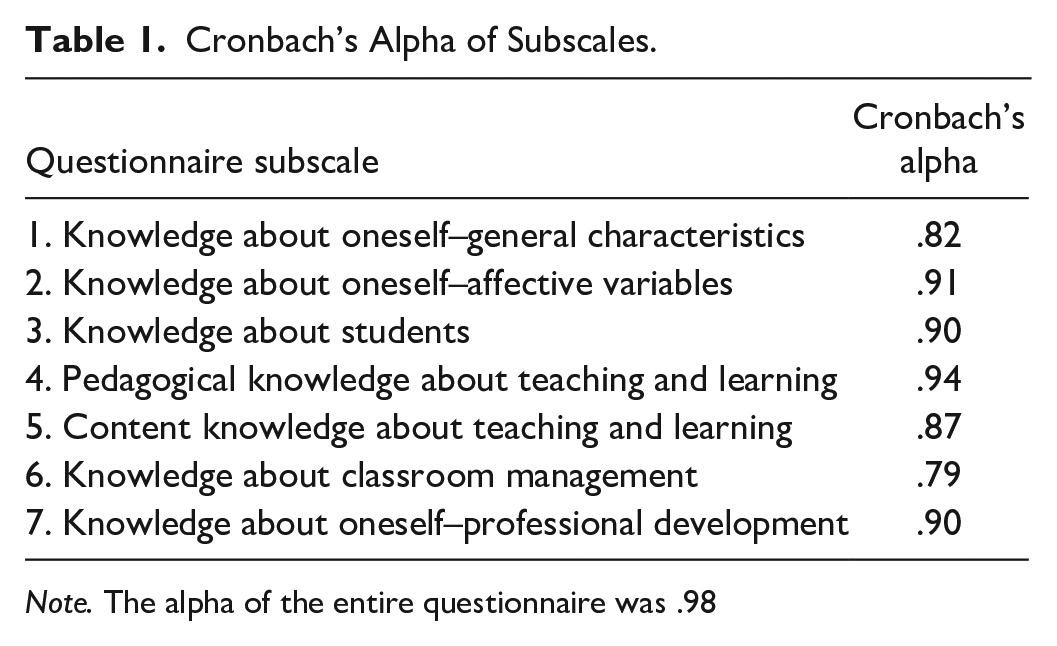
Note. The alpha of the entire questionnaire was .98
Student Survey Results
Descriptive statistics of the students’ responses are shown in Table 2. All mean scores were between 3 (“important”) and 4 (“very important”) on the Likert scales employed by the survey. Students found the subscale of “Knowledge about oneself–affective variables” (M = 3.61) to be most important and the subscale of “Content knowledge about teaching and learning” (M = 3.36) to be least important. Students’ mean score for each item is included in Appendix A.
Student Questionnaire Category Mean and SD.

On average, students found the subscale of “Knowledge about oneself–affective variables” (M = 3.61) to be most important. Within this scale, all items except one were within the range of 3.44 (“Have a good sense of humor”) to 3.82 (“Be tolerant of students’ incomprehension”). The only item not within this range was “Have an acceptable appearance” (M = 2.73), which received the lowest score of any item on any scale. The students’ responses show that they ascribe importance to teachers being kind (M = 3.82), being helpful (M = 3.81), treating students equally (M = 3.81), treating students fairly (M = 3.79), and so on.
Students found “Knowledge of students” (M = 3.57) to be the second most important subscale. Mean scores in this subscale ranged from 3.43 (“Have the skills to develop autonomy in learners”) to 3.77 (“Have positive attitudes toward pupils”). The three items receiving the highest scores relate to the relationship between teachers and students: “Have a positive attitude toward pupils” (M = 3.77), “Have a good rapport with pupils” (M = 3.65), and “Establish a good relationship with students” (M = 3.65).
The subscale that received the third-highest mean score was “Knowledge about classroom management” (M = 3.47). This scale included two items: “Have effective classroom management skills” (M = 3.40) and “Be able to manage the classroom properly” (M = 3.54). Students indicated that they found both scales to be important.
The subscale that had the fourth highest mean scores was “Pedagogical knowledge about learning and teaching” (M = 3.40). Mean item scores in this scale ranged from 3.11 (“Be aware of current trends in English language teaching”) to 3.73 (“Give useful feedback on written work in appropriate ways”). Two of the three lowest-rated items related to technology: “Use audiovisual aids/multimedia in teaching” (M = 3.2) and “Use the latest technology in teaching” (M = 3.17). The lowest-rated item in the scale was “Be aware of current trends in English Language Teaching” (M = 3.11).
The fifth-highest rated subscale was “Knowledge about oneself–general characteristics” (M = 3.40). The scores in this subscale ranged from 3.19 (“Come to class on time”) to 3.54 (“Be prepared for class”). Clear and audible speaking (M = 3.47) and clear and legible writing (M = 3.41) were also considered to be important.
The subscale that students rated sixth most important was “Knowledge about oneself–professional development” (M = 3.37). Items in this subscale ranged from 2.89 (“Participate in teacher professional growth events such as seminars, workshops, conferences, and so on”) to 3.52 (“Have a positive attitude toward change and innovation”). The top 3 items in this scale relate to teachers’ attitudes toward professional development: “Have a positive attitude toward change and innovation” (M = 3.52), “Be ready to learn new methods and teaching strategies” (M = 3.52), and “Care about developing professionally” (M = 3.51). In contrast, the lowest-rated item is specific to participating in professional development activities: “Participate in teacher professional growth events such as seminars, workshops, conferences, and so on” (M = 3.52).
Finally, the subscale that received the lowest mean score from students was “Content knowledge about teaching and learning” (M = 3.37). The mean item scores in this subscale ranged from 2.76 (“Be aware of Western cultures”) to 3.77 (“Be able to communicate well in English”). The two highest-rated items related to command of the English language: “Be able to communicate well in English” (M = 3.77) and “Have a high level of English proficiency” (M = 3.62). The two lowest-rated items related to culture: “Be familiar with the social and cultural background of the learners” (M = 3.01) and “Be aware of Western cultures” (M = 2.76).
Teacher Survey Results
Descriptive statistics of the teachers’ responses are presented in Table 3 below. The mean scores ranged from a minimum of 2.92 to a maximum of 3.52. All mean scores except the score for “Knowledge about oneself–professional development” (M = 2.92) were between 3 (“important”) and 4 (“very important”). “Knowledge about oneself–general characteristics” (M = 3.52) received the highest mean score, and “Knowledge about oneself–professional development” (M = 2.92) received the lowest score. The mean responses for each item of the teacher survey are included in Appendix B.
Teacher Questionnaire Category Mean and SD.

The subscale that teachers awarded the highest mean score was “Knowledge about oneself–general characteristics” (M = 3.52). The scores in this subscale ranged from 2.91 (“Write clearly and legibly”) to 3.91 (“Speak audibly and clearly”). Apart from the item about clear and legible writing, the items in this subscale received relatively high mean scores. The item on speaking clearly and audibly was one of three items that received the highest mean scores overall.
Teachers awarded “Knowledge about classroom management” (M = 3.50) the second highest mean score. This subscale comprised two items: “Have effective classroom management skills” (M = 3.55) and “Be able to manage the classroom properly” (M = 3.45). Both were rated as relatively important.
The subscale that had the third-highest mean was “Knowledge about oneself–affective variables” (M = 3.37). The mean scores of items in this subscale ranged from 2.82 (“Have an acceptable appearance”) to 3.73 (three-way tie: “Be patient with pupils,” “Treat students fairly,” “Be willing to repeat explanations or to modify strategies for weak students”). Two of the three items tied for the highest mean score related to patience, indicating that teachers found this characteristic important.
The fourth highest-rated subscale was “Knowledge about students” (M = 3.31). Mean scores in this subscale had a minimum of 3.09 (“Have the skills to develop autonomy in learners”) and a maximum of 3.64 (“Be able to assess learners’ strengths and weaknesses”). Two of the top 3 items related to the relationship between teacher and student: “Have a good rapport with pupils” (M = 3.45) and “Establish a good relationship with pupils” (M = 3.45).
The subscale that received the fifth-highest ratings was “Pedagogical knowledge about teaching and learning” (M = 3.30). Mean scores in this subscale ranged from 2.36 (“Use the latest technology in teaching”) to 3.91 (“Give useful feedback on written work in appropriate ways”). “Use the latest technology in teaching” had the third lowest mean of all items in all scales; “Give useful feedback on written work in appropriate ways” was tied for the highest rank of all items.
The subscale of “Content knowledge about teaching and learning” received the sixth-highest score (M = 3.21). The mean scores of items in this subscale ranged from 2.09 (“Be able to solve practical problems through conducting action research”) to 3.91 (“Be able to communicate well in English”). Teachers ascribed more importance to being familiar with the learners’ cultural backgrounds (M = 3.45) than with Western cultures (M = 2.76). The two highest-rated items were related to proficiency in English: “Have a high level of English proficiency” (M = 3.73) and “Be able to communicate well in English” (M = 3.91).
The subscale that teachers scored the lowest was “Knowledge about oneself–professional development” (M = 2.92). Scores in this subscale ranged from 2.45 (“Participate in teacher professional growth events such as seminars, workshops, conferences, and so on”) to 3.45 (“Be able to reflect on teaching effectiveness”). Four items scored below 3.0 on this scale: “Cooperate with colleagues to improve current teaching practices” (M = 2.91), “Have a positive attitude toward change and innovation” (M = 2.91), “Have the ability to help other colleagues to develop professionally” (M = 2.55), and “Participate in teacher professional growth events such as seminars, workshops, conferences, and so on” (M = 2.45).
Comparison of Student and Teacher Survey Results
Students’ and teachers’ mean responses to each of the subscales are shown in Table 4. Students’ scores were slightly higher on average. The mean of the students’ responses to the seven subscales is 3.46, whereas the mean of the teachers’ responses to the subscales is 3.30. The range of the students’ mean responses, 0.25 (minimum of 3.36 and maximum of 3.61), was narrower than the range of the teachers’ responses, 0.60 (minimum of 2.92 and maximum of 3.52).
Student and Teacher Questionnaire Group Means.

A comparison of students’ and teachers’ median responses to each subscale are shown in Table 5. The Shapiro-Wilk test of normality indicated that the data were not normally distributed; this was confirmed through visual inspection of the Q-Q plots. Accordingly, nonparametric statistics were employed to compare students’ and teachers’ responses in each of the subscales. The Mann-Whitney U test revealed statistically significant (p < .05) differences between the median responses of teachers and students in three of the subscales: knowledge about oneself–affective variables, knowledge about students, and knowledge about oneself–professional development. In all three cases, the median student response was higher than the median teacher response.
Mann-Whitney U Test for Teacher and Student Responses to Questionnaire Subscales.

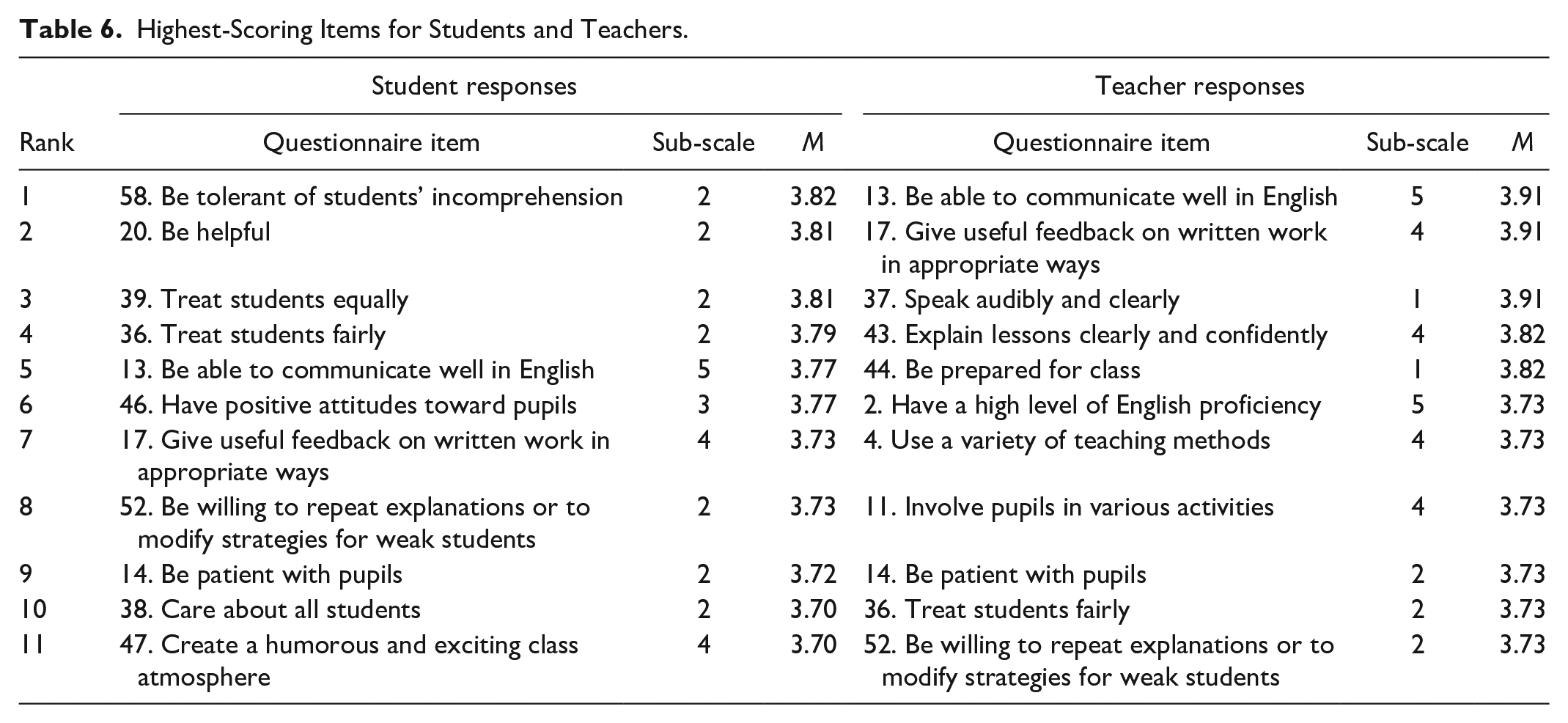
The 11 highest-scoring items for teachers and the 10 highest-scoring items for students are shown in Table 6. The top 11 highest-scoring items are included rather than the top 10, as two items were tied for 10th place in the respective rankings for both teachers and students. Seven of the top 11 items for students are from the subscale “Knowledge about oneself–affective variables.” The four remaining items are related to having strong English communication skills, having positive attitudes towards students, giving appropriate feedback, and creating a humorous and exciting atmosphere in class (subscales 5, 3, 4, and 4, respectively). In contrast, the top 11 items for teachers include several items related to pedagogical knowledge (four items), content knowledge (two items), general characteristics (two items), and affective variables (three items).
Highest-Scoring Items for Students and Teachers.
The 10 lowest-scoring items for students and the 10 lowest-scoring items for teachers are shown in Table 7. Several items are ranked in the bottom 10 for both groups: “Have an acceptable appearance” (lowest for students and third lowest for teachers), “Be aware of Western cultures” (second lowest for students and ninth lowest for teachers), “Participate in teacher professional growth events such as seminars, workshops, conferences, and so on” (third lowest for students and seventh lowest for teachers), “Be aware of current trends in English language teaching” (fifth lowest for students and fifth lowest for students), “Use the latest teaching technology” (sixth lowest for students and eighth lowest for teachers), and “Have the ability to help other colleagues to develop professionally” (ninth lowest for students and sixth lowest for teachers). Three items appeared in the 10 lowest-rated items for students but not in the 10 lowest-rated items for teachers: “Be familiar with the social and cultural background of the learners,” “Come to class on time,” and “Use audiovisual aids/multimedia in teaching.” Three items appeared in the 10 bottom-rated items for teachers but not for students: “Be able to cooperate with colleagues to improve current teaching practices,” “Have a positive attitude toward change and innovation,” and “Create a humorous and exciting class atmosphere.” Two additional items were tied for 10th lowest (M = 2.91) for teachers: “Vary the tone of voice to attract students’ attention” and “Write clearly and legibly.” Neither one of these items appear in the students’ bottom 10 responses.
Lowest-Scoring Items for Students and Teachers.

Discussion
The results from this study agreed with a number of viewpoints from the literature but also disagreed with many. The results from the study will be discussed by questionnaire subscale to aid in linking to the literature review. They will be organized in order of significance. The subscale with the highest mean, knowledge about oneself–general characteristics, will be discussed first, followed by knowledge about oneself–affective variables, pedagogical knowledge about, learning and leaching, knowledge about oneself–professional development and finally, knowledge about teaching and learning. The final area to be discussed will be the link between the students’ and teachers’ perceptions and the literature on Thai culture. The subscales Knowledge about the students and knowledge about classroom management have been omitted from the discussion due to a lack of statical significance regarding the students’ and teachers’ responses in these areas.
Knowledge About Oneself–General Characteristics
For the teachers in this study, the first subscale, knowledge about oneself–general characteristics, had the highest mean, with speaking audibly and clearly, and being prepared for class appearing in the top 11 highest-meaned items. This agrees with the literature in which teachers from multiple studies (Al-Mahrooqi et al., 2015; Brosh, 1996; Meksophawannagul, 2015) identified this as an important characteristic of a good English language teacher. However, although students in this study attributed importance to all items in the questionnaire, the fact that this subscale was fifth and no items from it were included in the top 11 by students is not in agreement with the literature. For instance, students from numerous studies mentioned the importance of communication and being prepared for class (Al-Mahrooqi et al.; 2015, Brosh, 1996; Meksophawannagul, 2015; Metruk, 2021; Wichadee, 2010), with one group of Thai students explicitly stating that they did not like teachers who were unprepared and lazy (Chen, 2012).
Knowledge About Oneself–Affective Variables
Conversely, regarding the second subscale, knowledge about oneself–affective variables, the highest subscale mean for students, with seven items in the top 11, there was general agreement with the literature. This was a major category from the literature, with students in numerous studies stating desired characteristics that related to affective variables (Adamson, 2004; Al-Mahrooqi et al., 2015; Chen, 2012; Kijkosol & Fisher, 2006; Meksophawannagul, 2015; Metruk, 2021; Wichadee, 2010), many of which were not mentioned by the students in this study, possibly due to the absence of qualitative data from interviews and focus groups. Teachers in this study and literature (Al-Mahrooqi et al., 2015; Meksophawannagul, 2015) attributed similar importance to this subscale. The main comment from the literature was fairness and confidence, but overall teachers contributed far fewer mentions of items from this scale than students, particularly Thai students.
Pedagogical Knowledge About Learning and Teaching
A further area of interest where there is agreement and disagreement with the literature is the subscale pedagogical knowledge about learning and teaching. Omani students stated that knowledge of current trends in English language teaching was a requirement for an effective English language teacher. However, that item was included in the bottom 10 for students and teachers in our study, which agrees with female Slovakian students (Metruk, 2021). Moreover, students and teachers in the literature stated the importance of varied classroom activities (Al-Mahrooqi et al., 2015; Brosh, 1996; Chen, 2012; Metruk, 2021). However, it was only teachers in this study who included this item in the top 10. Students, on the other hand, assigned more weight to a humorous atmosphere, which is similar to other Thai students from the literature (Chen, 2012)
Knowledge About Oneself–Professional Development
The importance assigned to the subscale knowledge about oneself–professional development is similar to that of the literature. Teachers and students in this study assigned the lowest and second-lowest subscale means to this category, with 5 of the teachers’ bottom 10 and 3 of the students’ bottom 10 items being from this area. Some comments in the literature reflect this, as there were a few mentions by teachers and students that it was of no importance (Al-Mahrooqi et al., 2015; Brosh, 1996), but it was mostly absent from the majority of the studies, which is interesting given the importance Thai students, in particular, placed on teachers using a variety of teaching styles (Chen, 2012). However, this absence from the literature could be due to students not being aware of professional development, especially in studies that solely relied on interviews and focus groups.
Knowledge About Teaching and Learning
A final area for discussion is knowledge about teaching and learning. Students and teachers in this study included knowledge of Western culture in the bottom 10, and students also included knowledge of students’ culture in the bottom 10 items, a sentiment reflected in the literature (Al-Mahrooqi et al., 2015; Brosh, 1996). It is surprising the lack of importance of knowledge of the students’ culture from students, especially Thai students in this and other studies, when they hold cultural expectations for teachers to act in a certain manner (Chen, 2012; Meksophawannagul, 2015; Wichadee, 2010). Also, teachers of Thai students in one study highlighted that it was of vital importance to understand the students’ culture in order to adapt their teaching appropriately (Kainzbauer & Hunt, 2016).
Thai Culture
The final area of discussion is the link between the results of this study and the literature on Thai culture. A number of the students’ results from this study are a reflection of Thai culture and consistent with the literature. One of the clearest influences of Thai culture in the results is regarding the subscale of knowledge about oneself–affective variables. About seven of the students’ top 10 highest-scoring items were from this category. These included items such as the teacher being helpful, kind, patient, and caring. This is a reflection of the Thai cultural concept of jai dee, having a kind heart (Kainzbauer & Hunt, 2016), which is considered of great importance in Thai culture, especially with other Thai university students (Chen, 2012; Meksophawannagul, 2015). Although the teachers did include patience, fairness, and repeating explanations from this subscale in their top 10, there was an absence of equivalent focus on this subscale by the teachers. This could result in a conflict of cultural beliefs between the students and teachers, which could create unnecessary barriers to teaching and learning.
A further area that featured in the students’ top 10 results was the teacher creating a humorous and exciting class atmosphere. This is directly related to the Thai concept of sanuk (fun), which is very important to Thai students, so much so that activities that are considered boring may not be completed by students (Kainzbauer & Hunt, 2016). This is of particular importance in this study as the teachers did not assign importance to it, but rather included it in their lowest 10 scored items. A lack of a humorous and exciting class atmosphere combined with a lack of focus on being kind and caring could create a considerably challenging teaching environment for non-Thai teachers. One solution to this would be to raise awareness with non-Thai teachers of the cultural beliefs that they bring into the classroom (Banks & Lynch, 1986) and to educate them on how the Thai culture can have an impact on their classroom (Deveney, 2005). This could greatly improve teaching and learning in these classrooms.
In addition to sanuk, kreng jai, the strict hierarchy of the teacher (Kainzbauer & Hunt, 2016) creating a teacher-centered classroom (Deveney, 2005) may have had an indirect effect on the results. The students in this study did not assign particular importance to the teachers using a variety of teaching styles or resources, which does not agree with other studies of Thai university students (Chen, 2012; Meksophawannagul, 2015). One speculation would be that many of the students had come from Thai schools that followed a more teacher-centered approach. They may not have been not aware of alternative teaching methodology and therefore did not see the importance of it. However, further study into this would be required to reach a more concrete conclusion.
Limitations
This study has several limitations. All survey research is subject to potential bias, as respondents may tend to give answers that are culturally acceptable or that they perceive will please the researchers. Further research could use a mixed-methods approach, which could help to identify and address potential bias. In addition to questionnaires, interviews and focus groups could be conducted. The results could also be triangulated by including additional types of data, including student feedback about teachers.
Implications for Teachers
There are a number of implications for teachers from this study. The main category that students identified as more important than teachers is knowledge about oneself–affective variables. This could be primarily a consequence of Thai culture. It is particularly interesting in this study the contradictory emphasis put on creating a humorous and exciting class atmosphere and the fact that seven of the students’ top 10 are from this category. Therefore to be an effective English language teacher in Thailand, more attention should be paid to this. It may help to have a rudimentary understanding of Thai culture and how that manifests itself in the classroom. This could have a positive effect on rapport, motivation, participation, and teacher evaluation from the students. Furthermore, the lack of emphasis from students on the use of technology, multimedia, and varying teaching methods is important as these are areas that many teachers and teacher training courses focus on. It is by no means being suggested that these are not important in classrooms. However, it is interesting to note that students do not hold these in as high regard as teachers.
Conclusion
This paper has presented the results of a study investigating teachers’ and students’ perceptions of the characteristics of effective English language teachers. The study built on existing literature on this topic by surveying teachers and students at a Thai university. The findings of the study differ from those of previous studies in this area and have several implications for teachers. Whereas students and teachers both valued classroom management skills, pedagogical knowledge, and general professionalism, students valued affective variables (e.g., tolerance, helpfulness, and fairness) and teachers’ knowledge of students (e.g., understanding their strengths, weaknesses, needs, and interests) more highly than teachers did. Students also placed a stronger emphasis than teachers on professional development. These findings can inform the practice of teachers in the Thai cultural context as they seek to be—and to be perceived as—experts in their field.
Footnotes
Appendix A
Students’ Mean Responses to Each Questionnaire Item.

| Questionnaire item | Subscale | M |
|---|---|---|
| 1. Be creative in teaching | 2 | 3.60 |
| 2. Have a high level of English proficiency | 5 | 3.62 |
| 3. Be aware of western cultures | 5 | 2.76 |
| 4. Use a variety of teaching methods | 4 | 3.60 |
| 5. Be enthusiastic about teaching | 2 | 3.57 |
| 6. Adjust English input to match learners’ proficiency level | 4 | 3.56 |
| 7. Be familiar with the social and cultural background of the learners | 5 | 3.01 |
| 8. Be aware of current teaching techniques | 4 | 3.37 |
| 9. Know how to set objectives | 5 | 3.45 |
| 10. Know how to evaluate pupils | 5 | 3.54 |
| 11. Involve pupils in various activities | 4 | 3.52 |
| 12. Encourage learners’ contributions | 4 | 3.48 |
| 13. Be able to communicate well in English | 5 | 3.77 |
| 14. Be patient with pupils | 2 | 3.72 |
| 15. Have a good sense of humor | 2 | 3.44 |
| 16. Motivate learners using different instructional strategies | 4 | 3.45 |
| 17. Give useful feedback on written work in appropriate ways | 4 | 3.73 |
| 18. Have effective classroom management skills | 6 | 3.40 |
| 19. Be aware of current trends in English language teaching | 4 | 3.11 |
| 20. Be helpful | 2 | 3.81 |
| 21. Vary class interaction strategies (e.g., use group and pair work, drama, role-play, and debate) | 4 | 3.33 |
| 22. Implement teaching objectives set for the lesson | 5 | 3.36 |
| 23. Use a variety of instructional resources effectively | 4 | 3.24 |
| 24. Be able to plan appropriate lessons | 5 | 3.52 |
| 25. Be able to comment on pupils’ responses appropriately | 4 | 3.61 |
| 26. Use audiovisual aids/multimedia in teaching | 4 | 3.20 |
| 27. Have a good rapport with pupils | 3 | 3.65 |
| 28. Understand learners’ personalities, needs, and learning styles | 3 | 3.47 |
| 29. Be able to assess learners’ strengths and weaknesses | 3 | 3.53 |
| 30. Take into consideration students’ needs and interests | 3 | 3.51 |
| 31. Be able to raise students’ interest levels in English lessons | 3 | 3.57 |
| 32. Select appropriate supplementary materials | 4 | 3.49 |
| 33. Be actively involved in learning new skills to improve teaching | 7 | 3.40 |
| 34. Be able to present language using different techniques | 4 | 3.41 |
| 35. Be kind | 2 | 3.55 |
| 36. Treat students fairly | 2 | 3.79 |
| 37. Speak audibly and clearly | 1 | 3.47 |
| 38. Care about all students | 2 | 3.70 |
| 39. Treat students equally | 2 | 3.81 |
| 40. Vary teaching methods to suit different learning styles | 4 | 3.49 |
| 41. Be able to explain unfamiliar concepts in various ways | 4 | 3.50 |
| 42. Use different techniques for presenting language | 4 | 3.40 |
| 43. Explain lessons clearly and confidently | 4 | 3.67 |
| 44. Be prepared for class | 1 | 3.54 |
| 45. Be able to manage the classroom properly | 6 | 3.54 |
| 46. Have positive attitudes toward pupils | 3 | 3.77 |
| 47. Create a humorous and exciting class atmosphere | 4 | 3.70 |
| 48. Have an acceptable appearance | 2 | 2.73 |
| 49. Vary the tone of voice to attract students’ attention | 4 | 3.40 |
| 50. Write clearly and legibly | 1 | 3.41 |
| 51. Come to class on time | 1 | 3.19 |
| 52. Be willing to repeat explanations or to modify strategies for weak students | 2 | 3.73 |
| 53. Be innovative in addressing students’ difficulties and needs | 2 | 3.60 |
| 54. Use the latest technology in teaching | 4 | 3.17 |
| 55. Always show care about student comprehension and progress | 2 | 3.58 |
| 56. Be able to cooperate with colleagues to improve current teaching practices | 7 | 3.48 |
| 57. Be confident and have self-control | 2 | 3.69 |
| 58. Be tolerant of students’ incomprehension | 2 | 3.82 |
| 59. Establish a good relationship with students | 3 | 3.65 |
| 60. Care about developing professionally | 7 | 3.51 |
| 61. Have a positive attitude toward change and innovation | 7 | 3.52 |
| 62. Be able to reflect on teaching effectiveness | 7 | 3.46 |
| 63. Participate in teacher professional growth events such as seminars, workshops, conferences, and so on | 7 | 2.89 |
| 64. Have the skills to develop autonomy in learners | 3 | 3.43 |
| 65. Be able to contribute to curriculum development | 5 | 3.26 |
| 66. Have the ability to help other colleagues to develop professionally | 7 | 3.20 |
| 67. Be able to solve practical problems through conducting action research | 5 | 3.31 |
| 68. Be ready to learn new methods and teaching strategies | 7 | 3.52 |
Note. All statements use a 4-point Likert scale (1 = unimportant, 2 = somewhat important, 3 = important, and 4 = very important).
Appendix B
Teachers’ Mean Responses to Each Questionnaire Item.

| Questionnaire Item | Subscale | Mean |
|---|---|---|
| 1. Be creative in teaching | 2 | 3.36 |
| 2. Have a high level of English proficiency | 5 | 3.73 |
| 3. Be aware of Western cultures | 5 | 2.27 |
| 4. Use a variety of teaching methods | 4 | 3.73 |
| 5. Be enthusiastic about teaching | 2 | 3.64 |
| 6. Adjust English input to match learners’ proficiency level | 4 | 3.55 |
| 7. Be familiar with the social and cultural background of the learners | 5 | 3.45 |
| 8. Be aware of current teaching techniques | 4 | 3.00 |
| 9. Know how to set objectives | 5 | 3.45 |
| 10. Know how to evaluate pupils | 5 | 3.55 |
| 11. Involve pupils in various activities | 4 | 3.73 |
| 12. Encourage learners’ contributions | 4 | 3.64 |
| 13. Be able to communicate well in English | 5 | 3.91 |
| 14. Be patient with pupils | 2 | 3.73 |
| 15. Have a good sense of humor | 2 | 3.00 |
| 16. Motivate learners using different instructional strategies | 4 | 3.64 |
| 17. Give useful feedback on written work in appropriate ways | 4 | 3.91 |
| 18. Have effective classroom management skills | 6 | 3.55 |
| 19. Be aware of current trends in English language teaching | 4 | 2.64 |
| 20. Be helpful | 2 | 3.55 |
| 21. Vary class interaction strategies (e.g., use group and pair work, drama, role-play, and debate) | 4 | 3.27 |
| 22. Implement teaching objectives set for the lesson | 5 | 3.09 |
| 23. Use a variety of instructional resources effectively | 4 | 3.55 |
| 24. Be able to plan appropriate lessons | 5 | 3.36 |
| 25. Be able to comment on pupils’ responses appropriately | 4 | 3.55 |
| 26. Use audiovisual aids/multimedia in teaching | 4 | 2.91 |
| 27. Have a good rapport with pupils | 3 | 3.45 |
| 28. Understand learners’ personalities, needs, and learning styles | 3 | 3.27 |
| 29. Be able to assess learners’ strengths and weaknesses | 3 | 3.64 |
| 30. Take into consideration students’ needs and interests | 3 | 3.18 |
| 31. Be able to raise students’ interest levels in English lessons | 3 | 3.27 |
| 32. Select appropriate supplementary materials | 4 | 3.27 |
| 33. Be actively involved in learning new skills to improve teaching | 7 | 3.00 |
| 34. Be able to present language using different techniques | 4 | 3.27 |
| 35. Be kind | 2 | 3.00 |
| 36. Treat students fairly | 2 | 3.73 |
| 37. Speak audibly and clearly | 1 | 3.91 |
| 38. Care about all students | 2 | 3.27 |
| 39. Treat students equally | 2 | 3.45 |
| 40. Vary teaching methods to suit different learning styles | 4 | 3.00 |
| 41. Be able to explain unfamiliar concepts in various ways | 4 | 3.55 |
| 42. Use different techniques for presenting language | 4 | 3.18 |
| 43. Explain lessons clearly and confidently | 4 | 3.82 |
| 44. Be prepared for class | 1 | 3.82 |
| 45. Be able to manage the classroom properly | 6 | 3.45 |
| 46. Have positive attitudes toward pupils | 3 | 3.09 |
| 47. Create a humorous and exciting class atmosphere | 4 | 2.73 |
| 48. Have an acceptable appearance | 2 | 2.82 |
| 49. Vary the tone of voice to attract students’ attention | 4 | 2.91 |
| 50. Write clearly and legibly | 1 | 2.91 |
| 51. Come to class on time | 1 | 3.45 |
| 52. Be willing to repeat explanations or to modify strategies for weak students | 2 | 3.73 |
| 53. Be innovative in addressing students’ difficulties and needs | 2 | 3.36 |
| 54. Use the latest technology in teaching | 4 | 2.36 |
| 55. Always show care about student comprehension and progress | 2 | 3.36 |
| 56. Be able to cooperate with colleagues to improve current teaching practices | 7 | 2.91 |
| 57. Be confident and have self-control | 2 | 3.09 |
| 58. Be tolerant of students’ incomprehension | 2 | 3.45 |
| 59. Establish a good relationship with students | 3 | 3.45 |
| 60. Care about developing professionally | 7 | 3.00 |
| 61. Have a positive attitude toward change and innovation | 7 | 2.91 |
| 62. Be able to reflect on teaching effectiveness | 7 | 3.45 |
| 63. Participate in teacher professional growth events such as seminars, workshops, conferences, and so on | 7 | 2.45 |
| 64. Have the skills to develop autonomy in learners | 3 | 3.09 |
| 65. Be able to contribute to curriculum development | 5 | 3.18 |
| 66. Have the ability to help other colleagues to develop professionally | 7 | 2.55 |
| 67. Be able to solve practical problems through conducting action research | 5 | 2.09 |
| 68. Be ready to learn new methods and teaching strategies | 7 | 3.09 |
Note. All statements use a 4-point Likert scale (1 = unimportant, 2 = somewhat important, 3 = important, and 4 = very important).
Ethical Approval
Ethics approval granted: MU-CIRB 2020/359.0311
Declaration of Conflicting Interests
The author(s) declared no potential conflicts of interest with respect to the research, authorship, and/or publication of this article.
Funding
The author(s) received no financial support for the research, authorship, and/or publication of this article.
