




Abstract
English is a vital tool for global communication and development, and also a compulsory course for college English as a foreign language (EFL) students. College students as the backbone of social development whose English proficiency is worth noting. Up to now, much research has empowered language learning by technology, which shows its effectiveness but does not solve the problem of less engagement. Student engagement is a crucial aspect of educational activities and has a significant impact on learning outcomes. Thus, this study combined mobile-assisted language learning (MALL) with collaborative learning (CL) to create a framework of mobile-assisted collaborative language learning (MACLL) special for college English courses. A quantitative quasi-experiment was applied to ascertain if and how MACLL affected students’ behavioural, emotional, and cognitive engagement. Thirty-two participants in the treatment group employed collaborative learning with assigning four in each group and thirty-two in the control group used individual learning. The results indicated that MACLL had a positive effect on student engagement. Moreover, MACLL developed students’ engagement in seven aspects from three dimensions. To be specific, flexible learning model, timely feedback, and technology assistance improved behavioural engagement; learning interest and positive individual enhanced emotional engagement; interaction and collaborative learning environment promoted cognitive engagement. This study is expected to provide a more effective and interactive language learning framework to advance college students’ English proficiency.
Keywords
Introduction
English, an international language, remains a vital force in driving global communication and development (Salomone & Salomone, 2022). For university students who are driving forces in globalization, learning English is essential. Under this circumstance, English proficiency is a crucial component of their educational and professional development. English proficiency provides students with access to a wealth of global academic resources, enriching their learning outcomes and enabling them to participate in international student exchange programmes. Additionally, English proficiency equips students with essential skills for achievements in an interconnected world and diversifies their career opportunities.
English proficiency is critically dependent on student engagement. Effective student engagement is an important factor in the success of learning and teaching (Kahu, 2013). Engagement is defined as students making attempts to participate during the learning process (Farrell & Brunton, 2022; Qashou, 2021), including behavioural engagement, emotional engagement and cognitive engagement (Fredricks et al., 2004. Active engagement can regulate college students’ learning behaviours like attendance and in-class participation; stimulate their emotions like learning interest and motivation, improve their comprehensive ability in listening, speaking, reading and writing and enhance their self-confidence; develop their cognition like critical thinking and creative thinking. It can therefore be posited that active engagement constitutes a significant factor in enhancing college students’ English proficiency.
Since the development of information and communication technology, the Internet has significantly contributed to this long-term project of enhancing students’ learning outcomes (Kim & Park, 2021). Mobile-assisted language learning (MALL), as a typical example, has been proven effective in language learning (Ghorbani & Ebadi, 2020; Islam & Hasan, 2020; Lei et al., 2022; Zain & Bowles, 2021). College students are allowed to bring mobile phones into class, providing the foundational devices for MALL. Furthermore, college students possess certain digital literacy, establishing a skill base conducive to MALL. While MALL boasts advantages, such a problem as less engagement still persists.
Specifically, behavioural engagement reflects students’ actual actions and performances in their learning, including engagement in classroom activities, completing homework, participating in discussions and actively participating in learning groups (Fredricks et al., 2004; Kang & Wu, 2022; Park & Kim, 2022). As for college students, the problems of behavioural engagement are absence, less interaction with others and a lack of participation in activities (S. C. Hoi et al., 2021Maamin et al., 2021; Olivier et al., 2020). As a result, students’ comprehensive proficiency cannot be improved.
Emotional engagement reflects students’ positive emotional experience and emotional investment in learning, including learning interest, self-confidence emotional connection and so on (Dubovi, 2022; Fredricks et al., 2004; Özhan & Kocadere, 2020). As for college students, the problems of emotional engagement are frustration and anxiety, and lack of interest (Z. Li & Li, 2022; Olivier et al., 2020). This may result in a negative emotional experience associated with English classes. Then negative emotions decrease learning motivation and outcomes.
Cognitive engagement reflects students’ thinking activities and knowledge construction in the learning process, and it is the degree of thinking, analysis and understanding of students in learning, including deep thinking, critical thinking and problem solving (Fredricks et al., 2004; S. Y. Huang et al., 2022; Liu et al., 2023). As for college students, the problems of cognitive engagement are superficial learning and a lack of critical thinking (Olivier et al., 2020; Y. Shi et al., 2021). The superficial learning approach limits cognitive engagement, as students may struggle to apply language skills in real-world situations (Y. Shi et al., 2021).
In recent years, student engagement in English learning in mobile learning environments has been explored, but there was no systematic solution to the forementioned problems in college English courses. Scholars identified the role of mobile applications, online learning platforms and e-learning resources in stimulating student engagement and explored how mobile technology could enhance students’ motivation and interest in learning, thereby increasing their active engagement in learning (Dewi, 2022; Rachman et al., 2022). However, few proposed a systematic framework specific to enhancing EFL student engagement in the three dimensions for college English courses. Only when all three dimensions of engagement – behavioural, emotional and cognitive engagement – are all achieved, can college students truly engage in learning activities. The existing studies often lack systematic and detailed strategies or actionable insights for educators and learners.
Based on technological pedagogical and content knowledge (TPACK), this study attempts to address the problem of less engagement by adding a pedagogical approach to MALL. TPACK is a dynamic framework that integrates technology, pedagogy and content knowledge (M. Niess, 2008; Thompson & Mishra, 2007). It describes the knowledge that teachers must rely on to design and implement curriculum and instruction while guiding their students’ thinking and learning with digital technologies in various subjects (M. L. Niess, 2011). Accordingly, we reviewed the literature and found that collaborative learning (CL) my help solve less engagement. For instance, Ansari and Khan discovered that online social media used for collaborative learning had a significant impact on interactivity with peers, teachers and online knowledge sharing behaviour. It is consistent with the improvement of behavioural engagement. Hilliard et al. (2020) revealed that collaborative learning activities reduced student anxiety and fear of negative evaluation. It aligns with the improvement of emotional engagement. Warsah et al. (2021) found that CL had a positive and significant impact on learners’ critical thinking skills and also supported the retention of their critical thinking skills. It in accordance with the improvement of emotional engagement. In a word, numerous studies have demonstrated the efficacy of CL in enhancing student engagement.
Therefore, this study integrates MALL with CL to create a technology-driven framework, namely, mobile-assisted collaborative language learning (MACLL), which is particularly suited to college English courses. To make it more rational, the theoretical framework is established in this study (shown in Figure 1), providing an overview of the theories that the researcher relies on for the study. Such theories like social constructivism, connectivism and engagement theory serve as standards and help shape the MACLL environment for improving students’ English language engagement. Social constructivists contend that the process of sharing individual viewpoints, called collaborative elaboration, results in learners constructing understanding together (Kumi-Yeboah et al., 2017). Connectivism theory was put forward by George Siemens, which added the element of technology and networks, and reflected the new trend of learning in the information age and digital environment. Connectivism views learning as a network phenomenon and is influenced by technology and socialization (Siemens, 2015). Engagement theory is a theoretical framework of education, which focuses on student active engagement in the learning process. which includes three dimensions as emotional engagement, cognitive engagement and behavioural engagement (Fredricks et al., 2004; Nkomo et al., 2021). As an outcome of the combination of these three theories, the theory MACLL framework is created. It is used to improve students’ English language learning performance and engagement.

Theoretical framework.
The objective of this study is to ascertain if and how MACLL affects EFL students’ behavioural, emotional, and cognitive engagement in college English courses. Increasing student engagement can improve English proficiency and foster a more dynamic and participatory learning environment, ultimately contributing to the advancement of language teaching and learning in higher education.
Literature Review
MALL
Mobile-assisted language learning (MALL) refers to language learning that is assisted or enhanced by handheld mobile devices. MALL refers to students’ language learning with the increased use of mobile technologies such as mobile phones (cellphones), MP3 and MP4 players, Pads and so on (Kukulska-Hulme & Traxler, 2005). MALL is a typical example of information technology applied to language learning.
MALL offers rich learning opportunities to learners in both formal and informal environments due to its unique principles such as portability, personalization, multiple resources, feedback and integrating real life (Ghorbani & Ebadi, 2020). There is a growing body of research on the effectiveness of MALL for language learning. Some evidence showed that MALL was an effective way to learn a language. There were pedagogical benefits of MALL application within ESL (English as a Second Language)/EFL (English foreign language) contexts, and the majority of the studies focused on the effectiveness of it on students’ language performance development, which further revealed their pedagogical benefits (Zain & Bowles, 2021). In addition, MALL can promote certain language skills. Ghorbani and Ebadi’s (2020)’s study showed that MALL led to a significant development in learners’ grammatical accuracy. Islam and Hasan (2020) found that MALL was meaningfully efficacious in teaching/learning EFL listening skills, so using appropriate strategies could positively contribute to better learning.
While it brings convenience, it also causes some problems (Abbasi et al., 2020; Criollo-C et al., 2021; X. Li et al., 2021; Perez-Juarez et al., 2023). And one of them is less engagement. Students’ engagement in learning does not mean that they just attend the class or accomplish tasks mechanically. Engagement includes behavioural, emotional and cognitive engagement (Fredricks et al., 2004). MALL still has obvious problems in the three dimensions.
As for behavioural engagement, the problems are less interaction with others and a lack of participation in activities (V. N. Hoi & Le Hang, 2021; Maamin et al., 2021; Olivier et al., 2020). Because of less interaction, Students might not actively engage with their peers in group activities, discussions, or language games. Students only listen to what the teacher says, and they have no chance to really engage in learning (V. N. Hoi & Le Hang, 2021). In addition, some students may exhibit passive behaviours in English language classes, avoiding participation in language exercises (Maamin et al., 2021). As a result, their comprehensive proficiency cannot be improved.
As for emotional engagement, the problems are frustration, anxiety, and lack of interest (Z. Li & Li, 2022; Olivier et al., 2020). To be specific, emotional disengagement is caused by frustration and anxiety, the difficulty of learning a new language, or fear of judgement. Students may feel anxious about making mistakes, hindering their willingness to actively participate (Mihai et al., 2022). Because of a lack of interest, students may perceive the English curriculum as uninteresting or irrelevant to their daily lives, which causes a lack of enthusiasm for language learning (Z. Li & Li, 2022). This may result in a negative emotional experience associated with English classes.
As for cognitive engagement, the problem is superficial learning and a lack of critical thinking (Olivier et al., 2020; Y. Shi et al., 2021). Some students may mechanically memorize vocabulary and grammar rules without really understanding their application (Olivier et al., 2020). In addition, some students copy others’ products or search for answers on the Internet directly without thinking and then hand them in. This superficial learning approach limits cognitive engagement, as students may find it difficult to apply language skills in real-world situations (Y. Shi et al., 2021).
These factors have adverse effects on student engagement. Student engagement is widely acknowledged as a crucial factor affecting students’ academic progress (Elshami et al., 2022). Therefore, solving these problems is the key concern in this study.
Student Engagement
Skinner and Belmont (1993) defined student engagement as student active participation in learning activities that is accompanied by a positive emotional tone. Chapman (2019) thought student engagement refers to the willingness of students to actively participate in everyday school activities, such as attending classes, submitting classroom tasks and following instructor directions. In addition, many researchers have described and defined student engagement as students making attempts to participate during the learning process (Farrell & Brunton, 2022; Qashou, 2021).
In recent years, scholars have studied students’ engagement in English learning from multiple aspects, such as mobile learning, social interaction and collaborative learning.
In terms of mobile learning, students’ engagement in English learning is a well-received area of research. Scholars studied the role of mobile applications, online learning platforms and e-learning resources in stimulating student engagement and explored how mobile technology could enhance students’ motivation and interest in learning, thereby increasing their active engagement in learning. For example, L. Shi and Kopcha (2022) performed a meta-analysis of 34 studies that directly examined the effects of users’ pedagogical role on K-16 students’ achievement in science when engaging in mobile learning (ML). The results showed that the use of mobile technology motivated students’ engagement. In addition, some researchers came to similar conclusions. Rachman et al. (2022) mentioned that MALL applications often incorporated interactive features that facilitated engagement and active participation.
In terms of social interaction and collaborative learning, the literature demonstrates that social interaction is a critical element influencing language learning (Hrastinski, 2008). Some scholars studied the impact of social interaction and collaborative learning on students’ engagement. They focused on how students learn, interact and communicate with each other, and explored the role of tools such as online discussion platforms, collaborative editing tools, and virtual team projects in promoting students’ engagement. For example, teacher-student interactions are one of the outstanding elements thought to aid in student engagement in the classroom (F. Xie & Derakhshan, 2021). Han (2021) focused on teacher-student interaction from the social perspective and its effects on student engagement in EFL classrooms.
Although previous studies have demonstrated the effectiveness of MALL and CL on student engagement, there is still a lack of a technology-driven systematic framework for college English courses.
Collaborative Learning
According to the features of TPACK, adding CL to MALL may be helpful to less engagement. The effectiveness of CL and its current integration with technology has been proved by previous research.
Collaborative learning (CL) is the educational approach to learning in groups to promote learning effects through working together. Groups of two or more learners work together to solve problems, complete tasks or learn new concepts. Each learner has his or her own responsibility, but their work will only be successful if everybody learns and performs his or her part properly. Even though each one has a separate role in the group, the entire group has a stake in the success of others (Johnson & Johnson, 2009).
In recent years, CL has been gradually combined with information technology. Technology empowering education has become the focus of many researchers. Some studies have shown that the combination of technology and CL can improve learning outcomes. MALL promotes interaction among students that reflects social interaction based on designated contexts. It can increase the frequency of interaction that contributes to the development of learners’ language competence and performance (Zain & Bowles, 2021). Some examples of empirical research are listed here:
Specifically, CL can both enhance learners’ intrinsic qualities and promote knowledge acquisition. In terms of intrinsic qualities, technology is a motivating factor in the CL process, and the social nature has a direct positive impact on information technology system utilization and user satisfaction (Salam & Farooq, 2020). CL has produced the most favourable outcomes due to its capacity to boost students’ self-confidence (Chien et al., 2020). A survey of 360 students from a university in eastern India done by Ansari and Khan (2020) showed that CL using online social media and mobile devices, and interacting with peers and teachers, helped students be more creative, dynamic and research-oriented. Technology combined with CL created a new learning environment – an e-collaborative environment, which had a significant and positive effect on the development of critical thinking (Alharbi et al., 2022). In terms of knowledge acquisition, especially English language learning, an E-collaborative environment could develop learners’ language knowledge and skills (e.g., speaking, listening, vocabulary, grammar), as well as metacognitive and metalinguistic knowledge (Su & Zou, 2022). Garzón et al. (2023) identified CL as the most beneficial approach in English education. Using a quasi-experimental research method, Yu et al. (2022) concluded that mobile learning technologies could significantly improve English learning outcomes compared with social media tools.
As an essential element of MACLL, the effectiveness of CL has provided a rational basis for MACLL.
Research Gaps and Questions
This study is expected to fill in two research gaps. First, the existing studies frequently lack systematic and detailed strategies or actionable insights for educators to foster student engagement in college English courses. This research presents a technology-driven framework, namely, mobile-assisted collaborative language learning (MACLL), which is particular to college English courses. Second, in college English courses, there is a lack of focus on ‘how’ MACLL affects student engagement in the three dimensions. This study conducted an in-depth exploration of ‘how’ MACLL affects student engagement in the classroom, which is essential for better understanding its role in promoting students’ engagement in the language learning process.
The corresponding research questions (RQ) are as follows:
RQ1: What are the effects of MACLL on EFL student engagement in English language learning, encompassing: behavioural engagement, emotional engagement and cognitive engagement?
RQ2: How does MACLL affect EFL student engagement in English language learning?
Research Design
Quantitative methodology, involving a combination of quantitative and qualitative data, was used in this study. This study explored a quasi-experimental design (shown in Table 1) with a pre- and post-test design approach for it was not possible to randomly assign participants to groups (Creswell, 2014). The study involved two groups: a treatment group and a control group. Initially, both groups took a pre-test before the experiment began. Following the intervention period, a post-test was administered to both groups. The post-test results were then compared to the pre-test results to determine if there were any differences between the two groups.
Quasi-Experimental Design (Creswell, 2014).

Participants
The sample was 64 EFL students from a college in China. Due to students had been assigned to the nature class before the experiment, purposive sampling was used in this research. The two classes instructed by the researcher were selected. With random assignment, Class A with 32 students served as the treatment group and Class B with 32 students as the control group. In the treatment group, students were divided into eight groups with four in each. The control group employed individual learning without group assignment.
The reasons for choosing these two classes were as follows: First, the students of these two classes were freshmen in the college who needed to take College English Courses, and the researcher served as the instructor of these two classes so that there was no bias or different techniques, skills and knowledge during teaching and learning. Second, these students had not yet been exposed to mobile learning (ML) and collaborative learning (CL) in college, so their previous learning experiences less influenced the results of the experiment. Third, since students were divided into classes according to their college entrance English examination scores, it also guaranteed the equality of participants’ learning ability to a certain extent. Finally, the two groups of students belonged to different faculties, which largely avoided interaction. These elements mitigate the threats to the integrity of experimental results.
To find the answer to RQ1, the treatment group answered Questionnaire A about MACLL. Meanwhile, the control group answered Questionnaire B about MALL of individual learning. Questionnaire B had the same constructs and items as Questionnaire A. For RQ2, only the treatment group served as a sample to participate in the interview. Ten of them participated in the interview, consisting of four top students, three intermediate students and three lower students, based on their performance in the post-test.
Research Instruments
Two kinds of instruments, questionnaires and interviews, were used in this study. The questionnaires were developed by the researcher to examine student engagement under MACLL and MALL. Questionnaire A and Questionnaire B consisted of three parts: (1) questions about students’ behavioural engagement, (2) questions about students’ emotional engagement and (3) questions about students’ cognitive engagement. The questionnaires applied a five-point Likert scale ranging from ‘Strongly Disagree’ to ‘Strongly Agree’. The scores of five-point Likert scale are interpreted under the criterion below (adapted from Banditvilai, 2016): 4.51 to 5.00 = Strongly agree 3.51 to 4.50 = Agree 2.51 to 3.50 = Neutral 1.51 to 2.50 = Disagree 1.00 to 1.50 = Strongly Disagree
In addition, the semi-structured interview is considered a key factor in supporting the research (McNamara, 1999). Ten students from the treatment group participated in interviews. The interview questions were related to student engagement in college English courses. Each interview lasted 20 min, and all interview materials were recorded and transcribed. The five interview questions are listed below:
1) What are the specific features that make you think MACLL is valuable in increasing your engagement?
2) Have you encountered any challenges in increasing engagement in the MACLL environment? If so, how do you address these challenges?
3) Would you like to share your experience of factors affecting student engagement in the MACLL environment?
4) How do you feel MACLL contributes to a more engaging English language learning experience?
5) What are your general comments on the MACLL environment?
Research Procedure
To ensure the strategic execution, this study utilized the ADDIE model, an instructional system design, consisting of five phases: analysis, design, development, implementation and evaluation. In this study, the aforementioned phases were adapted into three integrated phases of analysis, design and development, implementation and evaluation, to facilitate experimentation and improve efficiency. This adaptation still retained the basic elements of the original five phases. Based on this, the research procedure is shown in Table 2.
Research Procedure.

The MACLL environment was established and shown in Figure 2. It was used in the treatment group. The 4 kinds of software, Chaoxing App, iFlytek Input, Praat and Pigai App, used on mobile devices lay the technological foundation to empower collaborative language learning. Thirty-two students in the eight groups interacted with each other to complete the collaborative listening task, the collaborative speaking task, the collaborative reading task and the collaborative writing task.

MACLL environment.
Data Analysis
For RQ1, SPSS was used to analyse statistics from questionnaires to identify the effects of MACLL and MALL on EFL students’ learning engagement. Student learning engagement was analysed in terms of mean scores, standard deviations, T-test and effect size.
Based on the criterion of the five-point Likert scale mentioned in section 3.2, if the score is 4.51 to 5.00, it means students ‘strongly agree’ with the effectiveness of MACLL or MALL in improving student engagement. If the score is 1.00 to 1.50, it means students ‘strongly disagree’ with the effectiveness of MACLL or MALL in improving student engagement. In other words, the higher the score is, the more effective MACLL or MALL is. Therefore, the scale rate classification was set like this: 4.51 to 5.00 = very high 3.51 to 4.50 = high 2.51 to 3.50 = Neutral 1.51 to 2.50 = low 1.00 to 1.50 = very low
For RQ2, NVivo was used to analyse interview transcripts, and it was supposed to identify patterns and themes in the data, and create links between different pieces of data. In order to find out the themes, Braun and Clarke’s (2022) thematic analysis was employed in this study. It is an iterative process consisting of six steps: (1) becoming familiar with the data, (2) generating codes, (3) generating themes, (4) reviewing themes, (5) defining and naming themes and (6) locating exemplars.
Findings
Findings of Effects of MACLL on EFL Student Engagement in English Language Learning
To identify the effects of MACLL on EFL students’ engagement in English language learning, encompassing behavioural engagement, emotional engagement and cognitive engagement, the research analysed the data from Questionnaire A and Questionnaire B via SPSS. Questionnaire A was used to investigate the engagement of the treatment group, while Questionnaire B was used to survey the engagement of the control group.
The validity and reliability of the two questionnaires were analysed first. Then the description analysis as well as T-test and effect size analysis were conducted.
Validity of Questionnaire A & B
Table 3 shows the result of the validity of Questionnaire A. In KMO and Bartlett’s test, if the KMO is between 0.7 and 0.8, it indicates that it is more suitable for information extraction. Namely, the validity is convincing (Chung et al., 2004). As shown in Table 3, KMO was 0.788 and p < .05, which verified the validation of Questionnaire A. Therefore, it could be used to find the answer to RQ1.
KMO and Bartlett’s Test of Questionnaire A.

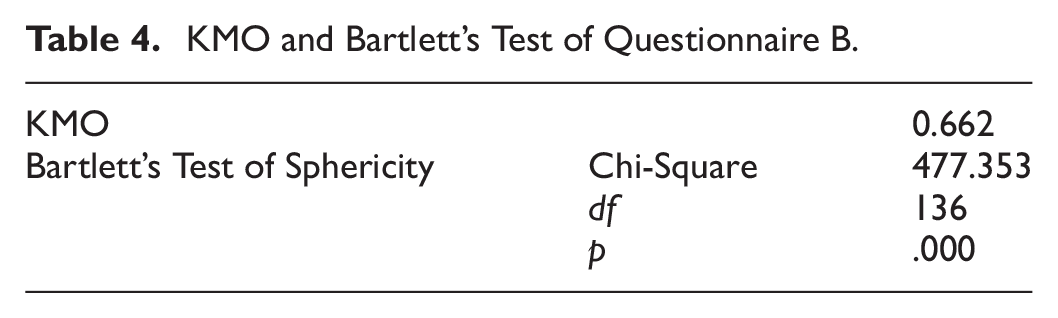
The validity of Questionnaire B was also verified here. If the KMO is between 0.6 and 0.7, it indicates that it is suitable for information extraction. Namely, the validity is dependable (Chung et al., 2004). As shown in Table 4, KMO was 0.662 and p < .05, which indicated the validation of Questionnaire B was dependable. Therefore, it could be used to find the answer to RQ1.
KMO and Bartlett’s Test of Questionnaire B.
Furthermore, regarding the content validity of Questionnaire A and Questionnaire B, two experts thoroughly examined and verified the content. This expert validation ensured that the questions included in both Questionnaire A and Questionnaire B accurately captured the relevant constructs and effectively measured the intended aspects of the study.
Reliability of Questionnaire A & B
Table 5 shows the result of the reliability of Questionnaire A. In this study, Cronbach α was used to measure the reliability. According to Eisinga et al. (2013), Cronbach α is .8 or higher indicating high reliability, while a value between .7 and .8 indicates good reliability. An acceptable level of reliability is indicated by a value between .6 and .7, and a value below .6 indicates poor reliability. In Table 5.8, the Cronbach α was .944, higher than .8, which indicated the higher reliability of Questionnaire A. Therefore, the findings from Questionnaire A were reliable.
Cronbach α of Questionnaire A.

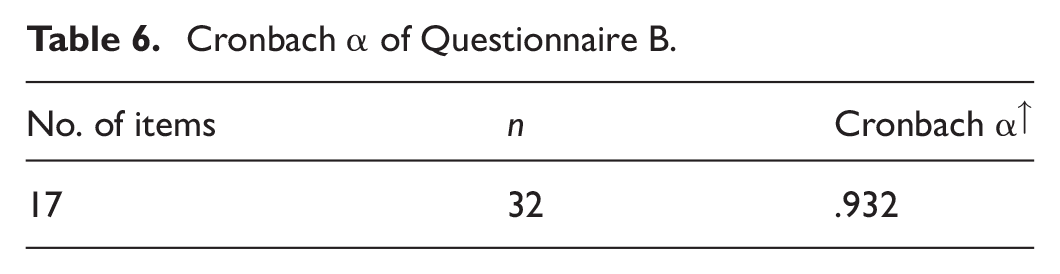
Table 6 shows the result of the reliability of Questionnaire B. In this study, Cronbach α was used to measure the reliability. It could be seen in Table 6 that the research data had a high level of reliability quality, as indicated by the Cronbach α of .932, which was greater than .8.
Cronbach α of Questionnaire B.
Descriptive Analysis of Questionnaire A & B
Table 7 shows the result of the descriptive analysis of Questionnaire A. Overall, the score for each item is above 4 points, indicating high student engagement in the MACLL environment. Some highest scores are listed in the following:
Q 1 (mean = 4.969)
Q 2 (mean = 4.844)
Q 4 (mean = 4.625)
Q 3 (mean = 4.469)
Q 6 (mean = 4.344)
Descriptive Analysis of Questionnaire A.
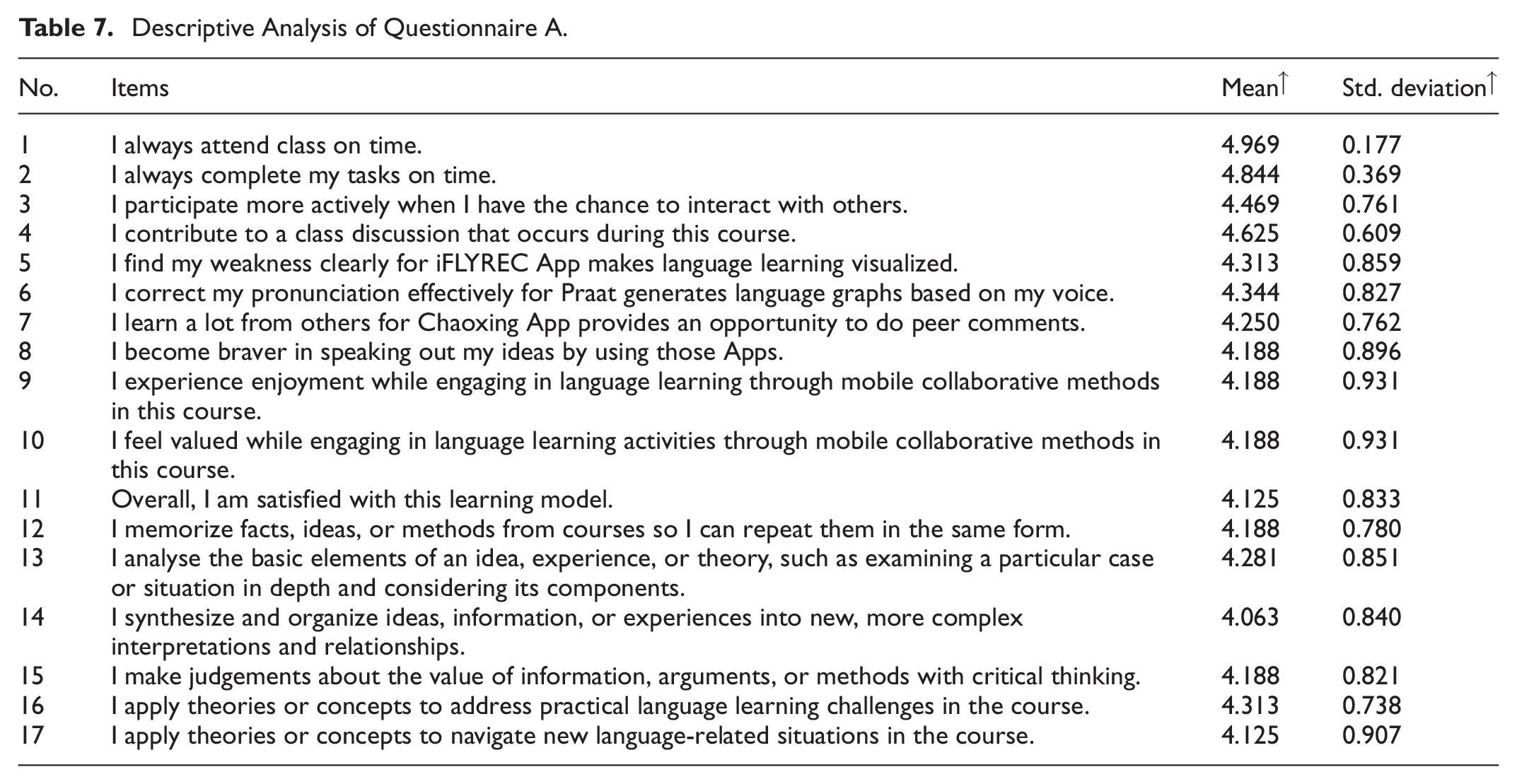
Table 8 presents the descriptive analysis of engagement dimension of Questionnaire A. The results revealed that the highest mean score, 4.45, was attributed to behavioural engagement, followed by cognitive engagement at 4.19 and emotional engagement at 4.17. Overall, the mean score across all dimensions was 4.33 (ranging from 3.51 to 4.50). Based on the scale rate classification mentioned in section 3.4, it was classified as high on the scale rating.
Descriptive Analysis of Engagement Dimension of Questionnaire A.

Table 9 shows the result of the descriptive analysis of Questionnaire B. Overall, the score for each item is above 3.5 points, indicating student engagement is good in the MALL environment. Some highest scores are listed in the following:
Q1 (mean = 4.719)
Q2 (mean = 4.656)
Q3 (mean = 4.406)
Q4 (mean = 4.281)
Q8 (mean = 4.125)
Descriptive Analysis of Questionnaire B.

Table 10 presents the descriptive Analysis of engagement dimension of Questionnaire B. The results revealed that the highest mean score, 4.29, was attributed to behavioural engagement, followed by emotional engagement at 4.01, and cognitive engagement at 3.97. Overall, the mean score across all dimensions was 4.11 (ranging from 3.51 to 4.50). Based on the scale rate classification mentioned in section 3.4, it was classified as high on the scale rating.
Descriptive Analysis of Engagement Dimension of Questionnaire B.

T-Test and Effect Size Analysis
Table 11 compares the mean between the control group and the treatment group on engagement. Due to the p-value being .016 (p < .05), there was a significant difference between the control group and the treatment group in engagement. To be specific, the mean of the treatment group was 4.33 while the mean of the control group was 4.11, which meant the treatment group performed better in terms of engagement. In addition, the result of the t-test, t = −2.543, p = .016 (p < .05), indicated that the treatment group and the control group showed significant differences. The treatment group learned English under the MACLL environment while the control group learned under the MALL environment. The result showed that MACLL was more helpful in students’ engagement.
T-test of Questionnaire.
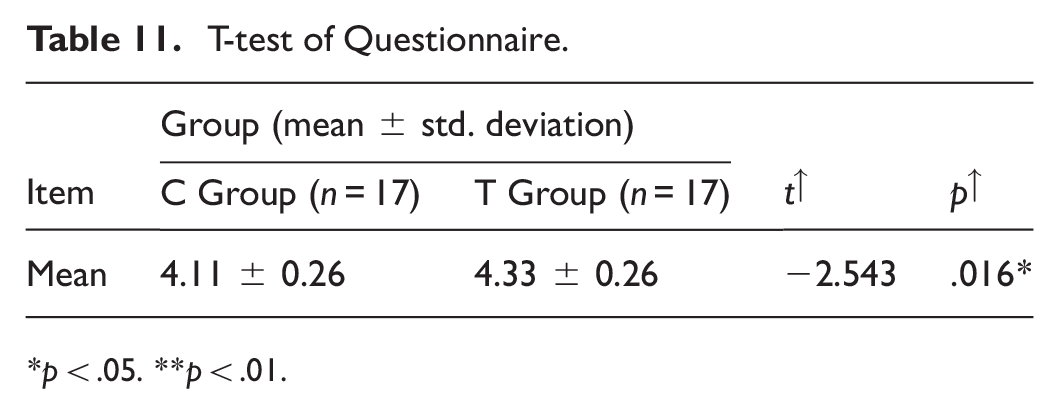
p < .05. **p < .01.
In addition, Table 12 shows the effect size, a statistical measure that quantifies the magnitude or the size of a difference between groups in research (Gaeta & Brydges, 2020). In the T-test, Cohen’s d was used to represent the effect size, and the larger the value, the larger the difference. Cohen (1969) developed benchmark values for the effect size d, in the context of small-scale experiments in social psychology. The benchmark values are widely used today: 0.2 small, 0.5 medium, and 0.8 large. In the study, Cohen’s d was 0.872, which meant the effect size was large. It means MACLL has a positive effect on EFL students’ engagement in English language learning.
Effect Size of Questionnaire.

Table 13 compares the mean between the treatment group and the control group on behavioural engagement. Both Questionnaire A and B were used to explore students’ behavioural engagement in different learning environments. Due to the p-value of .133 (p > .05), there was no significant difference between the control group and the treatment group in behavioural engagement. Namely, there is no significant effect of MACLL on students’ behavioural engagement.
T-Test of Students’ Behavioural Engagement.

p < .05. **p < .01.
Table 14 compares the mean between the treatment group and the control group in emotional engagement. Due to the p-value being .01 (p < .05), there was a significant difference between the treatment group and the control group in emotional engagement. To be specific, the mean of the treatment group was 4.17 while the mean of the control group was 4.01, which meant the treatment group performed better in terms of emotional engagement. The treatment group learned English under the MACLL environment while the control group under the MALL environment. The result showed that MACLL was more helpful in students’ emotional engagement. In addition, Table 15 shows the effect size, which is a statistical measure that quantifies the magnitude or the size of a difference between groups in research (Gaeta & Brydges, 2020). In the study, Cohen’s d was 2.644, which meant the effect size was large. Namely, the difference between the treatment group and the control group in emotional engagement was large. It means MACLL has a more positive effect on EFL students’ emotional engagement in English language learning.
T-Test of Students’ Emotional Engagement.

p < .05. **p < .01.
Effect Size of Students’ Emotional Engagement.

Table 16 compares the mean between the control group and the treatment group on cognitive engagement. Due to the p-value of .003 (p < .05), there was a significant difference between the treatment group and the control group in cognitive engagement. To be specific, the mean of the treatment group was 4.19 while the mean of the control group was 3.97, which meant the treatment group performed better in terms of cognitive engagement. The treatment group learned English under the MACLL environment while the control group under the MALL environment. The result shows that MACLL is more helpful in students’ cognitive engagement. In addition, Table 17 shows the effect size, which is a statistical measure that quantifies the magnitude or the size of a difference between groups in research (Gaeta & Brydges, 2020). In the study, Cohen’s d was 2.280, which meant the effect size was large. Namely, the difference between the treatment group and the control group in cognitive engagement is large. It means MACLL has a more positive effect on EFL students’ cognitive engagement in English language learning.
T-test of Students’ Cognitive Engagement.

p < .05. **p < .01.
Effect Size of Students’ Cognitive Engagement.

In a word, the results show that MACLL can better enhance EFL students’ engagement, encompassing student’s emotional and cognitive engagement, but has no significant effect on students’ behavioural engagement compared with MALL.
Findings of How MACLL Affects EFL Student Engagement in English Language Learning
To answer RQ2, the qualitative data from the interview was used to do a thematic analysis. An interview session was conducted to get a deeper understanding of EFL students’ engagement in the MACLL environment. The interview content was a supplement to Questionnaire A. Table 18 presents interview responses to RQ2 by using Braun and Clarke’s thematic analysis. The themes, codes and exemplars related to this research question are listed below.
Thematic Analysis of RQ3.

In this study, students’ engagement was explored from three dimensions: behavioural engagement, emotional engagement and cognitive engagement. Behavioural engagement reflects students’ actual actions and performances in their learning, including engagement in classroom activities, completing homework, participating in discussions and actively participating in learning groups (Fredricks et al., 2004; Kang & Wu, 2022). Such themes as flexible learning model, timely feedback and technology assistance were closely related to behavioural engagement. The flexible learning model enabled students to choose what, when and how to learn according to their own learning needs and preferences. Timely feedback helped students understand their progress and performance instantly. Technology assistance allowed them to focus more on learning with the help of rewards and supervision. Therefore, as for behavioural engagement, a flexible learning model, timely feedback and technology assistance are helpful in improving it.
Emotional engagement reflects students’ positive emotional experience and emotional investment in learning, including learning interest, self-confidence emotional connection and so on (Dubovi, 2022; Fredricks et al., 2004). Such themes as learning interest and individual emotion are closely related to emotional engagement. Learning interest refers to an individual’s positive attitude and strong desire for learning activities, which is one of the driving forces in the learning process, and encourages learners to invest more interests and emotions in learning activities. Individual emotion plays an important role in the learning process, it can affect individual learning attitude, emotional experience and learning outcomes. Therefore, as for emotional engagement, learning interest and individual emotion may influence it.
Cognitive engagement reflects students’ thinking activities and knowledge construction in the learning process, and it is the degree of thinking, analysis and understanding of students in learning, including deep thinking, critical thinking and problem solving (Fredricks et al., 2004; M. Huang, 2022; Liu et al., 2023). Such themes as interaction and a collaborative environment are important methods to improve cognitive engagement. In an interactive and collaborative environment, students discuss problems together, build knowledge together and build understanding and solutions through communication and collaboration. This process of co-building knowledge cultivates their critical thinking and enhances their cognitive engagement. Therefore, as for cognitive engagement, interaction and a collaborative environment can contribute to it.
Figure 3 shows the findings for RQ2. This figure explains MACLL increases students’ engagement in college English courses from seven aspects in three dimensions.

Findings of RQ2.
In conclusion, the MACLL environment increases students’ engagement from seven aspects, including establishing a flexible learning model, giving timely feedback and offering technology assistance to promote behavioural engagement; arousing learning interest and regulating individual emotion to motivate emotional engagement; facilitating interaction and setting up a collaborative environment to improve cognitive engagement.
Discussion
Based on the findings, in-depth discussions of the effects of MACLL on student engagement are illustrated here.
Discussions on the Effects of MACLL on EFL Student Engagement in English Language Learning
Section 4.1 presents the findings of RQ1, indicating MACLL’s potential to enhance EFL student engagement in college English courses (Mean = 4.33). CL is a meaningful factor in enhancing student engagement and is key to promoting learning and academic success (Qureshi et al., 2023). Specifically, as shown in Table 14 (t = −3.739, p = .01) and Table 16 (t = −3.950, p = .003), students’ emotional and cognitive engagement improved significantly in the MACLL environment, but there was no significant effect on behavioural engagement as shown in Table 13 (t = −1.611, p = .133). The improvement in engagement is in accord with Shi and Kopcha’s finding and Rachman et al.’s finding in 2022. However, the insignificant difference in behavioural engagement is inconsistent with Bernacki et al.’s finding in 2020 and the possible reasons are provided in the following part. This discovery has significant implications for the future research of English education.
Firstly, as proved in Table 14 with a mean of 4.17 (p = .01) in emotional engagement and Table 16 with a mean of 4.19 (p = .003) in cognitive engagement, the results highlight MACLL as an innovative teaching and learning environment that effectively stimulates students’ enthusiasm for learning and deep thinking at both emotional and cognitive dimensions. Some previous findings support the positive effects of MACLL on student emotional and cognitive engagement (Han, 2021; Rachman et al., 2022; L. Shi & Kopcha, 2022; Wang et al., 2021; F. Xie & Derakhshan, 2021). A creative factor in MACLL is CL that involves multiple factors, such as students’ collaborative knowledge construction and social-emotional interaction, and has a significant positive correlation with students’ academic performance (X. Li et al., 2021). On one hand, MACLL emphasizes CL and emotional engagement to provide students with a richer and deeper learning experience, which is essential for developing their interest and positive attitude (Lin & Li, 2021). As mentioned in Alwaleedi (2022)’ study, the researcher explored the impact of cloud-based collaborative writing on EFL learners’ emotional engagement. A group of 27 junior EFL college students participated in an 8-week intervention, during which they practiced collaborative writing and received feedback on Google Docs. The results indicated that the students’ emotional engagement improved overall.
On the other hand, MACLL emphasizes CL and cognitive engagement, providing students with a better platform for knowledge construction. CL is an important approach to cultivating learners’ collaborative ability, promoting their engagement in meaningful knowledge construction and creating new knowledge (Goodyear et al., 2014). Similarly, as mentioned by M. Huang (2022), MALL activities offered students a unique opportunity to enhance their engagement and knowledge construction through various forms of information sharing and language practice. The research also indicated an issue that collaboration was not happening among undergraduate students. Fortunately, MACLL environment proposed in this research provides a solution to this issue.
Secondly, although MACLL does not have a significant impact on students’ behavioural engagement (shown in Table 13 with t = −1.611, p = .133) compared with MALL and is inconsistent with Bernacki et al.’s finding in 2020, it should not be considered meaningless. It is because the research results were obtained by comparing the performance of the treatment and control groups, both of which employed mobile technology-assisted language learning. The treatment group adopted CL while the control group adopted individual learning. Therefore, this research suggests that CL and individual learning approaches do not have a significant impact on students’ behaviour engagement. However, based on the questionnaire survey results shown in Table 13, both the treatment group and the control group scored above 4 in behavioural engagement, with scores of 4.54 and 4.29 respectively. This indicates a positive impact of mobile technology on students’ behavioural engagement. It can also be inferred that MACLL improves students’ behavioural engagement to some extent, but there is no significant difference compared to MALL. On account of this, the result is consistent with Bernacki et al. (2020)’s in some degree.
Compared with the past studies (Bernacki et al., 2020; M. Huang, 2022; Wang et al., 2021), the research has two advantages. Firstly, it adopts a more comprehensive dimension of engagement, covering students’ behavioural, emotional and cognitive engagement. The comprehensive examination of this study allows for a fuller understanding of the overall impact of MACLL on student engagement in three dimensions. Secondly, this study’s discovery of the negligible impact of MACLL on behavioural engagement compared with MALL, providing a crucial direction for future research. Subsequent studies can delve deeper into the mechanism of MACLL’s influence on behavioural engagement and propose more sophisticated teaching strategies and intervention programmes based on it.
Discussions on How MACLL Affects EFL Student Engagement in English Language Learning
This section provides an in-depth discussion of the findings of RQ2. In section 4.2, seven themes (shown in Table 18 and Figure 2) were found to answer how the MACLL environment increases EFL students’ engagement in three dimensions.
Such themes as flexible learning model, timely feedback and technology assistance are closely related to behavioural engagement. The flexible learning model enabled students to choose what, when and how to learn according to their own learning needs and preferences. Timely feedback helped students understand their progress and performance instantly. Technology assistance allowed them to focus more on learning with the help of rewards and supervision. Therefore, as for behavioural engagement, a flexible learning model, timely feedback and technology assistance help improve it.
Such themes as learning interest and individual emotion are closely related to emotional engagement. Learning interest refers to an individual’s positive attitude and strong desire for learning activities, which is one of the driving forces in the learning process and encourages learners to invest more emotions and emotions in learning activities. Individual emotion plays an important role in the learning process, it can affect individual learning attitude, emotional experience and learning outcomes. Therefore, as for emotional engagement, learning interest and individual emotion may influence it.
Such themes as interaction and a collaborative environment are important methods to improve cognitive engagement. In an interactive and collaborative environment, students discuss problems together, build knowledge together and develop understanding and solutions through communication. This process of co-constructing knowledge cultivates their critical thinking and enhances their cognitive engagement. Therefore, as for cognitive engagement, interaction and a collaborative environment can contribute to it.
Discussions on Behavioural Engagement
In traditional learning without MACLL, there are some challenges and problems with student behavioural engagement. Absence is common, which results in students missing important content and opportunities for interaction. In addition, students may be less engaged in learning activities, perhaps due to a lack of motivation or interest in the learning content. At the same time, some students may fail to complete assigned learning tasks, perhaps because the tasks are too difficult or because they lack adequate resources and support. In conventional mobile learning, most learning is conducted online so it is difficult to supervise student behaviours behind the screens (Peng, 2020). These issues decrease behavioural engagement.
In the MACLL environment, the interview transcription in Table 18 shows that 10 students mentioned they can learn anytime, anywhere under MACLL. The application of technology to develop a flexible learning model enables students to learn anytime and anywhere, thus creating opportunities for enhancing behavioural engagement. In addition, 10 students mentioned such software as Chaoxing App provides timely feedback, which enables them to know their learning situation, including learning progress, strengths, and weaknesses timely and engage in learning activities continuously. With technology assistance, negative learning behaviours such as absenteeism, laziness, plagiarism and cheating are significantly reduced. The software records students’ learning progress and sends reminders automatically if they fail to complete tasks. In a word, a flexible learning model, timely feedback and technology assistance increase students’ behavioural engagement.
In conclusion, these findings highlight and support the previous research (Bedenlier et al., 2020; Heilporn et al., 2021; Yu et al., 2022) about the effectiveness of technology in promoting student behavioural engagement, while also providing insight into CL approach that requires further consideration to optimize its impact on behavioural engagement.
Discussions on Emotional Engagement
In traditional learning without MACLL, there are some problems and challenges in students’ emotional engagement. Students have no passion for learning when they are in a bad mood, which decreases emotional engagement. The traditional learning environment is often teacher-centred and emphasizes the direct delivery of curriculum content. Students may find the learning content monotonous and unattractive, resulting in a lack of interest in learning. In addition, although conventional mobile learning offers multiple resources to promote learning interest and motivation (Alamer & Al Khateeb, 2023), the effect of students’ personal emotions on their learning passion is still unsolved. If students face negative emotions such as anxiety and stress, a decrease in passion may appear in learning. Negative individual emotions cause distraction and reduce students’ learning engagement (Shakki, 2023).
The MACLL environment provides an attractive and supportive learning experience. Table 18 illustrates that 10 students mentioned the value of learning interest (S2: with MACLL, learning is full of fun; S7: with the software, I can keep my enthusiasm for learning at all times). And six students mentioned the influence of individual emotion (S6: I can get out of the fear of English learning…make me more confident; S10: Group discussion makes us more interested in learning, and we are in high spirits). It also can be seen from Figure 1 that how MACLL increases students’ emotional engagement. In the MACLL environment, students are more motivated to learn when they are interested in it or in high spirits, which increases engagement in group activities. It is important to regulate individual emotions, as they can impact their emotional engagement.
In a nutshell, the findings of Yu et al. (2022) and Warsah et al. (2021) have respectively demonstrated the effectiveness of mobile learning in improving emotional engagement, and the effectiveness of CL in it. This study combines mobile learning with CL and proposes MACLL that creates conducive conditions for students’ emotional engagement by increasing learning interest and regulating individual emotions. It is helpful for students to develop positive attitudes towards learning and to achieve better emotional engagement in academic tasks.
Discussions on Cognitive Engagement
Traditional learning without MACLL has obvious shortcomings in terms of students’ cognitive engagement. It often focuses solely on imparting knowledge but lacks opportunities for interaction and collaboration with students. Traditional learning places too much emphasis on teachers’ explanations, resulting in students passively accepting knowledge without engaging in deep thinking and application (Precious & Feyisetan, 2020). In conventional CL, some learners become what is known as ‘hitchhikers’. They contribute little or nothing to the group overall but reap the rewards (Apeanti & Essel, 2021). This teaching approach makes it difficult to stimulate students’ active learning and creative thinking. It may also hinder their ability to apply theoretical knowledge to practical situations, which limits their cognitive engagement.
In contrast, MACLL can compensate for this deficiency mentioned above by facilitating interaction, and setting up a CL environment. As shown in Table 18, eight students mentioned the value of interaction (S1: We can directly discuss with students who are far away from us through Chaoxing App). And seven mentioned the CL environment (S3: In this new learning environment, we can share ideas, solve problems, encourage and support each other). In addition, Figure 1 also illustrates how MACLL increases students’ cognitive engagement. MACLL offers a CL environment for interaction between teachers and students. In the MACLL environment, student-teacher interaction is strengthened. CL is the primary learning method in MACLL, promoting cognitive engagement. During discussions and communication, students express their own views and evaluate others’ learning outcomes. This requires them to master the basic knowledge first and then systematically organize the key points to form their own unique opinions. By doing so, they can use critical thinking to complete group tasks. Therefore, this kind of technological learning environment may better align with students’ learning needs and enhance their overall cognitive development.
To sum up, previous findings support the positive effects of MACLL on student cognitive engagement (Han, 2021; Rachman et al., 2022; L. Shi & Kopcha, 2022; Wang & Derakhshan, 2021; F. Xie & Derakhshan, 2021). However, this study goes deeper and demonstrates how MACLL improves cognitive engagement in terms of interaction and collaboration. The MACLL environment establishes a collaborative environment and promotes interaction, which is crucial in enhancing students’ cognitive engagement.
Based on these, a framework of MACLL enhancing student engagement was established (shown in Figure 4). This framework illustrates the effectiveness of MACLL and how MACLL improves student engagement in three dimensions. The framework provides a structured approach to enhancing student engagement in the MACLL environment. It demonstrates its unique value by addressing key aspects of each engagement dimension. For behavioural engagement, it emphasizes establishing a flexible learning model, delivering timely feedback, and offering technology assistance, which together support students in maintaining active participation and adapting to learning contexts. Emotional engagement is fostered by arousing learning interest and helping students regulate emotions, making the learning process more enjoyable and personally relevant. Lastly, cognitive engagement is facilitated through interactive opportunities and the creation of a collaborative learning (CL) environment, which enables deeper understanding and critical thinking. This holistic approach underscores MACLL’s potential to revolutionize language learning by integrating mobile technologies to create a dynamic, responsive and supportive learning experience.

Framework of MACLL enhancing student engagement.
Conclusion
In the technological era, this study constructs the framework of MACLL, the combination of MALL and CL, to solve the problem of less engagement in EFL learners’ college English language learning. It is found that MACLL has a positive impact on EFL student engagement; MACLL affects it from seven aspects in three dimensions. Specifically, a flexible learning model, timely feedback, and technology assistance improved behavioural engagement; learning interest and positive individual enhanced emotional engagement; interaction and collaborative learning environment promoted cognitive engagement. This study delivered a more efficient and engaging language learning framework tailored for higher education. However, there are limitations in sample size and the length of the experiment time. Therefore, future research should comprehensively consider these factors and combine the actual situations of different environments for in-depth discussion to make the research results more general and practical.
Footnotes
List of Abbreviations
CL Collaborative Learning
EFL English as a Foreign Language
MACLL Mobile-Assisted Collaborative Language Learning
MALL Mobile-Assisted Language Learning

Funding
The author(s) received no financial support for the research, authorship, and/or publication of this article.
Declaration of Conflicting Interests
The author(s) declared no potential conflicts of interest with respect to the research, authorship, and/or publication of this article.
Data Availability Statement
The datasets generated and/or analysed during the current study are not publicly available due to protecting the privacy of participants but are available from the corresponding author on reasonable request.