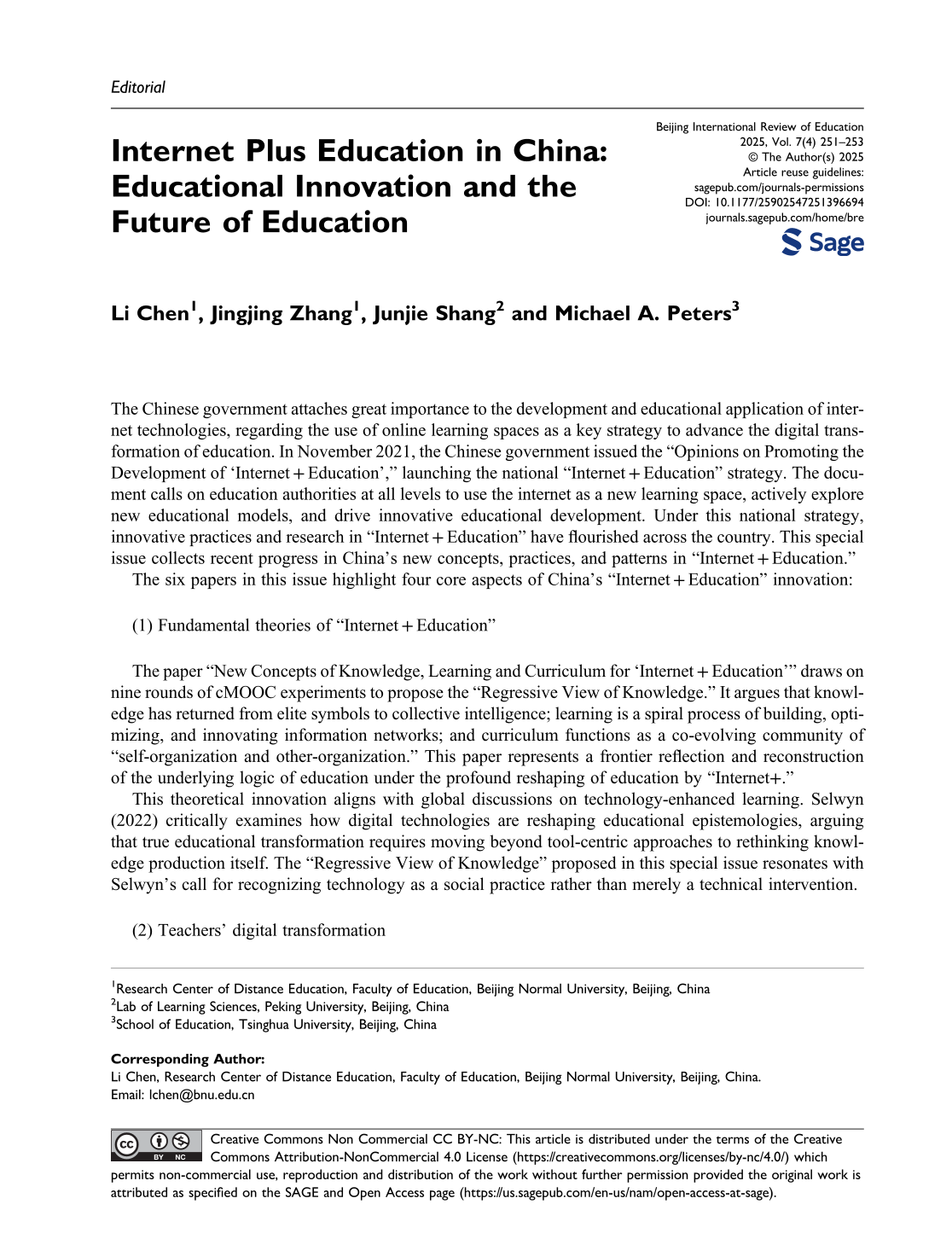
Editorial
Select search scope: search across all journals or within the current journal

The digital transformation of universities is a strategic choice to deepen educational and teaching reforms and strengthen talent cultivation. Leveraging the information and communication technology (ICT) strengths of Xidian University and the theoretical and practical achievements of educational informatization, we explored and practised methods for digital transformation to drive profound reforms in higher education. First, with the ideas of “data-driven, AI-empowered” as the core, we addressed systemic issues in educational and teaching reforms by establishing the intelligent education brain and the “intelligent teaching platform.” This facilitated data-driven process of reengineering, forming the five-duals nurturing model or Xidian model, harnesses digital transformation to drive educational reforms. Second, in response to the precise and personalized demands of talent cultivation, we constructed a resource provision model and a cobuilt sharing system based on human–technology collaboration. This generated a precise and personalized teaching model that was comprehensive and data-driven. Finally, to address the major formative issues in educational and teaching assessment, we built a data-driven evaluation system for the entire process. We have persistently pursued the integration of ICT with education and teaching, upholding the human–technology collaboration model for talent cultivation and development. Our approach has reshaped a first-class undergraduate education system in the era of the digital economy, establishing a benchmark university for “artificial intelligence + education” and creating a comprehensive solution that is replicable and adaptable.
The new generation of technology has reshaped information space for education, redefining some concepts of education. Based on the analysis of innovation practices and empirical studies in “internet + education,” we’ve developed the understanding of knowledge, learning, and curriculum. The Regressive View of Knowledge emphasizes knowledge transitions from finely symbolic information to comprehensive human intelligence, essential knowledge attributes evolve from static linearity to dynamic networking and the knowledge production mode changes from elite control to crowd intelligence aggregation. The new concept of learning shows that connectivist learning relies on constructing, developing, and utilizing information networks, both the pipe and the content within the pipe are equally important, the spiralling and deepening process of operation, wayfinding, sensemaking, and innovation, and the importance of the diverse interaction patterns and development paths. The new concept of curriculum points out that curriculum is a learning community, fostering connectivity and reciprocity of individuals and the community, and functions as a networked knowledge production system with continuous iterative evolution, coconstructed by both teachers and students. We urge education researchers and practitioners to enhance educational theories for the internet era in diverse contexts, further fostering innovative practices and exploring new approaches to cultivate outstanding innovative talents.
The allocation of high-quality teachers significantly impacts educational equity and quality. Current strategies for achieving balanced teacher distribution primarily adopt two approaches: (1) structural optimization through reallocation of existing teachers, and (2) incremental expansion via investments to diversify teacher roles and instructional services. This study examines an innovative government-led teacher distribution model implemented in Beijing Middle School teachers’ Open Tutoring Program. In this program, high-quality teachers are reallocated to meet students’ personalized tutoring needs through online tutoring modes such as “one-to-one tutoring” via the internet. Longitudinal analysis shows that sustained participation in the program correlates with improved student academic performance and enhances teachers’ professional development. Compared to conventional methods, the Open Tutoring Program offers a more efficient and flexible mechanism for deploying expert instructors. However, challenges remain in achieving precise student–tutor matching. Furthermore, from an educational ecology perspective, the program exerts complex multilevel influences across micro-, meso-, exo-, and macrosystem levels. These findings provide valuable insights for scaling similar educational innovations and can serve as references for optimizing teacher distribution models in various educational contexts.
Online teaching, widely adopted as an emergency response during crises such as the COVID-19 pandemic, has exposed various challenges and issues within vocational education while simultaneously offering opportunities for its digital transformation. While existing studies primarily focus on online learning from the learners’ viewpoint. In contrast, this study investigates teachers’ willingness to sustain online teaching in vocational education, thereby highlighting the teachers’ viewpoint. Using survey data from 17,009 questionnaire responses collected from vocational education teachers, this study employs structural equation modeling to capture the practical challenges of online teaching and learning in this context. The study extends the Technology Acceptance Model (TAM) by integrating context-specific variables. The findings demonstrate that perceived usefulness and perceived resources significantly and directly influence teachers’ willingness to sustain online teaching in vocational education. Additionally, perceived ease of use, perceived learner engagement, and perceived behavioral control exert significant indirect effects. Theoretically, this study extends the TAM by contextualizing it within vocational education. Practically, it proposes two key recommendations: (1) it advocates for the establishment of a comprehensive, accessible repository of digital teaching resources tailored to vocational contexts; (2) it underscores the importance of fostering multistakeholder collaborations to cultivate vocational education teachers’ digital pedagogical competence.
Learning engineering is an interdisciplinary field that uses learning sciences, specifically human-centered engineering design and data-informed decision-making, to support learners and their development. Its theoretical foundation is a blend of scientific disciplines, including learning sciences, data science, computer science, and instructional system design, and it uses a holistic engineering methodology. A learning engineering approach considers the full learning cycle, linking together divergent modules to achieve scalable solutions. As a “team sport” that requires multidisciplinary expertise and integrated efforts across different sectors, it functions as an inclusive ecosystem. This paper introduces the successful implementation of Learning@ZJU, a novel educational system based on a learning engineering approach, at Zhejiang University in China. The development included proposing a new theoretical framework (K-CPS, named for
Nonformal education and informal learning have gradually become the main forms of lifelong learning. In order to recognize the prior learning experience of people through informal education and informal learning and motivate people's lifelong learning, constructing the framework of lifelong education qualifications in the digital age has become one of the major strategies of education development and reform in China. This paper takes Guangdong province as an example to depict and analyze the lifelong education qualifications framework system, collaborative governance mode, Specification of Competency Standards, learning outcome accreditation system, digital credit bank operation system, and recognition of qualifications and credits in the Great Bay Area to establish the three in one lifelong education institution in the digital age which consists of Qualifications Framework, learning outcome accreditation system and Credit Bank System. This lifelong learning overpass model reveals the development trend of talent training and the integration of industry and education and collaborative innovation. From the case of Guangdong, the Lifelong learning overpass construction can be more visible and realistic.
This paper explores the intersection of artificial intelligence (AI), higher education, and academic publishing within the framework of knowledge socialism, a concept promoting a truly free and equitable exchange of ideas based on collective ownership of the means of knowledge creation and equality in the social relations of knowledge production. Knowledge socialism, rooted in the Marxist critique of capitalism, is to be understood vis-à-vis knowledge capitalism featuring privatised regulation of the production and circulation of knowledge and the transformation of knowledge into exchange values in the marketplace. While the two systems appear to represent mutually exclusive orientations, they are both fluid, always in motion, and meet each other in a reality of in-betweenness. With an understanding of the knowledge capitalism/socialism problematics, this paper then discusses how AI technologies disrupt existing paradigms of academic publishing and scholarship, enabling decentralised knowledge creation, open publishing, and democratised learning. Meanwhile, challenges such as algorithmic bias, corporate acquisition, and ethical issues threaten to undermine the progressive potential of AI. This paper argues that AI's capacity to tip the balance between knowledge socialism and capitalism is hardly questionable. However, such power needs to be ethically guided and directed by consensual efforts prioritising equity, transparency, and openness if it is to catalyse knowledge socialism.

