



Abstract
Nonformal education and informal learning have gradually become the main forms of lifelong learning. In order to recognize the prior learning experience of people through informal education and informal learning and motivate people's lifelong learning, constructing the framework of lifelong education qualifications in the digital age has become one of the major strategies of education development and reform in China. This paper takes Guangdong province as an example to depict and analyze the lifelong education qualifications framework system, collaborative governance mode, Specification of Competency Standards, learning outcome accreditation system, digital credit bank operation system, and recognition of qualifications and credits in the Great Bay Area to establish the three in one lifelong education institution in the digital age which consists of Qualifications Framework, learning outcome accreditation system and Credit Bank System. This lifelong learning overpass model reveals the development trend of talent training and the integration of industry and education and collaborative innovation. From the case of Guangdong, the Lifelong learning overpass construction can be more visible and realistic.
Keywords
Introduction
The digital age has entered an unprecedented period of reform in the field of education. In this new era background, the traditional talent training mode appears to be increasingly lagging behind, and it is in urgent need of innovative methods to meet the rapid changes of the society and the continuous emergence of the industry needs. Digital age ubiquitous learning form calls for new lifelong education concept and mode, to build a new era of qualifications framework leading lifelong education system is the focus of global education development and reform, is one of the major national strategies of lifelong education development in China, for the construction of learning society and learning power has great theoretical significance and practical significance. Guangdong province actively carries out the practice and exploration of the innovative mode of talent training in the digital era, and is committed to the construction of the people-centered Qualifications Framework system. The introduction of Qualifications Framework not only provides a clear direction for the education system but also injects flexibility and innovation into talent training. Through this framework, Guangdong province has established a set of norms in line with both international standards and local realities, laying a solid foundation for cultivating globally competitive talents. At the same time, the implementation of the Qualifications Framework also promotes the formation of the collaborative governance model, promotes the better cooperation of all educational subjects, and promotes the virtuous cycle of the education ecosystem.
This paper aims to describe and share the system construction and innovative practices of Guangdong province under the guidance of the Qualifications Framework, including the Qualifications Framework construction and the development of Specification of competency Standards (SCS), the accreditation of diversified prior learning experience, the accumulation and conversion mechanism and the construction of the digital credit bank operation system, and the promotion of the qualification and credit mutual recognition mechanism in the Guangdong–Hong Kong–Macao Greater Bay Area. It is anticipated that the outcomes of research and the accumulation of innovative experiences in Guangdong province will serve as benchmarks and precedents in upgrading and transforming talent cultivation practices, as well as reforming the educational system in the digital era. Furthermore, these accomplishments are poised to contribute significantly to the establishment and enhancement of a lifelong learning system, thereby enabling individuals to continuously enhance their knowledge and skills.
Literature Review
International developments in the construction of Qualifications Framework began from the late 1980s to the mid-1990s. Australia, New Zealand, Scotland, and South Africa were the first countries and regions to implement the framework. From the late 1990s to 2000, the development of the Qualifications Framework was expanded to more countries and regions such as Ireland, Malaysia, and Maldives (CEDEFOP, 2015). In addition, transnational regional Qualifications Frameworks are emerging, with most regions being developed to provide reference or serve as models for countries in the region to build their own Qualifications Framework (Xie, 2019).
From the perspective of reform strategy, the Qualifications Framework can be divided into cohesive framework, transformative framework, and improved framework (Lü, 2021). Among them, the cohesive qualifications framework, represented by Scotland, aims to systematically describe the existing education system, make it more transparent, and enhance the consistency between all levels of education, but does not attempt to directly promote the reform of the education system (Cui, 2020). The transformational framework represented by South Africa completely jumps out of the education system of that time, taking the future education and training system as the starting point, a new qualification system that defines the future state, and directly causes the change with rational orientation and goal orientation (Ouyang et al., 2020). The improved reform framework represented by Ireland, with the existing education system as the starting point, tries to optimize the current education system slowly through gradual and continuous reform (Young, 2003). From the perspective of coverage, the Qualifications Framework can be divided into local framework (higher education, vocational education), comprehensive framework (most national Qualifications Framework), and transnational framework (such as the European Union, ASEAN). In terms of the implementation level, it can be divided into loose framework and strict framework. The former has no strict unified requirements, and the pursuit of more flexible use, while the latter has a unified standard, and the implementation of the framework must be in accordance with the requirement which is strictly enforced (Yang, 2008).
The Domestic Status Quo of the Qualifications Framework Construction
At present, the establishment and implementation of the Qualifications Framework in China has entered the policy planning at the national level, and the important role of the Qualifications Framework on vocational education has been concerned at the same level. The Outline of the 13th Five-Year Plan for National Economic and Social Development of the People’s Republic of China first proposed the concept of a “national Qualifications Framework” (State Council of the People's Republic of China (2016, March 17) Outline of the 13th five-year plan for national economic and social development of the People's Republic of China. From 2010 to 2022, China has issued 23 national documents related to the construction of credit banks at the national level. For example, the China Education Modernization 2035 issued by the CPC Central Committee and The State Council in 2019 emphasizes that “an institutional environment for lifelong learning for all should be established, a national Qualifications Framework should be established, and the national Credit Bank System and learning outcome accreditation system should be established.” In the same year, the State Council issued the Implementation Plan of the National Vocational Education Reform, which made arrangements for the Qualifications Framework of the national level (State Council of the People's Republic of China., 2019, January 24). And took it as a specific task, put forward the specific implementation of the guidance, clearly proposed to implement the mutual recognition and exchange of vocational skill level certificates and academic certificates, and implement the pilot in qualified universities and regions. In 2022, the Law of the People's Republic of China on Vocational Education proposed to “ establish and improve school education at all levels and of all types with the certification, accumulation, and conversion mechanism of vocational training credits, qualifications and other prior learning experience, to promote the construction of a national credit bank for vocational education.” “Across the education department to carry out industry and regional practice exploration, Qualifications Framework is the superior standard beyond all kinds of prior learning experience mutual recognition and transformation.” China has not yet established national Qualifications Framework, but there have been some regional qualifications framework based on international experience of the exploration of innovation practice: such as the China Open University built the “entry-level + 6 level” learning framework (Chen et al., 2023). In 2017, Guangdong Province issued the Guangdong Lifelong Education Qualifications Framework (hereinafter referred to as the Guangdong Qualifications Framework: GDQF) in the form of local standards and implemented it.
In the implementation of the Qualifications Framework, Open University of China has played a significant role in promoting the standardization and recognition of qualifications in higher education. Guangdong province has carried out a series of exploration practices to meet the development needs of vocational education, including pilot projects in legislative guarantee, capacity standard formulation, credit recognition and conversion, connection between middle and higher vocational colleges, and cooperation between Guangdong and Hong Kong. In addition, Chongqing, Jiangsu, and other places have also actively carried out the research and practice of the Qualifications Framework. Various regions in China also actively apply big data, artificial intelligence technology, and block chain technology to innovate and develop the connotation of lifelong learning overpass, and explore and build an information system based on Qualifications Framework to provide learners with all kinds of intelligent learning and certification services.
Background of Qualifications Framework Construction of Guangdong Province
As Guangdong is a strong economic province and education province, qualifications framework has a strong internal demand, all levels of education communication, vocational education, and the labor market docking, the connotation of higher education characteristic development, a large bay area and “area” along the national talent flow need a unified standard and common reference (Zheng et al., 2019). Credit bank is the management system that implements the Qualifications Framework. The Guangdong Provincial government has taken a series of measures to promote the construction of credit bank. First, The policy documents such as “Outline of Guangdong Province's Medium and Long-term Education Reform and Development Plan (2010–2020),” “Opinions of the People's Government of Guangdong Province on Deepening the Comprehensive Reform of the Education System,” and “Guangdong Province's Plan for the Construction of Modern Vocational Education System (2015–2020)” proposed the establishment of a credit bank system to support the construction of a learning society and the economic and social development of Guangdong. Second, establish the government leadership. Credit bank construction included in the task of comprehensively deepening reform of Guangdong province, Guangdong provincial people's government organized the credit bank construction project meeting to determine the credit bank leadership system (provincial education system reform leading group overall coordination) and input mechanism, decision-making mechanism, consulting mechanism and execution mechanism and other important issues, established the credit bank government host, education administration Department heads, human resources security and other functional departments of multiple subjects to promote the construction Set the pattern. In December 2014, Guangdong decided to establish Guangdong Lifelong Education Credit Bank (referred to as “Guangdong Credit Bank”), which was included in the coordination scope of the provincial Leading group for Education System Reform led by the Governor. Meanwhile, it was clear that Guangdong Credit Bank was sponsored and managed by Department of Education of Guangdong Province. Third, legislation was promoted. Article 15 of the regulations on the vocational education was released, in which there says” Guangdong province shall establish and perfect the system of lifelong education credit, through credit accumulation, transfer and exchange, promote academic and nonacademic education cohesion connected, mutual recognition, promote the academic education learning achievements and vocational skill grade credit conversion mutual recognition, build ordinary education, vocational education, and performance recognition of lifelong education qualifications framework system. “Which means the legal status of building a credit bank and building the framework of lifelong education qualifications was established.”
Construction of Lifelong Education Qualifications Framework in Guangdong Province
In order to help Guangdong build a learning-oriented society, realize the communication and connection between education and training of all levels, establish the recognition, accumulation and transformation system of Prior learning experience, broaden the channel of lifelong learning, build an “overpass” for talent growth, and implement lifelong learning and promote social development, Guangdong has actively explored and practiced the construction of Qualifications Framework. Throughout the practice of many credit banks globally, the vast majority of them adopt the system model of Qualifications Framework. Its concept and practice are widely popular in the world and have achieved great success, which promotes lifelong learning and promotes the development of social economy. In term of establishing Qualifications Framework, the popular method is the legislation guarantee, such as New Zealand, Australia, and Hong Kong Qualifications Framework have legal status, but the preparation is long and difficult, so Guangdong province finally took the form of local standard to issue the Guangdong lifelong education Qualifications Framework standard, which is also the Guangdong characteristics. Guangdong Qualifications Framework is China’s first standardized characteristics of local Qualifications Framework. Standards are documents that provide rules, guidelines, or features for common use and reuse through standardized activities, or their results, in accordance with prescribed procedures (State Administration for Market Regulation of the People's Republic of China; Standardization Administration of the People's Republic of China (2014). GB/T (20000.1-2014) It is the direction of the reform of China's governance mode, and standards are playing an increasingly prominent role in supporting and guiding the modernization of education, building a strong country in education, and ensuring the success of the people.
Construction of the Framework System for Lifelong Education
According to the strategic deployment of “China Education Modernization 2035,” Guangdong Province has drawn on the EU Qualifications Framework standards and Hong Kong experience to build a three-pronged lifelong education system with the Qualifications Framework as the standard, learning results certification as the guarantee and credit bank as the platform (see Figure 1). The Qualifications Framework is a fundamental system that serves the integration and communication of Prior learning experience and connects with the talent market. The learning achievement certification system is a pivotal mechanism for reviewing and approving the quality of learning achievements through internal quality assurance mechanisms and external quality review mechanisms. The credit bank system is a management system for the recognition, accumulation, and conversion of learning achievements that have been reviewed and approved. The Qualifications Framework and the learning achievement certification system and the Credit Bank System complement each other, not a single one can be omitted (Li, X. C. 2023). As a core element for implementing lifelong learning strategies, promoting educational evaluation reform, and facilitating the growth of talent, the Qualifications Framework requires the integration of all social forces to promote it, and it needs the collaborative governance and cooperation of multiple stakeholders such as government, universities, industry enterprises, and communities. In the governance of the Qualifications Framework, Guangdong Province adheres to a model of government-led coordination and collaboration among multiple entities (Figure 2). It is coordinated and led by the Leading Group for the Reform of the Education System in Guangdong Province, and hosted and managed by the Department of Education of Guangdong Province, with collaborative construction involving Guangdong Open University, the Department of Human Resources and Social Security of Guangdong Province, and others. Guangdong Province also establishes decision-making, advisory, and management and implementation agencies, respectively, responsible for the decision-making, advisory, management, and operation of the Qualifications Framework in Guangdong. A third-party quality assurance agency is established to manage the qualification.”
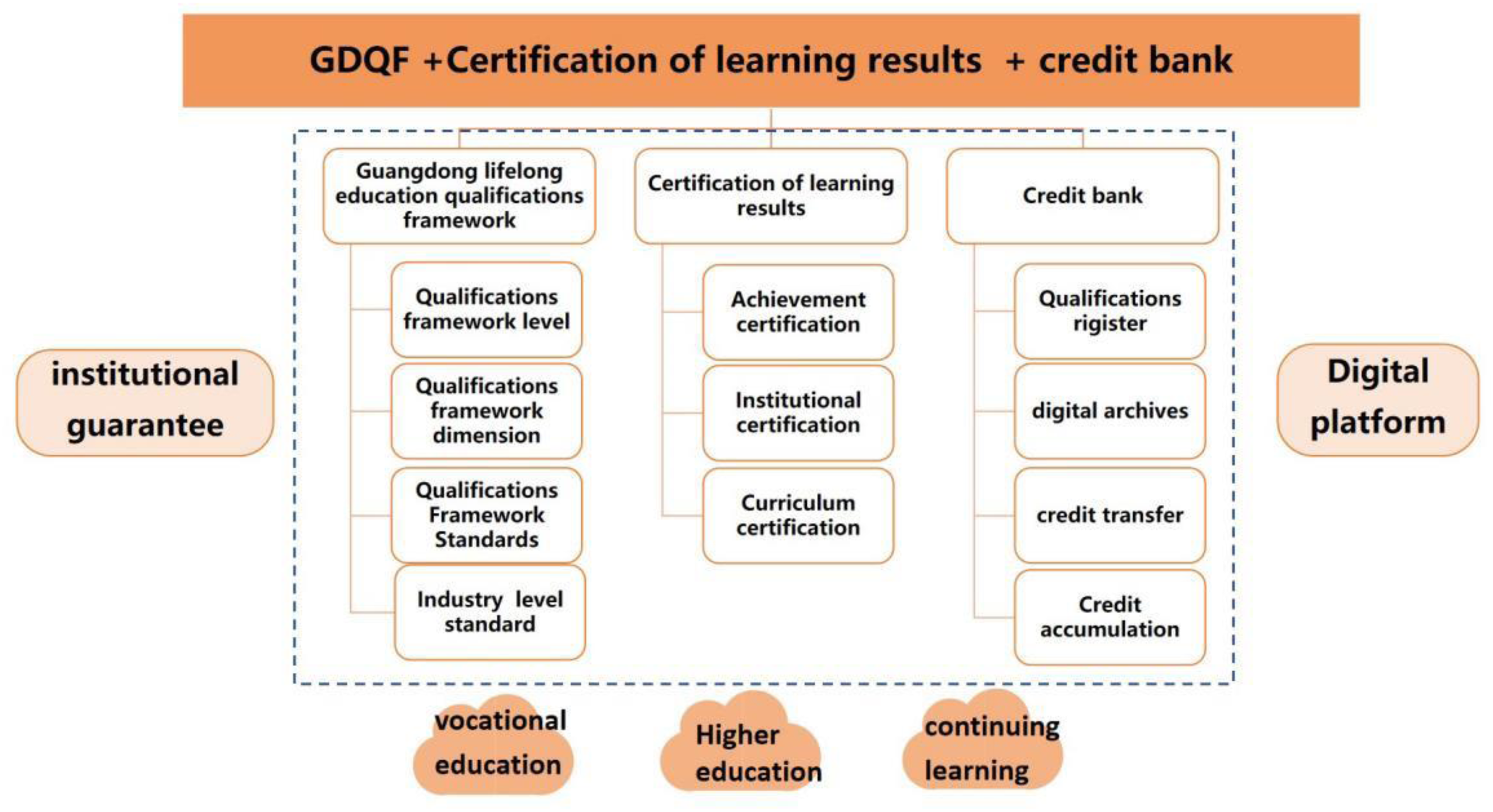
Three in One Mechanism of Guangdong Lifelong Education.
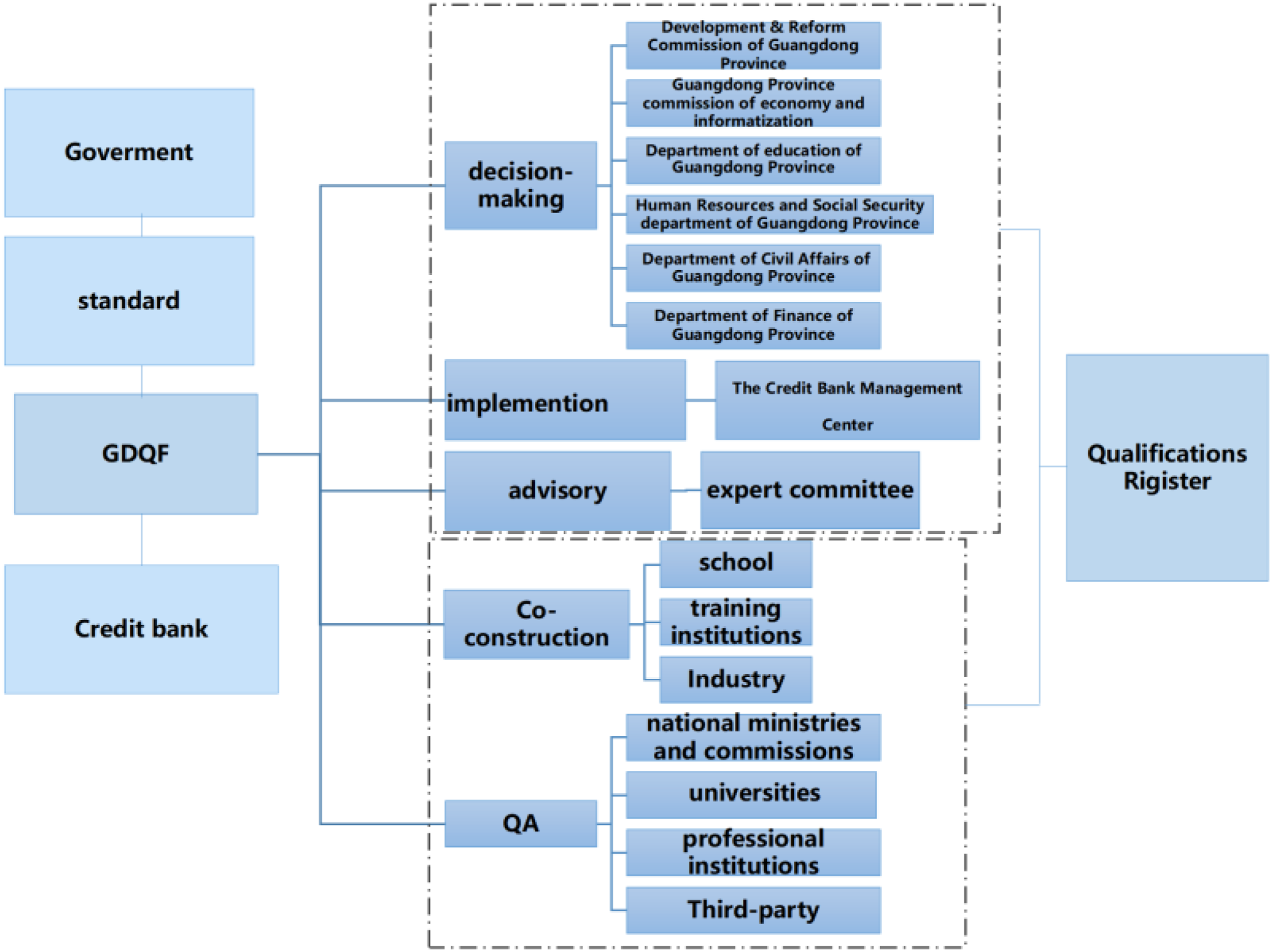
Government Model of Guangdong Qualifications Framework (Li et al., 2022).
Construction of Qualifications Framework Standards for Lifelong Education
In 2017, Guangdong province released the “Guangdong lifelong Education in the form of local standards Qualifications Framework Standard (DB 44 / T 1988-2017).” The standard defines the level and type of Prior learning experience, and the cohesion and communication of educational. Prior learning experience at all levels, Build a “lifelong learning overpass” for talent growth, It provides a common reference standard for the communication and integration of education at all levels, Provides a superior standard for the industry standards. It is the basic support system for the construction of a lifelong education system in Guangdong Province, with the functions and characteristics of the internationally accepted Qualifications Framework. It clarifies the relationship between general education, vocational education, training and performance. The levels consists seven grades, and the standards of each level from three dimensions described as knowledge, skill, and ability. It provides a common reference for the horizontal and horizontal communication between all levels and various types of education, see Figures 3 and 4 for more details (Department of Quality and Technical Supervision of Guangdong Province. (2017). DB44/T 1988-2017). First of all, by clarifying the types of relationships of qualifications, the horizontal communication channel between all kinds of education has been opened up, and the problem of poor connection between all kinds of education has been solved. Second, the establishment of the qualification level standards, from the source. It solves the problem that the education standards and the employment standards are not connected, so that the education standards and the employment standards are organically integrated in the framework. Finally, through the innovation of the system and mechanism, we ensure the long-term implementation mechanism of the Qualifications Framework, including government-led, multidepartment coordination, institutional system construction, and other measures, to set the foundation for the successful implementation of the GDQF.
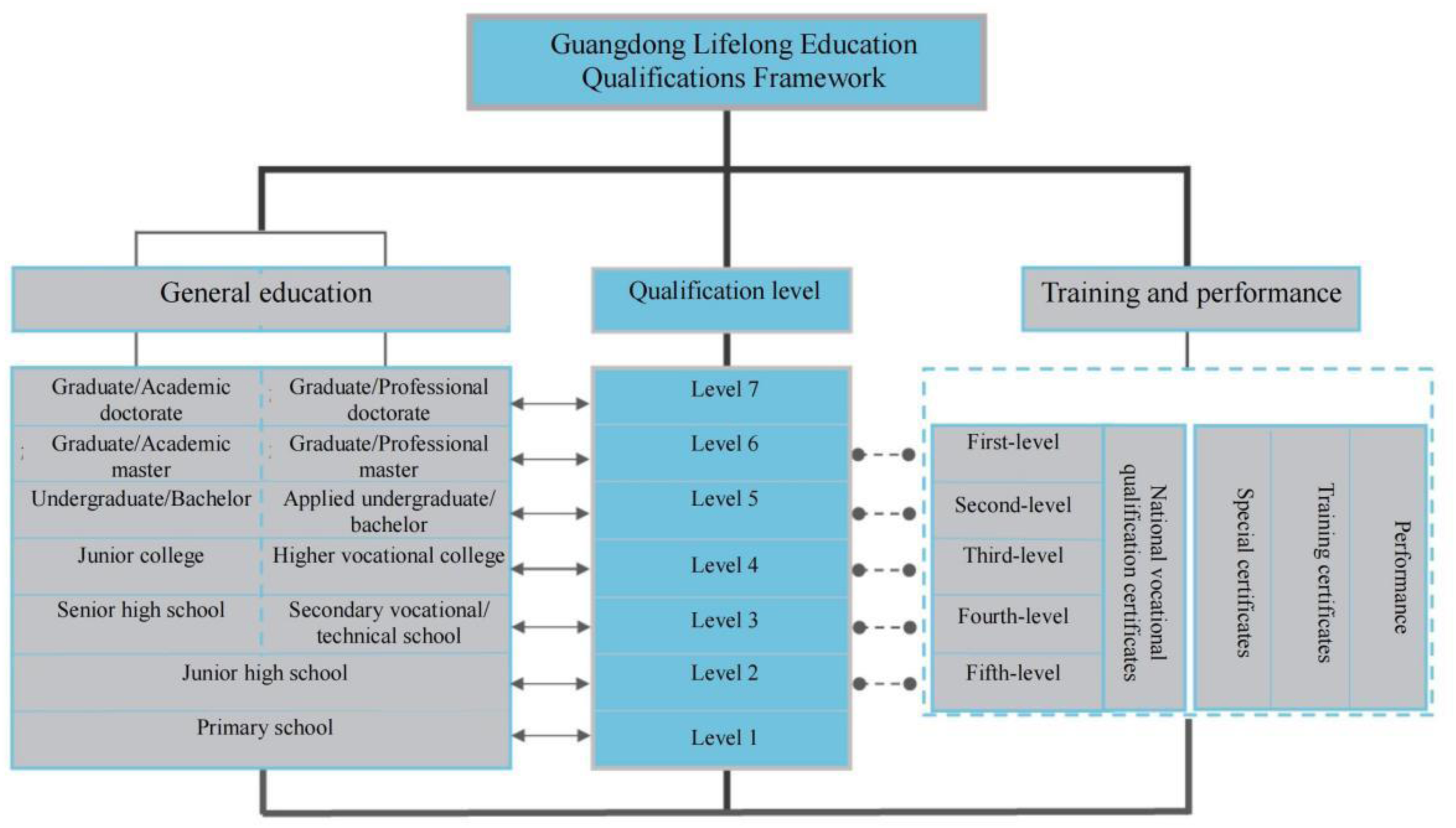
Guangdong Lifelong Education Qualifications Framework.
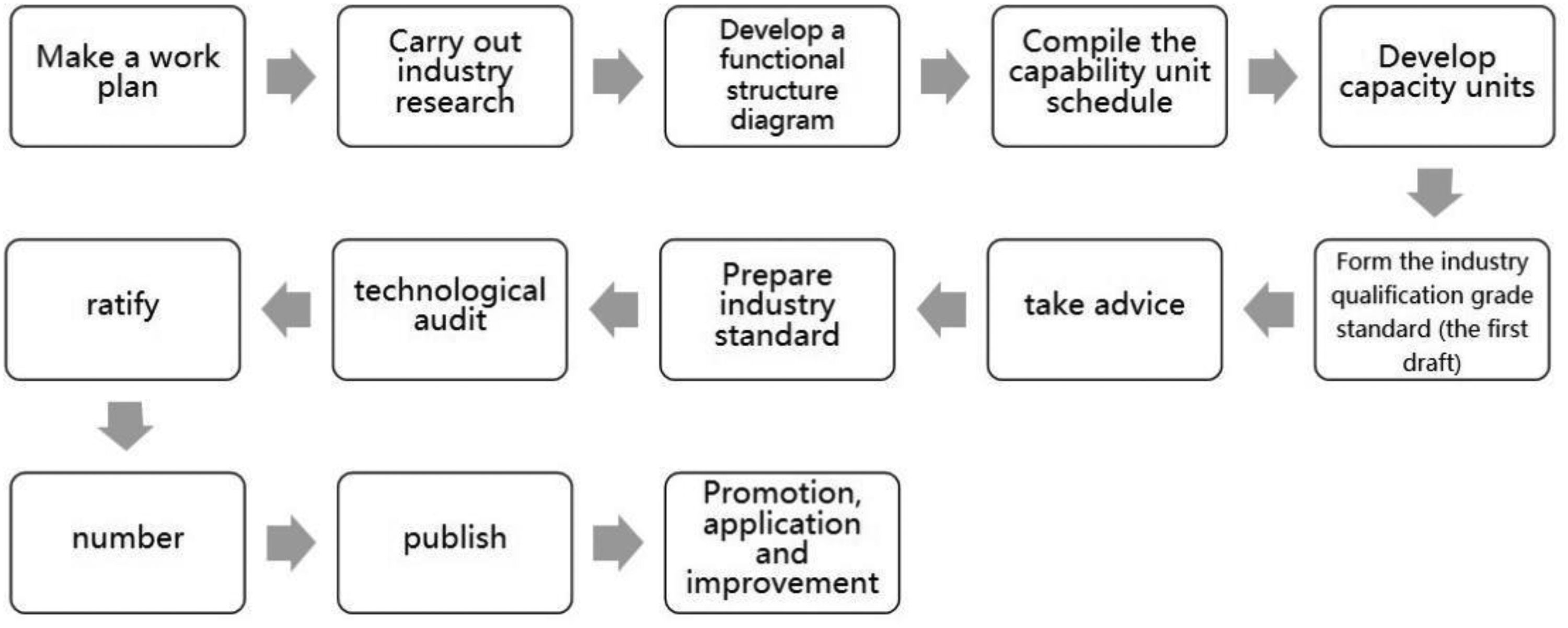
Guangdong Specification of Competency Standards (SCS) Development Paradigm.
Construction of SCS for Lifelong Education Qualifications
After the release of the GDQF, Guangdong Province, based on the development of vocational education, has deeply promoted the integration of industry and education, taking the provision of talent and intellectual support for social and economic development as a strategic starting point. It has organized educational research institutions, various levels of higher education institutions, industry associations, vocational skill assessment institutions, standardization technology institutions, and other market entities to jointly develop industry competency standards based on the GDQF for the automotive industry, logistics industry (cold chain), machinery manufacturing industry, and automation technology. These standards were ultimately released in the form of group standards, forming a standardized development paradigm that is aligned with international standards and suited to Guangdong's actual needs. This process includes developing work plans, conducting industry research, developing functional structure diagrams, compiling detailed lists of capability units, developing capability units, and formulating industry qualification level standards (drafts), seeking opinions, compiling industry qualification level standards, technological review, approval, numbering, publication, promotion, application improvement, and 13 other stages (Liu et al., 2023). This has promoted the precise alignment of skills training for talent and the talent requirements of industry positions under the Qualifications Framework, and provided pioneering experience for the development of domestic industry qualification level standards (Li et al., 2020).
The industry qualification level standards enable all of society to have a clear understanding of the required for different job positions, thus clarifying their own status and planning their development direction. Educational and training institutions can use this as a basis to develop talent training programs that integrate deeply with industry skill demands, thereby improving quality of talent development. Industry enterprises can use this as a basis to develop recruitment and talent training plans, thus improving the suitability of personnel positions and the effectiveness of training. Learners use this to communicate and connect various levels and types of learning achievements, and their training and performance can not only apply for recognition and conversion into credits for relevant academic courses but also apply for recognition of relevant qualifications, thus broadening the pathway for talent development and growth.
Development of the Prior Learning Experience Certification Management System
In terms of Prior learning experience certification, Guangdong has established a quality assurance, a qualification register database, and a credit recognition and conversion system (Wang, 2019). A preliminary exploration of the establishment of credit recognition and conversion rules under the credit bank model. [Adult Education, 39(7), 85–89.]. The quality assurance mechanism includes authoritative quality standards and standardized review processes, ensuring that the qualifications and credits under the Qualifications Framework meet the required quality level, ensuring fair and equitable recognition and conversion of qualifications and credits, and substantial equivalence. The qualification register constructs a lifelong learning ladder that integrates knowledge, skills, and abilities, providing diversified talent development pathways and promoting talent assessment reform. The learning achievement certification and conversion system helps to reduce dropout rates, decrease repetitive learning, improve learning efficiency, broaden talent development pathways, and promote cooperative training and credit recognition among educational and training institutions (Chen et al., 2016).
The quality assurance mechanism is the primary task of implementing the Qualifications Framework and is crucial to ensuring the quality of qualifications within the framework. The international practice is that only qualifications that have passed quality reviews can be entered into the qualification register for all members of society to consult or for lifelong learning. Figure 5 depicts the scene of the construction of the qualification register in Guangdong, and Figure 2 shows that qualifications must enter the qualification register according to certain procedures and review standards. After organizing and summarizing existing qualifications and matching them with qualification levels and credits, they are made available for lifelong learning by members of society. This increases the transparency, standardization, and diversification of qualifications; ensures the quality of qualifications within the Qualifications Framework; and highlights the lifelong, universal, flexible, and uniform quality of lifelong education (Li, 2020).
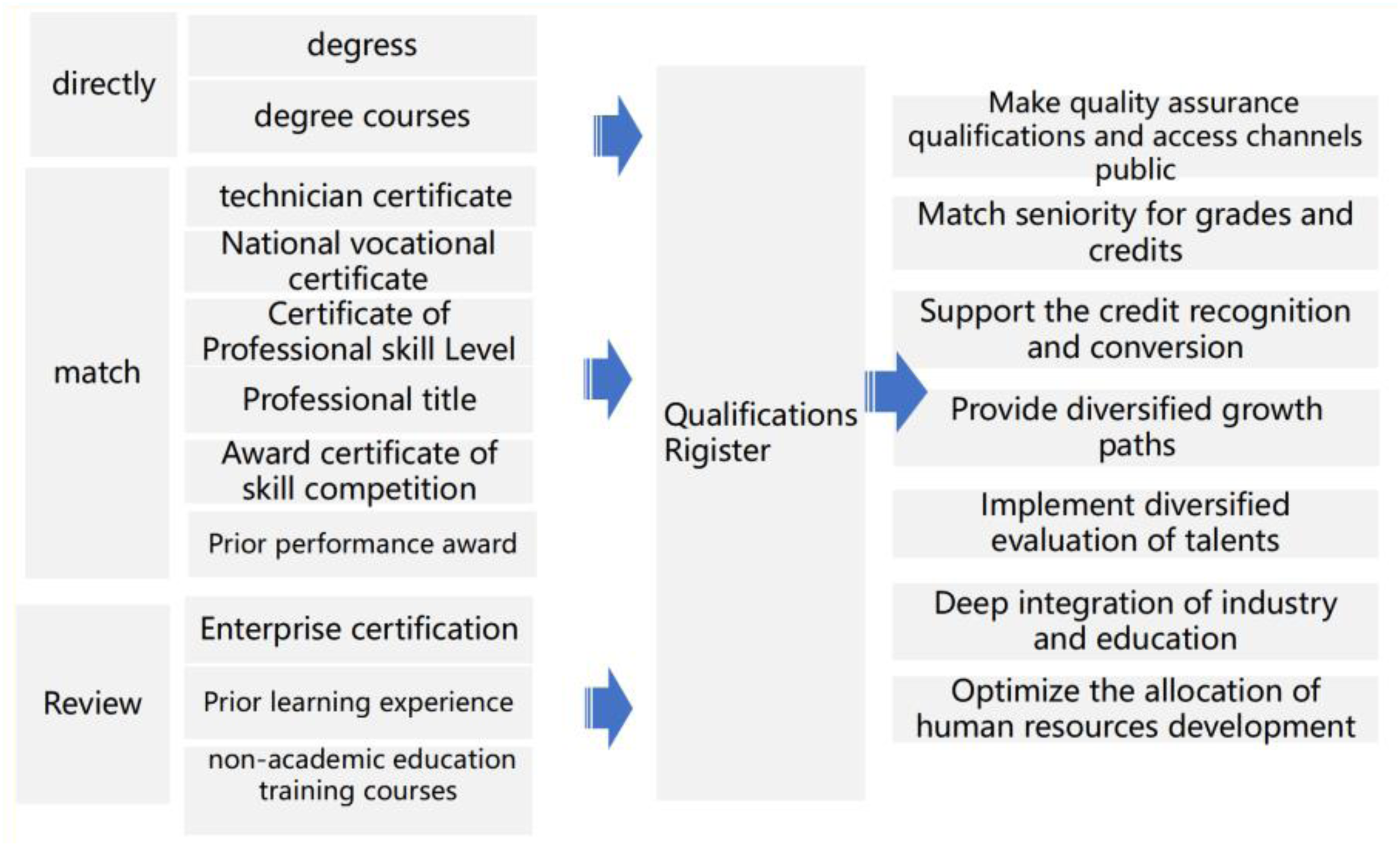
Qualification Register Rules.
In 2019, the “Implementation Opinions on the Implementation of Credit Recognition and Conversion in Higher Education in Guangdong Province (Trial)” (Department of Education of Guangdong Province., 2017, February 13) was issued by the People's Government of Guangdong Province in the form of a normative document, aiming to promote credit recognition and conversion in Guangdong Province and improve the quality of talent cultivation. The “Opinions” provide basic guidelines for credit recognition and conversion for over 160 higher education institutions in the province. It explicitly outlines the guiding ideology, basic principles, work objectives, and scope of application for credit recognition and conversion. The document also formulates methods for the recognition and conversion of achievements such as academic education courses, online course learning certificates, national vocational qualifications, special certificates, training certificates, skills competitions, intangible cultural heritage projects, professional experience, internships, volunteer services, innovation and entrepreneurship, scientific research, social services, cultural heritage, and invention patents. The “Opinions” serve as a comprehensive framework for the recognition and conversion of various types of achievements.
Construction of the Bank Operation System of Lifelong Education Credits
In recent years, China has proposed to accelerate the construction of new infrastructure such as 5G network base stations, artificial intelligence, big data centers, and industrial internet. The concept of “new infrastructure” has become a widely discussed and hot topic of concern in various sectors of society (Cyberspace Administration of the People's Republic of China., 2020, April 30). The credit bank is an important platform that connects lifelong learners, promotes educational equity, and facilitates the establishment of an open education system. It is also the foundation for building a learning society, requiring strong technical support and security capabilities. In terms of the operation system of the credit bank, digital technologies such as big data, block chain, and artificial intelligence are utilized to build an integrated online and offline service center. This includes the construction of the credit bank information system, the establishment of a lifelong learning digital archive, and the provision of services such as learning achievement certification, qualification profiles, credit maps, and career planning guidance for learners (Young, 2021). Additionally, Guangdong Province has innovatively constructed a integrated center with a three-in-one institutional system consisting of Qualifications Framework, learning outcome accreditation system, and credit bank system, providing publicity, experience, business processing, and cooperative exchange services for all members of society. As of December 2023, 1.39 million lifelong learning accounts have been established, with 14.6 million learning achievements from all levels and types stored, and 2.255 million instances of credit recognition and conversion conducted in 114 schools in Guangdong Province.
Figure 6 depicts the scenario of lifelong learning profile construction, while Figure 7 illustrates the integrated center of the Guangdong Credit Bank. In Figure 6, it is shown that learners can automatically establish a lifelong learning account in the credit bank through real-name verification via the identity recognition system. Subsequently, they can access the complete chain of personal lifelong learning data from educational and training institutions as well as relevant government departments. After establishing the lifelong learning profile, they can access various services such as credit maps and qualification profiles. Figure 7 demonstrates that the integrated center of the credit bank provides publicity and services for core business operations such as qualification registers and Prior learning experience conversion for all members of society, thereby promoting lifelong learning for all.
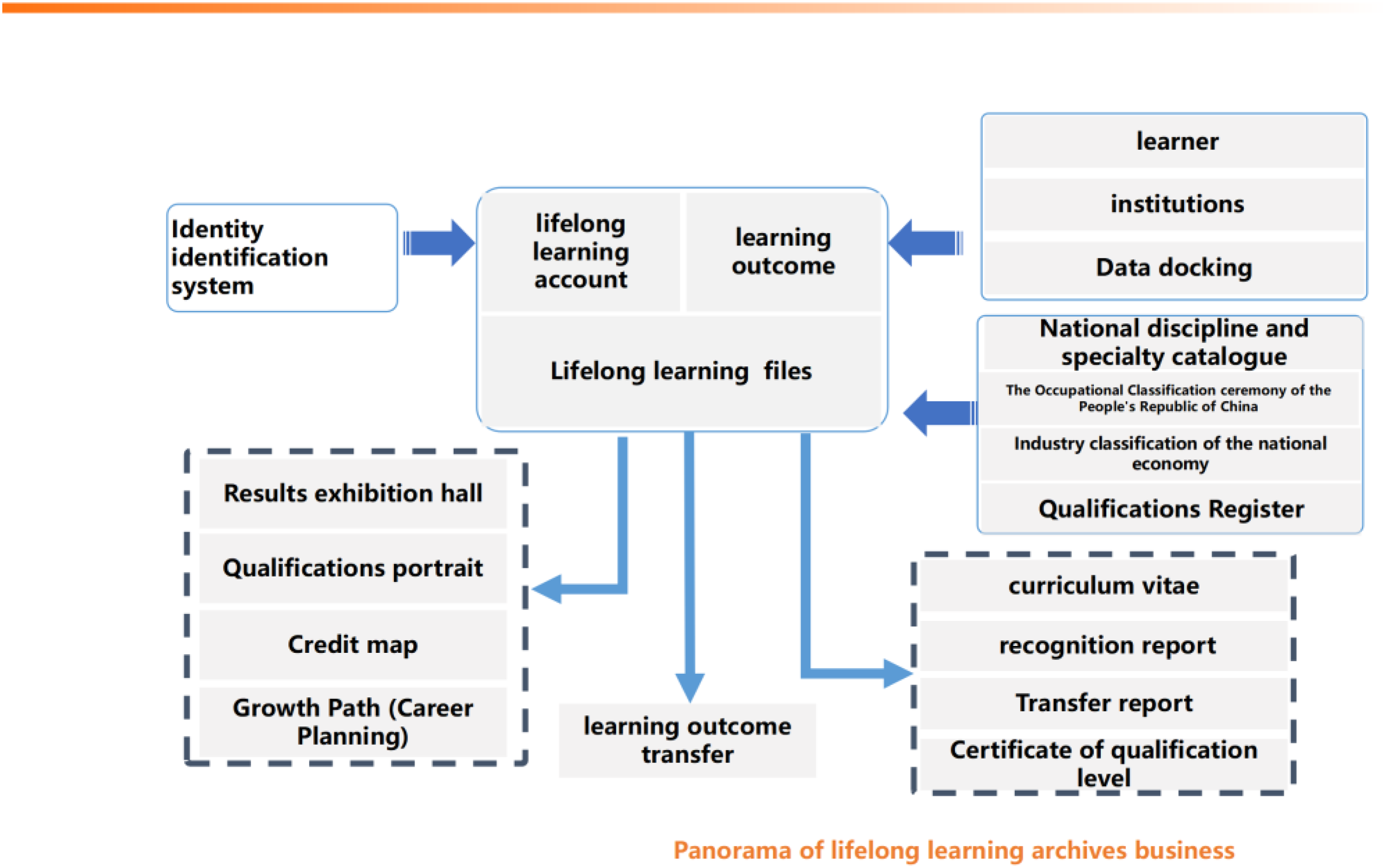
Lifelong Learning Archives.
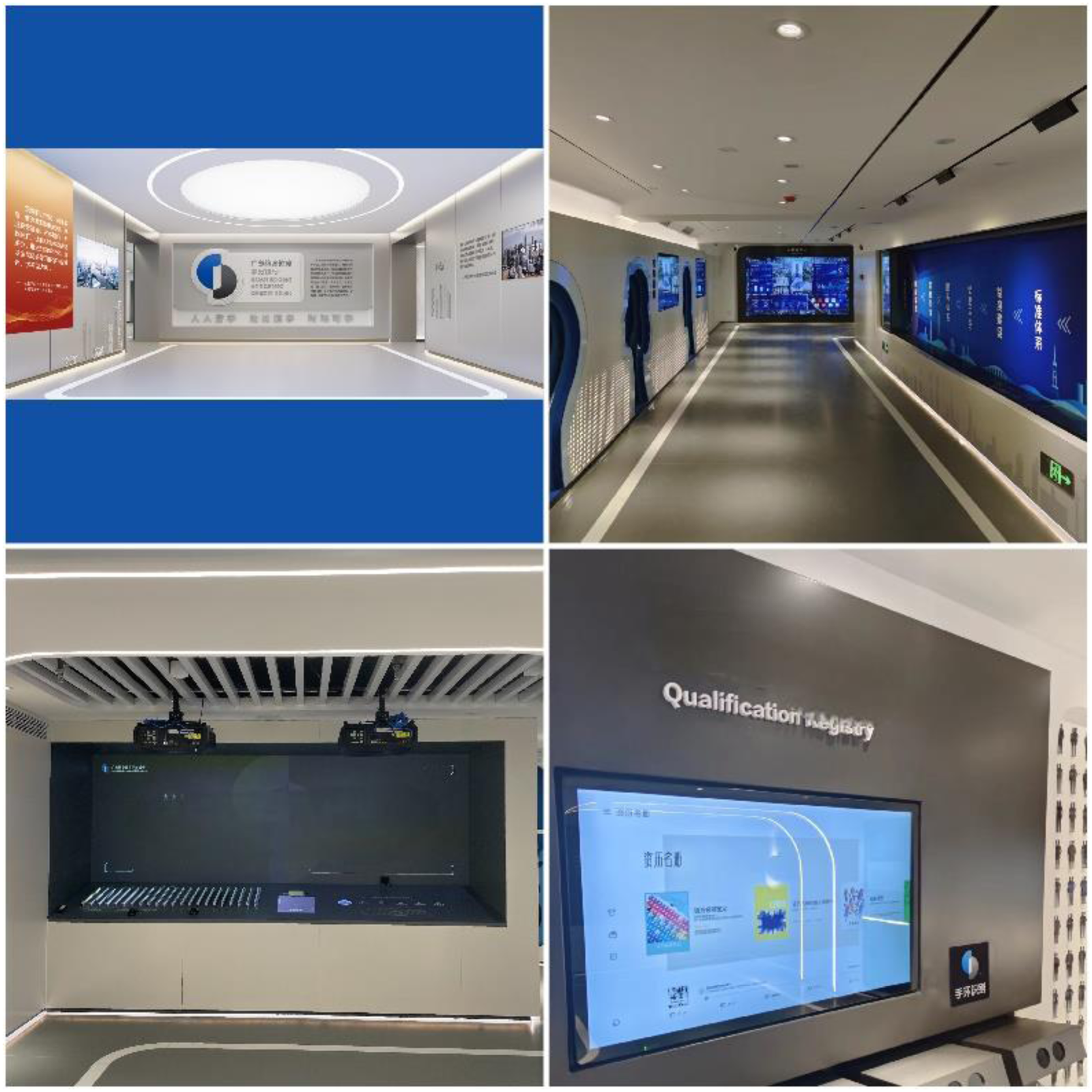
The Integrated Center of Guangdong Academic Credit Bank.
Collaborative Construction of Qualification and Credit Recognition in the Guangdong–Hong Kong–Macao Greater Bay Area
In order to promote lifelong education for practitioners in the Guangdong–Hong Kong–Macao Greater Bay Area, facilitate the orderly flow of talents in the region, and provide strong talent support for the development of the Greater Bay Area, the Department of Education of Guangdong Province signed the “Guangdong–Hong Kong Qualifications Framework Cooperation Intention Letter” with the Education Bureau of the Hong Kong Special Administrative Region in 2017. Additionally, cooperation intention letters were signed with the Education and Youth Affairs Bureau and the Higher Education Bureau of the Macao Special Administrative Region, establishing a mechanism for joint construction and sharing in areas such as Qualifications Frameworks, industry competency standards, and quality assurance mechanisms. This has promoted the mutual recognition of qualifications and credits in the Greater Bay Area, laying the foundation for international recognition of qualifications and credits (Xu et al., 2019).
In order to accelerate the realization of cross-regional and cross-level education connection and integration, and to create a more open and innovative education system, Guangdong Province is promoting the mutual recognition of subdegree level qualifications between Guangdong and Hong Kong. The mutual recognition of subdegree level qualifications between Guangdong and Hong Kong is an important step in the educational cooperation between the two regions, providing broader development opportunities for students in both Guangdong and Hong Kong, and also contributing to the development of the national “Guangdong–Hong Kong–Macao Greater Bay Area.”
Discussion
To establish “everyone success” education system and form “multiple talent, more journey success” system atmosphere and institutional environment, let “everyone has the chance to brilliant life” is the fundamental requirement of education modernization, Qualifications Framework as our universal lifelong learning and learning society construction of a basic and strategic task, there is a long way to go. In the process of Qualifications Framework construction, Guangdong province adheres to the people-centered development idea; makes full use of digital technologies such as big data, artificial intelligence, and block chain; and provides quality lifelong learning services for all members of society through multipaths and multidimensions. The exploration and practice of Guangdong province for building for everyone, benefit everyone, for everyone lifelong education system, establish all kinds of talent value can be reflected and respect the talent evaluation system provides Guangdong standard and Guangdong experience, it at the same time, Qualifications Framework, quality assurance mechanism and credit bank of the trinity system is to realize everyone can learn, always can learn the core elements of universal lifelong learning and important components.
Digitalization is leading the new wave of the future. The collision between education and digital technology will play a more beautiful movement in the symphony of human civilization and education China is making every effort to promote the education number Character, to build a lifelong learning society and learning country. Under this strategic background, the digital credit bank with digital characteristics, intelligence and information technology emerged at the historic moment, and played a positive role in enriching and improving the service ability and social value of the lifelong education system.
Qualifications Framework Construction: People-Centered, Serving the Whole People for Lifelong Learning
The Qualifications Framework, as an inclusive platform for promoting and assessing the comprehensive development, lifelong learning, and skills development of individuals, should be centered on meeting the needs of the people. It is committed to maximizing the opportunities for learners with different backgrounds and potentials to develop their own talents, allowing everyone to find multiple pathways for success and growth. This will help to promote the construction of a lifelong education system that is oriented toward everyone, benefits everyone, and is suitable for everyone, thereby providing higher quality services for lifelong learning for all.
Quality Assurance Mechanism: Ensuring the Substantive Equivalence and Fair Equivalence of Learning Outcome Certification
Quality assurance is the key to ensuring the authority and credibility of learning outcome certification and is a prerequisite for the benign operation and sustainable development of Qualifications Frameworks. It is also the core of communication and coordination between various levels and types of education and training. Only based on a common and followable quality assurance mechanism can learning outcome certification be substantively equivalent and fair. Quality assurance mechanisms generally include statutory third-party review organizations, grade standards (or common indicators), and a quality assurance system that combines internal and external elements.
Digital Credit Bank: To Provide Personalized, One-Stop and Intelligent Services for the Whole People can be Accurate Service
The digitalization of education is profoundly changing the way of learning, education, thinking, and life at an unprecedented speed. Credit bank construction in our country is striding into a new era of digital credit bank, digital credit bank generally include qualification register application system, lifelong learning electronic archives, information system, etc., which can provide personalized, one-stop, intelligent accurate service, such as qualification portrait, credit map, employment guidance and career planning, and digital credit bank effectively promoted the credit bank service ability and the charm of lifelong learning.
Conclusion
After ten years of theoretical exploration and practical innovation, Guangdong Province has established a system consisting of the Qualifications Framework, learning outcome accreditation system, and Credit Bank System, forming a comprehensive institutional system. It has developed a lifelong education qualifications framework construction model that combines international standardization and local innovative practices. This model includes a vision centered on meeting the needs of the people, a governance model involving multiple stakeholders such as the government, universities, industries, and communities, an institutional system with the lifelong education qualifications framework as the overarching standard and industry competency standards as the implementation standard, a qualifications register with a core quality assurance mechanism, and a credit bank operation system led by digitization.
However, the construction of the qualifications framework is a huge and complex system engineering project. It faces the ubiquitous new concepts and methods of lifelong learning in the digital age, as well as the continuous emergence of new technologies, new formats, and new models. The construction of the GDQF needs to keep pace with the times, benchmark national new requirements, expand new application scenarios for the qualifications framework, improve new mechanisms for learning outcome certification, and further unleash new dynamics of the credit bank system. This will contribute Guangdong's standards, experiences, and solutions to the construction of a learning society and a learning-oriented country, serving the lifelong learning needs of the entire population.
Footnotes
Ethical Statement
Ethical approval was not required for this study since no empirical studies were conducted, and no human data or participants were involved.
Funding
The author(s) disclosed receipt of the following financial support for the research, authorship, and/or publication of this article: This work was partially supported by the National Education Science Planning General Project (BKA230023): “Study on Digital Education for a Learning Society and a Learning Nation.”
Declaration of Conflicting Interests
The author(s) declared no potential conflicts of interest with respect to the research, authorship, and/or publication of this article.