



Abstract
The new generation of technology has reshaped information space for education, redefining some concepts of education. Based on the analysis of innovation practices and empirical studies in “internet + education,” we’ve developed the understanding of knowledge, learning, and curriculum. The Regressive View of Knowledge emphasizes knowledge transitions from finely symbolic information to comprehensive human intelligence, essential knowledge attributes evolve from static linearity to dynamic networking and the knowledge production mode changes from elite control to crowd intelligence aggregation. The new concept of learning shows that connectivist learning relies on constructing, developing, and utilizing information networks, both the pipe and the content within the pipe are equally important, the spiralling and deepening process of operation, wayfinding, sensemaking, and innovation, and the importance of the diverse interaction patterns and development paths. The new concept of curriculum points out that curriculum is a learning community, fostering connectivity and reciprocity of individuals and the community, and functions as a networked knowledge production system with continuous iterative evolution, coconstructed by both teachers and students. We urge education researchers and practitioners to enhance educational theories for the internet era in diverse contexts, further fostering innovative practices and exploring new approaches to cultivate outstanding innovative talents.
Introduction
The information space created by the internet has become an important new learning space for human beings. The new characteristics of the information space provide a new driving force to address the primary contradiction and promote the high-quality development of education. China's major policies such as the internet power strategy and the “Internet +” action plan have created a promising situation for the vigorous development of internet education in China and given birth to a new form of practice, that is, “Internet + education,” which has six typical characteristics: new spaces, new models, new formats, new elements, new institutional mechanisms, and new concepts. The introduction of new policies such as “the Guidelines of the promotion of ‘internet + education’ development” has further pointed out the direction for the vigorous development of “Internet + education” in China, driven by a new generation of disruptive technologies. While promoting practical innovation, the academic community continuously probes the “traces” of changes in knowledge, learning, and curriculum in the network environment. To explore the new theories and new laws of education hidden behind the complex educational reality and the educational innovation practices, we conduct an in-depth analysis of the innovative practice of “Internet + education” based on the new characteristics of information space and carry out empirical research and exploration based on curriculum data. On this basis, we summarize, refine, and develop new concepts of knowledge, learning, and curriculum of “Internet + education.” We hope that by sharing China's innovation experience and theory in “Internet + education,” we can provide a definitive reference and evaluation basis for enriching and developing the theoretical system of “Internet + education” for educational academia at home and abroad, to contribute to global educational development through China's efforts.
Background and Context
Technological Driver: The New Characteristics of Information Space Empower Education Reform and Innovation
Technological change is a key driving force for the development of human society. As a social subsystem, education finds itself in the midst of a transformative wave moving from the “physical-social” space to the “physical-social-informational” space. Compared with physical and social spaces, the information space presents new characteristics such as spatial and temporal flexibility, resource sharing, behavioral digitization, information crowdfunding, networked relationships, and system connectivity (Chen et al., 2019), which have become technological driving forces for innovations in educational practice forms and theoretical development. Specifically, spatial and temporal flexibility enriches teaching organization forms and teaching activity types, which helps promote the transformation of traditional teaching processes, structures, and functions. Learners can interact with a greater variety of information sources. In addition to real-time interactions between teachers and students, activities related to resource-based learning, topic discussions, online collaborations, task-driven learning, and human–computer interactions can enhance the online learning experience, giving rise to new teaching models represented by the learner-centered classroom and the flipped classroom. Resource sharing expands the availability of learning resources. High-quality educational resources, whether human or nonhuman, material or nonmaterial, tangible or intangible, from the whole society can be aggregated through the internet to jointly meet education achievement goals and the personalized development needs of students. The digitization of behavior enables the transformation of education research from “simple statistics and speculation” to “data-driven tracing, analysis, and early warning,” leveraging both machine intelligence and expert intelligence to unveil the previously inaccessible “black boxes” in research and provide profound insights into the underlying mechanisms and complex patterns of learning. Information crowdfunding manifests as changes in the knowledge producers, production processes, and knowledge forms in the network environment. The organization and methods of knowledge production are facing enormous transformation, as the aggregation of crowd intelligence has become a new way of knowledge production. Networked relationships manifest as the shift of interactions from a one-to-one and one-to-many linear structure to a many-to-many networked structure. The characteristics and quality of the network play crucial roles in learning outcomes. The purpose of learning shifts from memory replication to network development, leading to changes in the roles of curriculum and teachers. System connectivity means that education in the information space becomes more open and interconnected at the learning, teaching, and organization levels. The creation and utilization of an open education ecosystem to nurture innovative talents for future society has become a new challenge in education theory and practice.
Development in Practice: The New Forms of Educational Practice Require an Update in the Basic Understanding of Education
At the beginning of 2020, the COVID-19 pandemic broke out worldwide. To ensure the continuity of education and teaching at all stages as much as possible, China immediately implemented the policy of “suspension of classes but not learning.” As a result, various levels and types of education were “forced to transplant” into cyberspace, marking the beginning of unprecedented large-scale online teaching practices in China. Although the hastily launched online education practices were full of ups and downs, the new models, forms, and rules of online education supported by the internet have been noticed by education administrators, practitioners, and researchers. Different from traditional face-to-face classrooms, online teaching and learning are carried out in an open and distributed network environment, and new characteristics of the information space have given rise to various types of online learning methods (Wu & Chen, 2021). From the perspective of teaching characteristics, there are several types of online learning: self-directed learning, blended learning, collaborative learning, research-oriented learning, and hybrid experiential learning. From the perspective of teaching interactions, there are different modes of online learning dominated by teacher–student interactions, resource interactions, learning activity-centered interactions, student–student interactions, and human–computer interactions. The patterns and characteristics of different forms of online learning also vary. In particular, in online learning that focuses on student–student interactions represented by connectivist massive open online courses (cMOOCs) and virtual learning communities, the traditional basic understanding of knowledge, learning, and curriculum in the education field has been disrupted, the interaction structure has shifted from traditional one-on-one or one-to-many teacher–student interactions to many-to-many interactions. Learners have become producers and contributors of knowledge, and teachers have become facilitators for learner interactions. Knowledge is seen as something that grows and evolves rather than being preset, and learning is a process of continually developing an information network. The curriculum is no longer a stable system that disseminates content from top to bottom but is more open and defined by learners. Learning also exhibits more complex characteristics and patterns such as self-organization, collective intelligence emergence, nonlinearity, adaptation, and evolution (Xu & Chen, 2021). The limitations of traditional education theory become increasingly apparent when explaining and guiding such innovative practices. General Secretary Xi emphasized during a symposium on education, culture, health and sports, “We need to summarize the experiences of large-scale online education in response to the COVID-19 pandemic, use information technology to update educational concepts and transform education models.” The synergy between educational theory and innovative practices is key to the implementation of innovative practices in internet education on a larger scale. When educational theory innovation stagnates, the transformation of “Internet + education” practices is nothing but an illusion. The innovative practices of “Internet + education” have already emerged, and there is an urgent need for fundamental guidance through a new education theory that adapts to and matches it.
Exploration in Academy: Research in the Complex Pattern Supports Educational Theory Innovation
To explore the new perspectives on knowledge, learning, and curriculum in the context of “Internet + Education,” inspired by Connectivism learning theory, the author led a team to design and develop China's first online course based on Connectivism, starting in 2018. As of June 2023, the course has completed nine sessions. It has attracted a group of frontline educators, educational administrators, industry professionals, and students in the field of internet education who are willing to share, think, and communicate. This initiative has created an open learning community in the field of internet education, facilitating in-depth dialogue among diverse and heterogeneous learners through activities such as topic discussions, group collaborations, online seminars, blog reflections, and the sharing of case resources. It has gathered a wealth of practical experiences emerging from the course and used collective intelligence to extract innovative ideas and solutions, resulting in a series of achievements. Over the nine sessions, the course has had nearly 25,000 registered learners, with over 1.2 million interactions. The extensive learning data generated by the nine sessions and the reflective practices of the course team throughout the process have provided strong support for the exploration and development of new perspectives on knowledge, learning, and curriculum. On the one hand, using data-intensive research paradigms and a variety of research methods including complex network analysis, content analysis, text mining (word2vec, LDA topic clustering model, etc.), lag sequence analysis, qualitative comparative analysis, cognitive network analysis, and correlation and regression analysis, a series of research has been conducted to explore the complex patterns of knowledge and learning in connectivist courses. On the other hand, following the design research paradigm, through the iterative process of the nine sessions (Figure 1), data from learners, interview feedback data, course design data, and focus group discussion data, along with the author's experiential reflections, collectively contribute to the development and improvement of the new concept of connectivist curriculum. The dual efforts of practical exploration and research jointly drive the establishment and development of new perspectives on knowledge, learning, and curriculum in online education.
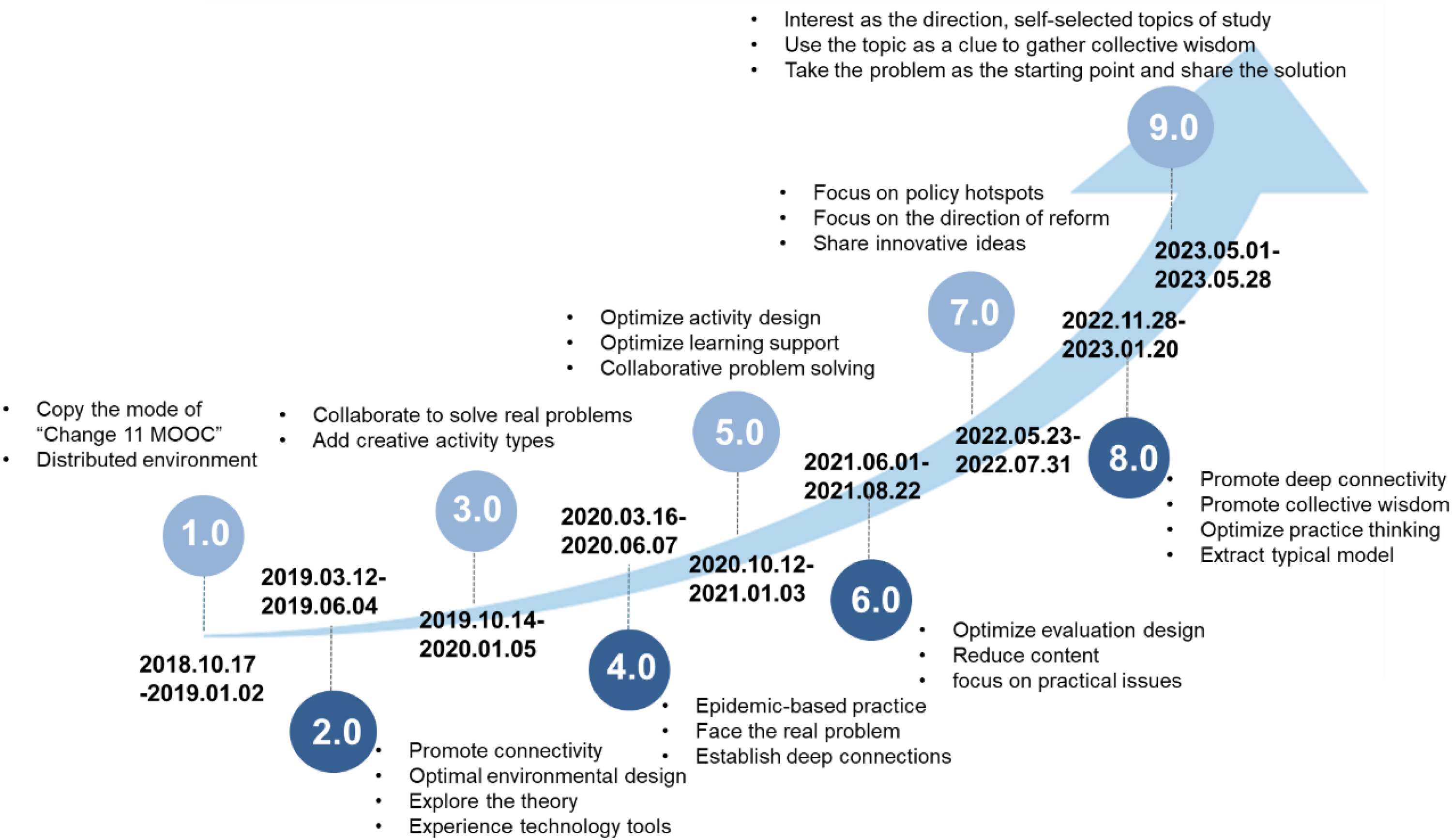
Nine circles of the connectivist massive open online course (cMOOC) “Internet + Education: Dialogue Between Theory and Practice.”
The New Knowledge Concept of “Internet + Education”
Knowledge is the human cognition and representation of cognitive objects. The development of media technology is driving the progress of knowledge concepts. The information space created by the internet has become an increasingly important education and teaching space. While providing a powerful medium for knowledge dissemination, the new characteristics of the information space also change the nature, characteristics, and production and dissemination patterns of knowledge. Using the history of media technology development as evidence, we compared the differences in knowledge across five stages, that is, the oral period, the handwritten period, the printed period, the electronic communication period, and the digital communication period (Chen et al., 2022). Drawing support from practical case analyses and research outcomes on cMOOC knowledge patterns, we proposed in 2019 the concept of knowledge in “Internet + education,” that is, The Regressive View of Knowledge, which adheres to the following three core viewpoints.
The Connotation of Knowledge Regresses from Finely Processed Symbolic Information to All Human Intelligence
The Regressive View of Knowledge emphasizes the full spectrum of knowledge. Knowledge consists of all the intelligence for human production and life, regardless of its physical form, social origin, or ethnic source. Knowledge not only exists in books but also takes various forms within human individuals. Not only do universal principles hold value but special experiences can also play important roles. Before the advent of the internet, although humans had accumulated a rich reservoir of intelligence, the limitations of media technology constrained the human capacity to understand and represent intelligence, and the amount of human intelligence that could be recorded and disseminated was like a drop in the ocean, with a vast amount of valuable human intelligence unable to be represented and disseminated. In addition, many cutting-edge fields of practice change rapidly, where the experiential intelligence discovered and accumulated by humans was not able to be translated into text before practices had already undergone dramatic changes. It is even more difficult to materialize this kind of knowledge in books. The information space creates the conditions for the dissemination of all human intelligence. The internet can overcome spatial and temporal limitations and quickly connect and aggregate all people's information. Multimodal networked knowledge can represent all types and sources of intelligence and break through the limitations of geography, expressive ability, and social status. As a result, all human intelligence can be circulated through the internet instantly and widely, highlighting the value of massive fragmented knowledge, subjective personalized knowledge, and comprehensive contextual knowledge. This view is also supported by curriculum data. A comparison of the characteristics of cMOOC-generated content and journal content under the same topic using word2vec and semantic similarity analysis shows that the perspective of knowledge generation is more diverse and the content is more vivid in cMOOCs and that the traditional knowledge represented by journal papers is more systematic and academic (Li et al., 2020).
The Essential Attributes of Knowledge Evolve from Static Linear Knowledge to Dynamic Networked Knowledge
The knowledge has changed from categories and hierarchies to networks and various ecologies, which makes the nature of things change and highlights the necessity of changing the space and structure of our organizations. Networked knowledge is built upon organizational and structural foundations and is related not only to nodes but also to the network structure between nodes. The acquisition of networked knowledge is the organization of fragmented information in a certain way so that new intelligence can emerge. Networked knowledge is a dynamic but not static representation and has timeliness, dynamic growth and context-dependence, evolving, developing, or disappearing according to changes in the environment and needs. Networked knowledge is comprehensive and fragmented, with small granularity and strong applicability, and it supports flexible separation and reorganization and is not constrained by the overall structure and logic, allowing it to more flexibly serve changing contexts and needs and making up for the shortcoming of long production and application cycles for systematized knowledge in the division of disciplines. Based on curriculum data, we attempted to construct a representation model for networked knowledge that includes seven attributes: contextualization, structural relationship, adaptability, type of contributor, degree of recognition, life activity, and cross-coverage. Based on this model, a method framework suitable for semiautomatic extraction of networked knowledge entities in internet communities was further constructed (Wang & Zheng, 2022). By setting classification rules based on topic documents, the text content is processed in relatively independent contexts. In addition, candidate entities are obtained through keywords, word combinations, and named entity recognition. Finally, the filtering and standardization of entities is achieved using entity semantic similarity calculation (Wang & Zheng, 2022).
The Knowledge Production Model Changes from Elite Control to Crowd Intelligence Aggregation
The full-spectrum characteristics of knowledge connotation imply that knowledge generation should not rely solely on a few intellectuals but rather on the power of all humankind. The internet has created information-sharing and crowdsourcing communities that are independent of spatiotemporal and social relations and has given birth to a new way of aggregating crowd intelligence for knowledge production. Knowledge producers are no longer exclusively intellectual elites engaged in knowledge production but encompass various types of social actors and even new technologies represented by generative artificial intelligence. Knowledge production and evolution rely on distributed collaborative networks, which have the dual functions of knowledge production and dissemination. The process of networked knowledge production is also the process of knowledge dissemination, which fundamentally disrupts the traditional linear model of knowledge production followed by dissemination and the relationship between knowledge production communities (Wang et al., 2022a). The contributors to knowledge are also the beneficiaries of knowledge. In addition, knowledge standards more respect individual values and personalized expression. Valuable knowledge is not necessarily a consensus of the crowd, and the degree of abstraction and generalization, the universal guidance, and the authority of knowledge producers are no longer rigid criteria for judging the value of knowledge. This conclusion is also supported by empirical evidence. The knowledge production in cMOOCs exhibits characteristics of crowd intelligence aggregation, internal iteration, and a bottom-up approach. In the community, learners establish connections through activities such as posting views, discussing topics, and providing collaborative feedback to form a knowledge production network. Many similar concepts are generated and gradually aggregated within the network, rather than presetting the knowledge system based on expert experience. Learners are not only knowledge recipients and consumers but also opinion producers, process evolutionists, and knowledge base miners. While contributing their own intelligence, they select, absorb, and integrate valuable information for learning based on their needs. Facilitators are not authorities in knowledge production but more often act as facilitators of knowledge production. Excessive intervention by facilitators may lead to the solidification of knowledge output or block the process of knowledge production (Lu & Chen, 2019).
The New Learning Concept of “Internet + Education”
The development of the concept of knowledge has made us realize that in the network environment, in addition to the original systematic knowledge by discipline, static objective knowledge, and limited book knowledge, there is networked knowledge that needs particular attention. How to cultivate innovative talents capable of adapting to and developing networked knowledge has become a new challenge for educators in this era. The connectivism theory provides a brand-new learning strategy that aligns with the new concept of knowledge, that is, learning is connectivity (Siemens, 2004). Individuals enter the internet with low-value knowledge or questions and within the massive amount of information, they search for, identify, filter, confirm, reconstruct, and finally integrate the information into high-value knowledge for output. Connectivism makes us realize that the increase in the value of individual knowledge no longer depends simply on reading and memorizing but on participating in extensive collaboration and open discussion, continuously connecting to valuable information sources and maintaining and developing high-quality information networks during interactions, becoming a crucial way of human learning in the “Internet +” era. A comparison with the previous two generations of learning theories reveals that the nature of connectivist learning has changed and that the interaction structure has been transformed from the original one-to-many linear structure to a many-to-many complex network structure (Xu & Chen, 2021). To further explore and enrich the understanding of the complex patterns of connectivist teaching and learning and to develop and enhance the connectivist learning concept, we conducted a series of research explorations based on data from nine course offerings, using methods such as complex network analysis, natural language processing, and qualitative comparative analysis. The main findings are as follows.
The Key to Connectivist Learning is to Construct, Develop, and Utilize Information Networks
Connectivism posits that learning is a process of establishing connections with specific nodes and information resources (Siemens, 2004). Identifying valuable information sources and building high-quality information networks represent completely new ways of learning in the networked environment. The differences in information networks between individuals become key factors affecting individual learning and development. The nodes in the information network include all information sources that are helpful and inspiring to an individual; they can be human nodes (e.g. teachers, partners, and experts) or nonhuman nodes (e.g. machines, websites, resources, and daily reports). A social network composed of humans can be considered a subset of an information network. Based on the curriculum data, we further analyzed the characteristics of information networks in connectivist learning, their evolution patterns, and their influence on individual development. In the courses, learners self-organized to form a multicentered social network with a small-world effect (Guo et al., 2020). There was a significant positive correlation between the position of an individual in the social network and the level of the conceptual network generated by the individual, and the position of the individual in the social network can reflect his or her ability to construct, organize, and utilize social network relationships(Xu & Zheng, 2024). The higher is this ability, the more beneficial it is for high-quality content production. These studies indicate the importance of social connectivity in learning. Second, social network relationships are more easily established and maintained between learners of the same gender, of the same social identity, and with similar behavioral tendencies, and there are significant reciprocity and transitivity effects during social network evolution (Xu & Du, 2022). When collaboration is needed, the closeness of social relations and similar ages are key driving factors affecting the selection of collaboration partners, and learners with close social relationships and similar topics, are easier to establish collaborative relationships (Wang & Xu, 2024). From the perspective of the pattern of learners’ attention distribution to nonhuman information sources, the weekly reports in the course accumulate more attention and can direct that attention towards learning resources such as blogs and forums (Gao et al., 2023).
The Pipe and the Content Within the Pipe are Equally Important in Connectivist Learning
The proponents of connectivism put particular emphasis on the role of the pipe in learning and put forward that “the pipe is more important than the content within the pipe,” that is, knowing where the knowledge is and the ways to acquire the needed knowledge is more important than what knowledge learners possess. To test this point of view, with the support of cMOOC2.0 course data, we used social network analysis, keyword extraction algorithms, and multiple linear regression to investigate the relationship of knowledge flow structure (i.e. “pipe”) and knowledge flow content (i.e. “content within the pipe”) with interaction levels. The study finds that the knowledge flow structure has a higher explanatory power for wayfinding interactions and sensemaking interactions than does the knowledge flow content (0.558 > 0.186 and 0.838 > 0.746) and has a lower explanatory power for innovation interaction than does the knowledge flow content (0.155 < 0.303), which indicates that the achievement of wayfinding interactions and sensemaking interactions relies more on the “pipe” and requires learners to actively express themselves and participate in interactions and that innovation interactions depend more on the “content within the pipe” and require learners to provide substantial input, demonstrating that to achieve the goal of knowledge creation, both the pipe and the content within the pipe are equally important (Tian et al., 2020). In addition, the feedback from learners collected through interviews also indicates that, for learners, the gain of connectivist learning is not only to expand network relationships but also to meet the practical needs of learners in knowledge development, solve real-world problems encountered in practice, and benefit from a new concept of knowledge and model of knowledge production. Connectivist learning is not only about the construction of interpersonal networks but also about problem discovery, experiential growth, continuous connection, and knowledge updating, drawing from diverse and fresh experiences and intelligence for solving complex problems (Wang et al., 2022a). Precisely for this reason, starting from the third period, the curriculum began to focus on how to promote the solution of complex problems and the realization of knowledge creation on the basis of connectivity.
Connectivist Learning is a Spiralling and Deepening Process of Operation, Wayfinding, Sensemaking, and Innovation
In 2014, Wang, author, and Anderson according to the degree of cognitive engagement from shallow to deep, constructed a framework of instructional interaction in connectivist learning(the CIE model) that includes operation, wayfinding, sensemaking, and innovation(Wang et al., 2014). This model not only offers an important theory to explain and guide the study of the interaction patterns in connectivist learning but also reveals four stages of deepening in connectivist learning. Operation interactions help individuals establish personalized learning spaces and construct distributed learning environments at the collective level; wayfinding interactions mark the beginning of learning; sensemaking interactions involve a process of enhancing and optimizing the learning network; and innovation interactions further elevate and maintain new knowledge innovation and build connections. To further clarify the relationships between different stages of connectivist learning, based on the cMOOC4.0 data, we used content analysis to encode the interactive behaviors and lag sequential analysis to identify the significant sequence of the occurrence of interactive behaviors (Huang et al., 2020). We also found a hierarchical support relationship between cross-level interaction patterns from low to high. For example, various wayfinding behaviors can facilitate discussion and negotiation, which further support the generation of learning products. The expansion effect of high-level interactions on low-level interactions is overarching, complementary, and weakly recursive (Huang et al., 2020). For example, knowledge creation can stimulate the occurrence of perception behaviors and promote the occurrence of proactive and direct wayfinding behaviors and emotional wayfinding behaviors across layers. In addition, the use of an epistemic network to analyze teaching interactions in connectivist collaboration also found that groups with different membership compositions do not have the same starting point for interactions. More technical and personnel preparations are often required when members have widely varying backgrounds. Groups with different types of problems employ differentiated low-level interaction methods to support high-level knowledge creation (Wang et al., 2023). The above results show to a certain extent that connectivist learning is not a linear and gradually deepening process but rather exhibits multithreaded, spiral-like progression.
Connectivist Learning Emphasizes the Interaction Between Students, and Learners Have Diverse Development Paths
Compared with behavioral-cognitivist learning and social-constructivist learning, connectivist learning places particular emphasis on the status and role of student‒student interactions. This is because diverse and heterogeneous learners brainstorm around the same complex problem; their differing perspectives and positions make it easier to generate new viewpoints and variables, driving the generation of new meanings and accelerating the transformation of knowledge (Xu & Chen, 2021). Through the continuous and extensive development of student‒student interactions, learners gradually move from the periphery of the network towards the center. A number of core learners with the same status as course facilitators emerge, and they disperse to form multiple community structures with the learners at the center (Xu & Zheng, 2024). This is a significant characteristic that distinguishes it from the traditional teacher-centered and teach-led learning. Connectivity learners are also self-oriented and network-oriented learners, setting their own goals and deciding independently with whom to interact and how to participate. To explore the autonomous and diverse development paths of learners in connectivist learning to provide more targeted support services, we further clustered and analyzed the participation types of learners based on social network and conceptual network characteristics. We found five types of learners: high-social and high-output connected creative learners, high-social and low-output social learners, low-social and high-output reflective learners, low-social and low-output wandering learners, and low-social and non-output marginal learners (Xu & Du, 2023). The first three types of learners are all connectivist learners, who show different development tendencies due to differences in goals and behavior styles. Different learners may undergo a transition in their participation type at different stages of curriculum learning. How to design learning evaluation rules that accommodate the development of different learners and how to optimize learning support to facilitate and guide the transformation from traditional learners to connectivist learners have become focal issues in connectivist curriculum design.
The New Curriculum Concept of “Internet + Education”
Technological innovation has revolutionized the fundamental understanding of knowledge and learning. Just as the emergence of industrial civilization has transformed the original production relations, and the operation and organization methods of assembly lines can better adapt to social development, the transformation of knowledge and learning concepts calls for the development of the concept of curriculum. Since 2008, under the leadership of George Siemens and Stephen Downs, the practice of connectivist courses outside China has flourished and garnered widespread attention and positive responses worldwide. Connectionism researchers have begun to pay attention to the unique features of this new form of online courses, such as emphasizing the openness, community-based nature, generative nature, and self-organization of the curriculum (Carreño, 2014; Wang & Chen, 2014; Xu et al., 2022). Based on the earlier research, we integrated the practical experiences from the nine periods of connectivist courses and the research findings for connectivist teaching and learning patterns to further test, develop, and refine the connectivist concept of curriculum as “an evolutionary knowledge community,” emphasizing the following three aspects.
The Curriculum is a Learning Community That Promotes the Connectivity and Mutual Development of Individuals and the Community
Connectivism posits that learning cannot rely on a single expert and that it is not limited to a formal learning environment and qualified professionals as the only sources of help for others; learners more need information sources that can play roles in specific situations. Connectivist course is actually a community in which members establish and maintain relationships based on common interests and values through interactions, communication, dialogue, and discussion. Its key role is to gather learners, meet and identify diverse needs, and connect learners with the information sources they need to achieve sharing and cocreation (Chen & Xu, 2023; Wang & Chen, 2014). Its aim is not to present content but instead to facilitate connectivity and shape the network, such as recommending potential and valuable content or learning partners to learners, guiding learners to quickly integrate into the community through a variety of wayfinding activities, and establishing close connections with others (Wang et al., 2022b). The course data also show that (Figure 2) with the implementation of courses, the network diameter gradually decreases, the average path length gradually shortens, the average clustering coefficient gradually increases, and the strength of connections among participants increases, indicating that the implementation of courses enhances the closeness and information dissemination efficiency of the social network. In addition, the information dissemination rate and the closeness of the network are both better than those of the social networks formed through platforms such as Weibo, YouTube, and Facebook. Furthermore, community attributes emphasize that the courses focus not only on the growth of individual learners but also on the shaping and sustainable development of the community, which is equally important. There are mutually beneficial and interdependent relationships between learners and the community as well as between individuals and the group. Influenced by community culture, organizational norms, reciprocal relationships, significant others, and social capital, the construction of individual networks, the setting of goals, and the content of focus change constantly. For example, individual learners many initially focus on areas or topics of personal interest, but they are continuously attracted and connected to a wider variety of resources or groups under the influence of constantly emerging new topics, content, and nodes in the network. Similarly, the continuous participation of heterogeneous individuals, the pooling of experiences, the clashes of ideas, and iterative corrections also contribute to the cohesion of the group and accelerate the emergence of collective knowledge (Xu & Du, 2022).
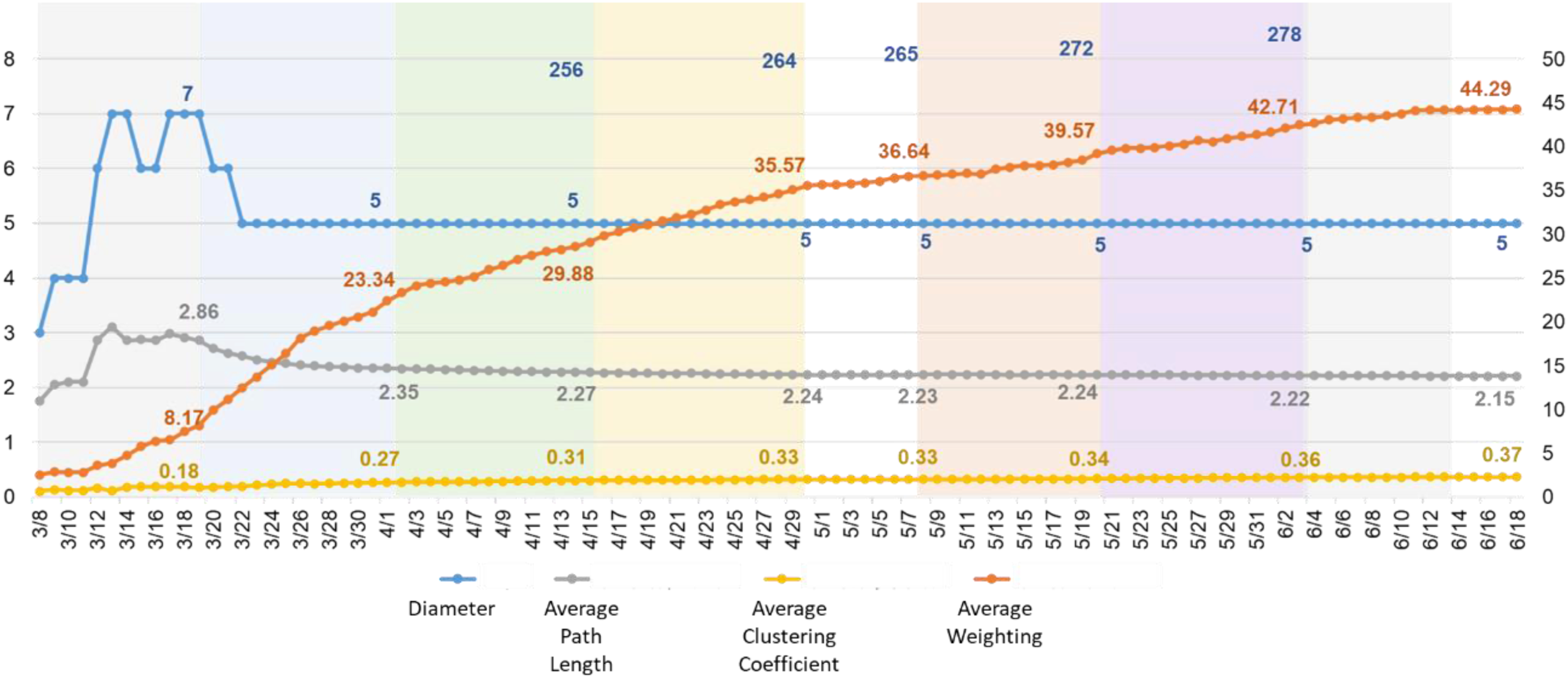
Accessibility indexes of social network over time.
The Curriculum is a Networked Knowledge Production System with Continuous Iteration and Evolution
Connectivist curriculum not only focuses on connections and pipes but also emphasises the exchange and aggregation of experiences, the realization of sustainable complex problem solving and knowledge creation, and the promotion of the dynamic growth of networked knowledge. This means that the curriculum is no longer devoted to the dissemination of content from top to bottom with a clear structure. Although the curriculum sets some open and complex topics, it does not contain authoritative and fixed learning content that must be mastered. The predesigned content of the curriculum serves only as a starting point for knowledge growth and a catalyst for divergent discussions. More content is dynamically generated during the process of learners’ continuous participation and discussion, and the generated content becomes new nodes or raw material to drive the next round of knowledge production processes. For example, in the third period of the curriculum, the blog contributed by learners, titled “Is ‘systemic knowledge’ really not important?” (https://cmooc.bnu.edu.cn/9032/), has become a hot-topic resource with widespread attention, leading to discussions of a series of questions regarding the relationship between “Internet + education” and traditional education as well as the values of systemic specialized knowledge and fragmented knowledge. The course design and development process itself is not an overnight process. Only the basic design can be completed in the early design stage, with more content, activities, and topics emerging during the implementation process and being fed back to supplement the original design. For example, the live events in each period, including guest speakers and content shared, are determined and flexibly adjusted based on the development and implementation process. Even learners can initiate online discussion activities themselves. Course discussions are not limited to specific topics, and generative topics are allowed. In the collaborative problem-solving activity in the third period, learners freely formed 13 collaborative groups. Among them, only five groups chose the problems predesigned by the curriculum team; the remaining eight groups opted for collaborating on generative problems contributed by the students. In addition, there is an accumulative, iterative, and evolving relationship in different periods of the curriculum. The high-quality content generated in earlier periods of the curriculum and the learning products created through integration become starting resources for new courses. For example, in cMOOC 2.0, topic II produced two blog posts, “Sharing of Classroom Interaction Tools” and “Summary of Classroom Interaction Tools,” which became key recommended resources for topic II of the subsequent courses.
The Curriculum is Coconstructed and Co-Operated by Teachers and Students Through a Combination of Other-Organization and Self-Organization
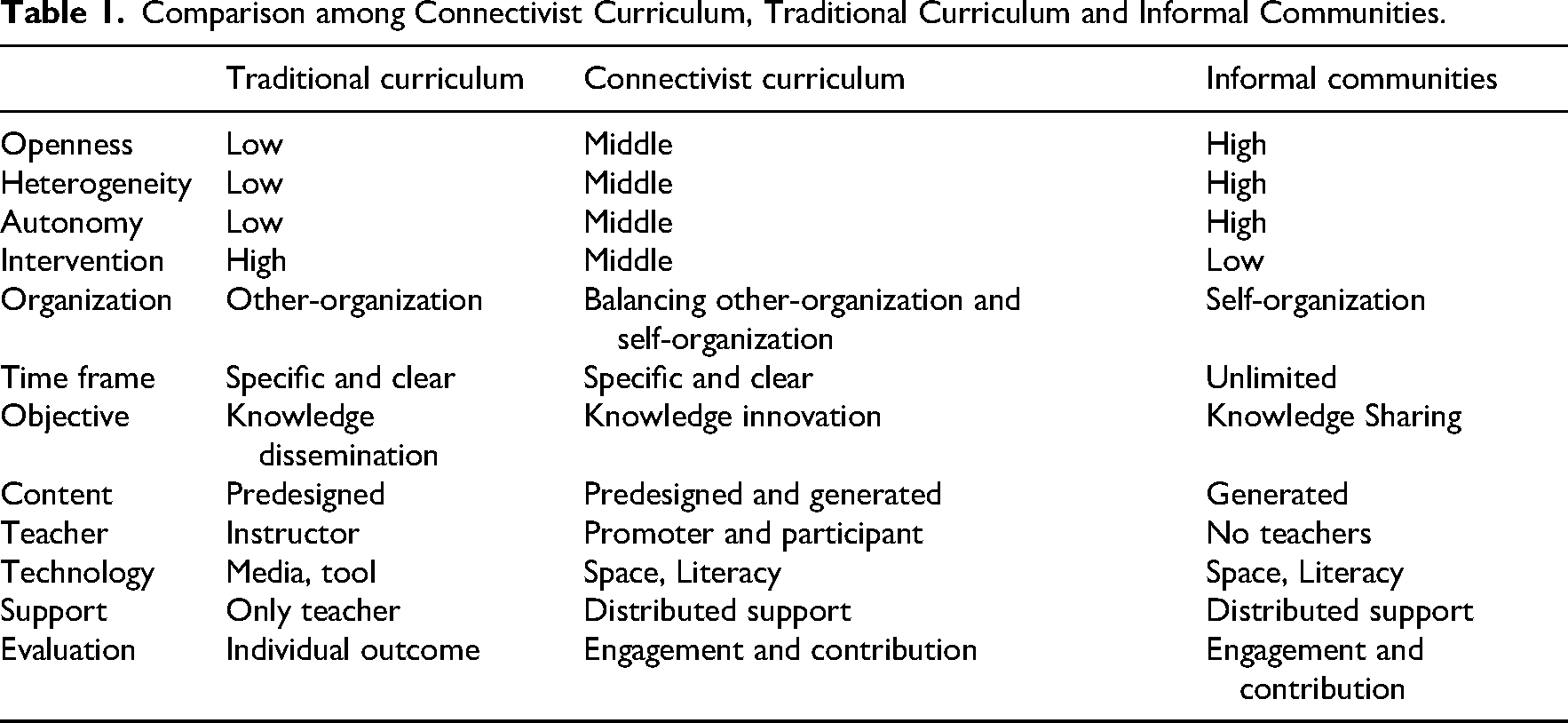
The curriculum retains the basic attributes and characteristics of the traditional curriculum in topic selection, time frame setting, resource preparation, publicity organization, and mechanism design. The courses are organized but not completely controlled by the curriculum team. In a traditional curriculum, teachers and students have a subject–object relationship, an authority–obedience relationship, a guiding–being guided relationship, and a central–peripheral relationship, and in the connectivist curriculum, learners are not just passive recipients and consumers of the curriculum but also curriculum builders, activity hosts, content contributors, and learning facilitators, that is, the curriculum is coconstructed and cocreated by all participants. As shown in Table 1, the openness, member heterogeneity, learner autonomy, and curriculum team intervention level of the connectivist curriculum are between those of traditional school education and informal knowledge communities, emphasizing the complementarity of other-organization and self-organization. Other-organization is reflected in the fact that the basic design of key elements and the curriculum implementation process still require the intervention of the course team based on the connectivist curriculum design theory and methods; self-organization is manifested in the fact that the establishment of community relationships, the development of networks, and the emergence and growth of course content are controlled autonomously by learners. In terms of the time frame for learning, connectivist curriculum has more clearly defined design and support service hours than does informal knowledge communities. However, after the course concludes, learners can still engage in self-organized connectivist learning. Furthermore, the knowledge objective of the curriculum places greater emphasis on how to harness crowd intelligence to facilitate the growth and innovation of knowledge rather than the dissemination of fixed knowledge and simple knowledge sharing. The course content also combines preset and generative elements. The role of the teacher shifts from being a guide and observer to that of a facilitator and participant. Technology is not just a vehicle for delivering the course or a medium for efficient content dissemination but it also represents a new space for learning. Engaging with technology and harnessing it for learning have become essential skills for learners. In terms of support services and evaluation orientation, connectivist curriculum is closer to informal knowledge communities, and it is characterised by peer assistance and distributed support and encourages individual participation and contributions.
Comparison among Connectivist Curriculum, Traditional Curriculum and Informal Communities.
Conclusion and Prospects
Over the past five years of research and practical exploration, we have become deeply aware that the development of science and technology, especially the emergence of the new information space with the internet at the core, has not only changed the way humans learn and live but is also triggering a revolution in knowledge, learning, and curriculum concepts. The internet has become a completely new field of human teaching and learning, and the potential that the new space can offer to students is far greater than what teachers, peers, and books can provide. However, some educators have not truly embraced or harnessed the advantages of the internet, still viewing it merely as a tool or medium. To use the internet to drive educational reform and innovation and to realize the digital transformation of education from school-based education in the industrial age to large-scale education in the “Internet+” era, one must focus not only on the traditional concept of knowledge but also, more importantly, on the concept of knowledge in the regression theory; pay attention not only to formal learning guided by behavioral-cognitivism and social-constructivism but also to lifelong education-oriented learning guided by connectivism; and emphasize not only the application of new methods and tools but also, more importantly, the promotion of the innovation of curriculum forms and educational models guided by new concepts of knowledge, learning, and curriculum. We hope that by reviewing previous research and exploring the results of practical experiences, we are able to inspire more education researchers and practitioners to focus on and examine the development of educational theories in the network environment, to test and improve the understanding of knowledge, learning, and curriculum in a wider range of contexts and, on this basis, to contemplate teaching strategies and instructional model innovations that support the implementation of new concepts of knowledge, learning, and curriculum, so as to jointly explore new ideas for cultivating top-notch innovative talent.
Footnotes
Declaration of Conflicting Interests
The authors declared no potential conflicts of interest with respect to the research, authorship, and/or publication of this article.
Ethics Statement
Ethical approvals were gained from the hosting institution.
Funding
This research is supported by the National Natural Science Foundation of China (NSFC) [Grant No. 62507026] and Natural Science Foundation of Shandong Province [Grant No. ZR2024QF166].
Informed Consent
Consent was obtained from all individual participants included in the study. Learners volunteered to participate in this study, and the data were reported anonymously by researchers.