




Abstract
Purpose
The purpose of this investigation was to evaluate the influence of radiant heat and ultrasound on fluoride release and surface hardness of 3 glass ionomer cements (GICs).
Methods
There were 3 experimental groups for each GIC; in group 1, the specimens were left to set without any treatment; in group 2, the specimens were irradiated for 2 minutes using a LED unit; and in group 3, ultrasound was applied using a scaler for 55 seconds on the specimen surface. Fluoride release measurements were performed daily for 7 days and at days 14 and 28. Surface hardness of the tested GICs was determined using Vickers method. The measurements were performed 24 hours and 7 days after mixing. Statistical analysis of the data was made using 1-way ANOVA and Tukey's and Bonferroni post hoc tests (α = 0.05).
Results
Radiant heat during setting reduced the fluoride release and increased the surface hardness of GICs (p<0.05). Ultrasonic treatment also reduced the fluoride release and increased the surface hardness (p<0.05) of GICs but in lower extent. Among the GICs there were differences in fluoride release and surface hardness properties depending on their composition (p<0.05).
Conclusions
Radiant heat and ultrasonic treatments may be useful methods for GIC restorations in order to achieve faster adequate initial mechanical properties.
Introduction
Glass ionomer cements (GICs) are broadly used for dental restorations in daily clinical practice (1) due to their advantageous properties such as fluoride release, which provides anticariogenic activity (2), good biocompatibility (3), and chemical bond to the dental tissues (4). However, they are sensitive to moisture and have slow maturing reactions, resulting in delays in the development of the final strength of the materials (5), which may be achieved 3 months after mixing of the cement (6).
GICs are formed by a neutralization reaction between typical fluoro-alumino-silicate glasses and aqueous solution of polyalkenoic acids, such as polyacrylic acid or acrylic/maleic acid copolymer (7). Setting reactions begin immediately after mixing powder which contains glass particles with acid liquid. The fluoro-alumino-silicate glasses are degraded after the acid attack, releasing calcium and aluminum ions, which are chelated by the carboxylate groups and crosslink the polyalkenoic acid chains (6). This crosslinking process contains complex reactions and continues for some weeks after initial hardening, leading to increased mechanical properties of GICs.
With the aim of overcoming the disadvantages of the initial stage of GIC setting, it has been recommended to accelerate the maturation process, providing external energy (8–9–10). Two methods have been used for this purpose: the application of ultrasonic waves, and the application of radiant heat from a dental light-curing unit. Regarding these methods, previous studies reported improved early mechanical properties (11, 12), enhanced resistance to water degradation and better adaptation to cavity walls (13).
After mixing of a glass ionomer material and as the setting reaction continues, the hardness of the material increases and achieves the highest values when the reaction completes (14). Moreover, fluoride release is very high in the beginning of the GIC setting and drops as the maturation of the material proceeds (15). As a matter of fact, the surface hardness and fluoride release of a GIC may indicate the stage of its maturation.
Thus, the aim of this in vitro study was to evaluate the influence of radiant heat and ultrasound on fluoride release and surface hardness of 3 conventional GICs and how their composition affects these properties. The following 3 null hypotheses (Ho) were set in the current study. Ho1 stated that fluoride release and surface hardness of the tested GICs are not affected by application of radiant heat during setting. Ho2 stated that fluoride release and surface hardness of the tested GICs are not influenced by application of ultrasound during setting. Ho3 stated that the tested GICs present the same fluoride release and surface hardness properties.
MATERIALS and methods
Materials
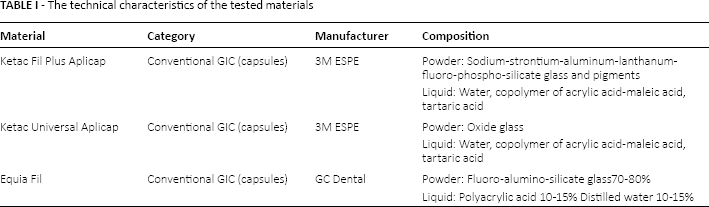
Three contemporary conventional GICs were investigated (Ketac Fil Plus Aplicap – KF, Ketac Universal Aplicap – KU, Equia Fil – EF). The tested glass ionomer materials were supplied in capsulated form and the shade was A3.5. Their technical characteristics are shown in Table I.
The technical characteristics of the tested materials
Experimental groups of the study
Thirty cylindrical specimens of each GIC were prepared. The dimensions of the specimens were 7 mm in diameter and 2 mm in thickness and were prepared using Teflon molds, resulting in 90 specimens in total. There were 3 experimental groups (n = 10) for each glass ionomer material. In group 1 (control group), after preparation the specimens were left in the mold to set without any treatment. In group 2 the top surface of the specimens was irradiated for 2 minutes using an LED unit (Elipar S10; 3M ESPE) at 1,200 mW/cm2 with standard curing mode. The highest temperature recorded at the tip of the LED unit during 2 minutes of irradiation was 54.7oC. The diameter of the light tip of the device was 9 mm and there was no distance between the light tip and the top surface of the specimen during irradiation. In group 3, ultrasound was applied on the top surface of the specimens using an ultrasonic hand piece with a flat tip scaler (2 mm wide) of Suprasson P5 Newtron (Satelec, Acteon Group). The parameters for the handpiece device were 36 KHz frequency with the maximum power setting, without water spray. The flat tip was moved continuously for 55 seconds on the specimen surface in a uniform manner over a polyester strip with a light hand pressure.
Preparation of specimens
The mixing of the glass ionomer materials for the preparation of the specimens performed according to manufacturers’ instructions in room temperature (23 ± 1oC). The capsule was activated and immediately transferred to a rotating mixer (RotoMix™; 3M ESPE) for mixing for recommended time. Subsequently, the capsule was loaded into the gun and the cement was immediately injected into the mold. Prior to placing the material into the mold, a polyester strip was placed on a glass slab; the mold was then placed and the GIC packed. After placing the GIC, a second polyester strip was placed on top of the mold and a glass microscope slide was placed over the GIC in order to achieve a standardized surface finishing and to remove the excess of the material. The glass ionomer specimens were left to set in the mold for the appropriate time of each material (7 minutes for KF and KU and 5 minutes for EF from the beginning of the mixing) and then they were removed carefully. Subsequently, the prepared specimens were immersed individually and suspended with nonfluoride dental floss in 4 mm of deionized water in a plastic container at 37 ± 1oC.
Fluoride ion release measurements
First, the fluoride ion release measurement was performed for each specimen 24 hours after mixing. One milliliter of deionized water was rinsed on each specimen above the plastic container and then the specimens were transferred to a new plastic container with fresh 4 mL of deionized water. Subsequently, 0.5 mL of total ionic strength adjustment buffer (TISAB III; Thermo Fisher Scientific) was added into the solution. The fluoride ion concentration was then evaluated using a fluoride ion-selective electrode (Orion 9609BNWP, Ionplus Sure-Flow Fluoride; Thermo Scientific) coupled to a bench top analyzer (Orion Star™ Series ISE Meter; Thermo Scientific) with a detection limit at ± 0.01 ppm. All measurements were carried out at room temperature (23 ± 1oC) and data were converted to μg/cm2F− units. Fluoride concentration analysis was continued for all experimental groups daily for 7 days and then for days 14 and 28.
Measurement of surface hardness
Eighteen specimens of each GIC were prepared using the same method as described previously for fluoride release assessment. In addition, the experimental groups (n = 6) were the same as mentioned above. Surface hardness was determined by Vickers method using a microhardness tester (HMV-2000; Shimadzu) at a load of 200 g with an indentation time of 10 seconds. The measurements were performed 24 hours and 7 days after specimen preparation. During the experimental period the specimens were immersed in 4 mm of deionized water individually and the solution was renewed daily. Five indentations were made on top surfaces of each GIC specimen, 1 in the center of the surface and 1 in every quadrant. The dimensions of the indentations were evaluated using the optical microscope of the hardness tester and the data were independently averaged and reported in Vickers Hardness Numbers (VHN).
Statistical Analysis
Statistical analysis of the data was done by SPSS 20.0 and performed using 1-way ANOVA. The differences in fluoride concentrations among the experimental groups were detected using Bonferroni post hoc test (a = 0.05). Paired t-test and nonparametric Wilcoxon test were done in order to compare the cumulative fluoride release among the experimental groups (a = 0.05). One-way ANOVA and Tukey's post-hoc test were used to compare the mean surface hardness between the GICs for each experimental group (a = 0.05).
Results
Fluoride release data
Fluoride release patterns (μg/cm2) of the treatment groups separately for each tested GIC during the 28-day period are presented in Figure 1 a–c. Figure 2 a–c illustrates the fluoride release patterns (μg/cm2) of the GICs, separately for each treatment group during the 28-day period.
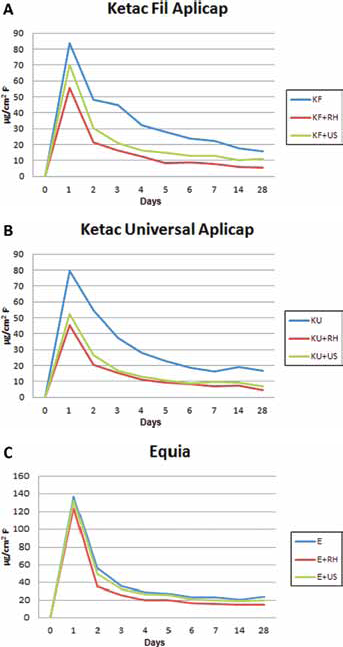
Fluoride release patterns (μg/cm2) of the treatment groups during the 28-day period: (
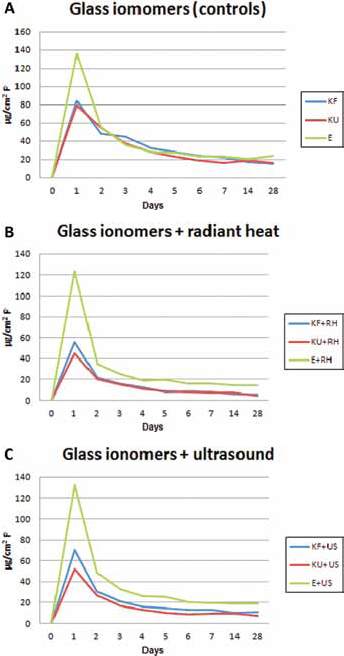
Fluoride release patterns (μg/cm2) of the tested GICs during the 28-day period: (
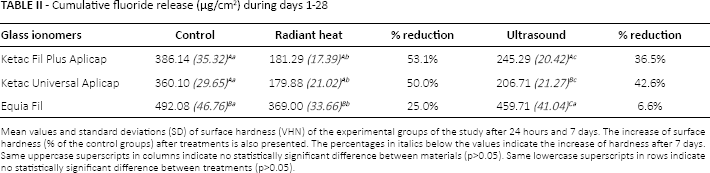
Mean values and standard deviations of cumulative fluoride release expressed in μg/cm2 F− during the 28-day period of the GICs for all the experimental groups are presented in Table II. In all treatment groups, EF specimens released the greatest amounts of fluoride ions (almost double for irradiant heat and ultrasound groups) among the GICs (p<0.05). Cumulative fluoride release of KF and KU did not differ significantly in control and radiant heat groups (p>0.05), while in ultrasound groups KF specimens released significantly larger amounts of fluoride compared to those of KU (p<0.05).
Cumulative fluoride release (μg/cm2) during days 1-28
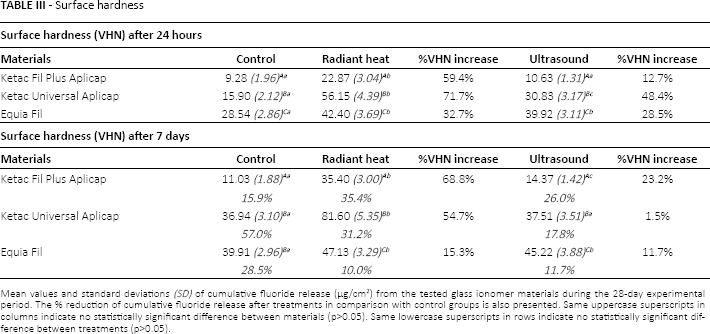
Mean values and standard deviations (SD) of surface hardness (VHN) of the experimental groups of the study after 24 hours and 7 days. The increase of surface hardness (% of the control groups) after treatments is also presented. The percentages in italics below the values indicate the increase of hardness after 7 days. Same uppercase superscripts in columns indicate no statistically significant difference between materials (p>0.05). Same lowercase superscripts in rows indicate no statistically significant difference between treatments (p>0.05).
Statistical analysis revealed significant differences in cumulative fluoride release among the treatment groups (p<0.05). In particular, control groups of the GICs exhibited the highest cumulative fluoride release (p<0.05) during the experimental period followed by ultrasound groups, except for EF which did not present significant difference (p = 0.11). The lowest cumulative fluoride release was obtained from radiant heat groups in all tested GICs (p<0.05). The reduction of cumulative fluoride release in comparison with control groups was in ultrasound groups: 42.6% for KU, 36.5% for KF and 6.6% for EF; in radiant heat groups: 53.1% for KF, 50.0% for KU and 25.0% for EF.
Surface hardness data
Mean values and standard deviations of surface hardness (VHN) of the experimental groups of the study 24 hours and 7 days after the preparation of the specimens are presented in Table III. After 24 hours, the surface hardness among GICs was significantly different, regardless of the treatment of the specimens during setting. More specifically, EF exhibited the highest surface hardness in control and ultrasound groups followed by KU and KF (p<0.05). However, in radiant heat groups KU presented significantly higher surface hardness than EF (p<0.05).
Surface hardness
Mean values and standard deviations (SD) of cumulative fluoride release (μg/cm2) from the tested glass ionomer materials during the 28-day experimental period. The % reduction of cumulative fluoride release after treatments in comparison with control groups is also presented. Same uppercase superscripts in columns indicate no statistically significant difference between materials (p>0.05). Same lowercase superscripts in rows indicate no statistically significant difference between treatments (p>0.05).
Among the treatment groups, the highest surface hardness was observed in specimen groups irradiated with the LED unit, followed by those that received ultrasonic treatment, while the control groups presented the lowest values (p<0.05). Exceptions were observed only for EF between radiant heat and ultrasound groups and for KF between control and ultrasound groups, for which the differences in surface hardness were not statistically significant (p>0.05).
The increase in surface hardness (% of the control group values) after treatments of the GICs during setting is also shown in Table III. The increase ranged for radiant heat groups between 32.7% and 71.7% and for ultrasound groups between 12.7% and 48.4%. The highest increase in surface hardness presented KU (71.7% in the radiant heat group).
After 7 days, the surface hardness of the GICs increased in all experimental groups. In control groups the rise of surface hardness ranged from 15.9% to 57%, in radiant heat groups from 10% to 35.4%, and in ultrasound groups from 11.7% to 26%.
Discussion
The outcomes obtained from the current study demand the rejection of Ho1 which states that fluoride release and surface hardness of the tested GICs are not affected by the application of radiant heat during setting. This is in agreement with previous investigations, which evaluated the effect of radiant heat on fluoride release (15) and surface hardness (8, 14, 16) of GICs.
In the current study all the GICs presented lower fluoride release after radiant heat treatment compared to control groups. This phenomenon may be due to the acceleration of the initial setting of GICs by the effects of heat from the dental LED unit, which may reduce the burst effect of the first process of fluoride release taking place in the first hours after mixing.
It is important to mention that induced heat – and not the light output – of the light-curing unit is crucial for the acceleration of the setting (10). Consequently, the parameters of a light source that are related to the effectiveness of this method are its thermal emission and the duration of the irradiation. In the present study, the specimens were irradiated for an extended time (2 minutes) in order to deliver more thermal energy to the GICs.
After radiant heat treatment the fluoride release of the GICs decreased. This phenomenon may influence the anticariogenic properties of GICs. Dijkman and Arends (17) demonstrated that cumulative fluoride ion release of 200 to 300 μg/cm2 during a month is adequate to completely inhibit enamel demineralization. In the current study the radiant heat groups of KF and KU released 181.29 ± 17.39 and 179.88 ± 21.02 μg/cm2 F− during the 28-day period.
The nature of the setting reaction in GICs results in an improvement of surface hardness with time (14). This coincides with the outcomes of the current study, which revealed an increase in surface hardness in all experimental groups 24 hours and 7 days after mixing. However, the increase in surface hardness was highest in radiant heat groups after 7 days compared to control groups. The outcomes of the current study are in agreement with those of previous studies (8, 14, 16). In contrast, a recent study (18) reported no effect of heat application on Vickers hardness of 3 conventional GICs. The increase in surface hardness may be explained by heat transfer from the LED unit to GIC, leading to increased ion mobility at the first stage of setting. Heat transfer reduces the viscosity of the material and leads to the acceleration of the setting reactions (14).
Statistical analysis revealed that Ho2 is rejected. This states that fluoride release and surface hardness of the tested GICs are not influenced by the application of ultrasound during the setting. This result is in agreement with previous studies regarding fluoride release (19, 20) and surface hardness (14, 16).
In the current investigation, cumulative fluoride release of the tested GICs decreased after application of ultrasound. Ultrasonic treatment provides heat transfer to the GIC specimens, which as mentioned above leads to the acceleration of the initial stage of the setting and as a consequence to the reduction of fluoride release. Consequently, a decrease in anticariogenic properties of the glass ionomer materials may be observed. In contrast, Thanjal et al (19), who focused on the kinetics of fluoride ion release from GICs after ultrasound and radiant heat treatments concluded that ultrasound application increases fluoride release from GICs. In addition, they found that heat reduces fluoride release. The authors assumed that induced heat by ultrasonic treatment is not its only effect and agreed with Rushe and Towler (20) who suggested the most likely explanation is the enhanced reaction due to greater glass surface area available for reaction. Although heat induced by ultrasonic treatment is not the only effect on GIC surface, the outcomes of the present study indicate that the heat effect seems to dominate compared to the other effects.
Various suggestions have been made regarding the ways that ultrasonic waves may improve the properties of GICs when applied during setting (8, 21). More specifically, adding kinetic energy from the ultrasonic treatment to the GIC increases the rate of the reaction because of the temperature rise. Kleverlaan et al (8) observed a temperature increase around 13oC for GIC specimens treated with ultrasonic scaler. However, O’Brien et al (14) did not find a significant temperature increase between glass ionomer specimens treated with ultrasonic scaler in comparison with control group specimens. As a result the authors concluded that an enhanced setting rate of GICs after ultrasonic treatment is less affected by temperature rise and more by mechanical excitation of the scaler tip itself.
It has been postulated that motivation of the scaler enhances the glass particle mixing with polyalkenoic acid chains, resulting in homogenous reaction kinetics. Ultrasonic treatment may have a declustering effect on the glass particles, leading to a larger reactive surface area and thus to a reduced time of GIC setting (8, 22). Previous studies reported that high-frequency vibration of the GICs due to the motivation of the scaler tip enhances the mixing of glass ionomer components, resulting in a reduction in volume and number of voids present in the material (23, 24). In addition, the increased temperature of the scaler tip during ultrasonic treatment may cause evaporation of the liquid of the GIC, increasing the powder/liquid ratio and, consequently, leading to higher mechanical properties (8).
In the present study, the surface hardness of the GICs investigated increased after ultrasonic treatment but to a lower extent compared to radiant heat treatment. This may be attributed to differences in the duration of the 2 treatments. This phenomenon is related to the acceleration of the setting process due to the ultrasonic energy that was provided, as described earlier. Previous investigations confirm this evidence (8, 14, 24, 25) and reported a reduction of the setting time of GICs ranging from 45 seconds to 3 minutes after ultrasonic treatment (13, 24, 26). In contrast, Daifalla and Mobarak (27) reported that ultrasound treatment on 3 high viscous GICs for 20 or 40 seconds did not enhance the surface microhardness of the materials.
According to the results of the current study, Ho3 is rejected. This states that the tested GICs present the same fluoride release and surface hardness properties. Fluoride release contains complex reactions and can be influenced by several intrinsic and experimental factors, such as type of glass particles and polyalkenoic acid, inherent fluoride content, solubility and porosity of the material, powder/liquid ratio used in preparing the material, method of mixing, and type of storage media (28, 29). Some of these factors may be the reason that the tested GICs exhibited different fluoride release abilities in this study. EF released the largest amounts of fluoride ions during the experiment among the materials investigated. However, after 2 days the level of fluoride release is very close to the other 2 GICs regardless of the treatment during setting. As a result, EF may not have better anticariogenic activities compared to the others (30).
Surface hardness of the tested GICs increased significantly 24 hours and 7 days after mixing. Differences among the materials in surface hardness may be explained by differences in composition. More specifically, the integrity of the interface between the glass particles and the matrix may improve the setting reaction and as a result the mechanical properties of GICs. Furthermore, different sizes and shapes of glass particles dispersed in the matrix enable a more efficient packing and consequently a higher integrated glass particle-polyacid matrix, leading to increased hardness of the material (14, 25). It has been found that powder/liquid ratios and molecular weight, viscosity and concentration of polyalkenoic acid affect the properties of GICs (29, 31).
Conclusions
Within the limitation of this in vitro study, it can be concluded that irradiation for 2 minutes with a dental LED unit reduces fluoride release and increases surface hardness of the tested GICs. Furthermore, application of an ultrasonic scaler tip for 55 seconds on the surface of the tested GICs also reduces fluoride release and increases surface hardness of the materials, but to a lower extent. These discrepancies may be mainly attributed to differences in treatment durations. Among the tested GICs there are differences in fluoride release; surface hardness properties may be due to differences in their composition. Radiant heat and ultrasonic treatments may be useful methods for GIC restorations in order to faster achieve adequate initial mechanical properties, which is crucial for the longevity of the dental restorations. Nevertheless, a disadvantage of these methods is the reduction of fluoride release from the glass ionomer materials.
Footnotes
Financial support: No grants or funding have been received for this study.
Conflict of interest: None of the authors has financial interest related to this study to disclose.