






Abstract
The aim of this study was to assess serum Cu/Zn SOD (Superoxide Dismutase) concentration in individuals with anxiety disorder. Serum from 16 individuals diagnosed with anxiety (no secondary depression) and 18 age and gender matched controls were tested for Cu/Zn SOD serum concentration using Enzyme Linked Immunosorbent Assays (ELISAs). Serum Cu/Zn SOD levels of anxiety individuals were significantly higher than age and gender matched controls. These results suggest an association between Cu/Zn SOD serum levels and Anxiety Disorder.
Introduction
Anxiety is a normal emotional response to a threat or potential threat. However, when this emotion is inappropriate, extreme and persistent, and is not proportionate to the nature of the peril, it is classified as pathological.1,2 In response to threatening situations, the feeling of anxiety is usually accompanied by emotional stress, which involves behavioral, expressive and physiological features, such as an avoidance of the source of the danger, assuming defensive postures and an increase in blood pressure, respectively.1,3
Anxiety disorders are the most common class of psychiatric disorders in the US 4 and many other countries.5–8 Yet, population-based studies have shown that anxiety disorders frequently go untreated.9,10 Anxiety is implicated in a number of psychiatric disorders, such as depression, panic attacks, phobias, generalized anxiety disorder, obsessive-compulsive disorder and post-traumatic stress disorder 2 and affects approximately 30% of the US population, 4 and one-eighth of the total population worldwide. 11 This imposes a social burden that amounts to billions of dollars each year. 12
Kuloglu et al recently established a link between oxidative stress and certain anxiety disorders (obsessive-compulsive disorder and panic disorder), demonstrating that other systems, such as oxidative metabolism, can affect the regulation of anxiety.13,14
Oxidative damage results from biochemical interactions between reactive oxygen species (ROS) and target biomolecules. ROS can damage nucleic acids, lipids, and proteins, and figures prominently in the etiology and progression of numerous cancers13–15 as well as coronary and carotid atherosclerosis.16–19
Oxidative stress, occurring as a consequence of imbalance between the formation of free oxygen radicals and inactivation of these species by antioxidant defense system, is capable of causing damage to various cellular and extracellular constituents. The deleterious effects of increased oxidative stress are termed oxidative damage. These effects generally appear after exposure to a relatively high concentration of reactive oxygen species (ROS) and/or a decrease in antioxidant (AO) defense system against ROS. 20
Cu/Zn superoxide dismutase (SOD-1) is a key enzyme in the dismutation of superoxide radicals resulting from cellular oxidative metabolism, converting them into hydrogen peroxide, 23 and, as a result, serves a key antioxidant role. In fact, mice lacking SOD die several days after birth, amidst massive oxidative stress. 24 Copper, and zinc participate in SOD enzymatic mechanisms that protect against free radicals and therefore serve an important adjunct role in oxidative balance. 25
Our study was designed to determine Cu/Zn SOD serum levels in individuals with anxiety and test the hypothesis that this oxidative stress marker is increased in anxiety.
Materials and Methods
ELISA to measure serum Cu/Zn SOD (Bender Systems)
All reagents and specimens were equilibrated to room temperature before the assay was performed. A 1:51 dilution of the patient samples was prepared by mixing 10 µl of the patient's sera with 0.5 ml of Serum Diluent. One hundred microliters of calibrators. (08–2.5 ng/ml Cu/Zn SOD), serum diluent alone, and diluted patient samples were added to the appropriate microwells of a microculture plate (each well contained affinity purified polyclonal IgG to Cu/Zn SOD). Wells were incubated for 60 minutes (±5 min) at room temperature, then washed 4x with wash buffer. One hundred microliters of pre-diluter anti-human Cu/Zn SOD IgG conjugated with Horse Radish Peroxidase (HRP) was added to all microwells, incubated for 30 minutes (±5 min) at room temperature, then wash 4x with wash buffer. One hundred microliters of enzyme substrate was added to each microwell. After approximately 30 minutes at room temperature, the reaction was stopped by adding 50 µl of 1M sulfuric acid, then the wells were read at 450 nm with an ELISA reader (BioRad Laboratories, Inc., Hercules, CA, USA).
Subjects
Experimental and controls
Serum from individuals with diagnosed anxiety (n = 16; 9 female; mean age 35.0 years) and controls (n = 18; 7 female; mean age 40.3 years) was obtained from patients presenting at the Health Research Institute/Pfeiffer Treatment Center. Most of these individuals were diagnosed using The Hamilton Rating Scale for Anxiety before presenting at the Pfeiffer Treatment Center, Warrenville, II. a
The-Pfeiffer Treatment Center is a comprehensive treatment and research center, specializing in the care of with neurological disorders, including Depression.
Cases and controls were age and gender similar (see above). Smokers and individuals taking medications which might affect oxidative stress, such as steroids, statins and indole-derived drugs, were eliminated from the study.
Serum/Plasma
All experimental and control serums were treated in an identical fashion–-frozen at -70 degrees C immediately after collection and cell/serum separation, then stored at the same temperature until thawed for use in ELISAs.
Statistics
Inferential statistics were derived from t-test and odds ratios with 95% confidence intervals. ANOVA analysis was used to do an analysis of variance and multiple comparisons.
Results and Discussion
Serum from 16 individuals diagnosed with anxiety and 18 age and gender similar controls was tested for Cu/Zn SOD plasma concentration using an ELISA (described above). We have measured Cu/Zn SOD serum concentrations in 110 individuals and found that Cu/Zn SOD levels are not age group dependent (ANOVA Fisher F value 0.374;
Each assay was repeated two or more times, with multiple wells for each serum in each assay. Results of a typical assay with assay controls and anxiety and control individuals are shown in Figures 1 and 2, respectively.
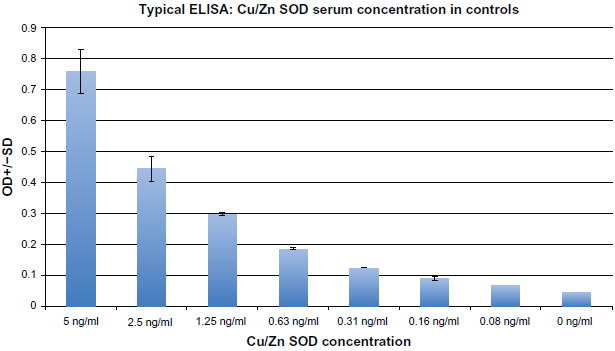
Positive and negative controls of typical ELISA to measure Cu/Zn SOD plasma levels.
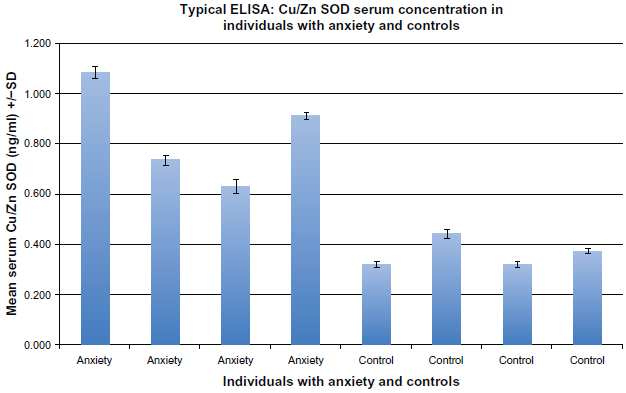
In a typical ELISA, plasma from 4 individuals diagnosed with clinical depression and 4 normal (neuro-typical) age/gender matched individuals was tested for the Cu/Zn SOD concentration. Cu/Zn SOD concentration is significantly higher in the individuals with anxiety.
Serum Cu/Zn SOD levels of depressed individuals were significantly higher than all non anxiety, normal controls (
Cu/Zn SOD plasma levels in individuals with anxiety are significantly higher than in normal controls.
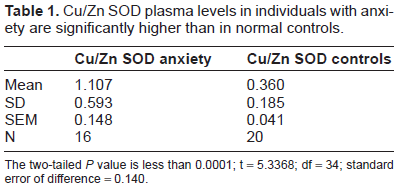
The two-tailed
Oxidative stress has been implicated in the pathogenesis of a diverse group of disease states, and, because the brain has comparatively greater vulnerability to oxidative damage, may be a common pathogenic mechanism underlying many major psychiatric disorders.
This study represents an attempt to assess levels of the oxidative damage expressed by Cu/Zn SOD levels in the serum of individuals with anxiety, but otherwise healthy adults. As our results demonstrate, compared with matched control subjects, those with anxiety show significantly higher serum levels of Cu/Zn SOD.
Recent data supports indirect evidence for a causal link between oxidative stress and anxiety-related behavior.26–28 Vitamin E deficiency in the mouse brain significantly increases the levels of central oxidative stress markers, resulting in anxiogenic behavior without abnormalities in the locomotor performance of the mice. 26 In rats, the consumption of a highly palatable diet enriched with sucrose leads to an obese phenotype, increases protein oxidation in the frontal cortex and induces anxiety-like behavior in the dark/ light choice test without altering locomotion in an open field test, 27 and mice developed anxious behavior during aging, likely due to the accumulation of oxidative damage, 28 which is a characteristic of the aging process in animals.29,30 In addition, a deletion of the p66Shc longevity gene in mice, which results in lower levels of oxidative stress and an extended life span, decreases anxiety-related behavior. 28 Overall, the data presented in these reports suggest that oxidative stress can provoke anxious behavior in rodents.
The potential causal role of oxidative stress on anxiety may generate interest in antioxidants. As an example, oxidative stress-related anxiety can be reversed in mice upon inhibition of NADPH oxidase or phosphodiesterase-2, enzyme that is indirectly implicated in oxidative stress mechanisms. 31 Surprisingly, diazepam, which is a well known anxiolytic, does not fully reverse the oxidative stress-related anxiety. 31 These results point to a possible use for antioxidants in the prevention or reduction of high anxiety. Further research will be necessary to show whether anxious subjects need more antioxidants than non-anxious subjects. Recent work31,32 has shown that some dietary polyphenols have both anxiolytic and antioxidant effects, which may be beneficial to anxious subjects.
Anxiety may be associated with oxidative damage through an increase in the production of reactive oxygen species (ROS). ROS can be antimicrobial; they damage lipid membranes and protein structures, thus destroying antigen-bearing cells. Oxidative damage is not limited to microbial targets, however, and extensive host tissue damage may result. 33 ROS from activated phagocytes can damage DNA bases 34 and induce strand breaks in neighboring cells, 35 leading some to argue that the hydroxyl radicals and peroxynitrite formed during inflammation are the greatest contributors to the oxidation of DNA. 36
Anxiety may not increase production or exposure to ROS, but rather decrease repair of damaged DNA. There is some evidence that repair of x-ray-damaged DNA is slower among highly distressed psychiatric inpatients. 37
The clinical relevance of increased oxidative damage in individuals with anxiety is currently unknown, and future studies should appropriately address this deficiency. Our data are consistent with the hypothesis that oxidative damage is a potential common pathophysiological mechanism underlying multiple co-morbid conditions in individuals with anxiety. Future studies should include measurement of multiple oxidative damage markers to different macromolecules, associated dietary deficiencies associated with these markers, associated severity of depression, and should address whether anxiety remission remediates underlying oxidative damage.
Disclosures
This manuscript has been read and approved by the author. This paper is unique and is not under consideration by any other publication and has not been published elsewhere. The author and peer reviewers of this paper report no conflicts of interest. The author confirms that they have permission to reproduce any copyrighted material.
Footnotes
Acknowledgements
I'd like to thank Scott Filer, Executive Director, and Allen Lewis, former Medical Director of The Pfeiffer Treatment Center for their support and help in this research and manuscript preparation.
I'd also like to thanks Laurie Myers and Kyle Andrews for their technical assistance.