






Abstract
Antimicrobial peptides (AMPs) are an essential part of innate immunity. These compounds have been considered as potential therapeutics because of their broad-spectrum activities and proven ability to avoid antimicrobial resistance, but their clinical and commercial developments have some limitations, such as susceptibility to proteases and a high cost of peptide production. To overcome these problems, many researchers have tried to develop short active peptides, their modifications and mimics with better properties while retaining their basic features of natural AMPs such as cationic charge and the amphipathic structure.
Introduction
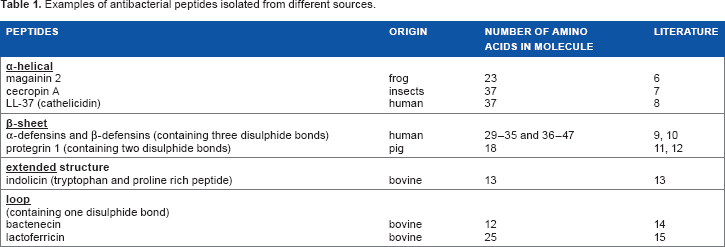
Antimicrobial peptides (AMPs), also called host defense peptides, are biologically active molecules produced by a wide variety of organisms as an essential component of their innate immune response. 1 The major part of AMPs is formed from high molecular precursors as a result of post-translational modification. 2 AMPs can be classified according to their structure, origin, biosynthesis mechanism, localization, biological function, mechanism of action, activity, and specificity. In the vast majority of cases, AMPs have the cat-ionic structure1,3 but anionic AMPs have also been described in literature. 4 Based on their structures, AMPs can be grouped into four classes: α-helical peptides, β-sheet peptides, extended peptides, and loop peptides. 5 The α-helical AMPs constitute a representative class of antibacterial peptides that have the most well-determined structure–activity relationships. Lack of cysteine residues in the molecule is characteristic of peptides of this group. These peptides have a disordered structure in aqueous solutions, but in the presence of trifluoroethanol or liposomes, these molecules are converted into α-helix forms. 2 The β-sheet AMPs are stabilized by disulfide bridges and form relatively rigid structures. The extended AMPs, which are predominantly rich in specific amino acids, such as proline, tryptophan, arginine, and histidine, have no regular secondary structure elements. The loop AMPs adopt a loop formation with one disulfide bridge (Table 1). AMPs show great structural diversity, but some features common to most of them are: a relatively small size (generally between 12 and 50 amino acid residues), their cat-ionic nature because of multiple Arg or/and Lys residues, and the amphipathic structure because of the presence of both hydrophobic and hydrophilic regions.
Examples of antibacterial peptides isolated from different sources.
Mechanism of Action
AMPs show a broad spectrum of antimicrobial activities against various microorganisms. Many of these peptides are effective against multidrug-resistant bacteria and possess a low propensity for developing resistance.
The precise mechanism of the action of AMPs is yet to be explained. The electrostatic interaction of cationic AMPs with negatively charged molecules on the membrane of bacteria cells seems to be the primary mechanism for antimicrobial activity. Currently, there are three most popular models explaining the increase in membrane permeability because of AMP action: the barrel-stave model, the toroidal pore model, and the carpet model (Fig. 1).16–19 According to the barrel-stave model, a variable number of channel-forming peptides are positioned in a “barrel-like” ring around an aqueous pore. In the toroidal pore model, the peptides induce membrane depolarization and form toroidal-shaped transmembrane pores. According to the carpet model, the peptides first bind to the target membrane and cover it in a “carpet-like” manner, then they disintegrate the membrane by disrupting the bilayer curvature.
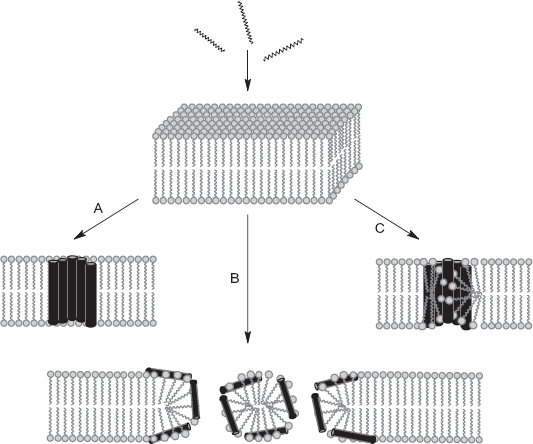
Three most popular modes of action of antimicrobial peptides against cytoplasmic membranes. (
Owing to a high level of cholesterol and low anionic charge, eukaryotic cells become out of the target range of many AMPs. 20 Understanding the selectivity of different AMPs for mammalian and bacterial membranes is of obvious interest in the development of these peptides as novel antibacterial agents. Molecular dynamic simulations are used to visualize in detail the interactions between AMPs and a variety of membrane mimics. This helps to understand the molecular mechanisms of the antimicrobial activity of these compounds and their toxicity.21–23 Several reviews connected with the structures, potential mechanisms of action, and biological activities of AMPs have recently been published.24–34
The AMPs have been considered promising and potential drug candidates for the future because of their broad range of activity, lesser toxicity, and decreased resistance development by their target cells.
Structure Modification
The widespread use of antibiotics has led to the development of numerous multidrug resistant strains, resulting in an urgent need to develop new effective antimicrobial agents capable of being established as therapies for bacterial infections. The AMPs have a proven ability to avoid antimicrobial resistance, a phenomenon that has rendered many pharmacologically derived antibiotics ineffective. Probably one advantage of AMPs is the generality of their mechanism of action, which involves either breaking the bacterial membrane integrity or disrupting their essential components inside their cells.35,36 This differs from the specific receptors targeted by conventional antibiotics, which allows the pathogenic bacteria to develop resistance more rapidly. AMPs are also fast-acting and potent compounds. They can be metabolically and rapidly cleared from the body. Although AMPs possess considerable benefits, their clinical and commercial developments have some limitations. The disadvantage of the AMPs is the fact that most peptides cannot be administered orally as they are rapidly inactivated by gastrointestinal enzymes, so that subcutaneous or intravenous administration is required.37–39 Although peptides exhibit significant in vitro activity against bacteria, for many peptides this activity appears to be lost under physiological salt and serum conditions. Salt-dependent inactivation of human β-defensins is an example. 40 Another problem is the size of molecules. They are small in comparison with proteins but large from the point of view of the chemical peptide synthesis. This is connected with high costs of their production. The price of synthetic peptides is considerably higher in comparison with conventional antibiotics. It can be a reason that the pharmaceutical industry has been reluctant to promote the clinical use of this class of antibacterial therapeutics.33,40 Because of this problem, the investigations have been centered on searching for smaller peptides with antimicrobial activity.
Lactoferrin Derivatives
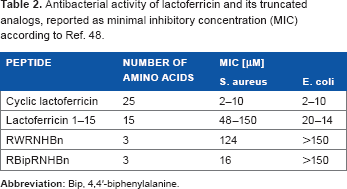
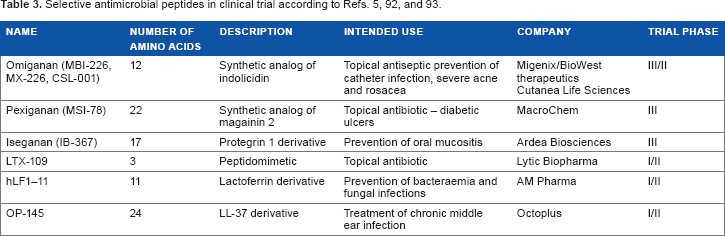
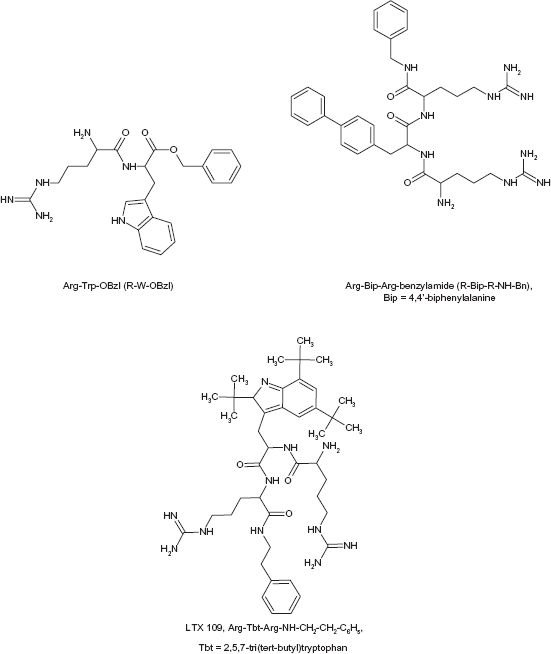
An example of an approach to this problem was the investigation of short fragments of complex AMP, lactoferrin or its 25-residue N-terminal fragment, lactoferricin 41 (Fig. 2), for establishing minimal structural requirements for antimicrobial activity (Table 2).42–48 An 11-residue linear peptide portion of bovine lactoferricin has been reported to have similar antimicrobial activity to lactoferricin itself, but with lower hemolytic activity. 47 The synthetic AMP hLF1–11, derived from the first 11 amino acids of human lactoferrin, was evaluated in both preclinical and clinical trials (Table 3), and it is an interesting candidate for further exploration. 49 The antibacterial active fragment of bovine lactoferricin, hexapeptide RRWQWR, was determined by Tomita et al. 42 Many fragments of lactoferricin were synthesized and examined,43–50 from the 15 residue peptide LFB, consisted of 17–31 residues of bovine lactoferrin, 43 to the modified dipeptides. 44 According to the pharmacophore model of short AMPs, 51 cationic charged as well as bulky and lipophilic moieties are necessary in the structure of such compounds. Charged moieties generally consisted of a side chain of arginine or lysine. Bulk units were represented by an indol, phenol, or phenyl group. Other studies suggest that the antimicrobial activity of peptides containing arginine is higher than those of peptides containing lysine, while peptides containing tryptophan are more potent than those with either phenylalanine or tyrosine.
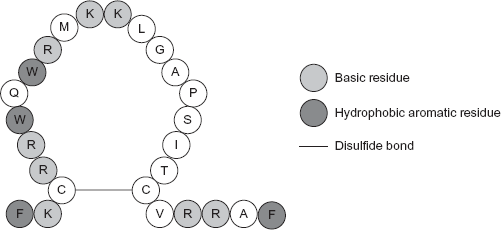
Amino acid sequence of cyclic bovine lactoferricin according to Ref. 46.
Antibacterial activity of lactoferricin and its truncated analogs, reported as minimal inhibitory concentration (MIC) according to Ref. 48.
Selective antimicrobial peptides in clinical trial according to Refs. 5, 92, and 93.
The series of peptides containing simple repeating sequence: (RW)
Short peptides derived from lactoferrin with minimal antibacterial motif.
AMPs Derivatives
Another possibility to design small peptides with antimicrobial activity was using combinatorial libraries for the examination of potential short active peptide sequences.56–58 These libraries were not only used to discover novel short AMPs 56 but also to improve the activity of already known compounds. 58 The result of such investigations was the synthesis of arginine and tryptophan-rich hexapeptides called by the authors combi-1 (Ac-RRWWRF-NH2) and combi-2 (Ac-FRWWHR-NH2). These hexapeptides possess antibacterial activities similar to natural peptides. 35 Smaller AMPs like cationic containing 13 amino acid peptide amide – indolicin 59 or dodecapeptide – bactenecin60,61 were used as a lead structure to develop potential new antimicrobial drugs, for example, omiganan (ILRWPWWPWRRK-NH2) (Table 3), a synthetic cationic peptide derived from indolicin.62,63 To obtain short cationic peptides with enhanced antimicrobial activity, fluorine atoms or trifluoromethyl groups were introduced in the structure. 64 Another reason for the structure modification of AMPs is searching for compounds with a potential for oral administration. It is connected with the problem of their stability toward the enzymatic degradation. Series of short cationic peptides (generally, tripeptides), with the presence of unnatural amino acids in the structure, were synthesized by the application of combinatorial libraries and its antibacterial activity, and their stability for tryptic65,66 and chymotryptic 67 degradation was examined. The use of Trp and Arg analogs can minimize the interaction of antimicrobial tripeptides with binding pockets of proteolytic enzymes and increase their stability. 48 The replacement of arginine with Agp (α-amino-3-guanidino-propionic acid) in AMP Sub-3 (NH2-RRWRIVVIRVRR-CONH2) protects this compound from its fast degradation in serum. 68 Also the cyclization of short tryptophan and arginine-rich AMPs generally brings about significant stabilization against serum proteases. 50
Another Antibacterial Compounds with Peptide Structure
Antibacterial activity was also observed in the case of peptides that are not fragments or analogs of natural AMPs. Several compounds with the linear or cyclic dipeptide structure belong to this group. Antimicrobial dipeptide β-alanyl-tyrosine was isolated from insects.
69
Series of antimicrobial analogs of Trp-His and His-Arg
70
as well as dipeptide-based amphiphiles
71
were synthesized. Antimicrobial cyclic dipeptides (diketopiperazines) were isolated from a
Peptoids and Peptidomimetics
The antimicrobial β-peptides have been designed as oligomers mimicking the structure of AMP magainin. 81 They can adopt a variety of different helical conformations and are resistant toward the degradation by trypsin and chymotrypsin. 82 A series of short, highly potent β-peptidomimetics based on the pharmacophore model of short AMPs 51 were obtained by coupling of achiral lipophilic 3-amino-2,2-disubstituted propionic acid to a C-terminal L-arginine amide residue. 83
Oligoacyllysines (OAKs) are a group of antimicrobial compounds, composed of tandem repeats of acyllysines. These simple structures were designed to mimic the primary structure and function of natural AMPs. To study the structure–activity relationships in OAKs, the library composed of 103 OAKs have been synthesized. Only few members of this library displayed the ability to inhibit bacterial growth. Antimicrobial activity was observed in the case of short (dimer) dodecanoyl-based OAK. 84 Further investigations suggested that the minimal requirements for potent and selective antibacterial activity with low hemolytic activity represent the sequence: aminolauryl-[lysyl-aminolauryl-lysyl]2 (designated NC12-2β12). 85 Peptoids (N-substituted glycines) are mimics of α-peptides in which their side chains are attached to the backbone of Nα amide nitrogen instead of the Cα-atom.74,82,86 A series of peptoids constructed from N-alkylated glycine residues were synthesized as potential mimics of antimicrobial lipopeptides. 87 The head-to-tail macrocyclization of linear peptoids was used to enhance the antimicrobial activity of these compounds. 88 The combinations of the peptoid subunits with lysine residues were also investigated. Several such lysine–peptoid hybrids showed potent antibacterial and low hemolytic activities.89,90 For example, N,N-disubstituted L-lysine amides were the simplest peptoids with antimicrobial activity. 91 Two positive charges were contributed by α and ε NH3+ groups of L-lysine; the hydrophobicity was brought about by a substituent of amide nitrogen: alkyl chain and bulky aromatic core.
Clinical Development
In their search for new antimicrobial therapeutics, several pharmaceutical companies have been attempting to introduce AMPs into the market. 29 Recent investigations generally focus on relatively small and cost-effective molecules that contain only the biologically active core region of the natural AMP. AMPs are in various stages of drug development, from early preclinical studies to phase III of clinical studies (Table 3). Compounds with different molecular sizes were examined, from the peptide containing 24 amino acids, OP-145, 67 to the modified tripeptide LTX-109 (Fig. 3), 55 both in phase II of clinical trial (Table 3). There has been limited success with those AMPs that were introduced into clinical trials, especially when the results were compared to conventional antibiotics.92,93 Two indolicin-based AMPs, MBI-226 and MX-594AN, which have been developed for the treatment of catheter-related infection and acne, respectively, belong to the most advanced potential therapeutics.23,29,62,63,92 MBI-226 (omiganan) has now completed two separate phase III clinical trials demonstrating safety and significant efficacy in decreasing catheter colonization and reducing microbiologically confirmed tunnel infections (Table 3). 93 The other one has been less successful. The AMP – pexiganan – a broad-spectrum synthetic analog of the African frog peptide magainin, developed for the treatment of diabetic foot ulcers, was denied approval for clinical use.23,29 This compound did not demonstrate an advantage over existing fluoroquinolone therapy.23,29,92,93 But it has recently been announced that pexiganan would re-enter phase III trials to enable the resubmission of a new drug application. It has also been reported that the second generation of AMPs based on pexiganan have been developed. 93 None of the AMPs have been granted Food and Drug Administration (FDA) approval for clinical use. 23
Conclusions
Out of thousands of potential synthetic peptides with antimicrobial activity, only a small number have been systematically studied and tested. Many AMPs and its analogs have been synthesized. Some of them have very small molecules (di- and tripeptides) and improved stability against the enzyme digestion, so they are devoid of certain disadvantages of natural AMPs and can be more suitable for pharmaceutical applications. The field is young, and it would be premature to conclude if AMPs can be clinically used therapeutic agents. Many AMPs have demonstrated antimicrobial activity under controlled experimental conditions
Author Contributions
Conceived the concepts: KMN. Wrote the first draft of the manuscript: KMN, AM. Contributed to the writing of the manuscript: KMN, AM. Agree with manuscript results and conclusions: KMN, AM. Jointly developed the structure and arguments for the paper: KMN. Made critical revisions and approved final version: KMN, AM. Both authors reviewed and approved of the final manuscript.