






Abstract
Physicochemical investigation of the red alga
Keywords
Introduction
More than 40,000 different species of phytoplankton, 680 species of marine algae belonging to seaweeds, and 71 mangrove plant species have been documented in the global marine biotope. 1 Marine floras are rich in biologically active and medicinally potent compounds. Polysaccharides and polyphenols are the most predominant groups, which are applicable for anti-inflammatory, anticancer, and antioxidant activities. 2 6 Their beneficial properties for plants, animals, and human beings were recognized in the past and are appreciated nowadays, in the development of new biotechnological products.1,2
In the past 10 years, the interest on the study of seaweeds as sources of bioactive compounds has increased. They provide bioflavonoids, ionic trace minerals, essential fatty acids, vitamins, enzymes, amino acids, and other nutrients.1,2 Flavonoids are natural compounds with variable low molecular weight polyphenolics, found in many plants, including seaweeds. 7 Polyphenols are recognized by their strong antioxidant, anti-inflammatory, and anticancer activities. 8 10 Polyphenol compounds are produced from seaweeds, which protect them from external conditions such as stress and herbivores. 10 Seaweed extracts contain appreciable amounts of polyphenols, but their amount depends on the extraction method.11,12 Different seaweed extracts have received increased attention due to their potent pharmacological effects, particularly hypolipidemic, antioxidant, analgesic, anti-inflammatory, immunological, and anticancer activities. 12 Apigenin, one of the most common flavonoids, has demonstrated anti-inflammatory, anticarcinogenic, and free radical-scavenging activities. 13
The red alga
Material and Methods
Collection and preparing of algal sample
Sample extraction
A sample of dried seaweed powder (150 g) was extracted successively in Soxhlet apparatus using, first, petroleum ether to remove the algal chlorophyll, and then the algal tissues were extracted with acetone to elute the flavonoid content. The acetone extract was filtered through Whatman No. 1 filter paper and then concentrated to a suitable volume.
Separation and identification of flavonoids
The flavonoids, in the acetone crude extract fraction, were detected on thin-layer chromatoplates: 20 × 20 cm, silica gel 60 (Merck) and eluted with 20 mL of the solvent system: methanol:chloroform:ethyl acetate (1:7:2) for each chromatographic plate. The flavonoid zones were scratched with a spatula and eluted three times with methanol:chloroform (1:1) until complete exhaustion. The eluted flavonoid was concentrated using rotary evaporator, and then tested for purity using thin-layer chromatoplates. The physicochemical analysis (infrared [IR], ultraviolet [UV], and gas chromatography (GC)-mass spectrum) was carried out at Toxicology and Microanalytical Research Unit, Faculty of Science, Suez Canal University to elucidate the structure of the separated flavonoid.
The GC-mass spectrum was performed with gas chromatography (Hewlett Packard 5890 Series II, column HP-5 cross-linked 5% Ph Me Silicone, 12 m × 0.2 mm × 0.33 μM film thickness). The conditions were as follows: initial temperature at 100°C/6 minutes, level 1 rate at 3°C/min and final temperature at 120°C, level 2 rate at 6°C/minute and final temperature at 260°C, and using mass spectrum (Hewlett Packard 5970 Series). IR spectrum was carried out by using IR spectroscopy (Perkin-Elmer 1430 Ratio Recording Infrared Spectrophotometer). UV spectrum was determined by UV spectroscopy (T 90 + UV/Visible Spectrometer, PG Instruments Ltd) in methanol in addition to the shift reagents sodium methoxide (NaOMe), aluminum chloride (AlCl3), hydrochloric acid (HCl), sodium acetate (NaOAc), and boric acid (H3BO3). 21
In vivo animal study
Chemicals
Glacial acetic acid was purchased from Sigma-Aldrich and diluted using pyrogen-free distilled water to obtain a 0.6% solution. Diclofenac sodium (declophen®) was purchased from local pharmacy and produced by Pharco Pharmaceutical.
Experimental animals
Male Wistar albino rats (125–175 g) and male Swiss mice (22.5–27.5 g) were used in the current study, which were purchased from the animal house of National Central Institute, and maintained in good hygienic conditions at the animal house of Pharmacology Department, Veterinary Medical College, Suez Canal University. Rats and mice were given a standard pellet and water ad libitum. The experimental animals were acclimatized for a period of seven days before the start of the experiments. Animal handling and experimental design were approved by the Research Ethical Committee of the Veterinary Medical College, Suez Canal University, Ismailia, Egypt (approval no. 20153).
Acute toxicity study
For acute oral toxicity, mice and rats (n = 8) were kept fasting for overnight and given water only. The isolated apigenin was given orally in different ascending doses (up to 5000 mg/kg bw) and observed for 72 hours to identify toxic signs and mortality.
Analgesic activities
The analgesic activity of apigenin was examined using acetic acid-induced writhing test and hot plate test in mice as well as tail-immersion test in rats.
Acetic acid-induced writhing test
Abdominal writhing behavior was induced by intraperitoneal injection of diluted acetic acid (0.6%, 10 mL/kg bw).22,23 Four groups (eight mice each) of Swiss albino mice (25 ± 2.5 g) were used. The first group received saline and served as negative control. The second and the third groups were orally given apigenin at doses of 25 and 50 mg/kg bw, respectively, 30 minutes before diluted acetic acid injection. The doses were selected according to a previous study. 24 Diclofenac sodium was given orally for the fourth group (100 mg/kg bw) as a standard drug. The stretching and writhing number was determined over a period of 15 minutes, starting at 5 minutes postinjection of the acid.
The reduction of analgesic response by apigenin was determined for each mice group as follows:

Tail-immersion test
Tail-immersion test was used as described.23,25 Briefly, the apical 3 cm of the rat's tail was immersed in a bath containing water (55 ± 0.5°C). The rats withdraw their tails as a reaction. The tail withdrawal time was measured at one-hour interval (0–300 minutes) after administration of test material. Thirty-two rats were grouped as previously described. The rat doses of apigenin (25 and 50 mg/kg bw) were selected in accordance with those reported previously. 26 The fourth group was given diclofenac sodium (100 mg/kg) and kept as a standard group.
Hot plate test
The analgesic effect was evaluated using the hot plate test in mice according to the method described.23,25 Thirty-two mice were grouped and given apigenin and diclofenac sodium as described in the writhing test. A large glass flask acted as hot plate (55 ± 0.5°C). The reaction time was determined when animals react by jumping or licking their paws. The reaction of each mouse in all the groups was taken at one-hour interval (0–300 minutes) post apigenin administration. The cutoff time (in the case of absence of a response) was considered as 15 seconds in order to avoid burning of the animals. 27
Anti-inflammatory activities
Apigenin anti-inflammatory activities were examined using carrageenan-induced paw edema and cotton pellet-induced granuloma in rats.
Carrageenan-induced paw edema
Paw edema and inflammation were produced by subplantar injection of 0.1 mL freshly prepared 1% carrageenan into the rats’ right hind paws.23,28 The thickness of the injected and contralateral paws was measured at one-hour interval (0–300 minutes) using skin caliber. Apigenin (25 and 50 mg/kg) 26 was administered to two animal groups, and the other two groups were given distilled water at 10 mL/kg (control) and diclofenac sodium at 100 mg/kg (standard).
Blood samples were collected from the orbital sinus in heparinized tubes, after the last measurement. The blood was centrifuged at 1200
Plasma interleukin-1β (IL-1β), interleukin-6 (IL-6), tumor necrosis factor-α (TNF-α), and PGE2 were evaluated using ready-made kits from Assay Designs Inc. using The Assay Max Mouse IL-1β, IL-6, TNF-α, and PGE2 ELISA kit according to the manufacturer's protocols through a quantitative sandwich enzyme immunoassay technique.
Cotton pellet-induced granuloma
The chronic anti-inflammatory activities of apigenin were evaluated using cotton pellet-induced granuloma according to the method of Winter and Porter. 29 Sterile cotton pellets, weighing 10 mg, were implanted subcutaneously, under light ether anesthesia, into axillary region, in each rat. Animal grouping as well as apigenin and diclofenac dosing was done as previously described; all drugs were given daily for seven consecutive days from the day of cotton pellet implantation. On the eighth day, the animals were anaesthetized, and the pellets together with the granuloma tissues were carefully excised and made free from the surrounding tissues. The wet pellets were weighed, and then dried in an incubator at 60°C for two hours until a constant weight obtained, after that the dried pellets were weighed again. The exudate amount (mg) was calculated by deducting the constant dry weight from the immediate wet weight of the pellet. The granulation tissue formation (dry weight of granuloma) was calculated after subtracting the weight of cotton pellet (1 mg) from the constant dry weight of pellet and taken as a measure of granuloma tissue formation. The percent inhibitions of exudate and granuloma tissue formation were calculated.
Statistical analysis
All data were expressed as mean ± SEM and statistically analyzed using Minitab (version 16.1). Statistical significance of differences among the different study groups was evaluated by one-way analysis of variance. Tukey's multiple comparisons test was used to differentiate among the means. Statistical significance was acceptable to a level of
Results
IR spectra
The IR spectra of the isolated compound (Fig. 1) showed a broad intermolecular OH stretch vibrations band at ~3333 cm–1. There was an aromatic C-H stretch, 3040 cm–1. There is a vibration band at 1646 cm–1 characteristic for flavone of conjugation between the C=O and double bonded of C2–C3, also, 1801 cm–1 for lactone ring.
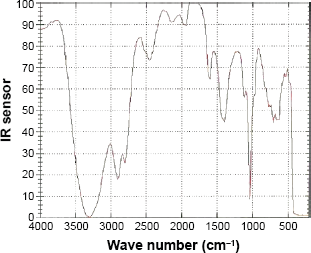
IR spectra of the isolated compound.
The IR spectra showed three vibration bands (1466, 1497, and 1578 cm–1) for the ring C=C, while 1466 cm–1 denotes the characteristic of C-O-H stretch. The intensive band at 1024 cm–1 was most probably the result of C-O-C stretch from the central heterocyclic ring.
Mass spectra
The mass spectrum of the isolated compound (Fig. 2) shows a molecular ion peak at

Mass spectra of the isolated compound.

Scheme for fragmentation pattern of the isolated compound mass spectra.
UV spectra
UV spectra in methanol in addition to the shift reagents are shown in Figure 4. The UV absorption spectra of the isolated compound in methanol exhibited two major peaks at 267 and 336 nm, characteristic of flavones and flavonols. The absorption spectra of methanol after the addition of shift reagents showed the presence of three hydroxyl groups in the 7, 5, and 4 positions. Table 1 shows that the UV absorption spectra of the isolated compound in methanol and the other shift reagents were in agreement with those reported for apigenin authentic sample.
21
Finally, the data obtained from IR, UV, and mass spectrum of the isolated compound from the red alga

UV spectra of the isolated compound in methanol in addition to the shift reagents.
Comparison between the UV spectra of the isolated compound and that reported for authentic sample of apigenin. 21

Acute toxicity studies
The test for oral acute toxicity revealed no mortality or toxicity signs for apigenin at doses up to 5000 mg/kg either in mice or rats. Based on these results, and according to,24,26 the doses of 25 and 50 mg/kg were selected for further evaluation of antinociceptive and anti-inflammatory activities. 30
Analgesic activities
Using mouse writhing test, apigenin induced a significant (
Effect of apigenin on acetic acid-induced writhing in mice.

Effect of apigenin using tail-immersion test in rats.

Effect of apigenin using hot plate test in mice.

Anti-inflammatory activities
Oral apigenin pre-treatment (25 and 50 mg/kg bw) markedly inhibited the rat paw edema in a dose-dependent manner (Table 5). In acute carrageenan-induced rat paw edema model, a dose of 50 mg/kg bw of apigenin showed a significant (
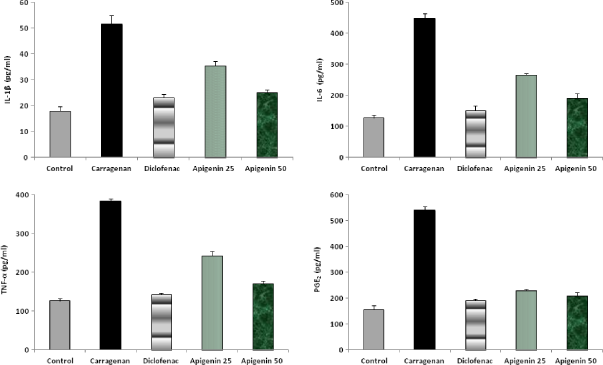
Effect of apigenin on plasma proinflammatory cytokine and PGE2 production in rats with carrageenan-induced paw edema.
Effects of apigenin on carrageenan-induced rat paw edema.

Moreover, the anti-inflammatory activities of apigenin were examined in chronic model; effects of apigenin on the cotton pellet-induced granuloma in rats are given in Table 6. Apigenin doses significantly (
Effect of apigenin on the cotton pellet-induced granuloma in rats.

Discussion
Algae are considered as a rich source of flavonoids.
Natural products have been widely used as good alternatives to produce new drugs and therapeutic agents for combating diseases.5,6,32–34 In the current study, apigenin expressed potent analgesic activities in writhing and hot plate tests in the mice models as well as tail-immersion test in rats. Moreover, it revealed potent anti-inflammatory activities using carrageenan-induced rat paw inflammation as well as cotton pellet-induced granuloma formation models. This study has shown that apigenin has potent antinociceptive action, which might affect prostaglandin synthesis pathway. A significant reduction in stretching and writhing induced by acetic acid, as well as a significant prolongation of the reaction time for hot plate and tail-immersion tests, indicated analgesic activities via both central and peripheral mechanisms.
Carrageenan-induced rat paw edema is a common model to evaluate anti-inflammatory therapeutic agents and study inflammation. 35 The edema or swelling is one of the acute inflammation signs, and it is an important indicator to be considered when examining agents with potential anti-inflammatory activities. 36 In carrageenan-induced rat paw edema model, the swelling is a biphasic process. Serotonin and histamine release occurs in the first phase, while in the second phase, bradykinin (BK), lysosome, protease, and prostaglandin are predominate. 37 The role of PGE2 in this model has been well clarified in many previous literatures.35,38–40 BK and PGE2 are responsible for the edema and the pain, which accompanies the inflammatory process, as both BK and PGE2 are sensitizing the primary afferent neurons.41,42 Therefore, the effect of apigenin in the reduction of edema might be due to the inhibition of cyclooxygenase enzyme and, in turn, the inhibition of PGE2 synthesis.
Apigenin showed a reduction of the paw swelling induced by carrageenan all over the time of experiment and induced potent anti-inflammatory activity. The effectiveness of apigenin at one and three hours indicates its antagonistic effect on prostaglandin, BK, histamine, and serotonin. Histamine and serotonin production occurs at one hour, whereas BK and prostaglandin are released at two and three hours, respectively, after injection of carrageenan. 43 Apigenin at the high-dose level was comparable with the anti-inflammatory activity of diclofenac sodium. The obtained results are an indication that apigenin could be effective for acute inflammatory conditions. Since inflammation is also accompanied by pain, most anti-inflammatory agents have an antinociceptive potential. The peripheral analgesic activity of the drugs could be via inhibition of cyclooxygenases (COX) and/or lipoxygenases as well as other mediators, while the central analgesic action might be through inhibition of central pain receptors.
Cytokines are indigenous proteins, which are not produced in the case of usual physiological conditions. However, the inflammatory stimulus overexpresses cytokine genes, promoting the inflammatory reaction. 44 TNF-α is a primary cytokine included in the inflammatory process initiation. Its effects involve the production of other cytokines, including IL-6 and IL-1β, as well as an induction of arachidonic acid metabolism. 44 Prostaglandins (PGs), thromboxanes, and leukotrienes (LTs) are arachidonic acid metabolites via COX and lipoxygenase. PGE2 could initiate alterations in blood flow and vascular tonus, leading to edema as a symptom of inflammation. Cox2 and PGE2 are cancer biomarkers, besides their activities as inflammatory mediators. 45 50
To examine apigenin anti-inflammatory mechanism of action, IL-1β, IL-6, TNF-α, and PGE2 and were further evaluated in the plasma in carrageenan-induced rat paw edema animal model. Our results indicate that apigenin caused a statistically significant (
The cotton pellet-induced granuloma model has been widely used to assess the transudative, exudative, and proliferative components of chronic inflammation. 53 The fluid absorbed by the pellet mainly influences the wet weight of the granuloma, and the dry weight correlates well with the amount of formed granuloma tissue. 54 Fibroblast proliferation and monocyte infiltration rather than neutrophil infiltration occur in chronic inflammation. 55 In the current study, apigenin reduced both wet and dry weights of the cotton pellets compared with control groups. This may be due to the ability of apigenin in the reduction of fibroblast infiltration and synthesis of mucopolysaccharide and collagen, which are natural proliferative agents of granulation tissue formation, indicating the antiproliferative effects of apigenin.
Conclusion
The current study confirms that the elucidated structure of the biologically active flavone (apigenin) from the marine red alga
Author Contributions
Conceived and designed the experiments: MMAD, GAES, MHM, EAS. Analyzed the data: MMAD, GAES, MHM, EAS. Wrote the first draft of the manuscript: MMAD, GAES. Contributed to the writing of the manuscript: MMAD, GAES. Agree with manuscript results and conclusions: MMAD, GAES, MHM, EAS. Jointly developed the structure and arguments for the paper: MMAD, GAES. Made critical revisions and approved final version: MMAD, GAES, MHM, EAS. All authors reviewed and approved of the final manuscript.