






Abstract
Acquired immunodeficiency syndrome (AIDS) continues to be transmitted in the developing world. The World Health Organization (WHO) produces an annual report from the United Nations AIDS (UNAIDS) Epidemic Update declaring the new AIDS cases across the world. UNAIDS had to make an estimates from certain countries like Saudi Arabia (SA), due to the fact that there is no adequate reporting of AIDS cases to the WHO. In 2001, the Ministry of Health in SA had created the Saudi AIDS—National Program which became responsible for counting old and new HIV-infection in Saudis and non-Saudis cases and produce an annual report in SA. Data collection shows that obtaining number of AIDS from Saudi—National Program would be more accurate than UNAIDS estimate in SA.
Introduction
Since the human immunodeficiency virus (HIV) infection started to evolve in the early 1980s, the reporting of the disease in Saudi Arabia (SA) was inaccurate. 1 The first published report about the epidemiology of HIV-infection in SA was done on 2004. 2 The report contained an 18-year surveillance result of HIV-infection in Saudis and non- Saudis between 1984 and 2001. A total of 6,046 HIV-infections, with 1,285 (21.3%) cases were Saudis.
Before 2004, information were obtained from estimates from United Nations AIDS Epidemic Update (UNAIDS) annual report about the number of HIV-infected persons in SA.
The Saudi Ministry of Health (MOH) started to produce an annual epidemiologic acquired immunodeficiency syndrome (AIDS) report on 2001. 2 The annual report was produced by the Saudi AIDS National Program-MOH, and it improved the quality of data collection each year.
The objective of this report is to provide a more accurate of the annual number of new HIV-infection and total number of HIV-infection in SA, depending on a better source of information's which is Saudi AIDS—National Program rather than an estimate from UNAIDS annual report.
Methods
Data collection was obtained from performing a medline-search (Keywords used are: AIDS—cases in Saudi Arabia, HIV-infection in Saudi Arabia, Epidemiology of AIDS in Saudi Arabia) of the prevalence of AIDS cases in Saudi Arabia. Also, there was a review of the AIDS-National Program Annual Reports from 2001 till 2009. There was a comparison between the AIDS National Program reports and the UNAIDS estimates of AIDS cases in SA.
The total number of HIV-infection in SA used to be presented at UNAIDS annual report as an estimate of prevalence but not as an actual number due to lack of appropriate reporting of SA authorities to the UNAIDS. However, since the creation of the Saudi AIDS National Program and because it is the center that all HIV-cases reported to, they can calculate how many cases reported who are Saudis or non-Saudis each year.
The National AIDS-Program reports all new cases of HIV-infection annually.
Results
The method by which the AIDS National Program (MOH) reports AIDS cases in SA used the total number of cases since 1984. The reports usually divide the total AIDS cases between Saudis and non-Saudis.
Figure 1, demonstrated the total number of HIV-infected person in SA and their nationalities from 1984 till 2001.
Total number of HIV-positive cases in saudi Arabia from 1984–2001.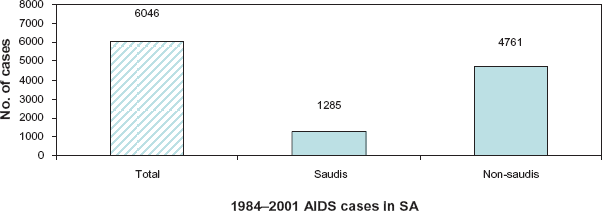
The 1,285 Saudi cases were found to be HIV-positive by year 2001 and that was a total number of Saudis with HIV-infection. The indication for HIV testing was clinical suspicion (34%) and contacts of patients (15%). 2
In 1984, the first case of HIV-infection was reported from SA. 3 However, the first 13 cases of AIDS cases were reported to World Health Organization on 1986. 4
On early 2004, it was reported that 1,743 cases with HIV-infection are the total number of Saudi cases. 5 A report from MOH showed that between 1984 and 2005 the total number of Saudi AIDS cases are 2,316 cases. 6
The annual report from AIDS National Program showed that between 1984 and 2008, the total number of Saudi AIDS cases are 3,538 cases. 7 The Saudi new HIV-positive cases during 2008 were 505 cases.
Figure 2, Shows a comparison of Saudi reported cases between 1984 till 2001 and 2002 to 2008. It shows that despite the fact that there is difference in duration (18 yrs to 7 yrs duration) the number is larger on the last 7 years.
Comparison of Saudi AIDS cases on 1984–2001 and 2002–2008 intervals.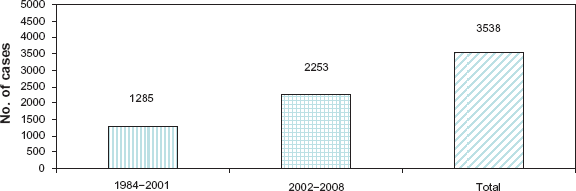
Figure 3, Demonstrates the reported annual new Saudis with HIV-infection from 2002 to 2008. During year 2002 and 2003, a total number of 458 cases were reported.
Annual report of the new HIV-infection cases in Saudis per year.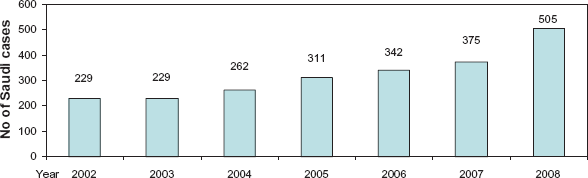
Discussion
It is obvious that reporting of HIV-positive cases in Saudi Arabia is much better currently than that during the 1990s. Everybody can reach to the website of Ministry of Health statistics (www.moh.gov.sa) that contains the annual report of new HIV-positive cases in the country and being updated by the National AIDS Program.
The first report was published about Epidemiology of HIV-cases in Saudi Arabia had declared that there is 1,285 cases who are Saudis. 2 That report described number of cases over 18 years from 1984 till 2001. The next 7 years has shown improvement of data collection and reporting of HIV-positive cases annually. In addition, the number of persons who were reported to be HIV-positive during 2002–2008 was 2,253 cases.5–7 It is clear that the total number of Saudis with HIV-infection is increasing significantly during the last few years. This is likely due to the lack of education in how to prevent being infected by HIV, and the usual pattern of transmission of HIV-infection to their spouses. Unprotected sexual practices was found to be responsible for 46% of the cases. 5
Estimates by the World Health Organization (WHO) and the Joint United Nations Programme on HIV/AIDS (UNAIDS) show that HIV-prevalence is low in the Middle East and North Africa region (0.2%–0.4%).8,9 However, these estimates are exaggerating the HIV-prevalence in SA. By early 2009, the total number of HIV-positive cases in SA are 3,538 persons who are Saudis. 7 A calculated HIV-prevalence in SA who are known to have a population of nearly 17,000,000 Saudi persons with an HIV-positive cases of 3,538 would be 0.02% which is less than the UNAIDS estimate.
The annual new HIV-positive cases in SA are increasing every year [Fig. 3]. The most plausible explanation for this increase in incidence is lack of detailed education of practicing safe sex, and the modes of transmission of HIV- infection in SA. 15% of HIV-positive cases got the infection by being spouses of newly infected persons. 2 Theoretically, those 15% (190 cases) could have been prevented by adequate and appropriate education of HIV-infection and transmission. In addition, a report has suggested that 46% of HIV-infection in Saudi's is transmitted by unprotected sex. 5
It is recommended to establish a clear method of education of HIV transmission among people to prevent this significant increase in incidence of HIV-infection in Saudis. The suggested candidates for these educational courses should be young people in SA particularly men.
Footnotes
This manuscript has been read and approved by all authors. This paper is unique and is not under consideration by any other publication and has not been published elsewhere. The authors and peer reviewers of this paper report no conflicts of interest. The authors confirm that they have permission to reproduce any copyrighted material.