






Abstract
Background
Prediabetes has been considered to be a reversible condition; a modification of lifestyle and other intervention can be successfully applied during the prediabetes period to prevent the development of type 2 diabetes. The purpose of the present study was to assess knowledge of prediabetes and its risk factors for the community in the Al-Ahsa region.
Design and method
A cross-sectional community-based study was conducted in the Al-Ahsa region from mid-to-late December 2018. A sample size of 812 was determined using a single-proportion formula.
Results
Of the 812 respondents who gave consent to participate in the interview; the male to female ratio was 1.1:1. 13.2% of the respondents reported that they had diabetes. Among the respondents, 87.1% had a high level of knowledge of prediabetes, while 12.9% had low-to-moderate knowledge. 84% of males 40 years of age or older, 88.7% (384) of people with university or higher education, and 95.1% (78) of people who worked as health practitioners had high knowledge of prediabetes. Overall, there was a statistically significant association between age and prediabetes knowledge (χ2 =5.006, p=0.025). Occupation also showed a significant statistical association with prediabetes knowledge (χ2 =9.85, p=0.02).
Conclusion
Knowledge is considered an important factor in the prevention of prediabetes and diabetes. People in Al-Ahsa demonstrated a high level of knowledge regarding some risk factors for prediabetes. However, there were a number of deficiencies in the knowledge of prediabetes risk factors and preventive measures as well as in general knowledge of prediabetes, which may lead to a high prevalence of prediabetes and diabetes.
Introduction
Significance for public health
Assessment of the community knowledge about prediabetes will have a significant impact on the control and prevention of type 2 diabetes in Saudi Arabia and worldwide, especially that Saudi Arabia is one of countries that have high prevalence of diabetes. Modification of lifestyle and other interventions can be applied during the prediabetes period to prevent the development of type 2 diabetes. Moreover, prediabetes knowledge assessment of public is unique and no research has been done about this topic in Saudi Arabia. A comprehensive evaluation of the prediabetes knowledge is required to assess its impacts on the prevention of both prediabetes and diabetes among Saudi communities. Therefore a well designed prediabetes community educational program must be constantly implemented in order to improve the diabetes awareness that lead to diabetes prevention.
Diabetes is a major growing public health issue. 1 The disease currently affects around 463 million people globally2,3 and approximately 55 million in the Middle East and North Africa (MENA). 2 The World Health Organization (WHO) has predicted the global prevalence of diabetes to double by 2030,3,4 and the number of cases in MENA to rise to 108 million by 2045. 2 Furthermore, 70% of all current diabetes cases affect people in developing countries.5,6 In terms of its rate of diabetes, Saudi Arabia has been ranked by the WHO as the second highest country in the Middle East and the seventh worldwide. 7 Moreover, the WHO has reported the prevalence of diabetes in Saudi adults to be as high as 18.3%. 2 A number of other studies have reported the prevalence of prediabetes in Saudi Arabia to be between 11.9% and 27.6%.8-10
Complications and mortality related to diabetes have a worldwide impact on healthcare systems, economies and societies, families and individuals. 11 Globally, the number of diabetes-related deaths in 2011 was approximately 4.6 million. 11 A recent study from Saudi Arabia also showed that 25 billion Riyals is spent on healthcare for those with diabetes, while 17 billion Riyals covers the healthcare costs of all other Saudis. 12 Overall, approximately 13.9% of the total healthcare expenditure in Saudi Arabia is spent on diabetes. 12
Prediabetes is a condition in which blood glucose or hemoglobin A1c levels are higher than normal but not sufficiently high to be categorized as diabetes. 13 According to the American Diabetes Association (ADA), people without diabetes are classified as having prediabetes if they have a glycated hemoglobin (HbA1c) value between 5.7% and 6.4%, impaired fasting glucose (IFG) between 100 and 125 mg/dl, or impaired glucose tolerance (IGT) between 140 and 199mg/dl.14,15 However, only a minority of people with prediabetes are aware of their conditions. For example, one study indicates that only 7% of the United States population with prediabetes is aware of having this condition. 16
Prediabetes is a risk factor for cardiovascular disease, and individuals with prediabetes are more prone to develop type 2 diabetes than those with normal blood glucose levels. 17 Recently, prediabetes has been considered to be a reversible condition; 18 a modification of lifestyle and other intervention can be successfully applied during the prediabetes period to prevent the development of type 2 diabetes. 3 To the best of our knowledge there has been little or no attention paid to assessing knowledge of prediabetes and its risk factors for the community in the Al-Ahsa region of Saudi Arabia, or in Saudi Arabia more generally. Instead, previous studies have been limited to assessing the prevalence of prediabetes and its risk factors.8-10 Therefore, it is important to undertake a reliable assessment of community knowledge of prediabetes and its predictors in the Al-Ahsa region as well as in other regions in Saudi Arabia. It was also determined that there is a necessity to obtain data that assists in combating issues related to development of type 2 diabetes. To combat these issues would require designing appropriate preventive programs and policies that assist in prediabetes treatment and diabetes prevention.
Design and methods
Study design and population
A cross-sectional community-based study was conducted in the Al-Ahsa region from mid-to-late December 2018. The Al-Ahsa region is located in Saudi Arabia's Eastern Province, 160 km from the Arabian Gulf. It has been divided into cities and villages with various markets and shopping centers. In this study, the entire populations of Al-Ahsa were considered as the target population. Therefore, the study included all people who visited shopping centers during the study period, so long as they were over the age of 15 years and gave consent to participate in the study. These included both men and women and both those with and without diabetes. People who were younger than 15 years or who did not give consent were excluded from the study. Impaired fasting glucose or prediabetes was defined as having a fasting plasma glucose (FPG) level between 100-126 mg/dl.17,19,20
Sampling
A sample size of 812 was determined using a single-proportion formula based on the assumption that 50% of the study population lacked knowledge of prediabetes. There was a 95% confidence interval, a3.44% marginal error, and the target population was 1,063,112. 21 All shopping centers, malls, and Toy Towns in the Al- Ahsa region were included in the community prediabetes and diabetes education program (41 centers). As a part of the education program, an assessment of prediabetes knowledge was carried out. Based on the calculated sample size, a systematic random sampling technique was used to gather the participants. To this end, every 10th respondent of all those who came to the centers or malls during the study period from mid-to-late December 2018, fulfilled the inclusion criteria, and agreed to participate in the study was included. The first respondent was thus the 10th respondent who agreed to participate in the study.
Data collection
The data was collected through structured face-to-face interviews with the respondents. This method was chosen over a selfadministered survey to ensure the validity of the answers. A prepiloted survey in the Arabic language was used in one of the shopping centers that were not included in the study. The data collectors asked all questions directly in a standardized manner to ensure reliability. The survey included demographic characteristics (i.e., age, sex, nationality, educational level, and occupation) and open-ended questions about prediabetes risk factors (i.e., weight, nationality, and smoking status) as well as prevention (i.e., exercise and dieting). In addition, the survey included general questions about prediabetes (i.e., “have you heard of prediabetes?” and “do you know what the normal level of HbA1c is?”). Trained interviewers conducted the interviews. Male interviewers interviewed the male participants, and female interviewers interviewed the female participants.
Data analysis
Data were entered, cleaned, checked, and analyzed using version 21 of the Statistical Package for the Social Sciences (SPSS) program. Frequency distributions were obtained, and cross-tabulation was performed to determine the correlations between the variables. A logistic regression analysis was used to identify the knowledge predictors. The chi-squared test was used to test the significance, with a p-value <0.05 indicating statistical significance. In addition, 95% confidence intervals were calculated. For knowledge scoring, we used 12 questions on prediabetes. For knowledge of prediabetes risk factors and preventive measures, a score of zero was given for answering incorrectly or not knowing the answer, and a score of one for giving the correct answer. Each respondent's scores were assessed together based on Bloom's cutoff point. 22 Based on the total scores, the level of knowledge was classified as high (80-100%; respondents who had scores of 10-12 out of the 12), moderate (60%–80%; respondents who had scores of 8–9),or low (less than 60%; respondents who had scores of 0-7). 23 The knowledge scores of the moderate and low groups were then considered together as one group with low-to-moderate knowledge.
Results
Of the 812 respondents who gave consent to participate in the interview, the male to female ratio was 1.1:1, such that more than half of the respondents (52%) were male. The mean age of the respondents was 32 years, with a standard deviation of 12.3 and a range of 15-66 years. A significant proportion (51.7%) of the respondents was older than 40 years. A minority of the respondents (13%) had a nationality other than Saudi, whereas the majority (87%) was Saudi nationals. More than half of respondents (68.3%) were married (Table 1).
Characteristics of respondents in Al-Ahsa community, 2018 (n=812).

With regard to education level, 53% of respondents had university or higher qualifications, 27.7% had high school qualifications, and 19% had low or intermediate qualifications. With respect to occupation, 10% of the respondents were healthcare practitioners, 13.7% worked in administration, and more than half (68%) had other occupations. The majority of the respondents (80.8%) were non-smokers; 13.2% of the respondents reported that they had diabetes, while more than half (68%) had a family history of diabetes (Table 1). Among the respondents, 87.1% had a high level of knowledge of prediabetes, while 12.9% had low-to-moderate knowledge. At the same time, 84% of the respondents aged 40 years or older had a high level of knowledge.
There was considerable variation in the responses among the respondents with regard to knowledge of prediabetes prevention and risk factors. Less than half (45.6%) of the respondents had knowledge of prediabetes. However, more than half (53.6%) of respondents knew the definition of prediabetes (either a fasting blood sugar level between 100 and 126 mg/dl or an HbA1c level between 5.5% and 6.4%). The majority of respondents (82.6%) were aware that being overweight or having an older age could cause prediabetes. Regarding prediabetes prevention, 78.2% of respondents had the knowledge that prediabetes can be prevented with regular daily exercise for at least 30 minutes or with dieting. However, less than half of the respondents (38.7%) knew that prediabetes is symptomless; 75.7% of respondents correctly answered that people aged 45 years or older should be screened for prediabetes. At the same time, 54.7% of respondents identified that people always have prediabetes first before developing diabetes. 87.6% of respondents responded correctly that family history of type2 diabetes is a risk factor for prediabetes. Moreover, more than two-thirds of the respondents (73.3%) correctly identified that preeclampsia is a risk factor for prediabetes. In addition, less than half of the respondents (46.8%) responded correctly that a body mass index equal to 20 is a risk factor for prediabetes. At the same time, 64.2% of respondents correctly identified that being Asian is a risk factor for prediabetes (Table 2).
Awareness of prediabetes in Al-Ahsa community, 2018 (n=812).

84% of males 40 years of age or older, 88.7% (384) of people with university or higher education, and 95.1% (78) of people who worked as health practitioners had high knowledge of prediabetes. Overall, there was a statistically significant association between age and prediabetes knowledge (χ 2 =5.006, p=0.025). In addition, there was a statistically significant association between sex and prediabetes knowledge (χ 2 =3.89, p=0.048). Occupation also showed a significant statistical association with prediabetes knowledge (χ 2 =9.85, p=0.02). However, there was no statistically significant association between education and prediabetes knowledge (χ 2 =2.64, p=0.48) (Table 3).
Knowledge of prediabetes in relation to age, sex, education, occupation and family history among respondents (n=812).

The independent variables (age, sex, education, and occupation) were entered into a regression model that revealed that age had a significant statistical association with knowledge of prediabetes (Table 4).
Binary logistic Regression analysis showing predictors of prediabetes knowledge among respondents (n=812).
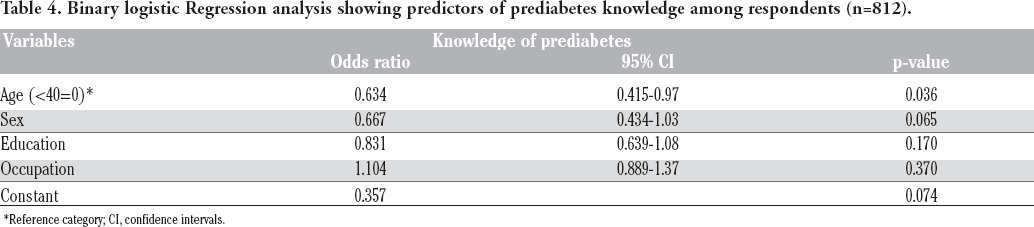
Reference category; CI, confidence intervals.
Discussion
The present study was the first population-based study assessing prediabetes awareness in Al-Ahsa. Perception of prediabetes can lead to early detection of the condition, which is fundamental to preventing diabetes and its complications.24-26 Several studies have reported that <10% of individuals are aware of prediabetes. 16,27 In contrast to these previous studies, the present study revealed that a significantly higher percentage of respondents had a high level of knowledge of prediabetes. However, in line with previous studies, the current study highlights a range of deficiencies in knowledge about prediabetes. One previous study showed that one-third of American had prediabetes, while only 10% of these were aware of their condition. 28 Another study showed that more than half of its participants were not aware of their prediabetes. 29 Zhuang et al. reported a similar low percentage (21.6%) of Chinese respondents with prediabetes who had also heard of prediabetes. 30 However, Campbell et al. also showed that a high proportion of their total sample of 2,999 United States adults with prediabetes were aware of their status. 31 The high level of prediabetes knowledge in the present study could be due to the high education level among some of the participants, which may have given them the opportunity to acquire knowledge regarding diabetes and prediabetes. Accordingly, a lack of community education programs on prediabetes could lead to deficiencies in prediabetes knowledge.
The present study also found an association between age and prediabetes awareness consistent with a previous American study that reported prediabetes awareness was lower among persons aged less than 44 years compared with those older than 44 years. 13 Old age is a risk factor for prediabetes and a driver of diabetes. Therefore, raising prediabetes awareness among these age groups could help to prevent prediabetes and type 2 diabetes.32,33 One explanation for the result of the present study could be that the higher prevalence of prediabetes within older age groups that leads to greater awareness concerning the disease.
At the same time, the present study did not find any statistically significant association between education level and knowledge of prediabetes. This is in contrast to a previous study that reported significant association between education and prediabetes awareness, with the prevalence of prediabetes awareness being higher among those in the USA with greater than high school education. 13 However, consisting with result of the present study, Singh and colleagues reported that regardless of educational level, none of the participants were aware of prediabetes. 34
There has also been evidence that a family history of diabetes is associated with development of the disease. 34 A significant proportion of respondents in the current study with a high level of prediabetes knowledge reported that they had a family history of diabetes. This is consistent with a previous study, in which it was found that prediabetes awareness was higher among participants with a family history of diabetes than among those without. 24 Campbell et al. also found that participants with prediabetes and no family history of diabetes tended to be unaware of their own condition. 31 Further, Li et al. also reported that prediabetes awareness was higher among participants with a family history of diabetes than among those without (10.4% versus 6.2%). 13 In agreement with previous studies, the participants in the current study demonstrated a high level of knowledge regarding family history of diabetes as a risk factor for prediabetes. Although it is considered impossible to improve this risk factor, a family history of diabetes leads to a high probability of increased prediabetes knowledge among the affected people. This may be due to the education given by the concerned persons to diabetes patients and/or their families. Approximately 70% of prediabetes patients develop type 2 diabetes.35,36 Further, normo-glycemic patients have an approximately 0.7% chance per year of developing type 2 diabetes, and those with impaired fasting glucose have a 5-10% chance each year. 35 In the present study, a significant proportion of respondents were able to identify that people with prediabetes may develop diabetes and that prediabetes awareness may thus prevent or decrease the risk of diabetes. In line with the results of the present study, Zhuang et al. demonstrated that 28.4% of respondents were aware that prediabetes is a leading risk factor for type 2 diabetes. 30
The findings of the current study also revealed that a significant proportion of respondents were aware of the risk factors of prediabetes, such as a lack of daily exercise, being overweight, and having preeclampsia. Zhuang et al. reported that less than a quarter of their Chinese participants were aware that prediabetes is a risk factor for chronic diseases, such as type 2 diabetes and cardiovascular disease. 30 Several studies have attempted to assemble information concerning prediabetes knowledge in different settings with respect to risk factors and risk-reducing behaviors.27,31,36-38 Some factors noted to lower the risk of developing prediabetes were young age, non-smoking, high education level, low body mass index, and receiving advice from healthcare providers. 30 In agreement with a previous study that found high levels of prediabetes knowledge regarding screening and obesity as a risk factor for prediabetes, 39 the results of the present study indicate a high level of prediabetes knowledge concerning risk factors. Lorga et al. reported that their participants had low response rates to questions on exercise as a risk for prediabetes due to the fact that they did not perceive running or walking as exercise. 3 Khan et al. reported similar results concerning awareness of prediabetes risk factors, finding that knowledge levels were average (53.3%). 38
However, evidence suggests that there may be gaps in knowledge about some prediabetes risk factors among various communities. For example, a study under taken by Hosler et al. demonstrated that the prevalence of self-reported prediabetes awareness was higher among older respondents (>45 years), those who had family history of diabetes, and those with a body mass index ≥25kg/m2. 40
The present study revealed a high level of knowledge concerning prediabetes screening in people older than 45 years even though there was no local literature addressing knowledge of prediabetes risk factors and screening. At the same time, a study under taken by Nadia et al. revealed that only a minority of participants explicitly reported that screening for prediabetes should be performed for individuals with a body mass index of 25kg/m2, and these did not mentioned age. 39 Further, the same study reported that some participants had the knowledge that gestational diabetes is a risk factor for prediabetes, while more than half considered family history of diabetes a risk factor for prediabetes. 39 In contrast, Khan et al. reported that a minority of respondents (10.6%) had knowledge concerning prediabetes screening for people over 45 years old. 38 In line with a previous study reporting that clinicians have greater prediabetes knowledge concerning screening and diagnosis compared with treatment, 41 the current study revealed a statistically significant association between prediabetes awareness and occupation, such as for healthcare practitioners. Khan et al. also reported that medical students had poor knowledge of prediabetes prevention as well as preclinical and clinical management of the condition. 38 The dissimilarities in the level of prediabetes knowledge among people of different occupations might be explained by the adequate or inadequate training received concerning prediabetes and diabetes depending on occupation. Overall, the findings of the current study are consistent with those of other studies in indicating that knowledge of prediabetes varies widely with regard to risk factors and preventive measures. Prediabetes knowledge was found to be high in some of the examined areas. However, the present study of prediabetes knowledge assessment of public is unique in Saudi Arabia and gave a model knowledge about prediabetes knowledge assessment among Saudi communities. Though, there are many areas that indicate multidisciplinary interventions to improve knowledge and lifestyle along with other risk factors would help in delaying or preventing the progression of prediabetes to diabetes. The multidisciplinary interventions would requisite a collaboration of the health authorities, policymakers, and the educational personnel to develop a welldesigned prediabetes community educational program. The designed prediabetes program must be constantly implemented in order to improve the diabetes awareness that leads to diabetes prevention.
Limitations
It must be acknowledged that there were some limitations to the present study. In particular, the data concerning prediabetes awareness was taken from in-person face-to-face interviews and might be subject to bias responses and the time-consuming nature of the interviews. Moreover, the sample may be not representative of the population, and actual levels of awareness might be higher or lower if non-participants differ from the participants. In addition, because participation was voluntary, it is possible that some level of selection bias occurred with participants who were already interested in the subject of diabetes being more likely to respond. Thus the responses may not be a true representation of the level of knowledge of prediabetes in the entire community at Al-Ahsa region. However, this was addressed by inviting all persons who fulfilled the inclusion criteria and sampling technique, and the response rate was relatively high.
Implications
A well designed prediabetes community educational program must be constantly implemented in order to improve the diabetes awareness that lead to diabetes prevention.
A comprehensive evaluation of the prediabetes knowledge is required to assess its impacts on the prevention of both prediabetes and diabetes.
Modification of lifestyle and other interventions can be applied during the prediabetes period to prevent the development of type 2 diabetes.
Conclusion
Knowledge is considered an important factor in the prevention of prediabetes and diabetes. Planned and structured educational programs have thus been recommended as an important strategy to improve compliance and reduce the risk and rates of prediabetes and diabetes. People in Al-Ahsa demonstrated a high level of knowledge regarding some risk factors for prediabetes, such as being obese, being old, and having a family history of diabetes. However, there were a number of deficiencies in the knowledge of prediabetes risk factors and preventive measures as well as in general knowledge of prediabetes, which may lead to a high prevalence of prediabetes and diabetes. These deficiencies reveal that there is an urgent need for mass educational programs on prediabetes to improve knowledge of the condition, and the need for prediabetes screening should also be stressed as a part of these programs. Further, investment in research investigating and assessing the prediabetes awareness and literacy of the public in the Al-Ahsa region as well as in other regions of Saudi Arabia is needed.
Footnotes
Acknowledgements
We would like to acknowledge Dr. Hassan AlHamrani (the owner of the inspiration of community prediabetes and diabetes education program in AlAhsa), Ahmed Al Dareese, Abass Al Salman, and Bader Al Hamad along with the diabetes team at the King Fahad Hofuf Hospital for their help in data collection.