




Abstract
Background
Cervical Cancer (CC) is the fourth most frequent malignancy worldwide among females with significant death rates. It ranks as the 8th most frequent cancer in Saudi female. CC is preventable, with likelihood of full treatment by early detection, because of its long pre-invasive period. Lack of awareness and practice on CC prevention and screening increase the risk of disease.
Objective
to examine knowledge, attitude, and practice on CC prevention among Saudi female university students.
Methods
A facility-based cross-sectional study with a convenience sample included 594 female university students studying at health and non-health colleges of Prince Sattam bin Abdulaziz University in Al-Kharj City, Saudi Arabia. All female students were asked to complete an online questionnaire on knowledge, attitude, and practice on CC prevention.
Results
A total of 594 respondents to the questionnaire, 88.7% of them had unsatisfactory knowledge about CC. Out of a total of 27 points, students’ knowledge mean score was 9.3 ± 6.4. Conversely the majority of students (94.4%) had positive attitude toward CC; the mean attitude score was 34.52 ± 5.04 out of 45. Regarding students practice, less than 7% of students were vaccinated against HPV and only 3.7% were screened for cancer cervix. Married females, health colleges students, and high attitude score were significant predictors for the students’ knowledge about cancer cervix (P < 0.05).
Conclusion
Majority of the respondents displayed lack of knowledge; however, they had a positive attitude toward CC. Very alarmingly, almost all of students had inadequate practice regarding CC prevention. So, the study recommends developing and implementing educational programs and strategies for female university students to improve their knowledge and practice related to cervix cancer. Results of this study provide evidence that can help in formulating effective awareness strategies and educational programs for women that would help in CC prevention.
Introduction
Globally, Cervical Cancer (CC) ranks fourth among cancers in women, following lung, colorectal, and breast cancer. CC is a major cause of death for over 310 thousand women globally each year, and it typically manifests at a younger age, placing a significant financial burden on families and society. In 2020 Nearly 90% of CC new cases and deaths globally occurred in low- and middle-income countries (Arbyn et al., 2020; Sung et al., 2021). Over 600,000 new CC cases in 2020 was the estimated number globally. Nearly all CC cases can be attributed to infection with Human Papillomavirus (HPV). Hence, accelerating the eradication of CC and HPV infection has emerged as a public health priority (World Health Organization, 2022).
Saudi Arabia has a population of 10.7 million women who are 15 years of age or older and are at risk of having CC. According to current estimates, 358 women are diagnosed with CC and 179 die from it every year. Cervix cancer ranks as the 8th most common malignancy in Saudi women between age of 15 and 44 years (HPV Information Centre, 2023). Data regarding the prevalence of HPV in Saudi Arabia's general population is currently unavailable. However, it is estimated that 2.5% of women in the general population in Western Asia, which includes Saudi Arabia, are infected with HPVs 16 or 18 that are responsible for 72.4% of invasive cervical malignancies. (Human Papillomavirus and Related Cancers, 2023).
Risk factors for CC include HPV infection, sexually transmitted diseases (STD), early sexual activity, numerous sexual partners, long-term use of hormonal contraception, advancing age, raised parity, and smoking (Usman et al., 2023). HPV is a well-known cause of CC. Increased rates of CC are because of lack of appropriate screening programs (Alshammari & Khan, 2022). Pap smear test screening has contributed to a 70% decrease in the incidence and death rates of CC by detecting cytological abnormalities of the cervix in developed countries (Alsbeih, 2014).
CC is avoidable, with high probability of complete treatment if detected early, as it grows slowly from detectable precancerous lesions in its metastatic stage. Regular screening and periodic check-up for female in reproductive age are the certain method of decreasing incidence rate of CC and its related deaths (Usman et al., 2023). Prevention remains the primary technique for addressing the growing CC burden. CC has a long premalignant stage, which allows for screening and treatment before it progresses to invasive CC. Population-based screening with Pap smear or cytology is an important secondary preventative measure for CC screening that leads to a high cure rate (Šarenac & Mikov, 2019; Taneja et al., 2021; World Health Organization, 2022).
Early detection and treatment of CC in women are essential for decreasing deaths rates. Comprehensive CC management includes primary preventive actions (HPV vaccine), secondary preventive actions (early detection of any precancerous cells and its treatment), tertiary preventive actions (treatment of invasive CC), in addition to providing palliative care (World Health Organization, 2022). One of the aims of the WHO's strategy to eliminate CC by 2030 is to vaccinate 90% of girls against HPV before the age of 16 (World Health Organization, 2022). HPV vaccination is offered in Saudi Arabia for all females from 9 to 18 years old on demand through the primary health care centers (Alherz et al., 2024).
Review of Literature
CC ranks the third among gynecological malignancies in Saudi women, after cancer of uterus and ovaries (International Agency for Research on Cancer, 2022). In Saudi Arabia, the majority of CC cases diagnosed in advanced stages, probably because of lack of awareness about CC, moreover, women are unwilling to participate in screening tests due to a lack of knowledge and practice regarding CC and its screening (Azer et al., 2022).
Knowledge about CC and its screening is one of the most effective strategies for CC prevention. Lack of knowledge and inadequate practice regarding CC prevention is from significant factors that rising the incidence of CC (Taneja et al., 2021). Hence, it is crucial to assess knowledge, attitude and practice (KAP) regarding CC among university female students in reproductive age. Many studies in Saudia Arabia revealed the lack of university students’ knowledge about CC and HPV (Akkour et al., 2021; Al-Darwish et al., 2014; Al-Shaikh et al., 2014), however Saudi studies examining the female university students’ attitude and practice regarding CC prevention are scarce. No previous study on the KAP regarding CC prevention in university students studying at Prince Sattam bin Abdulaziz University. So, the current study aimed to examine the knowledge, attitude, and practice on CC prevention among Saudi female university students studying at Prince Sattam bin Abdulaziz University in Al-Kharj city, Saudi Arabia. The outcome of this study would provide data about current knowledge, attitude, and practice regarding CC prevention in a sample of Saudi university female students, which can be useful for developing population-based educational programs leading to enhancement of awareness and practices regarding CC and its screening.
Methods
Research Design and Setting
A facility-based cross-sectional study design was utilized to examine knowledge, attitude, and practice of Saudi female university students studying in different colleges at Prince Sattam bin Abdulaziz University main branch located in Al-Kharj City, Saudi Arabia between October, and December 2023.
Research Questions
What is the level of knowledge about CC among female students?
What is the attitude of female students toward CC prevention?
What is the practice of female students regarding CC prevention?
Sample
A convenience sample included 594 female students studying at Prince Sattam bin Abdulaziz University. Inclusion criteria: female students, aged 18 to 28 years, registered in health colleges (applied medical sciences, medicine, nursing, dentistry, and pharmacy) OR non-health colleges (engineering and computer science, education, business administration, and humanity sciences), from all years and departments in main university branch in Al-Kharj city. Exclusion criteria: male students, master's degree students, and students from other university branches.
All female students were requested to answer an online questionnaire created as a Google Form asking about knowledge, attitude, and practice regarding CC prevention. The link to this questionnaire was sent to students via their WhatsApp and Telegram groups. Furthermore, they were asked to share the survey link with other peers to increase the response rate. About 594 female students accepted participation; all responses were analyzed because students could only submit their response after completing all the questions of the survey.
Data Collection Process
The researcher prepared an online self-administered close ended questionnaire on KAP regarding CC prevention and sent it to all the female university students via a link on WhatsApp and Telegram students’ groups between October and December 2023. The questionnaire was created by the researcher directed by the study purpose and review of literature. The researchers translated the questionnaire items into Arabic; to verify its relevance, accuracy and clarity, the Arabic and English surveys were reviewed by three faculty members from Prince Sattam bin Abdulaziz University. The questionnaire was verified for face and content validity and reliability by carrying out a pilot study on 30 participants. The questionnaire included four parts:
Ethical Considerations
Ethical approval was obtained from the Institutional Review Board of Prince Sattam bin Abdulaziz University (No. SCBR-162/2023); and informed consent was taken from participants before completing the question of the online questionnaire. This study was directed in accord to principles of the declaration of Helsinki. The participants were notified that the study was voluntary, they could withdraw at any time, and all gathered data would be confidential.
Data Analysis
All gathered data were tabulated and statistically analyzed with IBM SPSS Statistics for Windows, Version 23.0. Quantitative data were presented as mean and standard deviation, whilst qualitative data were presented as absolute numbers and percentages. Pearson's correlation coefficient was utilized to determine the correlation between research variables. The Cronbach alpha coefficient was derived to assess the scale's reliability based on its internal consistency. Logistic regression analysis was used to measure the association between dependent variables and independent variables using crude odds Ratio with the significance level set at 5%. Multiple logistic regression analysis for adjusted odds ratio. Statistical significance was determined at p < 0.05.
Results
Female Students’ General Characteristics
In total, 594 undergraduate female students participated in the current study and agreed to respond the online self-administered survey. Table 1 indicates that 71.4% of the students their age ranged between 20 and 22 years. 86.7% of the students were single, 95.1% lived with their families and 69.5% were studying in Health colleges (applied medical sciences, medicine, nursing, dentistry, and pharmacy); with 24.7% of them studying in College of Nursing. 38.2% of the students were studying in second year and 55.9% of them had GPA of more than 4. Only 2.9% of the students had family history for cancer cervix and related cancer.
General Characteristics of the Female University Students (n = 594).

Female Students’ Knowledge About Cancer Cervix
According to Table 2, the majority of the students (88.7%) displayed unsatisfactory knowledge about CC. The mean score of total knowledge of students was 9.3 ± 6.4 out of 27 which indicates unsatisfactory knowledge. Table 2 besides depicts the mean scores of CC knowledge domains. The average score of knowledge of students about risk factors of CC was 3.8 ± 3.06 out of 9 and the average score knowledge about symptoms of CC was 2.15 ± 2.03 out of 6. Additionally, the average score of knowledge of students about Pap-smear-test was 1.52 ± 1.54 out of 7 and the average score of knowledge about HPV vaccination was 0.98 ± 1.13 out of 3. All these mean scores indicate unsatisfactory knowledge regarding all knowledge domains.
Knowledge About CC in Female University Students (n = 594).
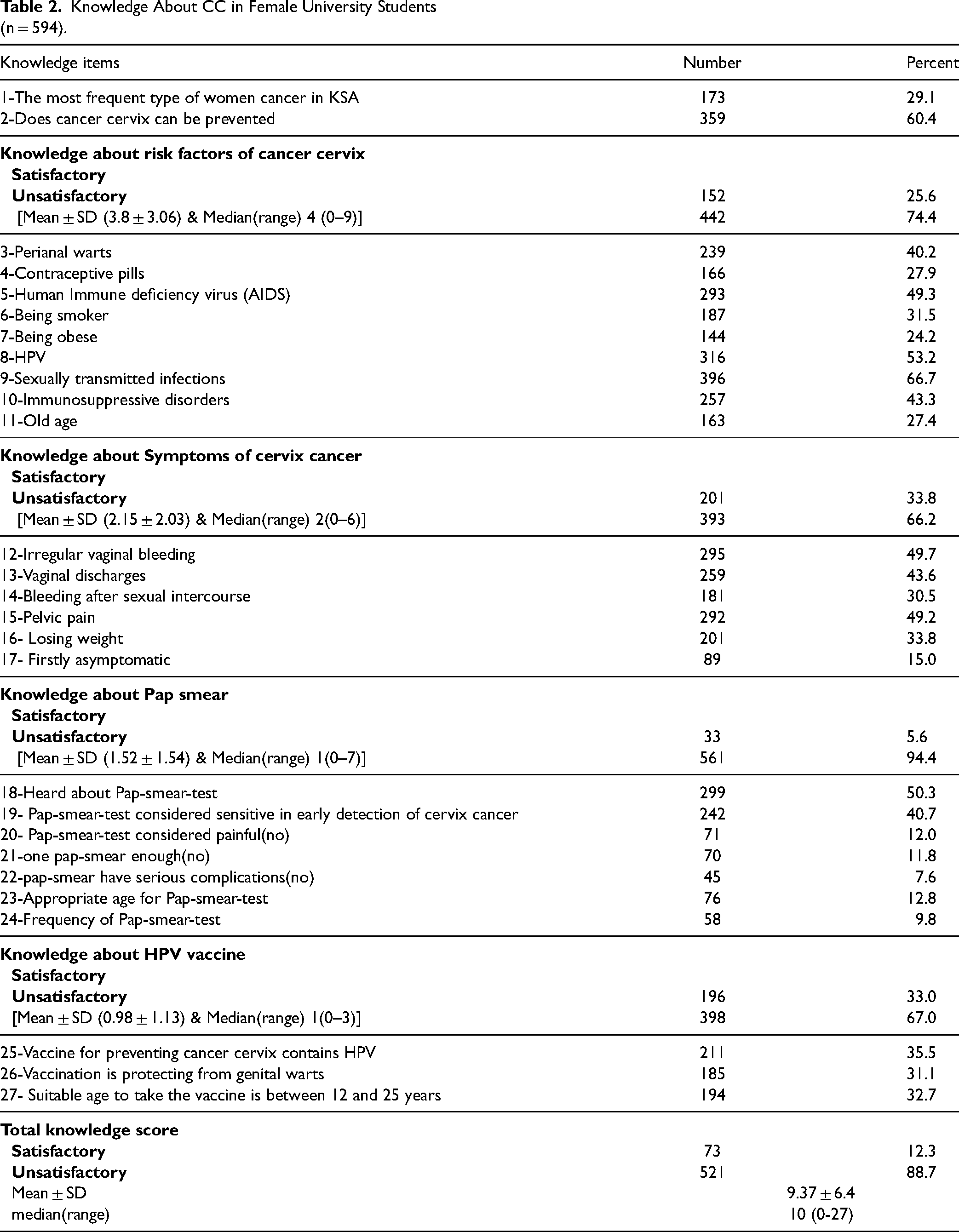
Female students’ responses to knowledge items are presented in Table 2. 60.4% of students recognized that CC is a preventable cancer. 66.7% and 53.2% of the students reported that sexually transmitted diseases and HPV respectively are CC risk factors. Nearly one half of the students knew that irregular vaginal bleeding (49.7%) and pelvic pains (49.2%) are symptom of cancer cervix. Half of female students heard about pap smear test (50.3%), and 40.7% of them identified that pap-smear-test is sensitive in early detection of CC. 35.5% of the students recognized that the vaccine against cancer cervix contains HPV and 32.7% of them knew the appropriate age for this vaccine (Table 2).
Female Students’ Attitude Toward Cancer Cervix Prevention
According to Table 3, the majority of the students (94.4%) had Positive attitude toward Cancer cervix. The mean score of attitude of students was 34.52 ± 5.04 out of 45 which indicates Positive attitude. Table 3 also depicts the female students’ responses to attitude items. The majority of the students had favorable attitude regarding early detection of cancer cervix (84.9%) and importance of screening for prevention of cancer cervix (81.7%). Moreover, 78.1% of the students had favorable attitude regarding seriousness of cancer cervix. These responses reflect the positive attitude of students toward prevention of Cancer Cervix. Conversely, the majority of the participants (86.4%) had unfavorable attitude regarding their chance of getting cervix cancer; only 13.7% of them thought that they have the chance of getting cervix cancer. Furthermore, only 45.5% of the students reported their willingness for CC screening.
Attitude of the Study Participants Toward Cervix Cancer Prevention (n = 594).
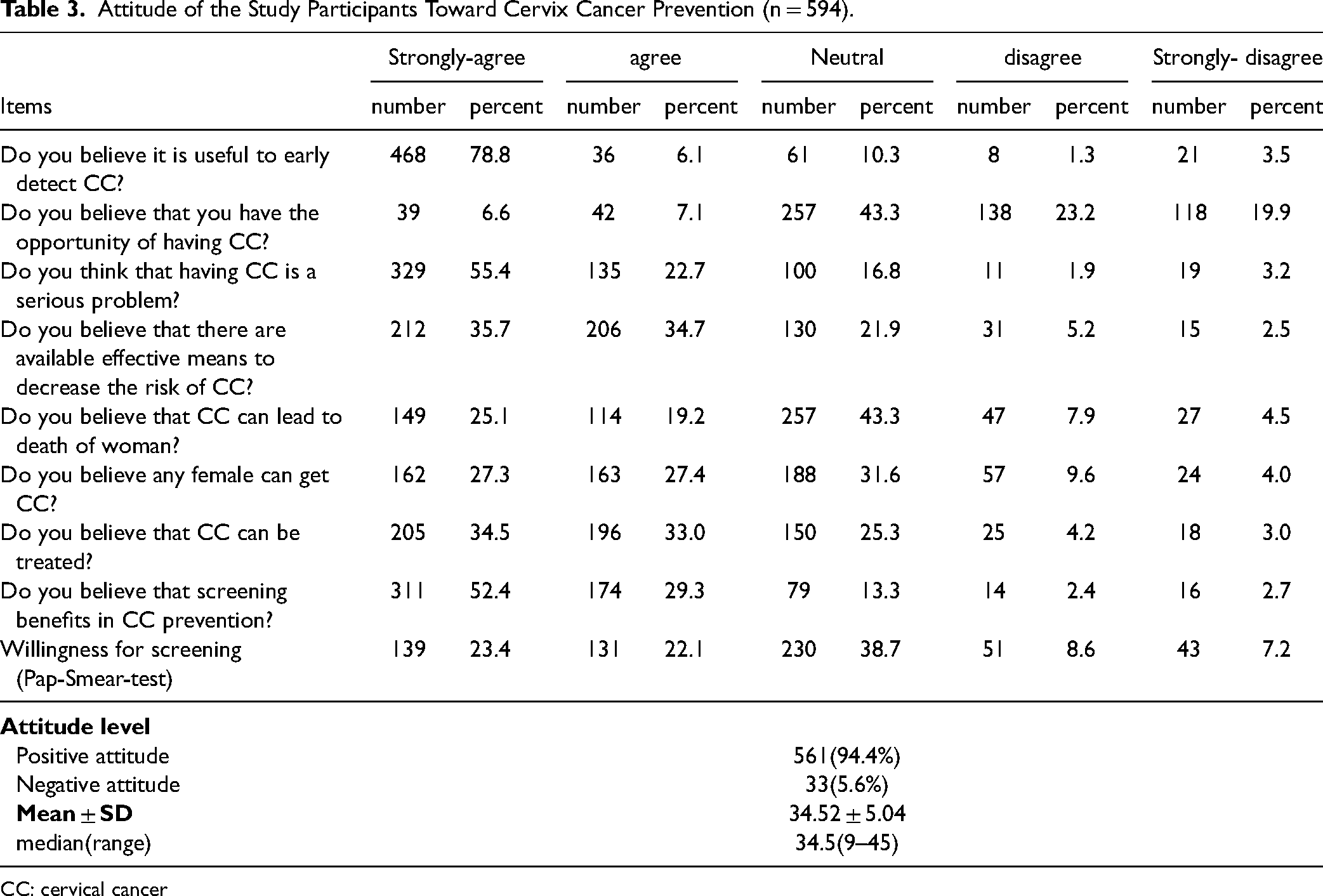
CC: cervical cancer
Female Students’ Practices Regarding Cancer Cervix Prevention
Table 4 indicates that only 41 students (6.9%) were vaccinated against HPV. Among all students, only 4.2% of them gone for Pap smear examination, moreover only 3.7% of them were screened for cancer cervix. Only 35 students (5.9%) were get married earlier than 18 years (had sexual experience) and were smokers.
Practice of the Study Participants Regarding Cervix Cancer Prevention (n = 594).

Predictors of Female Students’ Knowledge and Vaccination Against HPV
Table 5 demonstrates a significant positive correlation between female university students’ CC knowledge score and their attitude score. In Table 6, Logistic regression analysis was used to measure the association between dependent variables and independent variable using crude odds Ratio with the significance level set at 5%. Multiple logistic regression analysis for adjusted odds ratio. After defining the final model, its goodness of fit was determined by non-significant the Hosmer-Lemeshow test. Variance inflation factor (VIF) which measure of the amount of multicollinearity in regression analysis. VIF above 4 or tolerance below 0.25 indicates that multicollinearity. Table 6 indicates that married females, health colleges students, and attitude score were significant predictors for the students’ knowledge about cancer cervix (P < 0.05). Furthermore, married females, health colleges students, and Knowledge score were significant predictors for students’ vaccination against HPV (P < 0.05).
Correlation Between Students’ Knowledge Score and Their Attitude About Cancer Cervix.

Pearson’ correlation coefficient (r) ** Correlation is significant at the 0.01 level (2-tailed).
Multivariate Logistic Regression for Predicting Students’ Knowledge About Cancer Cervix and Students’ Vaccination Against HPV (n = 594).

Exp(β) = The odds ratios for the predictors, CI = Confidence interval.
Discussion
This study aimed to examine the knowledge, attitude, and practice (KAP) on CC prevention in Saudi female university students. To the researcher knowledge, this study was the first one that examined CC prevention KAP of the university students at Prince Sattam bin Abdulaziz University in Al-Kharj city. This study revealed that the majority of female students displayed lack of knowledge and a favorable attitude toward CC prevention. Moreover, almost all the female students showed inadequate practice regarding CC prevention. Thus, the finding of this study provided evidence on KAP regarding CC prevention in a sample of Saudi female university students which would be beneficial for planning and implementing population-based educational programs for enhancing awareness and practice regarding CC prevention and screening.
This study finding indicated that the majority of female university students (88.7%) had unsatisfactory knowledge about CC, which was also confirmed by the knowledge mean score that was 9.3 ± 6.4 out of 27 reflecting inadequate knowledge. This finding flashed that great attention must be given to CC prevention by developing educational programs for enhancing the female students’ knowledge about CC. In the same line, Al-Shaikh et al. (2014) who conducted their study in Saudi Arabia on female students at Princess Nora Bint Abdul Rahman University and revealed that 95.7% of them had poor knowledge level about cancer cervix. Similarly, a study by Al-Darwish et al. (2014) in Saudi Arabia revealed that most of the students in King-Faisal-University had poor knowledge about CC, and a study by Akkour et al. (2021) showed that Saudi women had limited CC knowledge. An added study in China by Zhang et al. (2022) showed a low knowledge about CC prevention in university students, and another study by Kamzol et al. (2013) in Poland found an insufficient awareness about CC in students. Moreover, a review study in India by Taneja et al. (2021) to study KAP on CC concluded that knowledge on CC in females was 40.22%.
On the other hand, a study in Saudi Arabia by Gari et al. (2023) revealed that most participants displayed had adequate knowledge about CC risk factors. Another study in Saudi Arabia by Almazrou et al. (2020) found that 61% of physicians had good knowledge about CC. Similarly, two studies Ethiopia in by Tsegaye (2015) and Getaneh et al. (2021) found that more than fifty percent of female medical students had good knowledge about CC. Additionally, a study by Rashwan et al. (2012) in Malaysia indicated a high level of knowledge on HPV infection and CC in students, also a study in Nigeria by Isara et al. (2013) revealed that 63.0% of female medical students had good CC knowledge.
As far as the students’ knowledge about risk factors of CC, 66.7% and 53.2% of the participants knew that sexually transmitted diseases and HPV respectively are risk factors for CC. Similarly, a study by Al-Shaikh et al. (2014) indicated that 59.6% of the students recognized that sexually transmitted infections as a risk factor, and the study in Saudi Arabia by Gari et al. (2023) indicated that 82.9% of women knew that HPV infection as a risk factor for CC. However, the study by Getaneh et al. (2021) found that only 15.6% of the students knew that HPV is a risk factor of CC and Al-Shaikh et al. (2014) indicated that only 26.5% of the students knew that HPV is a risk factor for CC.
Concerning the students’ knowledge about symptoms of cancer cervix, nearly one half of the participants knew that irregular vaginal bleeding (49.7%) and pelvic pains (49.2%) are symptom of cancer cervix. Similarly, Al-Shaikh et al. (2014) indicated that 54.8% of the students identified that abnormal vaginal bleeding was one of CC symptoms. However, the study by Getaneh et al. (2021) found that only 20.6% of the students knew that abnormal vaginal bleeding was considered one of CC symptoms.
Regarding the students’ knowledge about Pap-smear-test and HPV vaccine, the study identified that 50.3% of participants had heard about Pap-smear-test, also 40.7% of them identified Pap-smear-test is sensitive in early detection of CC. In the same line, Al-Shaikh et al. (2014) indicated that 46.7% of female students heard about Pap-smear-test and only 30% of them identified it a sensitive test for early detection of CC. Additionally, the current study indicated that 35.5% of students recognized that the vaccine taken for prevention of CC contains Human Papilloma Virus and 32.7% of them knew the appropriate age for this vaccine. Similar finding was found by Gari et al. (2023) study in Saudi Arabia and indicated that 36.3% of women had heard of vaccine against HPV and 30.3% of them knew the appropriate age to take the vaccine. Though, Al-Shaikh et al. (2014) study demonstrated that 10.9% of Saudi students knew that the vaccine containing HPV and 8% knew the suitable age for vaccination.
Concerning female students’ attitude, the finding of this study revealed that the majority of participants (94.4%) had positive attitude toward CC, which was also confirmed by the attitude average score that was 34.52 ± 5.04 out of 45 reflecting positive attitude of the students. Additionally, the majority of the students had favorable attitude regarding early detection of cancer cervix, importance of screening for prevention, and seriousness of cancer cervix. Similar results were identified by Getaneh et al. (2021) who found that 67.7% had a favorable attitude toward CC and the majority of the students had positive attitude about early detection and thought that screening helps in CC prevention. This result is inconsistent with Zhang et al. (2022) study in China that displayed expressing high willingness by students to take HPV vaccine which reflects their positive attitude toward CC prevention. Similarly, Rashwan et al. (2012) in Malaysia showed that most students had favorable attitude regarding HPV vaccine.
On the other hand, the majority of this study sample had unfavorable attitude regarding their chance of getting cervix cancer; only 13.7% of them thought that they have the chance of getting cervix cancer. This result is inconsistent with those of Getaneh et al. (2021) and Mulatu et al. (2017) research in Ethiopia who indicated that 56.8% and 49.28% of the students perceived that they could acquire CC.
In this study, there was a significant positive correlation between students’ knowledge and their attitude about cancer cervix which also confirmed by the results of the Logistic regression which showed that high score of attitude was a significant predictor for the students’ knowledge about CC. This may be due to the fact that the attitude toward certain subject is affected by the knowledge about it.
In terms of female students’ practice regarding CC prevention, finding of this study showed that almost all of students had inadequate practice regarding CC prevention as only 6.9% of them were vaccinated against HPV and only 3.7% were screened for cancer cervix. These findings flashed that distinctive attention must be given to CC prevention by vaccination against HPV, the principal risk factor of CC. These results are like those of the study in Saudi Arabia by Gari et al. (2023), that only 4.4% of the study sample were vaccinated and the research by Aldawood et al. (2023), that only 5.2% of sample reported receiving the vaccine. Additionally, Getaneh et al. (2021) reported that only 0.5% of students had been screened for CC and only 1.2% took HPV vaccine. Similarly, Rashwan et al. (2012) research in Malaysia, indicated that 3.6% of students took HPV vaccine.
This study showed that being a health college student was considered a significant predictor for knowledge about CC which mean that health colleges students had better knowledge than non-health colleges students. A similar result by Azer et al. (2022) study in Saudia Arabia and showed that health students had more knowledge about CC than non-health students. Another study in Saudi Arabia by Gari et al. (2023) found that medical students had higher knowledge than the students. Similarly, a study by Rashwan et al. (2012) in Malaysia revealed that health students had high knowledge level, and a Polish study by Osowiecka et al. (2021) who showed medical students significantly had good knowledge about CC.
Strengths and Limitations
The study findings represent the first evidence on current knowledge, attitude, and practice regarding CC prevention of Saudi female students at Prince Sattam bin Abdulaziz University and would be helpful for developing educational programs and policies for enhancing university students’ awareness on CC prevention and screening. However, this study has two limitations; firstly, is the disproportionate sample across different colleges, which may increase the likelihood of selection bias. Secondly, is that this study involved students from one Saudi university.
Implications for Practice
The results of this study provide evidence that can help in formulating effective awareness strategies and educational programs for Saudi female students that would help in CC prevention. For a more comprehensive estimation of CC awareness in Saudi students, a wide range study including multiple Saudi universities with a larger and more representative sample is recommended. The study recommends developing and implementing educational programs for female university students to enhance their knowledge and practice regarding CC prevention. Moreover, this study finding evokes the necessity for more efforts in the struggle against CC and encouragement of CC screening and uptake of vaccination. National comprehensive campaigns are strongly encouraged to enhance HPV awareness and to increase coverage rates of HPV vaccination. Furthermore, this study provides suggestions for researchers to conduct future studies focusing on enhancing female university students’ knowledge and practice regarding CC prevention.
Conclusion
The findings of the present study showed that the female university students displayed lack of knowledge and inadequate practice regarding CC prevention. However, they had positive attitude toward CC prevention. Furthermore, health colleges students had better knowledge and higher HPV vaccination uptake than non-health colleges students. Strategies to raise public awareness on CC and HPV are recommended.
Footnotes
Acknowledgment
The authors extend their appreciation to Prince Sattam bin Abdulaziz University for funding this research work through the project number (PSAU/2023/03/25698). The authors would like to thank all students who accepted to participate in this study.
Author Contributions
The study concept and design (HRA, NAM, MGE), data analysis and interpretations (HRA, NAM, MGE), manuscript draft (HRA, NAM, MGE), critical revision of the manuscript (HRA, NAM, MGE), article finalization (HRA).
Declaration of Conflicting Interests
The authors declared no potential conflicts of interest with respect to the research, authorship, and/or publication of this article.
Funding
The author(s) disclosed receipt of the following financial support for the research, authorship, and/or publication of this article: This research was supported by Prince Sattam bin Abdulaziz University through the project number (PSAU/2023/03/25698). Deanship of Scientific Research, Prince Sattam bin Abdulaziz University,
