




Abstract
The recent development of new methods to detect misfolded α-synuclein (αSyn) aggregates in biofluids and tissue biopsies in the earliest Parkinson’s disease (PD) phases is dramatically challenging the biological definition of PD. The αSyn seed amplification methods in cerebrospinal fluid (CSF) showed high sensitivity and specificity for early diagnosis of PD and Lewy bodies disorders. Several studies in isolated REM sleep behavior disorders and other at-risk populations also demonstrated a high prevalence of CSF αSyn positivity and its potential value in predicting the phenoconversion to clinically manifested diseases. Growing evidence exists for αSyn aggregates in olfactory mucosa, skin, and other tissues in subjects with PD or at-risk subjects. DOPA decarboxylase and numerous other candidates have been additionally proposed for either diagnostic or prognostic purposes in earliest PD phases. The newly described αSyn detection in blood, through its quantification in neuronally-derived exosome vesicles, represents a technical challenge that could open a new scenario for the biological diagnosis of PD. Despite this growing evidence in the field, most of method of αSyn detection and markers still need to be validated in ongoing longitudinal studies through an accurate assessment of different prodromal disease subtypes and scenarios before being definitively implemented in clinical settings.
Keywords
INTRODUCTION
α-Synucleinopathies are a group of neurodegenerative conditions, including Parkinson’s disease, dementia with Lewy bodies (DLB), multiple system atrophy (MSA), and other rarer entities defined by aggregation of abnormal forms of α-Synuclein (αSyn) and other proteins in neurons and glial cells. αSyn conformational modification into misfolded oligomeric and fibrillary forms is the most consistent pathological feature of α-Synucleinopathies. The interplay of these abnormal αSyn forms with the cellular pathways and cell organelles involved in their clearance results in neuronal dysfunction and, ultimately in axonal injury and neuronal death. The recent development of new techniques able to detect and quantify αSyn in vivo in different biofluids and tissues, including cerebrospinal fluids (CSF), plasma, olfactory mucosa, and skin, is now dramatically changing the scenario of α-Synucleinopathies, prompting the discussion for a biological definition of PD.1–3 Several studies showed that subjects later diagnosed as α-Synucleinopathies show a long prodromal phase, presenting with a combination of subtle non-motor or only mild motor features.4–6 Isolated REM sleep behavior disorder (iRBD) carries the highest positive predictive value for impending α-Synucleinopathies, with an estimated risk of phenoconversion over 70% after 12 years of follow-up.7–9 Subjects with iRBD are thus of particular interest for the study of the earliest biomarkers of α-Synucleinopathies, despite the fact they represent a specific prodromal subtype of disease with a higher risk of developing cognitive deficits and autonomic dysfunction.10,11, 10,11 To disentangle the complexity underpinnings prodromal α-Synucleinopathies, several longitudinal studies are now following-up subjects with subtle non-motor features such as hyposmia, autonomic dysfunction, subtle motor alterations, language impairment or individuals with positive family history for parkinsonism or carrying specific mutation associated with PD- all conditions related to a lower but consistent risk of developing α-Synucleinopathies. 10,12–14, 10,12–14
During the last few years, exciting results from such studies suggest that αSyn alterations are detectable even during the prodromal stages and might also be a potential target of disease-modifying intervention strategies. 15 This work will review the candidate biological markers for diagnosing α-Synucleinopathies, with a special focus on fewer studies in prodromal or earliest disease phases. The review will also include potential markers discussed within the research community for the differentiation of different α-Synucleinopathies and as markers of disease progression. Particular attention is paid to the recent development of seed amplification assays targeting the abnormal forms of αSyn in vivo and the clinical application of this assay which has dramatically changed the scenario of the ideal biological marker.7,8,16, 7,8,16 Clinical research also highlighted the value of numerous other candidates other than αSyn, including DOPA decarboxylase, neuronal, glial, and inflammatory disease associated biomarkers already in the early PD phases. The role of these biomarkers for the differential diagnosis of different α-Synucleinopathies and as possible proxies of progression and, thus, ideal targets for the disease-modifying strategies will briefly be discussed (see Fig. 1 andTable 1).
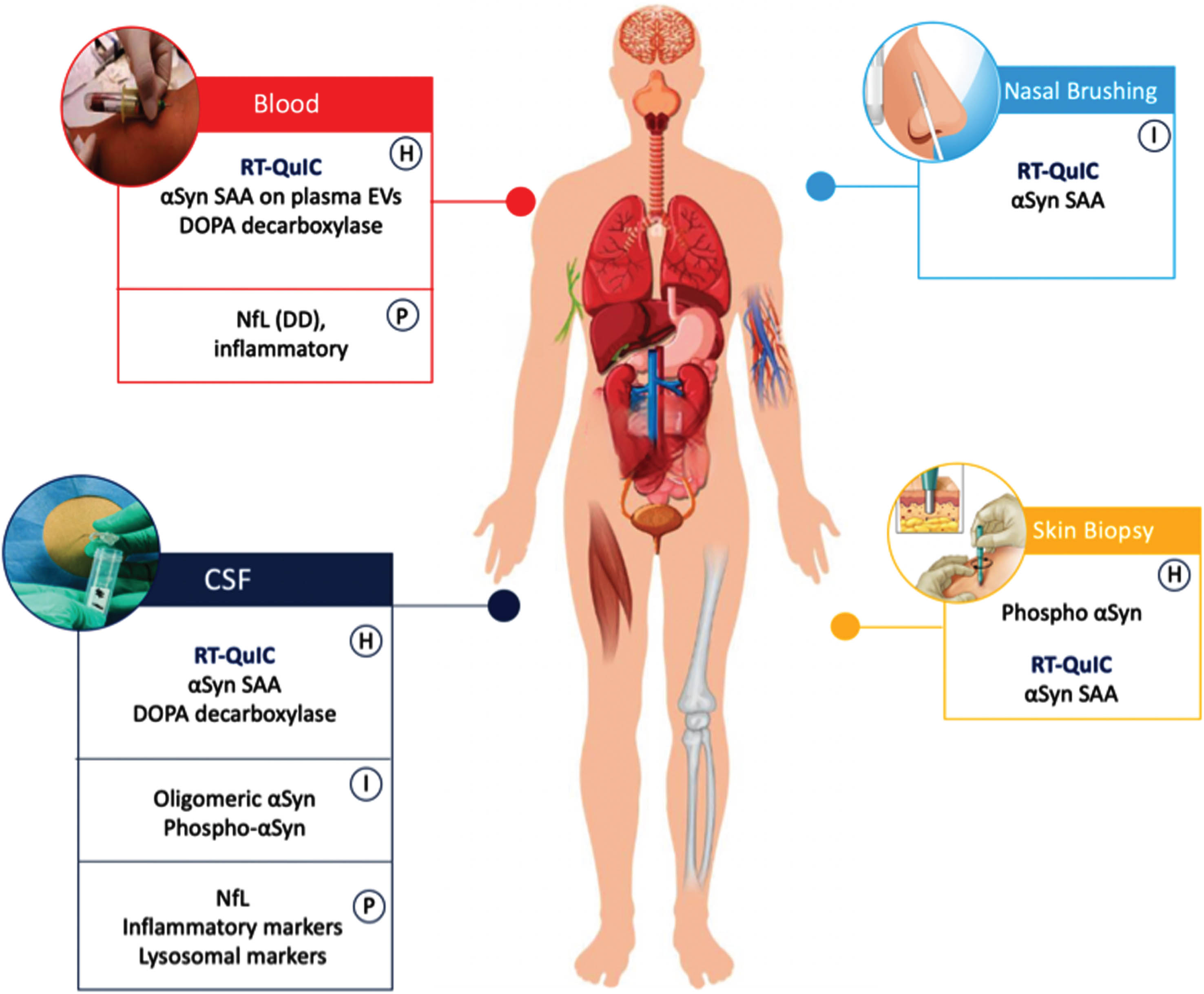
Potential biofluid and tissue markers of α-Synucleinopathies. Markers have been differentiated based on high sensitivity (H) when the mean diagnostic accuracy of the markers is > 80%, I intermediate accuracy when < 80%. (P) indicated prognostic markers. DD, differential diagnosis; NfL, neurofibrillary light chain; SAA seed amplification assay.
Most important markers used in earliest phase of PD and at-risk populations
Abbreviations: NfL, neurofibrillary light chain; SAA, seed amplification assay, αSyn, α-Synuclein; NE: not enough evidences for the use of the specific biomarker (based on negative or inclusive findings or meta-analyses); CS: cross sectional studies; L: longitudinal studies.
– = No efficacy (also scored if negative in a meta-analysis).
+ = Efficacy in at least one study.
*High sensitivity and specificity: >80%; moderate sensitivity and specificity: >70% and ≤80%; low sensitivity and specificity: ≤70%.
αSYN DETECTION IN CSF USING STANDARD ASSAYS
Total, phosphorylated, and oligomeric αSyn levels have been explored mainly in CSF of α-Synucleinopathies, with different methods and still debated results. 17
Several studies tested the correlation between total CSF αSyn concentrations in CSF and PD disease stage, but results are conflicting, with some studies reporting lower levels of αSyn in CSF of PD patients compared to matched controls while others report no differences or even higher levels of αSyn in PD cohorts. 17 A first meta-analysis conducted by Zhou and coauthors in 2015 found lower mean total αSyn concentration in CSF of PD patients compared to controls and significantly higher in PD compared to MSA, with no differences between PD and DLB. 18 Another updated meta-analysis found no differences in total CSF αSyn levels between PD and other parkinsonisms. 19 In contrast, total αSyn was significantly reduced in PD compared to controls, yielding an estimated sensitivity and specificity of 72% and 65% respectively. The overall heterogeneity remained high even after considering blood contamination, disease staging, and duration. 17 Moreover, reports show extensive signal overlap among tested individuals, diminishing its potential use in clinical practice. 20 ELISA assay settings for total αSyn were quite similar among the studies. However, significant analytical differences existed in the type of antibodies, calibrators, and quantitation methods, explaining an essential source of resultsheterogeneity. 21
Phosphorylated forms of αSyn have also been assessed in CSF, resulting in still conflicting results. In most studies, αSyn at serine-129 (Ser-129p-αSyn) levels have been elevated in the CSF of PD patients. However, similar increases are seen in atypical parkinsonism, limiting their diagnostic accuracy in clinical practice.17,22, 17,22 Different sites of αSyn phosphorylation has been claimed to be specific for α-Synucleinopathies, but their role has been no further confirmed in more extensive validation studies.23,24, 23,24
Other studies tested oligomeric αSyn in CSF as a potential marker, disclosing higher levels of PD in comparison to controls. The oligomeric/total αSyn ratio in CSF is one of the most promising biomarkers for distinguishing PD patients from controls, albeit a considerable overlap with controls and other neurodegenerative conditions was observed. 25 In general, standard measures of αSyn in fluids have given inconsistent results especially when trying to differentiate between PD and atypical parkinsonisms such as MSA.
Very few studies on CSF markers have been conducted in at-risk individuals.
Aasly and coauthors found that levels of CSF αSyn oligomers were significantly elevated in healthy asymptomatic LRRK2 mutation carriers compared to controls. 26 These findings were subsequently confirmed by Majbour and coauthors in an independent cohort of LRRK2 carriers, suggesting that the ratio between total and oligomeric αSyn is a risk biomarker candidate for the detection of pathological changes at the prodromal stage. 27 In iRBD, Wang and coauthors reported a reduction of total αSyn levels in CSF in these patients; of note, the subjects with lower levels exhibited an increased risk of phenoconversion to α-Synucleinopathies in longitudinal analyses. 28
OTHER PROMISING CSF MARKERS
The recent development of high-sensitivity techniques for CSF and plasma enables the quantification of other essential markers in CSF with potential value for differential diagnosis, subtyping, and prognosis in α-Synucleinopathies. One of the most established markers tested in neurodegeneration is the neurofilament light chain (NfL), which correlates to axonal damage and neuronal dysfunction and can be measured also in blood. 29 In PD, NfL levels in CSF were investigated in several cross-sectional and longitudinal cohorts of de novo PD patients, demonstrating the highest levels in other neurodegenerative diseases and atypical parkinsonism, including MSA and DLB and atypical tauopathies such as progressive supranuclear palsy and corticobasal syndrome. Thus, CSF NfL could be used for differentiating PD from atypical parkinsonism or identify PD subtypes of disease with a more severe motor and cognitive progression subjects.30–36
In a recent paper under review, Hoglinger and colleagues suggested that elevated NfL in αSyn-positive patients is more suggestive of MSA and should be used as an exclusion criterion for Parkinson’s disease. 37 In MSA patients, NfL levels are higher than in PD patients and HC both in CSF and in plasma samples 38,39, 38,39 and correlated with disease severity and progression rates. 40
MITOCHONDRIAL AND LYSOSOMAL MARKERS
Mitochondrial dysfunction contributes to the pathogenesis of PD. 41 The most studied mitochondrial biomarker is CSF DJ-1, which shows decreased levels in PD compared to controls and it correlated with disease severity. However, similar values in other parkinsonian syndromes limit its diagnostic use.42,43, 42,43
A dysregulated autophagy–lysosomal system can cause a reduced degradation of intracellular protein, thus enhancing αSyn accumulation in PD. 44 This hypothesis has been confirmed by identifying mutations in the GBA gene, encoding the lysosomal enzyme glucocerebrosidase (GCase), as the most common genetic risk factor for PD 45 . CSF GCase activity depends on the specific GBA1 mutations, but low levels are also reported in idiopathic PD patients compared with controls. 46 GCase levels are, however, of low value for diagnosing PD, and moderate diagnostic accuracy of lysosomal enzymes can only be yielded in combination with other markers; GCase activity, the o-/t- αSyn ratio, and age showed the best performance in discriminating PD from controls independent of GBA mutation status. 47 Moreover, CSF GCase levels correlate with cognitive impairment 48 also in idiopathic PD, underlying the potential role of lysosomal biomarkers in stratifying subjects with different disease subtypes. In contrast, no consistent data in prodromal phases has still been published.
DOPA-DECARBOXYLASE
DOPA-decarboxylase (DDC), an essential enzyme in neurotransmitter metabolism, has been recently suggested as a promising marker by two independent publications using large-scale multiplex proximity extension assay (PEA) on the Olink platform.49,50, 49,50 Findings showed an elevation of DDC in both CSF and plasma of people with PD or atypical parkinsonism and has been shown to be a biomarker of dopaminergic cell loss. 51 DDC levels in CSF can accurately identify patients with Lewy body disease (LBD) (AUC = 0.89 in Pereira et al. 50 , 0.80 in Paslawski et al. 49 ) and are associated with worse cognitive performance. Furthermore, DDC can detect preclinical LBD stages in asymptomatic individuals with a positive seed amplification α-synuclein assay (AUC = 0.81 in Pereira et al. 50 ) and that this biomarker could predict progression to clinical LBD over a 3-year period. 50
NEUROINFLAMMATORY CSF MARKERS
Mild neuroinflammation plays a major role in the pathology of PD since αSyn triggers the activation of the immune system 52 and inflammatory mediators have been investigated in CSF as candidate biomarkers for PD.
Neutrophil-to-lymphocyte ratios (NLRs), related to the overall inflammatory status, and glial fibrillary acidic protein (GFAP), a protein released by astrocytes, have been potentially suggested by recent publications as able to distinguish PD from healthy controls, despite a large overlaps of individual values and lack of significance of other studies.15,49,50,53, 15,49,50,53 The already cited study of Paslawski and coauthors identified Midkine (MK) using the PEA approach as specifically increased in α-Synucleinopathies (AUC 0.78). In the same study, the findings were validated using ELISA and correlated with the anti-inflammatory cytokines IL- 17D and IL-27cytokines expressed by astrocytes and has been suggested to play a role in local immune responses. 49 Other markers can reliably discriminate tauopathies from α-Synucleinopathies such as YKL-40 (chitinase-3-like protein 1) and MCP-1 (monocyte chemoattractant protein-1);54,55, 54,55 however, current evidence does not suggest that these markers would help in distinguishing clinically manifested PD from its earliest phases and from atypical conditions, also due to limited numbers of studies available. 15 Myelin basic protein (MBP) could represent a promising biomarker for MSA, considering that demyelination is a key features of MSA pathogenesis. Indeed, some studies have showed higher CSF levels of MBP in MSA patients compared to PD patients and HC.56,57, 56,57
In at-risk populations, the limited number of subjects who underwent CSF still limited its study in large longitudinal cohorts, and the recent development of blood-based assays represents a significant step forward for a wider use of biological markers in the earliest phases of α-Synucleinopathies.
SEED AMPLIFICATION ASSAYS AND αSYN DETECTION IN CSF
Recently, it has been shown that misfolded αSyn aggregates adopt alternative conformations and become self-propagating as prion proteins causing the rare Creutzfeldt-Jakob disease in humans. 58 Protein misfolding cyclic amplification (PMCA) and Real-Time Quaking-induced conversion (RT-QuIC) assays exploited this self-replicating nature of prions, approaching 100% sensitivity and specificity by applying this in human prion disorders.59,60, 59,60 To avoid confusion between RT-QuIC assay for prions and for other misfolded proteins, the consensus name ‘seed amplification assay (SAA)’ has emerged to refer to non-prion assays that exploit self-replication of misfolded proteins by means of fragmentation and elongation cycles, such as αSyn, tau, and TDP-43.61–63
Several studies confirmed excellent sensibility and sensitivity of αSyn SAA in differentiating healthy controls from clinically established PD patients in CSF samples.16,64, 16,64 Many studies have shown that αSyn SAA has a sensitivity and specificity above 90% for PD and for other α-Synucleinopathies.64,65, 64,65 The technique showed very high specificity when αSyn SAA was analysed in CSF from neuropathologically confirmed cases. 65 A recent meta-analysis on 22 SAA studies in CSF showed an overall sensitivity of 0.88 (95% CI, 0.82–0.93) and specificity of 0.95 (95% CI, 0.92–0.97) for distinguishing α-Synucleinopathies versus non α-Synucleinopathies including tauopathies. 64 In the recent study published on the PPMI cohort by Siderowf and colleagues, the sensitivity for established PD resulted in 87.7% with a specificity for healthy controls of 96.3%. Of note, the sensitivity increases in subjects with typical olfactory deficits up to 98.6% and decreases to 78.3% in those without hyposmia and 67.5% in LRRK2 mutation carriers. This fits the assumption that αSyn SAA in CSF might be associated with specific disease subtypes and mutations, including GBA, 66 with even possible prognostic implications.
In DLB, an early meta-analysis showed a sensitivity of 0.95 and a sensibility of 0.96 for CSF samples alone 67 compared to controls. In patients with dementia, however, the common detection of subjects with biologically established Alzheimer’s disease but positive αSyn SAA should be considered as a possible diagnostic challenge, especially in older subjects. 68
In MSA, the application of seed aggregation assays provided variable and inconsistent results: some studies showed a good performance in detecting αSyn in MSA patients, while some found very low rates of RT-QuIC positive MSA patients. This inconsistency could be partially due to inter-laboratory experimental parameters variability, but also to claimed different conformation of misfolded αSyn in MSA compared to either PD and DLB. 69 The kinetics parameters of RT-QuIC could also differentiate MSA from PD and DLB in some of these studies. 70 This might explain the prominent differences in sensitivity (0.30 for αSyn SAA specifically) detected in MSA patients compared to PD. Interestingly, some studies have demonstrated exemplary performance in combining the extent of αSyn seeding activity with NfL levels to distinguish MSA from PD. 71 In one study, published by Poggiolini et al., RT-QuIC parameters was also associated with rate of progression in MSA patients. 8
SAA IN AT-RISK AND PRODROMAL POPULATIONS
Only a few studies evaluated αSyn SAA seeding activity in CSF of subjects with prodromal PD, mainly including iRBD and genetic carriers. 64 Considering the whole studies included in the meta-analyses (which unfortunately excluded a few important recently published works), αSyn-SAAs yielded a pooled sensitivity and specificity to differentiate patients with prodromal signs of α-Synucle-inopathies from non-α-Synucleinopathies of 0.74 (95% CI, 0.36–0.93) and 0.93 (95% CI, 0.89–0.96), respectively in these phases of the disease. The diagnostic performance of αSyn-SAAs for patients with RBD showed sensitivity rates of 0.64 (95% CI, 0.50–0.77) 8 and 0.80 (95% CI, 0.58–0.92) 72 and 1.00 (95% CI, 0.82–1.00). 65 Pooled sensitivity and specificity rates could not be computed for this analysis due to the small number of included studies. Notably, the recently published cross-sectional study evaluating the PPMI at-risk groups indicated a sensitivity of SAA assays in 86% of subjects with iRBD/hyposmia and 8% of mutation carriers. 16
Unfortunately, only a few studies included longitudinal assessment and revision of conversion to clinical α-Synucleinopathies. The longitudinal study of Iranzo and co-authors found a diagnostic accuracy of 90% in predicting the phenoconversion of iRBD, considering a follow-up up to ten years. 72 A recent study found 92% positivity in subjects with pure autonomic failure. This study showed a crucial prognostic value of the magnitude and reaction kinetic of SAA in predicting the time to conversion to established α-Synucleinopathies. 73 No extensive longitudinal studies are available on subjects with hyposmia or mutation carriers.
SAA IN OLFACTORY NEUROEPITHELIUM
The olfactory neuroepithelium (OE) is a neural tissue mainly located in the upper nasal cavity. It is directly exposed to the external environment and vulnerable to physical and chemical injuries. OE comprises various cell types, including olfactory sensory neurons, supporting glial-like cells, microvillar cells, and basal stem cells. Nasal brushing (NB) was initially set up to collect OE neural cells for prion disorders diagnosis. It is a non-invasive procedure and easy to be performed without medical contraindications or therapy restrictions. In patients with sporadic Creutzfeldt-Jakob disease, the pathologic prion protein was detected in olfactory mucosa by Real-Time Quaking-Induced Conversion (RT-QuIC), yielding a diagnostic accuracy of nearly 100%.74,75, 74,75
In neurodegenerative disorders such as AD or PD, different studies have shown the presence of neurofibrillary tangles, amyloid-β deposits, or Lewy neurites in the olfactory sensory neurons (ONs).76,77, 76,77 Subsequently, we demonstrated that OE expressed all proteins associated to different neurodegenerative disorders, such as αSyn, TDP-43, tau, prion protein, APP indicating that the pathological aggregated forms, linked to specific proteinopathy, might be potentially detected in this neural tissue.62,78, 62,78
Thus, in subsequent studies, NB has been applied to patients with PD, DLB and to patients with iRBD for detecting αSyn aggregates by αSyn SAA. Among these αSyn-related disorders, a variable αSyn SAA sensitivity ranged from ∼80% in DLB to ∼45% in PD and iRBD was observed. 79 Since NB was usually performed at the level of middle turbinate (mt), NB was performed from an olfactory area with a higher concentration of olfactory neurons such as at the level of upper turbinate (agger nasi). αSyn SAA sensitivity increased from 45% to 80% if NB was performed at the level of upper turbinate instead of middle turbinate, and this difference correlated to the higher concentration of olfactory neural cells at the level of agger nasi. 74 In addition, in OE from PD patients but not in controls, an increased expression of αSyn and phospho-αSyn deposits were observed. PD and MSA patients showed higher seeding activity than HC and other neurodegenerative diseases; moreover, also in OE αSyn strains morphology differs between MSA and Lewy body pathologies. 80 Intriguingly, patients with the cerebellar MSA variant did not show any seeding activity, so OE α-synuclein RT-QuIC could potentially become a biomarker to distinguish these two clinical entities. 81 Although preliminary, these studies indicate that NB is a simple and harmless procedure for collecting ONs and neural cells to be tested by αSyn SAA using specific protein substrates of replication. This allows a molecular diagnosis of α-Synucleinopathy in clinically affected patients and during prodromal stages and αSyn SAA positivity might represent an essential marker of phenoconversion in addition to that detected in CSF, which appeared to be relatively stable over time. Further ongoing longitudinal studies in iRBD and other at-risk populations will definitively disentangle the application of NB coupled with SAA in α-Synucleinopathies.
TISSUE BIOPSIES
Phosphorylated αSyn (p-αSyn) deposits can be found at several central and peripheral nervous system levels in patients with α-Synucleinopathies, both in their prodromal and symptomatic phases. 82
In patients with RBD, seeding of p-αSyn was first reported in colonic tissue, with a very low positivity rate (24%). 83 Higher sensitivity (89%) was then obtained with submandibular gland biopsy. Still, adequate biopsy material can be obtained in less than half of the patients, 84 while minor salivary glands biopsy obtained adequate tissue in all cases, although showing less sensitivity (50%). 85
Lately, skin biopsy has emerged as a promising and less invasive technique. In 2017, two groups reported high sensitivity and specificity of this technique in detecting p-αSyn deposits utilizing immunofluorescence (IF) analysis. One study using biopsies of multiple unilateral sites showed a positivity of 56% in RBD patients (10 out of 18 patients) and 80% in PD patients (20/25 patients), with high specificity (0 out of 20 controls). 86 A second study independently confirmed this finding using bilateral biopsies at C8 and the distal leg, showing p-αSyn positivity in 9 (75%) of 12 patients with isolated RBD and 0 of 55 controls. Merged follow-up data of these two original cohorts showed consistent findings over time (two to three years of follow-up), with phenoconversion reported only in patients with a positive skin biopsy. 87 The analysis technique has shown excellent interobserver reliability in these two independent laboratories. 88 Subsequent studies further confirmed these data.89,90, 89,90
The distribution of pS129-αSyn varies among α-Synucleinopathies: in fact, the deposition involves more often the somatic sensory fibers in MSA, whilst in PD and DLB the involvement is prevalent in autonomic fibers.91,92, 91,92
Recently, studies have focused on measuring αSyn by means of αSyn SAA. The first group compared IF and αSyn-seed amplification assay (αSyn SAA) of skin and CSF in 41 iRBD and 40 matched controls, reporting an excellent diagnostic accuracy (89%) of IF and a lower accuracy in the case of skin and CSF-based αSyn-SAA (70% and 69%, respectively). 93
In another cohort, analyzed by Kuzkina et al. in 2023, αSyn aggregation using αSyn SAA was detected in 97.4% of iRBD patients (78.4% of iRBD biopsies), 87.2% of PD patients (70% of PD biopsies), and 13% of controls (7.9% of control biopsies), with a higher seeding activity in iRBD compared to PD, confirming αSyn SAA being sensitive but less specific than IF in differentiating α-Synucleinopathies since their prodromal stages. 94
Iranzo compared the results of αSyn SAA in the skin and CSF in 91 patients with IRBD and 41 controls. RT-QuIC detects αSyn in the skin and CSF with high sensitivity (>75%), specificity (>97%), and similar agreement. 95
Overall, searching for misfolded αSyn in the skin with IF or αSyn SAA turned out to be a sensitive and not invasive technique for providing diagnosis of α-Synucleinopathies, with IF analysis probably carrying higher specificity. One aspect that may directly impacts on the tool sensitivity is the choice of the best site of biopsy. There is some evidence of a proximal-to-distal gradient of αSyn positivity in patients with PD, but large studies systematically comparing different biopsy sites are lacking. 96
Longitudinal studies are needed to better understand its full potential as a diagnostic and prognostic marker of conversion. In that regard, in a recent survey, αSyn misfolding was found less commonly in the olfactory epithelium than in the skin. 97 Its distribution appeared not uniform, with a higher deposition of misfolded αSyn across all sampled tissues in the iRBD cohort compared to PD, 87 allowing the author to infer that this technique also holds promises for patient stratification.
PLASMA MARKERS
During the last few years, consistent results coming from different laboratories showed that αSyn SAA detection in blood is feasible, especially when vesicles have been previously selected with neuronal-specific markers.98–100 Indeed, a growing number of experience found seeding activity from pathological αSyn derived from plasma extracellular vesicles (EVs). 99 A recent report demonstrating the excellent ability of serum immunoprecipitation-based (IP) αSyn SAA to distinguish PD from healthy controls may herald a new approach to diagnosing PD via a simple blood test. However, lower detection rates in MSA, likely due to technical factors, still needs to be overcome. 101
The IP/RT-QuIC method was applied to various αSyn-related disease forms including α-Synucleinopathy patients, non-α-Synucleinopathy patients, healthy individuals, familial PD patients with parkin gene mutations, and REM sleep behavior disorder patients. The results showed significant detection of αSyn seeds in α-Synucleinopathies, with high diagnostic performance for differentiating PD from controls (AUC: 0.96 (95% confidence interval (CI) 0.95–0.99). In pathologically confirmed cases, positivity rates of IP/RT-QuIC varied among different patient groups. The transmission electron microscopy analysis revealed distinct fibrillary structure of the IP/RT-QuIC-derived αSyn fibrils, as well as their propagation potential was confirmed. The structural differences of αSyn fibrils in PD and MSA also corresponded to unique morphology of αSyn intracellular inclusions. One of the reasons for the low positive rate of MSA is that the seed aggregation rate and fibril structure are different from PD. Whether the fibrils from MSA are unstable or the proper amplification conditions differ depending on the disease requires further study.
With a different technique, Kluge and colleagues showed in different independent cohorts an increased level of αSyn amplified by SAA in neuronally derived EVs.99,102, 99,102 Recently, the same group re-evaluating subjects who developed PD demonstrated that all subjects exhibited a SAA positivity at time of diagnosis and that such alterations could appear 1 to 10 years before it with iRBD showing 30% of positivity. 103
Several further studies assessing the neuronal marker NfL are available for PD, indicating a low to moderate increase in subjects with PD, which could be useful in the differentiation against MSA and DLB or other tauopathies such as PSP or CBS (AUC = 86%; sensitivity = 56%; specificity = 89% in differentiating PD from atypical parkinsonism, with AUC = 95%; sensitivity = 51% and specificity = 100% for CBS/PSP and AUC = 88%; sensitivity = 57% and specificity = 90% for MSA).104,105, 104,105 In PD, several studies also found that the subset of subjects with higher values are associated with a higher longitudinal risk of motor progression and dementia.104,105, 104,105 In DLB, NfL is associated with severity and is an important potential predictor of progression in the prodromal MCI phase. 106
In prodromal PD, several studies are ongoing. GBA mutation carriers did not show any difference in evaluating ferritin and immunological markers compared to age-matched controls. 107
Recently, Yan and coauthors found a high discrimination accuracy for identifying subjects with iRBD or prodromal PD markers using an independent validation design. 108 However, most studies are cross-sectional and focused on specific subtypes of prodromal α-Synucleinopathies. One of the few longitudinal studies published using the SIMOA technique indicated NfL as a promising biomarker of conversion to clinically manifested α-Synucleinopathy using longitudinal testing and evaluating the individual changes over time in at-risk subjects. 109 Another longitudinal study on iRBD, published by Zhang et al. in 2023, confirmed that plasma NfL is valuable in reflecting disease severity of iRBD and predicting disease progression and phenoconversion. 110
Despite these inspiring results in the field, further results are needed to understand the role of blood αSyn SAA and other markers for the risk stratification of subjects at risk and in the earliest phases of α-Synucleinopathies.
CONCLUSIONS
The recent development of SAA and new sensitive assays for biomarker detection in biofluids and tissues is dramatically changing the scenario of PD diagnosis. Still, most studies are performed when the clinical diagnosis is manifested, and most of the works in prodromal/earliest phases of the diseases are cross-sectional. Especially for SAA, few laboratories have experience in this assay, and further inter-laboratories exchange and cross-validation studies are needed to validate the reliability and stability of results. In addition, the vast heterogeneity of clinical presentation of α-Synucleinopathies should be also considered for both at-risk target populations and the distribution of markers in different tissues, which might underline different pathophysiology mechanisms and subtypes of diseases. The combination of varying techniques and markers is pivotal to detecting and differentiating markers of stage and progression, which are particularly interesting as target engagement for disease-modifying treatments and strategies.
The use of biological markers for diagnosing PD and α-Synucleinopathies even before the development of symptoms is a significant challenge for the research and clinical community. Still, it will definitively change the scenario of PD clinical approach in the subsequent decades.
Footnotes
ACKNOWLEDGMENTS
The authors have no acknowledgments to report.
FUNDING
The authors have no funding to report.
CONFLICT OF INTEREST
The authors have no conflict of interest to report.
Nobutaka Hattori is part of the Editorial Board Member of this journal but was not involved in the peer-review process of this article nor had access to any information regarding its peer-review