




Abstract
BACKGROUND:
It is well known that some circulating microRNAs (miRNAs) are highly stable and might serve as promising biomarkers for many types of human cancer including esophageal squamous cell carcinoma (ESCC). However, the potential clinical significance of serum miR-1290 in ESCC remained unknown.
OBJECTIVE:
The aim of this study was to investigate the diagnostic and prognostic value of serum miR-1290 for ESCC.
METHODS:
The expression levels of serum miRNA-1290 in patients with ESCC and healthy controls were detected, and their potential diagnostic and prognostic value was analyzed.
RESULTS:
Our results showed that tissue and serum miR-1290 levels were both significantly elevated in ESCC compared to their respective controls. Tissue miR-1290 levels were highly correlated with serum miR-1290 levels. High serum miR-1290 levels were significantly associated with worse clinicopathological characteristics. Patients with high serum miR-1290 levels had significantly worse survival. Further multivariate analysis showed that serum miR-1290 was an independent risk factor for ESCC. Serum miR-1290 could effectively discriminate ESCC cases from normal controls.
CONCLUSIONS:
The level of serum microRNA-1290 in ESCC patients increased significantly, and its expression level could reflect the progress of ESCC, suggesting that serum microRNA-1290 might be a useful diagnostic and prognostic marker of ESCC.
Introduction
Esophageal squamous cell carcinoma (ESCC) is the most predominant histological subtype of esophageal cancer [1]. Despite advances in surgical excision, radiotherapy and chemotherapy, the prognosis of ESCC patients remains very unfavorable, with a 5-year overall survival rate of 15%–25% [2, 3]. To improve the clinical outcome of ESCC patients, it is urgent to identify novel biomarkers for diagnosis and prognosis of this malignancy.
MicroRNA (miRNA) is a class of small noncoding RNAs molecules that are 21–25 nucleotides in length [4, 5]. Growing evidence have showed that miRNAs participate in a variety of biologic processes including cell growth, proliferation, differentiation, and death [6, 7, 8]. Growing evidence has indicated that some circulating miRNAs in serum, plasma or cerebrospinal fluid (CSF) are differentially expressed in ESCC patients, and serve as biomarkers for diagnosis and prognosis in ESCC. For example, loss of miR-138 [9], miR-15a [10] and miR-1297 [11], were strongly correlated with poor prognosis of ESCC, while miR-21 [12], miR-183 [13] and miR-1246 [14] were significantly upregulated in ESCC patients.
MiR-1290 has been reported to be aberrantly dysregulated in ESCC. Li et al. revealed miR-1290 was significantly upregulated in ESCC tissue. MiR-1290 elicited oncogenic effects, including the promotion of ESCC cell proliferation, migration and invasion [15]. Moreover, miR-1290 may function as an oncomiRNA in the progression of ESCC via regulating NFIX [16]. These data suggested that miR-1290 might play an oncogenic role in cellular processes of ESCC. However, the potential clinical significance of serum miR-1290 in ESCC was unknown. The present study aimed to detect serum miR-1290 expression levels in ESCC patients and analyze its association with clinical variables as well as survival.
Materials and methods
Ethic statement
This study was approved by the Ethics Committee of Lianyungang NO.1 people Hospital of Xuzhou Medical University (Xuzhou, China), and written informed consent was provided by each participant. All specimens were handled and made anonymous according to the ethical and legal standards.
Patients and samples
Tissue and blood samples were collected from 118 patients who underwent ESCC resection. Around 7–12 samples from ESCC patients were collected every month, and the whole collection time is one year. Blood samples were obtained before surgery. Moreover, 120 healthy individuals were enrolled as controls. None of the patients had received any treatment prior to blood sampling. The clinical information for each ESCC patient, including age, gender, location, T stage, clinical stage, lymph node metastasis and differentiation, was documented. Detailed characteristics of all patients were listed in Table 1. The tumor-node-metastasis (TNM) staging system of the American Joint Committee on Cancer 7th edition was used for clinical staging. All subjects received routine follow-up. The follow-up time of ESCC patients was updated until July 2018. Overall survival (OS) was calculated from the date of surgery to the date of death or last follow-up. Progression-free survival (PFS) was calculated from the date of surgery to the date of relapse or death or last follow-up. Serum was collected following centrifugation of blood at 3,000 rpm for 20 min and at 12,000 rpm for 10 min at 4
Correlation of serum miR-1290 expression with clinicopathological characteristics of 118 ESCC cases
Correlation of serum miR-1290 expression with clinicopathological characteristics of 118 ESCC cases
The expression level of tissue and serum miR-1290 in ESCC.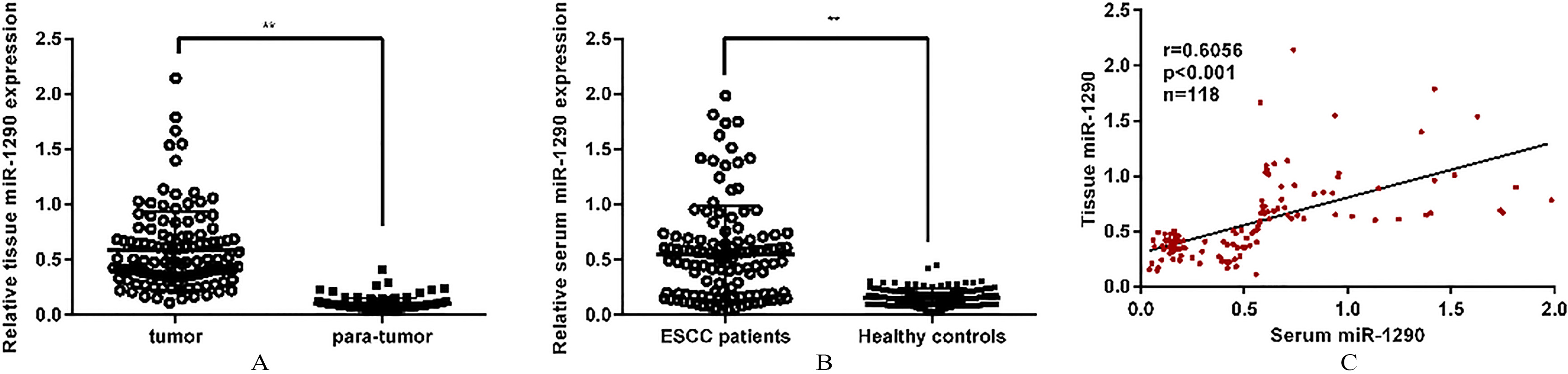
Total RNA was isolated from serum samples using a miRNeasy Serum/Plasma Kit (QIAGEN Inc., Valencia, CA, USA) according to the manufacturer’s protocol. Complementary DNA (cDNA) was synthesized using a First Strand cDNA synthesis kit (Fermentas; Thermo Fisher Scientific, Inc., Pittsburgh, PA, USA). The method used to measure the miRNA was RT-PCR of poly A tailed miRNA. RT-qPCR was performed in an Applied Biosystems
Statistical analysis
Statistical analyses were conducted using GraphPad Prism version 4 (GraphPad Software, San Diego, CA, USA). Statistical significance was defined as
Results
The expression level of tissue and serum miR-1290 in ESCC
The expression levels of miR-1290 were compared between tumor and their paired paracancerous tissue samples in 118 ESCC patients by using qRT-PCR. Our results showed that miR-1290 levels were significantly higher in tumor samples than in non-adjacent normal tissues (
Diagnostic accuracy of miR-1290 in ESCC patients
ROC curve analysis demonstrated that serum miR-1290 expression was a promising indicator for identifying ESCC cases from healthy controls, with the area under the ROC curve (AUC) of 0.822. In addition, the specificity and sensitivity were 98.33% and 65.25%, respectively (Fig. 2).
Serum miR-1290 effectively discriminated ESCC patients and healthy controls.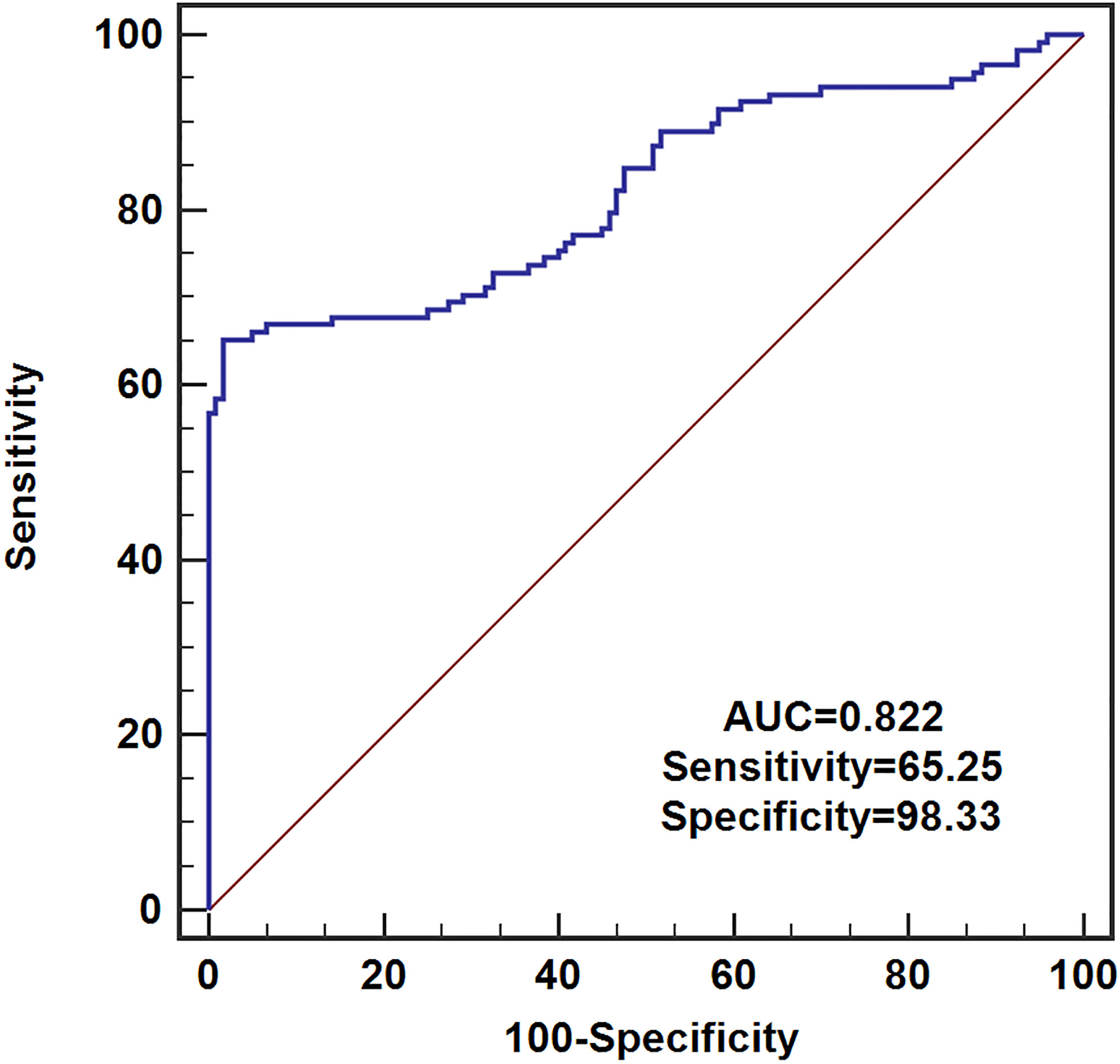
Analysis of correlations between serum miR-1290 expression with clinicopathological features of ESCC patients. (A) Expression of miR-1290 in ESCC serum with respect to gender, age, tumor size, histology differentiation (grade1: well, grade2: moderate, grade3: poor), LN status and TNM stage. Data were expressed by Whisker Plot to demonstrate the medium and the distribution of samples. Except for status of lymph node involvement (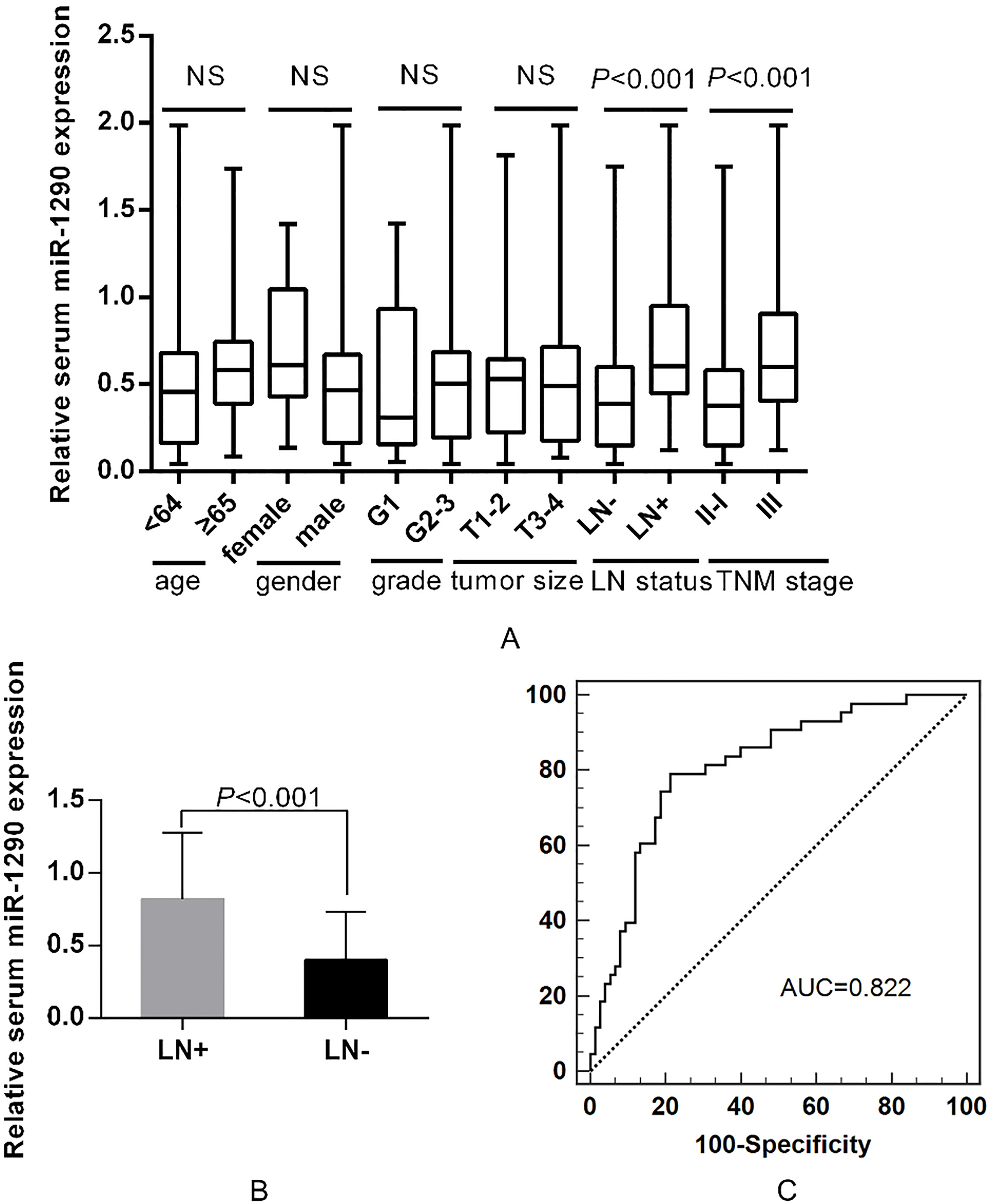
Next, the correlations between serum miR-1290 expression and clinical features of ESCC patients were investigated. The median expression levels of serum miR-1290 divided all 118 ESCC subjects into two groups. Table 1 showed the significant correlations among the high serum miR-1290 level, lymph node metastasis (
Association between miR-1290 expression and prognosis in ESCC patients
The association between serum miR-1290 expression and OS/PFS in patients with ESCC was evaluated by Kaplan-Meier method. ESCC patients with high serum miR-1290 had significantly shorter OS (
Multivariate analysis was used to explore the impact of clinical parameters on OS and PFS. In ESCC patients, high serum miR-1290 expression was strongly correlated with worse OS (RR
Multivariate analysis of prognostic factors for OS and PFS in ESCC patients
Multivariate analysis of prognostic factors for OS and PFS in ESCC patients
CI, confidence interval; RR, risk ratio.
The association between serum miR-1290 levels and overall survival and progression free survival in patients with ESCC. (A) Kaplan-Meier plot of overall survival for patients with ESCC. (B) Multivariate analysis of prognostic factors for OS in ESCC patients. (C) Kaplan-Meier plot of progression-free survival for patients with ESCC. (D) Multivariate analysis of prognostic factors for PFS in ESCC patients.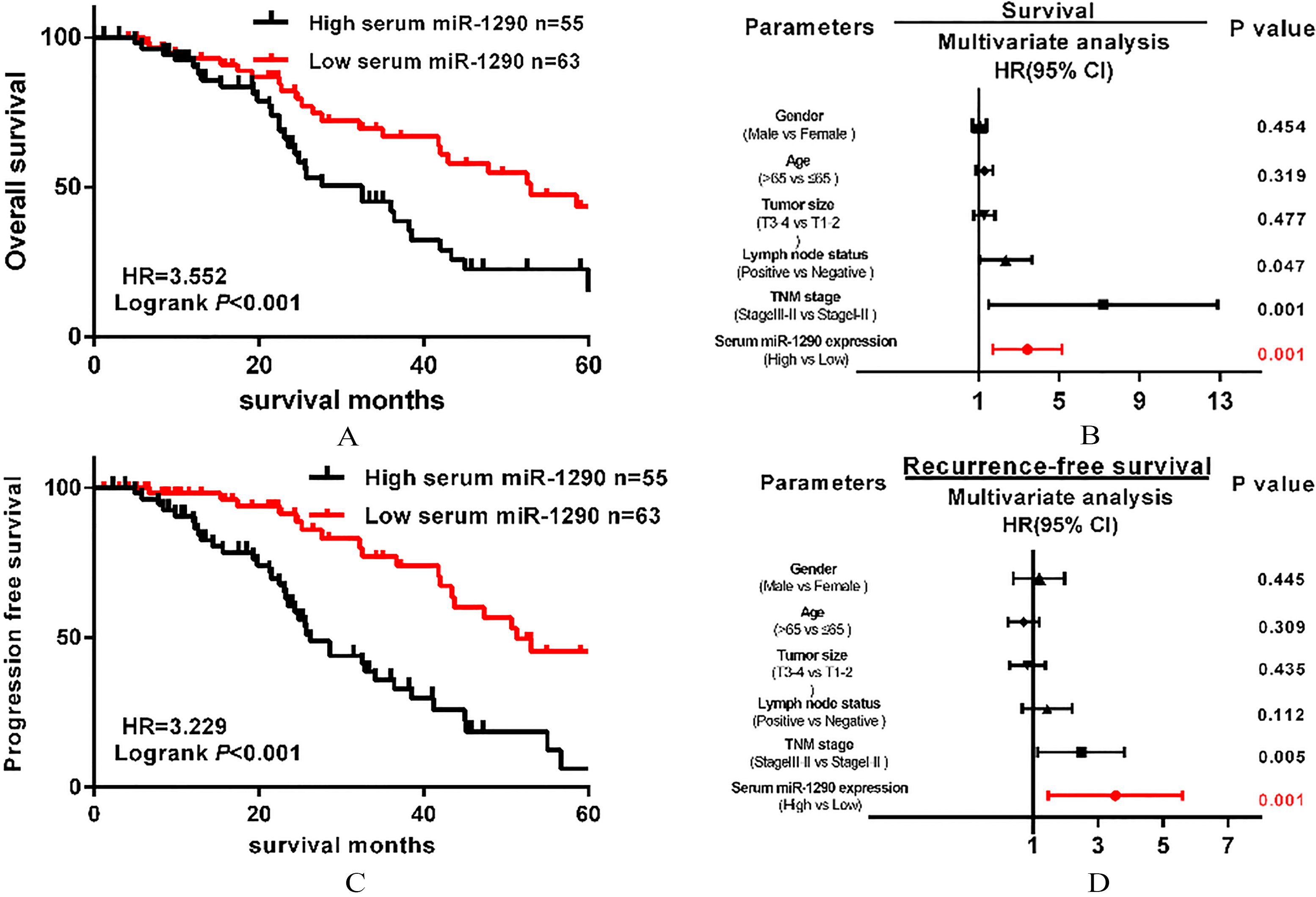
In the current study, we have demonstrated that serum miR-1290 expression levels were dramatically elevated in ESCC compared to the healthy controls. A strong positive correlation was found between tissue and serum miR-1290 levels. ROC analysis revealed serum miR-1290 had a good performance to differentiate ESCC patients from healthy controls. In addition, high serum miR-1290 was closely correlated with shorter survival, and serum miR-1290 was identified as an independent prognostic biomarker for ESCC patients.
In consistent with previous reports, miR-1290 exhibited oncomiRNA properties in ESCC [17, 18, 19]. To the best of our knowledge, our study demonstrated for the first time that serum miR-1290 might serve as a diagnostic and prognostic prediction biomarker for ESCC. MiR-1290 functions as an oncogene in ESCC and serum miR-1290 might be a good indicator of the miR-1290 levels in the cancer cells. Therefore, it is reasonable to observe that elevated serum miR-1290 level is associated with unfavorable clinical outcome in ESCC.
It seems that upregulation of miR-1290 expression was also a frequent event in multiple cancer types. In colorectal cancer, the expression level of miR-1290 was remarkably higher in cancerous tissues compared with normal adjacent tissues, and miR-1290 upregulation was strongly associated with aggressiveness and poor prognosis [20]. Moreover, Nagamitsu and colleagues [21] reported miR-1290 was frequently overexpressed in cervical cancer tissues. Downregulation of miR-1290 significantly decreased cell proliferation, invasion and migration in vivo by targeting IKK1 [19]. Moreover, recent studies have indicated that miR-1290 in serum, plasma are differentially expressed in several types of cancer patients, and served as biomarkers for diagnosis and prognosis in pancreatic cancer [22], colorectal cancer [20] and ovarian carcinoma [23].
A possible shortcoming of our study was that we only detected serum miR-1290 levels in relatively small group. Large multicenter studies are required to validate our findings to minimize the potential bias. In addition, we did not compare the diagnostic power of serum miR-1290 with current available biomarkers such as cancer antigen-125, carcinoembryonic antigen and SCC antigen. Moreover, the underlying molecular mechanisms of miR-1290 in ESCC needs further investigation. In addition, single biomarker is not enough to accurately detect and predict the prognosis of ESCC. Combination of several serum biomarkers and molecular events might contribute to avoid the false positive and negative findings.
Conclusions
Taken together, our data provided compelling evidence that serum miR-1290 might serve as a promising biomarker for the diagnosis and prognosis prediction of ESCC. Further studies with larger cohort are warranted to confirm our findings.
Footnotes
Conflict of interest
The authors declare that they have no conflict of interest for this study.