




Abstract
BACKGROUND:
Baicalein is an important Chinese herbal medicine and has multiple pharmacological activities. However, the biological mechanisms of the anti-tumor effects of Baicalein on non small cell lung cancer (NSCLC) still need to be understood.
METHODS:
Human NSCLC A549 and H1299 cells were pretreated with Baicalein or DMSO. Cells viability and transwell cell invasion assays were performed to assess cell proliferation and invasion. QRT-PCR assay was used to analyze mRNA expression levels of Twist1, E-cadhertin, Vimentin, Notch1 and hes-1. Western blot analysis was also performed to determine protein expression.
RESULTS:
In the study, we found that Baicalein had a significantly inhibited effect on proliferation ability of A549 and H1299 cells. Cells treated with Baicalein showed a down-regulated expression of CyclinD1 and CDK1 in A549 and H1299 cells. Furthermore, we found that Baicalein significantly inhibited cell invasion and Epithelial-Mesenchymal Transition (EMT) by up-regulating the mRNA and protein expression of E-cadherin and down-regulated the Twist1 and Vimentin expression, Moreover, Treatment of Baicalein down-regulated Notch1 and hes-1 expression in A549 and H1299 cells, which indicated that Baicalein could suppress the Notch signaling pathway.
CONCLUSION:
Our studies suggest that Baicalein may be a potential phytochemical flavonoid for therapeutics of NSCLC and serve as a molecular target for NSCLC.
Introduction
Lung cancer is one of the most common malignant cancers and non small cell lung cancer accounts for about 80% of all lung cancer cases [1]. Although some advances in diagnosis and therapeutic methods of NSCLC, the 5-year survival rate of NSCLC patients remain lower due to tumor metastasis and recurrence [2, 3]. Thus, exploring novel diagnostic biomarkers and novel targets for NSCLC treatment are necessary.
Baicalein is an important Chinese herbal medicine and has multiple pharmacological activities including antibacterial, antiviral, anti-inflammatory, antioxidant and antitumor activities [4, 5, 6]. For example, studies show that Baicalein inhibits cells epithelial to mesenchymal transition by down-regulation of Cyr61 and LOXL-2 expression in breast cancer cells [7]. Baicalein inhibits the migration and invasion of B16F10 mouse melanoma cells through inactivation of the PI3K/Akt signaling pathway [8]. In NSCLC, Zheng et al demonstrates that Baicalein inhibits the migration and invasion of B16F10 mouse melanoma cells through inactivation of the PI3K/Akt Signaling Pathway [9]. Cathcart et al also found that Baicalein has a large anti-cancer effect of in non-small cell lung cancer in-vitro and in-vivo [10]. However, the biological mechanisms of the anti-tumor effects for Baicalein in non small cell lung cancer (NSCLC) still need to be verified.
In the study, we found that Baicalein had significantly inhibited effects on cell proliferation, invasion and Epithelial-Mesenchymal Transition (EMT) in NSCLC. Treatment of Baicalein in NSCLC cells suppressed Notch signaling pathway by decreasing Notch1 and hes-1 expression. Thus, our studies suggest that Baicalein may be a potential phytochemical flavonoid for therapeutics of NSCLC and serve as a molecular target for NSCLC.
Materials and methods
Cell lines culture
Human NSCLC cell lines A549 and H1299 were purchased from ATCC (American Type Culture Collection, Manassas, VA, USA). Cells were cultured in Dulbecco’s modified Eagle medium (DMEM) supplemented with 10% fetal bovine serum (FBS) (Gibco; Thermo Fisher Scientific, Inc., Waltham, MA, USA), and added with streptomycin (100
Cell viability assay
The cell viability was determined by Cell Counting Kit-8 assay kit (CCK-8, Dojindo, Kumamoto, Japan). Briefly, NSCLC cells at a density of 3000 cell/well were seeded into 96-well plates. Concentrations of Baicalein (0, 20, 40, 60, 80, 100
Cell invasion assay
NSCLC cells treated with Baicalein (80
Baicalein inhibits cell viability of A549 and H1299 cells. (A)–(B) Cell viability was measured by CCK8 assay. The Concentrations of Baicalein (0, 20, 40, 60, 80, 100 
Total cell RNA was extracted using the using TRizol reagent (TaKaRa, Tokyo, Japan) according to the manufacturer’s instructions. The RNA was reversed to first-strand cDNA by the Reverse Transcriptase Kit (TAKARA, Tokyo, Japan). SYBR Green Mixture was used for the qRT-PCR reactions (TAKARA, Tokyo, Japan) on the ABI 7500 System. Primers sequences were synthesized by TAKARA (Dalian, China) as follow: Twist1-forward: 5’-AGAAGTCTGCGGGCTGT GGCG-3’, Twist1-reverse: 5’-GAGGGCAGCGTGGG GATGATC-3’;
Baicalein inhibits cell invasion ability and epithelial-mesenchymal transition of A549 and H1299 cells. (A)–(B) The cell invasion assay and invasive cell number was showed after cells were pretreated with Baicalein (80 
Baicalein inhibits Notch signaling pathway by regulating Notch1 and hes-1 expression. (A)–(B) The relative mRNA expression of Notch1 and hes-1 was showed after cells were pretreated with Baicalein (80 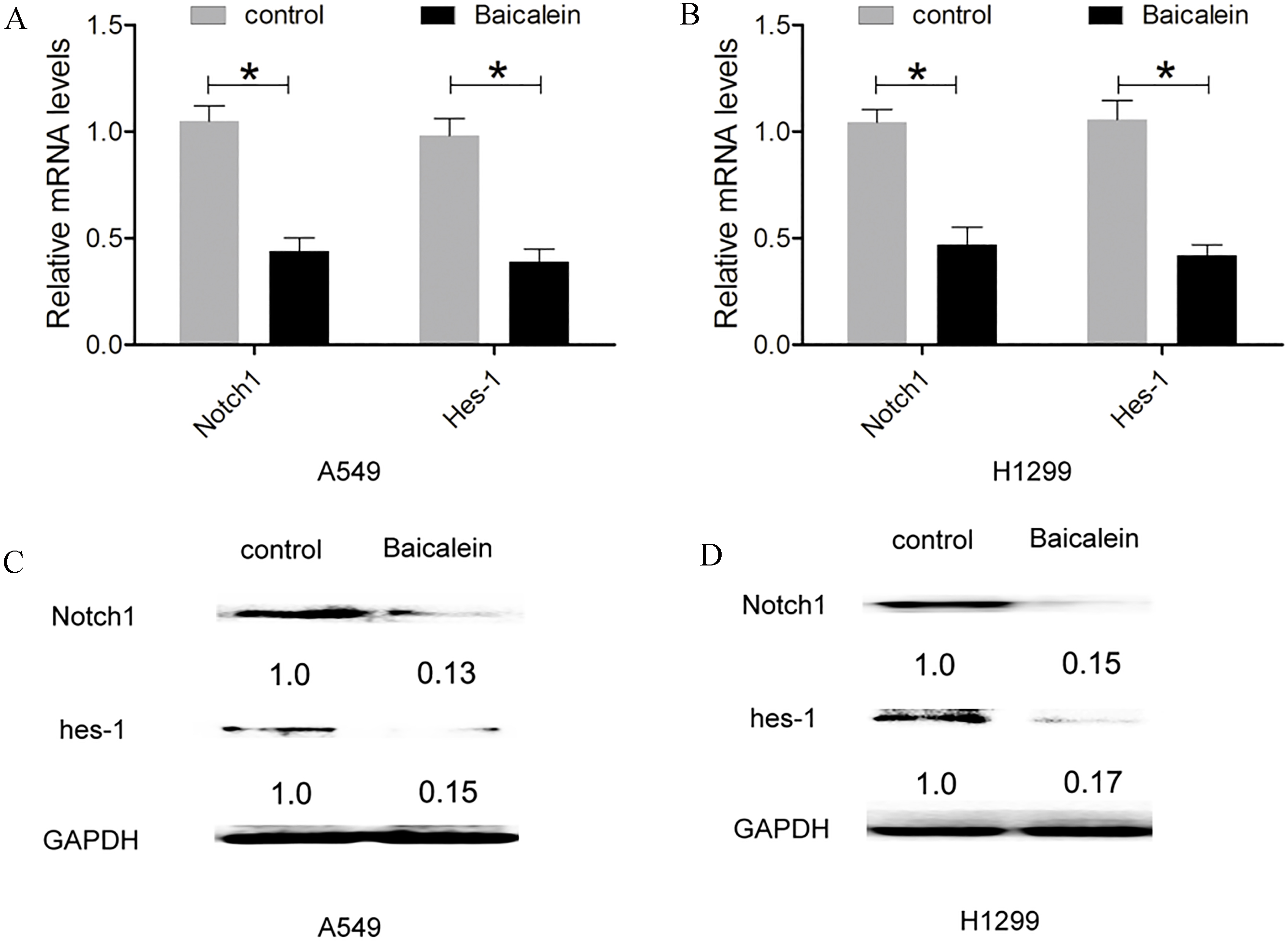
The NSCLC cells were lysed and extracted using lysis buffer (Beijing Biosynthesis Biotechnology Co., Ltd., Beijing, China). The protein concentration in the supernatants was determined using a BCA kit (Beijing Biosynthesis Biotechnology Co., Ltd.). Equal amount of protein was separated using 10% SDS-polyacrylamide gel electrophoresis and transferred onto polyvinylidene fluoride (PVDF) membranes (Millipore, USA). The membranes were incubated with antibodies against Twist1 (1:1000, CST, USA), N-cadherin (1:1000, CST, USA) and Vimentin (1:1000, CST, USA), Notch1 (1:1000, CST, USA), hes-1 (1:1000, CST, USA) and GAPDH (1:2000, Santa Cruz Biotechnology, USA) for 4
Statistical analysis
Data are presented as the mean
Results
Baicalein inhibits cell proliferation ability of A549 and H1299 cells
The cells were treated with Baicalein (0, 20, 40, 60, 80, 100
Baicalein inhibits cell invasion ability and epithelial-mesenchymal transition of A549 and H1299 cells
We further examined the effect of Baicalein on cell invasion in A549 and H1299 cells. After cells were treated with Baicalein (80
Baicalein inhibits Notch signaling pathway by regulating Notch1 and hes-1 expression
Several researchers have found that Notch signaling pathway associated with tumor EMT phenotype, which triggers cell invasion [11]. Activating Notch signaling pathway could also induce the EMT program by regulating transcription factors such as Twist1, ZEB1/2, and Snail1/2 in some tumor types [12]. Thus, we explored whether aberrant Baicalein could affect Notch1 and hes-1 expression levels in NSCLC cells. The results demonstrated that the mRNA and protein expression levels of Notch1 and hes-1 were downregulated after cells were treated with Baicalein (80
Discussion
Baicalein showed the anti-tumor effects in some cancer types. Liu et al. reported that Baicalein suppresses the proliferation of acute T-lymphoblastic leuk-emia Jurkat cells by inhibiting the Wnt
Aberrant transduction of Notch signaling was involved in many diseases including cancers [19]. Notch signaling pathway activators could promote cell invasion and induce the EMT program by regulating transcription factors and EMT makers [20]. In the previous study, Wang et al showed that the autonomous notch signal pathway is activated by Baicalein in K562 cells [21]. Treatment with Baicalein at 48 h, we demonstrated that the mRNA and protein expression levels of Notch1 and hes-1 were downregulated after treated with Baicalein at 48 h. Thus, the above results indicated that Baicalein inhibits Notch signaling pathway by regulating Notch1 and hes-1 expression.
In conclusion, we demonstrated that Baicalein could inhibit cell proliferation and invasion of NSCLC. Moreover, Baicalein suppressed cell EMT phenotype and inhibited Notch signaling pathway, which could inhibit tumor cells invasion. Thus, our study suggested that Baicalein may be a potential phytochemical flavonoid for therapeutics of NSCLC and serve as a molecular target for NSCLC.