



Abstract
This brief uses national data from the High School Longitudinal Study of 2009 to investigate deficit beliefs, or beliefs that students’ academic underperformance is primarily attributable to deficiencies in their home environments, among high school math teachers. Descriptive results reveal that students in low-level math courses have teachers with more deficit beliefs. Regression results show that net of extensive control variables for both student and teacher characteristics, having a math teacher with stronger deficit beliefs is significantly and negatively associated with students’ math performance. However, this negative association is not more pronounced for youth from minoritized and low socioeconomic status backgrounds.
Keywords
Education and social science researchers have long pointed to deficit beliefs as contributing to the status quo of educational inequality. Specifically, beliefs that primarily attribute lower levels of academic performance to the deficiencies of students and their families, most often aimed at minoritized youth and those from low socioeconomic status (SES) backgrounds, help absolve educational systems and their actors from responsibility. Although deficit narratives in previous decades tended to invoke genetic explanations for low academic performance, contemporary deficit explanations typically place primary accountability on presumed problems in the home environment, thereby excusing educators’ responsibilities and simultaneously ignoring the impact of systemic factors in creating inequality (Valencia, 2012).
Qualitative research suggests that when teachers hold such deficit beliefs, it is detrimental for students’ learning in their classrooms (e.g., Sztajn, 2003); yet there is very little large-scale quantitative research on this topic. We address this issue by using recent national quantitative data to focus on high school math teachers and their students. Specifically, we investigate the prevalence of beliefs that attribute the primary cause of academic underperformance to students’ home environment and further consider whether such beliefs are associated with math teachers’ own identities and backgrounds and math course level. Subsequently, we investigate whether, net of many factors (including prior performance), having a math teacher with stronger deficit beliefs is associated with subsequently lower math performance, particularly among students with identities and backgrounds most associated with deficit narratives of the home environment (e.g., Black students and those from low SES backgrounds).
Literature Review
Why would we expect that some teachers might broadly attribute low performance in school as ultimately the consequence of deficient home environments? One explanation points to the intense pressures teachers face to produce evidence of student learning via standardized exams, often in the midst of inadequate resources; from this lens, placing responsibility for learning elsewhere provides some psychological relief (Lasater et al., 2021). Yet more critical research points out that the U.S. educational system is predicated on cultural beliefs among White, Western, and privileged communities that a “good” home environment is one where parents actively reinforce the educational norms and content found in schools (Calarco, 2018; Ladson-Billings, 2006). Furthermore, focusing generally on the home environment as responsible for academic failure provides a more palatable justification for inequality and therefore may be more common and/or commonly admitted to than racist and classist beliefs.
And although some teachers of all subjects may hold deficit beliefs, we note that math is a domain particularly replete with narratives that can serve to exonerate educators for students’ performance (e.g., math is an innate ability) (Gutiérrez et al., 2023). As such, math teachers may perhaps be particularly likely to lean in to a deficit narrative because consistent with these other cultural narratives, it places the primary responsibility for learning math outside of the teacher and the school (Bol & Berry, 2005). Therefore, our national study explores the existence of deficit beliefs among students’ high school math teachers. Importantly, we consider potential variation, examining whether the severity of deficit beliefs is related to teachers’ backgrounds or identities and the level of math course taught because the strongly tracked nature of high school math may also contribute to teachers’ beliefs about students’ learning abilities (National Council of Teachers of Mathematics, 2018).
Furthermore, drawing on the limited qualitative research in this area, we expect that deficit beliefs likely translate into more negative classroom experiences (Sztajn, 2003). If math teachers believe that the home environment is the strongest determinant of students’ success or failure, they may focus less on actively engaging students in the classroom and be less critical and reflective of their own pedagogical choices, which could negatively impact all students’ math learning, with subsequent implications for their math trajectories. Because deficit beliefs about the home environment typically center the White middle-class home as the norm compared to which other families are lacking (Valencia, 2012), Black and Latinx students from low SES backgrounds are likely to be the most pronounced target of deficit beliefs and thus seem the most likely to suffer the negative consequences (Pollack, 2013). Although our study cannot test the mechanisms, we make a new contribution to the literature by using large-scale national data to establish whether there is an observable link between deficit beliefs held by students’ high school math teachers and their subsequent math performance.
Data and Methods
We analyze restricted data from the High School Longitudinal Study of 2009 using descriptive statistics and linear regression models with survey weights and school fixed effects, with missing data multiply imputed. The independent variable captures high school math teachers’ deficit thinking via a five-item scale. Sample items include “The amount a student can learn is primarily related to family background” and “When it comes down to it, you really cannot do much because most of the students’ motivation and performance depends on their home environment.” Responses are averaged across all items, each coded from 1 (strongly disagree) to 4 (strongly agree), such that higher scores indicate more deficit views. The mean score on the scale is 2.45 (SD = 0.52), very close to the midpoint of the scale, balanced between disagreeing and agreeing with deficit notions (per National Center for Education Statistics guidelines, the student is the unit of analysis when using data from the teacher survey; for more detail, see supplemental material available on the journal website).
The dependent variable is students’ ninth-grade math grade point average (GPA), constructed from transcript data on a typical 4-point scale. Additional variables include students’ race/ethnicity and parental education; we use a classification that considers both simultaneously (e.g., Black students with low parental education) in comparison to the most privileged student group (White students with college-educated parents). We include extensive control variables for teacher and student characteristics likely related to student performance, including their prior grades and test scores (see Table 2).
Results
As shown in Table 1, scores on the deficit scale vary somewhat by identity and background, with statistically significant gender differences (higher scores among men teachers) and differences by years teaching (lower scores associated with the most veteran teachers). Furthermore, students in lower level math courses have teachers who report significantly stronger deficit beliefs than in higher level courses.
Mean Scores on Deficit Belief Scale by Teacher Characteristics
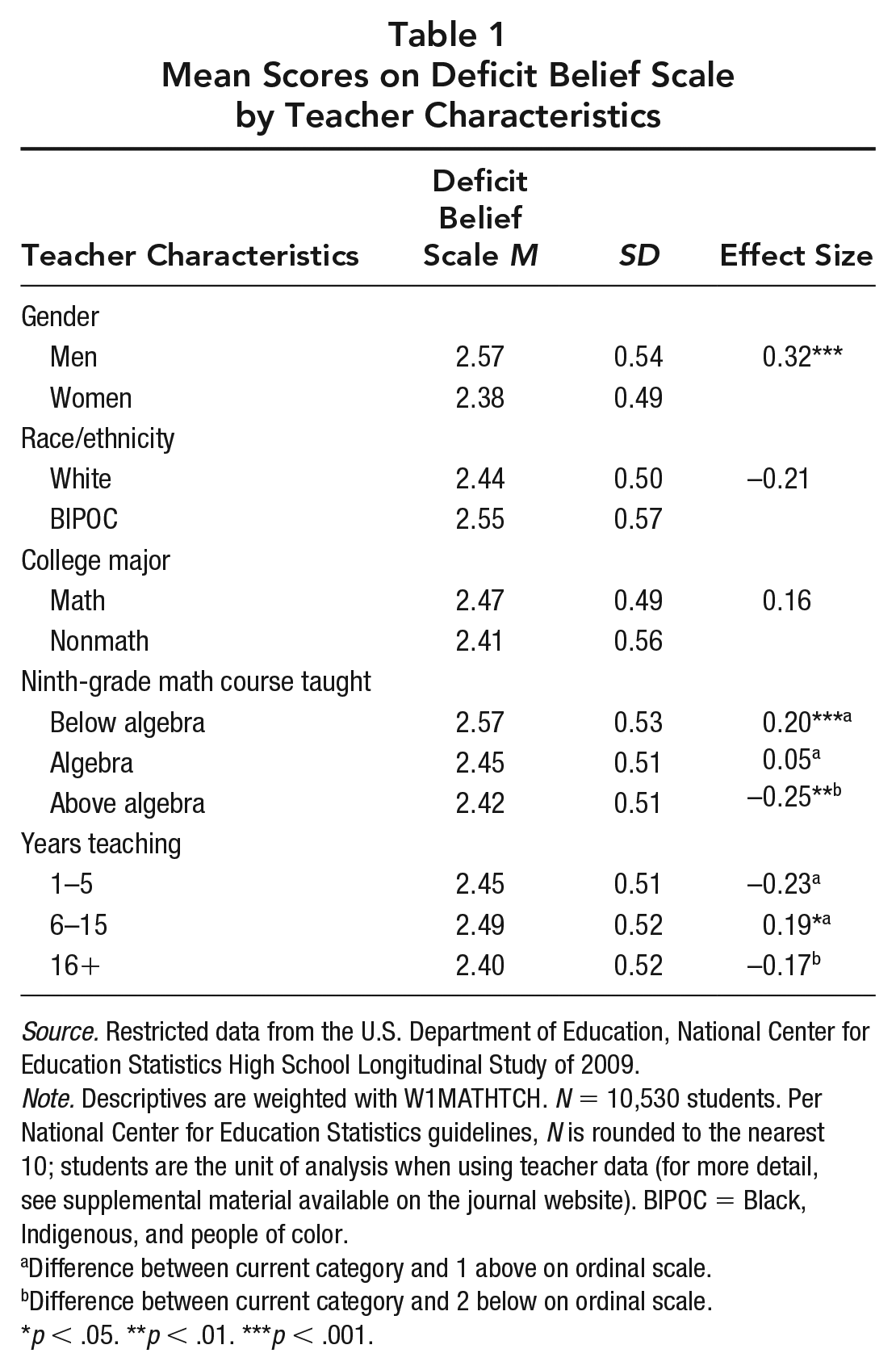
Source. Restricted data from the U.S. Department of Education, National Center for Education Statistics High School Longitudinal Study of 2009.
Note. Descriptives are weighted with W1MATHTCH. N = 10,530 students. Per National Center for Education Statistics guidelines, N is rounded to the nearest 10; students are the unit of analysis when using teacher data (for more detail, see supplemental material available on the journal website). BIPOC = Black, Indigenous, and people of color.
Difference between current category and 1 above on ordinal scale.
Difference between current category and 2 below on ordinal scale.
p < .05. **p < .01. ***p < .001.
Turning to Table 2, the baseline model reveals a negative and statistically significant association between teachers’ scores on the deficit belief scale and students’ math performance. The coefficient is reduced in Model 2 with the addition of all controls. In Model 3, we add a set of interaction terms between deficit beliefs and students’ race/ethnicity and parental education to examine whether this negative association is more pronounced for those from minoritized and low SES backgrounds. However, none of the interactions are statistically significant, indicating that the negative association between teacher deficit beliefs and student performance is comparable across groups. To help contextualize the magnitude of the main effect of deficit beliefs, we calculated predicted values (net of all controls); moving from 2 SD below the mean to 2 SD above the mean results in a decrease in students’ predicted math GPA from 2.45 to 2.30, a decrease that could have negative implications for students’ subsequent math trajectories.
Regression Analyses Predicting Students’ Ninth-Grade Math Grade Point Average
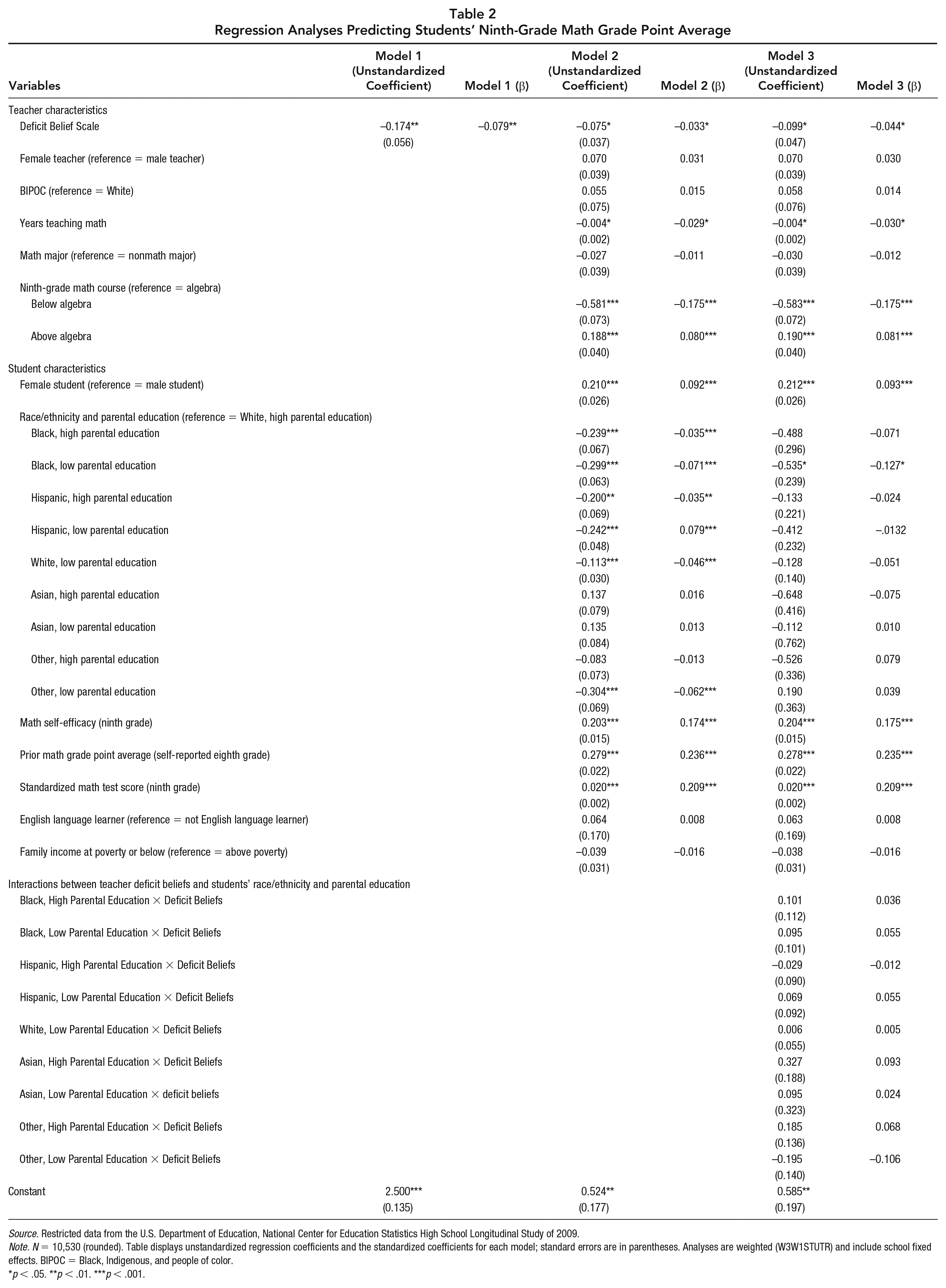
Source. Restricted data from the U.S. Department of Education, National Center for Education Statistics High School Longitudinal Study of 2009.
Note. N = 10,530 (rounded). Table displays unstandardized regression coefficients and the standardized coefficients for each model; standard errors are in parentheses. Analyses are weighted (W3W1STUTR) and include school fixed effects. BIPOC = Black, Indigenous, and people of color.
p < .05. **p < .01. ***p < .001.
Conclusion
Analyses of national data indicate that when high school math teachers hold deficit beliefs, their students’ performance suffers. Specifically, net of many student and teacher characteristics, deficit beliefs among high school math teachers have a robust and negative association with students’ math grades. Although the observed effect is relatively modest, it may be meaningful for students’ academic experiences, capturing the negative learning environment that deficit teachers may create (e.g., Sztajn, 2003). Somewhat surprisingly, this association was not more pronounced among minoritized youth and those from low SES backgrounds; however, such students have a higher likelihood of being in low-level math courses (see Table S.3, available on the journal website) and thus are more likely to be taught by a teacher with stronger deficit beliefs (see Table 1). Future research should focus on further unpacking the source of such beliefs among teachers, how they manifest in the classroom, and perhaps most important, how to support all teachers in recognizing the potential of all students (Siwatu et al., 2016).
Supplemental Material
sj-pdf-1-edr-10.3102_0013189X251317135 – Supplemental material for Exploring Deficit Beliefs Among High School Math Teachers
Supplemental material, sj-pdf-1-edr-10.3102_0013189X251317135 for Exploring Deficit Beliefs Among High School Math Teachers by Jenny Buontempo, Catherine Riegle-Crumb and Karisma Morton in Educational Researcher
Footnotes

Authors
References
Supplementary Material
Please find the following supplemental material available below.
For Open Access articles published under a Creative Commons License, all supplemental material carries the same license as the article it is associated with.
For non-Open Access articles published, all supplemental material carries a non-exclusive license, and permission requests for re-use of supplemental material or any part of supplemental material shall be sent directly to the copyright owner as specified in the copyright notice associated with the article.
