




Abstract
In 2013, the Chicago Board of Education closed 47 elementary schools, directly affecting 13,000 students and 900 teachers. The closures created employment uncertainty for closed-school teachers, and this article investigates the labor market consequences for teachers. We employ a difference-in-differences approach that compares the exit rates of closed-school teachers with teachers in schools that only experienced threat of closure. We estimate that the closures resulted in a near doubling of teacher exit among teachers in closed schools, particularly among low-performing teachers. We also find that, among closed-school teachers, Black teachers were more likely to return than White teachers. Given the nationwide trend of school closures for budgetary or performance reasons, this article has implications for strategic retention of effective teachers.
Keywords
Introduction
The body of literature on the effects of closures on students is growing, but there is little research on what happens to teachers in the aftermath of closures. We offer new contributions to the literature on school closures by unpacking what happened to teachers. In particular, this article examines the association between mass school closures and the short-term and longer term exit rates of CPS teachers. We also provide evidence of differential effects of closures on exit among different types of teachers. Our study asks the following:
We first establish the relationship between school closures and subsequent teacher exit, finding that the closures resulted in an increase in exit among teachers in closed schools relative to teachers in comparison schools by about 11 percentage points, with 23% of closed-school teachers leaving the district that year. The rehired teachers were, on average, of higher quality than the closed-school teachers who left—they typically had higher value-added measures and higher classroom observation scores and were more likely to be National Board certified. The rehired teachers were also more likely to be Black relative to the teachers who left, which is important given that the student and teacher populations in the closed schools were disproportionately Black. However, when we look at exit from the district 5 years later, in the longer run, closed-school teachers were as likely to have exited as teachers in comparison schools, suggesting that the closures may have accelerated the exit of teachers who would have left over the next few years even in the absence of closures. Further research is needed to explore the long-term implications of the policy on displaced teachers. Although we find that the composition of the teaching force is altered by closures in a way that may offset some of the negative effects on students, the increased short-term exit rates may challenge the work of sustaining school improvement efforts.
Prior Literature
We review the literature on two topics that offer useful perspective for examining the effects of closures on public school teachers in Chicago. We first describe the research evidence on the impact of school closings on students. We then turn to papers that explore teacher layoffs and rehires in other districts, and how these policies affect teacher exit. Although the mass school closures in Chicago involved layoffs and rehires, the context of our study differs from these other settings in significant ways.
School Closures Literature
Prior research has been focused on the effects of closures on students who attended closed schools. In many cases, students experience a transitory shock to achievement (i.e., test scores) during the year that closures were announced, though students on average return to their preclosure achievement trajectories even if they do not make up the initial learning losses (Barrow et al., 2011; Bross et al., 2016; Brummet, 2014; de la Torre and Gwynne, 2009; Engberg et al., 2012; Gordon et al., 2018; Larsen, 2014; Sacerdote, 2012; Steinberg & MacDonald, 2019). In cases where closed school students go on to attend schools with much higher levels of performance, there is evidence to suggest that student achievement, on average, improves (Barrow et al., 2011; Brummet, 2014; de la Torre & Gwynne, 2009; Engberg et al., 2012; Kemple, 2015; Steinberg & MacDonald, 2019).
Test score outcomes, however, only provide part of the picture of the short- and long-term impact of closures on students. Gordon et al. (2018) find no immediate effects on grade point average (GPA), attendance, or the likelihood of being suspended after the 2012–2013 round of closings in Chicago discussed in this article, whereas Steinberg and MacDonald (2019) find an increase in absences and suspensions among students from closed schools in Philadelphia, especially as the distance traveled to new schools increased.
Qualitative findings have illustrated how closures affect students’ social connections. Although the loss of students from CPS the year of closures was no greater than previous years, students were inevitably forced to attend new schools (Gordon et al., 2018). Students who went on to designated welcoming schools were more likely to maintain relationships from their closed schools as their peers and teachers were more likely to relocate to the same welcoming schools. However, one third of displaced students who reenrolled in CPS ended up choosing to attend a different CPS school (Gordon et al., 2018), which suggests that they likely encountered a new set of peers and teachers. Lastly, displaced students, who were mostly from historically marginalized communities, expressed experiencing a deep sense of loss, in terms of critical social ties and institutional memory, when their schools closed (Ewing, 2018).
Teacher Layoff and Rehire Literature
In the 2013 Chicago school closure context, all teachers from closed schools were laid off and had to be rehired from an application pool. Per the district–union contract, tenured teachers with high evaluation ratings were automatically entered into the rehiring pool, whereas other teachers had to take more steps to enter the pool. (We provide more details on the policy in the next section.) In this section, we summarize the impact of two different types of layoff policies on teacher mobility that offer a point of comparison with our study’s context in CPS. We first look at the evidence from reduction-in-force (RIF) layoffs in Charlotte-Mecklenberg Schools (CMS), Los Angeles Unified School District (LAUSD), and Washington State. In these cases, teachers were laid off based on predefined qualifications (e.g., effectiveness measures, seniority), which differed from what happened in Chicago where all teachers from schools slated for closures were laid off regardless of their qualifications. However, the criteria for rehiring in these other contexts appeared to be similar to that of Chicago, such that laid-off teachers were prioritized for rehiring based on their qualifications and available open positions. We then examine the impact of layoffs associated with school closures in New Orleans and North Carolina. These settings are more similar to the Chicago context, as all teachers from closed schools were laid off and had to reapply for new positions.
The existing research on RIF teacher layoffs provides findings on state and district contexts where teachers were targeted for layoff due to budgetary shortfalls. In CMS, the district prioritized layoffs in the following order with performance-based indicators considered first: those who had low or unsatisfactory evaluation ratings, a licensure deficiency, collected pension benefits, part-time/interim status, a yearly contract, and length of service in the district. In Los Angeles and Washington State, RIF policies differed from CMS in many ways, but, perhaps most importantly, in most cases, years of experience in the district was the sole or primary determinant for layoffs.
Previous studies on these RIF policies show that layoffs altered the composition of the teaching workforce differently across these settings, likely related to the rules regarding the qualifications related to RIF receipt (i.e., based on years teaching vs. based on evaluations or other criteria). In CMS, laid-off teachers had, on average, lower principal evaluation scores and value-added measures than those not laid off (Kraft, 2015). Unlike in CMS, in LAUSD and Washington, the propensity to receive RIF notifications or exit teaching did not vary significantly by teacher effectiveness (Goldhaber et al., 2016; Goldhaber & Theobald, 2013). Looking at teacher experience, in CMS, RIF layoffs during the Great Recession resulted in the exit of a higher proportion of nontenured teachers (Kraft, 2015). Similarly in Washington, teachers with more years of experience were less likely to receive an RIF notice (Goldhaber & Theobald, 2013). In research from LAUSD and Washington, more experienced teachers were more likely to switch schools in the face of RIF layoffs (Goldhaber et al., 2016). In summary, the teachers who were most prone to layoffs were the groups prioritized in the RIF policies.
To contrast with position-targeted RIF policies, in other settings, entire teacher populations were laid off due to school closures with teachers rehired based on vacancies the following school year. The studies of teacher labor market responses to school closures are most closely related to this article. In New Orleans, all schools were closed after Hurricane Katrina and reopened under a decentralized school system, and all teachers were laid off and had to reapply to positions after the school system was restructured. We note that the New Orleans context was much more disruptive than in other contexts because the entire workforce of the district was laid off at once. To contrast, under No Child Left Behind, North Carolina closed schools over an extended period from 2002 to 2013.
In New Orleans, only about one third of the previously employed teachers returned to the new system (Lincove et al., 2018). Whereas in North Carolina where a much smaller share of schools experienced closure in any given year, Hill and Jones (2019) find that teachers were about 6 percentage points more likely to leave the profession than in prior years, though they also found that teacher likelihood to switch schools increased in the year prior to the closures, which suggests that some teachers were anticipating closures.
Both studies looked at how various teacher groups may have been differentially affected. In New Orleans, Black and White teachers were rehired in similar proportions, though rehired Black teachers were more likely to continue employment in New Orleans in the longer run (Lincove et al., 2018). However, teachers newly hired in New Orleans were more likely to be White (Barrett & Harris, 2015), changing the overall racial composition of the teacher workforce. In North Carolina, Black teachers were twice as likely to leave as White teachers (Hill & Jones, 2019). Regarding experience, in New Orleans, nontenured teachers and teachers with 25-plus years of experience were most likely to exit (Lincove et al., 2018), and in North Carolina, more experienced teachers were much more likely to exit teaching than less experienced teachers (Hill & Jones, 2019). Finally, in North Carolina, teachers with high and low value-added measures were more likely to exit teaching than more typical-performing teachers (Hill & Jones, 2019).
This article adds to the literature on teacher exit and rehiring within the school closures context in particular. The Chicago setting provides a good opportunity to broaden our understanding of teacher labor market responses in the face of closures. Both Louisiana and North Carolina are “right to work” states, whereas Chicago has a strong teacher union presence, potentially offering teachers employed in closed schools more employment protections. Furthermore, unlike with RIF policies, all teachers in the Chicago closed schools were laid off, and rules for rehiring were outlined in the district–union contract for teachers primarily based on seniority and evaluations. We look at what happened to teachers within a district over time when many schools were abruptly closed in 1 year as a single event with little or no teacher knowledge in advance. As Chicago and school districts around the country continue to use school closings as a strategy to address budget shortfalls and declining student enrollments, it is important to understand how this policy affects the teacher workforce.
School Closures and Teacher Rehiring in Chicago
In this section, we detail the closures policy and the process by which CPS teachers were laid off and considered for rehire, including the process for new applicants to the district. We also discuss the circumstances surrounding the process that may have influenced the laid-off teachers’ decisions, or ability, to reapply.
In October 2012, CPS released a set of rough guidelines outlining the district’s policy for school closures, consolidations, reassignments, and phaseouts. Soon after, the district formed an independent commission that established a set of criteria for school closures (Weber et al., 2016). Three hundred thirty schools were initially identified for closure because of underenrollment. High schools were then removed from the list, as were underenrolled elementary schools with high district accountability ratings, leaving a narrowed list of 129 schools subject to closure by February 2013. After a period of public input and hearings, in May 2013, the Chicago Board of Education voted to close 47 elementary schools and one high school program, which affected about 13,000 students and 900 teachers. For a more detailed description of the closure policy, see Gordon et al. (2018). In this article, we identify four mutually exclusive groups of schools each facing a different threat of closure: (a) closed schools (the elementary schools closed at the end of the 2012–2013 school year), (b) underenrolled and low-performing schools (those most at risk of closure but ultimately remained open), (c) underenrolled schools with adequate levels of performance (those initially threatened), and (d) at-capacity schools (those never threatened). 2
All teachers from the final list of closed schools received layoff notices from the district in June and July 2013. These notices communicated that “many” of the dismissed teachers would “follow” students to their welcoming schools but did not provide further details about the process (Chicago Public Schools Office of Communications, 2013). The contract agreement between the district and the Chicago Teachers Union (CTU), however, established that dismissed tenured teachers with top evaluation ratings (“Superior” or “Excellent”) 3 who had no breaks in service exceeding 2 years would receive preferential treatment for rehiring (Agreement Between the Board of Education of the City of Chicago and Chicago Teachers Union Local 1, American Federation of Teachers, American Federation of Labor and Congress of Industrial Organizations, 2012-2015). Closed schools’ teachers who were laid off and who met this criteria were placed on the “Teacher Eligibility List” only if they had submitted an online application verifying their desire to be reconsidered for rehire and had not already found full-time employment elsewhere in the district (e.g., hired into a different school, accepted a different position within CPS), resigned, or retired (Agreement Between the Board of Education of the City of Chicago and Chicago Teachers Union Local 1, American Federation of Teachers, American Federation of Labor and Congress of Industrial Organizations, 2012-2015). Under the contract, all other dismissed teachers who did not initially qualify for the eligibility list (e.g., nontenured teachers), but who wanted to be considered for rehire, had to obtain statements of support from two administrators familiar with their teaching practice, and then participate in a screening interview either at a selection event (e.g., job fair) or with Board-selected administrators over the phone (CTU, 2013).
Once teachers were placed on the eligibility list, they were eligible to apply for vacancies within the district. Placement on the eligibility list, however, did not guarantee a position for the following school year. Under the contract, principals at welcoming schools were granted discretion over hiring. Principals with vacancies were encouraged to hire from the list but could interview multiple eligible candidates for each vacancy and decide against hiring any eligible teacher interviewed “within reason” (Agreement Between the Board of Education of the City of Chicago and Chicago Teachers Union Local 1, American Federation of Teachers, American Federation of Labor and Congress of Industrial Organizations, 2012-2015).
In addition, rehiring depended, in part, on student enrollment numbers, which were uncertain following school closures. Although families of displaced students were encouraged to enroll at their designated welcoming schools as early as possible, there was no deadline for them to do so or to notify the district if they chose to enroll elsewhere. By June 3, only 78% of displaced students enrolled in a new school for the 2013–2014 academic school year, and 65% of displaced students were enrolled at their designated welcoming school (CPS, 2013). Thus, new student enrollment numbers remained unclear until or after the start of the 2013–2014 school year. This likely delayed new hiring at designated welcoming schools because principals could not be sure of what their need was or how their budgets would change until enrollment counts were clear.
Although we recognize that the rehiring policy favored tenured teachers with high evaluation ratings, teachers with National Board certification, and teachers with strong administrative support or district connection, we are unable to factor in teacher choice in the mobility patterns, which presents a limitation to the study. In the data we have access to, we cannot differentiate between teachers who chose to leave the district, teachers who tried to stay but were not rehired, and teachers who tried to stay but eventually left because their prospects of being rehired into a full-time position seemed unlikely. However, we know that high-rated tenured teachers had an advantage of being rehired under the contract, and this understanding informs our analysis.
Data and Methodology
Data Description
We use longitudinal administrative and survey data maintained by the University of Chicago Consortium on School Research provided by CPS.
Personnel Data
Longitudinal teacher personnel data sets are used for the 2008–2009 school year through the 2017–2018 school year. The data allow us to track teachers within the school district over time with unique identification numbers. The personnel data include background information about teacher demographics, certification including National Board certification, level of education attained, and years of experience in CPS. The data also provide information about teaching assignment, such as where teachers are employed, allowing us to know when a teacher switches schools within the district or leaves the district entirely. We do not know, however, if a teacher leaves CPS to teach in another school district. Of the closed-school teachers who left the district, we also do not know which teachers attempted to be rehired after the closures versus those who did not apply.
Teacher Quality Data
We have data generated by the teacher evaluation system in 2012–2013 to provide more information about teacher quality. The measures that we use include value-added measures in reading and math (available for all Grades 3 through 8 teachers who taught reading or math) and classroom observation scores (indices generated from multiple classroom observations over the course of the school year). We standardize classroom observation scores. When characterizing teacher quality in this article, we use these evaluation measures as well as more traditional measures of quality such as having National Board certification or a graduate degree.
School-Level Data
Using the student-level data, we also aggregate information to the school level to construct measures of racial/ethnic composition, gender composition, the share of students with individualized education programs (IEPs), and average achievement. We also construct a count of the number of students in the school to account for student enrollment (in log terms).
Information About School’s Closure Status
Finally, we designate teachers as teaching in closed, underenrolled and low-performing, underenrolled, or at-capacity schools. Teachers in at-capacity schools never experienced threat of closure in 2012–2013. Teachers at underenrolled schools initially experienced threat of closure when the district first made the announcement at the beginning of 2012–2013. Teachers at schools there were underenrolled and low performing continued to experience threat of closure over the course of the school year until May 2013 but ultimately remained open. Lastly, teachers at closed schools worked in such schools until the end of the school year.
Methodology
In this article, we describe what happened to CPS teachers in the immediate aftermath of the largest single school closures event in the country. We first characterize the teacher populations based on their school’s threat of closure. We then show how exit rates differ between teachers based on their school’s closure status immediately following the mass closures and 5 years afterward. We then examine the extent to which the school closures caused changes in teacher exit from CPS. Finally, we examine the teacher characteristics that were correlated with a closed schoolteacher’s likelihood of exit, and whether or not the effects of closures on exit was heterogeneous across teacher groups.
Analysis of Teacher Exit
To understand more formally how school closings influenced teacher exit from the district, we implement two approaches. First, we use linear and nonlinear multivariate regression models to predict whether or not a teacher exited the district at the end of 2012–2013 as a function of the type of school a teacher worked in (e.g., closed, underenrolled and low performing). We build that model to include teacher characteristics that might be related to the type of school in which a teacher worked, such as teacher turnover. We then add school characteristics to the model to account for differences across school types. We estimate regressions using both linear and nonlinear models and find our results to be consistent across both types of specifications. The coefficients for the linear probability models (LPMs) can be interpreted as changes in probability of exit relative to the omitted group. The full model is specified as

where Exitisg is an indicator variable that equals 1 if teacher i from school s belonging to closure group g exits the district at the end of 2012–2013. The parameters of interest are in the vector
Second, we take advantage of the panel nature of the data where we observe teachers, their school placements, and their exit decisions over multiple years prior to the closures beginning in 2008–2009. We exploit the fact that teachers in closed schools were directly subject to the district’s mass layoffs and rehiring, whereas teachers in other schools were not. We also take advantage of the fact that the closures were not known in advance and the final closure list was not announced until the end of the 2012–2013 school year, suggesting that teachers could not be responding to the closures in the previous school years. Using a difference-in-differences strategy, we compare the likelihood of exit for teachers in different school types over time. This approach allows for teachers in schools at different risks of closure to have different likelihoods of exit, and we test for deflections from those likelihoods the year of the closures compare with years prior to the closures. The full model is estimated as an LPM:
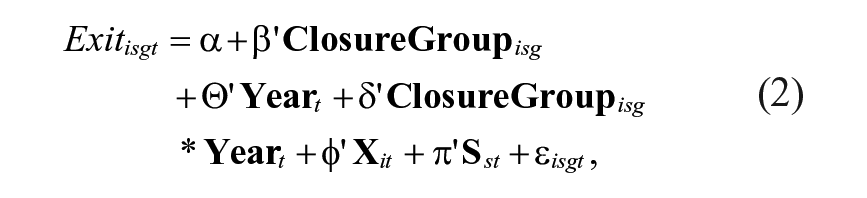
where
The
To interpret these comparisons as the causal effect of school closures on the probability of teacher exit, we must make assumptions that teachers in closed schools would have exited at similar rates to teachers in the underenrolled and low-performing schools, for example, in the absence of closures after taking into account any baseline differences in the probability of exit for those two groups of teachers. The key test of this assumption in a difference-in-differences strategy is that the trend in exit rates for closed-school teachers is parallel to the trend in exit rates for teachers in the underenrolled and low-performing schools. We provide evidence that this test holds in Figure 1, which shows the trends in exit rates for teachers in schools at different risks of closure leading up to 2012–2013. The exit rate for teachers in closed schools tends to follow the patterns in exit for teachers in all other types of schools, and the trend most closely follows the teachers in underenrolled and low-performing schools that were not closed. Furthermore, in all years prior to the closures, there is not a statistically significant difference in the exit rate, or the change in exit rate, for teachers at schools that were ultimately closed and teachers at schools that were on the narrowed list. For these reasons, we believe the likelihood of exit for teachers in the underenrolled and low-performing schools are a particularly good counterfactual for the predicted exit behavior of teachers in closed schools had they not been subject to closures, though the trends in teacher exits for the other groups of schools are also parallel leading up to the closures. 4 We also want to acknowledge another potential threat to causality: If there was another policy change or disruption that occurred at the same time as the closures that disproportionately affected teacher exit decisions in closed schools, then we are at risk of overstating the role of closures on teacher exit. However, we are not aware of any such potential occurrence.
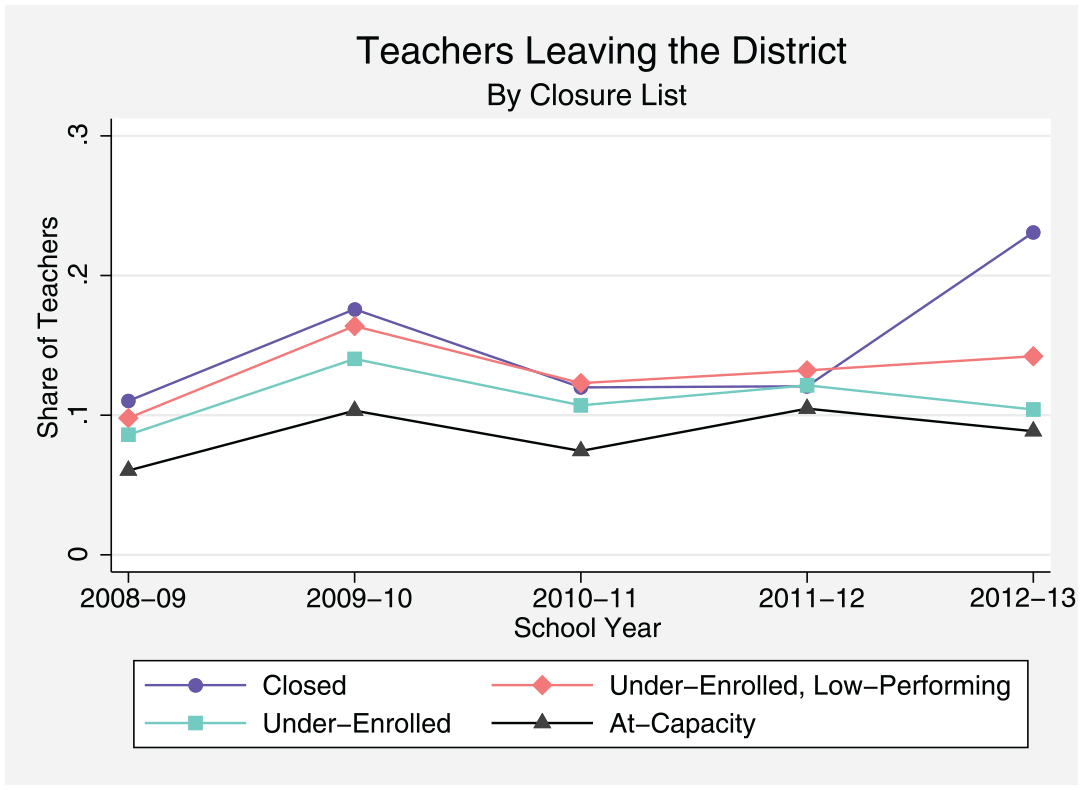
Share of teachers leaving CPS by school type.
Heterogeneity by Teacher Characteristics
Finally, we describe the association between teacher characteristics and the likelihood of exit from the district. We start by restricting the sample to teachers employed in the closed schools in 2012–2013, the year leading up to the closures. Then, we predict the likelihood of exit with a variety of teacher characteristics. We also explore heterogeneities in the effect of closures on the probability of teacher exit for different groups of teachers using the same model presented in Equation 2. Specifically, we look at these different comparisons: Black versus White teachers, tenured versus nontenured teachers, and teachers with the lowest evaluation ratings versus other teachers. The model we estimate is
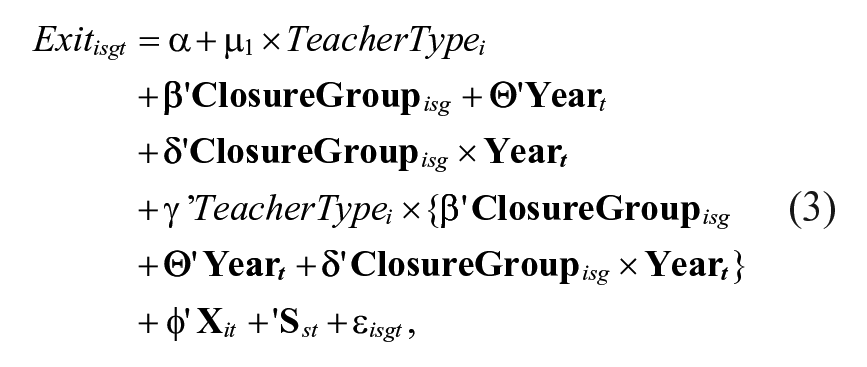
where the variables are as described in Equation 2 with the addition of TeacherTypei, which equals 1 if a teacher belongs to a group of interest (i.e., Black, nontenured, low performing, each in separate regressions). TeacherTypei is then interacted with the
Results
In this section, we present descriptive information about the composition of teachers in each school group the year leading up to the closures. We then provide results from the analyses aimed at addressing the research questions in this article. Specifically, we present the exit rates of teachers by school group preclosure, immediately postclosure, and 5 years postclosure. Finally, we show the difference-in-differences estimates of the effect of closures on teacher exit and whether or not these estimated effects varied across different teacher groups.
Sample Description
Table 1 includes descriptive statistics for the four mutually exclusive groups of teachers during the 2012–2013 school year: (a) closed schools, (b) underenrolled and low-performing schools, (c) underenrolled schools, and (d) at-capacity schools. Teachers working in the closed schools generally looked similar to teachers in underenrolled and low-performing schools, but vastly differed from teachers at the other elementary schools in the district. For example, 52% of teachers at closed schools were Black compared with 57% at the underenrolled and low-performing schools, 38% at the underenrolled schools, and 11% at the at-capacity schools. Whereas 6% of teachers at the at-capacity schools held National Board certification, only 4% of teachers at closed schools and at underenrolled and low-performing schools did. More than three quarters of closed-school teachers were tenured (76%), which was very slightly lower but generally similar to the share of tenured teachers in other schools.
Teacher Characteristics by School Closure Status, 2012–2013
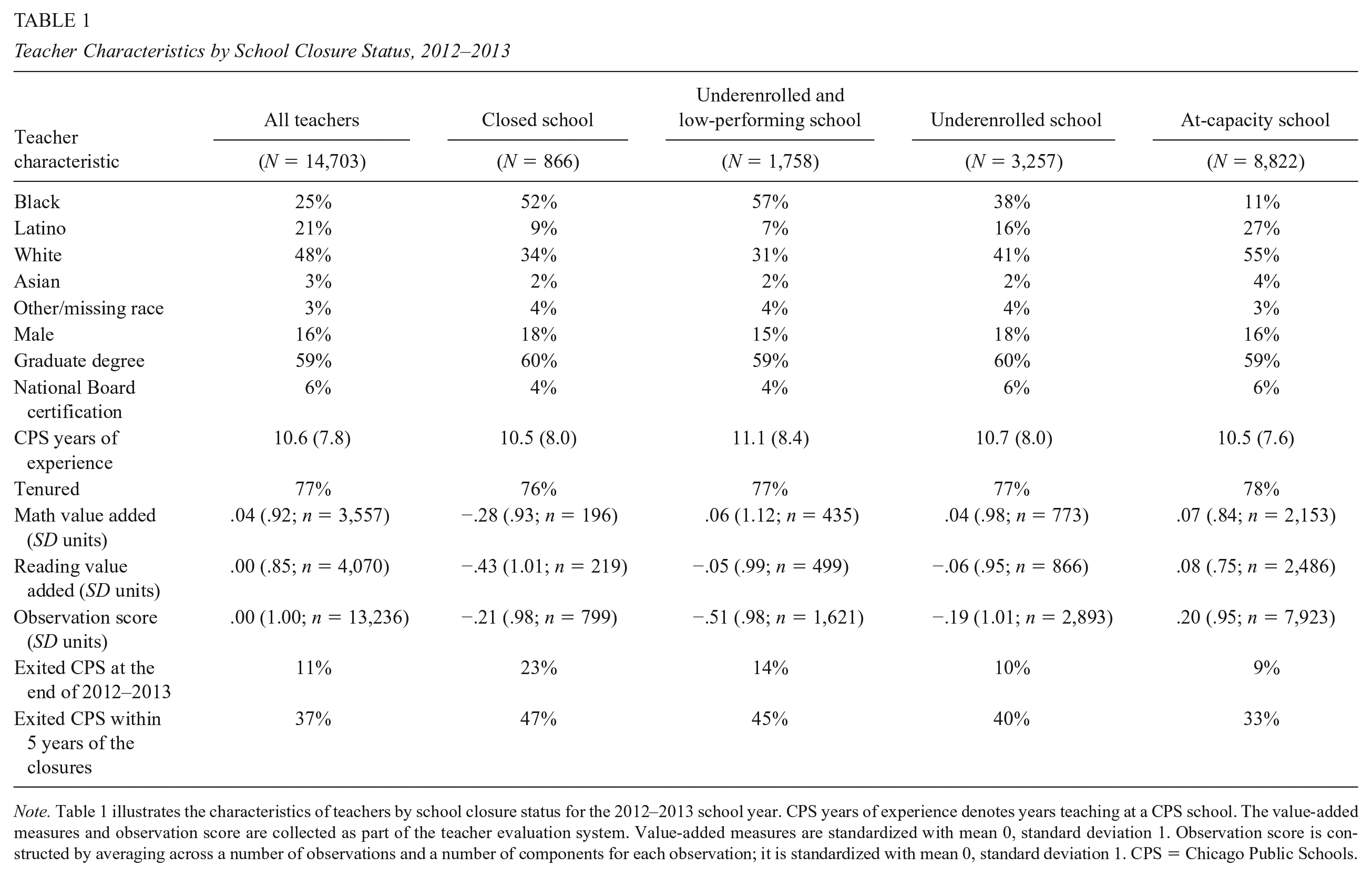
Note. Table 1 illustrates the characteristics of teachers by school closure status for the 2012–2013 school year. CPS years of experience denotes years teaching at a CPS school. The value-added measures and observation score are collected as part of the teacher evaluation system. Value-added measures are standardized with mean 0, standard deviation 1. Observation score is constructed by averaging across a number of observations and a number of components for each observation; it is standardized with mean 0, standard deviation 1. CPS = Chicago Public Schools.
When looking at teacher quality measures from the evaluation system, value-added measures for math and reading were lower on average for teachers at closed schools than for teachers at the nonclosed schools. On average, teachers in closed schools had math value-added measures that were about one third of a standard deviation lower than teachers at underenrolled and low-performing schools. Their reading value-added measures were, on average, about two fifths of a standard deviation lower than teachers at underenrolled and low-performing schools and about one half of a standard deviation lower than those at at-capacity schools. Furthermore, classroom observation scores were lower on average for teachers in closed schools than for teachers at at-capacity schools, but higher on average than those at underenrolled and low-performing schools. Although the differences in value-added measures are to be expected given that the district identified schools for closure based on underenrollment and low academic performance, the differences in observation scores may be because of variability in the evaluation system or because the observation-based measures of teacher practice pick up on different aspects of teacher quality than test score–based measures.
Figure 1 illustrates teacher exit trends from the district by school closure status in the years leading up to the closures and the year of the closures. Closed-school teachers and underenrolled and low-performing school teachers had similar exit rates preclosure. Teachers at underenrolled and at-capacity schools had slightly lower exit rates. However, the trends in exit rates for teachers in all four school groups were generally similar leading up to the closures.
Figure 2 illustrates the proportion of teachers who exited the district after the 2012–2013 closures by school closure status and for different groups of teachers. Overall, 23% of closed-school teachers did not return compared with 14% of teachers in underenrolled and low-performing schools. When comparing across teacher groups, closed-school teachers who were nontenured and who received the lowest evaluation score exited CPS at the highest rates—32% and 31%, respectively—whereas those who were tenured assigned average or high evaluation scores, and Black had the lowest rates of exit from the district at 20%. Although Black teachers at closed schools left the district at a lower rate than non-Black teachers, it is important to note that Black teachers made up a higher proportion of the teaching staff at both closed schools and underenrolled and low-performing schools (see Table 1) than districtwide.
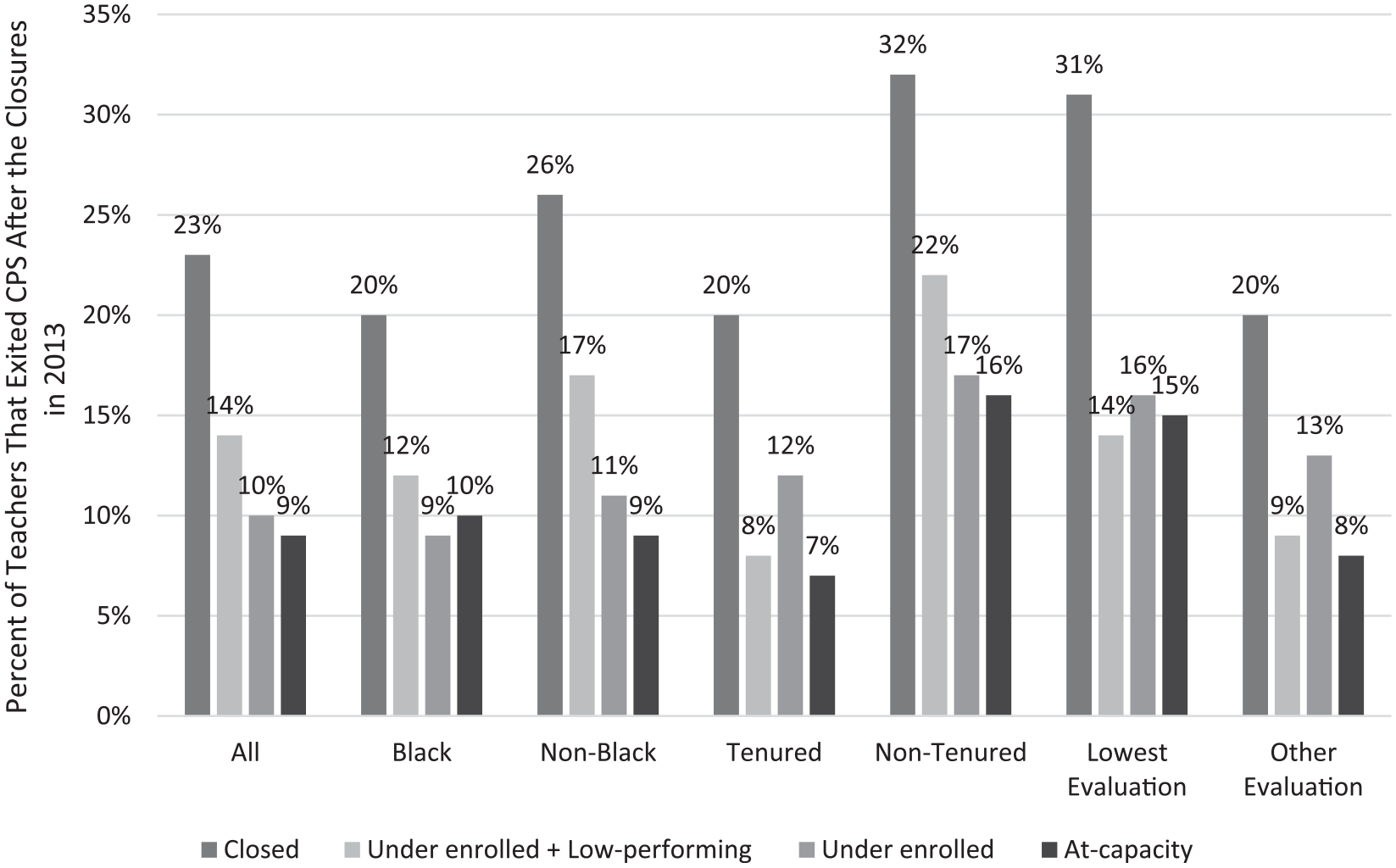
Percent of teachers who exited CPS after the closures in 2013 by school closure status.
Association Between Schools Closures and Teacher Exit
Table 2 compares the likelihood of exit for teachers in different school types immediately after school closures and at any point within 5 years of the closures. Column 1 shows results from an LPM where teachers in at-capacity schools serve as the omitted group. Results in columns 2 and 3 adjust for teacher characteristics and then teacher and school characteristics. The first three rows of each table compare the likelihood of exit between teachers who experienced actual, or threat of, closure with teachers in at-capacity schools never threatened. The likelihood of immediate exit from CPS after closures was significantly higher for teachers at schools that experienced threat of, or actual, closure compared with those at at-capacity schools. The model that includes both teacher and school characteristics shown in column 3 estimates that teachers at closed schools had a 9.7 percentage point greater likelihood of leaving than teachers at at-capacity schools and an 8.5 percentage point greater likelihood of leaving than teachers at underenrolled and low-performing schools. Table 2 also shows the statistical test that the change in exit among teachers in closed schools equals the change in underenrolled and low-performing and underenrolled schools. We find that exit was higher among closed-school teachers than for other groups of teachers, and those differences were statistically significant. Table A1 shows parallel results using a Cox proportional hazards model.
Linear Probability Model Estimates of the Probability of Exit From CPS After School Closures Immediately Following Closures and Within 5 Years of Closures
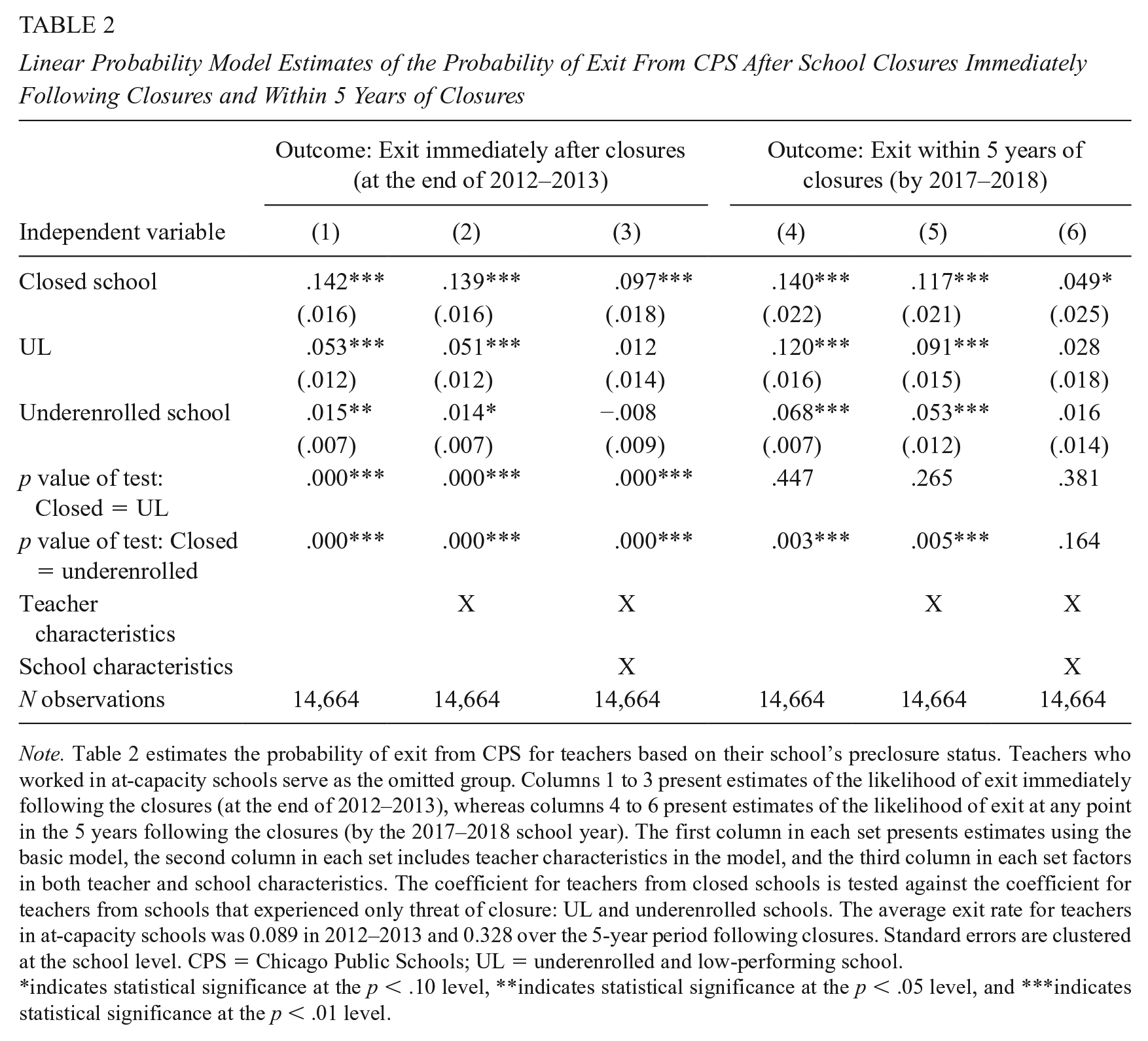
Note. Table 2 estimates the probability of exit from CPS for teachers based on their school’s preclosure status. Teachers who worked in at-capacity schools serve as the omitted group. Columns 1 to 3 present estimates of the likelihood of exit immediately following the closures (at the end of 2012–2013), whereas columns 4 to 6 present estimates of the likelihood of exit at any point in the 5 years following the closures (by the 2017–2018 school year). The first column in each set presents estimates using the basic model, the second column in each set includes teacher characteristics in the model, and the third column in each set factors in both teacher and school characteristics. The coefficient for teachers from closed schools is tested against the coefficient for teachers from schools that experienced only threat of closure: UL and underenrolled schools. The average exit rate for teachers in at-capacity schools was 0.089 in 2012–2013 and 0.328 over the 5-year period following closures. Standard errors are clustered at the school level. CPS = Chicago Public Schools; UL = underenrolled and low-performing school.
indicates statistical significance at the p < .10 level, **indicates statistical significance at the p < .05 level, and ***indicates statistical significance at the p < .01 level.
When looking at the likelihood of longer term exit (i.e., exit at any point within 5 years of the closures) in columns 4 to 6, Table 2, a different pattern emerges. We find that closed-school teachers were 4.9 percentage points more likely to exit after 5 years of closures than teachers in at-capacity schools. However, there is no longer a statistically significant difference between exit of teachers in closed schools and underenrolled and low-performing or underenrolled schools. This finding provides evidence that the closures may have accelerated the exit of teachers who would have ultimately left the district over the next 5 years even in the absence of closures. Although interesting, we note that this evidence is suggestive because teachers in underenrolled and low-performing schools may have been negatively affected by the closures in subsequent years to the extent that those schools were disrupted by influxes of new students and new teaching staff from the closed schools, as well as by the challenges of merging two populations.
Table 3 shows the estimates of the effect of closures on teacher exit using the panel data approach. Teachers who worked in closed schools in 2012–2013 serve as the treatment group, whereas teachers who worked in other types of schools serve as the comparison groups (with at-capacity schools serving as the omitted group). Column 1 presents the estimated effects using the basic model with no control variables. Columns 2 to 4 factor in teacher characteristics, teacher and school characteristics, and then teacher characteristics and school fixed effects, respectively. The first three rows show the likelihood of teacher exit from CPS in the years prior to the closures, relative to teacher exit in at-capacity schools. For example, comparing the estimates in the rows labeled “Closed school” and “Underenrolled and low-performing school” suggests that teachers in these two types of schools had similar exit rates prior to the closures.
Difference-in-Differences Estimates of the Probability of Exit From CPS After School Closures
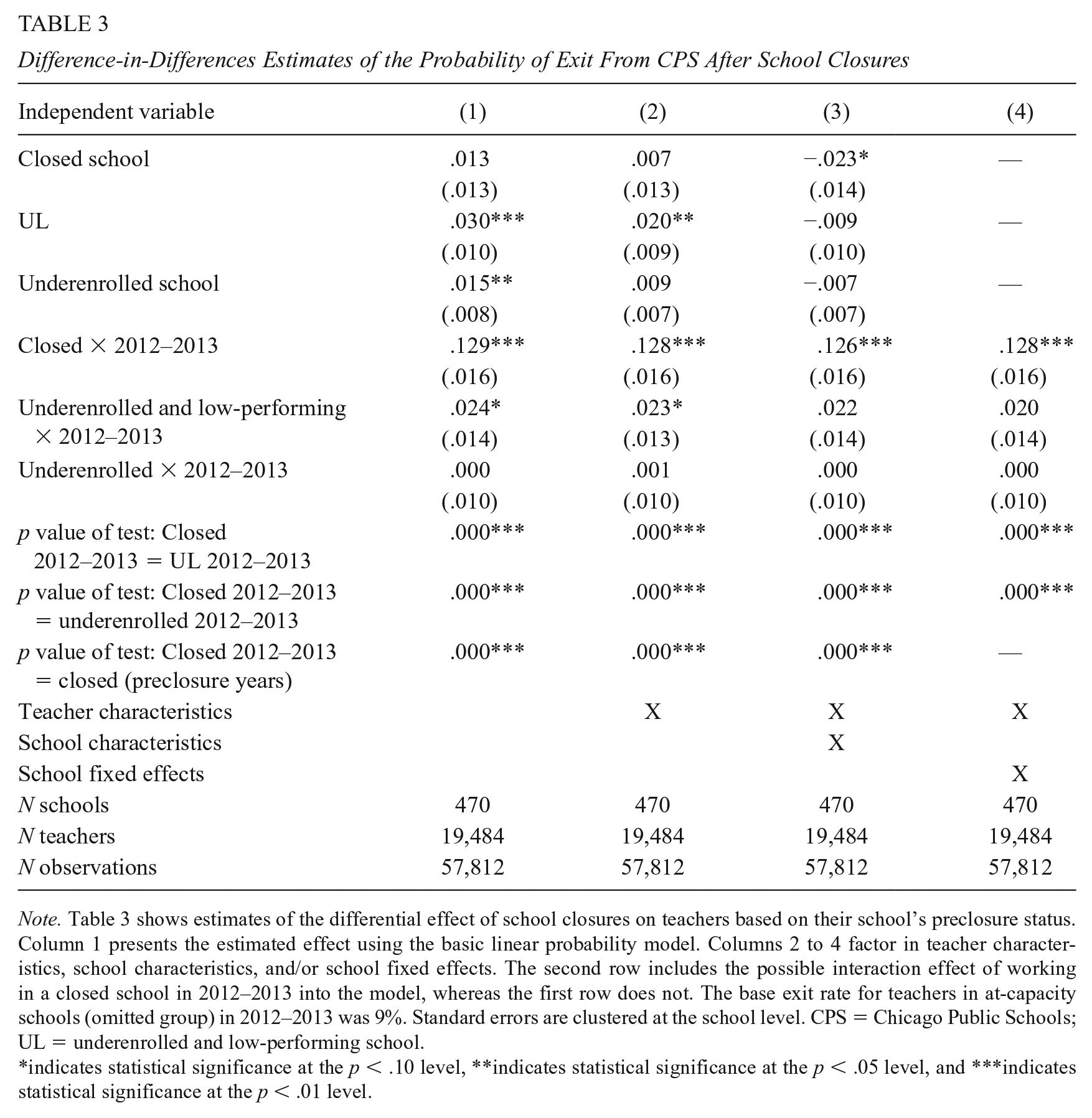
Note. Table 3 shows estimates of the differential effect of school closures on teachers based on their school’s preclosure status. Column 1 presents the estimated effect using the basic linear probability model. Columns 2 to 4 factor in teacher characteristics, school characteristics, and/or school fixed effects. The second row includes the possible interaction effect of working in a closed school in 2012–2013 into the model, whereas the first row does not. The base exit rate for teachers in at-capacity schools (omitted group) in 2012–2013 was 9%. Standard errors are clustered at the school level. CPS = Chicago Public Schools; UL = underenrolled and low-performing school.
indicates statistical significance at the p < .10 level, **indicates statistical significance at the p < .05 level, and ***indicates statistical significance at the p < .01 level.
The next set of rows includes the interaction effect of the school’s threat of closure and the year of closures, 2012–2013. The analysis indicates that school closures increased the probability of exit from the district by about 13 percentage points relative to teachers in at-capacity schools and about 11 percentage points relative to teachers in underenrolled and low-performing schools. This effect is statistically significant and consistent in magnitude across all variations of the model. Comparing exit rates among closed-school teachers over time, there is also a large and statistically significant difference in the likelihood that closed-school teachers exited the year of the closures when compared with earlier years. That difference is similar in magnitude, a 10 to 12 percentage point increase, depending on the model specification.
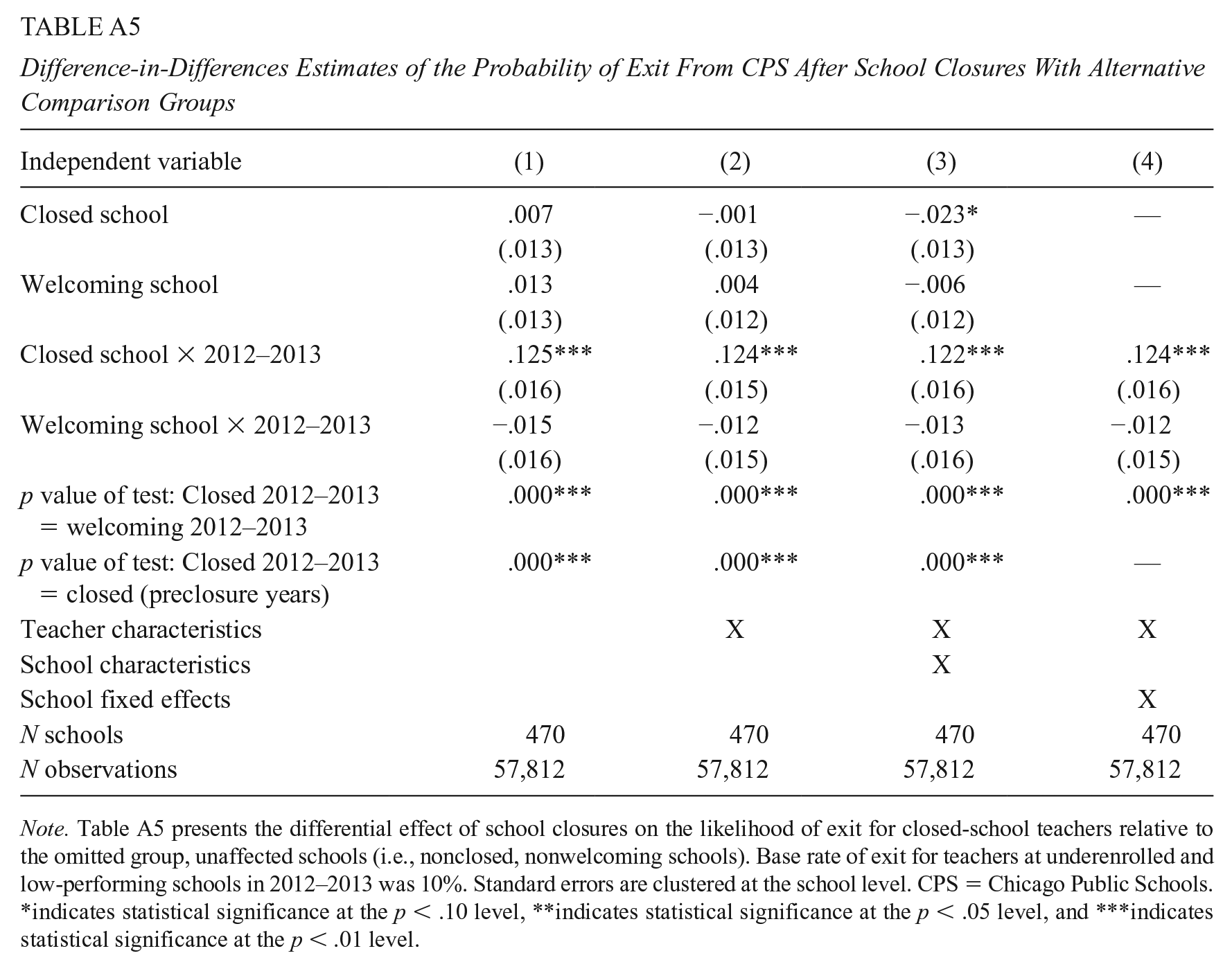
We implement various checks to ensure that our difference-in-differences estimates are robust to a number of assumptions and model specifications. The results from these robustness checks are presented in the appendix and described briefly here. Table A2 shows results of placebo regressions in which we compare the exit rates among teachers in the different school closure groups in the 3 years prior to the closures, adjusting for differences in teacher and school characteristics. In each year, we do not find statistically significant differences in the likelihood of exit for teachers in each of the different types of schools. Results from this table also suggest that, after adjusting for any differences in teacher and school characteristics, the preclosure exit rates across the school groups were similar. Tables A3 to A5 are similar to the difference-in-differences estimates shown in Table 3 but provide different sample restrictions. Table A3 limits the sample to just teachers in closed schools and underenrolled and low-performing schools with the assumption that the other groups of teachers are less directly comparable. Table A4 presents results when the analysis is done at the school level, rather than the teacher level, and we restrict the analysis to schools that were open for the complete period. We do this analysis to address concerns of any changes in the sample of schools and concerns that teachers were entering and exiting the sample prior to the closures. Table A5 uses alternative comparison groups, comparing exit of teachers in closed schools with teachers in the district’s designated welcoming schools and nonclosed/nonwelcoming schools.
Importantly, we find very consistent estimates of the closures on teacher exit. Across all the specifications and sample restrictions presented in the article and the appendix, and in the descriptive regressions and raw data, the effect of closures on teacher exit indicates an approximately 50% increase in exit over years past and when compared with teachers in various comparison schools.
Heterogeneous Effects on Teacher Exit
In this section, we describe which closed-school teachers returned to the district compared with those closed-school teachers who left, and investigate whether the closures resulted in differential exit for various groups of teachers. Table 4 illustrates where closed-school teachers went the year after school closures, specifically by placement status. Of 866 closed-school teachers, 23% left the district, 44% were rehired into welcoming schools, and 23% were rehired into nonwelcoming schools. We see that teachers rehired into welcoming schools were relatively more likely to be Black (58%) compared with those who left (46%) and those who were hired into other CPS schools (44%). Rehired closed-school teachers at welcoming schools had, on average, more years of teaching experience (13.4 years) than those rehired into nonwelcoming schools and those who left the district (9.4 years and 9.0 years, respectively). We also find that those rehired into the district were of higher quality by a number of measures than those who left—closed-school teachers who left CPS had, on average, lower value-added measures and classroom observation scores and were less likely to hold National Board certification than their peers who returned.
Closed-School Teacher Characteristics by Placement Status, 2013–2014
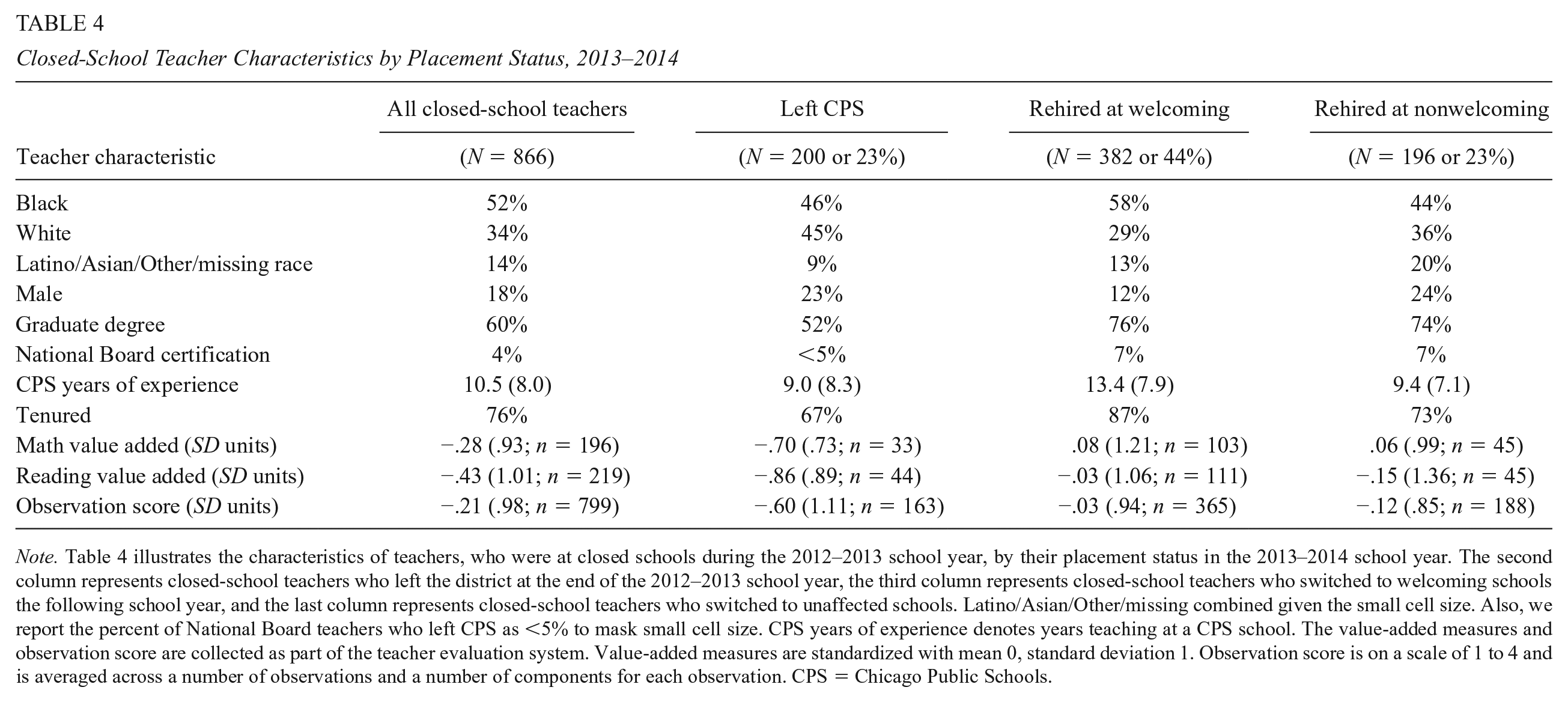
Note. Table 4 illustrates the characteristics of teachers, who were at closed schools during the 2012–2013 school year, by their placement status in the 2013–2014 school year. The second column represents closed-school teachers who left the district at the end of the 2012–2013 school year, the third column represents closed-school teachers who switched to welcoming schools the following school year, and the last column represents closed-school teachers who switched to unaffected schools. Latino/Asian/Other/missing combined given the small cell size. Also, we report the percent of National Board teachers who left CPS as <5% to mask small cell size. CPS years of experience denotes years teaching at a CPS school. The value-added measures and observation score are collected as part of the teacher evaluation system. Value-added measures are standardized with mean 0, standard deviation 1. Observation score is on a scale of 1 to 4 and is averaged across a number of observations and a number of components for each observation. CPS = Chicago Public Schools.
We also model this statistically by predicting exit only among closed-school teachers with a variety of teacher characteristics to understand whether some teachers were more or less likely to return to the district conditional on having been in a closed school in 2012–2013. These results are shown in Table 5. Teacher race, tenure status, National Board certification, and having low performance ratings were all statistically significant predictors of the likelihood that a closed-school teacher left CPS. Specifically, Black teachers were 7 percentage points less likely to exit CPS compared with White/Asian/Other teachers. Likewise, exit among tenured teachers was 9 percentage points lower than among nontenured teachers. As we saw in Table 4, there is evidence that lower performing, or less-qualified, teachers were more likely to exit the district. Teachers with National Board certification were 12 percentage points less likely to exit than their noncertified peers, and teachers with low evaluations were 8 percentage points more likely to exit than other teachers.
Predictors of Exit From CPS Among Closed-School Teachers
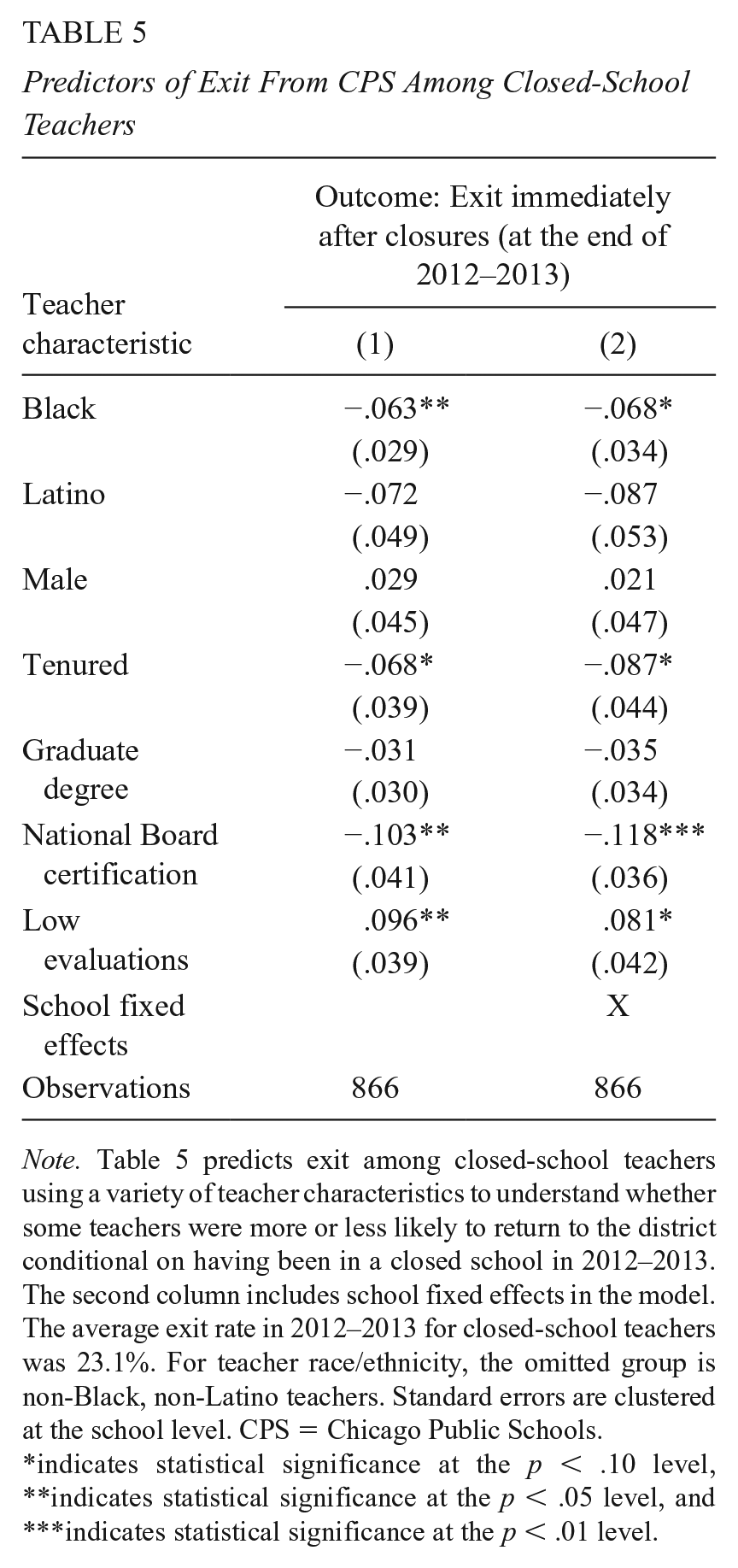
Note. Table 5 predicts exit among closed-school teachers using a variety of teacher characteristics to understand whether some teachers were more or less likely to return to the district conditional on having been in a closed school in 2012–2013. The second column includes school fixed effects in the model. The average exit rate in 2012–2013 for closed-school teachers was 23.1%. For teacher race/ethnicity, the omitted group is non-Black, non-Latino teachers. Standard errors are clustered at the school level. CPS = Chicago Public Schools.
indicates statistical significance at the p < .10 level, **indicates statistical significance at the p < .05 level, and ***indicates statistical significance at the p < .01 level.
Finally, we apply the same difference-in-differences framework to estimate whether there was a causal effect of the closures on teacher exit that varied by teacher group. These results are shown in Table 6 where each column represents results from separate regressions focused on different teacher group comparisons. Although Black teachers in closed schools were 3.5 percentage points less likely to exit in 2012–2013 compared with White teachers, this difference is not statistically significant. Similarly, tenured teachers in closed schools were 4.3 percentage points less likely to exit in 2012–2013 compared with nontenured teachers, but this difference is also not statistically significant. We do, however, find statistically significant evidence that the closures resulted in disproportionate exit among teachers with low evaluations. Closed-school teachers with low evaluation ratings were 9.4 percentage points more likely to exit than higher rated teachers. Taken together, these findings suggest that the closures did not differentially induce Black teachers to exit the district, but the closures likely resulted in the increased exit of low-performing teachers.
Heterogeneity in the Difference-in-Differences Estimates of the Probability of Exit From CPS After School Closures
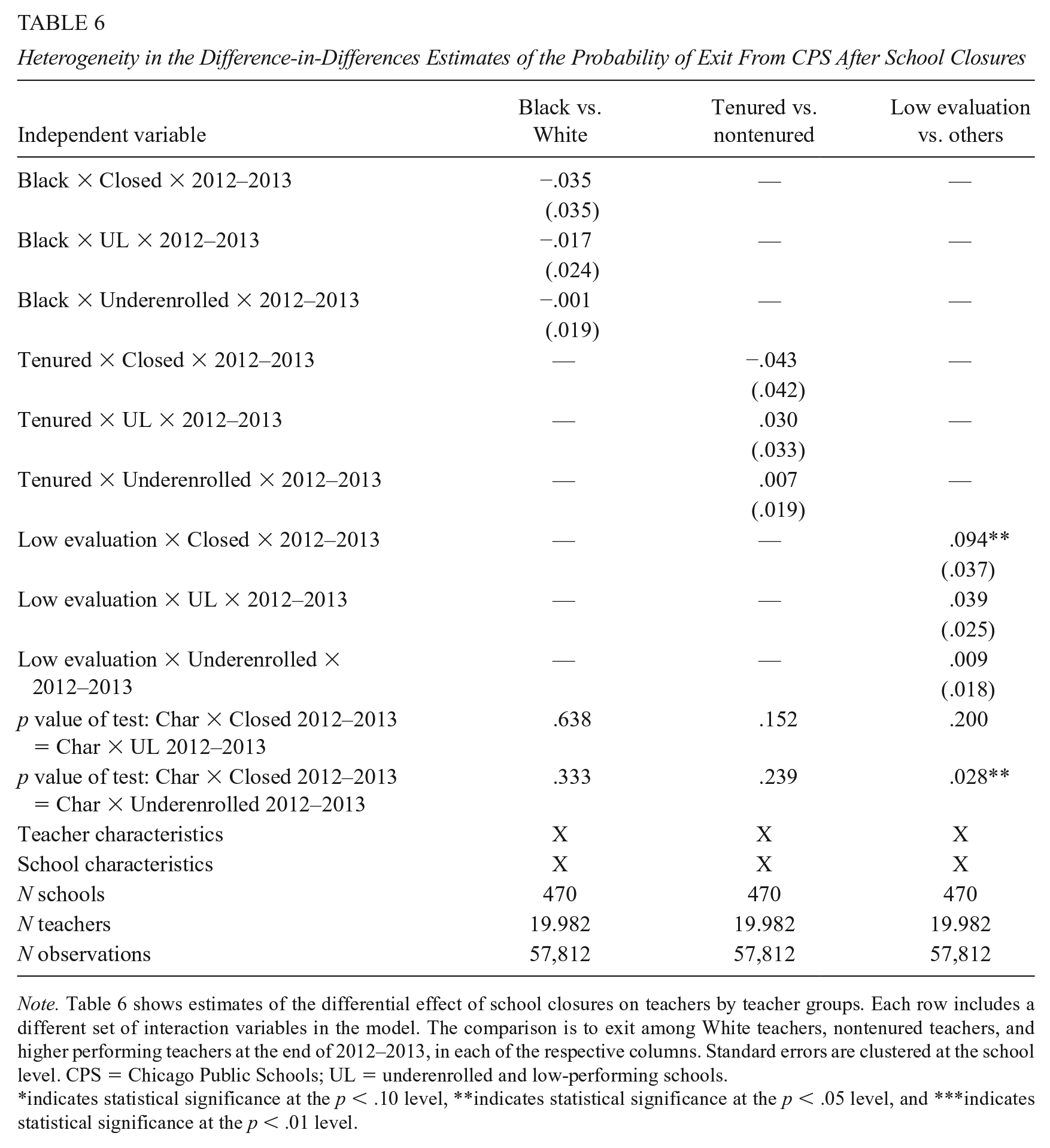
Note. Table 6 shows estimates of the differential effect of school closures on teachers by teacher groups. Each row includes a different set of interaction variables in the model. The comparison is to exit among White teachers, nontenured teachers, and higher performing teachers at the end of 2012–2013, in each of the respective columns. Standard errors are clustered at the school level. CPS = Chicago Public Schools; UL = underenrolled and low-performing schools.
indicates statistical significance at the p < .10 level, **indicates statistical significance at the p < .05 level, and ***indicates statistical significance at the p < .01 level.
Discussion
In this article, we empirically examine the relationship between mass school closures and teacher attrition in a large, urban district. We find that the 2013 closure of 47 elementary schools in Chicago increased the likelihood of teacher exit from the district, particularly among lower performing, less qualified teachers. Rehired closed-school teachers had, on average, more years of experience and higher classroom observation ratings than those who left, and they were also more likely to hold National Board certification and graduate degrees. Although the district–union contract in Chicago favored rehiring teachers with more years of experience and higher evaluation ratings, the retention of higher quality teachers appears to be an unintentional consequence rather than a strategic effort because the evaluation system used at the time provided very little differentiation between higher and lower quality teachers. However, retaining higher quality teachers may have helped to ameliorate or minimize the negative effects on students of closing schools and relocating students. As such, districts may want to consider policies outlining preferential rehiring to have a better chance of retaining the most effective teachers.
This policy implication is backed up by the research on RIF layoffs, which shows that policies prioritizing the layoff of less effective teachers rather than simply teachers with the fewest years of service have the potential to retain higher quality teachers (Goldhaber & Theobald, 2013; Kraft, 2015). The ability of schools and districts to implement such policies is likely even more promising following Race to the Top evaluation reforms that have led to the inclusion of a wider array of teacher practice measures. Namely, these evaluation systems may now provide district and school-hiring decision makers with better evidence to inform layoff and rehiring policies with the goal of retaining the most effective teachers in the face of these kinds of layoffs.
A particular concern in Chicago was that school closures disproportionately affected Black teachers and students. Indeed, closed schools served student populations that were majority Black and were more likely to be staffed by Black educators. However, when looking at closed-school teachers, we find that Black teachers were more likely to be rehired in CPS than White teachers. A shortcoming to note is that we cannot differentiate teachers who sought new positions in CPS and were not rehired from those who did not seek new positions in the district or how that may have varied by teacher race. For example, our finding that Black teachers were more likely than White teachers to be rehired in CPS could reflect that Black teachers were more likely to seek reemployment in CPS, whereas White teachers were more likely to seek positions in other districts or outside of teaching entirely. To contrast, if Black teachers and White teachers sought reemployment at similar rates, then perhaps hiring principals were looking to staff their schools with Black teachers who would likely better match the demographics of the student body, particularly in welcoming schools. This hiring approach would be consistent with the growing literature on the benefits of students having educators of the same race (Dee, 2004, 2005; Egalite et al., 2015; Egalite & Kisida, 2018; Gershenson et al., 2018; Lindsay & Hart, 2017).
The evidence from other school closure research on the differential labor market effects for Black and non-Black teachers may provide some insights as well. Lincove et al. (2018) hypothesized that White teachers in New Orleans were better positioned to escape the potential instability of employment in a district undergoing major restructuring, whereas Hill and Jones (2019) suggest that Black teachers may have experienced discrimination in the North Carolina teacher labor market and were more likely to be “first fired and last hired.” In the North Carolina paper, the authors also find that Black teachers were more likely to leave increased with the share of White students in the district. This may suggest that teachers themselves have preferences over race congruence, so Black teachers in Chicago may have been more likely to seek reemployment, particularly in the welcoming schools, which were more likely to serve Black student populations. Ultimately, districts may want to consider practices that maintain both the diversity and quality of their teaching force in face of closures, and scholars should continue raising questions about differences in available employment opportunities for educators of different races.
Questions remain about the stability of teacher employment after closures in the long run. We find that teachers from closed schools were as likely to be in the district 5 years after the closures as teachers in underenrolled and low-performing schools that were threatened with closure but remained open. On one hand, this evidence suggests that closures may have accelerated the exit of teachers who would ultimately have left the district over the next 5 years anyway. On the other hand, the closures may have affected the stability of teachers in the comparison group schools over the long term. If teachers in the schools that remained open felt the aftermath of the closures due to changes in student populations or working conditions, the effects of closures on teacher mobility may be greater than what is shown in this article. Future research should further explore the long-term effects of closures on teacher attrition and quality, and faculty hiring and layoff policies that can help mitigate any negative effects of closures on student achievement.
The merging of closed and welcoming schools can result in tensions among teachers (Gordon et al., 2018), as well as a shuffling of teachers that may be detrimental to both students and the schools. Prior studies have found that changes in teaching assignments and persistent churn can negatively affect student achievement, teacher perception of their schools and their decision to stay, and the organizational capacity of schools (e.g., Atteberry et al., 2017; Gordon et al., 2018; Ost & Schiman, 2015). Districts may, therefore, wish to implement policies that would ease the transition for rehired teachers and minimize subsequent changes that would negatively affect teachers’ capacity to support students and contribute to their new schools. For example, one consideration may be to match incoming teachers to similar teaching assignments and/or to students they have worked with at their closed school. Although we do not examine changes in teaching assignment associated with school closures in this article, future research should consider how such experiences may affect teacher effectiveness and mobility.
Closing schools inevitably leads to a shuffling of teachers within and out of districts, as well as uncertainty and anxiety about employment security. From the growing body of literature on layoffs due to budgetary constraints, we know the policies and contracts that outline the qualifications or characteristics of teachers who are the first to be laid off or who receive preference for new placements matter. As districts face declining student enrollment and consider the closure of schools or reduction in the teaching force as a strategy to consolidate resources, special attention should be paid to layoff and rehire policies to retain the teachers who are most likely to have positive effects on the lives of students.
Footnotes
Appendix
Difference-in-Differences Estimates of the Probability of Exit From CPS After School Closures With Alternative Comparison Groups
| Independent variable | (1) | (2) | (3) | (4) |
|---|---|---|---|---|
| Closed school | .007 | −.001 | −.023* | — |
| (.013) | (.013) | (.013) | ||
| Welcoming school | .013 | .004 | −.006 | — |
| (.013) | (.012) | (.012) | ||
| Closed school × 2012–2013 | .125*** | .124*** | .122*** | .124*** |
| (.016) | (.015) | (.016) | (.016) | |
| Welcoming school × 2012–2013 | −.015 | −.012 | −.013 | −.012 |
| (.016) | (.015) | (.016) | (.015) | |
| p value of test: Closed 2012–2013 = welcoming 2012–2013 | .000*** | .000*** | .000*** | .000*** |
| p value of test: Closed 2012–2013 = closed (preclosure years) | .000*** | .000*** | .000*** | — |
| Teacher characteristics | X | X | X | |
| School characteristics | X | |||
| School fixed effects | X | |||
| N schools | 470 | 470 | 470 | 470 |
| N observations | 57,812 | 57,812 | 57,812 | 57,812 |
Note. Table A5 presents the differential effect of school closures on the likelihood of exit for closed-school teachers relative to the omitted group, unaffected schools (i.e., nonclosed, nonwelcoming schools). Base rate of exit for teachers at underenrolled and low-performing schools in 2012–2013 was 10%. Standard errors are clustered at the school level. CPS = Chicago Public Schools.
indicates statistical significance at the p < .10 level, **indicates statistical significance at the p < .05 level, and ***indicates statistical significance at the p < .01 level.
Acknowledgements
The authors are grateful to the Chicago Public Schools for providing data access and policy knowledge. Funding for this work was provided by the Spencer Foundation and the Chicago Community Trust. The article has benefited from discussions with Lisa Barrow, Thad Domina, John Easton, Molly Gordon, Guanglei Hong, Steve Raudenbush, Matt Springer, Marisa de la Torre, and Sabrina Zadrozny, as well as the presentation at the annual conference of the Association for Education Finance and Policy. Authors are listed in alphabetical order.
Declaration of Conflicting Interests
The author(s) declared no potential conflicts of interest with respect to the research, authorship, and/or publication of this article.
Funding
The author(s) disclosed receipt of the following financial support for the research, authorship, and/or publication of this article: Lauren Sartain received funding from the Spencer Foundation and the Chicago Community Trust to conduct the research.
1
Author calculations from Census and American Community Survey data.
2
Chicago Public Schools (CPS)-designated welcoming schools were most often schools that experienced threat of closure, whereas unaffected schools—those that were neither designated to be closed nor welcoming schools—were most often at-capacity schools.
3
During the year of the closure, CPS transitioned to a new evaluation system that established criteria for observations, required more classroom observations, and included student data in the evaluation of teacher performances. However, the evaluation score criterion for rehire eligibility defined in the contract looked only at the old evaluation system, which was solely based on principal evaluations conducted without an observation rubric (Jiang & Sporte, 2016). Teachers did not have access to the new evaluation data or ratings until well into the fall of 2013 after they had already made labor market decisions. According to  , almost all teachers under the old system, which provided little differentiation between teachers, received high marks. For the purposes of this article, we use effectiveness measures from the new evaluation system, but the rehire policy used the old evaluation system. We do not have access to the evaluation ratings from the old system.
4
An alternative comparison is closed-school teachers with welcoming school teachers. We are concerned that the exit of welcoming school teachers in the wake of the closures might be endogenous, as they are also potentially affected by the closures because their schools were to absorb the closed-school students. However, we do not see graphical evidence of this concern (see Figure A1). Regardless, we include the estimates using the threat of closure groups in the main article.
Authors
HELEN LEE is a doctoral student in the Department of Comparative Human Development at the University of Chicago. Her research areas include mental health, teachers and schools, and Asian Americans.
LAUREN SARTAIN is an assistant professor in the School of Education at the University of North Carolina at Chapel Hill and an affiliated researcher at the University of Chicago Consortium on School Research. She studies a range of topics in urban education policy, including teacher quality, school choice and school quality, and discipline reform.