




Abstract
Purpose
In recent years, private tutoring has become increasingly prevalent in China and has become both a dominant way for students to learn after school and a major component of family educational expenditure. This paper aims to analyze the factors that affect Chinese students’ participation in private tutoring and the effectiveness of private tutoring.
Design/Approach/Methods
We use data from the Programme for International Student Assessment (PISA) 2015 of Mainland China area and focus specifically on science-related private tutoring. Multilevel logistic model and hierarchical linear model based on coarsened exact matching (CEM) are used to conduct the investigations.
Findings
Empirical results show that individual level factors including student's interest in science, educational expectations, and school-level factors such as school autonomy, science-related learning resources and school size pose a significant influence on the likelihood of participation in private tutoring. Moreover, science-related private tutoring has not significantly improved the overall scientific literacy scores of students. In addition, private tutoring has widened the performance gap among students from different socioeconomic backgrounds, with students from socioeconomically advantaged family experiencing more significant gains from tutoring.
Originality/Value
These findings suggest that providing free high-quality tutoring to students from disadvantaged families might be an effective way of promoting educational equity.
Introduction
In recent years, private tutoring has become increasingly pervasive in China, attracting extensive attention from researchers and the general public alike. An already large body of data reveals that the participation rate in private tutoring among Chinese students is at a relatively high level and appears to be continuing its upward trend. The China Urban Residents Education and Employment Survey released in 2004 shows that a majority of urban students have participated in private tutoring, and that the proportion of students participating in such tutoring during middle school was as high as 65.6% (Xue & Ding, 2009). A survey conducted in Gansu, Hunan, and Jiangsu provinces examined the participation in private tutoring of third-year middle school students and found that the average participation rate of students from the three provincial capitals was as high as 82.8%, while only around one-third of the students located in provinces’ various county seats did not take such tutoring (Tsang, Ding, & Shen, 2010). Another survey of high school students in Jinan also showed that students in later grades had higher tutoring participation rates (Zhang, 2013). At the same time, an international comparison using PISA 2012 data found that participation rate in private tutoring of 15-year-old students in Shanghai significantly exceeded the average of that in OECD countries and most East Asian countries (Zhou & Zou, 2016).
In addition, the family education expenditure of private tutoring in China has been constantly increasing. In 2007, the National Family Education Expenditure Survey showed that the average annual tutoring expenditure for students during compulsory education was 1,781.4 CNY, of which the average annual cost for core subjects tutoring was 823.9 CNY (Qian, Chi, & Shi, 2015). The 2012 China Family Panel Studies shows that the average tutoring expenditure among participants reached 2,227.24 CNY per person per year (Xue, 2015).
Based on this, we can see that private tutoring has become both a dominant way for students to learn after school and a major component of family educational expenditure. The effectiveness of private tutoring has become a focus of many researchers. In theory, such tutoring should supplement mainstream schooling and should have a positive impact on students’ academic performance. However, tutoring has the potential to reduce the enthusiasm level of students studying at school and may also affect efficiency in the classroom (Silova, Bray, Zabulionis, & Budiene, 2006). Because these two effects are mutually offsetting (at least to some extent), researchers have not yet rendered a final verdict as the overall impact of private tutoring. In light of this, empirical research based on representative samples is particularly important. This paper uses micro-survey data from China to empirically test the effectiveness of private tutoring. Specifically, we focus on (1) whether participation in tutoring affects student literacy levels and (2) the extent of any such impact.
At the same time, it is worth noting that there are many kinds of private tutoring services available in China, and there are also major differences in the educational content and quality provided by different tutoring organizations (or individual tutors). When students with different family backgrounds and academic needs choose among those different available options, the effectiveness of the tutoring they receive will naturally vary. Therefore, we believe that it is far from enough to know the extent to which participation in tutoring influences student literacy levels. It is also necessary to examine the heterogeneity of this influence among different groups, that is, (1) how the effectiveness of private tutoring varies based on the characteristics of students, and (2) whether any such variance, in turn, promotes or hinders educational equity.
In order to answer the above questions, we used the Chinese data from the Programme for International Student Assessment (PISA) conducted by the Organization for Economic Co-operation and Development (OECD) in 2015 to analyze the current status and effectiveness of student participation in private tutoring. Because the focus area of PISA (2015) was scientific literacy, this article analyzes the overall tutoring situation for the scientific disciplines (including physics, chemistry, biology and earth sciences).
The remainder of this paper is organized as follows: the second part summarizes existing research in this area; the third part describes the data, variables and empirical models used in our study; the fourth part uses the survey data from PISA (2015) for China to conduct a full sample and heterogeneity empirical analysis; the final part contains our conclusions and policy recommendations.
Literature Review
Generally speaking, private tutoring can be divided into two types: enhancement and remediation. When the mainstream schooling fails to meet the learning needs of different students, students will look outside the school for necessary supplementation. Despite this, the existing empirical research on private tutoring has not yet reached a conclusion as to the efficacy of such tutoring.
The study of the effectiveness of private tutoring originated in the 1990s. Since a research found that Japanese high school students who participated in private tutoring had a higher probability of entering college (Stevenson & Baker, 1992), a growing number of scholars have turned their attention to the impact extracurricular tutoring can have on student academic performance. However, findings are mixed that the impact of participation in private tutoring on student academic performance can be positive (Briggs, 2001; Buchmann, 2002; Dang, 2007), negative (Cheo & Quah, 2005) or insignificant (Kang, 2007; Smyth, 2008; Suryadarma, Suryahadi, Sumarto, & Rogers, 2006). Also, some other scholars have found that tutoring may generate a significant improvement in student performance in the short term but has a weak long-term effect (Lee, 2013).
The divergences in the above conclusions may be due to differences in the form, content, cost and duration of private tutoring. Certain studies have found that tutoring centers that provide in-person instruction can significantly improve student performance, while correspondence and online programs have an opposite, negative effect (Byun, 2014). Also, advanced learning in private tutoring may not have a significant impact on student achievement (Lee, Kim, & Yoon, 2004). Although more expensive tutoring programs may provide better quality teachers and content, thereby improving student achievement (Dang, 2007), the difference in effectiveness between more and less expensive options may not always be obvious (Ryu & Kang, 2013; Smyth, 2008).
In addition, it is worth noting that there is a large amount of research focusing on the differential effect private tutoring has among different groups and its impact on educational equity. We mainly focused on researches in China and divided those into three categories.
First of all, private tutoring is a fee-based educational service, and its quality and effectiveness may vary among students from different family backgrounds. Some studies using national sample survey data have found that enhanced-learning type tutoring activities maintain and strengthen social stratification (Xue & Ding, 2009). Shadow education (as well as education in schools) plays an important role in the intergenerational transfer of family capital, thereby leading to the solidification of existing class structures (Xue & Li, 2016). This poses a challenge to educational equity at the primary and secondary school level. A survey of rural primary schools in Northwest China also showed that, due to a lack of tutors and inappropriate content, extracurricular tutoring did not significantly improve the mathematics scores of rural primary school students (Pang, Yan, Nie, et al., 2017). However, another research based on the data of PISA 2012 in Shanghai revealed that as long as comparable tutoring opportunities were provided, supplementary math tutoring could narrow the gap of learning performance caused by differences in family socioeconomic status and thus improve the equality of educational outcomes (Hu, Fan, & Ding, 2015).
In addition, a student's academic achievement level also impacts the effectiveness of his/her participation in private tutoring. A two-year follow-up survey conducted at an elementary school located in a provincial capital city in central China found that students with poor academic performance in the previous period benefited more from participating in remedial classes. As a result, the remedial classes helped to close the academic achievement gap between higher-performing and lower-performing students (Li & Hu, 2017).
Third, when we examine the combined influence that student family background and student academic achievement level have on the effectiveness of tutoring, the disparity we find is even more staggering. Zhang (2013) used a sample of high school students in Jinan to find that while private tutoring significantly improved the college entrance examination scores of poorer-performing and students from low-performing schools in urban areas, it had a significant negative impact on the college entrance examination scores of rural students. Another study of “left-behind children” found that private tutoring can only help left-behind students who had good performance or were in high-quality schools to narrow the achievement gap with others. Private tutoring did not, however, deliver similar benefits to left-behind students with poor performance or were enrolled in low-quality schools (Xue, Wang, & Wu, 2014).
Previous studies demonstrate that even after controlling for differences among student, family and school characteristics, there are still variations in the effectiveness of private tutoring. These differences may be caused by representational issues of the samples underlying the collected survey data. Sampling data limited to specific regions, for example rural areas in Northwest China (Pang et al., 2017), a central province (Zhang, 2013) or a single, more-developed city in the east (Hu et al., 2015), may result in inconsistent findings. PISA (2015) of Mainland China area includes data from Beijing, Shanghai, Jiangsu and Guangdong, providing a solid sample basis for the nation's eastern coastal provinces.
In addition, many studies have relied on student self-reported grades or parental evaluation of student academic performance (Xue et al., 2014) as output variables, but this may lead to comparability problems among the sample data due to differing evaluation criteria. There are also studies that use college entrance examination scores (Zhang, 2013), graduation examination scores and other non-horizontally comparable test results as output variables. Differences in measurement tools may also lead to inconsistent conclusions. Moreover, when measuring student development, we should pay more attention to overall student achievement rather than just the results of a particular knowledge-based test. In light of this, our research used PISA (2015) scientific literacy test results as an output variable to measure the effectiveness of private tutoring in science-related subjects. At the same time, the use of standardized test scores also ensures that our research results can be compared horizontally and vertically.
Apart from differences in regional coverage and measurement tools, our review of existing research found that while past studies included students from different grades (from elementary school to high school), owing to comparability issues in the data, few studies have compared the determining factors and effectiveness of tutoring on students across different grade levels. PISA (2015) provides a good data foundation for this endeavor: the test mainly covers students from the third year of middle school and the first year of high school. In the Chinese education system, middle school is a compulsory education stage, while high school is not. This distinction essentially determines the different attributes of middle schools and high schools in China, and may also be reflected in the choices students at different levels of schooling make with respect to private tutoring and the effectiveness of such tutoring.
Although certain scholars have used PISA data to research tutoring, they have not distinguished students from grades according to the Chinese classification system for academic levels (Hu et al., 2015; Hu, Fan, & Ding, 2017; Zhou & Zou, 2016). This may have led to some deviation in their estimates and findings. 1 We believe that the approach of distinguishing between middle school and high school samples can make better use of data, not only to obtain more accurate statistical inferences, but also in the comparison of the differences in non-school-based education between the two groups.
Besides, many studies focus on measuring the effectiveness of tutoring in a particular discipline, but the selected control variables (especially school-level control variables) are generally measures of overall level (i.e., the variables cover all disciplines). This paper focuses on the effects of tutoring in science-related subjects. In the choice of control variables, whether for personal characteristics or at the school level, we used variables specifically related to science subjects as much as possible, such as the interest in science of the individual student, the time devoted to the science curriculum, the resources provided for science activities and the quantity and quality of the school's science teachers.
Finally, building upon the foundation established by existing research, this paper explores the disparate impact private tutoring may have on students with different levels of academic performance and family socioeconomic backgrounds. In the heterogeneity analysis, using the method of sub-sample regression and adding interactions, we attempt to compare whether the effectiveness of tutoring on students with different levels of academic performance in middle school and high school will vary due to changes in family socioeconomic background. This provides an empirical basis for the recommendation of appropriate policies to promote educational equity.
Research Methods
Sample
Data
The data used in this paper is from the Programme for International Student Assessment (PISA) conducted by the Organization for Economic Co-operation and Development (OECD) in 2015. PISA administers testing once every three years. The target group was 15-year-old students from the participating countries and economies. The main contents of the assessment are science, reading, mathematical and financial literacy. At the same time, the program also investigates and collects background information of sample schools, families and individual students. In 2015, Beijing, Shanghai, Jiangsu and Guangdong formed the consortium of Chinese mainland regions (B-S-J-G, China) to participate in the PISA test. The focus of this round of testing was science literacy. A total of 9,841 15-year-old students from 268 secondary schools in Beijing-Shanghai-Jiangsu-Guangdong participated in this round of testing and investigation.
Among the 9,841 Chinese 15-year-old students who participated in the PISA (2015) test, 5,574 were middle school students and 4,267 were high school students. A clear majority of the middle school students included in the sample were in their third year of middle school (86.3%), and an even higher percentage of the high school students included in the sample were in their first year of high school (95.4%). In order to eliminate the influence of different grade levels, we removed non-third-year middle school students and non-first-year high school students from the sample. 2 In addition, we also removed students for whom there was missing information on relevant variables. The final samples included 7,004 students—3,750 from middle school and 3,254 from high school.
Variables
Dependent Variables
This study uses PISA (2015) scientific literacy test results as an output variable to measure the effectiveness of private tutoring in science-related disciplines. PISA (2015) defines “scientific literacy” by the following three competencies: “explain phenomena scientifically”, “evaluate and design scientific enquiry” and “interpret data and evidence scientifically”. The main difference between the PISA scientific literacy assessment and the kind of science-subject test typically administered in China is that the former focuses more on comprehensive scientific knowledge and critical thinking, examining students’ “content knowledge” (science-related facts, concepts, ideas and theories), “procedural knowledge” (the procedures that scientists use to establish scientific knowledge) and “epistemic knowledge” (an understanding of the role of specific constructs and defining features essential to the process of knowledge building in science) (OECD, 2016a). The test's questions are based on real-world problems, with novel forms and rich content. Through professional test development and evaluation, the exam can more objectively and accurately gauge students’ overall scientific literacy.
In order to quantify and compare the effectiveness of tutoring for different grade levels, we converted the scientific literacy scores for each grade into an average score of 0 with a standard deviation of 1. A standardized value greater than 0 indicates that the student's scientific literacy score was higher than the average score at his or her grade level. The value per unit (1 point) indicates that the student's scientific literacy score was higher than (or lower than) the overall average score of his or her grade by one standard deviation.
Independent Variables
Previous studies on education production conclude that education inputs that determine students’ academic performance have a typical hierarchical structure. In general, the individual, family, class, school and socioeconomic factors applicable to each student will contribute to his or her academic achievement (Hu & Du, 2008; Xue & Wang, 2010; Zhang & Sheu, 2013). In this study, we divided the factors that affect students’ scientific literacy scores into two levels: the individual level (including individual student and family characteristics) and the school level (including class and overall school level attributes).
The core independent variable in our study was the dummy variable of whether the student participate private tutoring in science. 3 Additionally, at individual level, we also took student gender, interest in science, educational expectations and family socioeconomic status as control variables. The “self-determination theory” emphasizes the importance of intrinsic motivation in learning (Ryan & Deci, 2009) and a student's personal interest in science affects his or her time investment and participation in scientific disciplines (Nugent et al., 2015), which—in turn—drives academic performance. In addition, a large number of studies have shown that family socioeconomic background has a significant positive correlation with a student's academic success. Students from advantaged socioeconomic backgrounds are more likely to receive adequate and quality educational resources. At the same time, it is more likely that these students will enjoy a positive and conducive family atmosphere (Schulz, 2005), which in turn helps foster academic achievement.
Based on previous studies on the relationship between school resources and student academic performance (Hanushek, 1996; Hu et al., 2017; Zhou & Zou, 2016), the school-level factors selected in this paper can be divided into subject-related inputs (such as the number of courses and teachers, extra-curricular activities and homework assistance) and overall-school-level inputs (such as school size, type, location, autonomy and mean school socioeconomic status). School curriculum and activities have the most direct impact on student academic performance, while teacher and school quality determine the efficiency of them. It is worth noting that the mean school socioeconomic status can be used to measure the aggregated socioeconomic status of the student body. In general, schools with higher mean socioeconomic status have better overall academic performance (Perry & Mcconney, 2010). The degree of school autonomy primarily refers to the degree of authority given to school management, especially decisions about curriculum and student assessment policies (OECD, 2016b). At present, many countries and regions are gradually liberalizing school autonomy in curriculum and resource allocation to achieve better teaching results (Cheng, Ko, & Lee, 2016).
Sample Description
The variables used in this study and a basic description of the sample are shown in Table 1.
Descriptive statistics of the sample.
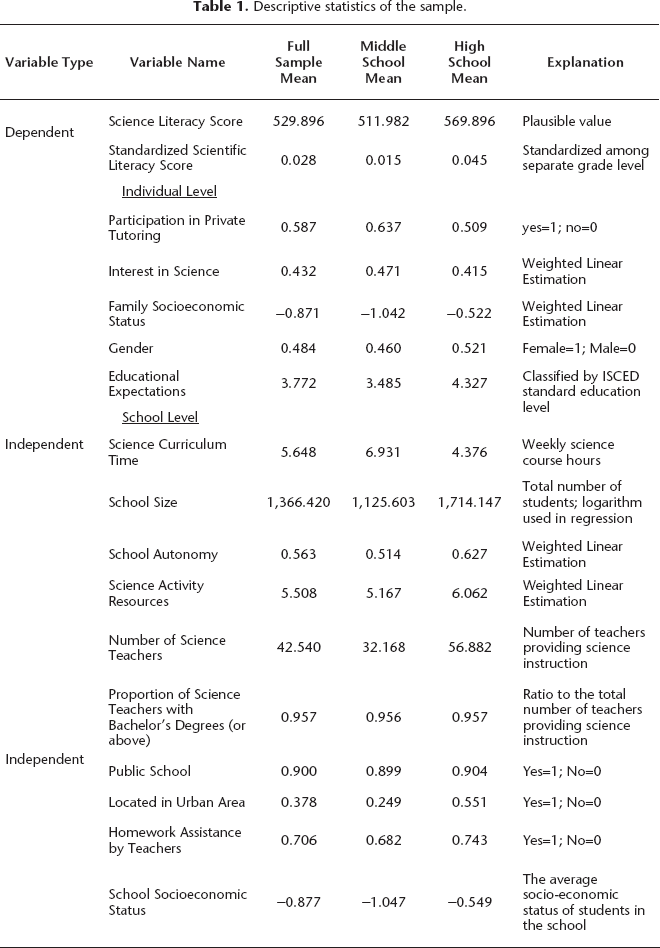
In the sample, the average scientific literacy test score was 529.9 points. The average score of high school students was greater than that of middle school students. 58.7% of the students participated in private science tutoring, and the participation rate for middle school students was 12.8% higher than the high school group. The average index for the student family socioeconomic status was −0.871 and the high school group was socioeconomically more advantaged than the middle school group. The proportion of female students in the sample was 48.4%, about 3% less than that of male students. The average educational expectations of middle school students and high school students were quite different. 4 The schools included in the sample were basically all public schools; the average school size was over 1,000 students; 38% of the schools were in urban areas. 5 Compared to the middle school sample, a larger percentage of high schools were located in urban areas. A majority of schools offered enhanced resources for scientific activities, and most of the teachers obtained a bachelor's degree or above. In school, approximately six hours per week were dedicated to the science curriculum, though there were pronounced differences between the middle school and high school groups. 6 Around 70% of school teachers provided after-school homework assistance to students.
To compare the effects of participation in tutoring among students from different family backgrounds and levels of academic performance, in addition to the overall analysis of the middle school and high school samples, we also classified students from each grade level into two groups: students with “above average scientific literacy scores” and students with “below average scientific literacy scores”. We then added an interaction of “participation in private tutoring” and “family socioeconomic status” to each group as heterogeneity analysis.
Hierarchical Linear Model (HLM)
The factors determining student academic achievement can be divided into two levels: individual and school. What cannot be ignored is the nested relationship between students and schools, which is to say, the variation of students among and within schools may not be identical. At this point, using traditional linear regression would violate the sample independence assumption, while multilevel regression can (1) identify the impact from individual and school level factors, and (2) attribute the respective variation to the two groups of factors (Rabe-Hesketh & Skrondal, 2012). Based on the nested relationship between the PISA student questionnaire and the school questionnaire data, we utilized hierarchical linear model (HLM) for our empirical research. Because the dependent variable “standardized science literacy score (Yij)” is a continuous variable, the independent variables can be divided into individual-level variables (ADDSCIE and Xnij) and school-level variables (Xmj). Therefore, we used a two-level linear regression model to examine the effectiveness of student participation in private tutoring. The regression model is as follows:
Level-1 (individual level)

Level-2 (school level)

In the regression model, individual-level variables include whether the student participate in private tutoring, level of interest in science, family socioeconomic status, gender and educational expectation. School-level variables include time spent on science curriculum, school size, school autonomy, science activity resources, number of science teachers, proportion of science teachers with bachelor's degrees or above, whether the school is a public school, whether it is located in an urban area, whether the teacher provides homework assistance after class and mean school socioeconomic status.
In the heterogeneity discussion section, the first level of the model also includes the interaction of “participation in private tutoring” and “student family socioeconomic status”.
In the two-level model, the total variance consists of the individual variation within the first level and the variation between groups in the second level. To test whether the data conforms to the assumption of multilevel nesting, variance component analysis can be performed from a zero model that does not contain any variables, that is, by calculating the intra-class correlation ρ:

Where τ00 is the variance of the residual of the level two (school level) model and σ2 is the variance of the residual of the level one (individual level) model. ρ refers to the percentage of the overall variance explained by school-level variables.
Empirical research is paying increasing attention to the endogeneity problem of core explanatory variables. Severe endogeneity often leads to inconsistency in parameter estimates, which in turn leads to unreliable statistical inference results. One potential problem with the above regression is the endogenous nature of the core explanatory variable “whether or not to participate in private tutoring”. Even if it is true that participation in tutoring can directly affect student scientific literacy levels, at the same time, tutoring choices are closely related to student and school characteristics that also affect student scientific literacy levels. Ignoring the self-selection problem of tutoring may result in estimation bias. In order to solve this potential endogeneity, we reconstructed the sample group by matching in order to reduce the self-selection bias as much as possible using a quasi-experimental method.
Many studies use PSM (Propensity Score Matching) to control and eliminate errors resulting from student self-selection. The method first fits the possibility of individual participation in tutoring through logistic regression, and then estimates a propensity score for each student based on the influencing factors in the logistic model, before further matching students who participated (or did not participate) in tutoring in equal or similar propensity values for further comparison (Cook & Weisberg, 1983; Heckman & Smith, 1995). However, this matching technique groups students with a comprehensive tendency value. That is, only the balance of the mean values of each characteristic variable can be achieved. In the process of synthesizing comprehensive indicators, the nature of each classification of variable may be neglected.
For purposes of our study, we used Coarsened Exact Matching (CEM) to preprocess the sample. The principle of CEM is to temporarily coarsen each characteristic variable used for matching into substantively meaningful groups, and then match the samples according to the grouping of characteristics, where the grouping of characteristic variables can be customized at a predetermined threshold. In this manner, for mixed data containing continuous variables, categorical variables, etc., CEM can preserve the original information of the data, thereby ensuring the rationality of the grouping (Iacus, King, Blackwell, & Porro, 2009; Iacus, King, & Porro, 2012). By deleting unmatched samples and weighing the remaining observations to ensure balance between groups, it is possible to filter and select a sample of students with comparable individual and school backgrounds that participated (or did not participate) in tutoring.
To select characteristic variables for matching, we used a Multilevel Logistic Regression to examine whether those controlled independent variables in the above model (equation (1) and (2)) would influence student tutoring choices. The nesting relationship between the school level and individual level variables was the core consideration of choosing multilevel models and as dependent variable here was a binary one—“whether the student participate private tutoring”, a multilevel logistic regression was adopted. This multilevel logistic regression yielded how factors affect the likelihood of student's participation in private tutoring and those factor with significance are regard as characteristic variables in the next matching process.
We then used the CEM method to match characteristic variables and then filtered the sample. The quasi-experimental samples constructed by CEM matching correct the endogeneity problem of tutoring choices. However, when considering academic performance, the imbalance between the groups cannot be completely eliminated. That is to say, even after matching, it is still necessary to control other characteristic variables in the econometric model to examine the effectiveness of private tutoring.
To conclude, our identification strategy can separate into three steps: a multilevel logistic regression were adopted in the first place to find out whether factors affecting student academic achievement would also affect student participation in private tutoring and then, based on those factors of significance, we reconstructed a quasi-experimental samples by CEM matching, where students tutoring choice were, in a sense, free from the influence of individual-level and school-level characteristics; finally, we used hierarchical linear model to reveal the effectiveness of private tutoring on student academic achievement.
Findings
Who is More Likely to Participate in Private Tutoring?
Models (1)–(3) in Table 2 are multilevel logistic regressions of weather to participate private tutoring among the full sample, middle school students and high school students. The results demonstrate that the factors affecting the participation among middle school and high school students in private tutoring are different, and it is necessary to match them according to their respective characteristic variables.
Among the individual-level variables, student interest in science has a significant positive impact on the probability of middle school and high school students participating in scientific tutoring. For middle school students, educational expectations have a significant negative impact on the probability of participating in tutoring. The higher the educational expectations, the better the student's grades will likely be, so the probability of attending private tutoring may be lower. Among high school students with a lower overall tutoring rate, girls are less likely to participate in private tutoring.
Among school-level variables, school autonomy significantly affects the choice of tutoring for middle school students. Schools with a higher degree of autonomy generally have greater flexibility in curriculum and assessment, and their students are less likely to participate in tutoring. At the same time, the more resources that are available for science-related activities, the greater the probability that middle school students will participate in tutoring. 7
Factors determining student participation in tutoring: Multilevel logistic regression results.
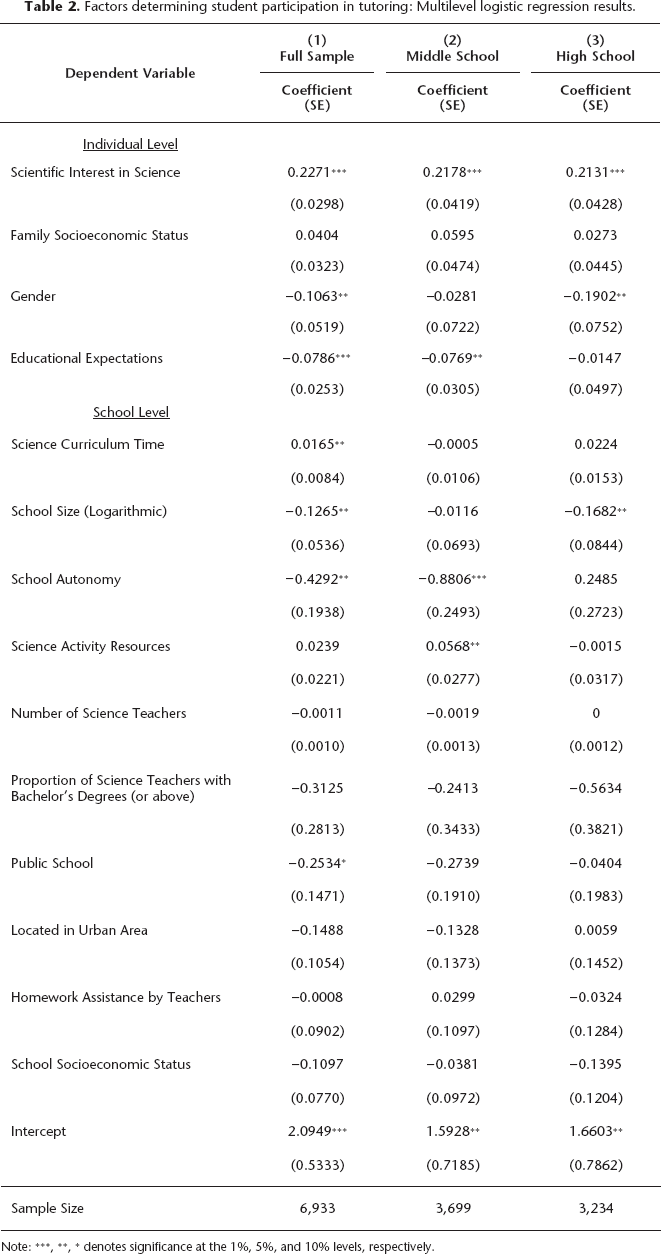
Factors determining student participation in tutoring: Multilevel logistic regression results.
Note: ***,**,* denotes significance at the 1%, 5%, and 10% levels, respectively.
Full Sample Analysis
According to the results in Table 2, the factors that significantly affect the private tutoring needs of middle school and high school students were selected for Coarsened Exact Matching. To some extent, the self-selection bias of the students participating in the tutoring was corrected. 8 After matching, there were 2,793 sample students from middle school, and 3,178 samples from high school. 9
Table 3 shows the HLM regression result of the matched samples from middle school and high school groups and students were weighted in regression according to the value that CEM matching has assigned to each sample. According to the variance analysis of the null model, inter-school variance contribute greatly to the composition of the total variance, 42.24% and 59.53% in the middle school level and high school level respectively, which is suitable for the introduction of multilevel linear regression models for analysis. The results of empirical analysis using standardized science literacy scores as dependent variables indicate that there is a significant negative correlation between middle school and high school students’ participation in private tutoring and their level of science literacy, but the degree of the effect varies slightly.
The effectiveness of tutoring: Multilevel logistic regression results.
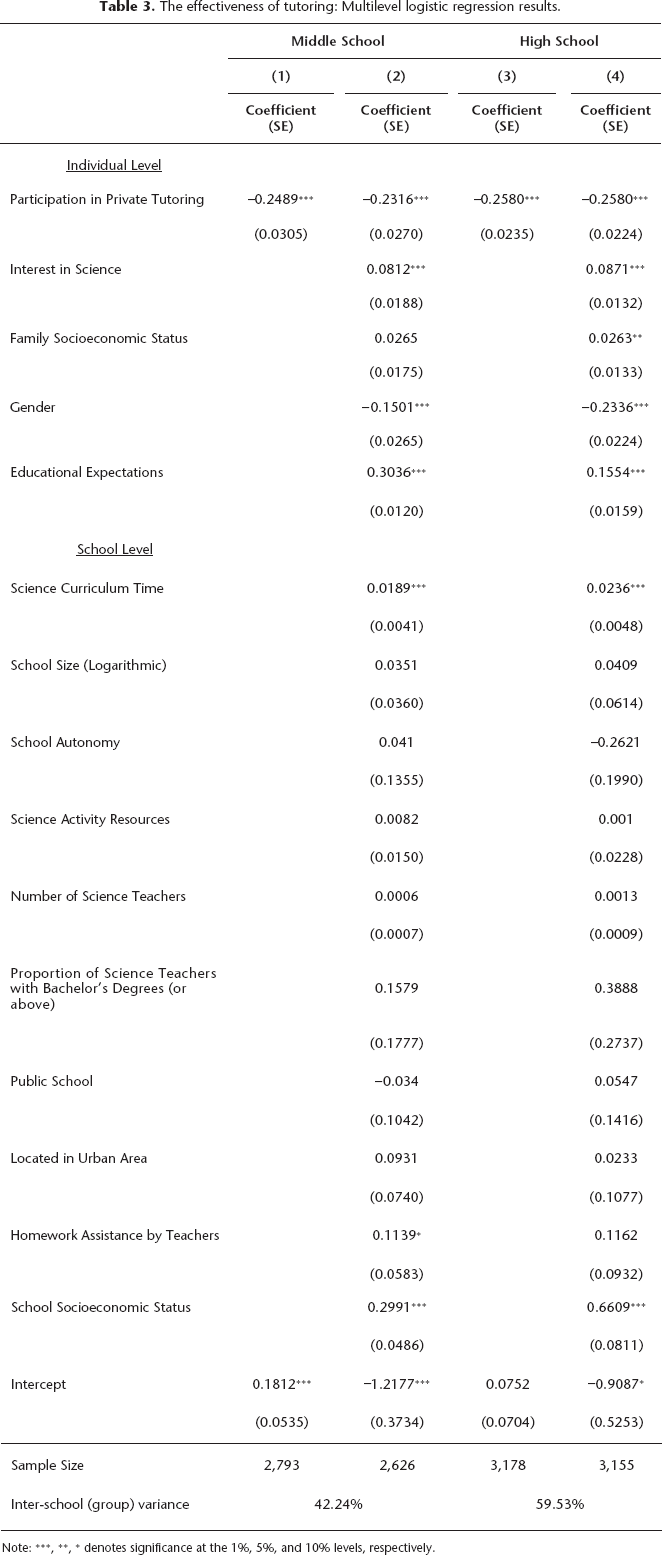
The effectiveness of tutoring: Multilevel logistic regression results.
Note: ***, **, * denotes significance at the 1%, 5%, and 10% levels, respectively.
For middle school, the science literacy scores of students participating in private tutoring were 0.2316 standard deviations lower than for those who did not participate. For high school, the gap was 0.258 standard deviations. This contrasts with the conclusion from PISA 2012 data that tutoring has a positive effect (Hu et al., 2015). The difference here is probably due to the fact that the PISA (2012) sample only covered students in the Shanghai area and is not universally representative. From this we can see that discussions of heterogeneity are especially necessary when the sample includes a wider range of regions and students. 10 In addition, it is worth noting that, unlike the effect of private tutoring, there is a significant positive correlation between in-school time devoted to the science curriculum and the level of scientific literacy.
The regression results for each group, where students were classified by the average science literacy scores are shown in Table 4. The results show that participation in private tutoring widens the overall scientific literacy gap among students from different socioeconomic backgrounds. However, at different grade levels, this effect varies among students with different levels of academic achievement. At the middle school stage, private tutoring significantly widens the gap between lower-performing students from different family backgrounds. At the high school stage, the varying impact of private tutoring among students from different family backgrounds is significantly reflected in the group with better grades. In general, students from socioeconomically advantaged family attain greater benefits from private tutoring.
The effectiveness of tutoring: Heterogeneity testing results.
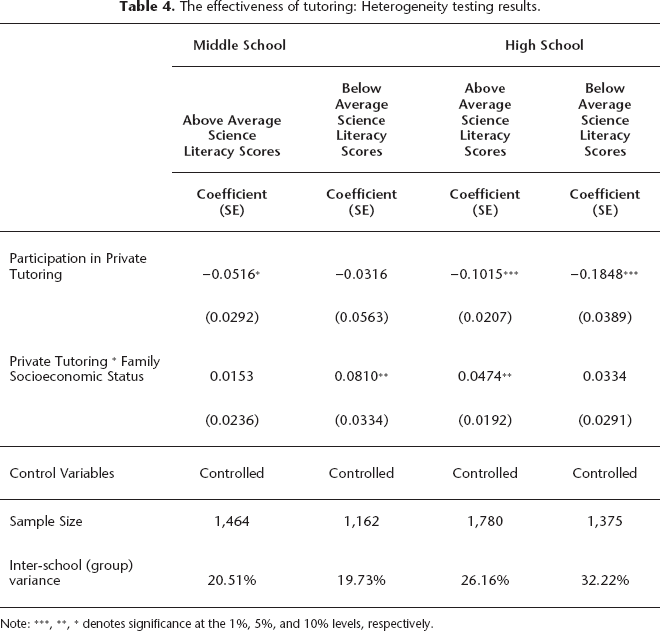
The effectiveness of tutoring: Heterogeneity testing results.
Note: ***, **, * denotes significance at the 1%, 5%, and 10% levels, respectively.
We used the original variable, the time spent on private tutoring, and the quadratic term of it to replace the dummy variable of participation in private tutoring for a robustness test. The results are shown in Table 5. There is also a significant negative correlation between private tutoring time and science literacy scores. At high school level, the relationship between tutoring time and science literacy scores is nonlinear. This indicates that our research results are stable.
The effectiveness of tutoring time: Results of robustness testing.
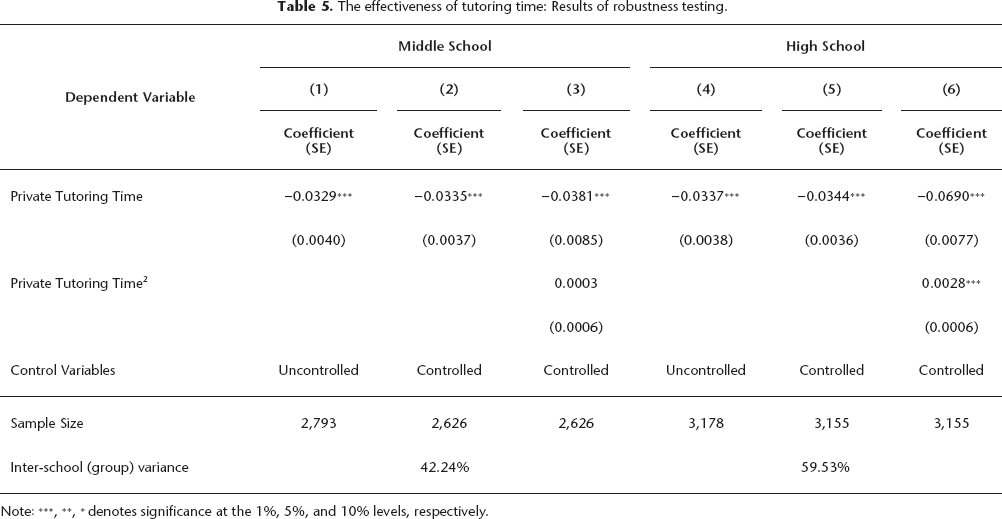
The effectiveness of tutoring time: Results of robustness testing.
Note: ***, **, * denotes significance at the 1 %, 5%, and 10% levels, respectively.
With the rapid increase in the participation in (and expenditures on) private tutoring in China, the development of a “shadow education” system has attracted widespread societal concern. This paper analyzed data from PISA (2015) in order to address the following three questions: (1) Do student and school traits affect student tutoring choices? (2) What is the overall effectiveness of private tutoring? and (3) Does the effectiveness of private tutoring differ among students?
Due to limitations in available data and research methods, prior research has not yet reached consensus on the above issues. We used the cross-regional and cross-grade-level data from PISA (2015) in China (including samples from Beijing, Shanghai, Jiangsu and Guangdong) to draw more general and representative conclusions. In addition, it should be pointed out that in this study, the science literacy level evaluated by the PISA test was used as the output variable to measure the effectiveness of private tutoring. This allowed us (1) to move beyond the limitations of previous similar studies that used school-level test scores as the output variable, and (2) to examine the relationship between private tutoring and student achievement from the perspective of overall subject-area literacy. We utilized a hierarchical linear regression model to analyze the influence of private tutoring on scientific literacy scores, and—taking into account the self-selection problem of tutoring participation—constructed a random quasi-experimental group by using the method of coarsened exact matching (CEM).
The main conclusions of our research are as follows:
First, the factors affecting middle school and high school student participation in scientific tutoring are different. At the individual level, a student's personal interest in science has a significant positive impact on the probability of his/her participation in scientific tutoring (at both the middle school and high school level); however, for middle school students, higher levels of educational expectations correlate to lower levels of tutoring participation. Additionally, the probability of high school girls participating in scientific tutoring is lower than that of boys. In previous studies, students’ personal academic interests were often neglected, but according to “self-determination theory”, intrinsic motivation is a major thrust for students to actively learn and achieve (Nugent et al., 2015; Ryan & Deci, 2009). Therefore, a student's personal interest in science will increase the probability of his or her participation in tutoring. Among the school-level variables, a major factor determining the participation rate of middle school students in tutoring is the degree of school autonomy. The degree of autonomy of a school includes freedom with respect to the selection of teaching materials, course content and student evaluation. Relaxing constraints on the content of classroom instruction encourages teachers to adopt a “student-centered” approach, which can improve classroom efficiency (Gunnarsson, Orazem, Sánchez, & Verdisco, 2009; OECD, 2016b), thereby reducing the need for tutoring among students.
Second, the participation of middle school and high school students in private tutoring has a significant negative correlation with their science literacy level. However, the degree of this effect varies. There was a larger disparity in the science literacy scores of high school students who participated in private tutoring versus those who did not. This paper used results from the PISA (2015) science test as the output variable, focusing on the relationship between student participation in private tutoring and overall science literacy levels (as measured on the basis of comprehensive science knowledge and critical thinking ability, which may not be emphasized in traditional testing). As a result, we reached different conclusions from many previous studies. This indicates that private tutoring may only help students learn the content of a particular exam, without having any significant effect on the improvement of their overall level of subject literacy. Currently, most examinations in China are still limited to testing the memorization of facts and figures from textbooks. The result is that most test-based tutoring is focused only on helping students improve their rote memorization skills. Reforming the content of examinations by designing them to evaluate students’ true problem-solving skills would result in private tutoring becoming more of a “second classroom” focused on improving students’ overall knowledge and skills—a development that would provide true benefit to students.
In addition, the PISA (2015) official report state, through international comparison, that compared with off-campus learning (such as private tutoring), in-school education is more effective in improving students’ academic literacy (OECD, 2016b). The results of our research show that (1) the overall literacy level of students participating in private tutoring is not particularly impressive, but (2) the more time students spend on science curriculum in the classroom, the higher their level of scientific literacy. This, on the other hand, illustrates one of the shortcomings of in-school education. Schools need to more fully and effectively utilize the time students spend in school and reduce unnecessary extracurricular burden, thereby allowing in-school education to play a leading role.
Third, private tutoring has widened the gap in overall science literacy levels among students from different socioeconomic backgrounds. Generally speaking, students from socioeconomically advantaged family experience better gains through private tutoring. However, the impact of this effect varies at different academic levels. At the middle school stage, private tutoring has significantly widened the gap between lower-performing students from different family backgrounds. Students from poorer families may have difficulty receiving effective guidance on the private tutoring options available to them through the market. Also, PISA is designed to evaluate overall science literacy, whereas poor-quality private tutoring may typically focuses more on the memorization of test-based facts and information. As a result, those tutoring can only “crowd out” students’ spare time, hindering the development of their creative thinking and true scientific literacy. However, for lower-performing students from families of higher socioeconomic backgrounds, private tutoring can be more effective. This shows that differences in teaching methods, content and overall quality of private tutoring can cause great differences in student development (Jones, 2015). In the compulsory education stage, the government can provide targeted, high-quality after-school supplementary programs to narrow the quality gap in students’ off-campus tutoring options that result from differences in family economic background. This will promote educational equity both inside and outside the classroom. In the high school stage, the diverging impact of private tutoring among students from different family backgrounds is mainly reflected in higher-achieving students. In other words, for high school students, enhancement-based tutoring is the primary form of off-campus education that contributes to the gap among students.
The main limitation of this paper is that because PISA (2015) data is cross-sectional in nature, we were unable to obtain information on the level of competence of students prior to their participation in private tutoring. Although we controlled for the individual and family characteristics of students, it is still possible that the omission of certain variables led to statistical inference errors. The mechanism driving the influences and effectiveness of private tutoring remains a subject for further exploration through qualitative investigation.
Funding
National Natural Science Foundation of China—“Family Capital, Shadow Education and Social Reproduction” Project (Project Approval Number: 71774112).
Footnotes
1
Middle school and high school students have different tutoring participation rates. There is also a significant difference in their test scores. In general, high school students have higher PISA test scores than their middle school counterparts. If middle school students have a higher tutoring participation rate (i.e., more middle school students with below-average scores are included in the sample of students participating in tutoring), the benefits of tutoring may be underestimated. If high school students have higher tutoring participation rates, the benefits of tutoring may be overestimated.
2
The sample size of students from other grades levels was too small to be able to properly account for the influence of grade level.
3
The question of “How many hours per week are spent on additional instruction in science” in the PISA questionnaire was converted into a dummy variable to gauge student participation in tutoring. Students who answered the question with “0” were deemed not to be participating in tutoring. The remaining students were deemed to be participating.
4
In the original questionnaire, educational expectations were divided into six categories according to the ISCED education level classification criteria. Based on the current situation in China, we divided educational expectations into five categories: middle school, middle-level vocational school, traditional high school, vocational college and traditional college/university. There was little difference between the results obtained using the original ordered categorical variables and the results obtained using the dummy variables, and we present the results obtained using the original variables.
5
The geographical location for each school was originally classified as follows: a village (with a population of less than 3,000 people), a small township (3,000 to 15,000 people), a town (15,000 to 100,000 people), a city (100,000 to 1,000,000 people), and a large city (more than 1 million people). In this study, we classified urban schools as those located in cities and large cities with a population of more than 100,000.
6
The fact that third-year middle school students’ weekly science curriculum time is greater than that of high school students may be due to curricular design. In the third year of middle school, students are offered all science courses (including physics, chemistry, biology and geography). First-year high school students are not offered biology courses. At the same time, the “high school” category also includes vocational high schools (which cannot be identified from the data). The average science curriculum time for the high school group likely appears lower due to the inclusion of vocational high schools.
7
The high school sample includes both ordinary high schools and vocational high schools, and it is impossible to identify and eliminate school types through school codes. Because vocational high school students generally do not participate in extracurricular tutoring, the sample may affect the analysis of the characteristics of ordinary high school schools, and our analysis of the impact mechanism here is tentative.
8
The L1 value of the overall imbalance of the variables was significantly decreased. The L1 value of the middle school group was decreased from 0.56 before matching to 0.21 after matching. The L1 value of the high school group was decreased from 0.31 before matching to 0.2 after matching.
9
After adding other control variables, samples with missing values were removed, leaving 2,626 students at the middle school level and 3,155 students at the high school level.
10
PISA (2012) only sampled the Shanghai area. All students were from a major city, resulting in sample bias. The PISA (2015) test covered students from cities and smaller towns.
Notes on Contributors
Xiangyi Liao, Graduate Student, China Institute for Education Finance Research, Peking University.
Xiaoting Huang, Associate Professor, China Institute for Education Finance Research, Peking University.