



Abstract
Purpose
The relationship between private tutoring (PT) and mainstream education is among the complex themes characterizing PT discourses in the literature. This study examined the complications of practices and processes in tutoring and schooling to elucidate different roles played by PT and its relationship with mainstream education.
Design/Approach/Methods
This study used qualitative data from a diverse set of 37 PT providers from the State of Maharashtra, India, to delineate their roles and explore their relationship with schooling in this context.
Findings
The classification of PT providers’ roles into complementary, accommodating, competing, and substitutive ones demonstrated a diverse range of relationships between PT and mainstream education. Further analysis showed that these relationships are dynamic in nature, and the boundaries between them are blurred.
Originality/Value
Research in the field of PT has been consistently pointing toward a perplexing mixture of positive and negative outcomes resulting from its relationship with mainstream education. This study transcended the positive vis-à-vis negative binary approach by contributing to the deeper understanding of PT relationships. Furthermore, it exemplified how future studies can disentangle the complexities of such relationships by deploying flexible, context-specific theoretical approaches.
Keywords
Introduction
Various terminologies and metaphors have been used to define the private tutoring (PT) phenomenon, such as shadow or parallel education, thus characterizing its close association with schooling (Zhang & Bray, 2019). As such, many researchers in the field of PT have sought to understand the ways in which PT implicates schooling, from which it originates. Supplementary tutoring would not have existed without mainstream education. However, PT is not unidirectional. Studies have shown that the practices and processes involved in PT implicate schooling in a complex feedback loop (Bray, Liu et al., 2019; Bray & Lykins, 2012; Dang & Rogers, 2008). The inextricability of these practices and processes happening concurrently during the academic year in schools and PT centers renders deciphering the complex relationships between tutoring and schooling challenging. One approach to address these challenges could be to obtain a close-up portrayal of PT practices and processes to acquire finer nuances on the phenomenon, whose broader contours have been outlined by the concerted efforts of PT researchers globally (e.g., Baker, 2020; Zhang & Bray, 2020).
This study illuminates the finer aspects of PT, thus both advancing existing knowledge in the field and highlighting the importance of PT as an integral part of education research. The study utilized qualitative data from a diverse set of 37 PT providers in the State of Maharashtra, India, to provide novel insights into their variegated roles. The theoretical approach deployed provides a heuristic tool to comprehend how these roles lead to different relationships with schooling. The systematic delineation of the relationships between tutoring and schooling, although specific to the study context, provides wider learning, as PT has been known to be a diverse and heterogeneous sector in most regions of the world.
Literature review and theoretical approach
Discourses on PT outcomes, a major theme in PT research, are rendered contentious owing mainly to the largely unregulated or underregulated spaces in which tutoring occurs (Aurini et al., 2013; Baker, 2020; Bray, 2009; Bray et al., 2013; Dang & Rogers, 2008; Zhang, 2021). The lack of stringent regulations allows a wide range of players to provide PT either from the comfort of their own or their tutees’ homes, from a mutually decided location, or in more formal commercial establishments. PT occurring in schools before or after their official hours has also been reported (e.g., Bray & Ventura, 2022). Another main PT feature is its informal provisioning, as opposed to schooling. Tutoring is essentially an informal activity in the sense that tutoring receivers (students and their families) can freely decide when to seek tutoring, what kind of tutor to select, for which subjects, what duration, and so on. Tutoring providers are also often free to make their own decisions regarding whether to provide tutoring and what kind of provisions to offer. While those operating in commercial setups may not have the same flexibility and freedom as residential tutors, the provision of tutoring is not formally binding. However, formal provision of schooling is compulsory and legally binding in almost all countries worldwide.
Despite this difference in the formal provision of schooling vis-à-vis the informal production and consumption of tutoring, the two modes are deeply and complexly interrelated. In terms of PT outcomes, these relationships influence (1) educational outcomes, (2) implications for mainstream education, and (3) implications for educational and social inequalities (Bray et al., 2015; Bray & Kwo, 2013; Bray, Liu et al., 2019; Zhang & Bray, 2020). Researchers have shown contention in each of these aspects. First, PT can lead to both educational benefits and drawbacks. Second, it can pose additional challenges to mainstream education, while eliminating some of the existing ones. Third, PT can be leveraged to mitigate educational and social inequalities but can also exacerbate these inequalities. Consequently, it becomes imperative to comprehend the disagreements regarding these outcomes, as indicated in the PT literature.
Aside from such contentions and contradictions, what can arguably be summarized from the current body of conceptual and empirical scholarship is that the aspects of student characteristics, schools, and PT have to be conducive for PT to be able to produce positive outcomes. In other words, a reasonable understanding of the conditions under which PT can produce positive outcomes for students, as well as the larger ecosystem they are part of, is a non-negotiable pre-requisite for minimizing or evading potential negative outcomes. However, the relationships between the students, their schooling, and tutoring are enmeshed; disentanglement is not a straightforward task. Such efforts require specific, insightful approaches that will help tease out the linkages and simultaneously provide the leeway to transcend binaries and dichotomies often associated with PT.
Among the various sets of actors involved in the PT domain, more clarity regarding the nature and roles of tutors is required for a holistic understanding of the relationship between schooling and tutoring. Therefore, with a central focus on the roles and relationships of PT providers, the research questions (in the context of Maharashtra) include:
What are the variegated roles played by the PT providers? Based on these roles, what are the relationships between tutoring and schooling? What are the implications of these relationships for the schooling–tutoring ecosystem?
Despite the linear framing of the above questions, answering them requires a flexible analytical approach to identify the relationships between tutoring and schooling in a nuanced manner.
Theoretical lens: Interaction between formal and informal institutions
This study approached the relationship between schooling and tutoring as one between formal and informal institutions. Considering schooling as a formal provisioning of education is straightforward; however, the same cannot be said about the informal nature of PT. As PT is becoming more widely accepted, the PT sector is becoming more organized (Baker, 2020; Bray, 2017; Zhang & Bray, 2020). Concomitantly, it may be argued that calling it informal may not be appropriate. However, tutoring is informally provided by tutors or tutoring companies and is voluntarily sought out by students and parents. Even if tutoring companies are legally registered, neither providing nor receiving tutoring is a formal requirement decreed by the state. As such, this study considers PT as informal vis-à-vis the formal schooling provision.
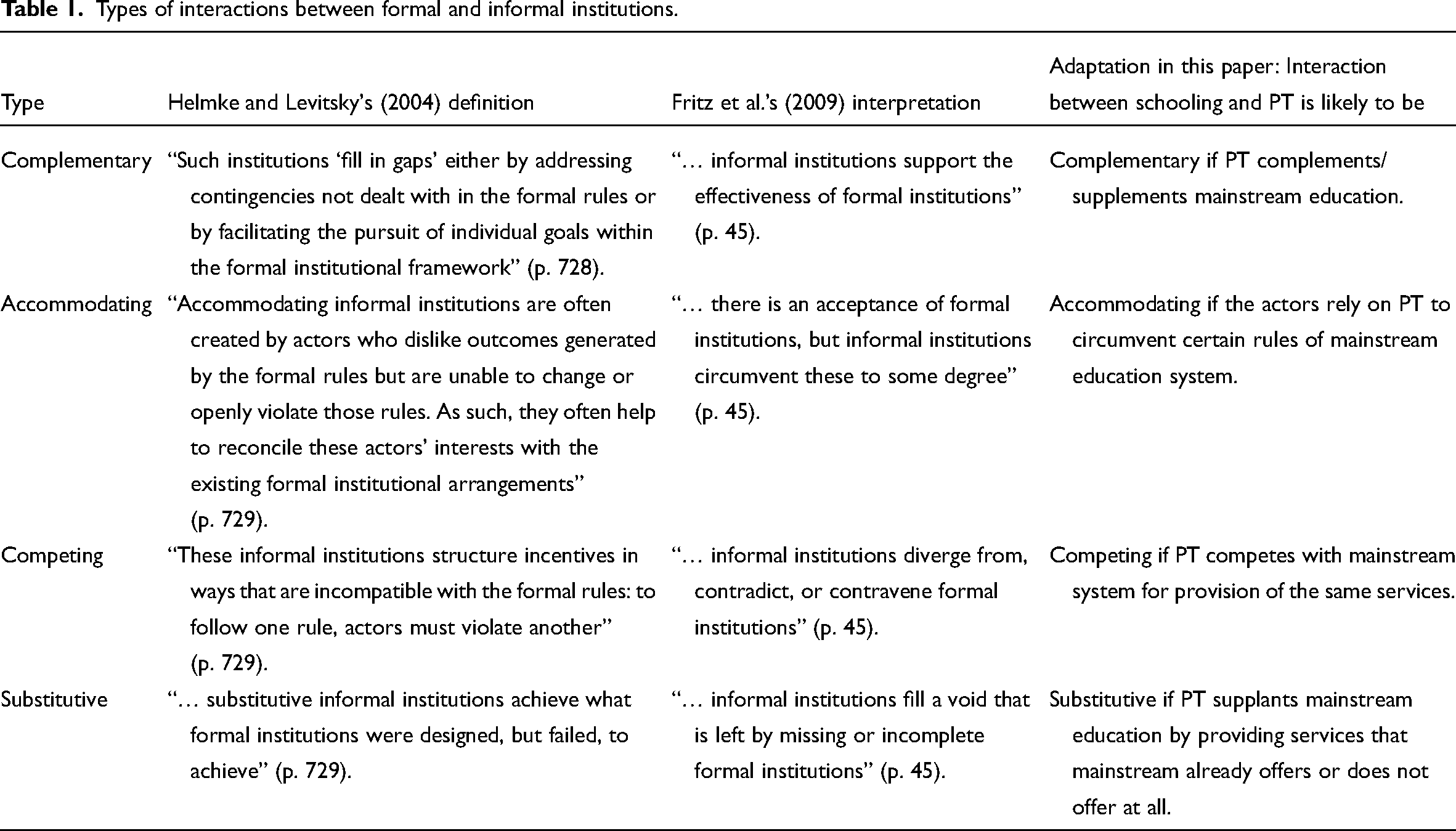
Helmke and Levitsky (2004) developed a framework for comparing formal and informal political institutions; informal institutions being those “created, communicated, and enforced outside of officially sanctioned channels” (p. 725). This framework comprises four types of formal–informal interactions: complementary, accommodating, competing, and substitutive. This typology has been employed in sociological and political economy studies (e.g., Balkaran, 2017; Estrin & Prevezer, 2011; Jütting et al., 2007; Mthanti & Ojah, 2016) to explore various kinds of interactions and correlations. Further, an adaptation of this framework by Fritz et al. (2009) provides more flexibility and dexterity for examining and exploring interrelationships in a broader definition of institutions. As per this adaptation, the framework transcends Helmke and Levitsky's (2004) original usage of North's (1990, p. 3) definition of institutions as “humanly devised constraints that shape human interaction . . . whether political, social, or economic,” or simply put, “the rules of the game in a society.” Fritz et al.'s (2009) framework encompasses a broader range of institutions that include (1) behavioral practices, processual aspects, and institutional outcomes and (2) organizations and actors involved in the organizations (Jütting et al., 2007, p. 44). Such broader definitions of institutions have been insightful for studying practices and processes in sectors that operate either as part of or in parallel with larger, formally institutionalized systems (Sen, 2007 1 ; van der Merwe, 2007 2 ).
Extending Fritz et al.'s (2009) interpretations to the formal and informal spheres of education, this study adapts their framework to explore the relationships between schooling and PT. The framework helps understand how PT can be complementary, accommodating, competing, and substitutive in relation to schooling (Table 1).
Types of interactions between formal and informal institutions.
This framework enables a micro-understanding of the roles and responsibilities of PT providers in specific contexts. It also facilitates nuanced insights into their relationships with different actors in schooling.
Methodology
The exploratory nature of the research questions and the overall goal of delineating the relationship between PT and schooling called for a qualitative research design (Creswell & Poth, 2018; Neuman, 2006). The qualitative inquiry included a case study of a community in the State of Maharashtra, India. Maharashtra has a long history of PT and has witnessed a rapid growth of a wide range of both home and commercial PT (Kale, 1970; Shinde, 2009; Tembhekar & Borwankar, 2015). Careful deliberations on selecting a place that would yield rich data for achieving an optimal understanding of the case led to zeroing in on an urban community in the city of Ambernath in Thane District. A case study in this community with a large and culturally diverse lower- and middle-class population enabled the observation of various manifestations of the PT phenomenon and the collection of data from a wide set of actors in the schooling–tutoring ecosystem.
The findings discussed and analyzed in this paper are mainly drawn from a diverse set of 37 PT providers and are part of a larger study comprising 166 multiple stakeholders: PT providers, school heads, teachers, parents, students, government officials, and other key participants. The categories of these stakeholders are listed in Table 2. Semi-structured and unstructured interviews, focus group discussions, and lesson observations at both PT centers and schools were the dominant methods of data collection. The tool for lesson observation was developed from the one used by other researchers for observing Indian classroom situations (Bhattacharjea et al., 2011; Sankar & Linden, 2014). Within the broad categories of “classroom environment, teacher attitude, teaching methods, and student activities” (Bhattacharjea et al., 2011, p. 5), minute details of the teaching–learning process were recorded. In addition, other aspects such as infrastructural provisions, classroom layouts, seating arrangements, pedagogical approaches, and student behaviors were also noted. The recorded details helped juxtapose clearly the school classroom observations with those in PT centers. Ethical procedural documents were prepared and the necessary approval was obtained from the review committee of the university where this research was conducted. All approval procedures were followed during field work, and written informed consent was obtained from all the participants.
Total number of participants in the larger study.
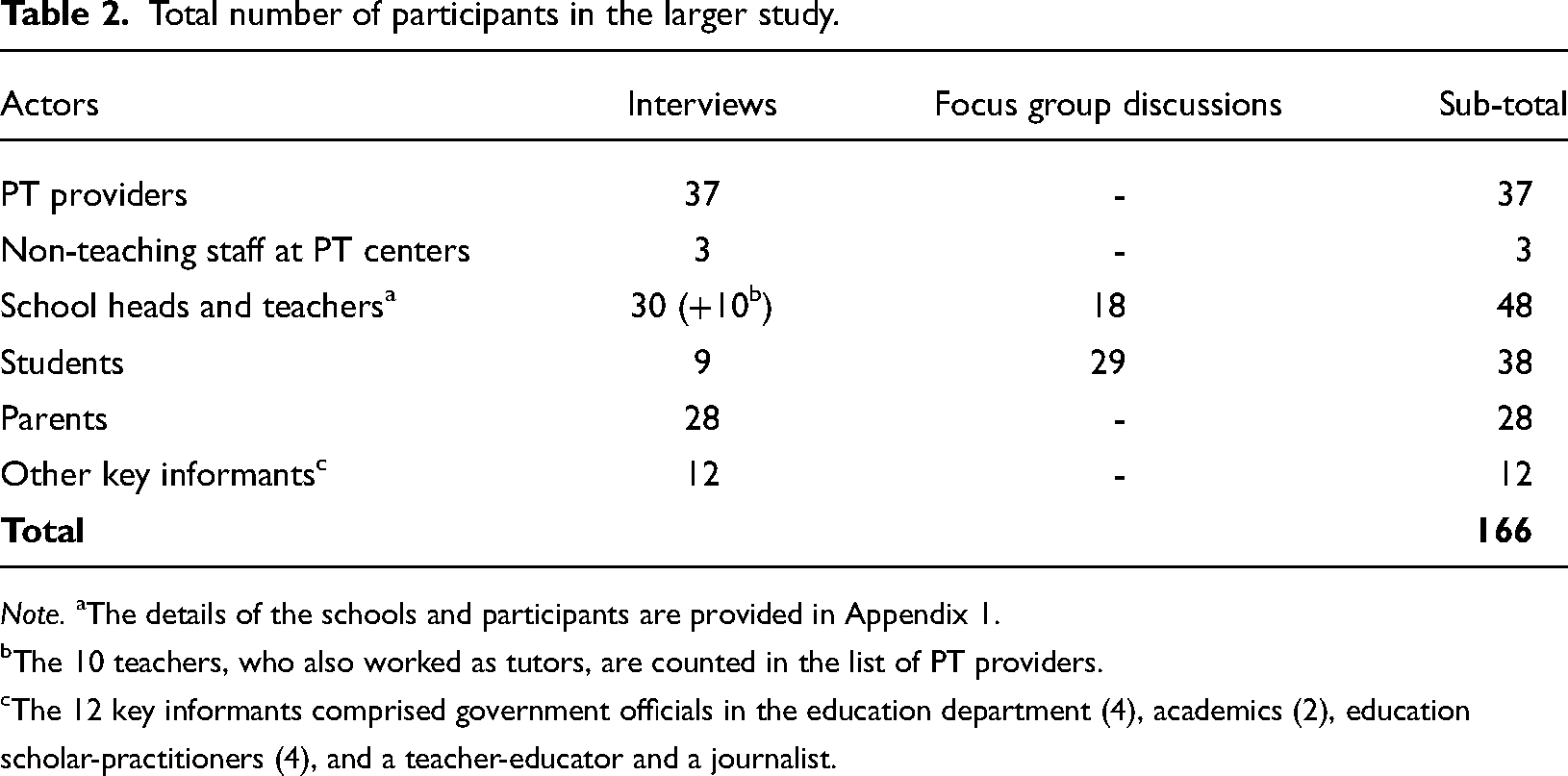
Note. aThe details of the schools and participants are provided in Appendix 1.
The 10 teachers, who also worked as tutors, are counted in the list of PT providers.
The 12 key informants comprised government officials in the education department (4), academics (2), education scholar-practitioners (4), and a teacher-educator and a journalist.
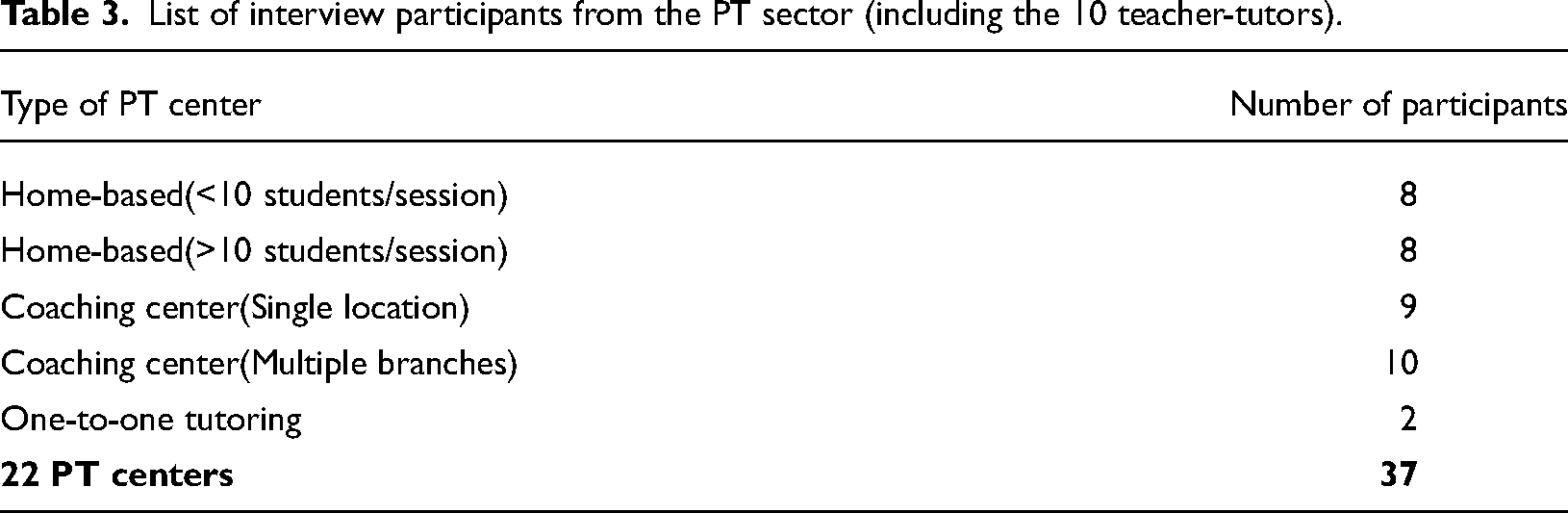
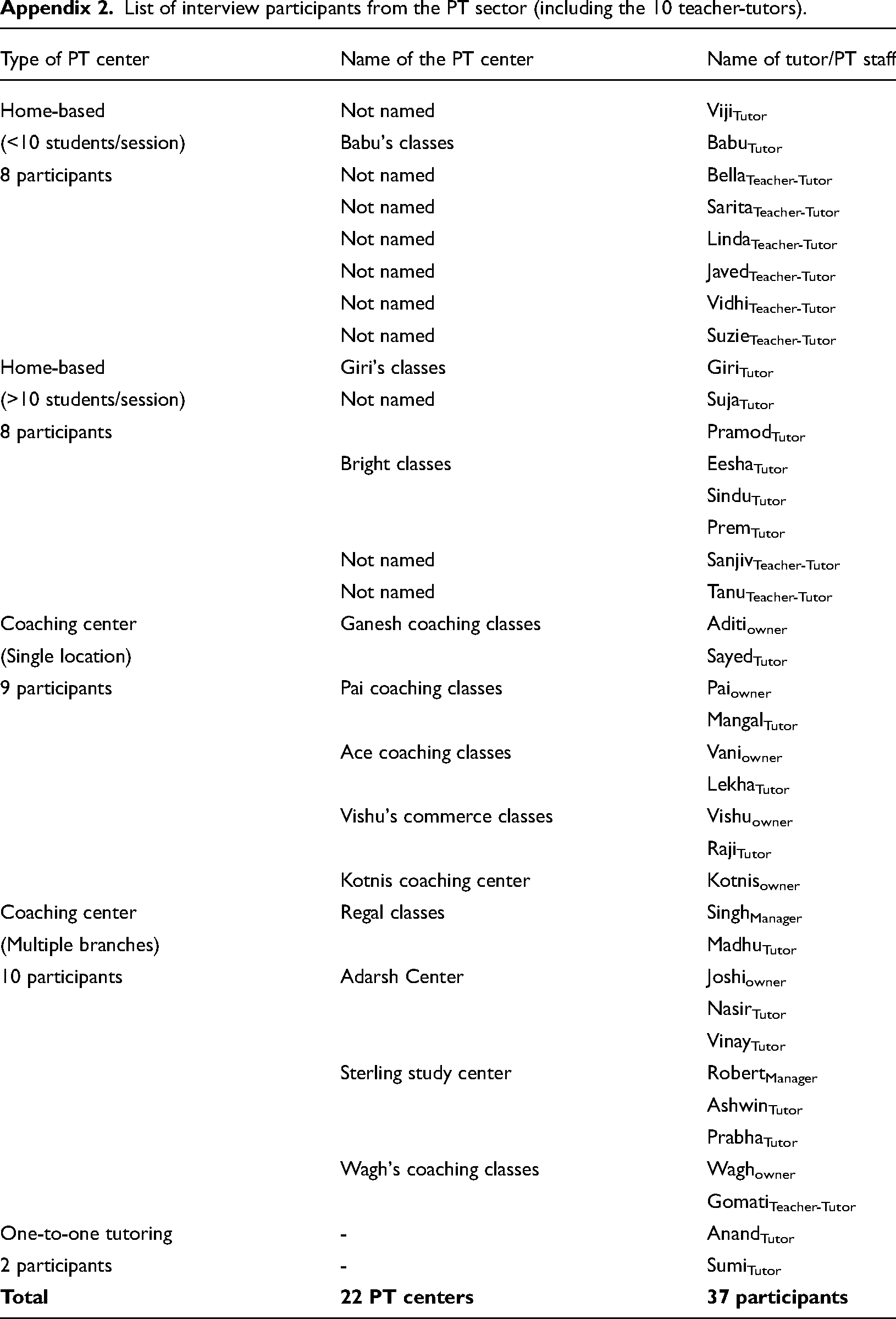
The sample of PT centers was selected after an initial exploration of the types of tutoring prevalent in the research site. This exploration, involving informal discussions with parents, teachers, and tutoring providers, showed that school students received face-to-face tutoring. Online tutoring was only received by those in tertiary education at the time of fieldwork. As a study probing relationships between schooling and tutoring, the sample therefore comprised an eclectic mix of residential tutoring centers (common among primary students) and coaching classes, the common parlance for commercial classroom-type tutoring centers (common among secondary and higher secondary students). Two tutors, who provided more expensive one-to-one tutoring, were also selected. Coaching classes were specifically selected to represent maximum variation in terms of their location, size, school years they catered to, and the subjects in which they specialized. Within the category of home tutoring centers, both smaller centers with fewer than 10 students per session and slightly bigger centers with 11 to 20 students per session were selected. The total number of tutoring participants is summarized in Table 3 and a more detailed list is provided in Appendix 2.
List of interview participants from the PT sector (including the 10 teacher-tutors).
Primary data from interviews, focus group discussions, and observations were supplemented with secondary data from documents, such as school syllabi handbooks, textbooks, workbooks, examination papers, and tutoring centers’ revision guides, notes, and booklets. Content analysis of these documents aided the process of inquiry and data triangulation (Bowen, 2009). More specifically, these sources aided in answering the research questions on the variegated roles of PT providers within the schooling–tutoring ecosystem. They added depth to the semi-structured interviews, facilitating the process of probing deeper when the participants referred to curricular minutiae. Prior knowledge of the curricular contents and examination questions added more meaning and depth to the lesson observations in the school classrooms and tutoring sessions. Overall, the primary data and documentary research together helped in drawing out the relationalities required for exploring the education ecosystem comprising actors from formal schooling and informal PT.
Findings and discussion
The complementary, accommodating, competing, and substitutive roles of PT, as per the adaptation of the framework presented in Table 1, form the basis of the discussion.
Complementary
The teacher is the pivot around the pedagogical process of students in schools and, therefore, plays a crucial role in school classrooms. While there is no single concept surrounding the role of a teacher within the diverse context of India, Kumar's (2005, pp. 73–95) articulation of the Indian teacher as a “meek dictator” encapsulates the teacher's tokenistic dominant role in the classroom vis-à-vis the largely restrictive, subservient role within the overall education system. In the classroom, the centrality of curriculum, textbooks, and examinations leave teachers with little power to decide what, how, and when to teach, and in what language. Measures to improve the job accountability of teachers have further led to “bureaucratic control of teachers’ work” with further reduction in the little autonomy that existed in the first place (Sarangapani, 2020, p. 3; Sayed et al., 2020). Since the establishment of the Unified District Information System for Education (UDISE 3 ), teachers have had to constantly and consistently maintain records for the government's education database. Overall, teachers’ abilities have been reported to be evaluated quantitatively, such as by the regularity of attendance, number of days taken to finish the curriculum and complete the necessary paperwork for maintaining records, in-service training sessions attended, and students’ marks on internal and board exams (Nawani, 2017; Ramachandran et al., 2005).
Several teacher participants interviewed for this study indicated that they were often judged by students, parents, the authorities within the school, and the wider system based on how well they adhered to the prescriptive textbooks, which play the most crucial role as “structuring device[s]” during the teaching–learning processes (Kumar, 2009, p. 25). Whether we completed every lesson in the textbook on time and whether we solved the questions and exercises at the end of each section or lesson—these are what we are judged by. It is not just being simply judged, but scrutinized minutely. Where we stand in terms of textbook completion is what forms several discussions on parents’ WhatsApp groups (Interview with the teacher). With the huge amount of paperwork that education officials demand from my teachers— every other day there is a requirement notification sent out to us—my teachers cannot play their role as teachers properly. They somehow manage to finish the textbook chapter, but they do not have time to complete all the exercises at the end of the chapter. They have to move on to the next chapter (Interview with the school head).
Against the restrictive backdrop of schoolteachers, who have very little autonomy to plan and conduct their teaching–learning processes, are PT providers operating in a largely unregulated, uncontrolled space in either their or students’ homes or in a commercial setup that they themselves or a tutoring company established. This provided them the freedom and flexibility to cater to the demands of the system, which emphasized working on and practicing end-of-chapter exercises. Thirty-six out of the 37 sampled tutors placed emphasis on solving these exercises, allotting much of their tutoring time toward it. Again, there were variations among the sampled tutors in terms of the questions practiced. These depended on various factors pertaining to the type and size of the PT center, tutors’ educational profile and background, and student characteristics. Depending on these factors, one or more of the following was attempted during the tutoring sessions:
More end-of-the-chapter exercises than the school HOTS (high-order thinking skills) questions in textbooks Doing the exercises in workbooks Topic-wise question sets
In the coaching centers, especially those in the medium- and high-priced ranges, the tutors minutely analyzed the texts and tended to look at every line in the textbook as a potential question in the exam. They often implored students to do the same to ensure that they scored full marks.
The role of PT providers, whereby they helped students take their learning to the next level in terms of their curricular activities at the school, could be considered as complementing the mainstream education system, in which teachers were under various constraints to deliver their lessons to the students. Such a role of PT could be considered resulting in a complementary relationship with schooling.
Accommodating
One of the features having a direct bearing on what educational activities students spend their time during school in is the purported objective of education. The aims of education stated in Indian official documents, in accordance with global norms, are along humanistic, economic, and political lines (National Curriculum Frameworks, 2005; Sadgopal, 2005). They are both intrinsic and instrumental. Personal growth, national development, citizenship building, social cohesion, adherence to constitutional principles, and international cooperation form some but not all these objectives (Mehendale, 2017). The states develop their curricular frameworks based on the national framework, thus closely aligning with these objectives.
In line with broader objectives, schools arrange for various extra-curricular activities. Within the sample of 13 schools in this study, the interviewed school heads reported that they had to make provisions to celebrate various Indian festivals; organize field trips; plan sports days, annual functions, and other competitions (elocution, quiz, debate, drawing, music, etc.) during the academic year. Furthermore, the educational objectives are linked to imparting education in subjects such as arts and crafts, music, and physical education. Interviews with school heads, teachers, parents, and PT providers portrayed the inferior status of these subjects, which were not considered in the same league as subjects like English, Hindi, Mathematics, Science, and Social Sciences. Regular tests and examinations were conducted for the latter set of subjects, and the grades were deemed important for admission into higher secondary and tertiary education courses. However, students were not regularly tested on the former set of subjects. Even if examinations are conducted, grades are not considered to be of any significant importance in the overall system (Durrani & Nawani, 2020; Kumar 2009). Nevertheless, schools had to plan and execute their timetables considering all the subjects and extra-curricular activities.
The interviewed teachers lamented this paradox. On the one hand, the educational system expected them to give due importance to subjects and activities necessary for holistic, all-round development of students. On the other hand, the same system was centered around the examination scores of certain specific subjects. The teachers stated that students who scored well on these exams reaped benefits in terms of their future opportunities, and not those who placed equal emphasis on subjects and activities deemed necessary for developing as well-rounded citizens. A corollary of this statement was that the overall system did not motivate students to give importance to all subjects and activities. Instead, those who focused their time and energy on certain subjects were likely to do well in exams despite not necessarily adhering to all the stipulated curricular and extra-curricular requirements. In this scenario, PT came across as accommodating the needs of students desiring to focus on certain subjects, thus providing them with an avenue for circumventing the stipulations. As stated by the owner of a coaching center: Parents cannot tell schools to not teach subjects like Drawing or Physical Education, or to stop spending time on extra-curricular activities. We provide the space and chance to focus all their time outside school on specific subjects. In fact, we do even better. Not only are our activities more in line with what the larger system rewards, but also what parents and students demand. We provide an avenue for compensating for the time students lose in schools—away from the subjects and topics they should be devoting all their time to.
The sampled parents concurred with such opinions of actors from schools and PT centers. In the words of a parent with one child in primary and another in secondary school, Even in the primary years, my husband and I feel that schools need to spend more time on subjects that have a direct bearing on our children's futures. However, we understand that there is only so much that schools can do to pander to our needs. Thankfully, we have tutoring centers. Those who really care about their children's futures get tutoring.
Considering the broader aims of education, schools had to give due importance to activities other than precisely academic ones. PT providers, unlike their counterparts in the mainstream system, came across as focusing all their attention on academics and scoring well. In this sense, PT could be seen as playing an accommodating role by allowing students and parents to circumvent some of the rules and regulations of the formal institutions and instead be more suited and obliging to their needs. More specifically, PT provided families with the means to leverage the instrumentality of the education system in paving their children's future tertiary education and career trajectory. Concomitantly, the relationship between PT and schooling could be considered accommodating, as PT provided the avenue for incorporating what was perceived to be a constraint for schooling.
Competing
In an education system where assessments and examinations form the central focus of the entire teaching–learning process, teachers teaching for tests and students learning for the same often end up being considered the most important activity in the classroom and beyond (Kumar, 2005, 2009; Majumdar & Mooij, 2015; Nawani, 2015, 2017). Amidst such a scenario, while the broader educational aims and values are relegated to a secondary position (as shown in the above section), the delivery of the curriculum in a manner that enables students to score effectively on tests and examinations becomes the yardstick for judging the teaching–learning process. In this sense, PT centers compete with schooling as deliverers of the same curriculum prescribed by the authorities.
Lesson observations in both primary and secondary sections in the sampled schools showed that all the teachers were striving to complete the curriculum by traversing through the textbook in a linear manner—both chapter-wise and within the chapter. They would start at the first paragraph of any chapter and proceed to the next until they reached the end of the chapter. While they would spend some time solving questions at the end of the chapter, many teachers would hurry to the next chapter. Statements such as those below were noted during the observation sessions. Let us return to these questions before the tests. For now, this chapter is complete. We do not have more time to spend on this chapter. We will not be able to finish the curriculum otherwise. You can work through the rest of the questions at home. In the next lesson, we shall start a new chapter.
While activities in both schools and PT centers fundamentally focused on the delivery of the state-prescribed curriculum, the differing practices and processes could be seen as PT playing a competing role. The techniques used by PT to deliver the same curriculum as schools, although specifically with the intention of providing students with a competitive edge, could be said to be giving competition to schools themselves. In the light of this argument, the role of PT could be considered to result in a competing relationship with schooling.
Substitutive
While tests and exams in general have become the central focus of the Indian education system, when it comes to the government-organized Year 10 and 12 board examinations, the level of concentrated attention from the stakeholders is of the highest order. Board examinations, ostensibly developed as an unprejudiced and fair system for merit measurement, both create and restrict the chances for students to maintain or move up the socioeconomic ladder (Majumdar & Mooij, 2015; Nawani, 2017). This linkage between the board examination system and one's life opportunities has led to a sense of heightened anxiety and fear among students and families (Kumar, 2009; Nawani, 2015, 2017).
The general conception of secondary and higher secondary education was that the mainstream system was “inadequate,” “dysfunctional,” and “not equipped enough” (interviews with students and parents) to cater to the needs of the students. Drawing on experiences both as a teacher and tutor, a PT provider who taught in a school and simultaneously ran their own PT center commented: I have been teaching Year 11 and 12 students for 5 years now. I believe that most schools have been rather ill-equipped to handle teaching in these important years. The futures of children depend on these years. I do not blame students for having stopped coming to school, and instead preferred studying in coaching classes. It is obvious why every higher secondary science student goes for coaching. What they obtain from coaching classes in terms of developing a thorough understanding of the subject matter and exam preparation cannot be matched by their school. So why go to schools?
Another point reported by the same research, and further substantiated by the participants in this study, is how the curricular misalignment resulting from a system of centralized entrance tests was another reason for the supplantation of schooling by tutoring. Prior to the introduction of nationwide centralized entrance tests, admissions for most higher education institutions were held at the state level. Over recent decades, states have been legally mandated to follow the centralized system of admission to engineering and medical colleges. The state-board higher secondary institutions deliver only the state-board curriculum, compelling students appearing for centralized tests to study on their own. Students’ and families’ perceptions regarding the higher difficulty level and the high stakes of these examinations seemed to have led them to choose PT over schools. I resisted the pressure to join tutoring until Year 10, even when my parents pressurized me to join coaching classes for Year 10 board examinations. However, I was forced to join coaching classes in Year 11. At school, they follow the state board curriculum. How will I pass the engineering entrance test (JEE)? In the coaching class, I studied for both my Year 12 board exams and JEE. There is no need for me to attend school anymore. (Interview with a Year 11 student)
Actually, one can pass the Year 12 state-board exams without tutoring. However, these marks are not so important for one's college admissions. Medical entrance test (NEET) is based on the central board, which is harder. You cannot pass without coaching, and we have no time to attend both. (Interview with a Year 12 student)
Furthermore, PT centers also seemed to provide guidance and counseling for students during their transitional years. Interviews and focus group discussions with students showed that the tutors at their coaching centers helped them with the choice of subjects and thus decide their future courses. Some of these students, stating the experience of their older siblings, reported that the PT centers also helped them with their university applications, both in terms of shortlisting the colleges and courses and also strategizing the entire application process. Students desiring to study abroad were directed to global consultants for further guidance on eligibility requirements and application procedures.
While provision of the same services as schools could be seen in PT's competing role, doing it in a more focused and targeted manner seems to have resulted in PT's substitutive role. It also seems that two other factors bolster this substitutive role. First, schools came across as being weakly equipped to adapt to policy changes regarding centralized entrance tests. However, the PT sector seems to have been quicker in adapting to such changes and, accordingly, offer the services required by students and their families. Second, PT catered to the transitional needs of secondary and higher secondary students in a more holistic manner by providing all necessary services as a complete package. Where they did not have the capacity, they seemed to have the necessary networks to direct students further. Such roles of PT, where students choose PT over schooling, could be said to result in its substitutive relationship with schooling.
Thus, delineating the roles of PT and the resulting relationships between tutoring and schooling into complementary, accommodating, competing, and substitutive ones has offered nuanced insights into the complexities of the relationships between schooling and tutoring. While the current body of PT literature consistently cautions against treating schooling and tutoring as mutually exclusive phenomena (e.g., Bray, 2009, 2021a; Bray, Kobakhidze et al., 2019; Győri & Bray, 2021), this section has illuminated some ways in which the relationships between the two depend on and implicate one another in a non-linear, cyclic manner.
Conclusion
The relationship between schooling and tutoring is likely to evolve further and pose more complexities, as PT itself has been established as a phenomenon whose scale and nature change rapidly (Zhang & Bray, 2020). While PT continues to intensify in regions where it has already existed and emerges in places where its existence was not previously reported (e.g., Baker, 2020; Bray, 2021b), it also comes across as relatively faster in responding to the need of the times. During the coronavirus pandemic, PT was reported to be faster in digitalizing than mainstream education (Zhang & Bray, 2020). Such advances are likely to further complicate the relationship and dependency between schooling and tutoring.
Furthermore, as seen in this study, the boundaries between the four categories of relationships themselves are blurred. The existence of one type of relationship does not rule out the simultaneous existence of another type. For example, PT's accommodating role provided students and parents the leeway to concentrate on specific subjects and topics. This role overlaps with PT's competing role in offering services that fall within the purview of the mainstream schooling system. Another example is the overlap of competing and substitutive roles. While providing the same services results in a competing relationship, PT seems to be supplanting schooling by offering it in a more palatable manner, solely from the examination point of view. This is particularly the case in the secondary years when students sit for high-stake examinations. Similarly, PT and schooling can be complementary, while simultaneously competing with and substituting one another. The non-static nature of relationships adds another layer to these multilayered, multidimensional complexities. The relationships themselves, at any point in time, depend on various dynamics, such as student characteristics, features of schooling, features of PT, and the overall social, cultural, economic, and political environment (both regional and global) that embeds the education ecosystem.
Notwithstanding such dependency, a critical examination of the relationship between schooling and tutoring also provides a vantage point for looking at mainstream education and some of the challenges therein. In the context of this study, the complementary relationship points to the need for teacher autonomy and empowerment. The accommodating relationship shows how the education system needs more alignment between its intrinsic and instrumental objectives so that students and families do not select one over the other. Competing and substitutive relationships indicate the perils of a prescriptive curriculum centered around examinations. Overall, despite the various roles of PT, one commonality can be noted. Several PT practices and processes have been observed to be incongruous and counterproductive to developments in the mainstream education system. Any attempts by the mainstream system to advance schools toward progressive pedagogies and provision of a broader, more holistic education to children could be partially or completely thwarted if PT places a constant countervailing force on schooling. However, this demands further research on the political economy of the contemporaneous education landscape to illuminate how underlying political economic forces could influence educational imagination, potentially leading to such transformations.
Equally important to note here is that the framework adapted for the analysis helped identify the four relationships between tutoring and schooling. These relationships may not be restricted to the four identified in this study. However, the framework has provided a more comprehensive, non-binary approach for exploring the tutoring–schooling relationships in an objective manner without advantaging one over the other. It has also shown the significance of a flexible theoretical approach, specifically adapted and reframed considering both the context and the research problem.
Elaborating more on the context, even though the findings are empirically grounded in the State of Maharashtra, they are embedded within the larger, centralized mainstream schooling system of India and the prevalent PT phenomenon across the country (National Sample Survey Office, 2016, 2020). The findings were analyzed against the backdrop of this schooling and tutoring landscape. Therefore, the issues highlighted in this study have broader interpretive relevance for PT in India. More specifically, the complexities of the relationship between schooling and tutoring have begun to acquire scholarly attention. One example is that of a study, conducted in Dehradun city of the State of Uttarakhand, of PT among students in private schools. Scholarly publications from this study highlighting PT's role in providing additional educational support and concentrated test preparations (Gupta, 2022a, 2022b) indicate that the roles and relationships critically delineated in this study could be the norm rather than the exception in many parts of India.
With increasing mapping of PT across regions such as Africa, Europe, and South America (Bray, 2021a, 2021b; Byun et al., 2018), the importance of understanding the micro-aspects of PT has acquired greater global significance. As shown in this study, utilizing approaches that analyze relationships between schooling and PT could shed light on the characteristics of PT specific to the schooling context of which PT is a part. Furthermore, with PT being recognized as an important stakeholder within the non-state actors in the education ecosystem (UNESCO, 2021), future studies focusing on relationships with other stakeholders (both state and non-state) of this ecosystem become pertinent and urgent. Such studies could be insightful in exploring further which relationships can be leveraged to overcome educational challenges and which ones can potentially pose additional challenges in achieving goals of educational quality and equity. Exploration and analyses of the micro-processes between schooling and tutoring could be one step toward this research objective.
Footnotes
Declaration of conflicting interests
The author declared no potential conflicts of interest with respect to the research, authorship, and/or publication of this article.
Ethical statement
Before the start of the study, appropriate ethical documents were submitted, and approval was obtained from the University College London, as per the UCL Research Ethics Review Process. The details are as follows: UCL Data Protection Registration Number: Z6364106/2018/04/165. Date issued: 30/4/2018. Accordingly, all the prescribed ethical procedures were followed during fieldwork and the entire research process, which included obtaining written informed consent from all the participants.
Funding
The author received no financial support for the research, authorship, and/or publication of this article.

Notes
List of interview participants from the PT sector (including the 10 teacher-tutors).
| Type of PT center | Name of the PT center | Name of tutor/PT staff |
|---|---|---|
| Home-based (<10 students/session) 8 participants |
Not named | VijiTutor |
| Babu's classes | BabuTutor | |
| Not named | BellaTeacher-Tutor | |
| Not named | SaritaTeacher-Tutor | |
| Not named | LindaTeacher-Tutor | |
| Not named | JavedTeacher-Tutor | |
| Not named | VidhiTeacher-Tutor | |
| Not named | SuzieTeacher-Tutor | |
| Home-based (>10 students/session) 8 participants |
Giri's classes | GiriTutor |
| Not named | SujaTutor | |
| PramodTutor | ||
| Bright classes | EeshaTutor | |
| SinduTutor | ||
| PremTutor | ||
| Not named | SanjivTeacher-Tutor | |
| Not named | TanuTeacher-Tutor | |
| Coaching center (Single location) 9 participants |
Ganesh coaching classes | Aditiowner |
| SayedTutor | ||
| Pai coaching classes | Paiowner | |
| MangalTutor | ||
| Ace coaching classes | Vaniowner | |
| LekhaTutor | ||
| Vishu's commerce classes | Vishuowner | |
| RajiTutor | ||
| Kotnis coaching center | Kotnisowner | |
| Coaching center (Multiple branches) 10 participants |
Regal classes | SinghManager |
| MadhuTutor | ||
| Adarsh Center | Joshiowner | |
| NasirTutor | ||
| VinayTutor | ||
| Sterling study center | RobertManager | |
| AshwinTutor | ||
| PrabhaTutor | ||
| Wagh's coaching classes | Waghowner | |
| GomatiTeacher-Tutor | ||
| One-to-one tutoring 2 participants |
- | AnandTutor |
| - | SumiTutor | |
|
|
|
|