




Abstract

The present paper focuses on the regulations on private supplementary tutoring, which in China is widely called Xiaowai Peixun ( ). Although much previous international literature has mostly focused on tutoring in academic subjects, tutoring in non-academic ones such as piano and painting has become popular in China and is also seen as educational investment by families. To fit this context, the present paper adopts a definition of private tutoring covering tutoring in both academic and non-academic subjects.
The present paper first elaborates on the development of private tutoring in China and why it should be regulated. And then it depicts a general picture about how governments have regulated private tutoring institutions and identifies the elements in regulatory framework. At last, it discusses the possible negative results and proposes two suggestions to complement regulations.
Development of Private Tutoring in China and Its Negative Impacts
Private tutoring has expanded to be a worldwide phenomenon alongside school education (e.g., Aurini, Davies, & Dierkes, 2013; Bray, 2017; Liu & Bray, 2017; Park, Buchmann, Choi, & Merry, 2016). Development of private tutoring in China is more recent than elsewhere, but it has become widely visible over the last decade (Lei, 2005; Tsang, Ding, & Shen, 2010; Xue, 2015; Zhang & Bray, 2016). Nationwide representative data from the 2017 iteration of the China Household Finance Survey (CHFS) indicated that 48% of students in primary and secondary schools received private tutoring with an average cost of 2,697 CNY per year, and that the market volume of the tutoring industry was over 0.49 trillion CNY (Huang & Wei, 2018, p. 101). The booming demand for private tutoring has stimulated the supply—and vice versa. Huge numbers of tutoring institutions have been set up in last decade, and many individual tutors have entered the marketplace.
The considerable growth of private tutoring in China has brought attention from both the public and scholars. One element arousing wide concern relates to the heavy study burden on students. According to the CHFS data, primary and secondary students spent 5.9 hours per week on private tutoring during the ordinary term-time, and 15.0 hours per week during vacation periods (Huang & Wei, 2018, p. 109). Another element widely criticized concerns the backwash on regular schooling. This backwash may occur in several ways, such as reducing students’ interests and energy in school classes, making the teaching in school class of students with and without private tutoring more challenging, distracting teachers who provide private tutoring from their regular duties, and encouraging misconduct among teachers like deliberately withholding content in school class to push students to private tutoring (Bray & Kwo, 2014; Kobakhidze, 2018; Zhang & Bray, 2017). Tutoring-school partnership in admissions, which may distort the officially-advocated procedures, have been another issue of concern (Liu, 2017; Zhang & Bray, 2017; Zhao, 2014). Other negative influences of private tutoring include (but not limited to) the anxieties among parents and students, the social inequality due to unequal probabilities of taking tutoring, and the heavy financial burden on some families. These negative impacts call for regulations on private tutoring.
Regulatory Policies on Private Tutoring
Previous Policies
Around the world, the private tutoring sector is still under-regulated compared to the formal schools (Bray & Kwo, 2014, p. 66). It is the same in China. Government previously paid little attention to private tutoring. Policy, if any, usually focused on a specific problem of private tutoring. For example, the Ningbo government introduced a guideline on the charges and refunds by tutoring institutions in 2009. The Ministry of Education (MoE) issued a policy in 2015 to prohibit in-service school teachers from organizing or providing private tutoring; and in 2017 the Chengdu Education Bureau stated that tutoring institutions should not organize academic contests among students in compulsory education. Only a few local governments have designed policies to regulate private tutoring institutions regarding various aspects including setting up and operation. The Hangzhou authorities did so in 2008, and the Chongqing counterparts in 2011.
The Nationwide Special Inspection in 2018
The negative impacts, especially the study burden on students got worse as private tutoring further intensified and expanded in China, which have been under the attention of Central Government since late 2017. The Central Government raised the necessity of easing students’ workload from private tutoring at the Central Economic Work Conference in Dec. 2017 for the first time. Premier Li Keqiang emphasized “[t]he government will spare no effort to resolve the heavy workloads of primary and secondary school students” when he delivered the Government Work Report in March 2018.
The MoE and three other ministries jointly issued a guideline to inspect private tutoring institutions in February 2018. Subsequently, all the 31 provinces/municipalities/autonomous regions released their guidelines in April 2018. 1 Under these guidelines, inspections and checks had been made on 382,000 tutoring institutions across the country by 20 August 2018, among which 259,000 were found to have problems and were ordered to rectify and improve (Wang, 2018). To fit the aim of reducing study workload and promoting the healthy development of primary and secondary school students, besides the major focus of tutoring institutions, this nationwide inspection also touched school education.
The elements of tutoring institutions which were inspected in 2018 are presented in Table 1. This inspection mainly focused on four aspects as follows:
Safety issues: Tutoring institutions with safety hazards would be ordered to stop their businesses to make rectification within the prescribed time limit.
The elements of private tutoring institutions under inspection in 2018.
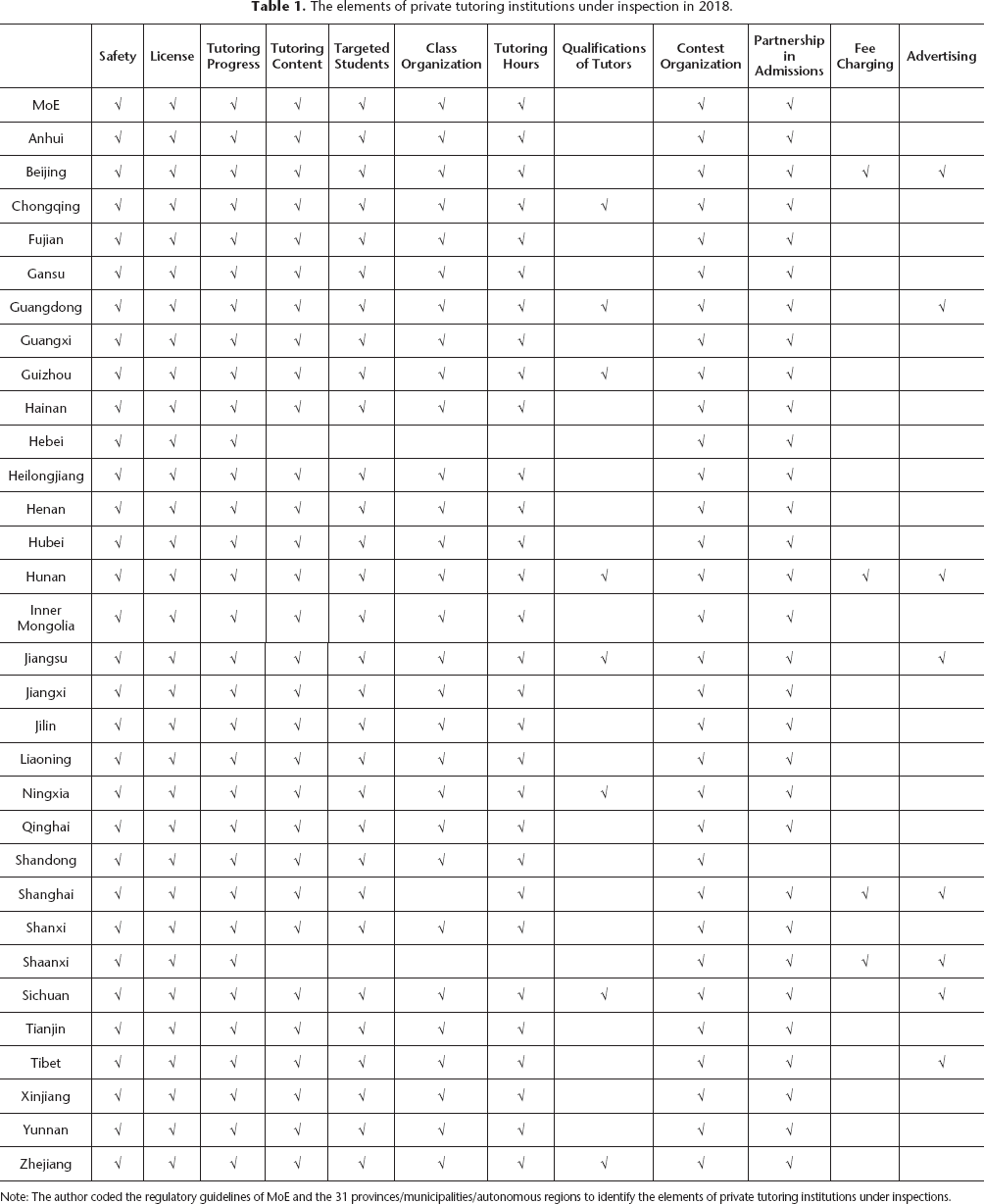
Note: The author coded the regulatory guidelines of MoE and the 31 provinces/municipalities/autonomous regions to identify the elements of private tutoring institutions under inspections.
Under this regulation, the tutoring institutions without license would be guided to apply for the school license from local education authority and the business license from the local industry and commerce authority if satisfying the requirements, or would be ordered to close down if not. Tutoring institutions only holding a business license would be guided to apply for the school license if satisfying the requirements, or would be ordered to stop providing tutoring services to primary and secondary school students if not.
Teaching in tutoring class: Government has been concerned a lot about the teaching in tutoring classes, the academic tutoring class in particular. Private tutoring institutions of problems like teaching beyond the national syllabus, teaching ahead of school schedule, and exam-oriented teaching would be ordered to rectify strictly. Institutions should report the information of tutoring content, targeted students, class organization and tutoring hours to local education authorities for recording and make the information public.
Contest organization and the tutoring-school partnership in admissions: The contest or ranking test in academic subjects organized by tutoring institutions was criticized as causing anxieties among students and their parents (Liu, 2017). And its result may be used by formal schools to enroll high-performing students. This tutoring-school partnership in admissions undermined governments’ efforts in promoting balanced development of education (Zhang & Bray, 2017). Therefore, this contest and partnership in admissions would be strictly prohibited. Tutoring institutions organizing contest or seeking partnership with schools in admissions shall be pursued according to law.
In addition to the four common elements under inspection, provincial authorities in Chongqing and Hunan also checked the qualifications of tutors. Besides the prohibition of hiring in-service school teachers, these governments paid attention to the teacher certificate and teaching experiences of tutors. Beijing, Shanghai, Hunan and Shaanxi also inspected and regulated the fee-charging of tutoring institutions. Beijing, Guangdong and Jiangsu checked the advertising practices and identified the unacceptable ones for regulation.
As the major sector to educate students, schools were also inspected. The major foci include the teaching and teachers. Because of the availability of private tutoring, some teachers might assume that their students have already learnt or have opportunities to learn in tutoring class, and they would put less efforts in teaching (Bray & Kwo, 2014, p. 30). And then the problem of teaching not according to syllabus and teaching plan was noticed in some schools. Under this regulation, schools of this problem would be penalized.
In-service school teachers were investigated in terms of their involvement in private tutoring. In-service teachers are not allowed to organize or participate in the provision of private tutoring. Teachers who persuade or coerce students to attend private tutoring would be dealt with severely or even stripped of their teacher certificates.
Following the work of special inspection, based on the information collected during inspection, the State Council issued a document on regulating private tutoring institutions in August 2018, which was the first central level regulation on private tutoring. It aims to establish a long-term mechanism of regulating private tutoring institutions to promote healthy and orderly development, which will be beneficial for maintaining a good education environment and reducing the extracurricular workload on primary and middle school students.
This document proposed four fundamental principles. First, the regulating work must be in accordance with education laws. Second, institution of academic tutoring is the major focus of regulating work, while institution of non-academic tutoring promoting students’ more-rounded development and cultivating students’ innovation spirit and practice ability will be encouraged. Third, school will be reformed to improve its education quality at the same time when regulating tutoring institutions. Fourth, regulating work calls for the collaboration of governments of different level, and the coordination of different departments.
This document stipulated further regulations on private tutoring institutions based on the guidelines released in Feb. 2018.
On setting up: It requires the education department at provincial-levels to set specific standards according to local contexts in coordination with other departments regarding the setting up of tutoring institutions. Some basic requirements are applied to institutions across the country. For example, the area shall be more than 3 square meters per student during any tutoring period. Tutors in academic subjects must hold teaching credentials.
On registration and approval: Besides the requirement of school license and business license before providing tutoring service, this newly released document requires the approval from local education authorities when the tutoring institution sets up branches in other county or district.
On operation: In addition to the requirements stated in the aforementioned guidelines, tutoring institutions have to abide by some new ones. For example, all tutoring classes shall finish before 8:30 pm. The tutoring fees shall not be charged for more than three months at a time.
Besides, certificates and licenses shall be reviewed by local education authorities every year. Local governments shall publish lists on their websites of both the qualified institutions and those failing to meet the standards.
Regarding mainstream schools, besides the regulations on in-service teachers and on class teaching in the aforementioned guidelines, this document prohibits schools to enroll students in collaboration with private tutoring institutions. To reduce the demand for certain types of private tutoring, schools shall provide after-school-hours services to their students with no lessons but activities which can cultivate students’ interests, broaden their horizons and strengthen their practice abilities.
To cooperate with the efforts in regulations at central level, some local governments have issued documents to regulate private tutoring institutions within their jurisdictions, like Shanghai (in 2017), Wuhan (in 2018), Xian (in 2018), Hangzhou (in 2018) and Jinhua (in 2018).
Discussions
Governments are responsible for monitoring and regulating private tutoring, although it is a form of privatized education service (Bray & Kwo, 2014; Fielden & LaRocque, 2008). As Fielden and LaRocque (2008, p. 13) remarked, “[g] overnments have an obligation to ensure that their citizens receive a good education from whatever source it is provided… In the case of private sector provision the same principles apply, with the necessity of developing instruments of monitoring and control to ensure that provision of both public and private sectors are of the highest quality possible”. The regulating task will be more challenging as private tutoring gets more deeply rooted in society and becomes more widespread. As private tutoring expands rapidly in China, it is wise and necessary for governments at different levels to monitor and regulate it.
The current regulatory policies will promote the sound and sustainable development of private tutoring sector in the long run. But it may cause some negative results in the short run, which should be given due attention. Some institutions, small ones in particular, which have difficulties to satisfy the demanding requirements may close down without prior notifications and the owners may skip off with money, as reported on newspapers (Ren, 2018). Some unqualified institutions may choose to provide tutoring services secretly and then the cost of private tutoring may increase because of the growing risks, as what happened in South Korea (Lee, Lee, & Hyo-Min, 2010, p. 104). The large-scale institutions have advantages in rectification with stronger capital and more resources and are more likely to expand and develop sustainably than small ones. As more small institutions close down under regulation, their tutees may move to large-scale ones gradually, which then occupy a larger market share and get more influence on pricing (Zhao, 2018). Then families have to pay more money for private tutoring.
Besides the major provider of tutoring institutions, some private tutoring in China is offered by university students, in-service or retired school teachers, and self-employed persons on an informal basis. Although the object of current regulation is the tutoring institution, tutoring offered by other providers also needs to be regulated. However, much of the informal private tutoring is beyond the reach of governments, and it is impossible for governments to regulate the whole private tutoring industry by themselves (Bray & Kwo, 2014). Many governments in other societies have placed weight on consumer awareness and tried to educate consumers, since well-informed consumers are “an important building block in a more liberalized regulatory framework for education” (Fielden & LaRocque, 2008, p. 22). For students in primary and secondary schools, their parents act as consumers to choose and purchase private tutoring (Devi et al., 2011; Jokić, 2013; Liu, 2017). Well-informed parents can help to monitor the private tutoring industry. Among the current guidelines, only those of Fujian, Guangxi and Jiangxi proposed to guide parents to choose private tutoring institutions rationally. Educating parents to make informed choices regarding private tutoring and empowering parents to monitor tutoring shall be introduced as a useful strategy into the current and future regulatory works.
Implementation of regulations is highly demanding in both personnel and finance, and governments have many other, even more crucial responsibilities. A balance between regulatory control and self-regulation must be found. For tutoring institutions, it is wise to be proactive in self-regulation, which is considered as a way not only to preserve their autonomy but also to enhance consumer confidence in their services (Bray & Kwo, 2014). For example, 16 tutoring institutions in Hefei signed a document of self-regulation in September 2018 to promote sound development under regulations (Chen, 2018). Such efforts shall be encouraged by governments.
Footnotes
1
Shanghai was ahead of other places in terms of inspecting private tutoring institutions. Shanghai launched the inspection in February 2017 as a pilot for the nationwide inspections, and then issued three documents on the registration standard of tutoring institutions and monitoring measures in December 2017. Shanghai also joined the nationwide inspections in 2018.
Note on Contributor
Junyan Liu got her Doctoral degree from the University of Hong Kong in 2017, and Bachelor's and Master's degree from Peking University. She worked in the Beijing Academy of Educational Sciences from 2007 to 2013, focusing on studies of education policy and planning.