



Abstract
Purpose:
Private supplementary tutoring, widely known as shadow education, has long been visible in East Asia, and now has spread to other parts of the world including Europe. This article maps the phenomenon, showing variations within Europe and analyzing its growth, underlying forces, and policy implications.
Design/Approach/Methods:
The article assembles a regional picture from available national sources. It focuses on the 28 members of the European Union.
Findings:
Within Europe, four subregions may be identified. Most prominent for the longest duration has been Southern Europe, pushed by political forces and cultural factors. In Eastern Europe, shadow education became prominent following the collapse of the Soviet Union and accompanying economic and social structures during which teachers and others had to earn extra incomes. In Western Europe, the advent of marketization alongside government schooling has fueled the growth of shadow education. Only in Northern Europe does shadow education remain modest in scale, but it is growing there too.
Originality/Value:
The article identifies forces underlying the growth of shadow education in Europe and highlights policy implications. By contributing this regional perspective to the wider literature on shadow education, the article permits juxtaposition with patterns in East Asia and elsewhere.
Introduction
Shadow education has become increasingly evident in Europe. This article draws on and updates an earlier publication prepared for the European Commission (Bray, 2011) and addresses the 28 countries of the European Union. 1 It is concerned with fee-paying lessons in academic subjects delivered outside school hours at primary and secondary levels. Following earlier literature (e.g., Bray, 1999, 2009; Stevenson & Baker, 1992), these lessons are described as shadow education because to a large extent (though with many variations) they imitate the mainstream: as the curriculum in the mainstream changes, so it changes in the shadow.
The 2011 report was entitled The Challenge of Shadow Education. The word Challenge was chosen for two reasons. First, it was argued, the existence of shadow education is a challenge to mainstream school systems. The shadow sector exposes shortcomings in mainstream systems, which may offend advocates of mainstream schooling, and offers ways to compensate for at least some of these shortcomings. Second, the shadow education system raises fundamental issues for policymakers, who must devise appropriate responses and may find this a challenging task. The arena is complex and requires discerning policies based on the circumstances of particular societies and particular types of shadow education. Since publication of the 2011 report, shadow education has become even more visible and issues have become even more complex (Bukowski, 2017; European Commission, 2017; Jerrim, 2017; Kim & Jung, 2019).
For analysis of shadow education, one major issue concerns availability of data. In a methodological article about international mapping of shadow education, the author likened the task to “assembly of a jigsaw puzzle with most of the pieces missing” (Bray, 2010, p. 3). More research is still much needed. Nevertheless, during the years since that remark was made, enough pieces have been added to the picture to permit identification of core themes and agendas. This article begins with indicators of the scale of shadow education before examining the intensity and modes. Next, the article considers actors, purposes, and approaches. For this commentary, it is necessary to ask who receives tutoring and why, as well as who provides tutoring and how.
From these remarks, the article considers implications for policy. The overall message is that shadow education should be given much more attention by policymakers, recognizing its increasing scale and significance. While shadow education may have positive dimensions, it can also have very problematic ones. Policymakers should reflect on the reasons why in general the sector has expanded but is more apparent in some countries than others. They may also consider various forms of regulation and steering to ensure that the positive dimensions of shadow education outweigh the negative dimensions. In the process, they can learn from comparative analysis.
The scale of private tutoring
Data on the scale of private tutoring come from scattered sources. They have different methodological underpinnings, and some are rough estimates rather than exact indicators. Nevertheless, they are part of the jigsaw puzzle which can be used to assemble the picture (Table 1).
Indicators of private tutoring in European Union countries.
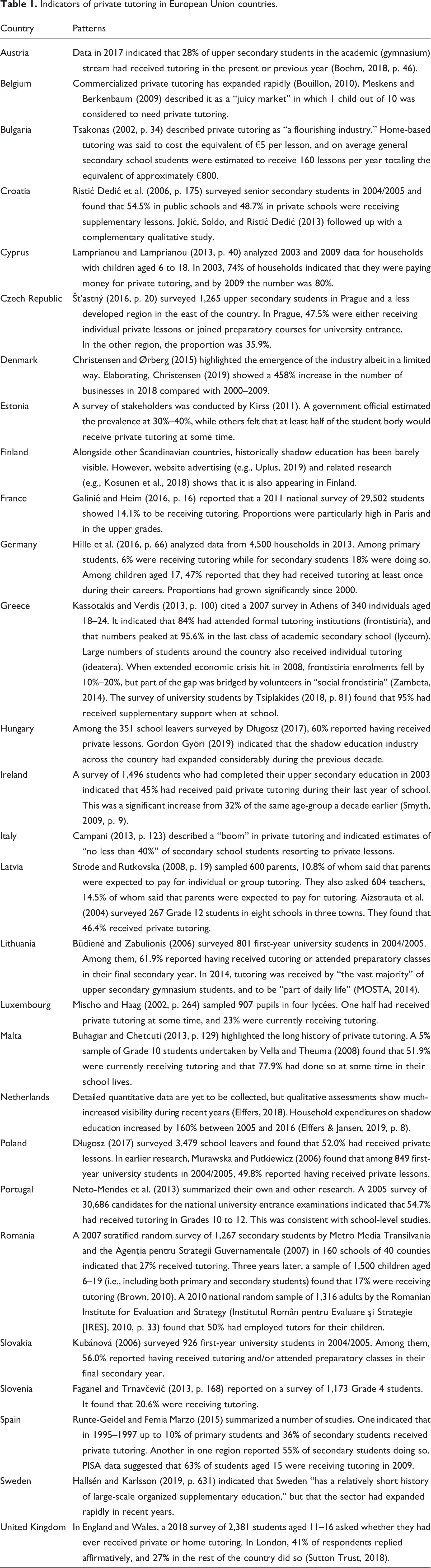
In addition to the data in Table 1 are statistics from the Programme for International Student Assessment (PISA) operated by the Organisation for Economic Co-operation and Development (OECD) and the Trends in International Mathematics and Science Study (TIMSS) conducted under the auspices of the International Association for the Evaluation of Educational Achievement (IEA). PISA and TIMSS have tested learning achievements in multiple education systems, including many European ones. The questionnaires have delivered potentially useful data on shadow education but were insufficiently precise to provide data that can confidently be placed on a single international yardstick (Bray & Kobakhidze, 2014; Bray, Kobakhidze, & Suter, 2020). Thus, although the PISA and TIMSS findings may tell some sort of story, the international numerical data have not been reproduced in this article. However, some countries supplemented the international questionnaires with their own questions and in so doing secured better national data.
Returning to Table 1, a difficulty arises from the fact that the reported studies have a wide range of foci and are not all based on rigorous sampling. Nevertheless, an overall geographic pattern can be observed:
Southern Europe has particularly high rates of tutoring, led by Greece and including Cyprus. Further research would be valuable to explore why Greece and Cyprus have long appeared to have much more tutoring than neighboring Italy, for example. Tutoring is also strongly evident in Malta, though has not reached the scale of Greece and Cyprus.
Eastern Europe has traditions of tutoring that predate the political transitions of the late 1980s and early 1990s, but during the period since those transitions the scale of tutoring greatly increased. Especially in the former Soviet countries, a major driving force was the collapse in purchasing power of teachers’ salaries, which required teachers to find supplementary ways to earn incomes. In the other countries associated with the Soviet Union the economic crisis was less severe, but also in those countries the economic pressures were major initial drivers. Now tutoring has become part of the established culture.
Western Europe has also had long traditions of private tutoring on a small scale. However, during the last decade, the volume of tutoring has greatly increased. It reflects the increasing competitiveness of societies in the context of greater mobility of labor and skills and is part of the marketization of education which has become more socially acceptable in these countries.
Northern Europe seems to date least affected by the rise of private tutoring. Scandinavian countries seem to maintain stronger traditions of schools adequately meeting their students’ needs. Certainly, students in Scandinavia receive extra support, both to help slow learners keep up with their peers and to stretch the learning of high achievers; but much of this work is provided within the framework of public schooling rather than through a parallel system. Yet within Scandinavia shadow education is becoming evident in Sweden and with patterns in Denmark and Finland not far behind.
Within these broad pictures, of course, are variations. Patterns in France differ from those in Spain and Portugal, and patterns in Latvia differ from those in Bulgaria and Slovenia. Moreover, significant variations may be found within countries. In Czech Republic, for example, 47.5% of the students in Prague sampled by Št’astný (2016, p. 20) were receiving tutoring, compared with 35.9% in the more rural Moravian-Silesian region. Similarly in Romania, Brown (2010) found that 27% of urban children received private tutoring while the proportion for rural children was 7%. Urban students are more likely to receive tutoring than their rural counterparts for reasons of both demand and supply. Cities tend to be more competitive, may have more higher-income families able to afford private tutoring, and are more likely to host universities whose students provide tutoring in order to earn supplementary incomes. Villages may have fewer avenues for private tutoring, since the major companies do not target thinly populated regions, and the individuals willing to provide tutoring are spread more thinly.
However, strong urban–rural biases are not found everywhere. The Slovakian study by Kubánová (2006) found a difference of only 3.5 percentage points between the scale of tutoring received by urban and rural students; and in Ireland, Smyth (2009, p. 11) reported that, contrary to her expectation, no difference in the scale of tutoring was evident between urban and rural areas. Although the formal tutorial schools were more easily accessible to urban students, Smyth concluded that the balance was maintained for other students by informal one-to-one tutoring. This certainly was the case in Slovakia. Kubánová (2006, p. 286) observed that while in Bratislava many more students received tutoring through institutional courses rather than on an individual and small-group basis, in the villages the converse pattern was the norm.
Intensity and modes
The statistics in Table 1 provide an indication of the incidence of tutoring, but do not show the intensity during the week and at peak seasons, or the modes of tutoring. The following remarks address these domains.
Intensity
The intensity of tutoring is partly shaped by its purpose. Tutoring which is seen as providing long-term support may be provided steadily throughout the year, but tutoring which is driven by high-stakes examinations is likely to peak in intensity just before those examinations. Tutoring may be provided on a part-time basis in the evenings and at weekends, and/or it may be on a “block” basis during vacations.
One might expect secondary school pupils to have longer attention spans and to face more pressure from the end-of-schooling examinations, and thus to receive more hours of tutoring per week. However, this does not necessarily occur: much depends on the aspirations of the parents and the extent to which they see tutoring as desirable for a strong foundation. A study of English-language tutoring in Czech Republic may match wider patterns. Korpasová (2009, p. 27) selected a sample of pupils aged 10 (Grade 4), 13 (Grade 7), and 15 (Grade 9). Just over half (54.4%) of the students receiving tutoring did so for up to one hour per week, with this pattern being equally distributed across the grades. Almost all the others (43.3%) received one to two hours per week, again with this pattern being equally distributed across the grades. Only 2.2% of the pupils received less than one hour per week or three or more hours per week.
The study in Czech Republic may be compared with one in Portugal which focused only on Grade 12 but covered all subjects and examined trends over a six-year period (Neto-Mendes et al., 2013; Ventura et al., 2008). Patterns were surveyed in four schools, and Table 2 shows findings in one of the sampled years. Half of the pupils received between one and three hours of tutoring per week, 40.7% received four to six hours a week, and 5.3% received seven to 10 hours a week.
Intensity of tutoring in Grade 12 of four secondary schools, Portugal.
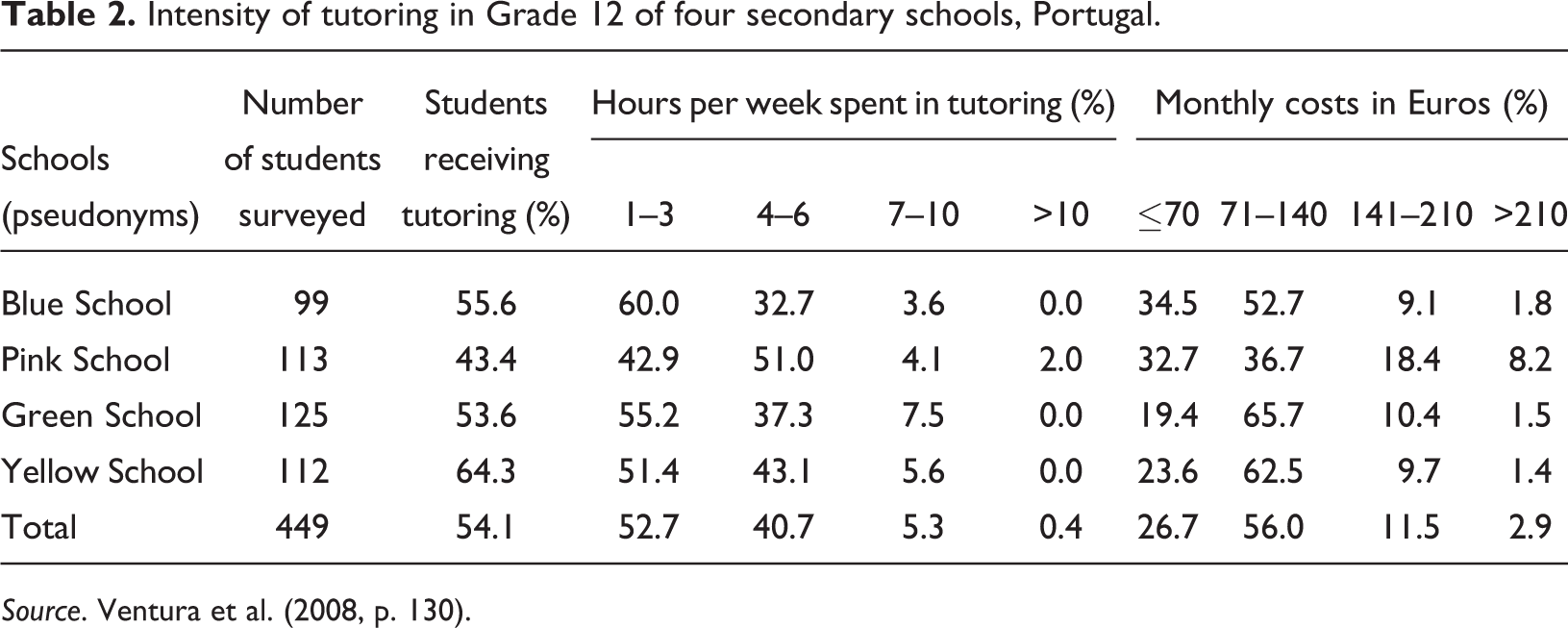
Source. Ventura et al. (2008, p. 130).
A third example may be taken from Malta, where Vella and Theuma (2008, p. 50) investigated a 5% sample of Grade 10 students and found that 51.9% were receiving tutoring. Among these students, 56.1% received private tutoring for up to three hours a week. Just over one third (35.4%) received tutoring for four to six hours, 1.4% did so for seven to nine hours, and 7.2% did so for 10 hours or more. Pupils in the high-performing schools were more likely to receive tutoring, and to devote longer hours, than pupils in the lower performing schools.
By contrast, the French study reported by Galinié and Heim (2016, p. 61) indicated that 48.8% of students receiving tutoring did so for up to an hour per week, 35.7% did so for up to two hours per week, and 15.5% did so for three hours or more. Nevertheless, the numbers were significant for a country in which the phenomenon had previously been rare.
Modes
Much tutoring is provided on a one-to-one basis, in pairs, or in very small groups; but other forms of tutoring are classroom-based. European countries have few “star tutors” of the sort found in Hong Kong SAR in which teenagers are encouraged to view their tutors like film stars or popular musicians and in which pupils pack large lecture theatres with overflow rooms to which lessons are transmitted by video (Eng, 2019; Yung & Bray, 2017). However, many tutorial schools (frontistiria) in Greece have long been classroom-based (Kassotakis & Verdis, 2013; Zambeta, 2014) and have counterparts elsewhere in the region. In general, the costs for the students are much lower in the large classes than in the small ones.
One-to-one tutoring and classroom-based tutoring are of course not necessarily mutually exclusive. This was noted in a study sponsored by the Open Society Institute (OSI) which covered nine former socialist countries of which three are members of the European Union. The study asked first-year university students about their experiences during the last year of secondary school. It recorded the proportions of respondents who had received tutoring in individual or small groups, the proportions who had received tutoring in classroom-based preparatory courses, and the proportions who had received both types. The findings for Lithuania, Poland, Slovakia, and Croatia are presented in Figure 1. In Lithuania, most students received only individual or small-group tutoring, though some received only preparatory classes and a slightly larger proportion received both. In Poland and Slovakia, patterns were more balanced with about one third receiving only individual or small-group tutoring, one third receiving only preparatory classes, and one third receiving both. In Croatia, preparatory courses were more dominant.
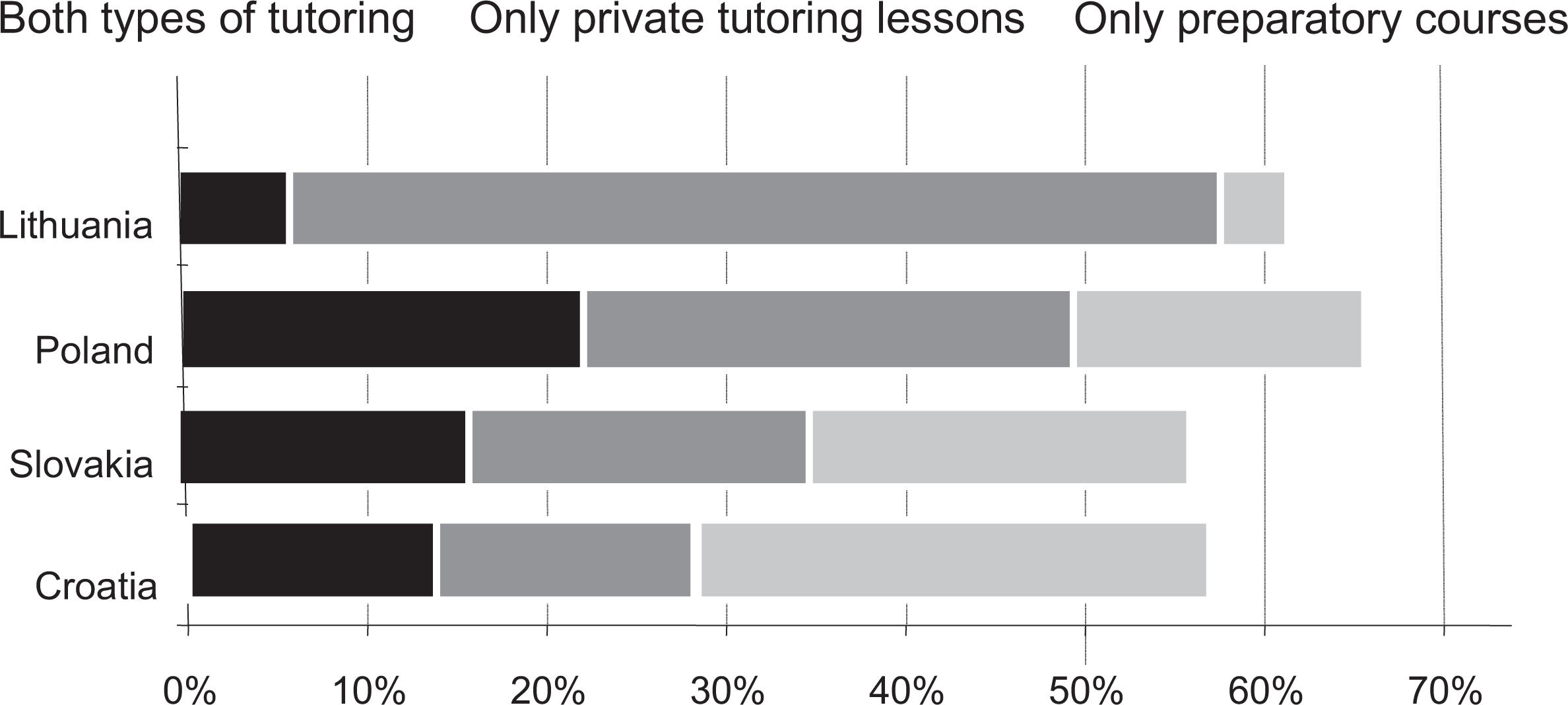
Modes of tutoring received in Lithuania, Poland, Slovakia, and Croatia. Source. Silova and Bray (2006, p. 73).
The market is also evolving in the skills stressed by tutors. While for many students and their families the subject-specific skills (i.e., correct grammar, accurate calculation of mathematics, etc.) remain the main focus, an expanding component of the tutoring sector focuses on study habits, information retrieval, and general organization. Oller and Glasman (2013) have highlighted this pattern in France, noting the development of broader forms of coaching alongside the traditional forms of subject-based support. Similar observations have been made in Sweden by Hallsén and Karlsson (2019).
As might be expected, new modes of tutoring are developing with new technologies. Most obvious among them is tutoring by Internet, which can be achieved face-to-face in real time using web cameras. This mode, moreover, crosses spatial boundaries. The pupil and the tutor do not need to be in the same village or town—or even the same country. TutorVista is a company based in Bangalore, India, which offers tutoring over the Internet through the medium of English to clients around the world including the United Kingdom. Other companies have seen the potential, some of them being publishers that seek to broaden their products beyond traditional paper-based books to electronic books and interactive media. As noted by Ventura and Jang (2010, p. 65), tutoring over the Internet can reduce the disadvantages faced by children in rural and remote locations. Families with good Internet connections can access the same levels of service as their counterparts in urban and suburban locations.
The Internet can also be used to identify tutors who will make home visits in person. Every major European city seems now to have one or more websites which provide matching services through which households can identify tutors in their neighborhoods. These tutors are commonly self-employed, and the managers of the websites cover their administrative costs through commissions from the tutors and/or the clients.
Actors, purposes, and approaches
Who receives tutoring and why?
Casual observers tend to assume that the groups which receive most tutoring are those who are most in need, that is, pupils who are achieving below national norms for their age-groups. This is certainly not the case in many parts of the world. In East Asia, for example, tutoring is more likely to be received by pupils who are already performing well but whose families wish to maintain or further enhance their performance in the competitive society (see e.g., Bray & Lykins, 2012; Zhang & Bray, 2018). In Europe, the social, economic, and cultural ingredients may differ, but it would still appear that if left to market forces tutoring is more likely to be received by relatively high academic performers than by their weaker counterparts. This is correlated with disparities in family incomes. Shadow education is much less about support to those who are in real need of learning support that they cannot find at school, and a lot more about maintaining competitive advantages within schools for students who are already successful and privileged. Elaboration on this matter requires identification of a range of motives for seeking tutoring.
Socio-economic groups
Families in higher socio-economic groups have more opportunity to invest in tutoring, and commonly use this opportunity. Figure 2 presents data from Ireland collected through a nationally representative survey of people who had left secondary school the previous year. Proportions of students receiving tutoring were greatest in the higher professional group. Participation was least among students from working-class backgrounds and especially among those from unskilled households.
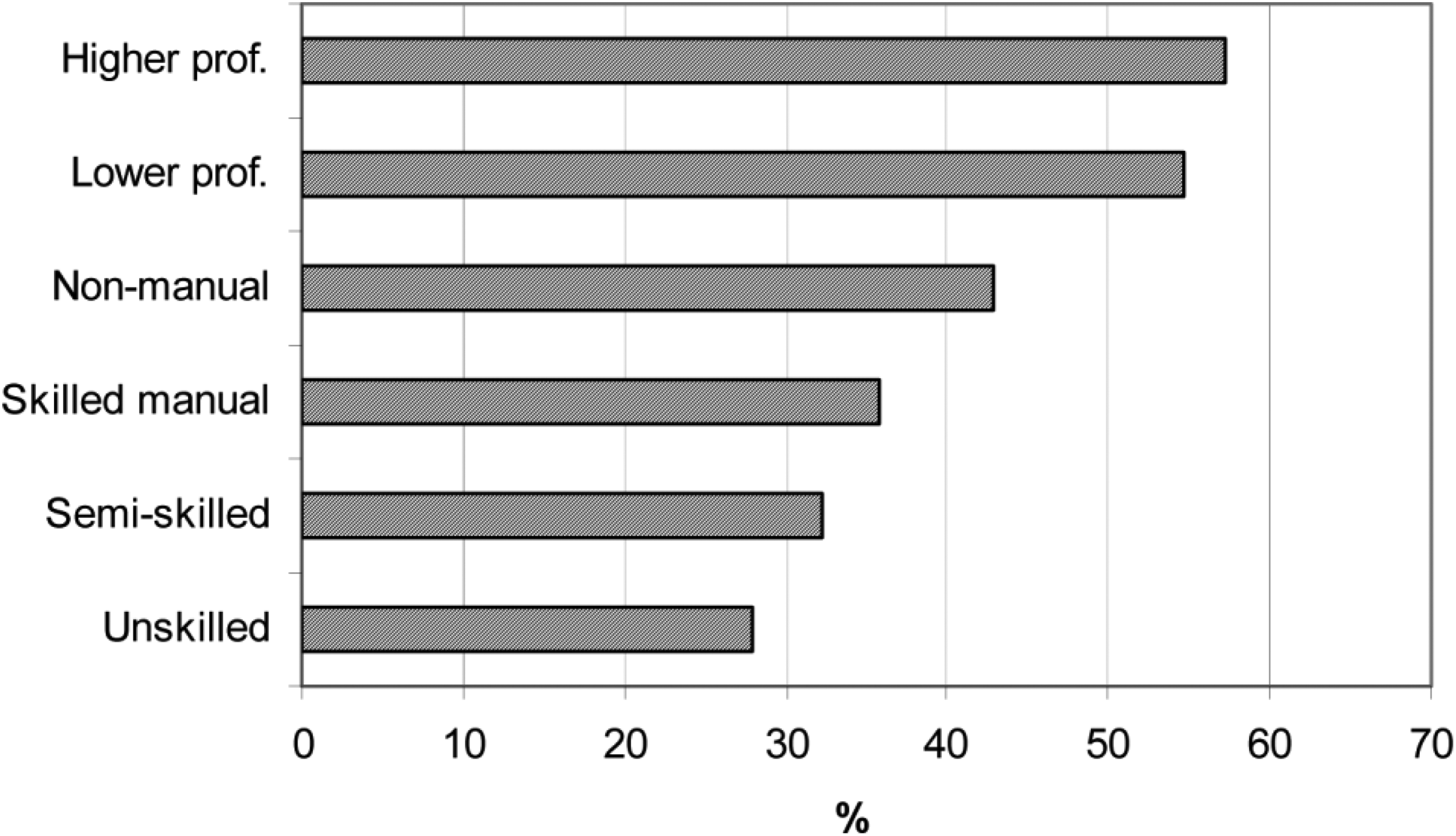
Receipt of private tutoring by social class background, Ireland. Source. Smyth (2009, p. 9).
Comparable findings emerged from research in Poland (Murawska & Putkiewicz, 2006, p. 271). Over half of the students in the sample who had attended private preparatory classes in their last year of secondary schooling were in high socio-economic groups, compared with one third in medium socio-economic groups and just 19.2% in low socio-economic groups. Related patterns were evident in consumption of one-to-one and small-group tutoring. Students from high socio-economic groups were much more likely than middle and low socio-economic groups to be receiving such tutoring (58.7% of the sample compared with 46.7% and 35.1%), and to be receiving tutoring in more subjects.
Various other studies match these findings. With reference to England, Jerrim (2017, p. 3) remarked that: There are big gaps between socio-economic and achievement groups…in time spent on additional instruction. For pupils of the same levels of achievement, well-off pupils receive 2.5 hours more additional instruction than less well-off pupils. Better-off families create a ‘glass floor’ for children in danger of low achievement, a barrier to social mobility.
High-stakes examinations
Examinations have high stakes when they significantly determine the future pathways available to the students. In most European education systems, the examinations at the end of secondary schooling fit into this category. Some education systems also have high-stakes examinations at earlier stages. In Ireland, for example, students take two nationally standardized examinations: the Junior Certificate at the end of lower secondary education and the Leaving Certificate at the end of upper secondary education (Smyth, 2009, p. 2). The Maltese system has had an examination at the end of primary school called 11+, and then further watershed examinations at Grades 11 and 13 (Buhagiar & Chetcuti, 2013, p. 138). Malta’s system is highly stratified, and the future prospects of students in the Area Secondary Schools are significantly different from those in the more academic Junior Lyceums.
Other systems have fluctuated between becoming less stratified and more stratified. Czech Republic, for example, has a set of elite secondary schools, known as gymnasiums, and a rigid system of tracking within institutions. This system has become even more stratified with recent reforms, and tutoring companies are recognizing the business opportunities (Št’astný, 2016). Lithuania also has a system of gymnasiums, which were reintroduced in the 1990s after the country regained its independence. The gymnasiums take the best and most motivated students and teachers, and their reintroduction fueled the demand for private tutoring (Būdienė & Zabulionis, 2006; MOSTA, 2014).
In some countries, school-leaving examinations are different from university-entrance examinations. In Slovakia, the government reformed its school-leaving examination, known as the maturita, in 2004. Universities were given the right to incorporate the results of the examination into their admission criteria but were not obliged to do so (Kubánová, 2006, p. 283). As a result, many students continued to face the demands of both the maturita and the individual entrance examinations, and felt a need for private tutoring on both sides. Similar issues were evident in Poland, where the examination at the end of secondary school is called the matura. Government reform of the examination system in 1999 sought to make it more egalitarian, but in practice increased the pressures for tutoring. As explained by Murawska and Putkiewicz (2006, p. 263): The matura examination was intended to replace university entrance examinations but…a significant number of [university] faculties decided to retain additional tests as part of the recruitment process. It is commonly believed that schools are incapable of preparing students for the new matura examination, particularly if its results are to be a decisive factor in university admission. Thus, students seek private tutoring for both the matura examination and preparatory courses for the individual university examinations.
Długosz (2012, pp. 99–100) noted that when in 2010 mathematics was made compulsory in the matura examination, the proportion of students that he sampled who were receiving tutoring in that subject rose from 46% in 2009 to 80% in 2011.
Also worth noting are the vested interests of the tutors. Writing about Romania, Popa and Acedo (2006, p. 104) observed the resistance by both secondary school teachers and university professors to reforms that would dilute the stress on high-stakes examinations. The chief factor, Popa and Acedo stated, is the fact that such examinations underpin the market for private tutoring and therefore significant extra incomes for the secondary teachers and university professors.
Finally, by way of contrast it is useful to note patterns in Finland. That country is recognized to have remarkable equality between schools, and a highly professional teaching force (Niemi et al., 2016). Finland is also characterized by the absence of national high-stakes testing. It is perhaps no coincidence that it also has very low levels of private supplementary tutoring, though rates are growing (Kosunen et al., 2018).
Nonacademic motives
Students may have nonacademic as well as academic reasons for seeking tutoring. Such reasons could include a desire to meet friends and fit into peer groups. In Malta, most teenagers go to single-sex schools but attend coeducational tutoring classes and are therefore able to mix in these settings with the other sex (Sultana, 2011). Other reasons for attending tutoring might be to please parents or other significant actors. In Slovakia, 34.4% of respondents in the survey administered by Kubánová (2006, p. 294) agreed or strongly agreed that they received tutoring “because their parents make them do so.” Similar remarks were made in England by pupils surveyed by Hajar (2018, p. 520).
The pressure from parents may reflect on their own comfort zones as much as their children’s needs. In Malta, Gauci and Wetz (2009, p. 8) remarked that Parents send students to private lesson in order to feel that they are doing all they could to help them. It is probably the case that [at least some] local students attend private lessons even when there is no real need. specialist childhood and parenting magazines thrive on both the commercial exploitation of anxiety and childhood generally as a new market opportunity. Such magazines offer advice, but also create new desires and fuel fears.
Parents may also have other nonacademic reasons for seeking tutoring. When children are young, parents may see tutoring as a sort of child-minding service (see e.g., Oller & Glasman, 2013). Similarly, tutoring may be a way to keep young people gainfully occupied during the school vacations, especially during the long summer months. And in general, especially for teenagers, tutoring may be seen by parents and the wider community to have a wider function of keeping young people constructively occupied in place of behavior which might otherwise be delinquent.
Who provides tutoring and how?
The range of types of personnel who provide tutoring is broad. Tutors may be trained or untrained, and full-time or part-time. The span of ages is wider than that for school teachers, who are typically aged from their early 20s to their early 60s. Some tutors are university students who tutor primary or secondary students, and even secondary students who tutor primary or other secondary students. Other tutors are retired teachers in their 60s, 70s, or beyond.
The identities of the tutors and their employers
Increasing volumes of tutoring are provided by companies working on a local, national, or international basis. The local and national companies are too numerous to list here, but among the international ones are some which reach across continental boundaries. Kumon is headquartered in Japan and claims to have 4.3 million subject enrollments in 51 jurisdictions including 16 in Europe. 2 Kip McGrath is headquartered in Australia, operates in four continents, and in Europe has franchised tutoring centers in the United Kingdom. 3 Within Europe, Acadomia is headquartered and has most of its operations in France but has now expanded to Poland. 4 These companies employ many part-time tutors.
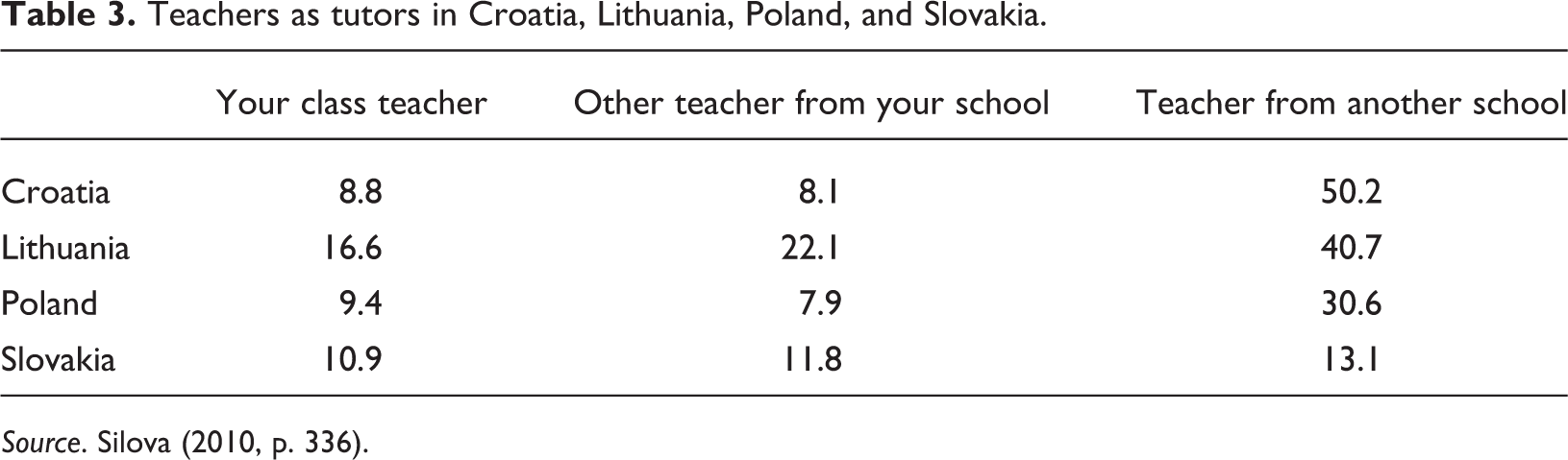
On a rather different note, in some countries a significant proportion of tutors are full-time teachers who provide additional tutoring in order to supplement their incomes. The study in Romania by Brown (2010) found that 30.0% of students received tutoring from their own teachers, and 60.4% from other teachers in their own or other schools. Table 3 presents additional data from Croatia, Lithuania, Poland, and Slovakia. The table indicates the responses of Grade 12 students on the identities of their tutors, and reports on those who were teachers (i.e., excluding university lecturers, full-time tutors employed by companies, etc.). In all countries, a significant proportion of these teachers were already responsible for these students in their mainstream schools. Other teachers in the students’ schools, and teachers from other schools, were also prominent categories.
Teachers as tutors in Croatia, Lithuania, Poland, and Slovakia.
Source. Silova (2010, p. 336).
The practice of class teachers providing extra lessons for their existing students can be problematic. Most obviously, it risks the temptation for teachers to reduce the effort they put into their normal duties in order to increase demand for their services outside school hours (Jayachandran, 2014). This has certainly been considered a problem in Lithuania (Būdienė & Zabulionis, 2006, p. 216). In addition to undermining the quality of mainstream schooling, the system may also lead to elements of favoritism. Among the 30.0% of students receiving tutoring from their own teachers in Romania, 68.1% justified the choice on the grounds that the teacher was a good professional and 8.6% on the hope that the teacher would be more lenient when making judgments (Brown, 2010).
However, the concerns about corruption and inequalities are not shared universally. With reference to Slovakia, Kubánová (2006, p. 284) reported that: Most pedagogy students interviewed for this study were not motivated to teach, but saw it as a last resort for employment and declared that, in such a case, they would certainly give private tutoring lessons. They justified this by pointing out how low teacher wages were and did not feel that it was an ethical problem to tutor one’s own mainstream students.
In England, a government-sponsored scheme launched in 2007 to provide one-to-one tutoring for low achievers permitted schools either to give extra money to classroom teachers who provided extra lessons for their pupils or to employ tutors from private agencies. An interim evaluation of the scheme (PricewaterhouseCoopers, 2008, p. 15) indicated that schools were having difficulty finding enough tutors. The final evaluation (PricewaterhouseCoopers, 2010, p. 64) reported that the shortage of tutors had been alleviated by greater willingness by teachers to become tutors because they saw the benefits for their pupils’ learning. Overall, 70% of the tutors were school-based. Schools showed a reluctance to employ agency tutors because of concerns about quality and the burden of administration. In addition, liaison between teachers and tutors was considered more demanding when external tutors were concerned. Yet while the scheme no doubt had strong professional underpinnings, some observers had misgivings about the notion of paying classroom teachers extra money to tutor their own pupils after school hours.
The tutors’ professional qualifications
When school teachers provide extra tutoring, one may assume that in most cases those teachers have been trained in pedagogic methods. Arguably, professional training is desirable not only to identify curricula which match the levels and capacities of individual children but also to know how to handle emotional disturbances, imbalanced power relationships, and variable concentration spans. Nevertheless, it remains the case that many tutoring companies employ personnel who have not been trained as tutors or have minimal training – perhaps for one day by the employing companies (see e.g., Hallsén & Karlsson, 2019). In Belgium, the company Educadomo has proudly declared on its website that its “instructional coaches” (tutors) are “all students at the university or in other higher educational establishments who are specializing in an academic field. They are aged between 20 and 25 years old and are studying medicine, civil engineering, applied economics, translation, teacher training or speech therapy, psychology, physiotherapy, etc.” 5 The website declares that they are selected “for their extreme human and instructional competence, as well as their skills in managing time and planning studies.” However, it appears that few have professional training. “Enthusiasm to pass along knowledge to younger students” seems to be considered a more important attribute. In Denmark, the largest tutoring company employs increasing numbers of secondary school students to tutor primary school students.
In a different category it was noted above that, especially in Eastern Europe, much tutoring for senior secondary students is provided by university lecturers and professors. These people are also unlikely to be trained in pedagogy, since the subject knowledge is generally more important to their university employers. In their case, however, the tutoring role is very different from the one-to-one tutoring in the homes of the pupils, many of them young, to which the examples from the United Kingdom and Belgium refer. The university lecturers are chiefly providing tips and related guidance to senior secondary students for university entrance examinations. For this mode, arguably the need for professional training is not so great.
Tutoring approaches
Classroom teachers who provide tutoring as an additional activity generally teach in much the same way as during regular lessons, particularly if their tutorial groups are large. However, if the groups are small they may adopt different approaches, and they may be more client-oriented since the students are paying fees for the service.
One-to-one tutors, of course, must necessarily employ different styles from classroom teachers. In England, a government-commissioned survey (Tanner et al., 2009, p. 24) commenced with a review of websites and found that 93% of the agencies that provided information on style of tutoring used such words as “individualized” and “flexible.” Only 7% offered specific programs, the majority of which used materials and programs specific to their agencies, such as Kumon and Kip McGrath.
A telephone survey provided additional information, including on the ways that the tutors decided which clients to accept (Tanner et al., 2009, pp. 60–61). Some tutors placed most emphasis on the needs of the parent or student when deciding whether or not to agree to provide tutoring. In other circumstances, tutors considered the student’s ability: some preferred students who were already achieving well because the tutors felt more confident that these students would secure good examination passes. Other tutors felt that they lacked the skills to tutor students with special educational needs. The timing was also important, especially if a student was working toward a specific examination. Some tutors routinely declined to take clients if they were “too close to the exam,” though the tutors’ perceptions about when this was varied widely (Tanner et al., 2009, p. 61). One tutor indicated willingness to take any student, in order to earn the money.
Finally, it is useful to return to the phenomenon of Internet tutoring and to note some distinctive approaches from that medium. Ventura and Jang (2010, p. 65) observed that despite the disadvantages compared with the direct physical presence of a tutor, Internet tutoring may have some advantages. In particular, certain types of students may feel more at ease in an online environment to ask questions and to expose doubts: When they are in the classroom or in a group at a private tutoring center they feel ashamed to assume that they do not know some things they should know. Sometimes, they fear being victims of embarrassment by their colleagues, or even of bullying situations, due to the fact that they show their ignorance regarding certain subjects or because they have a slower learning rhythm.
Implications for policymakers
The previous sections have identified a range of intensities, actors, and types of shadow education. It follows that the implications for policymakers are equally diverse. Also important are contextual factors. Thus, appropriate policies for Slovenia might not fit in Finland, and appropriate policies in Portugal might not fit in Italy. Nevertheless, some messages are generally applicable. The first is that the shadow education system needs attention: it should be recognized and evaluated. Policymakers may then decide what dimensions are desirable and to be encouraged, and what dimensions are undesirable and to be discouraged. They can devise regulations and incentives, and they can identify ways to engage with and/or harness market forces. Policymakers should also heed the signals that the shadow education system sends about the nature of mainstream schooling.
Recognizing and evaluating shadow education
This article began by noting the paucity of statistical information on shadow education. This paucity reflects two main factors. First, many of the actors deliberately avoid transparency. In England, Lampl (2017, p. 2) described shadow education as “the hidden secret” of the British education system; and researchers are commonly mindful that they are investigating part of the “grey economy” in which much revenue is beyond the reach of the tax collector and results from activities that are technically illegal.
Perhaps a stronger reason for the lack of statistical information is that until recently shadow education has been barely on the agendas of either researchers or policy analysts. Private tutoring has a history in Europe of decades and even centuries, but in previous eras was very limited in scope, mostly serving elite families and with few implications for the mainstream education of the majority. Researchers and policymakers who raised their eyes across continental boundaries did note the much larger-scale activities of juku in Japan and their counterparts in Korea (see e.g., Harnisch, 1994; Zeng, 1999); but those were largely viewed as components of education systems reflecting East Asian cultural characteristics and of little relevance to Europe. Private supplementary tutoring by ordinary teachers was recognized to have greatly expanded in Eastern Europe following the political and economic transitions of the late 1980s and early 1990s; but within those countries, policy analysts had more urgent priorities. Moreover, they tended to view the phenomenon as only a temporary feature driven by sharp drops in the purchasing power of teachers’ salaries and therefore likely to diminish when the economic frameworks stabilized and the Eastern European countries became more like their Western European neighbors. And while Greece has long had significant forms of shadow education, tutoring was not considered a priority for research even within that country let alone comparatively across national borders.
It is now clear not only that the phenomenon in Eastern Europe is not temporary but also that patterns in Western Europe have increasingly visible parallels. In Eastern Europe, supplementary tutoring is more likely to be provided by mainstream teachers than is the case in Western Europe; but this has long been a feature in Greece and is not unheard of in other countries. Moreover, the rise of commercial companies, some of them operating across national borders, is evident throughout the region.
With this in mind, the first step for policymakers must be to gain clearer data on the scale, intensity, and nature of shadow education in their jurisdictions. For reasons noted above, data collection from the tutors may not be easy. Moreover, even parents and students may not welcome scrutiny, especially if they feel that receipt of tutoring signals either handicap in learning or purchase of an unfair advantage in competition with peers. Nevertheless, the fact that this article has presented a great deal of information shows that there are ways round these information obstacles. Researchers can devise both quantitative and qualitative instruments to improve the database and enhance understanding. Returning to the metaphor used at the beginning of this article, many pieces of the jigsaw puzzle are missing; but many more pieces exist than in earlier decades, and there are ways to secure additional pieces for the picture. These pieces can be secured through large-scale international surveys such as PISA and TIMSS, provided the questions are sharper (Bray & Kobakhidze, 2014; Bray et al., 2020). They can also be secured through national surveys of various kinds. In addition, much useful information can be achieved through smaller-scale investigations, including ones undertaken by university students for postgraduate degrees.
Of particular importance are data not only on the numbers of students who receive tutoring in particular subjects and grades, but also how much this costs and what the service is like in terms of orientation and quality. These questions would provide important insights into the hidden social inequalities that are exacerbated by tutoring (Lampl, 2017). Other questions might focus on human capital formation: which types of tutoring and under what circumstances might provide beneficial forms of human capital, and which are simply wasteful of resources (Johnes et al., 2017; Liu & Bray, 2017). A further set of questions concerns the impact on child development of the balance between academic work and other activities. Thus, the number of questions on which further research is needed is considerable—and the questions could usefully be asked within separate regions of individual countries, and in communities serving different socio-economic groups, as well as nationally.
Identifying the driving forces
Statistical and qualitative data help to show the scale and nature of shadow education and to demonstrate the need to give it more attention. As the next step toward devising appropriate policies, it is necessary to identify the factors that are driving the expansion of shadow education. Here again, enough is already known to construct a general picture.
Returning to the observation made above about Eastern Europe, during the 1990s, a major force was the decline in the purchasing power of teachers’ salaries. In most countries of the subregion, official salaries ceased to be adequate to sustain teachers’ families at even basic levels, and teachers were therefore forced either to find alternative occupations or to find ways to supplement their incomes. For the latter, private tutoring was an obvious option.
In Western Europe, the forces have been rather different. Teachers may complain, but their salaries have certainly remained far above those of their counterparts in Eastern Europe. A stronger driving force is the general atmosphere of competition. The processes of Europeanization and globalization have brought much greater mobility of labor and associated competition for jobs (Dale & Robertson, 2009; Verger et al., 2016). In addition, whole systems of education have been ranked through instruments such as PISA and TIMSS. Policymakers have insisted on forms of accountability which rank the performance of educational institutions, and these pressures have been transmitted to families and children. Bouillon (2010) was referring specifically to Belgium, but expressed sentiments that had wider validity (see e.g., Bray, 2017) when he wrote about the “performance society” that had developed, and the extent to which the tutoring agencies “played on parental anxiety.” At the same time, financial cuts have reduced the extent to which institutions have felt able to provide individual care. Schools have increasingly operated according to standardized frameworks, and either explicitly or implicitly have delegated some of the catering for individual differences to parents, community groups, and other actors.
Nevertheless, most Scandinavian schools seem to retain the responsibility to serve a full range of age and ability groups, and to tailor the provision when and where necessary. This is among the reasons why shadow education has not been a feature of education in Finland, for example (Niemi et al., 2016). However, significant shifts have been noted in Denmark and Sweden where Christensen (2019) and Hallsén and Karlsson (2019) have highlighted the emergence of the shadow education sector in recent years. One major factor in Sweden was availability from 2007 for taxation relief for various household education services conducted in the home (Hallsén & Karlsson, 2019, p. 2). The system was withdrawn in 2015, but by then the market had been launched and the seeds for a cultural shift had been sown. Moreover, even in Finland, recent shifts have been noted by Kosunen, Ahtianen, and Töyrylä (2018).
Regulations and incentives
If left to market forces, it appears likely that tutoring will gain further intensity and coverage throughout Europe. As marketized shadow education spreads, it will maintain and exacerbate social inequalities since it is self-evident that families with higher incomes can afford both greater quantities and better qualities of tutoring than can families with lower incomes. Some of the latter will find themselves forced to purchase tutoring in order to remain in the race and will sacrifice other items of expenditure. Other families will simply be left behind in the competition, with risks of social dissonance and associated problems. This is a major threat to the social fabric.
The question then is what steps should be considered by policymakers to ameliorate some of the potential problems from completely unregulated markets. Informal arrangements through which families contract university students, self-employed tutors, and other individuals to work on a one-to-one basis are perhaps the most difficult to regulate, but authorities can at least regulate the work of teachers who are on government payrolls. A strong case can be made for prohibiting teachers from providing additional fee-generating tutoring for pupils for whom they already have responsibility in education systems; and in systems where teachers are paid adequately, a case can be made for prohibiting all teachers in the public education system from undertaking additional private tutoring.
One starting point could be to require tutoring agencies, and perhaps even individual tutors, to operate as registered enterprises. This requirement would assist in monitoring the scale and modes of operation of the actors. It would also provide a mechanism to tax earnings, thereby transforming the “black” (or grey) market into a white one. The revenue from taxation could offset the costs of registration and related overview.
For registered enterprises, governments may also set regulations on the modes of operation. The minimum could focus on basic standards of safety. This would include insistence that the premises used for tutoring comply with fire regulations, and it could include requirement for tutors to demonstrate that they have no criminal records for child abuse. 6 Governments are likely also to insist on proper accounting for the purposes of taxation. However, they are less likely to set ceilings on the fees that can be charged, the hours during which the agencies may operate, or the maximum class size. They are also unlikely to require particular content in the curriculum, forms of pedagogy or tutors’ qualifications.
On a somewhat different tack, some governments may decide to encourage forms of tutoring. One scheme in England has already been mentioned, namely the Making Good Progress initiative launched in 2007. The majority of tutors were teachers in the pupils’ schools, but about 30% were employed through private tutorial agencies. In this respect, the scheme was a government initiative which provided a stimulus to the private sector. It did so, moreover, within an ostensibly benign framework that could in the long run be highly problematic. A standard marketing technique in the commercial sector is to provide “free samples” to encourage targets to embark on certain consumption habits. If and when government funds for such services prove inadequate to maintain or extend the scheme, families would have been conditioned to think of finding their own resources to secure ongoing support; and society would have been conditioned to consider it entirely acceptable for such help to be provided beyond the school system rather than within it. Similar remarks apply to the voucher scheme recommended by England’s Sutton Trust (Jerrim, 2017, p. 29; Lampl, 2017, p. 2).
Rather different in focus, but with worrying potential parallels, is provision in France for taxation relief for payments to tutors by families who pay income tax. Eligible parents can claim a 50% refund of their payments—a fact to which the tutoring companies naturally call attention on their websites. Advocates of this arrangement describe it as a productive form of public–private partnership. Critics point out that only families with incomes above the threshold are eligible for the taxation relief, and that low-income families therefore must either do without the tutoring or pay the full price (Galinié & Heim, 2016). Critics add that the arrangement gives official sanction to the marketization of education which, many people feel, is eroding the nature of the public service provided by schools. As noted above, in Sweden, a system of taxation relief launched in 2007 sowed the seed for marketization of the education system which continued to grow even after the taxation relief was withdrawn in 2015 (Hallsén & Karlsson, 2019, p. 632). As in England, the system seems to permit schools to send families to the marketplace rather than themselves taking full responsibility for the learning needs of their pupils.
Finding partners
Of course when regulations are issued, it is important to ensure that they are enforced. For this, central authorities will need first to publicize the existence of the regulations and second to secure the compliance of subnational bodies and schools. Partnerships may help in this. Public awareness is a key ingredient, and consumers, community groups, and other components of civil society can work as watchdogs to facilitate the processes of enforcement.
Partners could include churches, community groups, and other bodies which are willing to provide fee-free tutoring, especially for disadvantaged groups. In Malta, for example, both the Catholic Church and the Labour Party provide fee-free tutoring in economically depressed areas (Sultana, 2011); and in Greece, volunteer groups provide support through “social frontistiria” (Zambeta, 2014). This reduces part of the social gap created by market forces even if it does not address the fundamental reasons why such tutoring is needed in the first place and how the commercial sector serves the middle- and upper-classes to maintain and consolidate forms of social stratification.
A different sort of partnership may be with the industry itself, and particularly with business associations which stress self-regulation (Bray & Kwo, 2014). In various economic sectors, ranging from financial advice to manufacturing, associations formed by business operators enhance consumer confidence by declaring standards to which members adhere. In the tutoring industry, Greece has had such a body since 1981 and has counterparts in Austria, Cyprus, Germany, and the United Kingdom. Some of these bodies set codes of conduct for their members and have announced principles for their modes of operation. The Cyprus Association, for example, stated that: every member must be registered with the Ministry of Education; the owners of the member tutorial centers must hold university degrees; member tutorial centers must not employ nonqualified teachers or professors; and members must not directly or indirectly employ teachers in public schools.
Such guidelines would seem to be in the public interest as well as in the interest of the enterprises operating the tutorial centers, and as such might be encouraged by governments.
Looking in the mirror
When looking carefully at the nature and scale of private supplementary tutoring, policymakers can also learn much about their mainstream education systems. In this respect, tutoring can function as a mirror.
At a broad level, the fact that shadow education is relatively small in scale in Scandinavia seems to imply that families are happier with the nature of the provision by the schools than are their counterparts elsewhere in Europe. With reference to Finland, for example, analysts have highlighted the social trust in the government and the public education system, which operates effectively and serves all sectors of the population (Niemi et al., 2016). However, even Scandinavian countries have shown growing dissatisfaction with schooling and the state’s mode of management. This pattern is even more obvious in other countries, and the fact that shadow education has grown considerably shows that families have less confidence than before in the extent to which schools can meet all their needs. Schools may be perceived as good places for children to learn to work together, to cover the basic curriculum, and to nurture values of citizenship and identity. However, at least some parents feel that only the basic curriculum is being covered and that their children need more inputs either to allow them to keep up with their peers or to stretch to more demanding topics. Further, many schools are perceived as providing inadequate preparation for the mechanics of passing high-stakes examinations. Much tutoring is exclusively focused on past examination papers, tips on likely questions, and strategies for answering questions within the time constraints.
An obvious question is whether tutoring is necessary and whether schools should not undertake these roles themselves. Many parents believe that they should. With regard to England, Askew et al., (2010, p. 31) observed that: Cultural values…would deem the need to tutor a pupil who was falling behind as an indictment on the quality of a mainstream educational setting. There is a belief in England that the state education package should provide all that is needed during the school day.
Other countries have different political dynamics but parallel forces. Families in Eastern Europe have faced more dramatic economic transitions than their counterparts in Western Europe and have become used to the idea that education has become to some extent a marketable commodity like many other components of daily life. Thus in Lithuania, for example, the respondents surveyed by Būdienė and Zabulionis (2006, p. 231) felt that ideally the education system should be such that nobody would need private supplementary tutoring; but they also recognized that realities had changed since the Communist era and that the market-driven economy included education as well as other sectors.
Among the ironies is that at an official level all governments claim to adhere to principles enunciated in international declarations about fee-free education. This results in contradictions. The official banner on the school system may proclaim that it is free of charge, but the back door charges fees. For some families, these fees are a burden, but the families choose to pay the charges so that their children are not penalized. Other families cannot afford to pay, and indeed are penalized.
Another image that tutoring shatters relates to the qualifications of teachers. Throughout Europe, official ideology stresses the need for teachers to be trained through preservice and in-service courses. The teachers’ unions hold a similar view. Yet the market is willing to employ tutors who are untrained. Indeed in some cases, the tutors are not old enough to have completed training: they are just university students or even secondary students. Rightly or wrongly, the consumers are willing to pay for a service which does not have the underpinning of the types of training which governments and unions insist are essential.
Policymakers can also learn from the motivations of tutors. Generating income is the most obvious motive for providing tutoring, but it is not the only one. At least some tutors are attracted to the work by the promise of flexibility in pedagogic approaches, unconstrained by the bureaucracy of formal education systems. As tutors, they feel that they have more control over what they teach, to whom, when, and where. Indeed, some of the most creative teachers would be frustrated if confined to the school system, and instead take their energies to the more flexible profession of tutoring where they contribute to society through a different channel.
Allied to the above point are the possibilities for innovation in the tutorial sector. Partly because private tutors are in a market place where they need to attract and retain clients, they are much more likely to experiment with new technologies and with alternative approaches to learning and teaching. They will use Facebook, twitter, websites, and anything else that helps to achieve the objectives. Policymakers might usefully reflect on the question why it is so much easier for tutors to use these tools compared with teachers in mainstream school systems.
Finally, the nature of the shadow education system can tell policymakers a great deal about social stratification and the forces that reproduce it (Bray, 2017; Buhagiar & Chetcuti, 2013; Giavrimis et al., 2018). All governments claim that they wish to reduce social inequalities and assist the disadvantaged sectors of society. If left to market forces, however, the shadow education system maintains and exacerbates inequalities. The extent to which governments do or do not pay attention to these matters is a telling indicator of the extent to which they are really concerned about inequalities. And the governments that are really concerned would be wise to commence with the mainstream school systems rather than just treating the symptoms in the shadow. This means providing adequate financial and human resources to allow school systems to cater fully for all students and thus avoiding the need for some of them to go to the private sector for supplementation.
Conclusions
This study has shown that shadow education has grown considerably in most parts of Europe. In so doing, shadow education is challenging the mainstream system and exposing various limitations. For a long time, many policymakers were able—and preferred—to ignore the existence of shadow education. That is no longer possible. Shadow education has reached such a scale, and has such strong implications for social equity, the knowledge economy, the labor market, the work of schools, and the lives of children and families, that it must be addressed. In some countries, private tutoring is considered: to be “the normal practice” (Tsiplakides, 2018, p. 81, referring to Greece), to have “become the norm rather than the exception” (Buhagiar & Chetcuti, 2013, p. 135, referring to Malta), and to be in “boom” (Campani, 2013, p. 123, referring to Italy).
In other countries, the sector is more muted but clearly growing. Even in Scandinavia, policymakers would be wise to heed patterns elsewhere in order to avoid future difficulties and to steer developments toward desirable goals.
The phrase about steering developments underlines that shadow education has positive as well as problematic dimensions. When organized sensitively and effectively, it can help slow learners to keep up with their peers and thus reduce disparities both in classrooms and in broader societies. Putting a positive spin on tutoring, the UK government has recognized the limitations of its schools, stating (Department for Children, Schools and Families, 2009, p. 3) that: While our current catch-up arrangements are effective for many, we know that they are not working for all pupils. Some need a level of support which is beyond our control to deliver in the context of whole class or small groups. Without an individualized approach it will be very hard for this group to make the progress needed to achieve their full potential. Even in the personalized classroom, we know that some pupils would benefit, at key moments, from an intensive burst of individual tuition, which the class teacher can guide and reinforce, but simply does not have the time to deliver.
This statement was made in the context of a government-supported program for one-to-one tutoring of needy pupils but could equally apply to private-sector provision. Even in the relatively well-resourced classrooms of the UK, the teacher “simply does not have the time to deliver” individualized teaching for all pupils. Parents increasingly recognize this and, with or without government support, have turned to the private sector for supplementary help. However, the fact that they are losing confidence in the public system sends major warning signals.
Moreover, the families that seek private sector support may be looking for sustained help rather than just an intensive burst; and these children are not necessarily the ones who are performing below national averages. Many children with tutoring are already performing well compared with national averages, but perhaps not in relation to their peers in specific schools. Others are performing well in relation to their peers, but their parents wish the children to be stretched further to reach new heights. As such, at least some forms of tutoring can be a way to develop talent and, from the perspective of national policymakers, enlarge the stock of human capital for economic and social development. This, however, is a complex domain needing further investigation (Johnes et al., 2017; Liu & Bray, 2017).
Like so many phenomena, moreover, activities which are highly desirable in some settings and from some perspectives may be very problematic from others. The challenge of social inequalities has been underlined several times in this study since it is obvious that families with greater incomes can afford more and better quality tutoring than families with lower incomes. Much has been spoken and written about the need for parental involvement and the benefits of individualized learning and choice. However, choice is only a reality for those who can afford to choose. As indicated above, shadow education is much less about pupils who are in real need gaining support that they cannot find at school, and much more about maintaining the competitive advantages within schools of the already successful and privileged. Moreover, when school teachers are permitted also to provide tutoring (for their own or for other people’s students), the shadow education system gives perverse incentives to divert effort from classrooms to private tutoring.
At the same time, education is such a complex domain that families have very little way to know whether indeed their children need tutoring, and, if so, how much and of what type. If there is reason to doubt the effectiveness of some forms of instruction in mainstream schools, there is perhaps even more reason to doubt the effectiveness of many forms of supplementary tutoring, especially when delivered by unqualified individuals and/or when replicating the forms of instruction already received at school. At the worst end, tutoring may not only be ineffective but also counterproductive. It could waste the students’ time in pressurized academic environments which give little opportunity for necessary leisure and which leave young people tired and inattentive to their mainstream lessons. It can also create difficulties for mainstream teachers who find that some pupils already know the material because of tutoring when others do not; and it can cause conflicts in pedagogical approaches when tutors teach mathematics or other subjects in one way but the teachers teach it in another way.
From a national perspective, moreover, policymakers need to consider whether shadow education always supplements mainstream schooling or whether it sometimes duplicates or even substitutes for it. Duplication would occur when the shadow repeats what has been covered in the mainstream with little or no extra learning. Substitution would occur when classroom teachers deliberately reduce the content of their mainstream lessons either to increase the demand for after-school tutoring or simply because they relegate roles to the tutoring sector.
Further questions concern the fact that the tutoring industry is an expanding source of employment. In Cyprus, shadow education has been described as a cancer (Lamprianou & Lamprianou, 2013, p. 29)—a term which might be echoed in other countries. However, if the Cypriot government were to kill the cancer by instantly closing all the tutorial centers, it would face a major social upheaval. The tutorial sector in Cyprus generates substantial incomes and employment, and thus has become a significant component of the social fabric. Policymakers in countries where tutoring has not (yet) developed to the scale of Cyprus may have more room for maneuver, but policymakers in countries where tutoring has become entrenched on a large scale must grapple with the phenomenon in all its magnitude.
In turn, this leads to questions about what should be done by policymakers in countries where the shadow education is less developed. The first step, this article has argued, is to recognize and evaluate the shadow education system and to promote public debate. The authorities in England took an important step when they commissioned a pair of studies on the scale and nature of tutoring (Peters et al., 2009; Tanner et al., 2009). Similar studies would be highly desirable in other parts of Europe. To these studies should be added comparative analysis of regulations. It is striking that England has almost no regulations on tutoring, particularly when provided by individuals. Several other European countries, including ones in Eastern Europe, are in this respect more advanced.
These points underline the value of cross-national comparative analysis. In undertaking such comparisons, policymakers must be mindful of the contexts. Many of the features of shadow education, like mainstream education, reflect the specific historical and cultural features of individual countries and localities. Recalling the evocative phrase of Sadler (1900, p. 310) in England at the dawn of the 20th century: We cannot wander at pleasure among the educational systems of the world, like a child strolling through a garden, and pick off a flower from one bush and some leaves from another, and then expect that if we stick what we have gathered into the soil at home, we shall have a living plant.
Footnotes
Author’s note
As noted at the outset, this article is based on content from the 2011 report published by the European Commission. It has been substantially shortened, revised, and updated from the original.
Declaration of conflicting interests
The author(s) declared no potential conflicts of interest with respect to the research, authorship, and/or publication of this article.
Funding
The author(s) received no financial support for the research, authorship, and/or publication of this article.