



Abstract
Purpose
Shadow education, also known as private supplementary tutoring, has significant repercussions across the entire educational ecosystem due to its widespread global presence. Despite growing academic engagement in this area of study, research on private tutors, a main driver of the phenomenon, is insufficient and dispersed. This review aims to analyze and synthesize private tutor identities as represented across diverse contexts in current literature, offering a cross-cultural perspective on understanding private tutors.
Design/Approach/Methods
This article utilizes Gee's identity theory as an analytical framework to examine 18 systematically selected empirical qualitative studies on private tutors, spanning from 2000 to 2022, via thematic content analysis.
Findings
Claimed teacher identity as educators, imposed tutor identity as service providers, and achieved business identity as entrepreneurs emerged as prominent identities for private tutors. These are mainly shaped by the socioeconomic status of a country or region, its political ideologies and social values, religion and traditional cultures, and the institutional operations of the industry.
Originality/Value
The review enhances our comprehension of private tutor identities situated within various cultural contexts, offering informative insights and guiding future research in shadow education. It also raises issues for policymakers and stakeholders to contemplate when assessing the sector's broader implications.
Introduction
Accompanying the rise of shadow education worldwide in the past few decades (Bray & Lykins, 2012; Manzon & Areepattamannil, 2014) is the growing academic interest in the phenomenon, which ranges from mapping the major features of the landscape to measuring its implications on the educational ecology (Luo & Chan, 2022; Zhang & Bray, 2020). This increasing interest during the last two decades is justified by the impact shadow education has on mainstream schooling and society, which is aggravated by the provision of the service by public schoolteachers. For this reason, findings from a review of research on private tutoring in the past four decades reveal that images of teacher-tutors in predominant shadow education studies are frequently portrayed as “poor teacher,” “corrupt teacher,” or “criminal teacher,” though such portrayals may stem from the partial and simplistic conception of the teaching profession (Duong & Silova, 2021). Indeed, such negative connotations are projections of the general social perceptions toward teachers in the shadow from an etic perspective rather than the emic perceptions of their own identity.
Methodologically, the dominance of quantitative surveys in the field (Luo & Chan, 2022) suggests a lack of in-depth understanding of the complexities of the human side of the phenomenon. A relative lack of direct research on private tutors (Duong & Silova, 2021) has rendered the aforementioned images inconclusive. Though limited, qualitative research on private tutor perceptions and/or their identities with an emic view has been conducted across the globe over the last two decades. Despite these efforts, a systematic review of such studies, which could illuminate private tutors’ attitudes, positioning of selves, expectations toward this profession, and their commonalities and disparities in identity construction grounded on social, cultural, economic, and geographical factors, remains absent.
To integrate the concept of private tutor identity within the broader research context of teacher identity, it is crucial to acknowledge that private tutors, much like their counterparts in formal education settings, engage in a dynamic process of identity construction (Beijaard et al., 2004; Britzman, 1992; Flores & Day, 2006). This process involves a complex interplay where private tutors actively shape and define their professional selves within the unique institutional and cultural milieus that define their work (Day et al., 2006; Mockler, 2011). Their roles and self-perceptions are thus not static but are continually influenced and molded by the shifting landscapes of the educational environments in which they practice (e.g., Wei, 2021). Therefore, it is crucial to situate private tutors in specific contexts when examining their construction of identity.
Seeking to bridge this gap, this review attempts to synthesize and analyze a selection of empirical qualitative studies on private tutors to understand how they perceive, justify, and negotiate their selves in the private educational space, explore the contextual factors contributing to their construction of different identities with a cross-cultural perspective, and provide new insights for various stakeholders and inform further investigation. The findings reveal the multifaceted identities of private tutors as educators, service providers, and entrepreneurs, shaped by a confluence of contextual elements including a country or region's socioeconomic status, political ideologies and social values, traditional cultural and religious beliefs, and institutional traits. Moreover, drawing on Gee's (2000) identity theory, the discussion explores the interrelationship between private tutors’ Institution-identity and Discourse-identity. It also seeks to analyze some notable geographical disparities in the prevalence of shadow education and its context-specific role in the holistic education system to capture and understand the associated variations in private tutors’ identities. The discussion and analysis contribute to a deeper understanding of the complex identities of private tutors by considering the various contextual factors that shape these identities. This knowledge can inform policymaking, especially in designing regulations that acknowledge the diverse roles of private tutors and the socioeconomic, cultural, and political landscapes within which they operate.
Gee's theory of identity and its relevance to the review
According to Gee (2000), identity is being recognized as a “certain kind of person” in a given context (p. 99). There are four ways to view identity, i.e., the nature perspective (N-identity), the institutional perspective (I-identity), the discursive perspective (D-identity), and the affinity perspective (A-identity). Such identities are powered by different sources, and rather than being discrete, they are interrelated.
N-identity, or biological identity powered by forces in nature, such as genes, is not considered here as the focus of research is on the social dimensions of private tutors. I-identity is sustained by institutional forces, i.e., laws, rules, traditions, rituals, or principles (e.g., a professor appointed by a university, a position that carries with it the corresponding rights and duties). An I-identity can be “a calling or an imposition” (p. 103), depending on whether the duties or roles of the occupation are actively or passively fulfilled. For instance, a schoolteacher happily teaching a class of pupils feels a calling to do so while a prisoner serving a life sentence in prison may view their circumstances as an imposition. Thus, at the ends of a continuum, an imposed I-identity is opposed to a calling I-identity. This perspective to view identity is especially applicable for tutors employed by tutoring companies whose institutional nature underwrites and sustains their I-Identities. Whether the tutor identity is imposed or actively fulfilled reflects tutors’ attitudes toward the profession.
D-identity is obtained through the process of being treated with, talked about, and interacted with by others, that is, through discourse and dialogue. Like I-identity on a continuum, D-identity can be ascribed by others or achieved with one's own accomplishment in terms of how actively or passively one seeks to get others to recognize such identities. The last perspective of identity is Affinity-identity, which is formed through the working of shared experiences and practices with an affinity group.
Notably, the Discourse with a capital “D” Gee emphasized is any combination of words, deeds, ways of interacting, values, beliefs, etc. that can get one recognized as a certain “kind of person” (2000, p. 110). The interpretation of any type of identities (be it N-, I-, D-, or A-Identities) cannot be independent of a specific Discourse which is dominant in a given time and place (Buchanan, 2015). For private tutors in different countries or regions with specific socioeconomic contexts, i.e., different Discourses, identities constructed and negotiated can vary accordingly. Gee's (2000) theory of identity provides an operational framework to analyze private tutors’ identity formation within diverse cultures and the factors influencing their commonalities and disparities in shadow education.
Blurring teacher identity under shadow education
Teacher identity as an independent research area which has attracted scholarly interest since the 1990s (Beijaard et al., 2004) emphasizes its determining role in teachers’ sense of commitment, motivation, self-efficacy, and job satisfaction (Day et al., 2006). It is directly linked to the profession of teaching and largely shaped by elements involved in the practice of teaching in an educational environment. Just as the Institution-identity defined by Gee (2000), the duties and rights of the teaching profession define a teacher's sense of professional identity. When the elements of the profession change, this sense of identity changes as well.
The changing roles of teachers toward tutors are a product of neoliberalism in education. Educational reforms under the neoliberal ideology have brought three policy technologies—the market, managerialism, and performativity—into the education system (Ball, 2003), through which public services are privatized or commodified either in an endogenous or exogenous manner (Ball & Youdell, 2008), transforming teachers’ role into managers and technicians characterized by the de-professionalized “entrepreneurial-competitive” (p. 87) value systems. Performativity and accountability, as well as low salaries resulting from educational budget reduction, mostly in developing countries, have subjected teachers to enormous emotional pressure and a loss of professional autonomy and authority which they try to regain by engaging in private tutoring (Popa & Acedo, 2006; Silova & Brehm, 2012).
In addition, competition driven by globalization has intensified the demand for private tutoring as the movement of labor and capital within and across national borders is increasingly easy (Bray, 2023), driving the proliferation of tutorial companies. These companies hire a large number of full-time or part-time tutors without school teaching experiences besides teachers from mainstream schools. As the industry expands and matures, the profession of tutors is also institutionalized accordingly. Hence, while teacher-tutors still maintain their strong teacher identity, professional tutors without school teaching experiences or formal teacher training have added some other elements into the profession other than its educational aspect, such as their service consciousness toward clients (students and parents), which is institutionalized as a principle by the service sector practitioners. Nevertheless, tutors are still inclined to address themselves as teachers (Bray, 2022; Feng, 2020). Thus, an overlap of roles inevitably leads to a conflict between self-images or identity discrepancy (Bray, 2022). In this study, teacher-tutors and professional tutors are the main subject of discussion though shadow education providers may also include other types of freelancers. Teacher-tutors are schoolteachers who also offer private tutoring, either independently or part-time through tutoring agencies. Professional tutors refer to those without school teaching experience but have received training from various tutoring institutions, from large transnational corporations to small local centers, and provide tutoring services adhering to established standards set by these institutions.
Traditionally, studies of teacher identity confine their target subjects to schoolteachers. Though the teacher-tutor dual roles have long existed in some countries and are now widespread as a phenomenon worldwide, teacher identity research is struggling to keep up with the “new” context, which in turn, says something about the hidden nature of shadow education as well as the public reluctance in recognizing private tutors as legitimate teachers. The intersection of education and business in private tutoring blurs the lines of teacher identity, presenting a crucial research focus for contemporary education researchers.
Method
A systematic review method emphasizes using transparent, accountable, and rigorous research methods (Gough et al., 2017) to “bring together the findings of primary research to answer a research question” (Newman & Gough, 2020, p. 4). Though variations exist in the approaches to this umbrella review method, common elements or steps are followed in most review processes, which include formulating research scope and questions, setting selection criteria, searching and selecting literature, assessing the quality of studies, and analyzing and reporting the data (Newman & Gough, 2020).
Scope and research question
The review focuses on private tutors’ perceptions and their identity constructions in the context of private tutoring, and how such constructions influence their personal and professional decision-making. Due to its complex and evolving nature, the narrow definition of shadow education by Bray (1999)—fee-charging supplementary tutoring on school academic subjects to primary and secondary students—will be expanded to include other tutoring of high-stakes tests with the aim of advancing into a higher level of education, such as the Scholastic Aptitude Test (SAT) (Buchmann et al., 2010). There is no boundary set for the modes and providers of shadow education. Modes of tutoring can be one-to-one, small group, or large-size classes. It can also be online or offline. Providers under the broad definition range from company-employed full-time and part-time tutors, schoolteachers who also work as private tutors, to self-employed freelancers in any setting across the globe.
The aim of this study is to synthesize qualitative studies on private tutors to understand their self-perceptions and identity within the shadow education landscape, examining various contextual influences and offering insights to guide stakeholders and future research. With this aim in mind, the present article attempts to answer the following two research questions:
What are the main categories of identities constructed by private tutors in shadow education across varied cultural settings? What are the contextual factors contributing to the similarities and differences of identities constructed by private tutors in different shadow education contexts?
Criteria for inclusion and exclusion
The following criteria are used to include studies:
Studies focusing on private tutors’ perceptions of the profession and their self-images and/or explicit identity research are included. Studies on other actors of shadow education (such as students, parents, tutorial company owners/managers, and policymakers) are excluded. Qualitative empirical studies are included. Review and conceptual articles are excluded. Peer-reviewed articles, books, book chapters, and dissertations are included to ensure a quality assessment as well as a more comprehensive coverage of the available literature. Studies published during the period of 2000‒2022 are included. Studies to be reviewed must be published in English.
Literature search and selection
Bearing the inclusion and exclusion criteria in mind, an exhaustive strategy of combining multiple bibliographic databases and Internet sources searching was adopted (Newman & Gough, 2020). Later on, snowballing was also employed to include relevant literature. Applying different combinations of key phrases such as “shadow education,” “private tutoring,” “private supplementary tutoring,” “teacher identity,” “tutor identity,” and “tutor perceptions,” a search was performed through ERIC (via EBSCO), ProQuest, Scopus, Google Scholar, and OneSearch of the authors’ university library. After reviewing the titles, abstracts, and full texts (when needed) of these articles, and after cross-referencing the search results from these databases to remove duplicates, we identified 11 studies that were relevant to the focus of the review. Another seven studies were collected after reading these articles and consulting their lists of references. In total, 18 qualitative studies (including one book, one dissertation, and 16 journal articles) on private tutors’ perceptions and/or identities from 2000 to 2022 were included for analysis (see Figure 1), covering 13 countries and one region (Hong Kong SAR) in Asia, Europe, and North America (see Table 1).
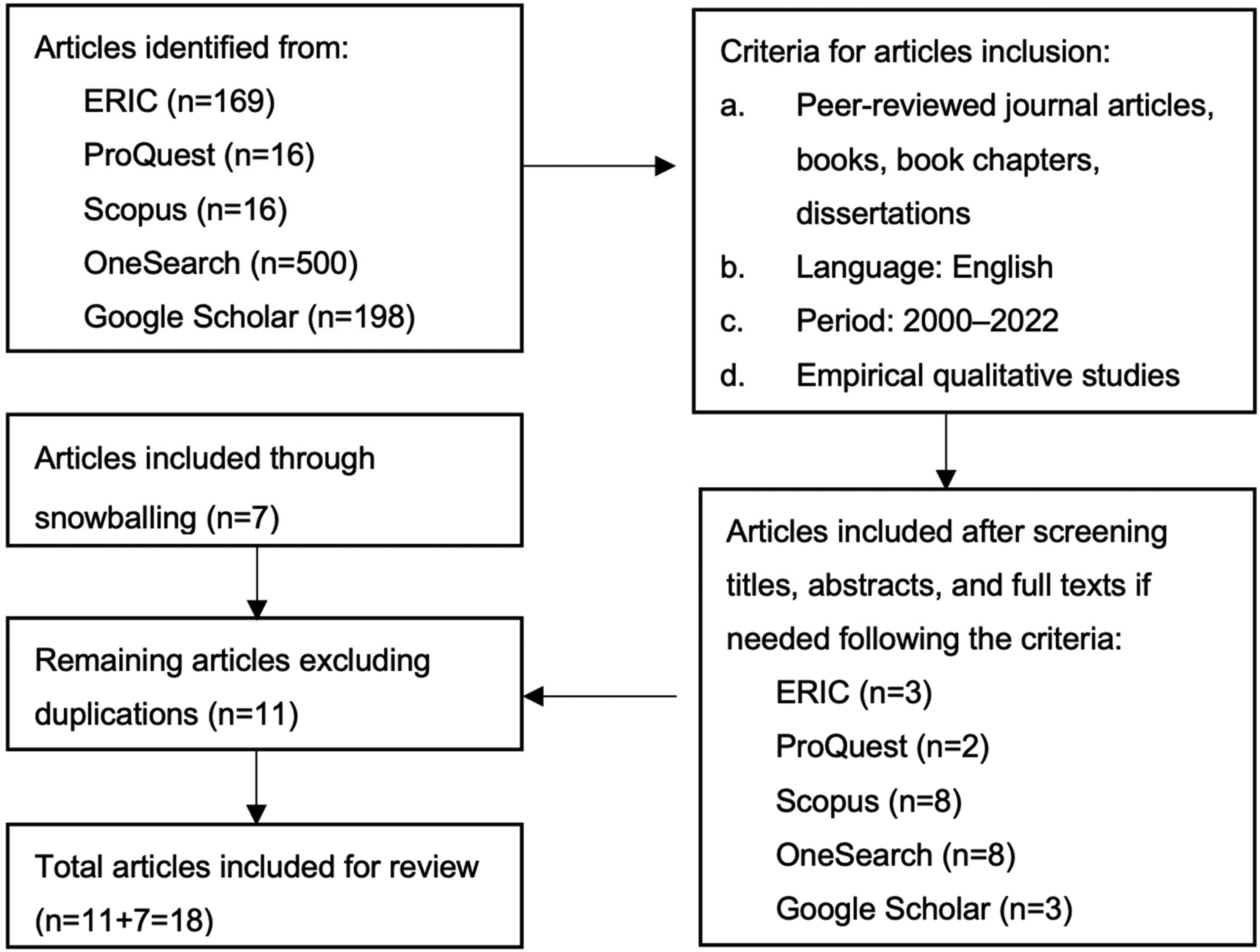
Flow diagram of literature selection.
Overview of the reviewed literature.
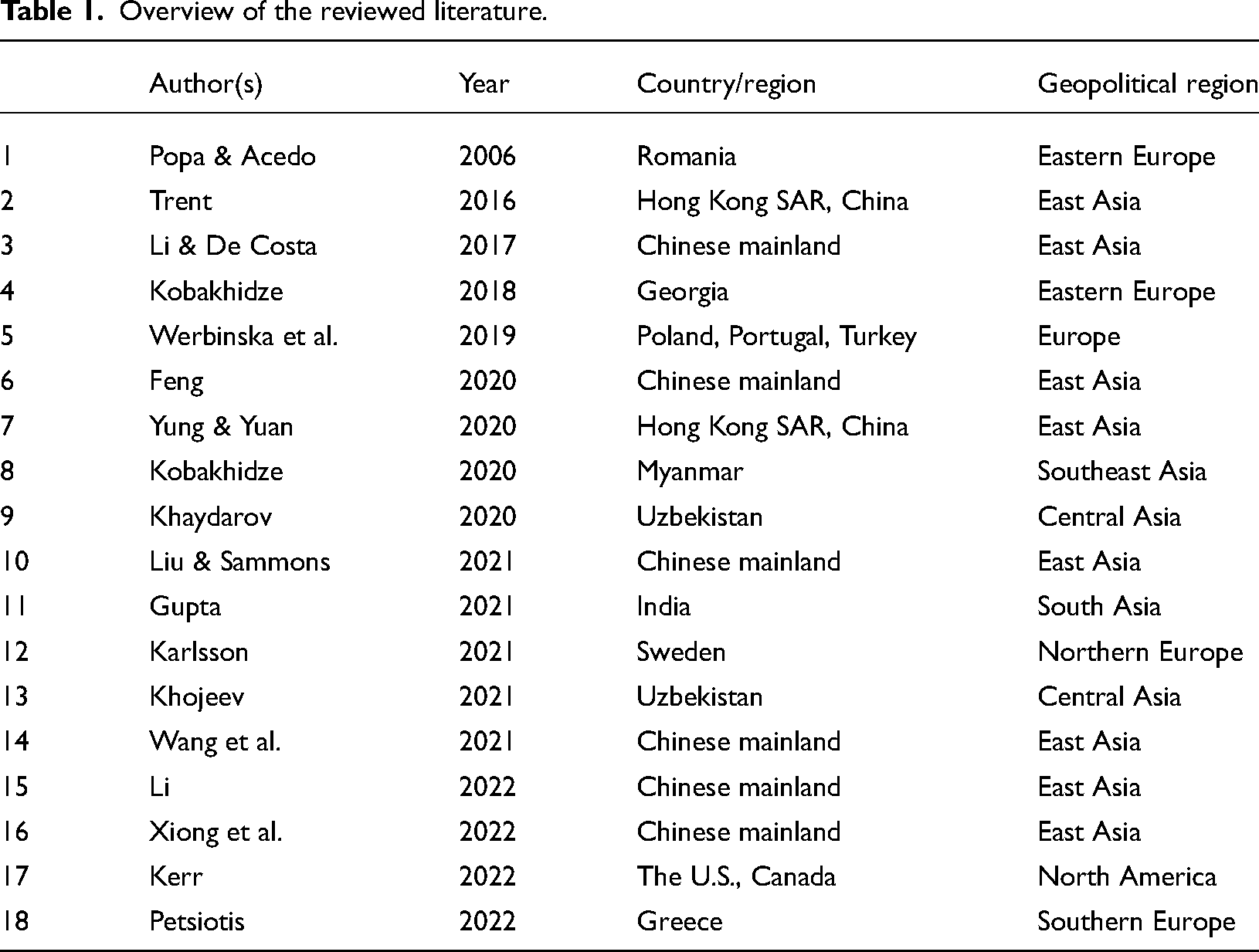
Among the 18 reviewed studies, eight were conducted in China (including two in Hong Kong SAR), two were in Uzbekistan, and one for each remaining country. Only one study was conducted in the first decade when research on shadow education started to gain momentum. The remaining ones are all concentrated in the following decades, especially from 2016 onward, signalling an increasing interest in private tutors from academia.
Data processing
Quality assessment of the studies, data extraction, and data analysis and synthesis are included in this section. Different from quantitative research, critical appraisal for qualitative studies remains controversial and without standardized criteria (Carroll & Booth, 2015). What is important in assessing qualitative research is the extent to which the study accurately captures and reflects the significance of the data, i.e., authenticity (Newman & Gough, 2020). Nevertheless, the three-dimensional appraisal framework—methodological quality, methodological relevance, and topic relevance (Gough, 2007)—is relevant here. Methodologically, the chosen studies employ robust qualitative designs, yielding valid data on private tutors’ self-perceptions and professional identity. The use of content, thematic, and discourse analysis effectively interprets the data in these 18 studies. Collectively, the evidence from these studies addresses the review questions comprehensively.
Adopting a thematic content analysis approach (Vaismoradi & Snelgrove, 2019), the studies were analyzed regarding their (a) identity/perception, (b) influencing contextual factors, and (c) implication. Initially, all articles were thoroughly reviewed to extract key findings related to specified criteria and logged into a spreadsheet. Additional study details, such as regional socioeconomic status, tutoring methods, student levels, tutor types, and subjects, were also recorded for further analysis and interpretation. Subsequent detailed reviews focused on recurring keywords related to tutor identity and contextual factors. This led to the creation of primary categories for tutor identities and socioeconomic and sociocultural themes. The categorization was repeatedly verified for accuracy and dependability.
Categories of private tutor identities
Three major categories of tutor identity were identified: claimed teacher identity as educators (7/18), imposed tutor identity as service providers (15/18), and achieved business identity as entrepreneurs (7/18). We should note that the identified identity categories may appear all in one study, or only one identity category was reported within a study, and not all identities found fit into these constructs. Overlaps of identities can be noticed but major themes will be stressed in each category in the following sub-sections.
Claimed teacher identity as educators
Seven of the 18 studies on private tutor identities reported educational teacher identity, among which five (Feng, 2020; Khaydarov, 2020; Kobakhidze, 2018; Petsiotis, 2022; Popa & Acedo, 2006) explored teacher-tutor dual identities where teachers expressed explicitly or implicitly that they were still teachers and/or fulfilling obligations of a teacher's role as an educator. Such claims are with good reason that even with the privatization of education and commodification of teacher expertise and skills under global neoliberalism, the role of private tutor implies its educational attributes in addition to its overt business nature (fee-based exchanges). It is especially true for schoolteachers providing private tutoring after school hours when the trained professional attitudes and conducts as a teacher over the years were carried with them into their tutoring sessions.
First, teacher identity as educators can be interpreted as a calling, an actively fulfilled Institution-identity. Tutors in these studies maintained that they were teachers doing what teachers were supposed to do. For example, Popa and Acedo (2006) found that Romanian teacher-tutors turned to private tutoring to reclaim their professional status, which post-communist reforms had eroded. These reforms stifled their professional competence, including authority and autonomy, which they restored in the avenue of private tutoring. Teacher-tutors in other countries with similar socioeconomic conditions expressed the same tendency toward recognizing the role of a teacher. Kobakhidze (2018) revealed schoolteachers’ struggle between the dual roles of being a teacher and being a tutor, prioritizing the teacher identity because they still referred to themselves primarily as teachers, downgrading the tutor identity to a secondary place. Hence, their self-claimed teacher identity was contrasted with the “self-imposed” tutor identity (p. 115).
Even in more economically developed countries or regions, where schoolteachers worked for tutoring companies, they exhibited similar mentality. Feng (2020) reported part-time teacher-tutors in Chinese mainland, for whom tutoring was just “doing a teacher's job here (at the tutorial center)” (p. 157). This strong sense of teacher identity is not limited to schoolteachers working as private tutors. Professional tutors also demonstrated positive attitudes when attempting to develop their teacher professionalism and gain teacher legitimacy. Liu and Sammons (2021) found that although 10 primary English tutors in Chinese mainland did not initially choose teaching as their career, they actively pursued professional development through intensive training, fostering student relationships, embracing moral responsibility in education, and cultivating collegial bonds. In carrying out these practices the tutors had in fact claimed the teacher identity as educators. It has demonstrated that teacher identity aptly justifies tutors’ position in the private education market. Such a commonly held belief was tactfully utilized by tutorial companies to advertise the preferred identity to attract students and parents, which was demonstrated by Yung and Yuan's (2020) study in Hong Kong SAR. However, no matter how strongly private tutors assert their educational identity, their role as service providers within the private tutoring industry remains undeniable.
Imposed tutor identity as service providers
Apart from the teacher identity as educators claimed by private tutors, over 80% of the studies (15/18) reveal the most prominent identity of being a tutor, i.e., being a service provider in the private tutoring industry. This identity as a service provider is considered an imposed Institution-identity since private tutors are expected to fulfill additional duties beyond the call of a teacher's responsibility. Whether self-employed or working for tutoring companies, tutors must prioritize meeting customer needs efficiently due to the transactional nature of their role. For example, in an exam-oriented education system, test-taking skills are desperately sought after and private tutors have thus taken on the role of “exam experts” (Xiong et al., 2022; Yung & Yuan, 2020) or “exam machines” (Trent, 2016). Being a service provider also means sacrificing personal and family time (e.g., Feng, 2020; Kobakhidze, 2018). The fluid working schedules and provisional workload make them like “firefighters” (Wang et al., 2021) who are always on call, or “stand-by tutors” (Karlsson, 2021) who provide for-profit services on demand.
Private tutors also double as salespeople, with some tutoring firms explicitly expecting them to engage in marketing efforts, from discussing renewals to distributing flyers (Feng, 2020; Xiong et al., 2022). Others adopt a subtler approach, embedding business acumen in tutors to foster relationships that secure future enrollments (Wang et al., 2021).
The shift from offline to online tutoring amplifies the service aspect of the role. Kerr (2022) found that two graduate students in the U.S. and Canada working as independent contractors for an online tutoring company experienced identity dissonance, rejecting the teacher label and likening themselves to consultants due to pressure to fulfill unrealistic promises and operating on a pay-per-lesson basis.
Under most circumstances, feelings and emotions attached to this tutor identity as service providers are negative. Professional tutors in Hong Kong SAR and Chinese mainland, and teacher-tutors in Georgia, Myanmar, and Uzbekistan all expressed negative sentiments toward their tutor identity. For example, in Myanmar, a nation deeply rooted in Buddhist tradition that venerates teachers, the commercialization of education through fee-based tutoring has tainted the esteemed teaching profession. Teachers there have expressed significant discomfort with the identity of a tutor, feeling “disgust” and “awkwardness,” yet many resort to it out of financial necessity (Kobakhidze, 2020). Such a downgraded service provider identity is also highlighted by Trent (2016) when a tutor positioned herself as “only a private tutor” (p. 122), contrasting a tutor located in a tutorial center with a teacher located in a real school. Unfavorable discursive environment is worsened by their clientele, who further reinforce the tutor identity as service providers. For example, clients, particularly parents, often scrutinize tutors’ credentials more rigorously than schoolteachers’, asserting their right to quality service in a paid transaction (Xiong et al., 2022).
Nonetheless, the negative feelings are sometimes offset by the gains from private tutoring. Despite the challenges of balancing dual roles, in his autoethnography, Petsiotis (2022) acknowledged the financial and professional fulfillment from private tutoring outweighs the drawbacks, with some tutors embracing the entrepreneurial aspect of their private business.
Achieved business identity as entrepreneurs
The third salient tutor identity is the business identity as entrepreneurs. Six studies show private tutors exhibit identity traits highlighting entrepreneurial mentality and strategies reflected in their views on the tuition market and approaches to navigating the education market. Neoliberal education reforms promote school privatization and business-like management, leading teachers to view themselves as “valuable resources” and commodify their teaching expertise (Gupta, 2021).
Business strategies adopted by private tutors include running tutoring centers, seeking partnerships, setting tuition prices, forming communities for tutee recruiting, and marketing. Running a tutorial center is an effective way to concentrate teachers’ resources while maximizing profit. For example, a tutor reported in India (Gupta, 2021) earned double the salary he received per month as a schoolteacher by operating his own center. Teachers also invested in professional equipment such as interactive boards, overhead projectors, computers, etc. (Werbińska et al., 2019) to assist the tutoring business. The tutoring price-setting process strongly manifests the business nature of this enterprise. Kobakhidze (2018) found that in Georgia, the pricing of tutoring services is influenced by competition, family income, subject demand, teacher qualifications, reputation, and marketing abilities, reflecting standard market dynamics. However, some tutors may offer discounted or free tutoring for social or moral reasons. Strategies for recruiting tutees include forming tutoring communities (Popa & Acedo, 2006), or a “system of referrals” (Kobakhidze, 2018), within which teachers recommend each other to their own students to mitigate risks. Private tutors exhibit entrepreneurial skills by marketing their services and personal brand through tactics such as discounts and package deals (Kobakhidze, 2018). Schoolteachers leverage their in-school reputation to attract students, whereas self-employed tutors use strategies like free trial classes to build trust and attract clients (Li, 2022). In Hong Kong SAR, professional tutors are even promoted as celebrities, borrowing the concept from the entertainment industry (Yung & Yuan, 2020).
Private tutors justify their entrepreneurial role by asserting they are “chosen” by clients based on their marketable skills and knowledge, meeting the natural demand for tutoring services (Gupta, 2021). Under this neoliberal thinking, both tutors themselves and the people surrounding them talk about, treat, and interact with them in such a manner that they have in fact achieved the business identity as entrepreneurs. This identity can be viewed as private tutors’ achievement or accomplishment.
Contextual factors of culturally diverse private tutor identities
Level of socioeconomic development
The teacher-tutor dual identity in the reviewed articles is mostly observed in countries with less developed economies, where salaries for schoolteachers remain just around the subsistence level. To illustrate, when private tutoring gradually became a global trend in the 1990s, the GDP per capita for Georgia, Uzbekistan, India, and Myanmar were significantly below the global average of $4,314, recorded at $1,614.6, $651.4, $367.6, and $49.3, respectively. By 2010, despite increases to $3,233.3, $1,742.3, $1,357.6, and $746.9, these countries remained well below the global average of $9,621 (The World Bank, 2023). The weak economies of these countries resulted in limited government spending on public education, as evidenced by teachers’ low salaries. In 2005, Georgian teachers earned $65 monthly, below the family subsistence level of $90, and despite increases to $175 by 2013, financial struggles persisted (Kobakhidze, 2018). Likewise, Myanmar teachers saw salary hikes in 2011 and 2015, yet averaged just 178,829 kyats, or roughly $85, by 2017 (Bray et al., 2020). In Africa, albeit no studies focusing on private tutors are found from the continent so far, relevant research shows that three out of the four lowest teacher salary ranking countries were African (Bray, 2021a). Financial strain has driven teachers from regular schools to provide private tutoring as a means to augment their income for survival. The professional sense of self inherited from being a schoolteacher thus has become a salient feature for their tutor identity outside of school. This sense is more strongly felt for teacher-tutors in the countries mentioned above compared to more economically well-off countries/regions, such as Hong Kong SAR, where teacher-tutors are not common (Bray et al., 2014) and tutors are mostly independent professionals.
The variation in tutor types reflects the extent of educational privatization across economies. In Hong Kong SAR's highly commercialized free economy, shadow education aligns with established market practices. Similar to the hagwons in South Korea, juku in Japan, and buxiban in Chinese Taiwan, tutoring companies in Hong Kong SAR are generally formally registered and can range from small to large scale, contrasting with the less formal arrangements often found in private tutoring sectors in poorer countries (Bray, 2013). Accordingly, some professional tutors are advertised as “star tutors” by leading tutorial companies (Yung & Yuan, 2020) with much fanfare compared with the modest word-of-mouth promotion strategies by teacher-tutors in less commercialized markets. In Chinese mainland, private tutoring experienced industrialization and capitalization phases (Feng, 2021) until 2021 when the “double reduction” policy, prohibiting financing for tutoring services, prompted legislative control and a move away from industrialization (Zhang, 2023). Previously, China had four million training centers and over 11 million shadow education workers (p. 58). The market's maturity meant professional tutors, often without school experience, were more involved in business-related activities beyond just teaching (Feng, 2020). Their weaker sense of teacher identity is sometimes overshadowed by the more prominent business identity, which is negatively claimed as just employees or service providers.
In Chinese mainland, despite a ban on in-service teachers offering private tutoring since 2015 (Liu, 2018), schoolteachers continue to provide these services, albeit more covertly. Teacher-tutors in Chinese mainland and those from economically disadvantaged countries both cite financial reasons for offering private tutoring, yet the former engage in it to enhance their quality of life rather than as a means of economic survival (Feng, 2020, p. 173). This distinction in economic motivation leads Chinese teacher-tutors to more readily embrace the commercial aspects of tutoring and engage in business activities, reflecting their business identity. This “earning extra money” business sense of private tutors is in line with that of tutors from Poland, Portugal, and Turkey (Werbińska et al., 2019), where teachers’ incomes are relatively better off.
Inherited political ideologies and social values
This factor is most salient in the post-Soviet and post-socialist countries in Central Asia and Southeast/Central Europe. Before the Soviet Union's dissolution in 1991, education across the republics was uniform and centrally managed (Heyneman, 2010; Tudge, 1991), guided by Marxist-Leninist principles that education should be universal and free, and with an emphasis on moral education about the values of collectivism and labor (Tudge, 1991). Schools and other state or publicly operated educational institutions were the sole recognized venues for education, sidelining any form of for-profit supplementary private tutoring, which the government dismissed as undermining the esteemed Soviet educational system (Silova, 2009; Silova & Bray, 2006). Despite the socialist tenet of a classless society, the Soviet society exhibited significant class stratification (Nove, 1983). Within this hierarchy, teachers occupied a nuanced position: They were at the lower end of the intelligentsia yet held a higher status than peasants and blue-collar workers (Zajda, 1980). Though existing, private tutoring was officially disregarded and deemed contradictory to socialist ethics (Kobakhidze, 2018). Moreover, market activities were condemned as “illegal” and “immoral” according to Marx and Lenin's socialist philosophy (Humphrey & Mandel, 2002). The fall of the Soviet Union precipitated major political and economic shifts in post-socialist countries, leading to a value system upheaval amidst the transition to democracy and capitalism (Finifter & Michiewicz, 1992; Keshishian & Harutyunyan, 2013). Private tutoring took hold due to financial constraints that cut expenditure on public education and teacher salaries, educational reforms that decreased public schooling quality and heightened competition for university admission, and a growing cultural emphasis on higher education attainment (Silova, 2010).
The Soviet legacies clashed with the post-Soviet changes, contributing to shifts in perceptions of private tutor identities. On the one hand, neoliberal reforms in the education system after the collapse of the socialist bloc—standardization of curricula, decentralization and privatization of schools, the introduction of national educational assessment and international testing (Silova & Brehm, 2012, p. 55)—brought about immense pressure to teachers who were becoming “the implementers of reform policies designed and controlled by others” (Popa, 2007). The threat to teacher professionalism engendered by the reforms drove teachers to a parallel educational space—private tutoring—in an attempt to regain their lost professional authority and autonomy (Popa & Acedo, 2006; Silova & Brehm, 2012). In this sense, negotiating their professional self in a private space free of control reinforces teacher-tutors’ teacher identity as educators.
On the other hand, although the post-socialist nations were eager to transform into Westernized democracies since the collapse of the Soviet Union, its legacies—social values, ethics, etc.—were still felt across the whole society (Silova & Bray, 2006). For example, in Georgia, a post-Soviet state, the enduring communist belief that education should be free and universal brands for-profit private tutoring as an “illegal private business” that undermines equality (Kobakhidze, 2018, p. 43). The socialist governments’ legacy of hostility toward private tutoring intensified tensions between teacher-tutors’ strong sense of morality and the profit-seeking market values of private tutoring. Once esteemed as intellectuals during the Soviet era, teachers’ engagement in private business has since diminished their social status. Consequently, negative feelings such as guilt and humiliation are often attached to the tutor identity when tutoring is seen only as a service to make money, rather than as a public good serving every child. This moral dilemma can be found in other post-socialist and post-Soviet countries such as Romania (Popa, 2007) and Uzbekistan (Khojeev, 2021).
Religion and traditional culture
The local sociocultural environment influencing private tutors’ perception of teacher identity also includes religion and traditional values, a factor notable in East and Southeast Asia. In particular, Confucius culture is believed to have driven Chinese families to seek extra tutoring (Zhang, 2014). The Confucian principle 有教无类 (literary “impartial instruction for every kind” [you jiao wu lei]) suggests education should be classless, offering students of all backgrounds the prospect of a better future through hard work (Kwok, 2004; Zhang, 2014). Chinese parents thus view private tutoring as a worthwhile investment in their children's education, enabling them to compete and break barriers to social mobility. From the teachers’ perspective, this idea aligns with the philosophy of universal and equal education, offered to all for free. This belief paradoxically clashes with the reality of fee-based private tutoring, which creates a skewed view of educators. Public school teachers are respected for developing students’ overall growth, while private tutors are often dismissed as mere service providers focused on exam preparation. This discrimination contributes to the differing identities of teacher-tutors versus non-teaching tutors. Being a schoolteacher justifies the legitimacy of tutoring outside of school and in effect privileges teacher-tutors when recruiting tutees. Therefore, teacher-tutors more readily claim the teacher identity as educators, while company-employed tutors are more identified with the imposed identity of service providers.
Strong religious beliefs can be another cultural factor shaping private tutors’ perceptions of their identities. Kobakhidze (2020) noted that in Myanmar, where Buddhism shapes societal norms, teachers are revered, akin to Buddha, embodying high moral standards. Yet, their engagement in private tutoring has diminished their role from respected educators to mere service providers, undermining their esteemed status. Individualist values such as self-interest clash with collectivist ones such as common good, incurring negative sentiments when referring to private tutoring. Hence, social condemnation alongside financial plights strengthens teacher-tutors’ struggle between symbolic satisfaction and economic needs. Their professional identities are fragmented and professional legitimacy undermined, reinforcing their tutor identity as no more than service providers.
Both Confucian and Buddhist traditions historically revere teachers, with respect for them deeply rooted in cultural practices. However, Feng (2020) and Kobakhidze (2020) argued that paid tutoring compromises the very qualities—knowledge, morality, integrity—that earn teachers respect, thereby affecting how tutors perceive their own professional identity. To illustrate, being needed and recognized by clients justifies a tutor's sense of being a qualified teacher (Li, 2022), whereas being questioned strengthens their sense of being “underdogs” (Xiong et al., 2022); and not being addressed by the title “teacher” or laoshi in Chinese can be confusing and annoying to tutors sensitive to their educational identities (Feng, 2020). This highlights one facet of how cultural and religious forces shape private tutor identities, showcasing their intricate interplay.
Likewise, the local private tutoring traditions can partially influence private tutors’ views toward the practice and their tutor identities. The assumption that shadow education has a low participation rate in Europe is contradicted by Greece, where a strong tradition of private tutoring persists due to historical, political, and socio-economic conditions (Kassotakis & Verdis, 2013). This misconception overlooks the particular European contexts where the phenomenon is actually gaining prevalence (Bray, 2021b). Greece has the highest rate of private tuition in Europe, with rates surpassing 95% among last-year secondary school students, and it is a common practice for schoolteachers to offer such tuition (Bray, 2011, 2021b). Petsiotis (2022) revealed that despite its illegality, private tutoring is culturally and socially embedded in Greece, often taking precedence over ethical considerations. Furthermore, for many teachers, the identity as a tutor is as significant, if not more so, due to the financial benefits and job satisfaction it provides. The normalized practice of private tutoring in the Greek society (Tsiplakides, 2018) thus facilitates acceptance of the tutor identity.
Institutional dynamics
The last recurring dimension of contextual factors shaping private tutors’ attitudes and perceptions of their identities relates to the institutional dynamic of a country or region's dominant school administration approaches, the general landscape of the shadow education industry, and the organizational features of individual tutoring companies. These institutional factors function independently or jointly in forming tutors’ conceptualization of their identities. On the school side, neoliberal educational reforms have pushed public schools toward market-oriented practices, driving teachers to monetize their expertise in response to demands unmet by standard schooling (Ball, 2016; Silova & Brehm, 2012). Capitalizing on their positions, teachers are increasingly venturing into the shadow education market, adopting entrepreneurial roles.
On the private industry side, the profit-driven operation of the shadow education businesses has reinforced the imposed tutor identity as service providers. In the competitive exam-oriented education landscape, tutorial businesses prioritize profits, often at the expense of educational quality. They cater to students’ immediate needs for exam preparation, adopting an industrial approach that prioritizes quick, efficient results. In highly commercialized markets in East Asia, South Korea, Japan, and Hong Kong SAR in particular, tutoring companies are characterized by large classes and a focus on test-taking skills. Consequently, tutors have limited opportunities to build meaningful relationships or pursue professional growth, which diminishes their sense of professional identity and reduces them to mere cogs in a teaching machine, focused on delivering results rather than fostering genuine learning (Li & De Costa, 2017; Trent, 2016). In some online private tutoring, the combination of “unrealistic” expectations from the management and clients, overstated promises to students, a pay-per-lesson compensation model, and isolation from professional communities in one-on-one settings discourage tutors from claiming a teacher identity (Kerr, 2022). Other non-teaching engagements attached to the tutor role by tutorial institutions, such as class promotion, company marketing, and student enrollment activities (e.g., Feng, 2020; Wang et al., 2021), all work to shape private tutors’ role perception and reinforce their sense of the tutor identity as service providers.
Discussion and implications
The review synthesizes 18 empirical studies on private tutor perceptions and identities, uncovering several issues for scholarly discussion despite the limited sample size. In the discussion, we try to understand private tutor identity through Gee's lens, analyze the geographical disparities of research in the field, and review the different roles shadow education plays within the holistic education system and their relationships to private tutor identity. Implications for future research as well as for regulation of the sector are suggested.
Interrelationship between I-identity and D-identity
It is useful to understand private tutors’ identities through Gee's theory in three ways: (a) the roles or duties entailed in the I-identity and its different realizations along a continuum, (b) the discursively realized I-identity, and (c) the fluidity between I-identity and D-identity.
First, Gee (2000) argued that a person's institutional identity is largely shaped by his or her position institutionalized by society, molded by the roles or functions he or she is undertaking, and how the person perceives this I-identity influences how he or she actively fulfills or passively fills his or her role or duties. The multi-dimensional tutor identity reveals the multiple roles undertaken by tutors in the shadow education sector, while some of them see the position as a calling, others see it as an imposition. When private tutors embrace their role as educators, they assert their expertise and equivalence to classroom teachers, despite often teaching one-on-one, and commit to student success and professional growth. When they view themselves as service providers, they engage passively, delivering content to clients, fostering client relations, accommodating schedules, marketing their offerings, and navigating client scrutiny and demands within a transactional context. When adopting an entrepreneurial identity, tutors align with the neoliberal shift in education, leveraging opportunities to commercialize their knowledge, employing market tactics for pricing and recruitment, and rationalizing their operations within the logic of supply and demand. These roles, obligations, and attributes are institutionalized by social traditions, rules, and/or principles. Hence, the multiple identities constructed by private tutors indicate a complex integration of multiple roles, which cannot be naively judged with a dichotomy of good or bad, sacred or profane, moral or corrupt.
Second, the realization of the I-identity must be underwritten and sustained by discursive practices by an institution, which means “that institution works, across time and space, to see to it that certain sorts of discourse, dialogue, and interactions happen enough and in similar enough ways to sustain the I-identities it underwrites” (Gee, 2000, p. 105). As analyzed in the last section about institutional dynamics, private tutors employed by tutoring companies often internalize the service culture of the shadow education market, which is explicitly stipulated by the company or implicitly abided by as “unwritten rules.” In every tutoring session/class, every teaching meeting, every interaction with students and colleagues, and even just being in the company environment, private tutors are surrounded by discourses through which their I-identity as service providers is sustained. For teacher-tutors, who primarily derive their sense of identity as educators from school discourses that emphasize professional conduct and ethics, being addressed as “teacher”—a title that carries specific rights and duties—serves as a constant reminder of this identity. This identity, discursively constructed within the mainstream educational system, remains with them even when engaging in private tutoring, ensuring they do not forget their primary role as educators.
Third, the relationship between the I-identity and the D-identity is fluid and dynamic. Sometimes, the influence of institutional values and norms extends beyond their original boundaries, permeating people's “‘everyday’ common sense” (Gee, 2000, p. 111). For example, a teacher-tutor does not work for a tutoring company, however, when the teacher provides tutoring, he or she is expected to adopt the service-oriented values such as individualized tutoring and test-taking skills teaching. Conversely, a company-employed private tutor would be recognized as a teacher as it fits people's everyday “common sense” when the tutor cares for students and provides professional teaching, even if the D-identity “teacher” is not underwritten by any institution (school). At this point, the boundary between teacher and tutor is blurred, indicating the intersection of education and business and overlap of roles (Bray, 2022). Furthermore, as governments in different countries frown upon private tutoring, especially tutoring provided by schoolteachers, the official rhetoric is increasingly infiltrating the daily lives of individuals. One example can be the effect of the “double reduction” policy in Chinese mainland. Examination of their early experiences (Yang et al., 2023) reveals that images of private tutors have been greatly diminished as they are cracked down on for engaging in illegal tutoring activities. When people talk about and treat private tutors in a negative way, this discursively constructed D-identity represents the attitudes and values of national institutions (e.g., the State Council, Ministry of Education, and law enforcement agencies). It indicates that any evolution of private tutor identity may reflect changes in “Discourse,” a combination of words, deeds, values, etc. (Gee, 2000, p. 110). Further research of private tutor identity should take into account spatial and temporal factors as Discourse varies across time and space.
Geographical disparities of research
The distribution of studies on private tutors is geographically uneven. As shown in Table 1, two thirds of the reviewed studies were conducted in Asian countries/regions, especially in East Asia. From a historical perspective, the tradition of private tutoring in Asia, particularly Japan, South Korea, and Chinese Taiwan, has been long and most visible (Bray & Lykins, 2012). In the case of Chinese mainland, despite the legacy of Confucianism, private tutoring was suppressed during the period when the Communist government prohibited private business activities. It only began to prosper around the 1990s as market economy gained traction under the Party's reform and opening-up policy (Bray & Lykins, 2012). In other parts of Asia, the phenomenon has also been entrenched in the day-to-day existence of families, though the reasons for its origins vary as analyzed in the section of contextual factors.
Despite increasing academic interest in shadow education in the recent two decades, research on private tutoring in the Asian region mostly focused on its causes and determinants (e.g., Bae & Choi, 2024), social impacts (e.g., Entrich, 2017), and policy implications (e.g., Zhang, 2023) besides mapping its landscape, attention accorded to private tutors is marginal. In regions like Northern and Western Europe, the Middle East, North and South America, Oceania, and Africa, where mapping of the phenomenon is at the early stage (e.g., Bray, 2021a; Bray & Hajar, 2023; Bray & Ventura, 2024; Christensen & Zhang, 2021), there is a notable scarcity of data on private tutoring, and even less is known about the private tutors themselves. Furthermore, it is possible that studies of private tutors in these countries/regions have been conducted and published in languages other than English, making them linguistically inaccessible for this review.
Finally, studies on private tutors conducted in the Asian region are far from abundant in comparison to the scale of the phenomenon in this area, as evidenced by the relatively small sample of the current review. To enhance our understanding of private tutors globally, we need more studies from diverse socioeconomic and sociocultural settings. For instance, the practice of Egyptian tutors in the Arabian Gulf reflects unique tutoring traditions (Bray & Hajar, 2023; Ridge et al., 2017).
Additionally, existing research, including studies from regions undergoing policy shifts like China's 2021 “double reduction” policy—which strictly regulates subject tutoring for students receiving compulsory education and seeks to curb the tutoring market (Ministry of Education of the People's Republic of China, 2021)—needs to be updated to capture the evolving landscape.
Context-specific role of shadow education and policy implications
The geographical disparities in the prevalence of shadow education indicate that private tutor identity is also influenced by the different roles the phenomenon plays within the holistic education system. Shadow education exerts complex multi-level effects on the ecology of education, including but not limited to students’ academic performance, teachers’ roles and professionalism, family and national expenditure in education, government policies, and educational inequality (Luo & Chan, 2022). The nature and extent of these influences indicate whether it supplements formal schooling or has become a norm, effectively substituting the mainstream education system. In the countries/regions reviewed, for example, shadow education in East Asia (e.g., South Korea, Japan, Hong Kong SAR) is highly institutionalized and widespread, constituting an indispensable part of a student's education. In this region, a high cultural emphasis on educational achievement and entrance into prestigious universities fuels the demand for private tutoring.
Moreover, different from the remedial nature of shadow education in many places, high-achieving students are more likely to attend private tutoring in these countries/regions (Byun et al., 2018). Private tutors under institutionalized shadow education are professionals more committed to helping students achieve higher academic performance and excel in high-stakes tests.
In Eastern Europe and Central Asia (e.g., Romania, Georgia, Uzbekistan), private tutoring did not gain popularity until the 1990s when the Soviet Union dissolved and the economy collapsed in these countries. It has thus become a parallel space (Popa & Acedo, 2006) for students to seek extra tutoring to compensate for the deteriorating quality of public education and prepare for competitive university entrance exams, and for schoolteachers to supplement their shrinking wages and regain their lost professional autonomy induced by educational reforms.
In Western Europe and North America (e.g., Sweden, the U.S., Canada), the scale of shadow education is modest though increasing in recent years. Private tutoring is often provided by part-timers (professionals, university students) to cater to specific needs (e.g., Karlsson, 2021). Notably, government-subsidized tutoring programs targeting low-achieving students characterize countries such as England, Australia, and the U.S., as noted by Bray (2009). It is different from the market-driven tutoring the current study discusses. However, it is worthwhile to conduct further comparative examination of the two types of tutoring to derive valuable insights for the future development and regulation of the tutoring industry.
Beyond the countries/regions reviewed, there is a need for research into private tutors in areas where shadow education takes on a contextually distinct role. For instance, Dubai presents a unique case: 91% of its population is non-national and 87% of schoolchildren attend private schools that offer up to 17 different curricula, which in turn shape the role and structure of shadow education (Bray & Hajar, 2024; Bray & Ventura, 2022). It is assumed that private tutors within this emirate construct their identities in a manner that markedly diverges from their counterparts in other regions.
The analysis of the relationship between private tutor identity and the contextually specific role shadow education plays within an education system is illuminating for policymaking. As evidenced in many countries, regulations and policies enforced to curb or crack down on shadow education usually fail to do so, and sometimes are even counterproductive (e.g., Exley, 2022; Zhang, 2023). As suggested by Bray and Kwo (2014), although it is not easy to mitigate the phenomenon that is deeply engrained in the culture, in places where private tutoring (esp. provided by schoolteachers) is still in its infancy, governments can learn lessons from their experiences. When crafting policies, it is also important to factor in the contextual factors unique to specific areas. By examining private tutors’ identities and the forces driving their spread, policymakers can gain insights to better address the industry's growth.
Conclusion
In the ongoing quest to uncover the nuances of tutor identity, this study marks a recent attempt to review qualitative studies on private tutors over the past two decades. Though limited, they represent private tutors from historically, economically, and culturally diverse contexts. Behind the prominent private tutor as educator, service provider, and entrepreneur sub-identities, contextual factors such as socioeconomic status, political ideologies and social values, religions, and institutional operations are concurrently shaping the similarities and discrepancies of private tutors’ perceptions toward their identities. The findings also reveal several key insights, including the multifaceted roles reflected in private tutors’ multi-dimensional identities, the interplay between their institutional and discursively constructed identities—which signals shifting public discourses about the profession and the geographical disparities in both the prevalence of shadow education and its research, highlighting the variable roles that private tutoring plays within the educational ecosystems of different contexts. By situating private tutors in the cross-cultural and broader global picture of shadow education, we are able to extend our understanding of the complex phenomenon while mapping its landscape and evaluating implications for policymakers and other stakeholders.
Although the reviewed studies constitute a modest subset of the extensive shadow education landscape, and the sample size is relatively small given the possible difficulties accessing private tutors, the review offers insights for future research by synthesizing the sampled studies, identifying patterns and themes and engaging in in-depth discussions. Current research on shadow education is struggling to keep up with the sector's rapid global expansion, with studies on private tutors lagging even further. The review underscores the necessity for a more robust and expansive research agenda. It is imperative that scholarly attention is not only sustained in regions with a recognized research tradition but also merited in areas that have been understudied to date, such as North America, South America, Africa, Western and Northern Europe, and the Middle East. Therefore, we call for an enhanced scholarly focus on the sector and its practitioners, with a keen attention to the diverse and multifaceted contextual factors that shape this phenomenon.
Footnotes
Contributorship
Min Lyu was responsible for conceptualization, methodology, data curation, analysis and interpretation, and writing. Ricky Lam contributed to conceptualization, review and revision, guidance, and mentorship.
Declaration of conflicting interests
The authors declared no potential conflicts of interest with respect to the research, authorship, and/or publication of this article.
Funding
The authors received no financial support for the research, authorship, and/or publication of this article.
