





Abstract
In this study, powernet warp-knit fabrics were designed using polyethylene terephthalate (PET) yarns melt-spun with three different amounts (20, 25, and 30 wt.%) of barium titanate (BaTiO3) and 30 wt.% elastane yarns. The resulting fabrics were characterized by antimicrobial activity cytotoxicity electromagnetic shielding properties, differential scanning calorimetry (DSC) analyses, stiffness tests at MD and CD (machine and cross directions), and pressure measurements using wireless pressure sensors. According to the results, the newly-designed pressure garments would help in the rehabilitation of cerebral palsy patients to improve motor skills and to prevent complications by training muscles with the needed tight structure and electric stimulus onto limbs. They would also provide a hygienic environment during long physical therapy for future designs.
Introduction
Pressure garments have been shown to provide physical therapy relief for cerebral palsy (CP) sufferers. These garments help a person build strength that can allow them to sit up, roll over, hold their head up, or perform other physical feats, according to suit therapy practitioners. The entire suit acts as a soft exoskeleton that corrects abnormal muscle tone and re-trains a person's brain to recognize correct muscle movements. They are effective when they are donned, providing much-needed dynamic compression to muscles with abnormal tone, sensory and proprioceptive feedback, and musculoskeletal alignment and stability. People with CP, spinal cord or traumatic brain injuries may have problems with balance, leg positions, lower limb awareness, and endurance or muscle extension, among other physical challenges. There are different compression garments available to help with these problems. In Fig. 1, a pressure garment used for a patient with CP is presented.
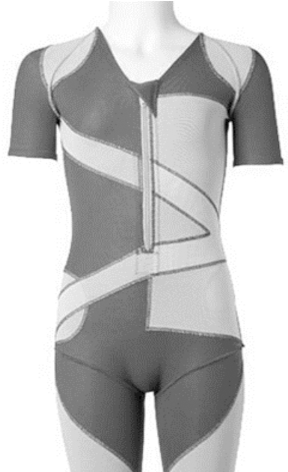
A pressure garment for use with cerebral palsy patients.
Although elastic orthoses have been used for around ten years, there are very few research studies that have looked at the effectiveness of these garments. There are some short-term before and after studies, but long-term effectiveness has not been evaluated. There has been one randomized controlled trial of the effectiveness of elastic garments. 1
Pressure garments are dynamic splints, which reduces hypertonus and fluctuations in tone, reduces contracture of muscle and soft tissue, and improves postural alignment, proximal stability, and upper limb movements. The knitting structure and the yarns used in designs provide extra support by creating an increase in proximal stability. The transformative nature and excellent elastic recovery of pressure garments can provide correction to abnormal postures and movements. Smoothing of movement and improved proximal and/or distal stability have been demonstrated in children with athetosis, ataxia, and spasticity. An assessment of upper-limb function and movement in children with CP wearing elastic garments was analyzed and the garments gave improvements in at least one of the functional scales of the Paediatric Evaluation of Disability Inventory (PEDI). 2 In addition, improved trunk control, fine motor skills, and sitting balance have been reported in children with hypotonia. 3
The present study aimed to help the rehabilitation of CP patients with a new pressure garment design using a powernet warp-knit structure including 30% elastane using antibacterial PET/ barium titanate (BaTiO3) yarns in three different barium titanate percentages.
Experimental
Materials and Methods
PET yarns melt-spun with three different percentages of BaTiO3 nano-powders were purchased and knitted in a powernet warp-knit structure using 30% elastane yarns. This was a raschel knit with inlaid yarns, where each needle in the knitting width was fed by at least one yarn and was in line with the direction of fabric production. All fabrics were knit at a weight of 300 g/m2 and 2.00-mm thickness as shown in Fig. 2. The powernet warp-knit structure was chosen due to its elastic structure and elastic recovery properties. The elasticity of these fabrics was extremely important as it is one of the major contributing factors affecting the pressure exerted by pressure garments on the skin. Fabrics with high elastic moduli will exert more pressure on the skin than those with low elastic moduli. The BaTiO3 contents in the yarns were chosen as 20, 25, and 30 wt.% and the yarns were labelled as A, B, and C respectively. The effects of the BaTiO3 percentages on the antibacterial activity, cytotoxicity, electromagnetic shielding, exerted pressures, and stiffness properties of the materials were determined.
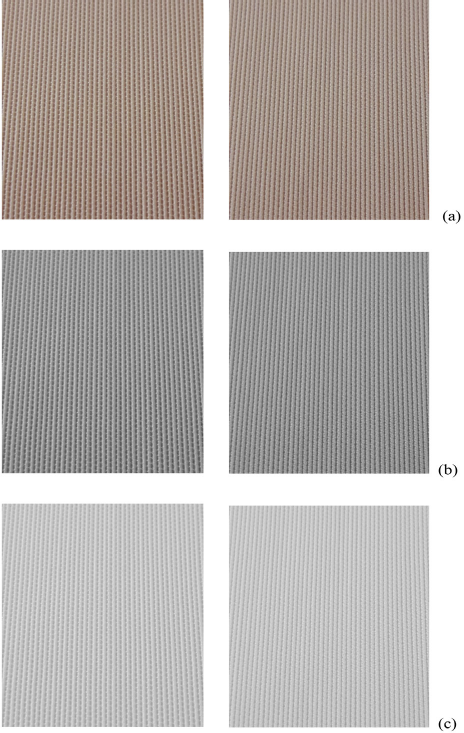
PET/BaTiO3 powernet fabrics. (a) Samples A, (b) B, and (c) C (left-fabric face, right-fabric reverse).
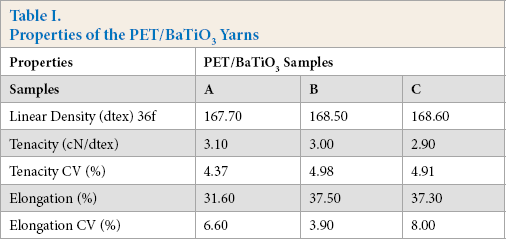
The properties of the samples are presented in Table I and cross sections of the PET/BaTiO3 yarns taken with an optical microscope are presented in Fig. 3. Type A yarn showed the greatest tenacity at 3.1 cN/dtex. It showed a small, but statistically significant decrease with the increase in the BaTiO3 nano-powder percentage, which indicates a weakening of the bonds between each polymer. The BaTiO3 nano-powders in cubic crystalline phase were from Sigma Aldrich (St. Louis, MO, USA) with purity of ≥99% based on trace metal analysis, a dielectric constant of 150, a particle size of ≤100 nm, and a density of 6.08 g/mL at 25 °C.
Properties of the PET/BaTiO3 Yarns
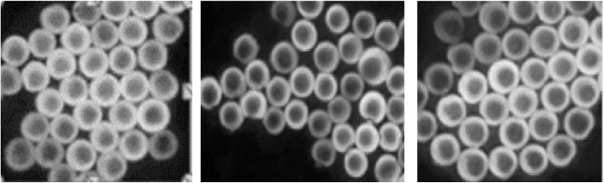
Cross section images of PET/BaTiO3 samples (from left to right; samples A, B, and C).
Analysis
Antibacterial Activity
The experimental method used to determine the antibacterial activity was AATCC TM100-2004 using Staphylococcus aureus (ATCC 6538) and Escherichia coli (ATCC 25922) with a 2.00 × 10⁵ CFU/mL test inoculum. 4 AATCC TM61 (2A)-2010 was followed to evaluate the washing durability.5 The samples were evaluated after 10 and 20 washes. Percentage reduction of bacteria was calculated using Eq. 1.
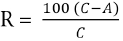
R is the percentage reduction of bacteria, A is the number of bacteria recovered from the inoculated sample at 0 contact time (CFU/mL), and C is the number of bacteria recovered from the inoculated sample after 24 h oscillation (CFU/mL).
Cytotoxicity Testing
The cytotoxicity of PET/BaTiO3 was assessed using the MTT (3-(4,5-dimethylthiazol-2-yl)-2,5-diphenyltetrazolium bromide) assay with L929 mouse fibroblast cells. First, cells were cultured in the MEM-Alpha medium supplemented with 10% fetal bovine serum (FBS). Then they were incubated at 37 °C in a wet atmosphere containing 5% CO2. The tested PET/BaTiO3 fabrics were cut into 2.5 × 2.5 cm pieces and soaked in 2 mL of culture medium with no FBS for 3 days. The extracts were diluted to a concentration of 25% with culture medium, and then L929 cells were seeded in 96-well plates at a density of 2000 cells per well and incubated for 24 h. Then, the medium was removed and replaced by prepared extracted dilutions. After incubation for 24, 48, and 72 h, the cells were treated with 20 μL per well MTT solution (5 mg/mL in phosphate buffered saline, PBS) and incubated for another 4 h at 37 °C. Then, 200 mL per well dimethyl sulfoxide (DMSO) was added to dissolve the formazan crystals. 6 The plates were shaken for 15 min, and the optical density was detected on a multi-well microplate reader (Tecan GENios, Tecan Austria GmbH, Salzburg, Austria) at 490 nm. Cell viability was calculated using Eq. 2.

OD sample is the absorbance of the test sample and OD control is the absorbance for untreated control cells.
Electromagnetic Shielding Effect
The electromagnetic shielding properties were evaluated according to the ASTM 4935 standard test method for measuring the electromagnetic shielding effectiveness of planar materials. 7 This test method provides a procedure for measuring the electromagnetic (EM) shielding effectiveness of a planar material due to a plane-wave, far-field EM wave. From the measured data, near-field shielding effectiveness (SE) values may be calculated for magnetic (H) sources for electrically thin specimens. The measurement method is valid over a frequency range of 30 MHz to 1.5 GHz. SE is the ratio of power received with and without a material present for the same incident power. SE was calculated using Eq. 3.

P1 is the received power with the material present and P2 is the received power without the material present.
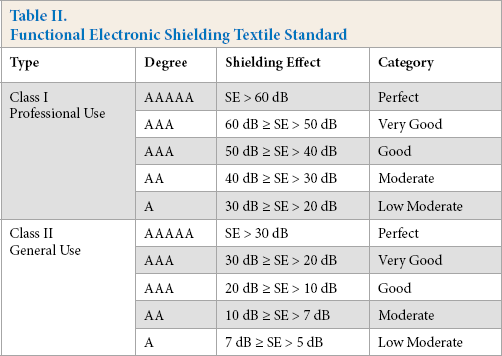
The measurements were taken from different parts of the samples between 30 MHz and 1.5 GHz frequencies and repeated ten times. The shielding effect data were all obtained in dB units. Then, the obtained results were evaluated according to FTTS-FA-003 (2005) (Functional Technical Textile Standard) 8 as shown in Table II. This standard was used to determine the required SE for significant shielding effect values.
Functional Electronic Shielding Textile Standard
Differential Scanning Calorimetry (DSC)
Thermal transitions of the type B samples were determined using a Perkin Elmer Diamond 7 differential scanning calorimeter (DSC). In the DSC procedure, a small sample (4–5 mg) was pressed into an aluminum mold and heating-cooling-heating cycles were applied at 0 °C to 300 °C. After the first heating cycle, the sample was kept at 300 °C for 1 min before being cooled to 0 °C. The first heating was carried out at a rate of 10 °C/min, with successive cooling and heating cycles of 10 °C/min, and the analysis was repeated three times.
Stiffness Tests
Stiffness was measured for all samples according to ASTM D5732, 2001. 9 The samples were conditioned for 24 h at 20 °C and 65% relative humidity (RH) in the physical testing lab before testing.
Pressure Measurements
Pressure measurements were taken on each garment designed for calf and ankle (from ankle to knee) using a static mannequin. They were tested using wireless pressure sensors with 10 repeats after samples were conditioned for 24 h at 20 °C and 65% RH in the physical testing lab. Measurements were recorded using calibrated pressure sensors that were connected to a data acquisition and management software program by wireless transmitters.
Statistical Analysis
Statistical analysis of the experimental data was performed using the JMP version 8.0.2 software package (SAS Institute Inc., Cary, NC, USA). Statistical analysis includes the analysis of variance (ANOVA), where SS is the sum of squares of the deviations from the means, df is the degrees of freedom, MS is the mean squares, F is the ratio of two independent chi-square variables divided by their respective degrees of freedom, p-value is the probability of obtaining test results (at least as extreme as the results actually observed during the test, assuming that the null hypothesis is correct), and F-crit determines the significance of the groups of variables. For the one-way ANOVA, p-values less than 0.05 were considered statistically significant. All of the data are also presented as average ± standard deviation.
Results and Discussion
Antibacterial Activity
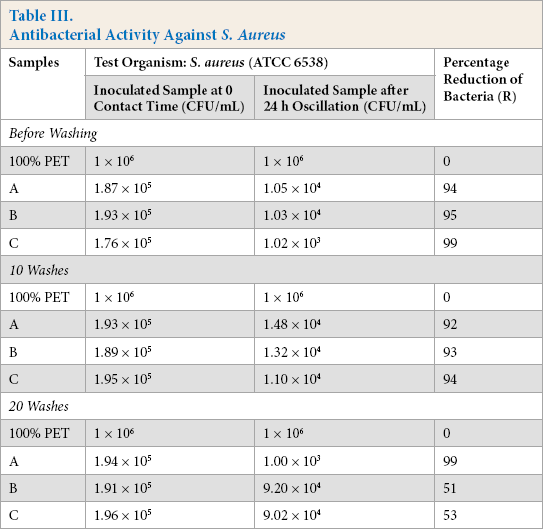
The antibacterial properties of the control (100% PET fabric) and PET/BaTiO3 samples are presented in Tables III and IV. The total population of S. aureus and E. coli on each sample was determined. After the antibacterial tests were performed, the live bacterial concentration of the standard blank sample at zero contact time, as well as that of a standard blank sample oscillated for 24 h, and that of the antibacterial fabric sample oscillated for 24 h, were compared. The effect of contact time on percentage reduction of bacteria with PET/BaTiO3 fabrics against E. coli and S. aureus are shown in Tables III and IV.
Antibacterial Activity Against S. Aureus
Antibacterial Activity Against E. coli
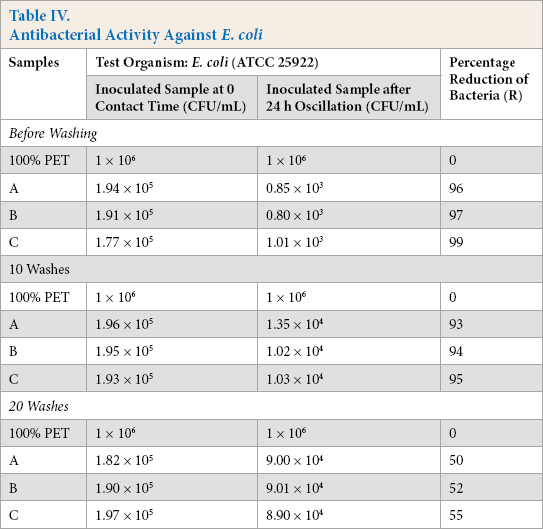
The percentage reduction of S. aureus was lower than that of E. coli, because the cell wall for Gram-positive bacteria like S. aureus consists of linear ester linkages crosslinked with short peptides of bacteria to form a three-dimensional rigid structure. 10 A small but a statistically significant increase was observed for both bacteria with the increase in BaTiO3 concentration. This can be attributed to the antibacterial effects of BaTiO3.
Since AATCC TM100 is a quantitative test method, reliable test results were obtained for the antibacterial activity of Gram-positive S. aureus and Gram-negative E. coli. Although the antibacterial mechanism of BaTiO3 is not yet understood, it's believed to have antibacterial properties against Gram-positive bacteria according to the reported values of such inorganic nanoparticles. 11 Although, the metal ions ionically-bonded to ester chains provided stable and excellent antibacterial activity, the growth rate of S. aureus and E. coli decreased with increasing wash cycles, showing the weakening of the bonds. Therefore, the durability of the antibacterial fabrics was reasonable even after 20 wash cycles.
Cytotoxicity Testing
The cytotoxicity of raw PET fabric and PET/BaTiO3 fabrics was evaluated through MTS testing. The extraction medium was cultured with mouse fibroblast cells (L929) for 24, 48, and 72 h. As shown in Fig. 4, the raw PET fabric showed no significant difference from the control cells at 24 h, as well as at 48 h and 72 h. The viability of cells treated with PET/BaTiO3 fabrics was 97%, 95%, and 94% of the negative control at 24 h, 79%, 78%, and 77% of the negative control at 48 h, and 82%, 81%, and 80% of the negative control at 72 h for samples A, B, and C respectively.
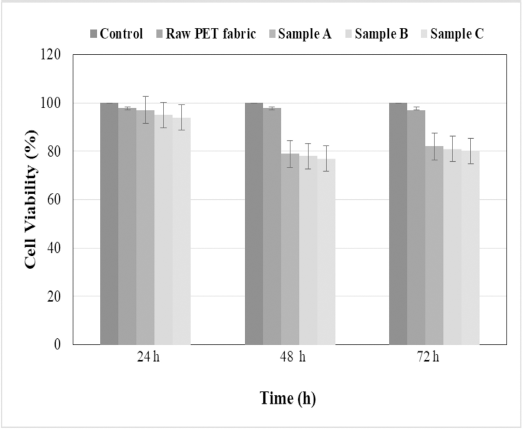
In vitro cytotoxicity tests of L929 cells cultured in extracts of raw polyester fabric and PET/BaTiO3 fabrics after 24, 48, and 72 h. The data are represented as mean ± standard deviation (SD).
The viability of cells treated with raw polyester fabric was slightly higher than that of PET/BaTiO3. Generally, higher BaTiO3 content C samples showed a higher percentage of cell viability in comparison to A samples with lower BaTiO3 contents. According to the MTS results, most of the samples permitted cell growth. As reported previously, the average relative cell viability was over 70%, indicating the low toxicity of PET/BaTiO3.12–15 These results indicated that the PET/BaTiO3 fabric had low toxicity to L929 cells.
Electromagnetic Shielding Effect
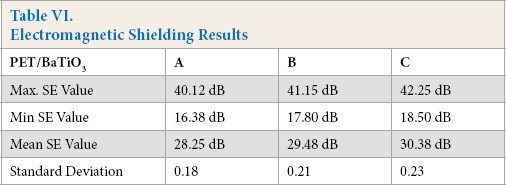
The highest and the lowest shielding effect frequencies were used as reference values, the mean shielding effect values were calculated, and the results were evaluated as shown in Table V. SE is directly related to an infinitely-spread screening layer. The results of SE measurements depend on the method, frequency range, size of the sample, and the properties of the material itself.
Electromagnetic Shielding Reference Limits
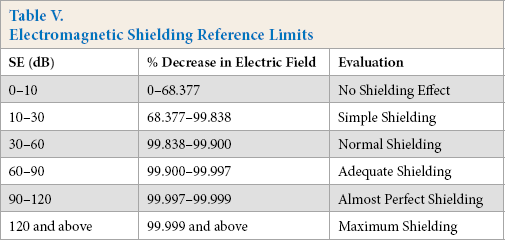
The mean SE values were found in the range of 28.25 to 30.38 dB at a frequency of 0-1.30 GHz. The highest SE value of 42.25 dB was measured for C samples (30% BaTiO3 concentration) at 86 MHz frequency and the results are presented in Table VI. A small, but statistically significant, increase was observed with the increase in BaTiO3 content. This could be due to longer conductive path of PET/BaTiO3 fibers that provided a better conductive network to the fabrics. When the fabrics were evaluated according to the FTTS-FA-003 standard, they provided a simple shielding in the general use class, provided moderate protection, and the newly-designed fabrics can help sensing and actuation.
Electromagnetic Shielding Results
Differential Scanning Calorimetry
According to the results presented in Fig. 5 and the data obtained from differential scanning calorimetry (DSC) curves, melting temperatures of 249.1 °C, 249.5 °C, and 251.1 °C were obtained for samples A, B, and C respectively. The BaTiO3 nanoparticles lowered the melting temperature of PET from 260 °C to around 249.5 °C. A small, but statistically significant, decrease in melting temperature was observed with the increased BaTiO3 concentration in the structure. The BaTiO3 decreased the crystalline density (crystallinity) of PET fibers, so this lowered the melting temperature. 16 It was concluded that the new materials would provide big advantages during processes such as dyeing and other treatments by energy savings in the future.
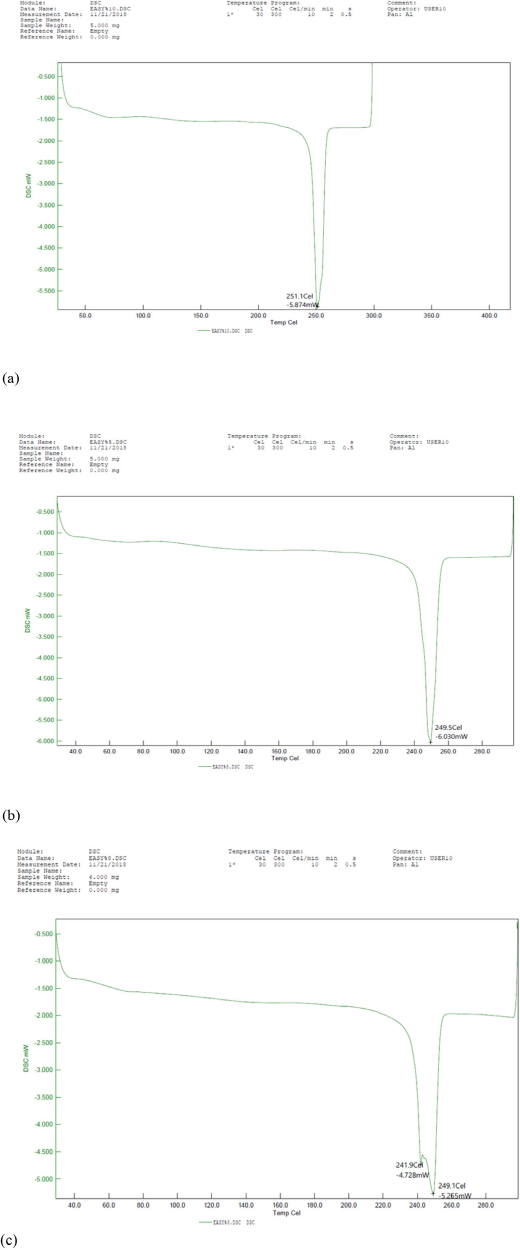
DSC analysis for each specimen versus percent content of BaTiO3 nanoparticles. (a) Samples A, (b) B, and (c) C.
Stiffness
All fabrics showed good elasticity according to the results presented in Fig. 6. The stiffness showed a small, but statistically significant, decrease for all fabrics with increased BaTiO3 concentration. The increase in BaTiO3 content created more elastic structures. In a parallel study, it was also observed that the increase in the filler content gave higher elastomeric performance on the PET resin embedded with BaTiO3 nanoparticles. 16 It is thought that the BaTiO3 nanoparticles decreased the crystallinity and increased the amorphous structure, yielding increased elastic structure of the fabric. The higher percentage of nanoparticles created more amorphous structures bringing more elasticity into the fabric. According to the results, the newly-designed pressure garments would provide flexibility and comfort to help muscle training during long rehabilitation use.
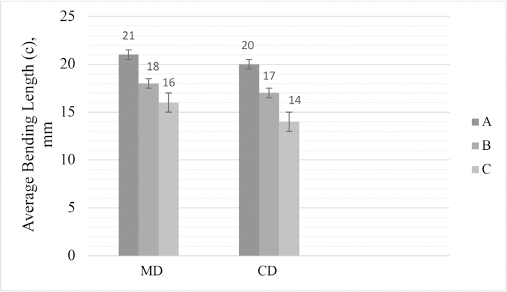
Stiffness (MD = machine direction and CD = cross direction) for each specimen versus percent content of BaTiO3 nanoparticles for samples A, B, and C.
Effect of BaTiO3 Concentration on Stiffness
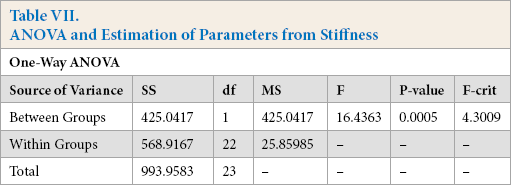
One-way ANOVA was used to analyze the effect of BaTiO3 on stiffness. Using one-way analysis of variance, the p-value was 0.0005. The results of the analysis are shown in Table VII. As the p-value was less than 0.05, the BaTiO3 concentration had a significant effect on stiffness.
ANOVA and Estimation of Parameters from Stiffness
Pressure Measurements
The exerted pressures measured using wireless pressure sensors were between 6.21 and 7.25 mmHg for the ankle and between 6.06 and 7.12 mmHg for the calf, which was in the required medical range. The results are presented in Fig. 7. Exerted pressures showed a small, but statistically significant, increase with increased BaTiO3 concentration. It is thought that the increase in nanoparticle concentration decreased the crystallinity, and thus the amorphous structure increased and created a more elastic structure.
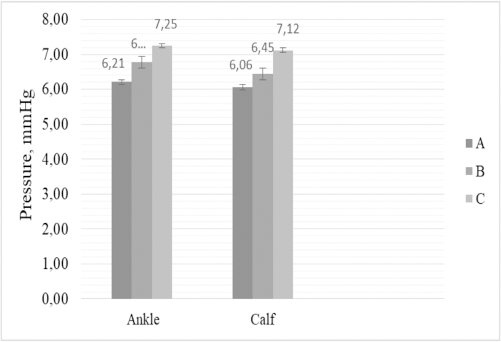
Exerted pressures (mmHg) for each specimen versus percent content in BaTiO3 nano-particles for samples A, B, and C.
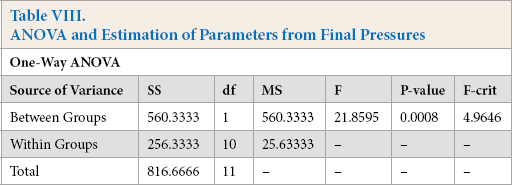
Statistical analysis demonstrated that these mean values were not significantly different. From the analysis of variance and estimation of parameters effect summarized in Table VIII, the BaTiO3 concentration had a statistically significant effect on the final pressures (p < 0.05).
ANOVA and Estimation of Parameters from Final Pressures
Conclusion
The PET/BaTiO3 fabrics showed excellent antibacterial activity against tested bacteria. In addition, reasonable laundering durability of the antibacterial fabrics was obtained, after washing 20 times. Type C samples showed better antibacterial activity, and a small, but statistically significant, increase was observed with increased BaTiO3 concentration. From cytotoxicity testing, the PET/BaTiO3 samples were found to be non-toxic. All samples with continuous BaTiO3 fillers showed good electromagnetic shielding effects in the range of 28.25 to 30.38 dB at a frequency of 0–1.30 GHz. The results were evaluated according to the FTTS-FA-003 standard. The samples were classified in the general use class and would provide very good protection. Electromagnetic shielding effectiveness showed a small, but statistically significant, increase with increased BaTiO3 nanoparticle content. Thus, the materials provided longer conductive networks and provided electromagnetic shielding. DSC analyses showed that the addition of BaTiO3 nanoparticles decreased the orientation of crystalline units inside the fibers and lowered the crystallinity of PET fibers, which resulted as a small, but statistically significant, decrease in the melting temperature. The stiffness showed a small, but statistically significant, decrease for all fabric samples with increased BaTiO3 concentration. BaTiO3 nanoparticles increased the amorphous structure, yielding an increased elastic structure of the fabrics. Exerted pressures showed a small, but statistically significant, increase with increased BaTiO3 concentration. In a study conducted by Abot et al., nanoparticle reinforcements created higher elasticity in the structure and Yan et al. fabricated flexible strain sensors using carbon/graphene composite nanofiber yarn and observed that the sensors showed excellent flexibility and conductivity.17,18 The new materials provided big advantages during processes such as dyeing and other treatments by energy savings in the future. Finally, the newly-designed PET/BaTiO3 pressure garments provided a long elastic and strong structure with a close ft for training muscles and help with sensing and actuation. The acquired conductivity of BaTiO3 would help sensing with the needed tight structure onto limbs during physical therapy as suggested by therapists.19,20 They would also provide durable antimicrobial activity and an electromagnetic shielding effect to help the rehabilitation of people suffering from cerebral palsy (CP) during long continuous use.