




Abstract
Whereas the adrenal glands of healthy ferrets produce only limited amounts of androgenic steroids, adrenocortical neoplasms that arise in neutered ferrets typically secrete androgens or their derivative, estrogen. The 17,20-lyase activity of cytochrome P450 17α-hydroxylase/17,20-lyase (P450c17) must increase to permit androgen biosynthesis in neoplastic adrenal tissue. We screened ferret adrenocortical tumor specimens for expression of cytochrome b 5 (cyt b 5), an allosteric regulator that selectively enhances the 17,20-lyase activity of P450c17. Cyt b 5 immunoreactivity was evident in 24 of 25 (96%) adrenocortical adenomas/carcinomas from ferrets with signs of ectopic sex steroid production. Normal adrenocortical cells lacked cyt b 5, which may account for the low production of adrenal androgens in healthy ferrets. Other markers characteristic of gonadal somatic cells, such as luteinizing hormone receptor, aromatase, and GATA4, were coexpressed with cyt b 5 in some of the tumors. We concluded that cyt b 5 is upregulated during gonadectomy-induced adrenocortical neoplasia and is a marker of androgen synthetic potential in these tumors.
Keywords
The adrenal cortex is a major source of steroid hormones, which are synthesized from cholesterol through the sequential activities of a series of enzymes (Fig. 1). A dual-function enzyme, cytochrome P450 17α-hydroxylase/C17-C20 lyase (P450c17), catalyzes both the 17α-hydroxylation reaction required for the production of cortisol and the 17,20-lyase reaction required for the synthesis of the adrenal androgens dehydroepiandrosterone (DHEA) and androstenedione, the precursors of sex steroids. 2 The 17α-hydroxylase and 17,20-lyase activities of P450c17 are differentially regulated; consequently, cortisol production dissociates from adrenal androgen synthesis in certain physiologic and pathophysiologic states. 1, 2, 8, 9
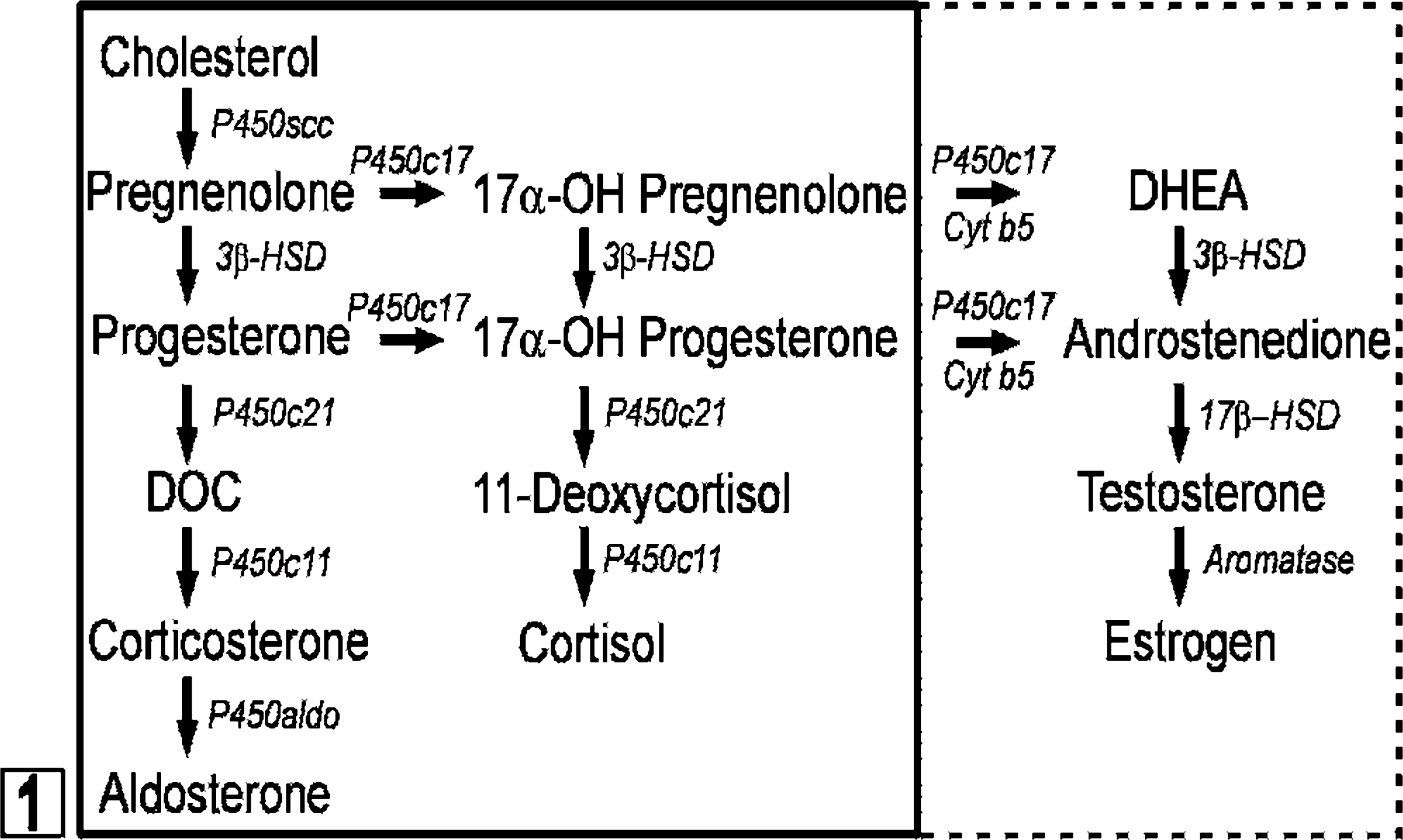
Steroid hormone biosynthesis in normal (solid lines) versus neoplastic (dashed lines) adrenocortical cells. All steroidogenic cells share the capacity to mobilize and cleave cholesterol. The repertoire of enzymes distal to P450scc determines the steroidogenic capacity of a given cell. Note that P450c17 has both 17α-hydroxylase and 17,20-lyase activities. Cyt b 5 selectively enhances the 17,20-lyase activity of P450c17 through allosteric effects. 3β-HSD = 3β-hydroxysteroid dehydrogenase, 17β-HSD = 17β-hydroxysteroid dehydrogenase, cyt b 5 = cytochrome b 5, DOC = deoxycorticosterone, DHEA = dehydroepiandrosterone, P450aldo = aldosterone synthase, P450c11 = cytochrome P450 11β-hydroxylase, P450c17 = cytochrome P450 17α-hydroxylase/17,20-lyase, P450c21 = cytochrome P450 21-hydroxylase.
One such state is gonadectomy-induced adrenocortical neoplasia in the domestic ferret, Mustela putorius furo. 3 Normally the adrenal glands of intact or neutered ferrets produce cortisol but only minimal amounts of androgenic steroids. 4, 7 In contrast, adrenocortical neoplasms that arise in gonadectomized ferrets typically secrete androstenedione, DHEA, DHEA-sulfate (DHEA-S) and/or estrogen but little cortisol. 3, 7 The ectopic production of sex steroids and their progenitors by neoplastic adrenocortical tissue causes a syndrome known as adrenal-associated endocrinopathy (AAE) or hyperadrenocorticism. 3, 7 Clinical signs of AAE include bilateral symmetrical alopecia, enlargement of the vulva, and squamous metaplasia of prostatic ductular epithelium. 5 Adrenocortical neoplasia in neutered ferrets is theorized to be due to chronic stimulation by luteinizing hormone (LH), which, in combination with other gonadectomy-induced hormonal changes (e.g., decreased inhibin levels), causes progenitor cells in the adrenal cortex to differentiate into gonadal-like steroidogenic cells. 5 Adrenocortical tumors in neutered ferrets express markers characteristic of gonadal somatic cells such as inhibin-α, GATA4, and LH receptor (LHR). 3
The 17,20-lyase activity of P450c17 must increase to permit biosynthesis of androgen precursors and sex steroids in gonadectomy-induced adrenocortical neoplasms of ferrets (Fig. 1). We hypothesized that increased intracellular expression of cytochrome b 5 (cyt b 5), an allosteric regulator that selectively enhances the 17,20-lyase activity of P450c17, 1 could account for the preferential production of androgenic steroids by the tumor tissue. To test this hypothesis, we screened archival specimens of adrenocortical tumors from ferrets for expression of cyt b 5.
Surgical biopsy and necropsy specimens of ferret adrenocortical neoplasms were obtained from archives of the Michigan State University Animal Health Diagnostic Laboratory (12 cases) and The Ohio State University Department of Veterinary Biosciences (16 cases). Our analysis included cases of anaplastic adrenocortical carcinoma (12), well-differentiated adrenocortical carcinoma (6), adenoma (7), and nodular hyperplasia (3). Criteria for classification of these tumors are listed elsewhere. 6 All of these tumors were from gonadectomized ferrets with signs of AAE as documented by a review of pathology records. Several of these neoplasms contained residual normal cortex, and some had direct hepatic invasion or metastasis. For negative controls, we used autopsy specimens from 5 gonadectomized ferrets with no proliferative lesions in their adrenal glands; none of these ferrets had signs or symptoms of AAE.
Paraffin-embedded tissue sections were processed for immunoperoxidase staining as described previously. 6 The following primary antibodies were used: 1) goat anti-mouse GATA4 immunoglobulin (Ig) G (sc-1237, Santa Cruz Biotechnology, Inc., Santa Cruz, CA), 1 : 200 dilution; 2) mouse anti-human LHR hybridoma conditioned media (CRL-2685, ATCC, Manassas, VA), 1 : 100 dilution; 3) rabbit anti-human cyt b 5 (sc-33174, Santa Cruz Biotechnology, Inc., Santa Cruz, CA), 1 : 200 dilution; 4) mouse anti-human inhibin-α (MCA77G, Serotec, Inc., Raleigh, NC), 1 : 200 dilution; 5) goat anti-human aromatase (sc-14245, Santa Cruz Biotechnology, Inc., Santa Cruz, CA), 1:200 dilution; and 6) goat anti-mouse P450c17 (sc-46081, Santa Cruz Biotechnology, Inc., Santa Cruz, CA), 1:200 dilution. Secondary antibodies used for immunoperoxidase staining were: 1) donkey anti-goat biotinylated IgG (Jackson Immunoresearch, West Grove, PA) 1 : 200 dilution; 2) donkey anti-mouse biotinylated IgG (Jackson Immunoresearch), 1 : 200 dilution; and 3) goat anti-rabbit biotinylated IgG (NEF-813, NEN Life Science, Boston MA), 1 : 200 dilution. The avidin-biotin immunoperoxidase system (Vectastain Elite ABC Kit, Vector Laboratories, Inc., Burlingame, CA) and diaminobenzidine (Sigma-Aldrich Corp., St. Louis, MO) were used to visualize the bound antibody; slides were then counterstained with 100% hematoxylin.
There was little or no cyt b 5 immunoreactivity in normal adrenocortical tissue adjacent to neoplastic lesions (2a, b). Nor did we observe cyt b 5 expression in adrenal tissue from gonadectomized ferrets without proliferative lesions (data not shown). This lack of cyt b 5 may account for the minimal androgen production in the adrenal glands of healthy ferrets. In contrast, cyt b 5 immunoreactivity was observed in 96% of ferret adrenocortical neoplasms, including 17 of 18 carcinomas (Figs. 2b and 3a), 7 of 7 adenomas, and 3 of 3 cases of nodular hyperplasia. The cells expressing cyt b 5 were large, lipid laden, and scattered throughout the neoplasms (Figs. 2b and 3a). Cyt b 5 staining intensity did not differ between malignant and benign adrenocortical lesions. In addition to neoplastic epithelial cells, adrenocortical tumors in ferrets often contain a spindle-cell component of uncertain clinical significance. 3 Negligible cyt b 5 staining was seen in the spindle-cell component of the tumors (data not shown). All of the neoplasms that exhibited cyt b 5 immunoreactivity were from ferrets with clinical signs of AAE. Thus, cyt b 5 is a useful marker of androgen synthetic potential in these neoplasms.
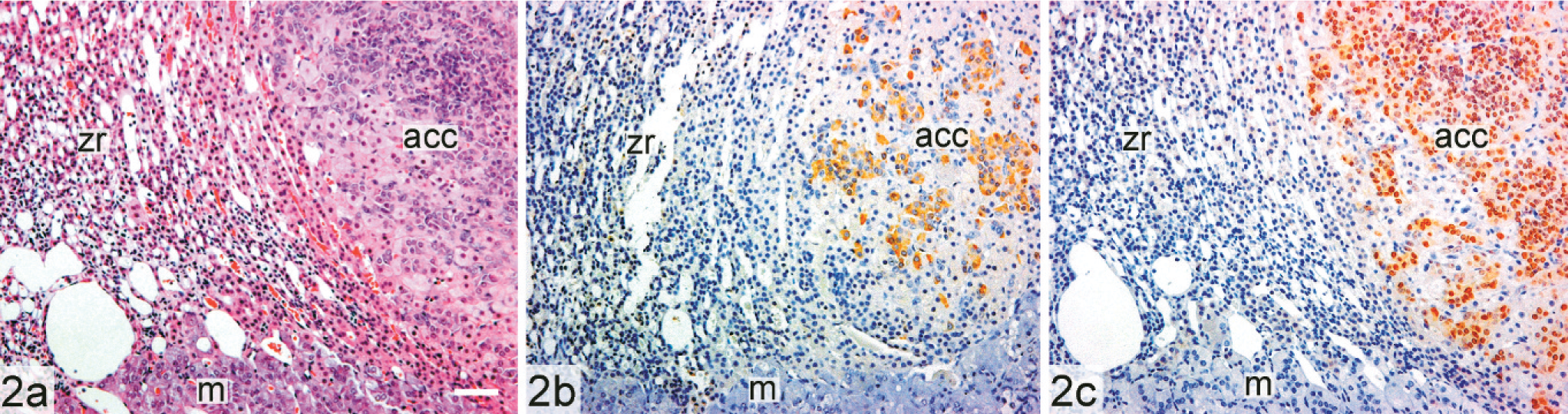
Adrenal gland, adrenocortical carcinoma; ferret. The junction between the zona reticularis (zr) and medulla (m) is shown. Note that normal cells in the zr lack expression of cyt b
5 and GATA4, whereas, adrenocortical carcinoma (acc) cells express both of these markers of gonadal cell differentiation.
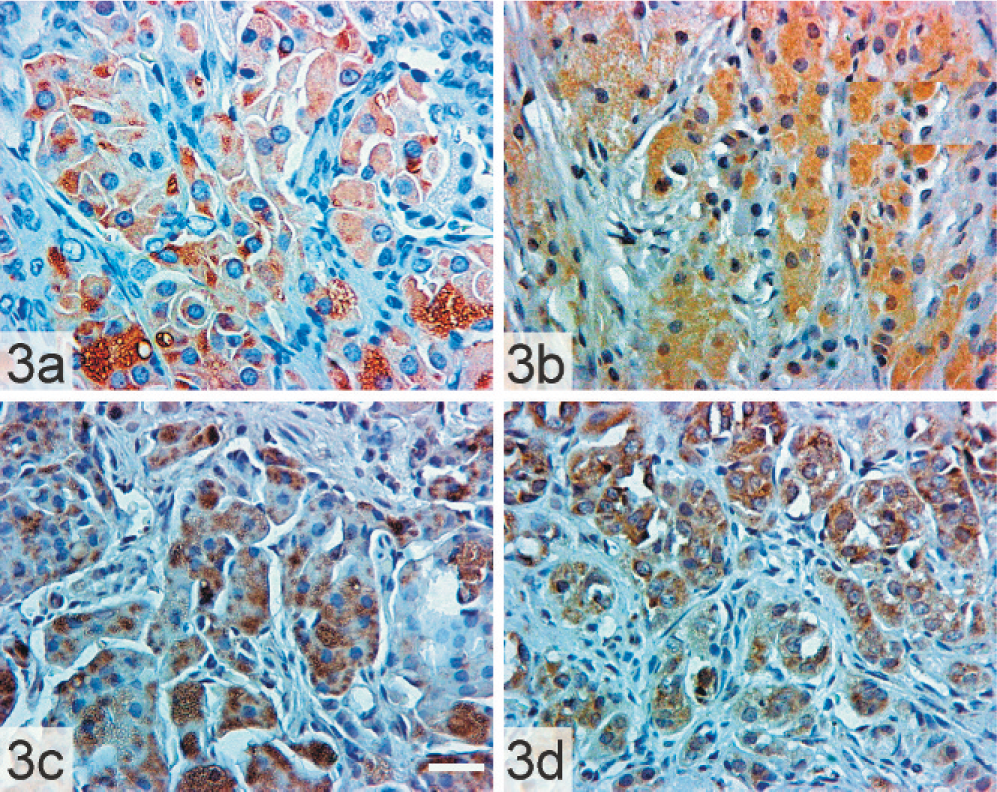
Adrenal gland, adrenocortical carcinoma; ferret. Note that cyt b
5, LHR, aromatase, and P450c17 are coexpressed in the tumor cells.
Other markers of gonadal steroidogenic cell differentiation, such as GATA4 (Fig. 2c), LHR (Fig. 3b), aromatase (Fig. 3c), and inhibin-α (not shown) were coexpressed with cyt b 5 (Fig. 3a) in some of the ferret adrenocortical tumors. Among neoplasms tested for at least 4 gonadal steroidogenic cell markers, 9 of 9 (100%) expressed cyt b 5, 6 of 9 (67%) expressed GATA4, 4 of 9 (44%) expressed LHR, and 4 of 9 (44%) expressed inhibin-α. Consistent with the notion that P450c17 is essential for cortisol and androgen biosynthesis, P450c17 immunoreactivity was evident in normal zona fasciculata and zona reticularis cells and in 7 of 9 (78%) adrenocortical neoplasms (Fig. 3d).
In primates, as in ferrets, the expression of cyt b 5 in normal and neoplastic adrenocortical tissue correlates the capacity to produce androgens. The onset of cyt b 5 expression in the human adrenal cortex coincides with increases in circulating levels of adrenal androgens during adrenarche. 2 Similarly, induction of cyt b 5 in the adrenal cortex of female marmosets correlates with the capacity to secrete DHEA. 5 Elevated levels of cyt b 5 were reported in adrenocortical adenomas from 2 patients with high circulating androgen levels. 9 Conversely, functional human adrenocortical tumors that produce cortisol rather than androgens were shown to express low levels of cyt b 5. 9
In theory, other mechanisms besides increased expression of cyt b 5 could contribute to the preferential production of sex steroids by neoplastic adrenocortical cells in neutered ferrets. Elevated LH levels stimulate cAMP production in steroidogenic cells, and cAMP-induced phosphorylation of human P450c17 stimulates its 17,20-lyase activity, whereas dephosphorylation abrogates this activity. 10 In some humans with adrenocortical neoplasms, high circulating levels of DHEA or DHEA-S were attributed to reduced 3β-hydroxysteroid dehydrogenase activity in the tumors (Fig. 1). 8 Whether these alternative mechanisms contribute to androgen production in ferret adrenocortical neoplasms awaits further study.
We concluded that cyt b 5 is upregulated during gonadectomy-induced adrenocortical neoplasia in ferrets and is a marker of androgen synthetic potential in these tumors. We propose that increased cyt b 5 expression accounts in part for the preferential production of adrenal androgens and estrogen by these neoplasms.
Footnotes
Acknowledgements
This work was supported by the NIH (DK075618 and DK52574), the Sigrid Juselius Foundation, and the Academy of Finland.