




Abstract
The finding of tomacula, focal areas of sausage-shaped hypermyelination in peripheral nerves, is reported for the first time in avian riboflavin deficiency. Day-old, meat-type chickens were fed a riboflavin-deficient diet (1.8 mg/kg) and were killed on postnatal days 6, 11, 16, and 21, while control chickens were fed a conventional diet containing 5.0 mg/kg riboflavin. Tomacula were found in sciatic and brachial nerves from day 11 onward, became more frequent and prominent with increasing time, and preceded the onset of segmental demyelination.
A group of human neuropathies are characterized by focal regions of swellings in teased nerve-fiber preparations and hypermyelination in transverse plastic sections. The sausage-shaped expansions of the myelin sheath are termed tomacula (from the Latin tomaculum meaning sausage). 10 Tomacula were originally believed to be pathognomonic of an inherited, pressure-induced nerve palsy, 2 but they are now known to occur in other hereditary and nonhereditary neuropathies. 5 Fine structural examination of tomacula reveals that redundant folds and loops of myelin form symmetric or asymmetric expansions of the sheath. Most tomaculous neuropathies are associated with segmental demyelination. 5
In a study of riboflavin (vitamin B2) deficiency in chickens, we consistently found striking tomacula formation in sciatic and brachial nerves. Although tomacula have been reported in a bovine peripheral neuropathy of probable autosomal recessive inheritance, 6 and in myelin-associated glycoprotein 3 and peripheral myelin protein 22-deficient 1 mice, we believe this to be the first acquired primary demyelinating tomaculous neuropathy described in animals. Tomacula were not reported in previous studies of riboflavin deficiency in chickens. 7, 8
Newborn, rapidly growing broiler meat chickens (Cobb 500; Cobb-Vantress, Siloam Springs, Arkansas) were fed either a riboflavin-deficient diet containing 1.8 mg/kg riboflavin or a conventional diet containing 5.0 mg/kg riboflavin. The normal riboflavin requirement for rapidly growing meat-type chickens is 3.6 mg/kg of feed (Nutrient Requirements of Poultry. 1994. National Academy of Sciences, National Academy Press, Washington DC). Liver riboflavin levels were analyzed on postnatal day 11 by a microbiological method using Lactobacillus casei as the test organism. The growth of this riboflavin-dependent microorganism correlates with the amount of vitamin in the sample.
Peripheral nerves were fixed by transcardiac perfusion with 4% paraformaldehyde/2.5% glutaraldehyde in 0.1 M phosphate buffer (pH 7.4) on postnatal days 6 (n = 6), 11 (n = 14), 16 (n = 6), and 21 (n = 5). Sciatic and brachial nerves were collected and processed according to a published method 4 for light and electron microscopy and teased nerve-fiber studies. Five control birds fed the conventional diet were killed at each of these time points.
This experimental protocol was approved (83/04) by the Animal Ethics Committee of the Institute of Medical and Veterinary Science, Adelaide, and conformed to the Australian Code of Practice for the Care and Use of Animals for Scientific Purposes (2004).
Neurologic signs were observed from postnatal day 8, chickens initially being incoordinated and, although alert, reluctant to move. As paresis became more severe, some birds could not extend their hocks and, instead of plantigrade ambulation, toes were intermittently flexed and curled under (termed “curled toe” paralysis, a characteristic feature of avian riboflavin deficiency). 9 With increasing time, stunting occurred because birds were either reluctant or unable to access feed. No neurologic signs were observed in control birds. The riboflavin concentration in birds (n = 5) on the deficient diet (mean ± SD = 23.9 ± 1.49 μg/g) was significantly (Student t-test, P < .01) lower than control (n = 5) birds (mean ± SD = 32.36 ± 1.96 μg/g) fed a conventional diet.
Tomacula were first detected on postnatal day 11 and became more numerous and prominent with increasing time. These focal myelin swellings were characterized by complex internal and/or external wrapping of redundant myelin loops (Fig. 1A, B). From day 16 onward, some tomacula appeared unstable, with myelin splitting and degeneration. In teased nerve fibers at day 11, tomacula were located at the paranodal region and by days 16 and 21 were accompanied by segmental demyelination involving the internodal region (Fig. 1C). Regeneration of myelin was observed at postnatal day 16 and became more apparent at day 21. Axonal degeneration was minimal, but Schwann cells were hypertrophied and contained myelin debris and numerous lipid droplets. Tomaculous changes cannot be reliably recognized in routine formalin-fixed, paraffin-embedded, hematoxylin and eosin (HE) stained sections.
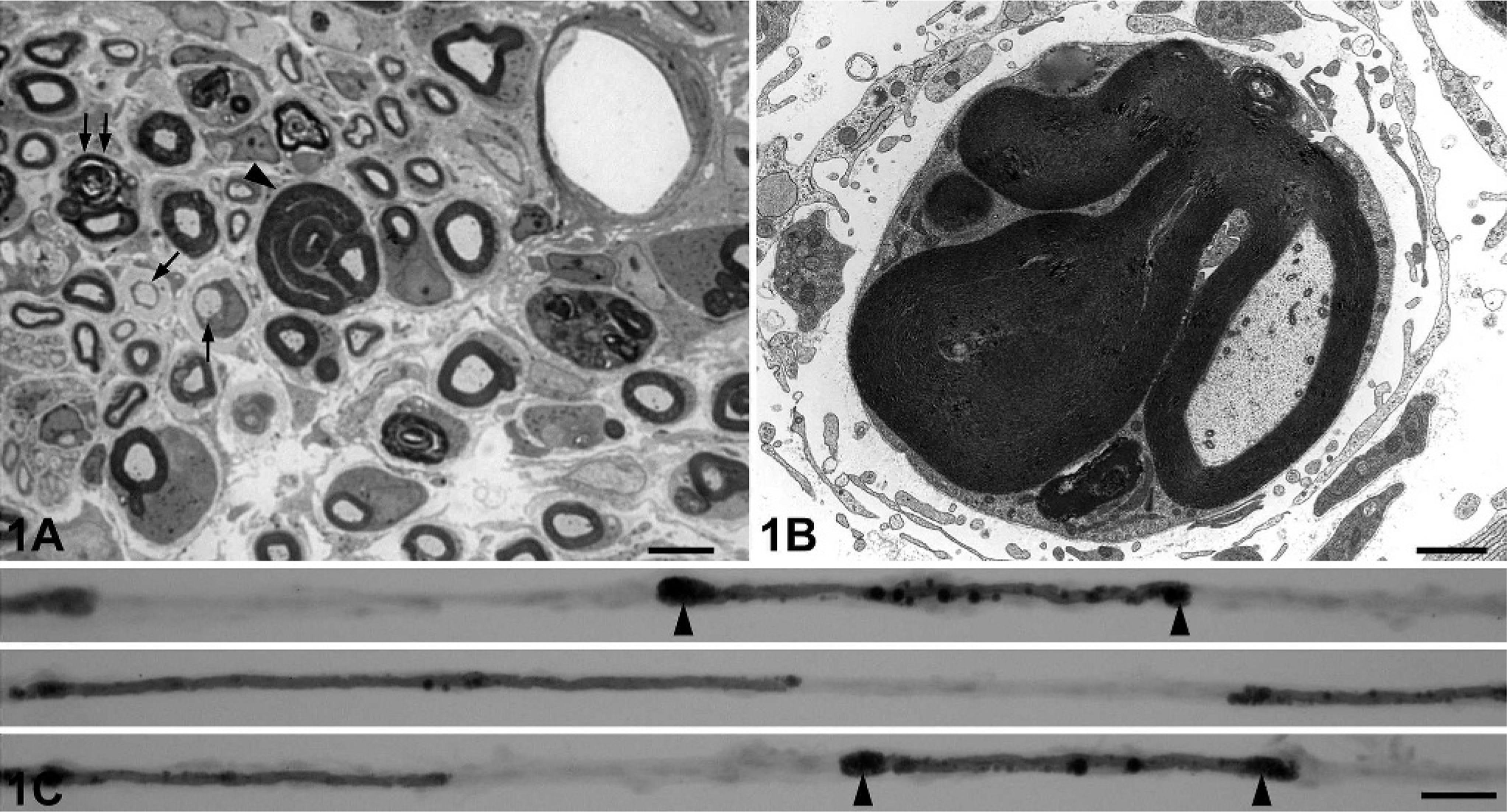
Right sciatic nerve from a postnatal day 16 riboflavin deficient chicken.
In conclusion, we report the novel finding of tomacula in riboflavin-deficient chickens and believe this to be the only documented acquired tomaculous neuropathy in animals.