




Abstract
Objectives:
The purpose of this mixed-methods study was to explore the cognitive and motivational challenges sonography students encounter by examining the relationships between sonography students’ levels of self-regulation and self-efficacy and their performance in a 16-week introductory vascular sonography skills laboratory course.
Materials and Methods:
Measures for the study were designed to yield qualitative and quantitative data related to student goals, strategies, and course performance and were generated by both students and faculty. Qualitative data from the study included student self-reports of self-regulatory strategies and instructor evaluations of student performance, while quantitative data were provided by instructor and student ratings of performance, student self-efficacy ratings, and student reports on their use of deliberate practice.
Results:
The data showed that many students learning how to perform sonographic examinations encountered motivational challenges that appeared to be tied both to their self-efficacy and their ability to effectively use self-regulatory activities.
Conclusion:
The findings of this study suggest possibilities for improving sonography’s curricular models and teaching strategies toward the goal of making sonography instruction more efficient and effective.
To perform sonographic examinations proficiently, individuals need a multifaceted skill set. This includes the simultaneous execution of both psychomotor spatial orientation, manual dexterity, perception, and hand-eye coordination1 –6 and cognitive (evaluating anatomy as normal or pathological) skills.7,8 This complexity presents challenges within sonography education programs, as it may produce motivational and confidence issues among the student population.9 –12 Improving student outcomes in sonography programs is imperative as there is a need for well-qualified individuals to enter the workforce. 13 Individuals who experience challenges with motivation may have difficulty self-regulating their learning, as well as developing self-efficacy in performing sonographic tasks.8,14
Self-regulation and self-efficacy are two psychological concepts that have been found to influence motivated performance based on research conducted across numerous other fields and domains. Self-regulation can be defined as the ability to achieve goals through one’s own intrinsically developed thoughts, feelings, and actions. 15 This concept has been found to be a necessary component of academic achievement and is learned from a social cognitive perspective, which involves personal, environmental, and behavioral determinants. 16 In addition to self-regulation, self-efficacy is also thought to be an important component in academic achievement. Self-efficacy refers to the self-perceptions one has about their capabilities to learn or perform tasks in specific domains. 17 Self-efficacy is thought to have a significant influence on achievement behavior, subsequently influencing self-regulation, and believed to be influenced by self-regulation. 16 Furthermore, additional research has shown that individuals who are more self-efficacious have a greater tendency to engage in complex tasks and successful in completing them.18,19 Given sonography’s required complex skill set, self-efficacy and self-regulation are both important to consider, as part of sonography education.
In academic settings, students who self-regulate, assist themselves in successfully completing their curriculum. 20 In applied health care education programs, students are expected to plan and manage their time to attend class and clinical experiences, complete assignments, engage in the necessary amount of practice to learn skills competently, organize content, and use effective learning strategies. Having a collection of self-regulatory strategies to draw on can impact academic success in these programs. 16 Similarly, developing self-efficacy is an important student skill, as they must ultimately demonstrate competency across a wide range of sonographic examinations.
The overall purpose of this study was to explore the cognitive and motivational challenges students encounter, while learning sonography. To assist in the identification of these challenges, emphasis was put on exploring the motivational constructs of self-regulation and self-efficacy and their relationship to students’ academic performance, using a mixed-methods research design.
Therefore, the research questions were:
Materials and Methods
Participant Sample
Ethical approval for this study was obtained from the host college’s institutional review board (IRB) (IRB#1608-001) and the university’s IRB review (IRB#20160816366). Participants were recruited from a 16-week introductory vascular sonography skills laboratory course.
Thirteen student participants were recruited for this study. All the participants were completing a baccalaureate-level cardiovascular sonography program. All participants had no prior training in vascular sonography; however, some of the participants had previously completed one year of instruction in adult cardiac sonography.
Instructional Procedure Description
The skills laboratory met 3 hours each week with no more than a 6:1 student-to-instructor ratio. The laboratory curriculum used a scaffolding approach to introduce sonographic skills. In addition to the instructor-led skills lab meetings, participants had readily available access to example videos, images, and procedural exam steps through the course’s learning management system. These student resources were encouraged to be used throughout the semester and before attending each laboratory session. After attending laboratory sessions participants engaged in a minimum 3 to 4 hours weekly of self-regulated practice scanning assignments, which allowed for deliberate practice of these skills. Participants’ sonographic knowledge and skill levels were assessed, observed, self-critiqued, and instructor feedback to the student provided about them on a weekly basis.
Research Design
This study used a mixed-methods design, which is referred to as convergent parallel design and allows for both qualitative and quantitative data to be collected concurrently. Even though both data sets were collected at the same time, they were still analyzed separately using the appropriate qualitative and quantitative techniques. Finally, an interpretation was formed from the merged results, following Creswell and Plano Clark’s 21 description of a convergent parallel design.
Data Collected
A 13-item survey was developed with open- and close-ended questions that focused on the participants’ self-regulatory activities. The survey was administered a total of 15 times during the semester. Instructor evaluations of participants’ scanning performance in the course objective categories of technical skills, critical thinking, professionalism and accountability, client sonographer interaction, organization, and safety were collected. Participants’ scanning performance came from their sonographic knowledge and skill levels being rated as either exceeding or meeting requirements and graded for each of the six course objective categories as: no errors (2 points), met requirements with minor errors (1 point), or did not meet requirements (0 points). Under each category and type of exam, participants were evaluated on several specific sonographic skills (e.g., technical skills such as selecting the appropriate transducer, exam preset, and depth, etc.). Also, included in these evaluations was the primary investigator’s qualitative feedback about participants’ sonographic skill performance. These were obtained by reviewing participants’ recorded and live sonographic examination performances. Fourteen evaluations on each participant were completed throughout the semester. The primary investigator’s observations and interactions with participants during class periods, practice sessions, and one-on-one meetings throughout the semester were collected. Memos and note-taking were used to record these observations and interactions of participants.
A self-efficacy scale (appraisal inventory) was developed for this study, using Bandura’s 22 Guide for Constructing Self-Efficacy Scales as a reference. This instrument was designed to measure participants perceived self-efficacy levels on specified sonographic skills or tasks, which were divided into five subcategories (technical skills, critical thinking, client/sonographer interaction, organization, and safety). Each item on the rating scale ranged from 0 to 100 with every ten units shown on the scale. A rating of zero on the scale indicated “cannot do at all,” a rating of 50 indicated moderate certainty of successful performance, and a rating of 100 indicated complete certainty the skill could be completed. Participants completed this self-efficacy scale four times during the semester in weeks 1, 7, 11, and 15. A summed self-efficacy subcategory score was calculated by adding the five subcategory scores for each self-efficacy scale administered.
Qualitative Data Analysis
Qualitative data was analyzed through using Strauss and Corbin’s grounded theory principles, 23 which included open coding and identifying major themes from these codes. The codes were also discussed with a peer debriefer and then combined into overarching themes. The codes came primarily from reviewing open-ended responses from surveys at four specific time points throughout the semester (e.g., weeks 3, 7, 11, 15). Instructor evaluations of participant scanning performance were also coded for themes using a similar strategy. Initial interpretations were discussed with a peer debriefer and then revised based on the peer debriefer’s recommendations. The revised interpretations were grouped into eight types of feedback descriptions and subsequently reviewed for accuracy with a second peer debriefer, a sonography educator who had provided similar feedback to her students. Following this second round of debriefing, the feedback descriptions (themes) were condensed into six types of feedback provided to the participants. Finally, the primary investigator’s observations and interactions with the participants were included also a part of the coding process. Using multiple forms of data collection provided for increased validation of the data and an in-depth analysis, which created a validation strategy, known as triangulation.24,25
Determination of Self-Regulation Across Participants
The following self-regulatory activities participants engaged in were reviewed on the survey: completing assigned and additional readings, performing required and/or voluntary scanning, obtaining tutor and/or instructor assistance, viewing example videos/images, the amount of practice and study time expended toward vascular sonography, the self-set goals based on instructor feedback, and other activities participants self-reported. The primary investigator assigned weightings for each of the following categories based on their judgment as to the extent to which each of these groupings of self-regulatory activities might be expected to relate to participants’ sonographic performance, as well as whether or not any part of that activity was a required element of the course: readings (10%), scanning (50%), assistance (20%), and example videos/images (20%).
Participants were grouped as either being the most self-regulated or the least self-regulated based on the number of times they engaged in each of these activities throughout the semester based on this scale.
Quantitative Data Analysis
For all quantitative data analysis collected (e.g., survey items, instructor evaluations, self-efficacy scales), the following descriptive statistics were calculated: frequencies, percentages, and measures of central tendency (mean and median).
Integration of Qualitative and Quantitative Data
The analytical strategy used for the integration of the qualitative and quantitative data was typology development. Typology development occurs when “. . . the analysis of one data type yields a typology that is then used as a framework applied in analyzing the contrasting data type.” 25 For this study, the quantitative data yielded a typology that was then used as a basis in analyzing the qualitative data.
Validity Approaches
The following strategies were used to ensure validity of the qualitative data: triangulation, long terms and repeated observations at the research site, peer examination, and clarification of researcher bias. 24 The quantitative data for this study, in contrast, were validated in terms of its content validity. In this study, content validity was used to validate the instructor evaluations of participants’ scanning performance. The self-efficacy scale likewise was validated by means of a content validity approach as there were no comparable instruments that could be used. The self-efficacy scale was developed and used for this study was based on Bandura’s self-efficacy examples. 22
Results
Research Question 1: What Are the Cognitive and Motivational Issues Sonography Students Encounter While Learning Sonography and How do the Motivational Constructs of Self-Regulation and Self-Efficacy Affect Their Learning?
As expected, the weekly survey results underscored that the most self-regulated participants self-reported as having engaged in more self-regulatory activities throughout the semester than the least self-regulated participants. Both groups of participants reported a decrease in the number of self-regulatory activities they participated in a few weeks into the semester. During the second half of the semester, however, the most self-regulated participants showed a large increase in their number of self-regulatory activities, whereas the least self-regulated participants did not (See Figures 1–3) with the exception of the scanning self-regulatory activity (See Figure 4).
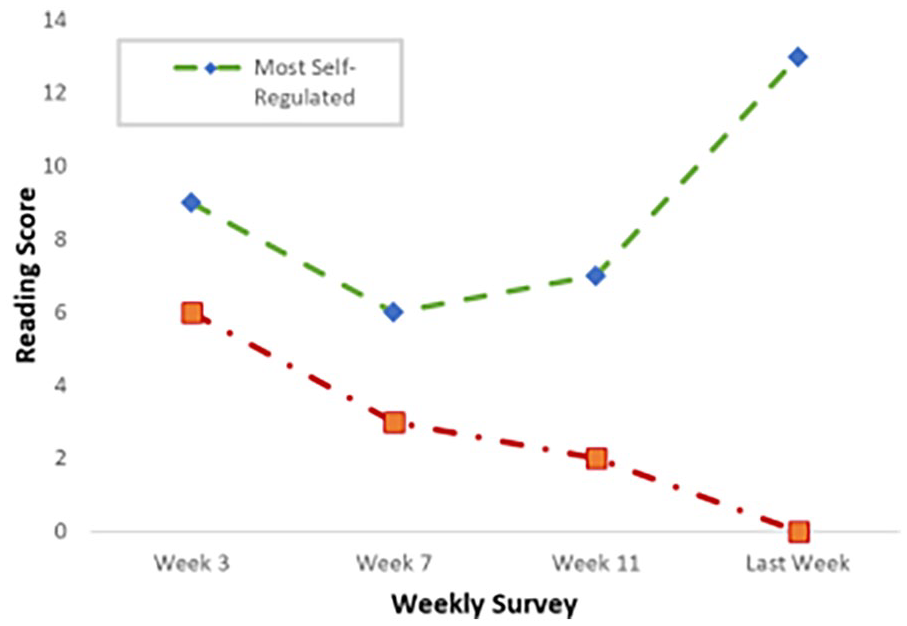
The graph shows that the most self-regulated participants self-reported reading more than the least self-regulated participants. Also, a considerable increase in reading engagement occurred among the most self-regulated participants during the second half of the semester. The least self-regulated participants reported the opposite, declining noticeably in their level of seeking assistance by the end of the semester.
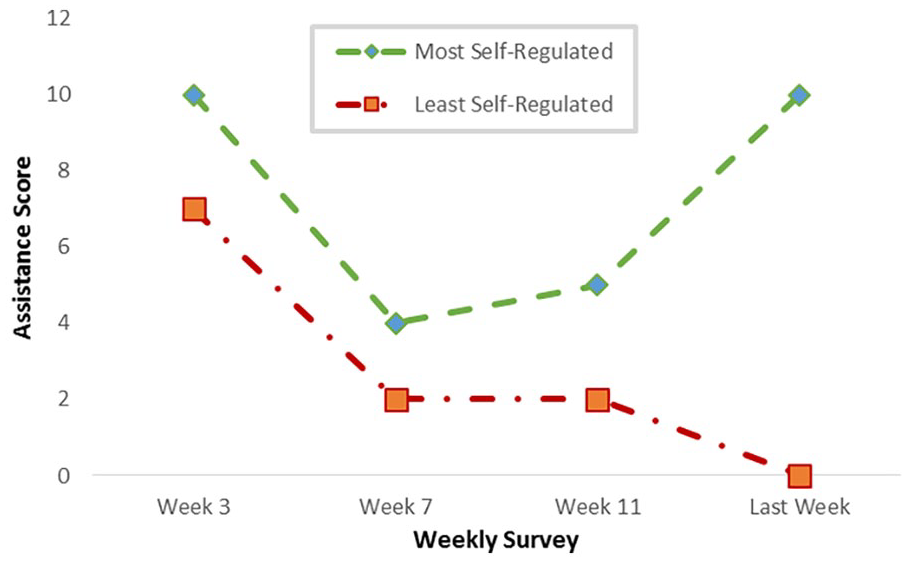
The graph shows that the most self-regulated participants self-reported seeking assistance throughout the semester more than the least self-regulated participants. At the beginning of the semester, both groups reported obtaining assistance at higher level and declining considerably a few weeks later into the semester. However, toward the second half of the semester, the most self-regulated participants reported an increased level in pursuing assistance, reaching the same level of assistance they had originally reported at the beginning of the semester. The least self-regulated participants reported the opposite, declining noticeably in their level of seeking assistance by the end of the semester.
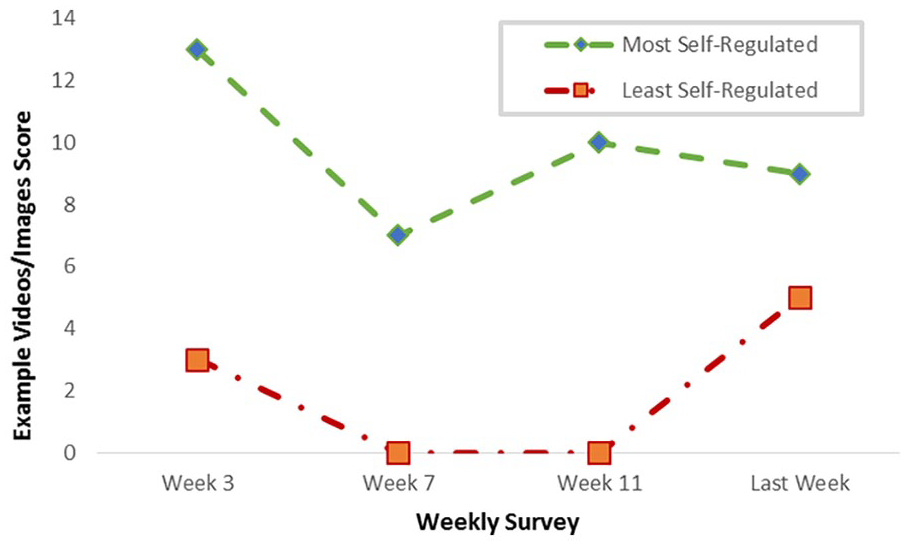
The graph shows that the most self-regulated participants self-reported viewing the example videos/images throughout the semester considerably more than the least self-regulated participants. A few weeks into the semester both groups reported lower mid-semester participation in this activity. Finally, the least self-regulated group reported a considerable increase in their viewing of the example videos/images at the end of semester.
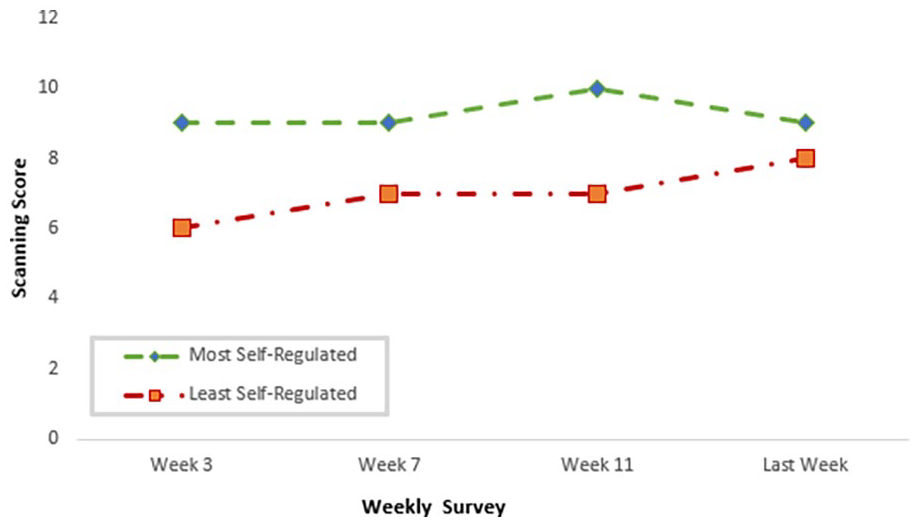
The graph shows that the most self-regulated participants self-reported scanning throughout the semester slightly more than the least self-regulated participants. However, toward the end of the semester, the most self-regulated participants decreased scanning slightly, whereas the least self-regulated participants had a minimum increase in scanning.
Additional data obtained from the weekly survey came from participants self-reporting the amount of time they practiced sonographic skills. The total amount of time participants reported practicing sonographic skills from a sampling of four weekly surveys ranged from 15.75 to 21 hours for the 13 participants with a mean of 18.69. The mean values of sonographic skill practicing for the three most and least self-regulated participants were also calculated. The mean for the most self-regulated participants was 19 and the mean for the least self-regulated participants was 19.33, suggesting no difference between these two groups. Participants were also asked “Do you feel the amount of time you spent practicing scanning vascular sonography this week was an adequate amount of time?” Most of the participants responding to this close-ended question said “yes,” but for some of the weeks, a small number replied “no.”
In addition to the time spent practicing, participants were asked on the weekly survey to self-report the amount of time they studied vascular sonography. The total amount of time participants reported studying vascular sonography from the sampling of four weekly surveys ranged from 15 to 55 hours for the 13 participants with a mean of 28.34. The mean values of studying vascular sonography for the three most and least self-regulated participants were also calculated. The mean for the most self-regulated participants was 24.66, and the mean for the least self-regulated participants was 23.16. Participants were also asked “Do you feel the amount of time you spent studying this week was an adequate amount of time?” Most of the participants responded “yes”: however, a small number of the participants indicated “no.”
Qualitative results on the weekly survey came from the responses of six open-ended survey questions. The survey questions focused on the participants’ weekly engagement in self-regulatory activities, their amount of time spent practicing and studying, identification of goals based on instructor feedback, and quiz/final test-out preparation, which yielded 15 codes and were developed into five overarching themes. These themes were: (1) clarification of information/skill/technique, (2) preparation for class or skill performance, (3) improvement of skill level, (4) assistance, and (5) validation.
For survey questions that inquired about the practice of sonographic skills, the participants’ responses to these questions indicated time constraints as a barrier to practicing scanning. These constraints seemed mainly related to an array of distractions participants experienced that interfered with their ability to practice scanning. For example, one participant stated: “I feel I should have taken more time to better my color images. Time crunches were an issue.”
Results that came from questions asking about participants’ amount of time they spent studying showed participants had difficulty with ineffective study strategies, and that an inadequate amount of time was not a primary concern for them. For example, one participant said, “I just feel like there are some subjects I should have focused more on.”
Responses to questions which concentrated on participant’s setting of goals and their attainment of them revealed that just over half of the participants early in the semester said they did have additional goals. However, as the semester progressed, the number of participants who indicated having additional goals decreased dramatically with only two participants reporting having additional goals toward the end of the semester. Overall, the responses to this survey item indicated participants did in fact have specific and detailed goals for improvement of their knowledge about sonography and their skill development. For instance, one participant stated their goals were to “stay on top of readings, keep working on scanning skills (opening up vessels, specifically the mid and distal ICA).” It was also noted that most of the goals participants listed were related to decreasing the time required to perform sonographic examinations. For instance, one participant reported that their time spent conducting an examination was “. . . always something I strive to cut down on. So this is a constant goal.” Participants’ responses relating to goal attainment generally indicated that they were able to identify either partial or full goal attainment, with a majority expressing optimism about achieving their goals. For example, one participant stated “I was very effective. My time went down for this scan and my images were much better, I thought.”
The final item on the weekly survey asked participants to discuss their quiz/final test-out preparation. This item was an open-ended response, which showed participants used a variety of methods and strategies to prepare for quiz/final test-outs (e.g., studying previously learned material, generating new study materials, engaging in additional study techniques, practicing technical skills, and memorizing the protocol).
Research Question 2: Do Levels of Self-Efficacy Vary During a Semester Skills Laboratory Course as Students Learn Complex and Novel Cognitive-Motor Tasks?
Overall, results for the self-efficacy scale showed a considerable amount of variability; however, self-efficacy levels were similar across all participants by the end of the semester (See Figure 5).
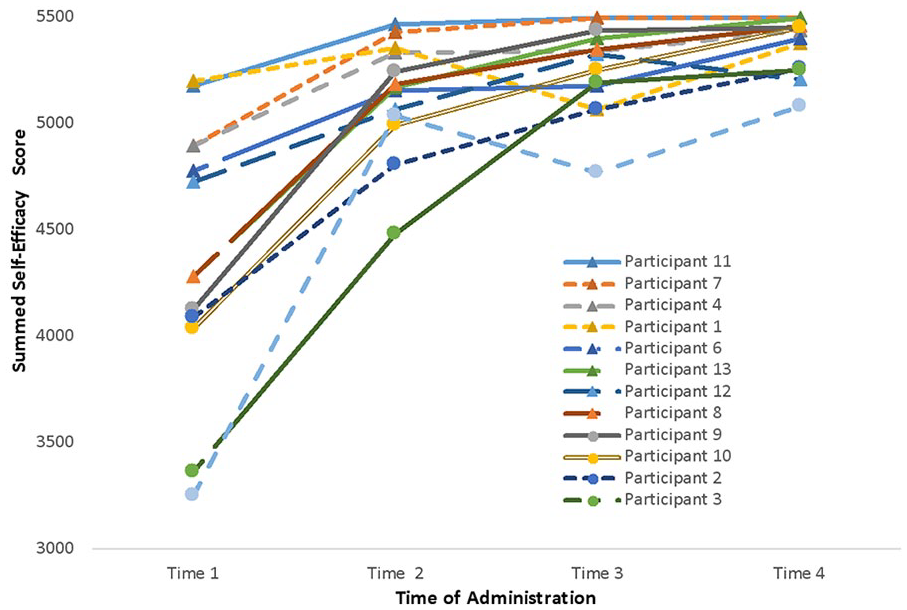
The graph shows for the scale’s initial administration that participants’ total self-efficacy scores ranged from high to low. As the semester progressed, self-efficacy scores increased for most participants, and by the end, most of their scores were relatively high with all participants having similar levels.
A cumulative self-efficacy scale score for each participant was calculated by adding the summed scores of the four self-efficacy scales across the entire semester, with participants then grouped based on these scores as having either higher or lower self-efficacy. Those participants with cumulative scores above the median (20 340) of the total number of cumulative scores were assigned to the higher self-efficacy group (seven participants) and those with scores below the median score were assigned to the lower self-efficacy group (six participants). The summed self-efficacy scores for the higher and lower self-efficacy group means were tracked across the four times the self-efficacy scale was administered (See Figure 6).
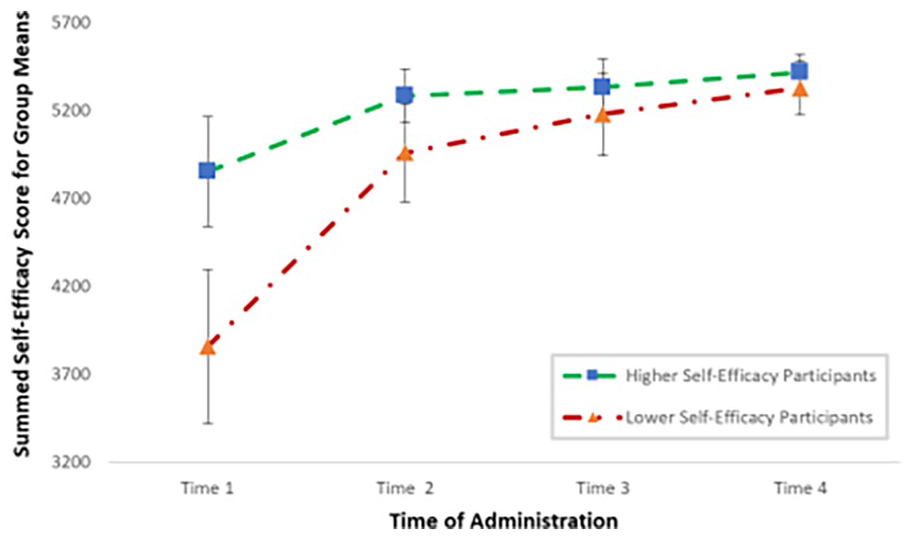
The graph shows both the higher and lower self-efficacious participants reported having a low level of self-efficacy at the initial self-efficacy scale’s administration. However, for the scale’s second administration there was a noticeable increase in self-efficacy scores for both groups. For the scale’s last two administrations (i.e., second half of the semester) scores increased and were high for both groups.
Research Question 3: What is the relationship between the use of self-regulatory strategies and levels of self-efficacy, as it relates to the evaluation scores, during a semester skills laboratory course, in which sonography students perform complex psychomotor and cognitive skills?
Results from the instructor evaluations of participants’ scanning performance for the six skills showed a range of 11 to 19 points, overall means from 13.46 to 14.53, means for the most self-regulated from 14.67 to 15.67, and means for the least self-regulated 12.33-14 (See Table 1). Finally, the means for the three most and least self-regulated participants for all categories were summed together and calculated. These means were 90.66 for the most self-regulated participants and 80.00 for the least self-regulated participants.
The Range of Points, Overall Means, and the Means of the Most and Least Self-Regulated Participants for the Instructor Evaluations of Participants’ Scanning Performance on Six Skills.
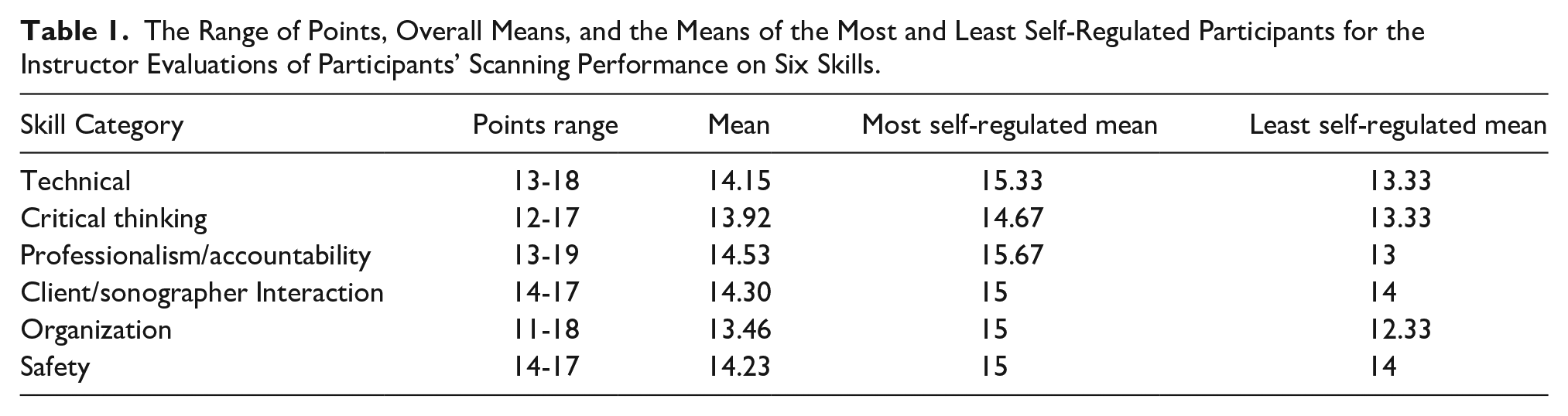
When comparing the self-regulation rankings, self-efficacy scores, and the instructor evaluation scores, these results showed participants grouped as the most and least self-regulated had similar self-efficacy scores across the entire semester. Although self-regulation rankings for the participants did not differ greatly from those derived from their self-efficacy scores, there was a substantial difference between these two groups in their overall instructor scanning evaluation scores based on their demonstration of sonographic knowledge and skills.
Qualitative results for instructor evaluations of participants’ scanning performance were reflected in the feedback about participants’ sonographic skill acquisition and organized into six different themes:
Theme 1: Feedback was positive, detailed, and indicated demonstration of skills.
Theme 2: Feedback was neutral, detailed, and indicated demonstration of skills.
Theme 3: Feedback was positive, detailed, but indicated that the skill was almost not demonstrated, and instruction was needed on major activities and concepts.
Theme 4: Feedback was positive, detailed, but indicated that skill was almost not demonstrated, and instruction was needed on major activities and concepts, and that assistance was offered.
Theme 5: Feedback was positive, detailed, but indicated that skill was not demonstrated, and instruction was needed on major activities and concepts, and that no assistance was offered.
Theme 6: Feedback was positive, but indicated skill was not demonstrated and instruction was needed on major activities and concepts, and that assistance was offered.
Overall, the feedback that was delivered to most of the participants was judged to be positive, detailed, and focused on demonstration of skills, with findings indicating that those participants receiving this type of feedback were both successful in skill development and at performing the required sonographic examinations adequately.
Additional interpretation of the feedback by the primary investigator identified those participants who were categorized as the least self-regulated had a higher incidence of not or almost not demonstrating skill in performing the major activities/concepts of scanning assignments. These participants were also needing further instruction with skill acquisition compared to the most self-regulated participants.
Discussion
The results of this study introduced new findings on the cognitive and motivational factors linked to self-regulation and self-efficacy as they relate to sonography students’ abilities to learn how to perform sonographic examinations. Among the most prominent influences identified in this study on students’ abilities to learn sonography were the type and frequency of self-regulatory activities they engaged in throughout the semester, and how their engagement differed based on their self-regulation level. Overall, the self-regulatory activities that showed the greatest difference in engagement between the most and least self-regulated groups were reading, seeking instructor and/or tutor assistance, and viewing example videos/images. These findings revealed that the most self-regulated participants engaged in more of these three activities than the least self-regulated participants, which is consistent with prior research on self-regulation. 26 The participants who exhibited the most self-regulation throughout the study also obtained higher evaluation scores for their sonographic knowledge and skills. Suggesting when more self-regulated students learn how to perform sonographic examinations, this increased level of self-regulation has a positive influence on their ability to learn sonography more effectively. Similarly, other research has reported on the number and type of strategies students use to learn, which have been found to be highly predictive of their academic success. 15
Equally as important, to the self-regulation findings of this study, may be the self-efficacy level results and how these influenced students’ abilities to learn sonography. The findings showed self-efficacy levels are not static and can modulate, but more specifically, that they can be raised. This increase in self-efficacy was identified within a few weeks of instruction and was maintained thereafter. This is an important point to consider within the education of sonography, as educators themselves have the potential to influence these self-efficacy levels. This influence on students’ self-efficacy may come from the feedback instructors provide to students about their performance, which may guide how students change their self-regulatory strategies to improve skills. Furthermore, consideration should be taken for how self-efficacy, in conjunction with self-regulation, changes over the course of study. As discovered in this study, self-regulatory activity engagement showed fluctuations for the most and least self-regulated participants with a noticeable decrease in both groups; at the same time, self-efficacy levels were rising. This finding may indicate when self-efficacy levels are high, individuals may perceive they could perform required sonographic tasks, and engagement in self-regulatory activities is no longer necessary. However, this perception can change as the task difficulty is modified and is perceived by individuals as more challenging. This is a possible explanation for why the most self-regulated participants ended the semester reporting more engagement with reading and seeking assistance, and why the least self-regulated participants engaged in more viewing of example videos/images. However, it does not support why the least self-regulated participants did not engage in more reading and seeking assistance like their more self-regulated peers. This difference in the findings for seeking assistance, however, is supported by previous self-regulation research, which showed individuals who are not as self-regulated are hesitant to seek assistance because asking for help is viewed as a reflection of them being socially dependent and they are afraid to do so. 27 This is the opposite for how self-regulated individuals view seeking assistance, they do not view it as being tied to social dependence; therefore, they are more willing to engage in it. 15 It should be noted when comparing the self-regulatory activities of seeking assistance and viewing example videos/images, there is a difference in the self-regulation involvement that occurs between the two activities. It could be inferred that engaging in the activity of seeking assistance requires more self-regulation and motivation, as compared to viewing example videos/images, based on the amount of effort that needs to be put forth to engage in this self-regulatory activity. As a result, sonography educators may want to offer a variety of resources and pathways that students can use, focusing on the least self-regulated students, who may benefit from assistance the most. Possible examples may include having educational institutions provide more accessible means of seeking assistance, such as, a tutoring website, regularly scheduled tutoring hours that are in person and virtual, and invitations to office hours to de-stigmatize assistance seeking from these students.
Other reasons for not engaging in additional self-regulatory activities that were reported as a part of this study included time constraints and ineffective study strategies; however, the qualitative data showed that time constraints were probably due to using ineffective study strategies and allowing distractions to occur. Previous research has shown more self-regulated students will eliminate distractions and use more effective study strategies on average. 26
Although some participants in this study chose not to engage in certain self-regulatory activities, the study’s findings did indicate participants do set goals, and they are specific and detailed, but this occurred more during the first half of the semester, and participants discontinued this activity toward the end of the semester. The reasons for why participants no longer set goals toward the end of the semester could be due to either the participants already having met their goals and/or knew the end of the course was approaching; therefore, setting more goals would not allow enough time to attain them. Setting goals has been described as a self-regulatory process in previous research. 15
Overall, this study’s findings highlighted the need for students to be self-regulated and engage in activities, which promote self-regulation; they also illustrated how self-efficacy levels can change and be increased, as complex sonographic skills are learned across a semester. This increase in self-efficacy is theorized to have been attributed to the instructional methods by which sonographic skills were taught, which was a scaffolding approach and also included Ericsson et al.’s 28 deliberate practice and individualized feedback framework, and self-evaluation, all of which have been validated in the literature as advantageous for increasing skill level and self-efficacy. Research results conducted by Bosse et al. 29 and Wittler et al. 30 regarding feedback in clinical procedural skill acquisition indicated that faculty review and feedback are effective in enhancing skill acquisition and self-assessment accuracy. In addition, the scaffolding approach’s primary purpose was to decrease the amount of cognitive load that can arise when individuals are learning to execute a complex task. 31 This was accomplished by separating out sections of the whole sonographic examination each week and building on those during the subsequent weeks. As participants were instructed with the scaffolding approach, they were also provided with increased assistance at the beginning of their training, and gradually diminishing this support in subsequent weeks of instruction. This practice is consistent with the 4C/4ID van Merrienboer methodology. 32 Taken altogether, these items are judged not only to enhance students’ actual sonographic skills but also their perceptions of themselves as competent, two factors that have been theorized by Bandura 17 and Aper et al. 33 to influence self-efficacy levels. Given the increase in self-efficacy seen across all participants in this study, a scaffolding approach to instruction that used decreasing assistance over the course may assist students in achieving success in their courses where they learn sonographic skills.
Limitations
The main limitation of this study was the convenient sample and the pre-experimental research design. Therefore, these results are unique to those students enrolled in this study, which there were 13 total and 11 of those being female. In addition, information about students’ self-regulatory practices and their self-efficacy levels were primarily gathered from self-reports, which has the potential for bias.
Another potential limitation was the dual roles that the primary investigator played, which also included being the research participants’ instructor. However, to minimize the potential adverse effects of the primary investigator holding two roles, all participants were informed that the results would not be reviewed and analyzed until their grades were submitted for the course that they were enrolled in during the research study.
The final limitation identified for this study was related to the instructor evaluations of participants’ scanning performance for course purposes. These evaluations were made using a mastery scale to rate participants’ sonographic skill performance on weekly skills laboratory assignments. However, this type of grading scale was found not to produce adequate variability in participants’ sonographic skill performance. A different assessment tool that more discretely evaluates students’ sonographic skill performance as they are developing their knowledge and skills would be more useful than a mastery scale.
Conclusion
Overall, the findings of this study showed that self-regulation and self-efficacy influence students’ abilities to learn sonography, and these two constructs have the potential to relate with one another. When teaching sonography, educators are highly recommended to use instructional methods and strategies that promote self-regulation and self-efficacy in their students, such as implementing scaffolding, deliberate practice with instructor feedback, self-evaluation, and opportunities for engagement in self-regulatory activities. The results also highlight the importance of not only implementation but also assessing student self-regulation and self-efficacy periodically and adapting teaching techniques to maximize student performance.
Footnotes
Ethics Approval
Ethical approval for this study was obtained from the host college’s institutional review board (IRB) (IRB#1608-001) and the university’s IRB review (IRB#20160816366).
Informed Consent
Written informed consent was obtained from all subjects before the study.
Animal Welfare
Guidelines for humane animal treatment did not apply to the present study because no animals were used during the study.
Trial Registration
Not applicable.
Declaration of Conflicting Interests
The authors declared no potential conflicts of interest with respect to the research, authorship, and/or publication of this article.
Funding
The authors received no financial support for the research, authorship, and/or publication of this article.
