




Abstract
Objective:
Continuous improvement is vital to ensuring quality in sonography education. The aim of this literature review was to compile and summarize the current literature on accreditation, credentialing, and quality improvement initiatives in sonography education.
Materials & Methods:
Four sonography-specific journals and six health science/academic databases were searched using the terms education, sonography, ultrasound, accreditation, credential, and quality. The search was limited to findings in the English language, from 2000 to 2020.
Results:
The search uncovered only 19 articles on this topic in sonography education. The vast majority of papers focused on quality improvement initiatives, while just a few concentrated on accreditation or credentialing.
Conclusion:
Much of the contemporary sonography educational literature focuses on clinical, lab, or didactic quality improvement initiatives. Overall, it is clear that more research is needed in the field of sonography education. This review provides examples of quality initiative research in other allied health fields that can be useful guides for future sonography educational research.
Key Takeaways
Much of the sonography educational literature focuses on clinical, lab, or didactic quality improvement initiatives while very few papers address accreditation or credentialing.
Only 19 articles were published, on these topics, in nearly 20 years. This would indicate that more research is needed in the field of sonography education.
There are numerous quality initiative examples in other allied health fields that are useful guides to expand research in sonography education. It is vital to continually emphasize educational assessment and improvement initiatives to assure all stakeholders of educational program quality.
Quality improvement is an essential guiding principle in diagnostic medical sonography. Quality improvement refers to regular reflection, evaluation, and adjustments to continually advance processes. This essential concept is seen in all aspects of sonography. Practicing sonographers use this approach to continually strengthen their scanning skills, sonography students use this exercise to improve their study habits and learning, and sonography educators employ this technique to enhance their teaching. Continuous appraisal and the resulting changes help to ensure the highest quality services throughout the sonography field.
A research article published in 2019 highlighted the existing literature on quality improvement in clinical sonography but did not include scholarly research on sonography education. 1 A search of the field uncovered no comprehensive literature reviews on the topic of quality improvement in sonography education. The objective of this current manuscript is to add to the field by compiling and summarizing the contemporary literature on accreditation, credentialing, and quality improvement initiatives in sonography education. The three questions guiding this research were as follows:
The results of this review are important to sonography program administrators, directors, and instructors.
This educational review includes a summary of the literature findings, a discussion of the research implications, and specific recommendations for future study based on gaps in the literature. Throughout this current review, accreditation refers to specialized or programmatic accreditation, as opposed to institutional or regional accreditation. In the United States, specialized accreditation is offered to sonography educational programs by the Commission on Accreditation of Allied Health Education Programs2,3 and is technically a voluntary process of quality improvement.1,4,5 Credentialing is mostly voluntary as well1,6,7 and the American Registry for Diagnostic Medical Sonography, American Registry of Radiologic Technologists, and Cardiovascular Credentialing International currently offer credentials to sonographers.1,2,6–11
Materials and Methods
This literature review was conducted in preparation for dissertation research, and many of the ideas within this review are expressed within the dissertation. 12 Institutional Board Review approval was obtained by the University of Hartford for the dissertation research. 12 Between September 2019 and April 2020, searches using the terms sonography, ultrasound, education, accreditation, credential, and quality were performed in the Journal for Vascular Ultrasound, the Journal of Diagnostic Medical Sonography, the Journal of the American Society of Echocardiography, and the Journal of Ultrasound in Medicine as well as in Academic Search Premier, the Cumulative Index to Nursing and Allied Health Literature, the Education Resources Information Center, Ovid MEDLINE, ProQuest, and PubMed. These sonography-specific journals and health science and academic databases were purposefully chosen to elicit publications related specifically to the research questions. Similarly, the search terms were explicitly grouped as follows: sonography education accreditation, sonography education credential, sonography education quality, ultrasound education accreditation, ultrasound education credential, and ultrasound education quality. The search was limited to findings in the English language since the year 2000. The 20-year timeline of the search was chosen to include a reasonably large time period, while still generating current results.
Within the limits of the search criteria, there were only 19 results that focused on accreditation, credentialing, and/or quality improvement initiatives in sonography education. These 19 manuscripts were all thoroughly read, assessed, aggregated, compared, and contrasted for this review. As the focus of this article is on education, the papers were grouped by their emphasis on clinical/lab education, didactic education, and general education (without a specific concentration). The results section includes general information on the included papers while the discussion explores the common themes that emerged during the review.
Results
This literature review is concentrated on educational quality improvement and the majority of manuscripts addressed clinical and/or lab education.13–22 Seven research studies highlighted didactic improvements23–29 and two articles discussed education in general.10,30 In comparison, articles on accreditation 30 and credentialing10,29 were sparse. As for the breakdown within sonography, abdomen18,22 and vascular technology13,16 were each the subject of two studies while musculoskeletal 25 and pediatric sonography 24 were each the subject of one article. Five articles discussed multiple sonography specialties14,15,17,20,29 and eight articles were on sonography, in general.10,19,21,23,26–28,30
Eighteen of the articles were published between 2010 and 2020,10,13–29 with 13 of these published in the last 5 years.10,15–17,19–22,24,26–29 The remaining article, and the sole one focused on accreditation, was published in 2001. 30 Of note, 16 articles were published in the same journal, the Journal of Diagnostic Medical Sonography.10,13,14,17–29 The remaining manuscripts include two dissertations15,16 and one article published in the Canadian Journal of Medical Radiation Technology. 30
As seen in Figure 1, the 19 manuscripts included in this review are comprised of 15 research studies,13–22,24,26,27,29,30 3 literature reviews,23,25,28 and 1 symposia article. 10 Of the research studies, seven utilized mixed-methods,16,17,20,22,24,26,27 five included quantitative analyses,13,14,18,19,29 and three used qualitative techniques.15,21,30
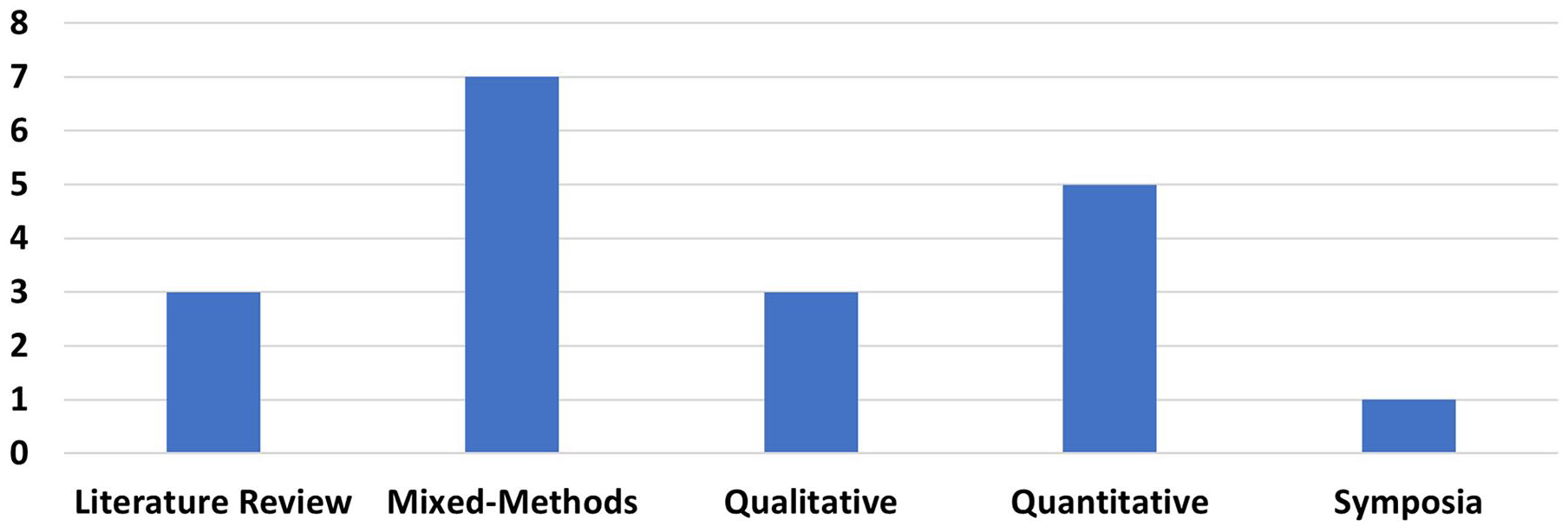
The types and methodologies that were represented in the manuscripts reviewed.
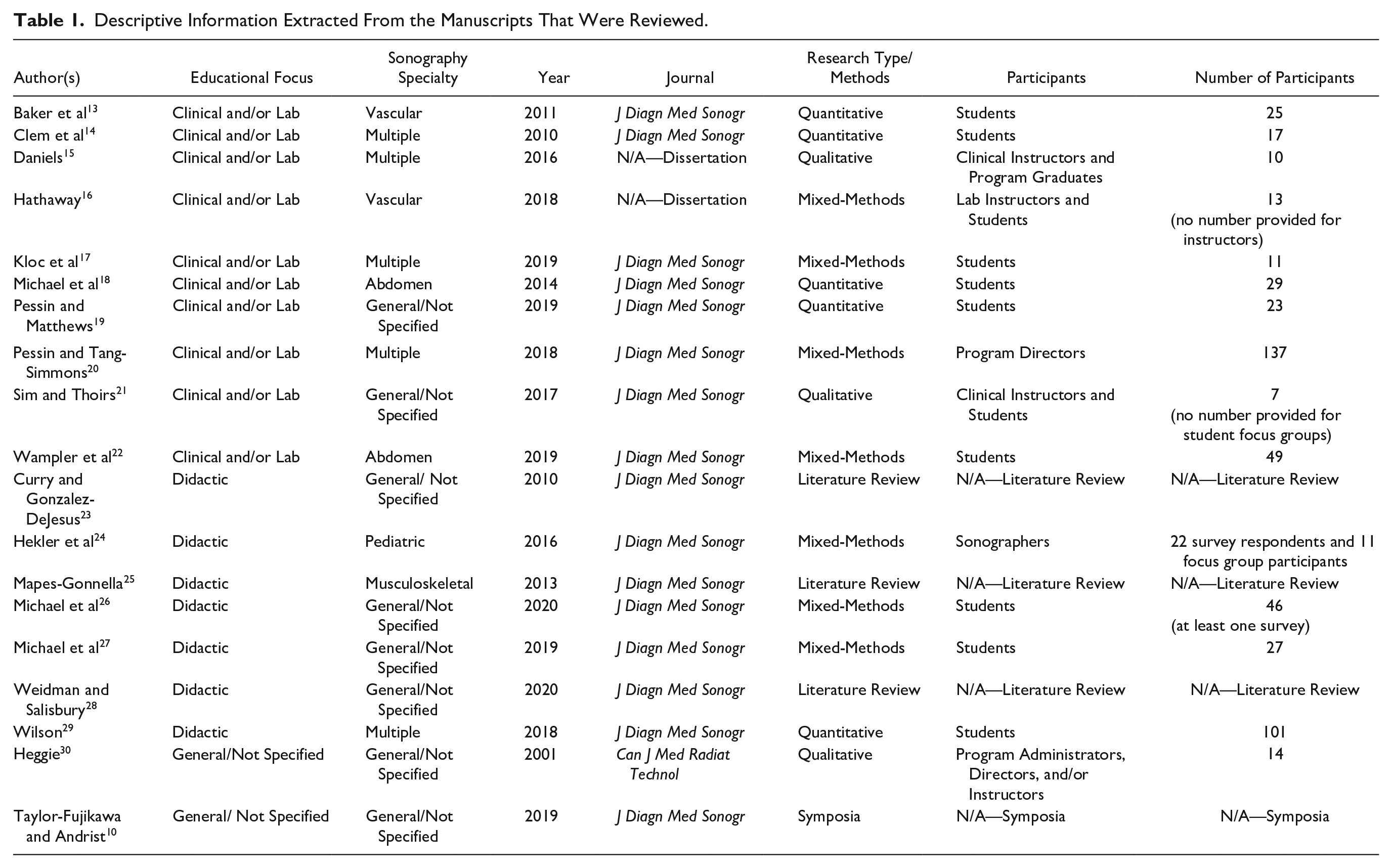
Figure 2 illustrates that students were most frequently the research subjects,13,14,16–19,21,22,26,27,29 but other study participants included clinical or lab instructors15,16,21; program administrators, directors, and/or instructors20,30; program graduates 15 ; and sonographers. 24 The number of participants within the studies varied widely and ranged from around 7 to 137,13–22,24,26,27,29,30 with an estimated average of 36 and median of 25 participants. The values are approximate as two papers did not disclose the exact number of participants in focus groups 21 or instructor evaluations. 16 Table 1 summarizes the descriptive information listed in this results section.
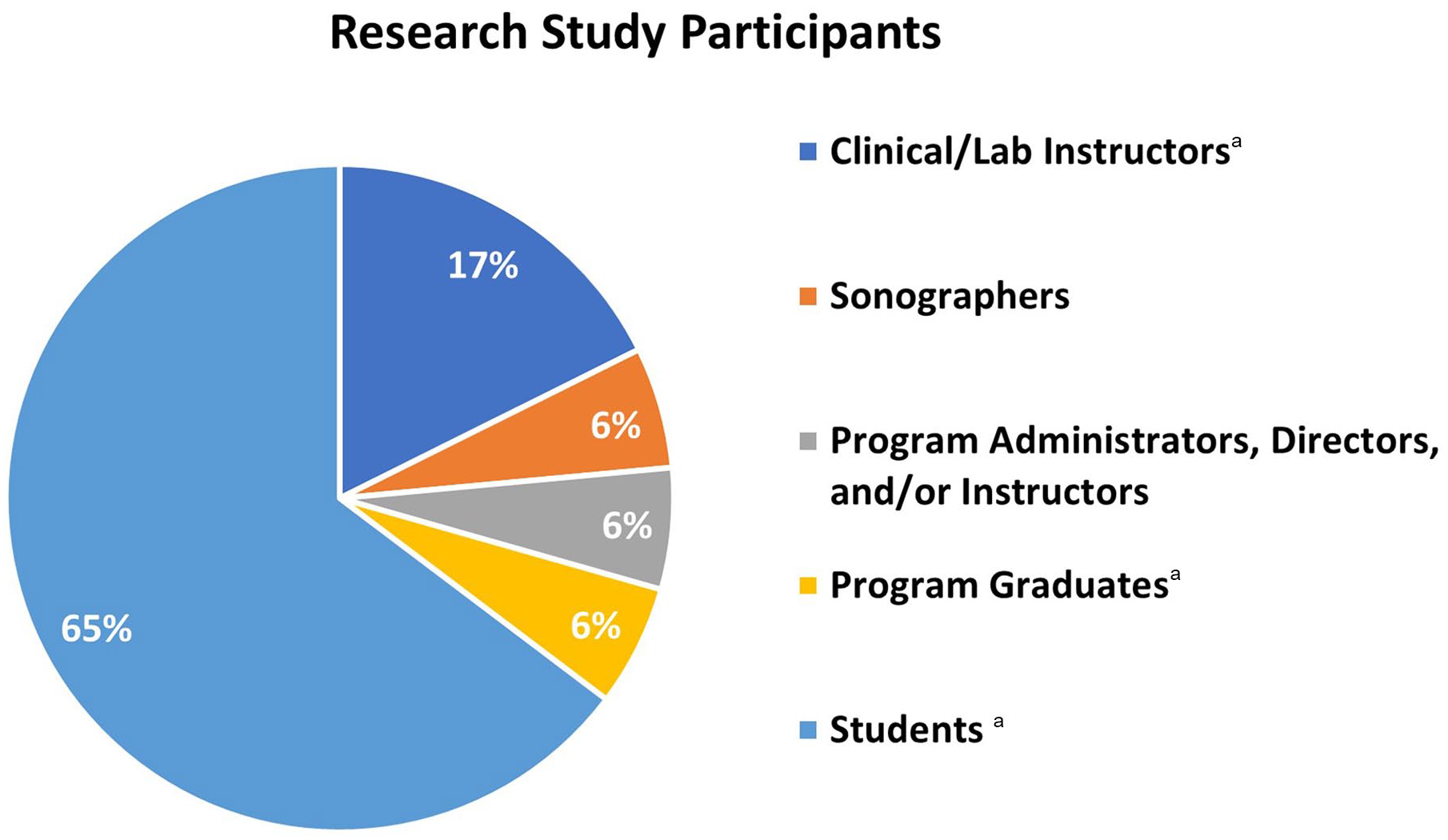
Types of participants who contributed to the research studies reviewed.
Descriptive Information Extracted From the Manuscripts That Were Reviewed.
Discussion
Overview
It is hopeful that so many sonography manuscripts in this review focused on quality improvement, and it is especially encouraging to see so many publications on quality within the last 10 years. Another positive finding is the variety of sonography specialties represented in this education literature review, which contrasts with the predominantly cardiac and/or vascular focus of a recent review of quality improvement efforts in the clinical setting. 1 The rest of this discussion section explores the themes identified within the papers as well as limitations and gaps in the literature.
Accreditation, Credentialing, and Assessment
This review revealed only one original research study focused on accreditation. 30 Benefits of specialized accreditation included protections for students, programmatic self-reflection, the peer review process, continuous quality improvement, and improved status for the program and its graduates. 30 Conversely, cost was cited as a challenge to specialized accreditation. 30
Notably, future accreditation researchers may choose to use a revised conceptual model proposed by the author of the accreditation article. 30 The original model included a variety of linkages between educational programs, certification, accreditation, national government legislation, professional associations, and employers. 30 This was expanded to incorporate local government policies, the connection between employers and educational programs, and the interactions between local and national factors related to the accreditation process. 30
Two manuscripts within this review addressed credentialing.10,29 The symposia article provided a historical overview and stated, the benefits of certification [credentialing] include demonstration of knowledge, skills, and abilities . . .; validation of clinical experience . . .; and a clear, competitive edge over noncertified candidates. Those aspects also contribute to reassurance of safety to the public.10(p522)
In addition, one study looked at the relationship between practice examinations and subsequent credentialing scores and found that practice examinations resulted in significantly increased credentialing scores as well as reduced self-reported testing anxiety. 29
Assessment was the central topic of a literature review. 23 Continual assessment and self-evaluation are important parts of accreditation self-study reports. The literature review provided a wealth of assessment information for sonography program faculty by describing formative, summative, indirect, and direct assessments; explaining the various aspects of the assessment cycle; emphasizing the importance of assessment; presenting details of course, program, and institutional assessment; and highlighting the linkage between course, program, departmental, and institutional missions and goals. 23 The authors stated, “A critical part of assessment is using what we have learned from our assessment tools to improve the teaching and learning environment. This, in turn, should improve student learning outcomes.”23(p101) Another study detailed assessment within the learning-testing cycle and discussed the benefit of providing immediate feedback to students after formative assessments. 29
Quality Improvement Initiatives in Clinical/Lab Education
The vast majority of manuscripts in this review focused on quality improvement in clinical/lab education.13–22 The literature uncovered the following themes as important aspects of a quality clinical education: a supportive15,21 and professional 15 learning environment, time for instructor/student interaction,15,21 modifying instruction to the individual student,15,21 encouragement for students to continually expand their skills, 22 opportunities for students to build critical thinking 28 and reasoning skills, 21 and consistent communication between clinical instructors and program faculty.15,21
Quite a few studies evaluated the relationship between training tools and clinical/lab performance. Many program directors noted that simulation was valuable in education 20 and students were found to have improved confidence 17 and competence 22 after participating in simulation activities. Although the majority of program directors surveyed used simulation, 20 cost20,22 and time constraints 22 were cited as challenges in implementing simulation in sonography education. One study found an objective structured clinical examination to be accurate and reliable in assessing student clinical skills, but also mentioned how it required cost and time resources. 13
Multiple articles discussed a variety of other quality improvement initiatives related to clinical/lab performance. A unique article described how glow powder was used to help students learn infection protection/control in lab and the authors found that the exercise led to significant improvements in knowledge and practice. 19 On another note, a retrospective review of student abdominal clinical scans concluded that the liver and common bile duct were the most challenging areas to accurately scan. 18 Two additional studies correlated student scanning skills with spatial ability scores 14 or self-efficacy/regulation results. 16 A strong correlation was noted between spatial ability scores and scanning after two semesters, and the authors noted that it might be beneficial to include spatial ability in program admissions as well as in creating individualized instructional plans. 14 Similarly, student self-efficacy and/or self-regulation were found to correlate with skills such as goal setting, self-evaluation, practice time, and willingness to seek assistance that ultimately related to lab performance. 16
Quality Improvement Initiatives in Didactic Education
Quality improvement in didactic education was not the most common topic in this review, but there were some articles that underscored the latest initiatives in the field. Studies that focused on the newer sonography specialties of pediatric and musculoskeletal sonography recommended standardization of curricula.24,25 The sonography national education curriculum has since been updated to include basic information on these specialties.10,31 In another study, objective structured clinical examination scores and didactic test grades were found to have a weak positive association. 13 The researchers concluded that, “this supports the idea that multiple-choice tests are not able to adequately assess student performance in the clinical setting.”13(p208)
A few articles considered the topic of student stress/anxiety.26,27,29 In one study, students reported that mindfulness exercises helped to improve attention, awareness, relaxation, and self-care. 26 Two other studies found that self-reported anxiety was reduced with practice 29 or open-book examinations, 27 but that only practice examinations were found to significantly increase successive examination performance. 29
Limitations
One limitation of this review is that over 80% of the articles were from one sonography journal and this could have unintentionally introduced bias. Unfortunately, no articles from the other sonography-specific journals searched met the criteria for inclusion. Future publications on this topic from a variety of journals would provide a much broader perspective on ongoing quality improvement efforts in sonography education.
Another aspect that could have also potentially introduced confounding factors is the variability in sonography education that was noted multiple times in this literature review.13–15,18,20–22,24,25 Recommendations for limiting variability in the educational environment included increased clinical instructor training/support15,18,21 as well as standardization of patients,13,18 instructor assessments,13,14 and educational curricula.24,25 Although variability of clinical experiences can be challenging for students, it provides the benefit of learning from a variety of instructors and patients as well as the flexibility of experiencing a range of workplace settings prior to officially joining the workforce.
Gaps in the Literature
It is evident that more quality initiative research is needed in the field of sonography education. This review covered nearly 20 years of research and it is surprising that more articles were not published on this topic during this time, especially considering the strong emphasis on quality within the health field. The paucity of articles focused on educational accreditation and credentialing is unexpected as well.
Conclusion
Overview
This review of 19 sonography educational manuscripts on accreditation, credentialing, and quality improvement is important in that it provides a synopsis of the existing literature in the field while responding to the three guiding research questions. The review identifies the publications that have focused on sonography educational accreditation, credentialing, and quality improvement efforts in the last 20 years; discusses the most commonly explored areas within the extant body of literature; and uncovers gaps that remain in the literature. The next section is valuable for future researchers as it provides examples of additional quality initiative research opportunities in sonography education.
Recommendations for Future Research
There is published research on quality improvement initiatives in other allied health fields that can potentially be used as guides to begin exploring these areas within sonography. For example, one health study reported that the majority of education professionals/administrators supported requiring completion of a program with specialized accreditation for credentialing applications, 32 but no similar study was found focused on sonography. In addition, a few health studies researched if there was a relationship between credentialing scores and clinical skills/time33–35 and multiple studies evaluated the link between clinical instructor characteristics and student learning/ratings36–41 with no comparable studies found in sonography. Additional ideas for future research include outcome comparisons of sonography educational programs based on accreditation status,1,30 educational standard compliance of initial and renewal programmatic accreditation applications, didactic continuous improvement efforts, associations between clinical skills and student grades/scores or programmatic accreditation status, and qualitative perspectives of students, faculty, and clinical instructors about the educational experience.
Footnotes
Acknowledgements
The author would like to acknowledge and thank Dr Karla I. Loya, Dr Kerry E. Weinberg, Dr Linda Moran, and Dr William J. Gammell for their invaluable assistance and help as doctoral dissertation examining committee members. The author would also like to acknowledge and thank Angelo Sorrentino for his encouragement in writing this article.
Declaration of Conflicting Interests
The author declared no potential conflicts of interest with respect to the research, authorship, and/or publication of this article.
Funding
The author received no financial support for the research, authorship, and/or publication of this article.
