




Abstract
AbstractThinking LEAN is an informal way to continuously be aware of and look to improve the value of your surroundings. A sonography department has many moving parts or “steps.” Identification and reduction of unnecessary steps may create greater efficiency and value for a process. This may ultimately provide a better experience for the sonographer and the customer.
Keywords
Lean is a set of operating philosophies and methods that help create maximum value for customers by eliminating waste. 1 Lean originated from Six Sigma, which aims to reduce defects through standardization and problem-solving. Together, Lean Six Sigma works to maximize strengths and minimize weaknesses within an organization. Its roots go back to the manufacturing industry in the 1980s with Motorola microchip production and quality tests. 2 Other manufacturing companies, such as Toyota, added new concepts in the 1990s with their production system. 3 General Electric also applied these concepts to its business strategy in that era. 4 Healthcare applications followed with an emphasis on value. Value drives any good process and waste may inhibit those processes from functioning effectively. Each step of a process is vital to the overall work of the system. This article focuses on utilizing Lean thinking in everyday situations to build high-quality, efficient processes and to maximize value by eliminating waste. Waste is any action or step in a process that does not add value to the customer. In other words, waste is any process that the customer does not want to pay for. 5 This article introduces the concept of Lean thinking and its application in sonography.
An example of Lean thinking is to have a customer make a shopping list and map out their first visit to the grocery store afterward. The goal is to complete the visit in the most timely and efficient manner. The customer’s first visit through the aisles was as follows: 1, 2, 3, 2, 4, 6, 5, 3, 4, 7, 8, 2, 5, 3, 8 > checkout. This visit is mapped out, starting from the grocery story entry to the grocery store checkout (Figure 1).
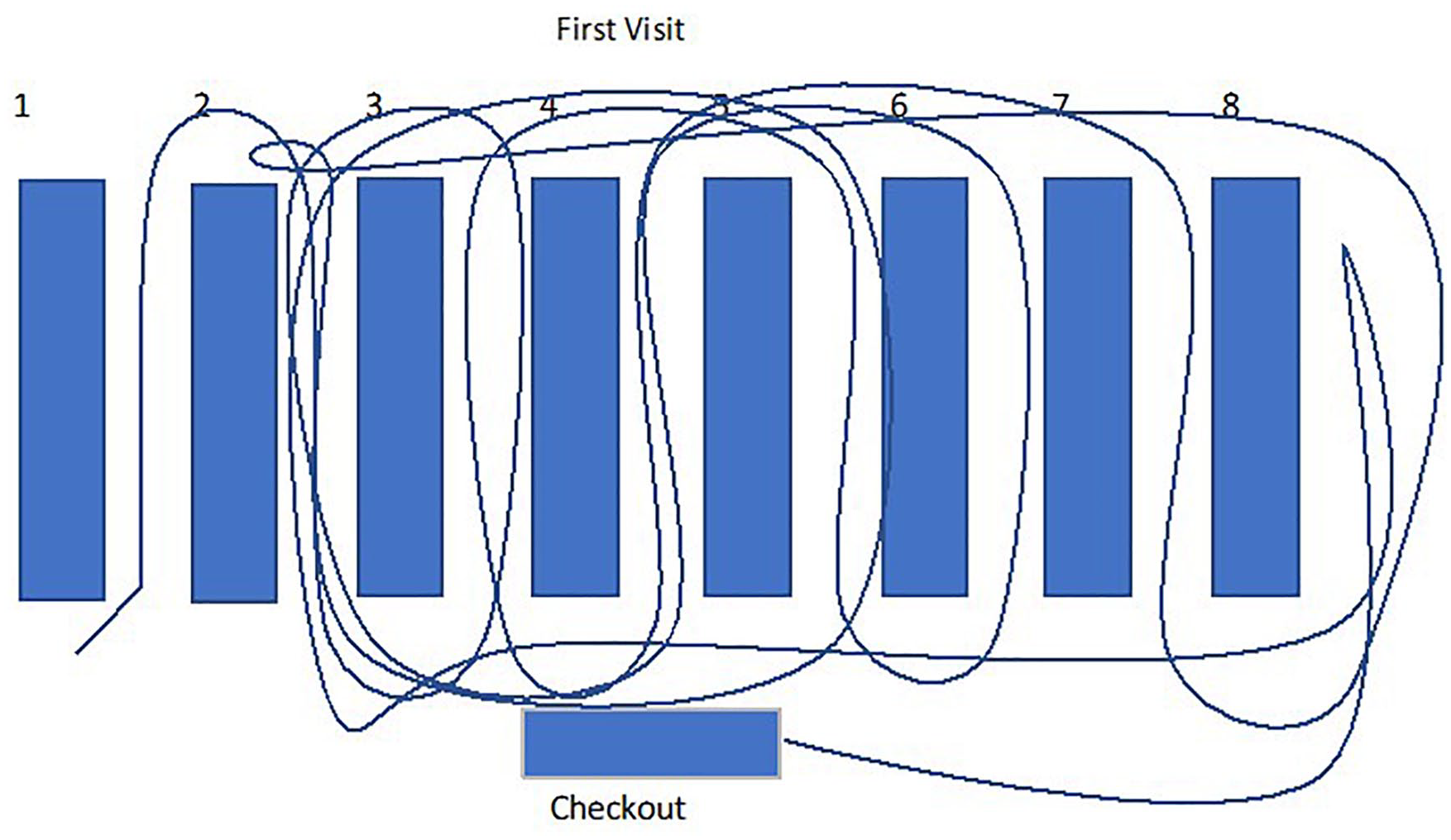
Grocery store visit 1.
The hypothetical time for visit 1 was 13 minutes. The spaghetti diagram (first visit) demonstrates the customer’s pathway through the store, which can be termed “current state.”
“Current state” is simply the original process. A week later, the customer had the same list, but had a much better outcome, as seen in Figure 2 (second visit). The customer was prepared by mapping out the trip in advance based on the items on their list.
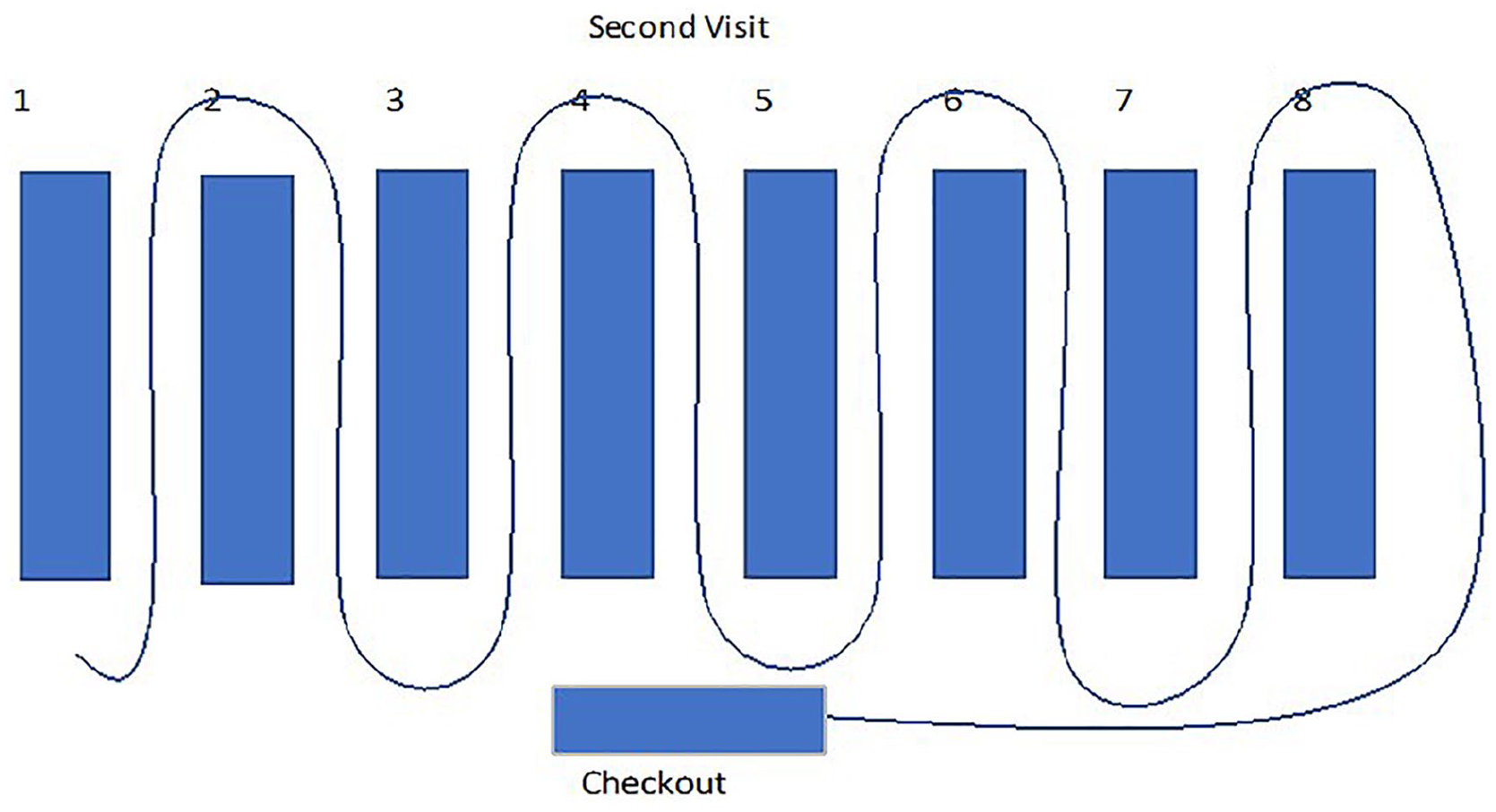
Grocery store visit 2.
The second visit demonstrates the “ideal state,” or what is desired. The hypothetical time was 6 minutes. The customer obtained the same products in less than half the time, and all it took was some previsit preparation to eliminate wasted steps (Table 1).
Value Classification Chart 6 : Strive to Eliminate “Non–Value Added.”
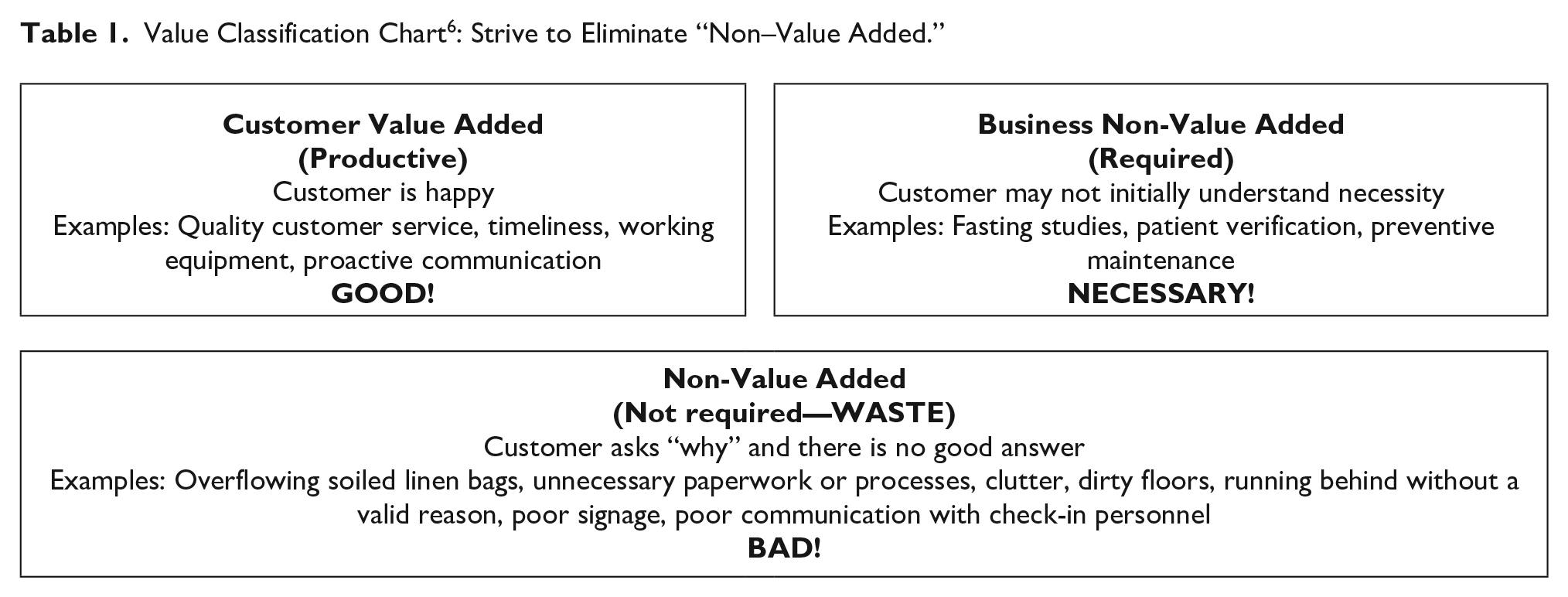
Lean opportunities may take on different profiles. Anything that is “non–value added” (NVA) should be considered waste and eliminated or minimized as much as possible.
Thinking Lean at the Registration Desk
Scenario 1
The customer experience begins at the registration desk. The patient checked in on time for their 10:00
Scenario 2
The patient checked in on time for their 10:00
For customer service, there is nothing wrong with borrowing a great idea from a different industry. Think of the last time you were at a favorite restaurant and were told, “It’s a 30- to 45-minute wait.” How did you feel when they called for you after only 15 minutes?
Experienced sonographers have a good idea about wait times. In this case, the sonographer borrowed from the restaurant world and communicated appropriately to the registration desk. Delivering healthcare requires time that is often complex and fluid. You simply never know how long an examination will take to complete. Underpromising and overdelivering on estimated wait times and thanking the customer for their patience demonstrates high-quality care and value for the patient’s own time.
For scenario 2, the patient was informed about the hour wait, ultimately waited only 30 minutes past their scheduled appointment, and was thanked twice. This may not always work but is easy to implement. A couple of extra seconds to pass along information may help minimize negative comments or complaints and make the customer feel better about their overall experience. That minimal amount of extra work (CVA) is worth your time.
Thinking Lean in the Waiting Room
The patient checked in and was directed to a nearby vacant waiting room. A reality TV show was on with the volume turned up very high. Many old, tattered magazines were haphazardly strewn over two tables. An overflowing trash container was visible in a corner. An empty coffee cup was on the floor.
Where should Lean have been applied? Regardless of who was responsible for maintenance of the waiting room, all the issues described could be remedied in seconds if someone stepped up to “fix it now.” A reality television show in a hospital waiting room can make people feel uncomfortable. Turn the sound down, change the station to something more suitable, or turn the television off. Straighten up the magazines. Make the effort to pick up the coffee cup and throw it away. Get rid of the trash or call whomever takes care of janitorial services. By eliminating these wastes (NVA), the patient is more likely to enter a professional waiting room environment. The appearance of waiting room spaces matters to patients and family members.
Thinking Lean With a Patient on the Examination Table
How Can You Utilize Lean During an Examination?
Sonography equipment systems have tools that automatically populate annotations for the next protocoled image or initiate Doppler. Companies call the technology different names, but “auto-populate” may dramatically eliminate waste and increase workflow. An example of this process could be a routine renal examination image: “sagittal right kidney lateral.” If typed out, that is 29 keystrokes counting the spacebar. That means 29 times to potentially mislabel, backspace, misspell, and so on. Gradually, cheat keys have made their way onto systems and enabled a single keystroke for “sagittal” instead of eight strokes to type out the word. Add to this one keystroke each for “right,” “kidney,” and “lateral.” This gives you a total of 4 keystrokes versus the original 29. Those extra keystrokes are wasted effort and undermine standardization attempts. This is a great example of Lean. The auto-populate function revolutionized this portion of the sonographer’s work. It allowed for placing annotation wherever needed, utilizing measurement calipers, populating color Doppler, and changing transducers for a specific image. These are just a few examples of the myriad applications with this time-saving tool.
Also, for auto-populate after storing an image, the system returns to real-time B-mode (unfreezes). Think about the function of the freeze key. It is important to consider a possible 50 images in a sonographic examination. How many times is the freeze key used? At least 50 for the images stored and another 50 to return to real-time imaging, and perhaps a variety of other reasons. With auto-population, the system goes back live without hitting freeze, which saves at least 50 keystrokes per examination, times the number of examinations a day, times the number of days a week. Over time, hundreds of thousands, if not millions, of keystrokes are saved for the sonographer. Why does that matter? Every keystroke is an opportunity for wasted effort to arise. Type a wrong letter and the sonographer must backspace or delete the error. By maximizing keystrokes, this helps to minimize mistakes as well as accumulated fatigue for the sonographer.
Another example of Lean is side-by-side measurements. If image 11 is a sagittal measurement, why wait until image 23 for the transverse measurement? The second measurement should be as close as possible to the first measurement. It is very important to utilize dual-screen images if available on the equipment. This will save valuable time scrolling through images to locate what the sonographer or the radiologist needs to report for measurements. It is important that these functions are consistent among sonographers and to orientate new staff to these protocols.
How about the number of sonographic images taken? How many images should demonstrate a normal gallbladder? If a couple of images in two planes demonstrate the anatomy, why continue to save more images? This suggestion could also apply to recording pathology. As a new sonographer, I thought it was cool to take numerous images showing pathology. Looking back, it wasted a lot of time, taking six images of a routine 2.0-cm cyst when two were acceptable. Set an imaging protocol and process that is department endorsed and stick to it. It is important for sonographers to work smarter.
Thinking Lean With the Transducer in Your Hand
Far too many sonographers are scanning in pain. Work-related musculoskeletal injury is a huge challenge for our profession. Here are some personal “fix it now” Lean suggestions that may help prevent sonographer’s work-related injury risk:
Release the grip and pressure on the transducer whenever possible.
Practice loosening transducer grip while conducting an ultrasound. Sonography does not always require gripping the transducer as tightly as possible, applying intense pressure, or both. Grip as tightly as needed and apply pressure as needed. Any more than necessary is waste (NVA) and increases the risk of a work-related musculoskeletal injury.
While an image is frozen and measurements or annotations are applied, release the grip and pressure on the transducer. These rest breaks are a precious few seconds but will add up over time.
Thinking Lean as the Patient
It is important for sonographers to consider the role of the patient. Try to imagine what a patient would see as they enter the examination room. It may be useful to lie down on the examination table and look around. Another way to consider this exercise would be to imagine a relative coming to visit your home. Are the floors clean? Are soiled linen bags under control? Is your supersized latte right there at eye level for the fasting patient to see? Remove unneeded materials or at minimum store them away and out of the patient’s view. Eliminate NVA before it becomes a problem for the patient and the department.
Initially, these suggestions may not seem important. However, impressions and appearances do make a difference to the patient. It is also important to clean the sonography system daily. During the cleaning process, untangle and straighten transducer cords. Then look behind or under the equipment and the examination table for dust or other trash that always seems to appear.
Thinking Lean With 20 Minutes Left on Shift
Preparation is a huge CVA component of Lean. For example, 20 minutes is left on shift and the room is clean and stocked. What else can be done to maximize value? Perhaps retrieve requests for the next day. It is always important to “do your homework” by looking up old examinations, making notes, or filling out sonography worksheets in advance. These vital tasks must be accomplished regardless of when they are done, which is “business non–value added” (BNVA). One suggestion is to add these activities during downtime or at the end of the shift. Look for ways to maximize valuable work time and be ready for the next day.
There may be other assigned duties but think about the most CVA way to start the next workday. It is NVA to waste 20 minutes at the end of a shift that could have been used to prepare for tomorrow. You never know what challenges may happen on the following clinical day. How many times have there been add-on patients from the start of a shift or computer or equipment issues? A little preparation for the upcoming clinical day may be a huge investment for the staff and patients.
Thinking Lean Every Day
As with the grocery store example used earlier, Lean thinking can be used anywhere, anytime to maximize value and eliminate wastes. Here are some other common examples:
Learn to better prepare for air travel, especially when headed through security. Be proactive and know what you can and cannot carry on to a flight.
The work commute may be 30 minutes shorter if you account for traffic and leave home at 6:50
Set your DVR once to record an entire series instead of manually setting it once a day or week to record a single episode.
Fill the car up with gasoline when needed. Do not wait until the following day. The time wasted by not getting gas will make a big difference if traffic is stalled on the highway or if the gas freezes in colder climates.
Summary: Thinking Lean
It is important to canvas the workplace and the home for ways to be more efficient. Carefully consider any wasteful items or processes that may exist. Why take five steps when two would be adequate? Thinking Lean can be a beneficial process for anyone, anywhere, at any time. All professionals’ time is valuable, whether in the workplace or elsewhere. Do not waste work time contributions. Some minor critical thinking could lead to changes that result in higher value for patients, coworkers, and you.
Footnotes
Declaration of Conflicting Interests
The author declared no potential conflicts of interest with respect to the research, authorship, and/or publication of this article.
Funding
The author received no financial support for the research, authorship, and/or publication of this article.