




Abstract
Background
In line with zero-waste movement, there is a need for pharmacies to start reducing waste. There is no systematic waste minimization efforts by local pharmacies or studies to evaluate their effectiveness.
Aim
Assess behavioral change factors towards waste minimization at National Cancer Centre Singapore and evaluate effectiveness of recycling effort and patient education campaign.
Methods
Preliminary surveys were carried out among pharmacy staff, patients/caregivers to assess behavioral change factors. Recycling rate of staff and plastic bag consumption levels of patients/caregivers were measured.
Results
46 staff members and 335 patients/caregivers were surveyed. Both populations were optimistic about the suggested green initiatives, 82.6% of staff members viewed recycling as a potential solution to reduce waste and 67.6% of patients and caregivers demonstrated willingness to participate in a Bring Your Own Bag (BYOB) campaign. Recycling efforts improved recycling rates by 53.4% while BYOB campaign resulted in no notable decrease in plastic bag consumption levels.
Conclusion
This study revealed the need for improvements in current waste management practices in local pharmacies, and demonstrated the effectiveness of implementing a recycling effort. BYOB campaign was not shown to be effective. Follow-up studies should be carried out to capture long-term sustainability data. Future efforts should include studies at other non-specialized local pharmacies.
Introduction
Pharmaceutical waste is generated at each stage of the pharmaceutical supply chain. According to World Health Organization (WHO), pharmaceutical waste comprises unwanted pharmaceutical products, drugs, vaccines or sera, and “discarded items used in handling pharmaceutical products”, including packaging material. Some definitions of pharmaceutical packaging include materials used in the transport of pharmaceutical products, such as large cartons and shrink wrap, while some do not. Hence, there is divergence in the classification of pharmaceutical packaging.1,2 In this study, common pharmaceutical packaging materials will be taken to include large cartons, cardboard boxes, drug inserts, labels, plastic or glass bottles, foil blisters and plastic wrap or bags.1,2
The zero-waste movement aims to move towards sustainable production, consumption and recycling to reduce waste incineration and conserve landfill space. 3 Similar to other countries,4–7 Singapore is gearing towards a zero-waste movement 8 as research has shown that current levels of waste generation are unsustainable. Despite Singapore’s incineration plant having a filter system which prevents emission of harmful gases, and careful measures to prevent detrimental environmental effects of landfilling, 9 Singapore faces serious space constraints. 10
Given the problem of limited landfill space and potential environmental issues from incineration11,12 and landfilling, 13 there is a need to start reducing waste. Hence, pharmaceutical waste minimization is an area of interest in pharmacy practice. Pharmacists play important roles in the pharmaceutical supply chain and can contribute to the reduction of pharmaceutical waste. WHO and the International Pharmaceutical Federation have proposed interventions to reduce waste in pharmacies, including recycling of pharmaceutical packaging materials.1,14 Yet, such interventions are still not part of current local practices.
In addition to the Resource Sustainability Bill, which aims to impart accountability to large companies in reducing packaging waste, 8 local efforts to reduce plastic bag usage by retailers are on the rise. 15 Pharmacies are also changing their practices in a bid to reduce waste; some adopted strategies include distribution of free reusable bags and the implementation of plastic bag charges.16,17 However, to the authors’ knowledge, studies evaluating the effectiveness of such strategies are lacking. Furthermore, there is no systematic waste minimization efforts in most local pharmacies, including the pharmacies at National Cancer Centre Singapore (NCCS).
This study aims to achieve change in recycling and plastic bag consumption behavior within pharmacies by designing green solutions based on a behavioral change theory, Theory of Planned Behavior (TPB), 18 and measuring their effectiveness. TPB is a behavioral change theory commonly applied to environmental-behavior studies.19–22 Attitude, perceived behavioral control and subjective norm have been proposed to be the main driving forces for behavioral change. 18 The findings of this study will inform feasibility and effectiveness of green initiatives in local public institution pharmacies and guide the design of future waste minimization projects. Findings could facilitate knowledge-sharing about minimizing pharmaceutical waste among the pharmacy force and promote the implementation of such initiatives.
Therefore, the objectives of this study are: (a) To assess behavioral change factors of pharmacy staff, patients and caregivers in a local public institution pharmacy. (b) To determine effectiveness of a recycling effort in a local public institution pharmacy. (c) To determine effectiveness of a patient educational campaign in a local public institution pharmacy.
Materials and methods
Overview
This study consisted of three phases. Results from two exploratory phases were used for the final evaluation phase (Figure 1). The study was based at the Specialist Outpatient Clinic (SOC) pharmacy of NCCS, and was classified as a Quality Improvement project. No identifiable personal data was collected and Institutional Review Board approval was not needed. Overview of study methodology.
Exploratory phases
Theory of planned behavior
The behavioral change factors were harnessed to design surveys for pharmacy staff, patients and caregivers. As there were limited studies on pharmacy waste minimization, questionnaire items were brainstormed among study team members.
Phase one: Exploration in pharmacy
All NCCS pharmacy staff members, including pharmacy managers, pharmacists, pre-registration pharmacists, pharmacy technicians and pharmacy assistants were eligible to participate. Staff members were approached via convenience sampling. Using sample size calculation 23 for a population size of 60, sample size of 52 was required at 95% confidence level.
The staff survey comprised mainly close-ended questions (Annex A). Content validation of the survey was carried out via a pilot test. The survey sought to obtain staff opinion on existing gaps and opportunities of pharmacy waste management and assessed TPB behavioral change factors 18 of staff members towards reducing and recycling pharmaceutical waste. Additionally, staff knowledge about recycling of pharmaceutical packaging was assessed. Data generated was tabulated in Microsoft Excel for analysis.
Phase two: Exploration with patients/caregivers
Patients and caregivers who visited the NCCS SOC pharmacy from 2nd to 13th September 2019 were eligible for participation. Convenience sampling was carried out over 10 days. Using sample size calculation 23 for an estimated population size of 2500, sample size of 331 was required at 95% confidence level.
The patient/caregiver survey comprised mainly close-ended questions ranked on a 5-point Likert scale (Annex B). Content validation was carried out via a pilot test. The survey assessed current behavior and TPB behavioral change factors 18 towards reducing plastic bag usage. Patient/caregiver demographic information and survey response rate were recorded.
The four questionnaire items assessing intention to participate in pharmacy greening were taken into account to tabulate the intention score out of 100. Using average median for all the domains, a score of 70 was used as cut-off. The scores for attitude, subjective norm and perceived behavioral control were tabulated in a similar manner. Data generated was tabulated in Microsoft Excel for analysis. Univariate statistical analyses were carried out using IBM Statistical Package for the Social Science (version 23).
Phase three: Assessment of implementation, importance and feasibility
Determining effectiveness of pharmacy recycling effort
To encourage pharmacy recycling effort, recycling bins were made available within the pharmacy. Posters were also designed to educate pharmacy staff on the types of waste suitable for recycling (Annex C).
Waste generated in the pharmacy was collected and sorted into different categories. Waste quantification was carried out once (defined as “round 1”) before implementation of the pharmacy recycling effort. Waste quantification was carried out twice after the implementation of the recycling effort; the first (defined as “round 2”) to measure changes in recycling rates and the second (defined as “round 3”) to measure sustainability of improved recycling rates.
In all rounds of waste quantification, each category of waste was weighed using a handheld weighing scale. Two repeated measurements were taken and mean values were recorded. Each round of measurements was taken over a typical work week of 5.5 days. Percentage weight of recyclable waste that was being recycled were calculated. Data analysis, including means comparison and paired samples T-tests, were carried out.
Determining effectiveness of patient educational campaign
As part of the patient educational campaign, patient education leaflet (Annex D) were distributed to patients and caregivers at the NCCS pharmacy. The leaflet aims to educate patients on the size and impact of plastic bag crisis.
For the month of the campaign, weekly plastic bag consumption levels were tracked and compared against baseline consumption levels. Baseline plastic consumption levels were estimated using the pharmacy’s monthly plastic bag order forms from 2018.
Results
Phase one: Exploration in pharmacy
Pharmacy staff survey results
Results of preliminary staff survey.

aMore than one option can be selected.
bReason initially listed under “Others” was re-categorized into “Perceived behavioral control”.

Staff perception of recycling within the pharmacy.
Solutions to change recycling behavior
Based on results from phase one, different solutions were implemented to target identified behavioral change factors. The lack of a supportive subjective norm was identified as the greatest behavioral change barrier, while poor perceived behavioral control and attitudes were also identified. Hence, greening efforts to encourage recycling in the pharmacy focused firstly on building a supportive subjective norm and, secondly, improving staff perceived behavioral control and attitude.
Among subjective norm statements, the lack of institutional policy for waste minimization was identified as the greatest reason for excessive waste generation in the pharmacy. To target this, a recycling effort was implemented. Staff members were encouraged to sort packaging waste and discard recyclable and non-recyclable waste into respective bins. An incentive system that rewards staff members when recycling targets were achieved was also implemented. Setting expectations from the institution for staff to engage in recycling would build a more supportive subjective norm for behavioral change.
Modification of workflow was simple and required no additional human resource nor substantial additional time for waste sorting, thus, improving staff perceived behavioral control. To target the lack of recycling knowledge and attitude among staff members, educational posters were placed around the pharmacy to guide the recycling process.
Phase two: Exploration with patients/caregivers
Patient/Caregivers survey results
Demographics of patient/caregiver survey respondents (N = 335).

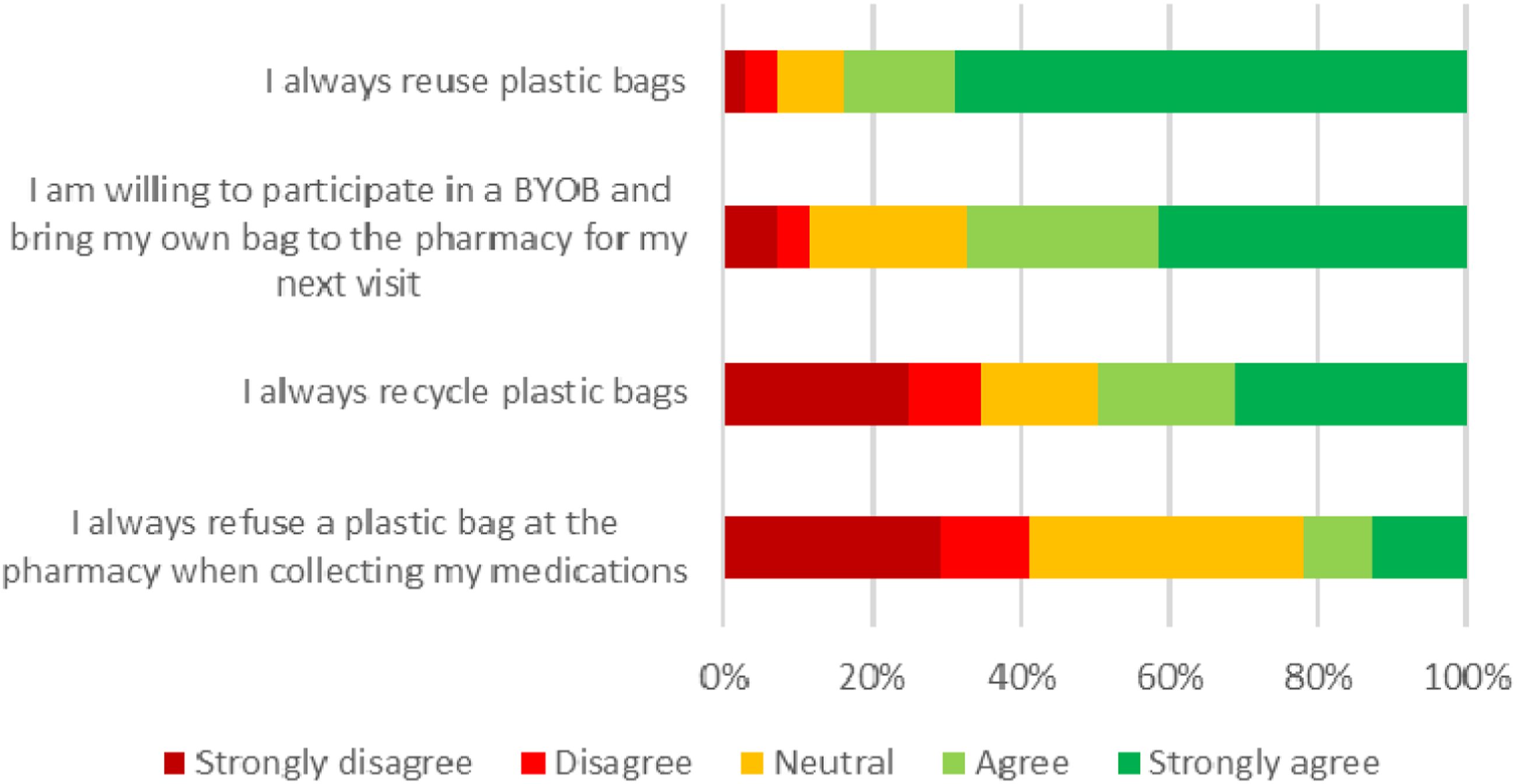
Plastic bag usage pattern of patients or caregivers.
Behavioral change factors for surveys patients and caregivers.

aReasons submitted by respondents are categorized into three main groups.
bReason initially listed under “Others” was re-categorized into “Perceived behavioral control” and considered as “agree/strongly agree”.
Univariate analysis.

Legend: attitude (AT), subjective norm (SN), perceived behavioral control (PBC).
*Statistically significant at a level of 0.05.
Solutions to change plastic bag consumption
Based on results from phase two, several solutions were implemented to target identified behavioral change factors. The lack of a supportive subjective norm was identified as the greatest behavioral change barrier. This is followed by poor attitudes and then perceived behavioral control. Hence, greening efforts to encourage the use of reusable bags when patients or caregivers collect medications in the pharmacy focused on building a supportive subjective norm and improving attitudes towards reducing plastic bag consumption.
A Bring your Own Bag (BYOB) campaign was carried out to spread awareness of NCCS′ commitment to reduce plastic bag usage. The campaign aimed to set a new norm of patients bringing their own reusable bags. Patients or caregivers were invited to pledge their commitment to using reusable bags during future visits to the pharmacy. Individuals who pledged their commitment were given a sticker to contribute to a chart which helped them visualize the impact of each individual’s effort.
Negative attitudes towards reducing plastic bag usage were targeted by disseminating educational leaflets. The leaflets highlighted the importance of reducing plastic consumption by switching to reusable bags, rather than merely reusing plastic bags. 24 National Environmental Agency’s (NEA’s) ‘Say YES to Waste Less’ campaign wobblers and posters were displayed to amplify campaign messages. To improve perceived behavioral control, reusable bags were given out to facilitate the convenience of switching to reusable bags.
Phase three: Assessment of implementation, importance and feasibility
Determining effectiveness of pharmacy recycling effort
Waste collected from the pharmacy includes large cartons, medication cardboard boxes, plastic, patient information leaflets, other paper, label backings and other general waste. Waste in the pharmacy can be sorted into two categories: recyclable waste (large cartons, medication cardboard boxes, plastic, patient information leaflets, other paper) and non-recyclable waste (label backings and other general waste). Pharmaceutical packaging waste made up 90.2% while other waste made up 9.8% of all waste generated in the pharmacy in a typical work week.
Weight of different types of packaging waste generated at NCCS outpatient pharmacy across one work week and during fortnightly stock delivery.

aPharmaceutical packaging waste: large cartons, medicine cardboard boxes, patient information leaflet, plastic, sticky labels and backing.
bRecyclable pharmaceutical packaging waste includes: large cartons, medicine cardboard boxes, patient information leaflet, plastic.
cNon-recyclable pharmaceutical packaging waste includes: Sticky labels and backing.
dIncorrectly recycled.
eRegular refers to waste generated from regular operations at the pharmacy, which includes medicine cardboard boxes, patient information leaflet, plastic, sticky labels and backing.
fStock refers to waste generated when stocks arrive from the pharmacy store, which includes mostly cartons and medicine cardboard boxes.
Overall, recycling rates improved, and improvement was sustained from round 2 to round 3. Some non-recyclable packaging materials were incorrectly placed into the recycling bin, but the rate of error did not increase between round 2 to round 3.
Determining effectiveness of patient educational campaign
The total number of plastic bags ordered for the year 2018 was 77,700, while the number of patients served was 76,323. Therefore, baseline weekly plastic bag consumption level was estimated to be 1494 bags or 1.02 bag per patient.
In September 2019, plastic bag consumption levels showed fluctuation across the 4 weeks (Figure 4), but was notably highest in the first week (2020 bags for 1746 patients or 1.16 bag per patient). Plastic bag consumption levels were lower and remained relatively constant across the remaining weeks. Overall, mean plastic bag consumption level was calculated to be 1565 ± 304, which is equivalent to 1.04 ± 0.08 bag per patient. Weekly plastic bag level consumption for month of BYOB campaign (September 2019).
Discussion
The TPB framework 18 was used to explore behavior-influencing factors for recycling of pharmaceutical packaging and reduction of plastic bag consumption. This approach has been applied to other waste management studies 25 to investigate initiatives that could modify behavior, but this study goes a step further to evaluate the effectiveness of identified initiatives.
Determining effectiveness of pharmacy recycling effort
Significant increase in mean recycling rates demonstrated effectiveness of the various greening efforts in minimizing waste and the effectiveness of using TPB in the design of greening solutions to change recycling behavior.
Part of this success can be attributed to the staff’s general optimistic view towards recycling as demonstrated in the staff survey, which might have translated into greater willingness to engage in recycling. This is supported by a study conducted on employees of a UK hospital, where environmental attitude was found to be among the most important factor for sustainable waste management behavior. 26
Round 3 of waste quantification showed that the same level of recycling rate had been maintained 1 month from the time of implementation. This suggests that the use of TPB to contextualize green solutions is able to effectively bring about sustainable change in recycling behavior. Our implementation of recycling effort by adding recycling bins has helped the formation of new habits. A study conducted in a telecompany in Holland has shown that conscious planning can reduce old behavior and form new habit that is stable over time. 27
Recycling rate for waste generated during the fortnightly stock delivery was higher than that from a typical work week in both round 2 and round 3. This is likely due to differences in the composition of types of waste generated. Packing waste, such as large carton boxes, from stock deliveries are generally recyclable. Not needing to sort recyclable from non-recyclable packaging waste led to a simplified recycling process that staff were more likely to follow.
Given the high levels of recycling rates achieved and relatively low rates of erroneous sorting, errors in sorting might have been a result of time constraints faced by staff members who were picking and packing medications, rather than a lack of recycling knowledge. This could have resulted in staff members being unable to sort through packaging waste accurately. Hence, the erroneous sorting of non-recyclable materials is likely unrelated to the suitability of using TPB in designing of green solutions, but a reflection of operational time constraints.
Given that most of the waste generated in the pharmacy comprises pharmaceutical packaging waste, this study is a good starting point for waste minimization efforts in local pharmacies. However, non-packaging waste still makes up nearly 10% of the pharmacy’s total weekly waste. Further efforts to minimize other sources of waste in the pharmacy should be introduced.
Determining effectiveness of patient educational campaign
Observed fluctuations in the plastic bag consumption level was expected as the patient load experienced by NCCS SOC pharmacy is often highest in the first week of every month, based on past trends. The weekly fluctuations are offset by calculating mean plastic bag consumption level of the month of September to provide a more accurate representation of consumption patterns.
Despite the initial optimism with which the BYOB campaign was received by survey respondents, plastic bag consumption level for the month of September did not show any notable reduction from the estimated baseline level. This study did not show the educational BYOB campaign to be effective at modifying patient/caregiver plastic bag consumption patterns. It is possible that public education is a gradual process of modifying subjective norms and the short duration of study was insufficient to capture long term data trends that suggest a behavioral shift among patients and caregivers. This study is unable to conclude whether the use of TPB to design green solutions was effective in modifying plastic bag consumption behavior. Assuming that public education efforts can only translate into actual behavior change in the long term, follow-up studies are required for the evaluation of its effectiveness.
If the lack of notable reduction in plastic bag consumption levels identified is indeed indicative of the lack of effectiveness of the implemented campaign, it can be attributed to one of two reasons. Firstly, higher levels of social influence may be required to build a supportive subjective norm. More drastic measures which have shown success in other studies may be needed. These measures may include legislative measures, plastic bag charges or a plastic ban. 28 Secondly, the use of TPB to design green solutions to modify plastic bag consumption behavior may be unsuitable. The use of TPB to design interventions aims to change behavioral intent, but does not always translate into actual behavioral changes. 29 Ingrained habits, as indicated by phase two survey respondents, may be a possible reason for patients or caregivers to forget to refuse plastic bags provided at the pharmacy. The convenience of readily available plastic bags and the need to collect plastic bags for future waste disposal at home are also possible derailers to green effort despite the intent to do so.
Limitations and recommendations
This study was carried out at a specialized cancer center. Results may not be generalizable to other local public institution pharmacies. Larger scale studies at other non-specialized local public institutional pharmacies can be carried out in the future to further knowledge about the effectiveness of green solutions in pharmacies.
Survey respondents in phase one and two were recruited via convenience sampling. This may introduce selection bias and survey results may not be generalizable to all NCCS pharmacy staff, patients and caregivers.
Survey was conducted in English and Mandarin only as majority of the population in Singapore are Chinese. This may introduce selection bias as participants who understand Malay or Tamil only were excluded.
Theory of planned behavior has been used successfully to predict and explain a wide range of behavior and intention, including smoking, drinking, health service utilization, substance use and recycling, among others. As a construct, it has limitations in demonstrating influence from environmental and financial factors. Hence, its application will not be able to uncover all the salient and significant factors.
Determining effectiveness of pharmacy recycling effort
The number of staff members surveyed in phase one was smaller than the recommended sample size calculated. This increases the margin of error to 7.04%.
While data collected 1 month from the time of implementation of the recycling effort seems to suggest that the solutions introduced may be sustainable in the long run, this claim cannot be confirmed with the limited data collected during the short study duration. More follow up waste quantification would be required.
Determining effectiveness of patient educational campaign
Plastic bag consumption levels were only measured for the month of September. Behavioral changes may be a gradual process and hence, longer-term tracking of plastic bag consumption levels may be needed to reveal the full extent of effectiveness of the BYOB campaign.
Conclusions
The exploratory phases of this study revealed the need for greening solutions to be implemented. The recycling effort improved recycling rates by 53.4% and this improvement was maintained 1 month after initial implementation. The BYOB educational campaign organized for patients and caregivers resulted in no notable decrease in plastic bag consumption levels within the period of study. Hence, the recycling effort showed a greater degree of success as compared to the BYOB campaign. This is because reducing our use of materials requires more conscious effort to change behavior and habits. Follow up studies may be required to reveal more meaningful trends in behavioral change.
Supplemental Material
Supplemental Material - Towards zero waste in pharmacy: Challenges and opportunities in Singapore
Supplemental Material for Towards zero waste in pharmacy: Challenges and opportunities in Singapore by Jo Lene Leow, Liyi Looi, Yixuan Lee and Lita Chew Sui Tjien in Proceedings of Singapore Healthcare
Footnotes
Author Contributions
Conceptualization, Lita Chew and Jo Lene Leow; methodology and validation Jo Lene Leow; investigation, Liyi Looi; writing—original draft preparation, Liyi Looi; writing—review and editing, Yixuan Lee, Jo Lene Leow; supervision, Lita Chew ; project administration, Yixuan Lee. All authors have read and agreed to the published version of the manuscript.
Declaration of Conflicting Interests
The author(s) declared no potential conflicts of interest with respect to the research, authorship, and/or publication of this article.
Funding
The author(s) disclosed receipt of the following financial support for the research, authorship, and/or publication of this article: This publication was supported by National Cancer Centre Singapore Pharmacy Department.

Supplemental Material
Supplemental material for this article is available online.
References
Supplementary Material
Please find the following supplemental material available below.
For Open Access articles published under a Creative Commons License, all supplemental material carries the same license as the article it is associated with.
For non-Open Access articles published, all supplemental material carries a non-exclusive license, and permission requests for re-use of supplemental material or any part of supplemental material shall be sent directly to the copyright owner as specified in the copyright notice associated with the article.
