



Abstract
Beyond enhancing contract clarity and operational functionality, user-centered design can also facilitate the development of new knowledge and skills. Fostering an environment of continuous learning has become critical amid the global sustainability crisis, which demands expansive problem solving and rapid adoption of more regenerative ways of operating. This article explores how a contract design process could serve as a learning path to support such transformation. Specifically, we ask: do different learning theories help us understand what kind of learning occurs or should occur during the contract design process? To address this question, we examine the contract design process through four elements of “designerly learning” derived from learning theories: learning through experience, participation, progressive problem-solving, and expansion. Drawing on insights from learning and design literature, as well as our own experiences as legal designers, we propose how learning could be supported throughout the contract design process within a practical workshop setting.
Keywords
Introduction
In the face of a global sustainability crisis, our times call for transformation at all levels of human life. Contracting is not an exception to this. In proactive contracting research, contracts are recognized as tools for pursuing different types of goals in the context of business. 1 Proactive contracting emphasizes that contracts are not only legal documents enforcing legal rules, but they can also be used to prevent problems from occurring and to promote desirable outcomes. Therefore, contracts must be operationally effective and functional. 2 Recent discussions on proactive contracting and proactive law have emphasized leveraging contracts to promote regenerative business practices and advance the United Nations’ Sustainable Development Goals. 3 There is also a growing recognition within the field that contract design plays a crucial role in achieving these demands, as it more broadly supports the aims of proactive contracting. 4
The primary focus of previous contract design research has been on how to design contracts to be more understandable for users by employing various information design techniques and methods, such as language simplification and visualization. 5 However, beyond enhancing contract clarity and functionality, user-centered design can also facilitate the development of new knowledge and skills, fostering businesses’ overall development and transformation, which has yet gained less scholarly attention. Learning is generally acknowledged as a key feature of creative organizations, as well as innovation and knowledge formulation through design. 6 Fostering an environment of continuous learning provides businesses with a competitive edge, but has become critical amid the global sustainability crisis, which requires organizations to learn what and how they need to change in order to operate more sustainably. The ideal of continuous learning is also part of the proactive contracting philosophy. Proactive contracting embraces interprofessional collaboration and group-learning, where “lawyers keep learning from their clients and vice versa.” 7 According to Haapio, “Being a continuous learner, using legal skills to design and implement new creative solutions, and working for the common good give a feeling of being of valuable service to others - of making a difference, and building a better future.” 8
In practice, the potential of using the contract drafting process as a means of making a positive difference is typically overlooked or not fully understood. For example, when integrating new sustainability requirements into contracts, legal teams may simply update the organization's old contract templates by copy-pasting new code of conduct provisions using dense legal language. 9 While this legal-centric and reactive approach may meet formal requirements, it can leave expectations unclear, responsibilities buried, and stakeholders confused or disengaged about what they need to do differently to comply with the new obligations. At the contract level, sustainability clauses are often imposed unilaterally on suppliers, written in complex sustainability jargon, which can lead to poor enforcement of standards (the “tick-the-box” approach), and limited transparency in supply chains. 10 As highlighted in contract design research, typical contract drafting or updates happen in isolation, by lawyers or business representatives entrusted with the task, with little involvement from those affected by the changes. 11 The result is a focus on delivering documents, rather than questioning old, potentially unsustainable ways of working, resolving their root causes and making the necessary changes to everyday operations to align with sustainability goals.
In contrast, a more collaborative contract design process would bring together a cross-functional team from various departments within the organization, as well as business partners, clients, suppliers and other key stakeholders, whose unique perspectives and experiences can help overcome the siloed, legal-centric view of what is relevant and effective in practice. 12 The multistakeholder team may reflect on the purpose of the clauses for their respective organizations, explore their real-world implications for different users, and experiment with clearer, more usable formulations in line with the organization's style and tone of voice. This not only has the potential to lead to contracts that are more functional and user-friendly but can also generate shared understanding, ownership, practical changes that support sustainability goals and align with how people work—in other words, learning.
Despite the acknowledged relationship of proactive contracting and learning, previous research has mainly explained how contract design, or generally legal design, can be taught or how it can be applied to improve legal education. 13 However, developing a profound understanding of how a contract design process as such can promote learning may help use it more strategically as a catalyst for positive change. This framing raises many intriguing questions that warrant scholarly exploration, most of which lie beyond the scope of this article. To initiate further research on the topic, we ask: Do different learning theories help us understand what kind of learning occurs or should occur in the contract design process? The following chapters aim to explore this question by employing interdisciplinary literature focused on learning and design. In other words, we aim to identify key elements of learning that a contract design process should support while leaving out the more context-dependent questions of what exactly should be learned, by whom, and how. Acknowledging the need for a more nuanced, interdisciplinary analysis supported by empirical testing to fully understand the multifaceted phenomenon of learning in a contract design context, this paper aims to serve as a conversation starter and inspiration for future research on the topic.
The paper begins with an introduction to learning theories pointed out in design education literature that explain the different elements of learning that are intertwined or contribute also to the innovation and design processes. We propose that these elements form the framework of “designerly ways of learning” for proactive and sustainable contracting that can be introduced into a contract design process, for example, by organizing one or more contract design workshops that embody these elements. Next, in chapter three, we discuss how the phases of a classical design process align with the proposed framework, hypothesizing some of the settings and strategies that may have the potential to initiate desired learning outcomes in practice. In doing so, we will reflect the learning theories discussed in chapter two as well as our own practical experiences working in and with legal teams and facilitating contract and legal design workshops. Our observations focus primarily on the learning of multistakeholder and multidisciplinary teams, particularly in activities such as co-design workshops and contract prototyping, aiming at aligning contracts with businesses’ sustainability goals. In chapter four, we will conclude with a summary of our key insights, as well as some questions for future research on learning focused contract design for sustainability.
Theoretical Foundations for Designerly Ways of Learning
In this paper, we understand learning as an event or process of events through which individuals or organizations undergo change, whether in knowledge, skills, attitudes, or understanding. This view aligns with definitions proposed by many learning theorists. 14 As Crow and Crow note, “Since the concept of change is inherent in the concept of learning, any change in behavior implies that learning is taking place or has taken place.” 15 From this perspective, it is also essential to pay attention to, and actively foster, learning as an integral part of the sustainability transition in organizations and their multilateral relationships, including contracting. If a new sustainability clause, reporting mandate, or policy fails to change how contracting parties operate together or within their organizations, it signals a need for learning. In practice, this can mean, first of all, learning what aspects of the contract relationship do not support the desired sustainability goal and what could be done to mitigate them, but also acquiring the knowledge, skills, mindsets, and methods that support the change making.
The connection between learning and change is acknowledged also in design literature. Davis notes that the design process, by dealing with “that which does not yet exist,” fosters learning behaviors that equip learners for an environment of change. 16 This insight is reflected in the growing application of design thinking in education. Design education programs, particularly those focused on children's learning, have existed for decades. 17 Later on, the benefits of design thinking pedagogy have been recognized in higher education and adult learning, including law schools, where its promise lies in educating future lawyers to be more emotionally intelligent, resilient, experimental, and collaborative. 18 In the context of business and management education, it has been discovered that integration of design thinking to curricula and training helps students to learn new metacognitive skills, such as abductive, deductive, and inductive reasoning and systems thinking. 19
But what makes the design process so supportive for learning and, therefore, change? How does learning happen, and which elements of the design process facilitate it? Here, to propose a framework of “designerly ways of learning”
20
for proactive and sustainable contracting, we draw from the core, actionable elements of design thinking and doing as cited in the design education literature, such as experimentation, making ideas tangible, collaboration, and creative problem-solving.
21
In the light of learning theories, the corresponding factors that explain how learning happens would be:
Learning through experience, Learning through participation, Learning through progressive problem solving, and Learning through expansion.
We will next take a closer look at these elements of “designerly ways of learning” through the lens of respective learning theories. It is useful to note that some of these theories observe learning from the viewpoint of an individual learner, whereas some theories are focused on organizational learning. However, there is an inherent connection between organizational and individual learning. Although individual learning does not guarantee organizational learning, organizations can only learn through their individual members, who acquire and share knowledge within the organization. This process contributes to the growth of the organization's knowledge base, institutional memory, and the renewal of its culture and operations over time, an evolution that can be initiated through smaller collaborative activities, such as developmental projects and design workshops. 22
What is also noteworthy is that the understanding of learning has developed over time and will continue developing. Early classical theories, like behaviorism and cognitive theory, focused on one-dimensional causality and external stimuli, primarily in children's learning. 23 In contrast, modern learning theories, like the ones presented here, offer a more holistic approach, highlighting the role of life experiences, social interactions, culture, and creative elements in the learning process—features that are also distinctive of many design practices. In this way, they can also be used as a theoretical framework for researching how a contract design process could support learning, development, and transformation towards sustainability in practice.
Learning Through Experience
Modern learning theories emphasize the role of experiences in human learning. 24 One of the early developers of the idea was Dewey, who proposed that learning is most effective when the learner engages in concrete action. 25 Kolb has developed the idea further in experiential learning theory, which suggests that knowledge is created through the transformation of experience. 26 The deeper meaning of learning is therefore to experience a fundamental shift to “another level” of thinking or “movement of mind.” 27 Kolb's theory illustrates learning as a cyclical four-stage process involving four modes: (1) concrete experience, (2) reflective observation, (3) abstract conceptualization, and (4) active experimentation. 28 These modes are divided into two main learning events, grasping (through concrete primary experiences and abstract conceptualization) and transforming (through reflective observation and active experimentation). The cyclical process has been popularized by the experiential learning cycle model (see Figure 1).
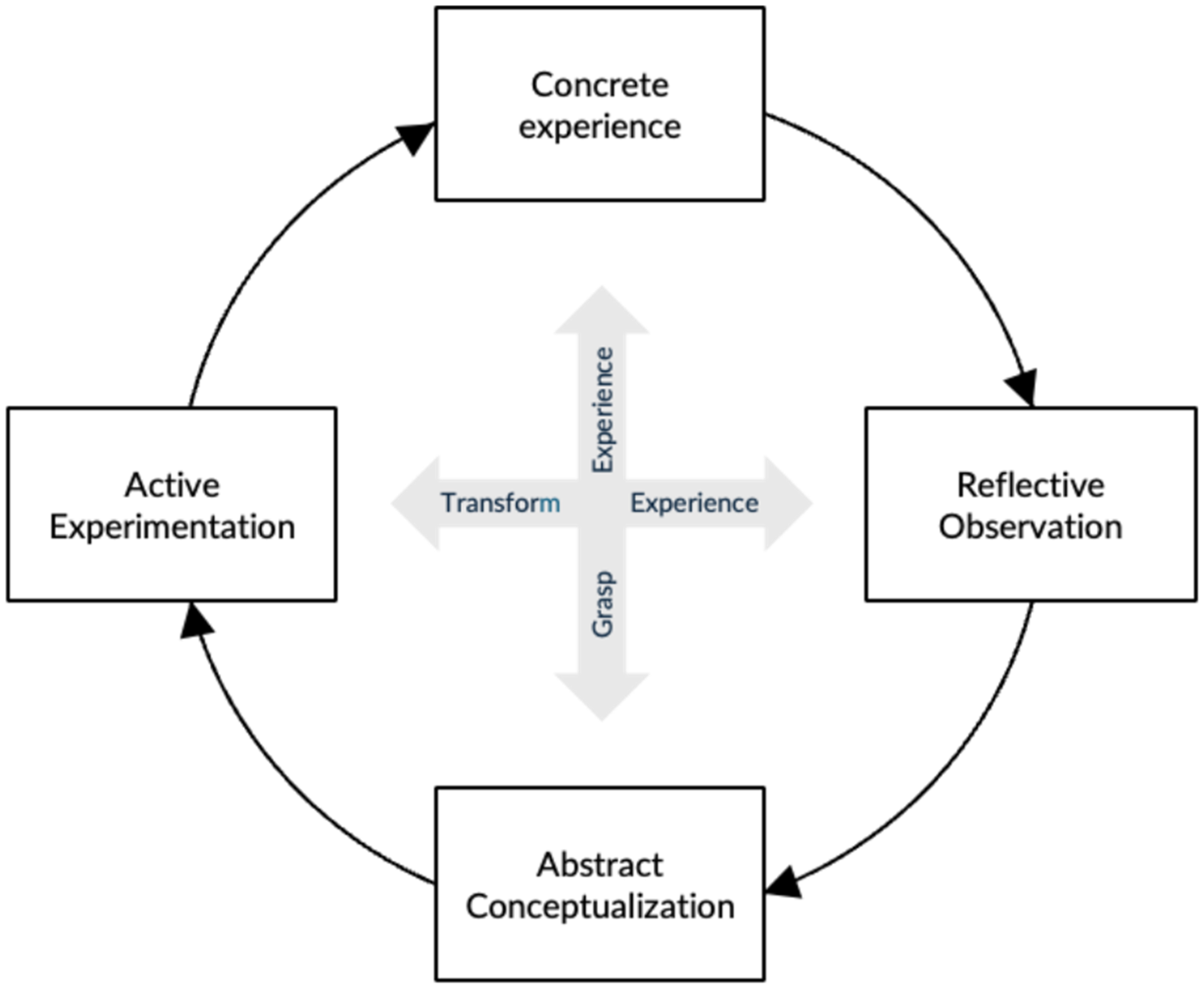
The experiential learning cycle by Kolb & Kolb 2017. Reproduced with permission from the publisher.
In Kolb's view, learning begins when a person experiences a situation that conflicts with their old beliefs or ideas. For example, facing a problem or being exposed to new ideas, opinions, or methods that challenge the status quo initiates the learning process. In a contract design setting, a hands-on workshop can provide such triggers. For lawyers trained in traditional text-based contract drafting, even a simple visualization exercise, such as mapping out a timeline of contractual milestones and related responsibilities, can reveal gaps, contradictions, or false assumptions in the original thinking and language. Similarly, when lawyers and their clients, or colleagues from different departments, observe and discuss how contract documents are actually used—holding them, flipping through them, searching for key information—they can all gain insight and learn from each other. Lawyers may begin to see which parts truly matter in day-to-day work, while colleagues better understand the legal intent behind certain clauses. This exchange can reveal surprising differences in priorities. In Kolb's model, when this experience is reflectively observed, it can be transformed into divergent knowledge.
However, Kolb underlines that it is not sufficient to simply perceive an experience; something concrete must be done with the perception for learning to occur, as “knowledge results from the combination of grasping experience and transforming it.” 29 For instance, a lawyer's observation that a particular contract clause is misunderstood by the contracting parties must be followed by formulation of new concepts and their active experimentation to generate learning. In practice, this could mean addressing the root causes of the misunderstandings and testing different solutions with users to mitigate them. Consequently, such a process would result in convergent knowledge of what needs to be done differently in the future to prevent the confusion that initially triggered the learning process.
The alternating learning modes—similar to inductive and deductive reasoning—are also highlighted in the design process. 30 In design and innovation, divergent thinking is needed to probe the future and create new possibilities, while convergent thinking focuses on analyzing input, refining it into a single outcome. Creative problem solving and knowledge building operate through these both dimensions: imagining multiple possibilities and selecting the best option based on concrete experience. 31 In the experiential learning cycle model, divergent (inductive) thinking occurs specifically when the experience is grasped, and convergent (deductive) thinking occurs when the experience is transformed into new knowledge. 32
The experiential learning cycle model has been criticized for oversimplifying the complexity of human learning. The model is said to exclude cultural and historical factors that shape the learning experience and illustrate learning as a process without explaining why the learning modes follow the proposed sequence. 33 However, several authors have noted that while the effectiveness of Kolb's theory as a comprehensive understanding of learning can be questioned, it can be used as a classification model that helps identify different learning styles and a flexible framework applicable to various learning contexts 34 , such as contract design. The model's emphasis on experience as a source of learning also aligns with the experiential orientation of a contract design process. In a contract design process, various experiences related to the design challenge can be collected, discussed, reviewed, and converted into insights that help understand what needs to be developed. The development of new contract design solutions is also about active experimentation and hands-on doing. 35
Learning Through Participation
The experiential learning approach as well as social constructivist learning theories highlight that to produce learning, the active engagement with real-world situations should also be social and participatory. 36 Therefore, learning may require not only experiencing a novel situation, but also sharing and reflecting on that experience with others. The idea that learning occurs through participation in a community where members engage, share practices, and create meaning closely aligns with the collaborative and multidisciplinary setting of a co-creative design process.
The socio-cultural learning theory views learning as a socially mediated process, influenced by interactions with others and the broader cultural context, and can happen effectively through participation in social practices, such as those happening at the workplace. 37 When people participate in joint work, they are not only exposed to the different knowledge others have, but are also able to create a collective, shared understanding of the issue at hand that potentially contributes to their organizations’ learning at large. Often this kind of learning happens unconsciously 38 , but in a contract design workshop, for example, it can be facilitated through particular sense-making exercises, like creating visual maps to analyze each stakeholder's role, responsibilities, challenges and capabilities in fulfilling contractual duties. 39
Contracts serve particularly well as design targets for participatory learning. In his social theory of the learning process, Wenger combines learning as experience and learning as doing to learning as belonging (to a community) and learning as becoming (shaping an identity). Wenger emphasizes the importance of informal groups within organizations, known as communities of practice, which offer a different perspective compared to the institutionalized and individualized views of learning. 40 He has also proposed that different artifacts, documents, and terms can be conceptualized as boundary objects, which connect different communities within an organization (and beyond). When understanding artifacts as boundary objects, it becomes evident that their design is also about designing for the community's participation, not just for their use. 41 Building on the theories of boundary objects, Passera argues that when contracts are designed with multidisciplinary teams to be visually engaging, well-structured, and accessible, contracts reach their potential as effective boundary objects, bridging gaps between various stakeholders, such as lawyers, managers, and engineers. 42
Learning Through Progressive Problem-Solving
It is important to note that not all experiential and participatory learning is necessarily progressive or transformative. As pointed out by Argyris and Schön, learning in organizations typically takes the form of single-loop learning, where errors are identified and corrected within the existing organizational norms and assumptions. 43 This kind of learning preserves the status quo and stabilizes the organization back to its old ways of operating, although the environment changes. In their article focused on individual learning, Bereiter and Scardamalia propose that such problem-solving, where the problem is merely reduced into tasks that can be managed with already established procedures, is not progressive. 44 In the context of contract design, this could mean using old contract templates or traditional drafting techniques without questioning their suitability to address parties’ needs for a documented agreement and guidance throughout the contract relationship. Also, merely adding new sustainability clauses to the contract, or updating its appearance without addressing the contract's broader implications and operational concerns, may not bring forth desirable results.
For the purposes of learning proactive and sustainable contracting, which advocates designing contracts for the real needs of the contracting parties, including not just legal but also business, people, and sustainability interests 45 , the double-loop learning model and the idea of progressive problem-solving provide better support. According to Argyris and Schön, double-loop learning occurs when an organization needs to change its underlying norms and assumptions due to conflicts with internal or external requirements, potentially leading to radically new solutions. 46 Bereiter and Scardamalia define learning through progressive problem-solving as an active, iterative process of confronting and overcoming challenges. Therefore, when transformation is desired, people need to seek out more difficult problems that push the boundaries of their current understanding and competence, instead of relying on routine solutions. 47 In a contract design workshop, this kind of learning could be initiated by design methods that help challenge the status quo, such as user research, systems mapping, root-cause analysis, and rapid prototyping. Similarly, Salo-Lahti and Haapio note how possibility-driven design can support the aims of proactive law by envisioning what could be possible, instead of focusing on what already is. 48
Learning Through Expansion
Expansive learning theory, developed by Engeström, emphasizes how collective transformation happens through co-creative learning activities that focus on developing new practices and tools to address evolving needs and challenges. 49 Similarly to the above-described learning cycles and loops, the expansive learning theory illustrates learning as an iterative and progressive cycle composed of learning actions, but on a larger scale and for longer periods of time. This makes expansive learning theory a potential framework to understand how seemingly small co-creative efforts, such as design workshops or developmental projects, can initiate bigger transformation at an organizational—and even societal—level turning the learning actions into continuous new learning activities (see Figure 2).
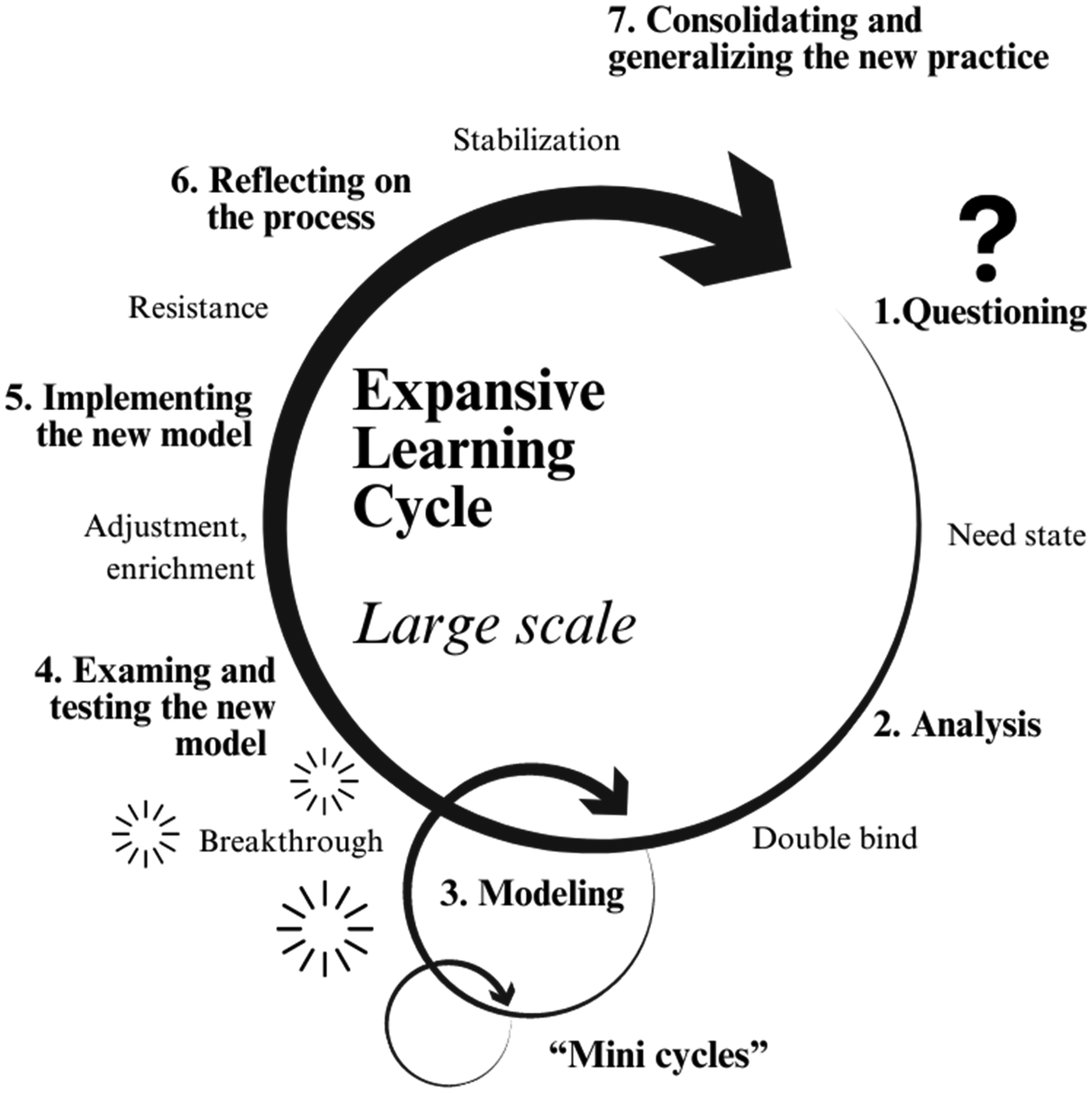
The expansive learning cycle, adapted from Engeström (2016).
The expansive learning theory shares similar elements of other learning theories that emphasize social and artifact-mediated construction of knowledge and the role of challenges in driving development. Much like the other learning theories, the expansive learning theory locates the starting point for learning in “doubt, hesitation, and disturbance.” Drawing on Vygotsky's concept of the zone of proximal development, Engeström explains how the inner contradictions of the preceding form of the activity can keep producing new structures, objects, and practices of the said activity. 50 Therefore, criticism of the existing reality—such as inefficient, operationally dysfunctional or unsustainable contracting practices—creates the need for expansion, the need to learn what would improve the current status. From this perspective, compliance failures, or contract-related conflicts and legal disputes can have their “silver lining,” as they provide an opportunity for collective learning through proactive problem-solving and the creation of solutions that prevent the recurrence of the original issues. 51
According to the expansive learning theory, the need state organically follows divergent and convergent analysis and reflection, and efforts to model new solutions and test them in real-life settings. The theory adds the dimensions of culture and history to explain how the expansive learning process ultimately transforms the socio-material reality of the learners. 52 Learning outcomes materialize not only in new objects and practices, but also in new ways of framing and associating the object of activity. This expansion in understanding provides a foundation for future learning through the implementation and continuous evaluation of the learning outcomes in practice. 53
The expansive learning theory also provides insight to how people can learn “something that is not yet there” through creation. 54 The theory thus emphasizes the role of abductive reasoning in learning, ideation, and imagining of alternative possibilities, which is characteristic for design thinking. 55 This understanding of learning is said to serve well multilevel contexts, like organizations and their systemic sustainability challenges, where “nobody knows exactly what needs to be learned” to change the reality for the better. 56
According to Engeström, the “real breakthroughs” often occur in “mini learning cycles” which take place in separate settings distanced from the larger and periodically longer learning cycle of the organization. A contract design process including multi-stakeholder workshops where new ways of contracting are ideated and prototyped, can provide such a “mini cycle.” Engeström calls this kind of activity “co-configuration work,” which generates and requires a certain type of knowledge to create “customer-intelligent products and services” to adapt to “the changing needs of the user.” 57 It must be noted that all the questioning, analysis, and examination phases of the expansive learning cycle may not be covered in a single contract design process—let alone in a single workshop—but rather require a series of events that help implement and scale the learning outcomes into new activities. A single design process or a workshop can nevertheless initiate important conversations, providing a platform for collective sensemaking and problem-solving, and playing a critical role in the learning journeys of both individual participants and their organizations.
How Do the Phases of a Contract Design Process Align with Learning Theories?
Reflecting on the introduced learning theories and our own experiences facilitating contract and legal design workshops, we will next hypothesize how a contract design process as a mini learning cycle can be aligned with the “designerly ways of learning.” The contract design process model developed by Lawyers Design School's team (see Figure 3) 58 is used as an illustrative example. 59 The model is inspired by the Double Diamond framework by the British Design Council. 60 It was initially created to structure the learning path for a contract design workshop conducted by one of the authors, based on the insight that learning—as well as problem solving in design—is most effective when the challenge is decomposed into smaller, defined problems, making it easier to gain knowledge and find solutions by building on previous steps. 61 The process is divided into two main phases: problem definition (1. Clarify who is the user, 2. Choose what to design) and solution creation (3. Create a prototype, 4. Collect feedback), 62 which correspond to the “grasp” and “transform” elements of the experiential learning cycle, as well as the questioning, analysis and modeling phases in the expansive learning cycle. Participants to a contract design process typically move between these phases, drawing insights from practical experiences, converting them into abstract ideas or theories, and then translating those ideas back to possible practical artifacts or practices for the organization or the contracting parties. 63
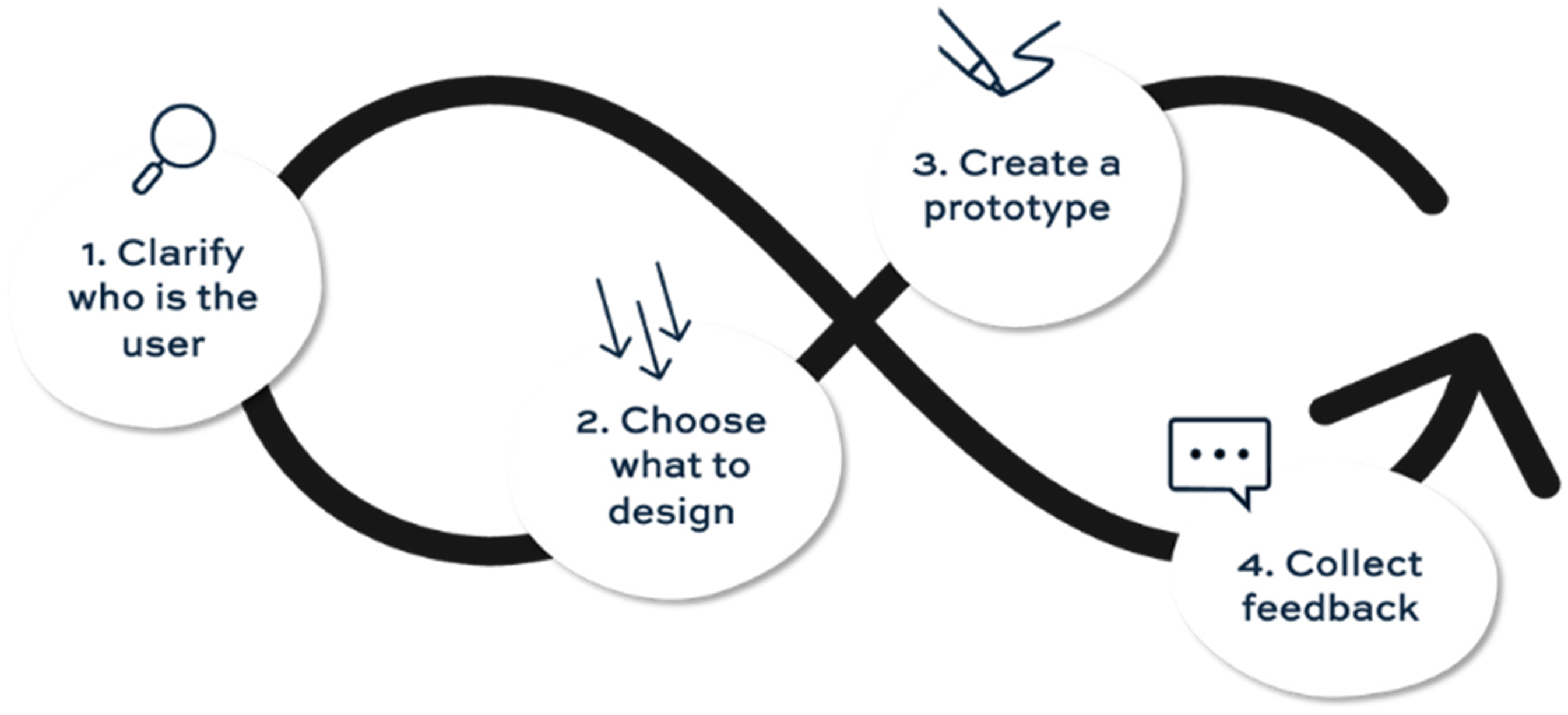
Contract design process by Hannele Korhonen, Lawyers Design School, 2021. Acknowledgements: Jenni Valonen and Tania Malréchauffé.
In our work, the workshop often acts as the starting point, a structured environment where participants learn by working on a real contract and receiving real feedback. In some cases, a workshop can initiate a longer-term contract design project in which the methods, mindsets, and insights developed during the workshop are applied and further developed in practice. For the workshops, the contract design process model provides a strong backbone, guiding the sequence and order of activities and learning. The contract design process itself can extend well beyond a single workshop, of course. Also, learning can unfold both in a structured workshop setting and through real-world application or other day-to-day operations beyond the workshop. Designerly activities that can sustain and extend learning beyond workshops include user research methods, such as engaging with users; observing, following, and listening to them to deepen understanding. Tools like user journey mapping and personas can further support this process by making insights visible. To make ideas tangible and testable, activities such as rapid visualization, mock-ups, and iterative prototyping enable teams to explore opportunities, and gather feedback, and refine solutions. 64 These activities can help embed learning into ongoing work practices, supporting the desired change.
Clarify Who is the User: Get Real-World Knowledge and Enable Multistakeholder Participation
Using the analogy of experiential learning theory, the first step of a contract design process could be defined as “grasping a concrete experience of the real-world.” This involves identifying the users and other stakeholders of the contract, as well as understanding their needs, experiences, and challenges in relation to the implications of the required change. 65 From a participatory and social learning perspective, a multistakeholder design process can provide a learning curve not just of the contract drafter but for everyone involved. When key stakeholders take part in influencing the design outcome, it can foster dialogue, expose them to each other's knowledge and views that may conflict with their own, encourage the suspension of assumptions, and promote genuine collaborative thinking. 66
A significant part of the learning in the design process also involves interpersonal aspects, such as developing empathy and gaining a deeper understanding of users’ perspectives and needs, as well as collaborating with individuals who bring different viewpoints. 67 In practice, when for example updating contract templates with new code of conduct requirements, this phase could mean analyzing the new requirements and reviewing existing contract versions together with different stakeholders in a workshop or interviewing users about their perspectives and experiences related to the code of conduct compliance. This contrasts with the traditional approach to contract drafting, where lawyers often gather necessary information and compile the contract using existing templates, typically working in isolation from the broader business context and with limited attention to how the contract will be understood or used by its end users.
Choose What to Design: Use Methods That Help Spot the Root-Cause and Challenge Existing Knowledge
The second step of the contract design process is about processing and reflecting the insights gathered in the first phase, particularly using abductive reasoning. 68 In the sense of progressive problem solving and the desired impact, the goal is to create a common understanding of the root causes of the problem to provide enough information for prototyping and solution creation. In practice, using our code of conduct example, this may involve synthesizing stakeholder input from the first phase or analyzing user-research data to identify key issues. From there, specific clauses of the contract that need to be updated or redesigned can be selected. Especially different visual and holistic root-cause analysis methods can help participants to push beyond already existing knowledge, beliefs or biases, as the hidden or often ignored causalities behind problems are made visible to everyone. 69 This contrasts with traditional contract drafting, which often does not involve deeper analysis of the underlying contract challenges, thus missing the opportunity for double-loop learning, and instead applies standard templates—such as code of conduct requirements—at face value, without questioning their relevance, clarity, or usability in the given organization and its context, reflecting single-loop learning.
Create a Prototype: Provide Concrete Materials to Experiment What Could be Possible
The third phase of the design process provides an opportunity to expand participants’ understanding about the design challenge, users’ needs, and the subject matter of the contract itself by creating a prototype of the redesigned contract. Prototyping enables participants to engage in keymodes of the experiential learning theory, such as constructively “interact with the object,” learn by doing, and refine their understanding by “conceptualizing the abstract.” 70 Prototyping also works as a progressive problem-solving method, as participants are compelled to transform the previously gained insights into concrete new ideas. Using the phrasing of expansive learning theory, a prototype is the first concrete materialization of “the something that was not there yet.” The prototyping phase is also where participants have a chance to recognize their perfectionism and other fears related to experimentation, as prototyping as a mode of knowledge building legitimates and embraces failure and mistakes. 71 Beyond learning to redesign the contract, this phase aims to center participants’ focus on experimentation for feedback and iteration. According to Rauth et al., applying a design thinking process can help participants develop creative confidence and competence to come up with creative solutions, as experiencing the process builds trust in their creative abilities. 72 In a code of conduct workshop, prototyping might involve reorganizing the contract content, restructuring specific sections, translating code of conduct legalese into plain legal language, adjusting the visual layout, or adding infographics to support understanding. Participants are encouraged to try different methods to see how they affect usability and clarity to be applied later in “real-life” outside the safe workshop setting. This contrasts with traditional contract drafting, which is typically template-based and focused on producing a single, finalized version, often without a space for experiments or learning from mistakes.
Collect Feedback: Activate Constructive Evaluation
The last phase of the contract design process is to assess whether the knowledge transformed into concepts, ideas, and prototypes works in the real-world, or if further refinement is needed. This phase also includes experiential learning elements of reflective observation and abstract conceptualization, as participants begin to generalize based on their reflections. They may ask themselves: How can this insight be applied to other contracts? What implications does this have for our team's working practices? What should we do differently next time? Further, this phase of the design process encourages participants to request and provide constructive feedback, develop communication skills, and learn to be thoughtful in giving and receiving criticism. 73 In a workshop setting participants immerse themselves in participatory and social learning, building on interactions with others. In practice, participants working, for example, on the code of conduct can share their prototypes with peers during the workshop to collect immediate feedback or conduct user testing with different stakeholders afterward, using similar methods to those employed in the first user-research phase. Sharing work is particularly useful when participants have been working on the same contract in the workshop, as it allows them to see how others have approached the same problem differently. This can lead to new insights, deeper understanding, and an opportunity to build on each other's ideas, potentially combining multiple ideas into a stronger next iteration of the contract, illustrating both progressive problem solving and expansive learning. In contrast, traditional contract drafting may involve feedback rounds, but the focus is on accuracy or compliance with the law or the company policy rather than usability or overall experience of the contract. Contract drafting is not typically seen as an iterative or collaborative process, and opportunities for shared reflection and learning are often missed.
Conclusions
Both design and education research recognize an inherent connection between design activities, learning, and change. Building on this connection we have proposed in this article that the process through which contracts are designed could serve as a potential learning path toward more proactive and sustainable contracting, and therefore, support more strategically the overall sustainability shift in businesses and society at large. To address the question posed at the beginning of this paper—whether different learning theories can help us understand what kind of learning occurs, or should occur, in the contract design process—we observed this process through the lens of four learning theories highlighted in design and design education literature. Based on our observations, each theory provides insights that can be distilled into four particular learning elements characteristic also to design: learning through experience, social learning, progressive problem solving, and expansion. We propose that, when combined into a framework of “designerly learning,” these elements offer a structure for designing contracts in a way that can foster deeper sustainability transformations in organizations by revealing what needs to change in contracting—and why—and turning those learning outcomes into new, more sustainable contracting practices.
We illustrated the practical applicability of the framework by showing how the four learning elements can be aligned with the different phases of a contract design process using various design methods, particularly within a co-creative workshop setting. Firstly, regarding the element of learning through experience, it is necessary for participants to engage with diverse real-world experiences, hands-on experiments and conflicting perspectives that trigger reflection and new thinking. Typically, this involves methods like user research, but also the more inclusive engagement of users as co-designers of the solutions. Particularly from the social learning perspective, the contract design process should be participatory, enabling the exchange of ideas, feedback, and validation of solutions among a broad range of stakeholders, not only the usual or primary contract drafters. Thirdly, learning through progressive problem-solving entails incorporating methods and strategies into the design process that challenge the status quo and address the root causes of unsustainable contracting practices or other related challenges. Finally, expansive learning theory emphasizes the importance of translating learning outcomes into new activities—such as new objects, practices, or concepts—integrated into the organization's daily operations.
The observed learning theories offer a valuable lens for both contract design research and practice. They make visible the variety of learning modes and outcomes embedded in the contract design process. By examining elements of designerly ways of learning, it is possible to understand not only what is learned (e.g., empathy, problem-framing skills, creative confidence, collaborative capabilities), but also how that learning can be supported. Mapping each phase of the contract design process to these elements highlights opportunities for more deliberate choices that can enhance the contract design process as an impactful learning path for proactive and sustainable contracting.
When writing this article, one of the insights for us authors was that not all contract design projects lead to learning; the process should be intentionally structured to enable learning based on desired learning goals. For organizations, this means that learning should be made an explicit project objective, and the learning outcomes need to be specified and measured. Learning outcomes, on the other hand, depend on how a contract design project is facilitated and whether stakeholders are encouraged to experiment, learn from mistakes, and truly challenge the status quo.
It is evident that empirical research is needed to better understand learning in a contract design process. We hope that our paper inspires further research on the topic, focusing, for example, on some of the following questions:
- What do participants of a contract design process/ project/ workshop learn? - From a learning perspective, how does drafting a contract through a design process differ from “traditional” contract drafting? - How can the learning outcomes of a contract design process be empirically tested and measured? - How can the contract design process as practical activities be planned and organized to create proactive and sustainable contracts? - What contract design methods, techniques, or tools provide the best support for learning? - What role does motivation play in learning through contract design? - How can different stakeholders be engaged in the contract design process to maximize learning benefits? - How do the learning outcomes of a contract design process generally impact contracting practices?
As we have proposed in this article, “designerly ways of learning” can serve as a powerful driver of change. To move beyond a “tick-the-box” approach to implementing new sustainability demands, change must occur at a deeper, more systemic level—something that learning can facilitate. Achieving this, however, requires focused attention, further research, and the development of practical methods to catalyze learning. At its best, the contract design process can serve as a learning path capable of promoting sustainability transformation at the individual, organizational, and societal levels.
Footnotes
Acknowledgments
The authors thank the anonymous reviewers for their valuable comments and suggestions, which helped improve this article.

Funding
The authors received no financial support for the research, authorship, and/or publication of this article.
Declaration of Conflicting Interests
The authors declared no potential conflicts of interest with respect to the research, authorship, and/or publication of this article.