




Abstract
Research shows that strategic dispute resolution and early intervention reduce direct and indirect costs of conflicts. Minimal costs are involved in preventing and de-escalating disputes, compared with the costs of arbitration and litigation, for example. In this context, the traditional view of contracts as legal documents or reactive enforcement mechanisms is too narrow. Contracts can be used proactively, ex ante, too, enhancing the parties’ chances of success and preventing unnecessary problems. In Europe, this is part of what is known as Proactive Law; in the US, Preventive Law. On both sides of the Atlantic, it can also be framed as practicing proactive contracting or proactive contract design. Well-designed contracting processes and documents can prevent misaligned expectations and disappointments so that unnecessary disputes can be avoided. Early intervention methods of dispute resolution, such as mediation, can be used to de-escalate the dispute and promote cooperation. Along with other crucial elements, contracts can provide pre-agreed procedures and resolution mechanisms if changes, delays, or disturbances occur or a conflict situation arises. Building on our previous work on civil and commercial mediation and a managerial-legal view on contracts and their design we illustrate, with examples, how proactive contract design, combined with early intervention procedures and monitoring systems as well as post-award management processes can be used to better deal with the commercial, legal and human elements of a dispute. With a focus on commercial business-to-business contracts and related conflicts we explore how design methods can be used to address the root causes of legal disputes and to operationalize an effective dispute prevention and resolution system.
Keywords
Introduction
The Most Negotiated Terms 2018 survey conducted by the International Association for Contract and Commercial Management, IACCM (2018) listed the terms that negotiators believe are most often the cause of claims or disputes in the post-award phase of contract performance. Among the most frequently contested terms were price/charge/price changes, invoices/late payment, delivery/acceptance, scope and goals/specifications, payment, change management, service levels, responsibilities of the parties, performance/guarantees/undertakings, liquidated damages and warranty. Among the most negotiated terms were on the other hand issues such as limitation of liability, indemnification, and termination, hence terms that were not listed among the most contested terms. In fact, 5 of the top 10 terms frequently causing claims or disputes did not appear in the top 10 most negotiated terms. The report concluded that negotiators did not necessarily focus on the issues that generate problems; instead of reducing the frequency with which these occurred, negotiators concentrated on terms that minimize their consequences (IACCM, 2018: 10).
A similar conclusion can be drawn from a more recent survey published by World Commerce and Contracting, WorldCC (formerly IACCM; WorldCC, 2020b). Their Most Negotiated Terms 2020 report shows that amendments to contract, change management and Force Majeure rank among the most disputed terms, but are not listed under the 10 most negotiated terms (WorldCC, 2020b: 13, 15). Clauses on dispute resolution did not rank among the top 10 of most important or most negotiated terms in either of the surveys. While there is altogether little scientific data on the reasons for disputes in contract performance, these survey results indicate that negotiators still concentrate primarily on managing the consequences of a breach, failure or dispute rather than on ways to prevent them from arising or on mechanisms that may induce compliance with the contract or renegotiation in order to reach the parties’ commercial goals during contract performance.
This article seeks to shift the attention from legal disputes, the law and legally relevant facts to the root causes of disputes and the underlying conflicts. It deals with conflicts that may—if not addressed in time—escalate, turn into disputes and end up in arbitration or litigation. The article focuses on the prevention of these disputes, understood in a wide sense. Dispute prevention, as we see it, includes not only the prevention of arbitration or litigation, but also the entire spectrum of conflict escalation and management, beginning with the identification and elimination of the root causes of conflicts.
In this article, our primary focus is on dispute prevention in the context of commercial, business-to-business contracts that contemplate ongoing relationships over time. While we do not address consumer contracts, employment agreements or public procurement contracts, many of the issues discussed here may apply to such contracts as well, even though the parties’ freedom of contract might be more limited in such contexts. This article proposes proactive contract design as a means to shift focus on the real causes of disputes and to operationalize dispute prevention and resolution systems. In essence, our goal is to explore the elements of effective dispute prevention by design.
The article is structured as follows: The second section discusses changes in the approach to dispute resolution and litigation and the need to look beyond the parties’ legal positions. This requires a deeper understanding of the nature of conflicts and their tendency to escalate into disputes, if not resolved through renegotiation or otherwise. The third section deals with the root causes of conflicts before or during conflict escalation, demonstrating the benefits and alternatives of addressing them early, when negotiating contracts or at the lower levels of conflict escalation. After noting that in this context, the traditional view of contracts as legal documents or reactive enforcement mechanisms is too narrow, the fourth section proposes a different view: one where contracts serve not only as legal instruments but also as managerial tools. After introducing the principles of Preventive Law and Proactive Law, we suggest merging those principles with design methods so as to bring effective dispute prevention and management into practice. Building on the emerging research in these fields, we envision a future where contracting processes and documents are fully integrated with effective conflict prevention and resolution mechanisms, all geared toward enhancing the parties’ chances of success and preventing unnecessary problems. The fifth section provides two examples to illustrate how proactive contract design and visualization can be used in this context. The sixth section concludes.
Looking beyond the obvious—Disputes and their underlying causes
Recent developments suggest that companies’ perspective on disputes and dispute resolution has started to change. The Global Pound Conference survey conducted in 2018 showed that efficiency is one of the parties’ main priorities in the choice of dispute resolution processes (Herbert Smith Freehills and PricewaterhouseCoopers, 2018: 10). By means of efficient dispute resolution the parties seek to avoid wasting time, money and efforts in adversarial dispute resolution processes, such as arbitration and litigation. There was a large consensus among the participants of the survey that companies should be encouraged to use pre-dispute protocols and non-adjudicative dispute resolution, such as mediation or conciliation, prior to or in parallel with adjudicative processes (Herbert Smith Freehills and PricewaterhouseCoopers, 2018: 14).
Research shows that disputes do not only cause costs that are easily visible, such as the costs of litigation or hiring external advisors. Costs arise even before a dispute is brought to litigation. Besides and beyond calculable costs, such as the cost of litigation, there are costs which cannot be so easily tagged, such as hours spent by management and personnel on resolving underlying conflicts internally and with business partners, the loss of internal motivation and willingness to cooperate, higher turnover of staff and the loss of clients and partners (KPMG, 2009; Kirchhoff et al., 2013: 33). The costs of conflicts are, however, not the only reason why businesses look out for new and improved dispute prevention and resolution strategies.
For German companies, for instance, one reason for choosing alternative dispute resolution is the fact that it corresponds better to company values (PricewaterhouseCoopers and Europa-Universität Viadrina Frankfurt (Oder), 2005: 12). In the US, a considerable number of companies have recognized that there are more effective methods of dispute resolution than litigation and signed the 21st Century ADR Pledge, where they commit to using alternative forms of dispute resolution in order to attain sustainable dispute management and resolution processes (International Institute for Conflict Prevention & Resolution (CPR), 2020). Companies consider that alternative forms of dispute resolution may be more useful to protect their commercial interests, even though regional differences still persist. Globally and regionally new instruments are developed to foster alternative forms of dispute resolution across the world (Directive 2008/52/EC; Singapore Convention on Mediation, 2019).
Legal disputes and their underlying causes
A change in the approach to dispute resolution requires a change in the way legal disputes are perceived. While a failure to perform under a contract may give rise to a legal dispute, non-performance is usually not an aim in itself, but the real cause lies somewhere else. From a conflict theory perspective, legal terminology and disputed contract terms rarely show all the dimensions of the underlying conflict and the interests and needs that are truly involved. Legal disputes are usually at the end of a process of escalation that starts when someone perceives that someone else has frustrated or is about to frustrate some concern of his or hers. The conflict that has started with a perceived injury undergoes a transformation when this frustration is communicated to the other party and a claim is made. The conflict is transformed into a dispute when the claim is rejected in whole or in part (on this transformation see: Felstiner et al., 1980–81: 631, 636). The dispute turns into a legal dispute when the claim is based on or involves a legal position. At this stage of the escalation, the parties’ understanding of the dispute is often reduced to its legal dimension. Instead of focusing on the parties’ commercial or technical interests and how they can be addressed in the future, the parties concentrate on facts and issues that will be legally relevant in arbitration or litigation and therefore on the past. As a consequence, the reality will be filtered and constitute communication that produces meaning within the legal system, while other aspects of the conflict as well as its underlying causes will be set aside (Hietanen-Kunwald, 2018: 33). From a broader perspective it is helpful to understand that a dispute is rarely merely a conflict about who is right or wrong from the legal point of view, but it involves different interests and needs that underlie the parties’ legal positions (Menkel-Meadow, 1984: 801; Moore, 2014: 124). These underlying interests and needs may be very different from the positions that are presented by the parties or that will be relevant in adjudicative dispute resolution proceedings. An arbitral award or court ruling on the other hand will only resolve the legal issues, while the underlying conflict and its root causes may still persist.
The causes of conflicts may be very different from the causes for the legal disputes, and so is the nature of the conflicts. Different types of conflicts may have different causes which often overlap (Moore, 2014: 116). I nterest conflicts, for instance, are caused by perceived or actual competition over the parties’ substantive, legal or procedural interests. Relationship conflicts are caused by difficulties in the communication or the behavior shown by the conflicting parties. Structural conflicts may be caused by unequal control, ownership or distribution of resources. Data/information conflicts are caused by perceived or actual lack of data or information or exchange of information. Value conflicts have their roots in different ideas, values or principles guiding behavior (on conflict categories and causes, e.g. Boulle and Nesic, 2009: 82). These causes may be mirrored as legally relevant causes of disputes. Changes in goals or interests may, for instance, result in a dispute on the amendment of the contract, but this connection or underlying cause is not necessarily analyzed from a contract or legal perspective. Often the parties are unwilling to disclose their real interests at a higher stage of conflict escalation. Instead, they confine themselves to finding arguments that support their legal positions.
When collaboration becomes difficult—conflict escalation and its consequences
Legal disputes that take place in a business environment related to commercial relationships are not purely technical, commercial or legal. In most cases a human is involved who acts on behalf of a legal entity and pursues commercial interests. Most conflicts include also a relational element, with the consequence that the relationship and communication between humans has an impact on the way conflicts are addressed. While the parties may be willing to collaborate at the beginning of their relationship, their behavior changes, once the spiral of the conflict has started and develops its own dynamics.
Friedrich Glasl (2013: 235–305; Jordan, 2000) has developed a stage model to describe this typical change of behavior of the conflicting parties during the escalation of a conflict. He divides the escalation into three levels sub-divided into three stages each. During the first stage of escalation there are certain tensions between the parties, but this stage will not yet be perceived as the beginning of a conflict. In stage 2, the conflicting parties engage into debates to convince the other party. The debate may become polemic and black-and-white thinking starts. In the third stage of escalation, the conflicting parties increase the pressure on the other party. Words are followed by deeds and communication may disrupt. During this first level of escalation the conflict may still be settled through cooperation, the parties are still focused on the issues and both parties may still win. In the next level of escalation, the situation changes. The conflict itself may become more important than the issue to be solved. During this level, the parties start to look for allies and coalitions that support their side (stage 4). Stage 5 is characterized by the loss of face and credibility; the parties seek to destroy the identity of their opponent. In stage 6, the parties threaten the opponent and show power by presenting claims, such as claims for damages. During this second level of escalation (stages from 4 to 6), there is usually one party that wins, while the other party loses. When the conflict escalates to the next level, there are no winners anymore, but both parties start to lose. Stage 7 is characterized by attempts to destroy the opponent. The parties accept their own losses in order to increase the damage suffered by the other party, who is not anymore seen as being human. In stage 8, the parties seek to destroy the supporting network of the opponent. During stage 9, they accept self-destroyance in order to win.
Glasl’s escalation model demonstrates that the further the conflict evolves, the more difficult it becomes to detect the parties’ true interests and needs. This has as a consequence that the parties lose sight of what they really want. The further the conflict escalates, the less becomes the parties’ ability to handle the conflict in a cooperative way; they increasingly focus on narrow positional thinking. Glasl (2013: 399) suggests at lower levels of escalation intervention by means of conflict moderation (stages 1–3) and therapeutic mediation (4–6) and at higher levels of escalation (5–7) a structured form of mediation. From stage 6 to 8 he considers arbitration or litigation as the most appropriate form to intervene. This model implies that in many cases interventions at lower levels of conflict escalation can be used to prevent further escalation. Early intervention provides an opportunity to address the true causes of conflict while higher levels of escalation often entail an intervention focusing on narrow legal positions.
Conflict patterns, interests and needs are not efficiently addressed in commercial practice
What does conflict theory teach us on the prevention of disputes? First of all, it shows that organizations need to become sensitive to the root causes and patterns of conflicts that typically evolve in the respective organizations. While each conflict or potential conflict is unique due to the persons involved and the human aspects that accompany conflicts and their escalation, it is in the interest of the business to identify and understand conflicts that typically arise and to develop tools for detecting possible conflict indicators at an early stage. Conflict databases may be used as an analysis, information collecting and reporting tool by the organization (PricewaterhouseCoopers and Europa-Universität Viadrina Frankfurt (Oder), 2011: 46).
A better understanding of conflict patterns and interests would enable tailored interventions
Typical patterns of conflict as well as their root causes vary in different contexts and industries. They can serve as instruments of early intervention for the prevention of disputes. The construction sector, for instance, is likely to have conflicts relating to scope, delays and communication issues, while other industries that rely on long-term cooperation or a network of subcontractors will have issues that relate to the parties’ interests and goals and how these change. In some organizations overregulation and compliance requirements may cause conflicts on the interpretation of contracts, while other organizations encounter problems due to a lack of regulation, clear contractual settings and guidelines (KPMG, 2009: 15). Hypothesis building regarding the patterns of conflict and their escalation is important in order to enable organizations to prevent disputes and to help them choose appropriate ways of conflict resolution that address the interests of the parties. While the need for early detection of root causes and conflict potential has been recognized, there is little scientific research on the root causes and conflict patterns in companies.
The escalation model further shows that it makes sense to intervene at a low level of the escalation ladder when the parties are still willing and able to cooperate and listen to each other. At this stage the visible and invisible costs of intervention are low. An escalation of the conflict to the courts will harden the positions of the parties but does not address the root causes of the conflict or satisfy the parties’ real interests, those that are underlying factors behind the parties’ positional claims and motivations in their negotiations (Boulle and Nesic, 2009: 78). They may be substantive interests, tangible outcomes or benefits, such as money or time (Moore, 2014: 128) or interests in long-term cooperation, profits, or cost reduction. In a broad sense, also the sustainability of business operations or the reduction of negative effects on climate change and public reputation can be substantive commercial interests. Psychological interests, again, refer to the relationship’s needs, reputation, or need for respect and self-esteem of the persons involved (Moore, 2014: 129). These may also be the interests of the individuals who negotiate the contract or settlement, or of the project managers, employees, business owners or management. Procedural interests relate to the process in which solutions are achieved: being treated fairly and with respect (Moore, 2014: 128). Procedural fairness requirements initially developed in the context of procedural justice in litigation can be extended to negotiations, consensual forms of conflict resolution and even transaction design (Solarte-Vasquez and Hietanen-Kunwald, 2020: 196).
In practice the focus is on anticipated reactions to past failures
In practice negotiators often fail to address the parties’ interests and early interventions are still not sufficiently used. Companies tend to outsource their problems to the courts. Courts on the other hand base their decision-making on a very specific legal rationality. They intervene in general at a very high level of escalation. Courts are interested in legally relevant facts and rationalize their decision-making on the basis of the premises of the legal system and the legal positions of the parties. Courts are not interested in commercial interests, such as future cooperation, reputation or the company’s overall strategy when making their decisions, unless the parties have managed to translate their commercial interests into legally relevant rights and obligations or principles that guide the interpretation of these obligations by the court. Courts are not interested in the psychological aspects of their decisions, either, or in their decision’s effects on the parties’ behavior in the conflict. The parties’ ability to cooperate in the future or to adapt their relationship to changed circumstances or needs does not guide the decision-making of the courts. Court decisions are a reaction to past failures and not strategic decisions that support the parties’ future relational and commercial interests.
This is not to say that the satisfaction of the parties’ legal position or intervention by litigation or arbitration is never desirable (see further Ury et al., 1993: 15). A focus on the legal position may in fact prevent the escalation of the conflict in some cases and secure the parties’ commercial interest to limit their commercial risk. Litigation and conflict resolution on the basis of legal positions may also be in the interest of the parties to end a dispute or terminate a relationship. This strategy should, however, be chosen on the basis of a conscious assessment of the goals and interests of the organization. In most cases conflict resolution at a lower level of escalation serves the interests and also the values of the organization better.
IACCM/WorldCC report results indicate that many negotiators anticipate the mindset of the courts when negotiating their agreements and focus primarily on the highest level of conflict escalation. This certainly satisfies the legal interests of the parties to be legally protected in the worst case. This, however, is just one of the purposes and functions of a commercial contract (Hurmerinta-Haanpää, 2021, forthcoming; IACCM, 2017). Excessive focus on this function alone causes the parties to miss the many opportunities that contracts offer to eliminate the root causes of conflict and to design an appropriate mix of dispute prevention and resolution techniques.
A continuum of dispute prevention and resolution techniques (Figure 1)
Efficient dispute prevention starts with an analysis of typical dispute patterns and root causes that may jeopardize the interests of the company in a given situation (Ury et al., 1993: 40). Ideally this analysis extends to the strategic goals of the company in respect of dispute resolution and conflict management. Contract negotiations are an instrument to address the parties’ mutual interests as well as possible risks emerging from identified root causes and to find an optimal balance between the parties’ interests and risks (on principled negotiation, see Fisher et al., 2011). Procedural mechanisms and negotiations may be used to facilitate and enhance the collaboration of the parties in long-term contracts and to provide solutions to a problem that the parties have not foreseen during their initial negotiations or that arises because the parties’ goals have changed or because the agreement is incomplete (on the costs of incomplete contracts, see, e.g. Scott and Triantis, 2006: 816). During the escalation process conflicts and disputes provide valuable information on root causes, including problems that have been missed during contract negotiations. Conflict analysis during contract performance helps the organization learn how problems can be more effectively addressed in the future and be prevented ex ante. This information can be used proactively in contract design.
Procedural instruments that can be used to address the issues at stake can be consensual—inducing interest-based conflict resolution—or adjudicative—based upon an assessment of the merits of the dispute (Blomgren Amsler et al., 2020: 42; on rights-based, power-based and interest-based dispute resolution: Ury et al., 1993: 4). Consensual means that the solution is subject to the consent of the parties. Examples include negotiations between the parties. If negotiations fail, the inclusion of a third party may be needed, and the parties may have recourse to mediation. Mediation is an umbrella term for different forms of third-party interventions where a neutral third party who has no power to impose agreements or outcomes assists the parties in finding a solution to their conflict (Wall and Dunne, 2012: 219). It is a process in which an impartial third party facilitates negotiations between the parties to enable better communication, encourage problem solving and develop an agreement (Kovach, 2005: 304; Menkel-Meadow et al., 2006: 91; on different concepts of mediation see, Alberstein, 2006: 341; Bush and Folger, 2005: 9–18; Hietanen-Kunwald, 2018: 42). Mediation may have the broader aim to transform the conflict interaction of the parties and serve to resolve relational conflicts at a lower level of conflict escalation (Bush and Folger, 2005: 13). It may also be used to reach a settlement agreement on a dispute that includes legal elements. The focus of mediation is, however, not the determination of the dispute on the basis of the parties’ legal rights. On the contrary: the aim of mediation is to facilitate a solution that satisfies the parties’ interests and needs, whether commercial, legal, procedural or human (see, for instance: Alexander, 2009: 27; Moore, 2014: 39–41). As such it helps the parties to adapt to changed circumstances and develop their future cooperation; it can also constitute a cost-efficient mechanism to end a contractual relationship.
Adjudicative forms of dispute resolution are processes where a neutral third party is authorized by the parties to take a decision or render an opinion on facts or rights (Blomgren Amsler et al., 2020: 50). The third party may then either impose a binding solution on the parties or make a (non-binding) recommendation based on evidence and a (legal) assessment of the dispute. The most widespread adjudicative form of dispute resolution is litigation in the public courts. An alternative to litigation in the courts is arbitration, “a process by which a private third-party neutral renders a binding determination of an issue in dispute” (Cole and Blankley, 2005: 318). Arbitration is a private and flexible process that is usually used at a rather high stage of conflict escalation. In commercial arbitration, arbitrator(s) are required to render a final and binding award on the basis of a legal assessment of the merits of the case (Brown and Marriott, 2011: 121). Arbitration is widely used in international commercial disputes, but also in domestic disputes. Another adjudicative mechanism used mostly in infrastructure projects are dispute boards. Standing dispute boards are established by the parties to resolve disputes that may arise during contract performance. Members of the dispute board are appointed by the parties before the dispute has arisen. They become part of the project administration (Chern, 2011: 2) and can intervene at a rather low level of conflict escalation. Dispute boards may be structured in different ways, with some taking binding decisions, while others may only make recommendations (Peters, 2017). Like an arbitral tribunal, a dispute board is a creature of contract; the parties can choose how they establish and empower them.
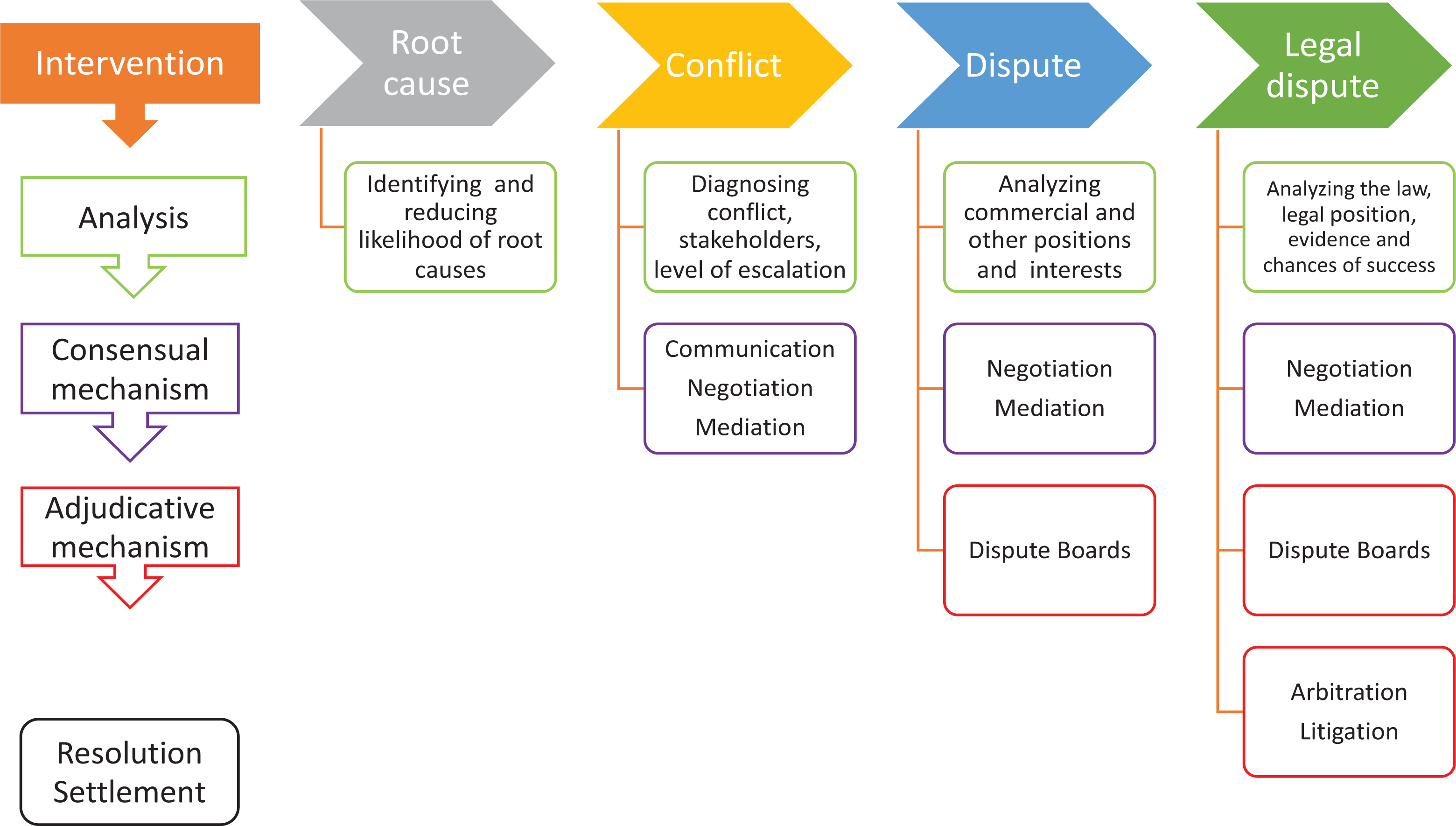
Intervention mechanisms during conflict continuum: from root cause to legal dispute.
Operationalizing conflict resolution through contracts
Procedural mechanisms can be integrated into contracts to allow interventions at different levels of conflict escalation (WorldCC, 2020a: 6-8). Dispute resolution clauses, for instance, steer the parties’ behavior in the case of disputes and may be used to promote the goal of efficiency or interest-based dispute resolution. They offer themselves as both objects of and tools for dispute systems design. They can be used to determine, whether a dispute will be automatically escalated to the courts and if yes, to which court. By making a choice between consensual and adjudicative dispute resolution mechanisms, the parties can choose the extent to which they will be able to secure their commercial and other interests and keep control on the outcome once the conflict starts to escalate. The parties can also in advance agree in more detail on the elements of the respective dispute resolution mechanism or structure the mechanism itself to correspond to their needs in respect of conflicts that typically arise in their business. Dispute resolution clauses provide usually for an escalation in case a consensual mechanism like mediation or negotiations fails. The parties can agree whether they want to escalate the dispute to a state court or to arbitration, they may agree on the framework of the arbitration as well as on procedural questions (Kurkela and Turunen, 2010: 201; on fast-track procedures, see Blackaby et al., 2015: 362).
Dispute resolution clauses are not the only means to integrate procedural mechanisms into contracts. These mechanisms can be operationalized at different levels of conflict escalation, for instance through terms that structure the parties’ cooperation during contract performance or that provide for adjustment and changes. All contracts that regulate human cooperation can be used to formulate, transpose and manage the parties’ goals and interests and to agree on preferences in the case of possible conflicts. Ideally contracts reflect the goals and values identified by the organization for its conflict management system and so mirror the company’s strategy toward conflict management (on possible goals, see Blomgren Amsler et al., 2020: 26). Goals, such as efficiency and resource savings, interest-based dispute resolution and dispute prevention instead of litigation can be aligned with the company’s general values and vision. In this way, conflict management can serve as an instrument of and be integrated into the company’s corporate management (Kirchhoff et al., 2013: 31).
Contracting processes and documents can be used to prevent conflicts from arising in the first place. They can help manage the parties’ expectations and feelings of entitlement and reduce the risk of misunderstandings by structuring cooperation and defining the parties’ roles (Blair, 2020: 818). Pre-contract documents and negotiation preparation tools can be used to clarify and integrate the parties’ interests and needs. Typical causes of conflicts and interests identified by the parties can be addressed by means of substantive contract terms and formal and informal procedural mechanisms. Informal methods of communication and interaction can be provided for to satisfy the parties’ procedural need to be heard and treated with respect and to give them a possibility to articulate their interests at a lower level of conflict escalation. Relational contract terms can help the parties structure their relation where adjustment and adaptation are needed to manage uncertainty (on relational contract terms, see WorldCC, 2020b: 8). A continuum of dispute prevention and resolution techniques exists and waits to be operationalized through contracts (for illustrative contract language demonstrating how these techniques can be incorporated into contracts, see also Groton and Haapio, 2007).
Proactive contract design for the prevention of conflicts and disputes
Our world—according to the WorldCC (2021)—is an ecosystem of contracts. This is but one example of how the contracting community has started to reimagine contracts and their role in the commercial world. Reform-minded lawyers, too, have started to look at transactions, relationships, and the contracts that shape and govern them in new ways. Their focus is not on preparing to win in court, but on supporting business in achieving their objectives and preventing unnecessary problems from arising. Although proactive design was only recently added to scholars’ and practitioners’ vocabulary (e.g., Haapio et al., forthcoming; Rossi and Haapio, 2019), the idea of an ex ante approach to contracts, disputes, or law is not new. In the following, we will explore the theory behind the approach which has evolved from Preventive Law originating in the US to Proactive Law and proactive contracting originating in the Nordic countries. When merged with design tools and methods, these approaches offer a wealth of opportunities for making contracts better tools for the prevention of conflicts and disputes.
Preventive law: The three domains of prevention
In the context of practicing law, the idea of prevention was first introduced by Louis M. Brown, a US attorney and law professor, in the 1950s. He emphasized an ex ante view and the lawyer’s role as a planner. Previously, lawyers had been seen mainly as fighters or “hired guns”—now they were presented in a new light: as trusted advisors, coaches, and problem solvers. One of Brown’s fundamental premises was that in conventional, curative law it is essential for the lawyer to predict what a court will do, while in Preventive Law it is essential to predict what people will do (Brown, 1956; Dauer, 1987, 2008).
Preventive lawyering seeks to anticipate and account for possible future conflicts. Building on an appreciation of predictable human behaviors—the first principle of a general theory of Preventive Law (Dauer, 2008)—the pioneers of Preventive Law noted some findings that are of particular interest for the purposes of this article: first, people bring legal claims when they sense a feeling of injury or loss; and, second, people experience a feeling of injury when their expectations have been disappointed. Against this background, according to the theory of Preventive Law, optimal conflict management and legal risk management require attention to be paid in advance to three preventive domains, often depicted in a pyramid figure form borrowed from the field of Preventive Medicine: primary (prevent the cause of the problem from arising), secondary (prevent the cause from having an adverse effect), and tertiary (minimize the possibility of adverse consequences; minimize the damage) (Dauer, 2008).
In the context of contracting, the goal of preventive lawyering is to take steps in the present to arrange transactions and relationships in a way that minimizes the probability of conflict, avoids its disruptive potential, and secures best possible transactional success, thus reversing the typical method employed in adjudicative legal reasoning. Instead of searching for facts and, when “found,” taking them as givens and applying legal rules to those facts to arrive at results, preventive reasoning begins with the parties’ purpose(s) and determines the facts that must exist in order for the purpose(s) to be realized (Nyhart and Dauer, 1986: 35). Here, one important feature is prediction: for example, who is likely to experience a sense of having been injured as the arrangement unfolds, on what occasions, and how is that perception likely to be acted upon? (Nyhart and Dauer, 1986: 35) In the words of Edward A Dauer: Litigation law is mostly law. Preventive law is mostly facts. And the critical time for preventive lawyering is when those facts are first being born. As a lawyer speaking to business people, I would have one request of them: Please let us be involved in the making of those facts (Dauer, 1988: 16; for primary prevention, see also Dauer, 1998).
From a preventive to a proactive approach: Balancing business and legal needs
The proactive approach originates from the late 1990s and early 2000s (Haapio, 1998, 2006; for the origins, see also Berger-Walliser, 2012; Haapio, 2013b; Siedel and Haapio, 2010). The Nordic pioneers of the approach merged quality and risk management principles with Preventive Law, adding a stronger promotive dimension to the preventive dimension. In Proactive Law, using the medical analogy, the goal is to not only to prevent “legal ill-health” and the “disease” of litigation, but also to promote “legal well-being”: embedding legal knowledge and skills in corporate culture, strategy and everyday actions to actively promote success, ensure desired outcomes, balance risk with reward, and prevent problems (Haapio, 2013b: 39; Nuottila et al., 2016).
In 2008, the European Economic and Social Committee (EESC) adopted its Opinion on “the proactive law approach: a further step towards better regulation at EU level” published in the Official Journal of the European Union in 2009 (EESC, 2009). In the Opinion, the EESC urges a paradigm shift, stating: The time has come to give up the centuries-old reactive approach to law and to adopt a proactive approach. It is time to look at law in a different way: to look forward rather than back, to focus on how the law is used and operates in everyday life and how it is received in the community it seeks to regulate. While responding to and resolving problems remain important, preventing causes of problems is vital, along with serving the needs and facilitating the productive interaction of citizens and businesses (EESC, 2009: art 1.4). [Preventive Law] favors the lawyer’s viewpoint, i.e. the prevention of legal risks and problems. In Proactive Law, the emphasis is on achieving the desired goal in particular circumstances where legal expertise works in collaboration with the other types of expertise involved. In Proactive Law, the need for dialogue between different understandings is emphasized (Pohjonen, 2006: 53–54).
Proactive contracting and contract design: Putting users in the center
The proactive contracting approach highlights the ex ante promotive and preventive uses of contracts and their managerial functions, putting the users in the center (Haapio, 2013b; Hurmerinta-Haanpää, 2021, forthcoming; Nuottila et al., 2016). The goal of proactive contracting, according to Soile Pohjonen, is that “the contracting parties achieve the goal of their collaboration in accordance with their will.” “This requires,” Pohjonen continues, “above all, a careful investigation of their goal and will, and the skill to create a clear and legally robust framework for their implementation” (Pohjonen, 2002).
The promoters of proactive contracting saw early on the need to change contracts from merely legal tools to managerial tools and to write contracts firstly for business. They did care about how a contract will work in a possible legal dispute, but they prioritized helping businesses and people use and act upon their contracts so there will be no unnecessary conflicts or disputes. For them, contracts’ primary readers were the transacting and performing parties and their representatives, who are most often not lawyers; among contracts’ secondary readers, again, were lawyers representing the parties in negotiating, drafting, or resolving contract disputes, including mediators, arbitrators and judges (Annola et al., forthcoming; Haapio, 2012, 2013a, 2013b; Passera et al., forthcoming; for the distinction between primary and secondary readers, see also Chesler and Sneddon, 2019). While recognizing legal needs related to contract clarity, enforceability and interpretation, the practitioners of proactive contracting sought to provide in their contracts workable ways to prepare for and respond to events—such as changes, claims, and conflicts—after the contract is made. Seeking to balance the needs of primary and secondary readers, they wanted their contracts to be legally functional and, at the same time, user-friendly and usable (Haapio, 2012, 2013a, 2013b).
One of the core arguments of proactive contracting is that when business readers in charge of implementing contracts know what to do and what not to do, unnecessary misunderstandings can be prevented. Problems can be solved where they arise, by delivery teams and project personnel, at an early stage, in a business-like manner. According to the pioneers of the proactive approach, [a] proactive contract is crafted for the parties, especially for the people in charge of its implementation in the field, not for a judge who is supposed to decide about the parties’ failures. Instead of providing the most advantageous solution for one of the parties, in case of the failure of the other party to comply with its contractual obligations, the proactive contracting process and documents seek to align and express the interests of both sides of the contract in order to create value for both (Berger-Walliser et al., 2011: 61).
Proactive contract design applies good process, content and document design to contracting processes and documents, aiming at identifying and serving the goals and needs both of the contracting organizations and of the people who work with contracts (Barton et al., forthcoming). The goal is not just a proactive contract, but its successful implementation, so that the parties reach their objectives and avoid unnecessary problems. This requires successful communication throughout the lifecycle of the contract, within and across the participating teams and organizations.
Contract design methods and patterns, such as layering, timelines and flowcharts (WorldCC et al., nd), can help readers find what they need, understand what they find, and use the information. They can also make the reading process faster and more pleasurable—or in any case less unpleasant for the readers. Design methods, such as visualization, are not about decorating contracts; they have much more substantive goals. They can be used to embed in the contract and help operationalize effective processes for the early detection and resolution of causes of claims as well as for change and dispute management (e.g. Henschel, forthcoming). In addition to content—stating, for example, when and how those processes are triggered and what steps need to be taken—design is also about presentation, seeking to capture readers’ attention, engage them, and motivate or nudge them to doing the right thing.
Proactive contract design applied—Two sample cases
The following two examples illustrate how conflicts and disputes can be prevented and managed through contract design and early intervention mechanisms.
Using visuals to make expectations visible and tangible—And prevent disputes
The first example relates to a real and widely cited (e.g. Austen, 2006; Haapio, 2011; Haapio and Siedel, 2013: 164–169) Canadian dispute over an agreement between Rogers Communications Inc. and Bell Aliant Regional Communications Income Fund. It all started in 2002 when Rogers signed a Support Structure Agreement with Aliant for access to power poles Rogers used for its cable lines. Some poles were owned by Aliant and others by New Brunswick Power Corp. Changes to the agreement between Aliant and New Brunswick Power Corp. in 2004 led the annual rates to jump considerably. So Aliant terminated the contract with Rogers, believing that the contract allowed it to do so at any time with 1 year’s notice. Rogers objected to the termination and the increase of fees that would have followed. According to its reading of the contract Rogers thought that the contract would be in effect for 5 years, until May 31, 2007. The differing views led to a 18 month dispute and two differing Telecom Decisions by the Canadian Radio-Television and Telecommunications Commission, CRTC, over the meaning of the following termination clause (Telecom Decision CRTC, 2006-45, 2007-75): This agreement shall be effective from the date it is made and shall continue in force for a period of five (5) years from the date it is made, and thereafter for successive five (5) year terms, unless and until terminated by one year prior notice in writing by either party.
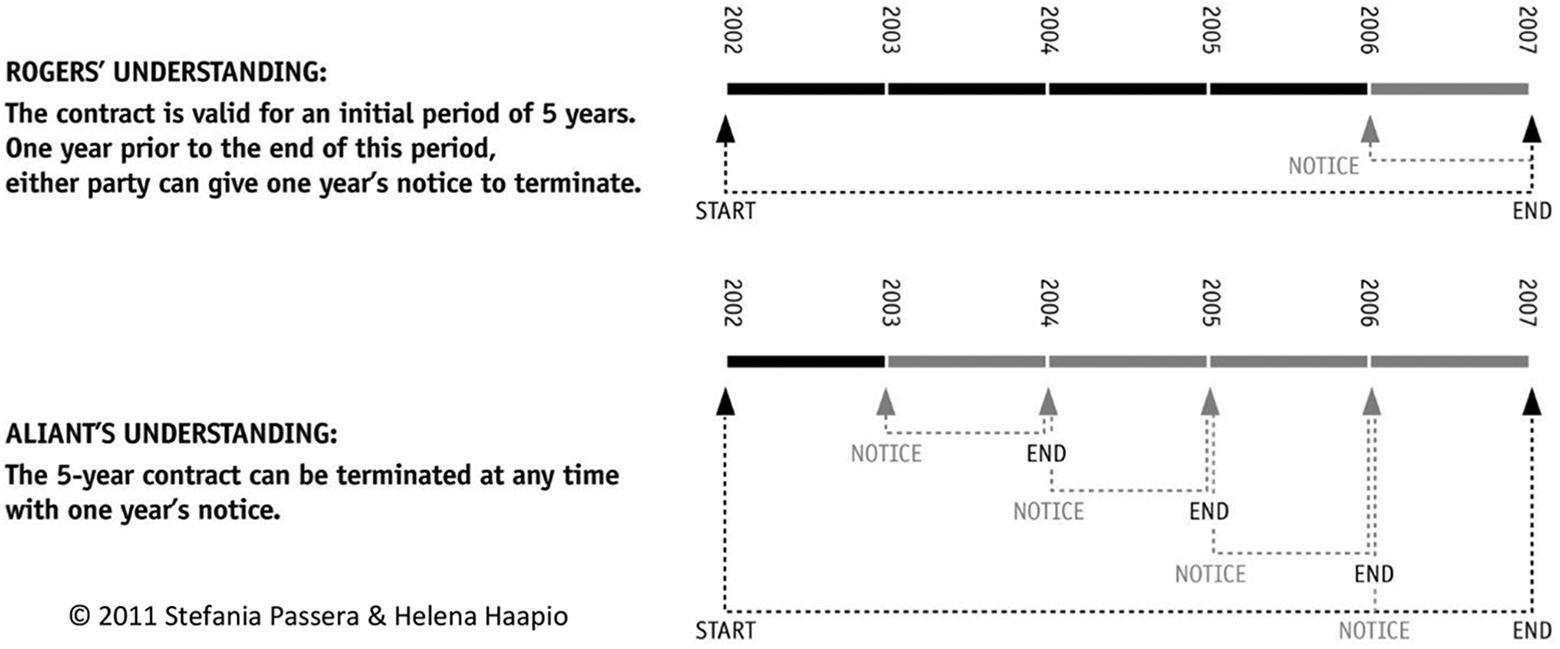
Two timelines that could have made different understandings visible and prevented a major dispute. The image originally appeared in Passera and Haapio (2011).
Case law provides many similar examples illustrating that it is not always easy to make sure what the parties’ intent is and to state it clearly in the contract. Expectations are hard to manage, if they are not visible. Design offers tools and methods, such as visualization, that help make things visible and tangible. The goal of contract visualization is insight and shared understanding, not just images. Images can help the parties and their lawyers stop, think and focus on important issues, such as the duration of the contract and change mechanisms, before it is too late. In the words of Louis M Brown, the Father of Preventive Law: “It usually costs less to avoid getting into trouble than to pay for getting out of trouble” (Brown, 1950: 3).
Preventing conflict escalation through proactive contract design
The second (fictitious) example illustrates the escalation and handling of a conflict between shareholders in a start-up company. Let us imagine that there are three co-founders Mary, Joe and Christopher who have known each other since university, where they have worked together on a project for the development of contract management software. It is typical for start-up companies that there is a rather low degree of formality as the founders often know each other and rather focus on the project than on paperwork. Therefore, when setting up the company Mary, Joe and Christopher want to keep it simple—after all, they are good friends, they have known each other for a long time and can work things out. They enter into a shareholders’ agreement, where they roughly define the goals of the company and the business plan. Seeking equality in their business operations, they agree that they all have an equal share and vote in the company, and will all obtain equal payment. They assume different roles in the management of the company and all work very hard. While Joe is responsible for investor relations, Mary is in charge of developing the software and Christopher is responsible for marketing.
In the beginning things work out very well and the company is able to attract investors. It is, however, not uncommon that once the honeymoon period is over, tensions between the co-founders begin. In our example Mary is irritated because Joe has started to work also for another company that is in her opinion competing with their business. She also—and this is also a rather typical problem—perceives that the co-founders do not contribute equally to the success of the company and that they do not deserve an equal share or equal pay. Often conflicts over who has a say in the company arise, if roles and responsibilities are not clearly assigned. In addition, a lack of a clear governance structure may easily turn into overt or covert conflicts over power. In our case Mary wants to take a leading role, which is not accepted by Joe and Christopher who are annoyed with Mary’s controlling behavior. Unresolved disputes over power may spread and the co-founders may, for instance, start to doubt Mary’s ability to contribute to the software development. In our case things get worse when Mary overhears a conversation that Joe and Christopher want to get her out, because they doubt her professional abilities and are troubled by what they perceive as dominant behavior. Frustrated by these allegations, Mary wants to leave the company. At this moment she accepts that she cannot be part in the company’s future and therefore accepts her own losses. She, however, wants to get a compensation for her share in the company and the software that she thinks she co-invented. When confronting her co-founders with her claims, they refuse to pay, claiming that the software was not Mary’s idea and that the company has no value as it still does not make any profit. Mary thinks that it is outrageous to leave her with “nothing” and files a lawsuit.
In this—simplified—case it is not difficult to see, how the escalation of the conflict could have been prevented by drafting a shareholders’ agreement that seeks to address the management and escalation of possible future causes for disputes and guide the parties toward cooperation. Issues such as the ownership of the software, requirements regarding the responsibilities and contributions of the co-owners as regards work and investments, non-competition and the governance structure of the company could have easily been dealt with in the shareholders’ agreement. Setting forth the rules on how to address changes in the parties’ goals would have helped to prevent disputes, too. In order to deal with ongoing conflicts that relate to psychological, procedural and substantive interests, the contract could have provided for an informal procedure that enables the parties to handle these interests by themselves or with the assistance of a mediator in a process that focuses on the improvement of the parties’ interaction and communication. Once the dispute has turned into a legal dispute, litigation that may be detrimental to all of the parties can still be avoided when the parties agree on a mediation to settle their claims including their legal claims. Preferably this is part of the dispute resolution clause of the shareholders’ agreement and provides for a procedure to determine the dispute in case mediation fails.
Conclusion
The terms that are most negotiated before a contract is signed rarely deal with the root causes of conflicts. The same is true for many of the terms that negotiators list as the causes of claims or disputes during contract performance. Rather than focusing on the issues that generate problems, those terms focus on failure and disputes that are at the end of conflict escalation. Instead of reducing the likelihood or frequency of problems, they concentrate on minimizing their financial consequences. While the terms topping the WorldCC (formerly IACCM) list of most negotiated terms—limitation of liability and indemnification clauses—help allocate and control risk, they do not help prevent conflicts or their escalation into legal disputes. A focus on the legal side of contracts or disputes often fails to respond to the commercial, procedural and psychological needs and interests of the parties and the people representing them.
We propose proactive contract design as a means to shift focus to the real problems and their causes. The design process instructs us to focus on the users and on identifying, defining and addressing the problems from their point of view first, before developing solutions. From the users’ point of view, contract terms may be part of the problem, but the root causes lie elsewhere. Experience and research tell us that they can often be found in misaligned or frustrated expectations or miscommunication. These may be attributable to what the parties did or did not do or to external reasons. Sometimes they are caused by genuine misunderstandings leading to unintentional breach. Design methods such as simplification and visualization can help achieve and maintain a shared understanding and prevent the causes of conflict from arising, beginning with making the parties’ expectations visible so that they can be aligned and managed. The processes of visualizing and designing offer ways to respond to the needs and requirements related to the business purposes and managerial functions of contracts. We suggest that a stronger focus on the most important terms—scope and goals or specifications, responsibilities of the parties, and change management, for example—during negotiations, in the contract itself, and during implementation can help address the root causes of conflicts and enhance the parties’ chances of success. Contract design combined with formal and informal procedural mechanisms can guide and shape the parties’ cooperation and enhance their ability to manage and resolve changes, claims and conflicts before they escalate to legal disputes.
Efficient and proactive contract design requires a sufficient understanding of conflicts and their causes as well as the interests and needs that arise in different contexts, industries and businesses. While some companies have developed conflict databases to monitor, report and manage conflicts, more scientific research on their root causes is needed. Once the root causes have been identified, proactive contract design offers the interface between strategy and action: well-thought-out, easy to implement contract provisions along with contractual change and claims management procedures merged with early intervention mechanisms to address the different dimensions of disputes can help operationalize an effective dispute prevention and resolution system. The goal: effective dispute prevention and resolution by design.
Footnotes
Declaration of conflicting interests
The author(s) declared no potential conflicts of interest with respect to the research, authorship, and/or publication of this article.
Funding
The author(s) received no financial support for the research, authorship, and/or publication of this article.
