



Abstract
As the number of sustainability laws and regulations increase and stakeholders become increasingly concerned about the sustainability impacts of commercial activities, companies need to integrate environmental, social, and economic considerations not only in their own operations but also in their relationships with suppliers and throughout their value chains. Contracts will play a key role in promoting sustainability as they contribute to holding together the links and nodes in global supply chains. A key question, then, is how to integrate sustainability mechanisms into supply contracts and contracting processes. This article proposes proactive contracting and legal design as approaches to promoting sustainability in supply management. It uses a “jigsaw puzzle” metaphor to outline key elements at the intersection of the literature streams on proactive contracting and legal design and purchasing and supply (chain) management and proposes routes for further research to fill the identified gaps.
Keywords
Introduction
Sustainability has become a concern for politicians, consumers, researchers, and businesses. International organizations such as the United Nations 1 and the Organization for Economic Co-operation and Development (OECD) 2 are actively promoting sustainable business, as are several European countries and the European Union (EU). As a result, the EU and its member states have recently adopted or are in the process of adopting several new sustainability laws and regulations. For example, the Corporate Sustainable Reporting Directive (CSRD) 3 came into force at the beginning of 2023 to speed up and enhance sustainability-related information processes. Complementing the CSRD, the Directive on Corporate Sustainability Due Diligence (CSDDD) 4 entered into force on July 25, 2024. Both instruments also have an impact on the contracting process and contract documents. This new generation of sustainability legislation and policies will have a significant impact on companies operating in the EU, as well as on third country companies doing business with the EU. In addition to legislation, the expectations of stakeholders such as partners, suppliers, financiers, customers, and shareholders are driving this change and changing societal attitudes toward sustainable business practices. 5
The impact of the new rules and expectations will be felt particularly in the business functions of purchasing and supply chain management. On the academic side, the integration of sustainability and purchasing and supply management has received attention already for several years, 6 with authors arguing that “a company is no more sustainable than its supply chain.” 7 However, procurement practices have been slow to change, and the pursuit of short-term cost benefits has remained a priority at the expense of longer-term impacts on global sustainability. 8 Companies will need to integrate environmental, social, and economic considerations not only in their own operations but also in their relationships with suppliers 9 and throughout their value chains. 10
One question is how sustainability-related mechanisms will be integrated into supply contracts and contracting processes. Contracts will play a key role in enhancing sustainability globally, as they are an important component of the “glue” that binds the links and nodes in global supply chains. Due to their legal enforceability, supply contracts can be regarded as “legal vehicles” for achieving corporate sustainability goals. 11 Where the level and enforceability of legal protection of human rights, worker safety, and the environment vary across locations, it has been argued that supply chain contracts have the potential to fill regulatory gaps and influence firm behavior. 12 The way companies draft and manage contracts could therefore have a significant impact on promoting sustainable business practices throughout global supply chains. However, contracts remain an underutilized resource in business. 13
The traditional approach to contracts (emphasizing safeguarding and ex post legal thinking) does not seem to respond well to disruptive events that have impact on supply chains; for instance, research has reported that during the COVID-19 pandemic, buying companies showed short-sightedness and opportunistic behavior toward their suppliers in the Global South. 14 As new laws and regulations come into force, there is a need to reconcile contractual conventions with the expectations of legislators and other supply chain stakeholders. The legal literature already provides newer approaches to “contracts” that can better leverage mitigation strategies for responding to sustainability challenges, namely the proactive contracting and legal design approaches. 15 According to these approaches, contracts should be seen as social artifacts that serve as tools for management, communication, knowledge sharing, and cooperation. 16 In a recent publication, Stange, Schiele, and Henseler also suggest that purchasing and supply management research can address problems, such as climate change and the effects of increasing globalization, through design science research. 17
In this article, we present a cross-disciplinary overview of managing interorganizational relationships through contracts with the aim of promoting sustainability in supply management and throughout supply chains, based on insights from the literature streams of proactive contracting and legal design and purchasing and supply management. We discuss how alternative approaches to contracting, namely proactive contracting and legal design, could enable systemic change and resilient sustainability. The article aims to piece together the complex “jigsaw puzzle” of knowledge on sustainability and contracts in supply chains, by outlining and comparing key elements of proactive contracting and legal design with insights from purchasing and supply chain management and contract research. In doing so, the article outlines gaps in the literature on the governance involved in sustainable procurement and the integration of sustainability into contracts and proposes future research opportunities to fill these gaps. We argue that there is a need to initiate multidisciplinary and cross-sectoral research involving scholars from law, design thinking, and supply chain management as well as practitioners representing legal, purchasing, and supply chain management functions within companies.
Identifying Elements for Integration
Purchasing and Supply (Chain) Management
Companies may procure a wide range of supplies, components, materials, and services from a very large number of suppliers. Purchasing is a business function that has become increasingly important and strategic within companies and is increasingly seen as a critical element in the management of supply chains. 18 It should be noted here that there are a variety of definitions for the concepts “purchasing,” “procurement,” and “sourcing” in the literature and for different contexts, although they are often used interchangeably. There are also different views on how these terms and the business functions they describe relate to the business function of supply chain management. 19 The related term “supply management” has traditionally been used to refer to a strategic activity or level of procurement related to the portfolio of items being procured, 20 or in other words, the management involved in the procurement of strategic items.
Proactive Contracting and Legal Design
The proactive contracting approach is a multidisciplinary stream of research that applies a variety of theoretical and methodological approaches to the study of contracts and contracting in practice. 21 It departs from the traditional view that contracts are documents made by lawyers for lawyers, 22 which focuses on defining the responsibilities and rights of the parties involved, including safeguarding clauses to secure the interests and position of a company in the event of a dispute. 23 The proactive contracting approach focuses on the ex ante use of contracts, that is, the planning and implementation of contracts, rather than the ex post use of contracts, that is, the interpretation of contracts in the event of a dispute, as in traditional contract law studies. 24 The approach views contracts as legal, economic, managerial, and social artifacts that should be used to identify problems and prevent them from occurring, and to proactively guide and support business success and relationships. 25 Contracts thus have multiple functions other than, and equally significant as, safeguarding, such as promoting business and fostering collaboration between the contracting parties. 26
Legal design, in turn, is an umbrella term for merging forward-looking legal thinking with design thinking. More specifically, it “applies human-centered design to a world of law,” 27 encompassing legal information, documents, legal services, processes, and systems. 28 The design process is cyclical and iterative, with multiple phases that can be repeated in any order: understanding the context of use, identifying the users, setting clear objectives for the project, designing and testing different solutions, reviewing, and evaluating the results, and making changes if necessary. 29
The Intersection of the Two Fields
The two streams of literature share an interest in the interorganizational relationship between two contracting parties, but while the proactive contracting and legal design literature focuses on the contracts and contracting processes (in an unconventional way) and their antecedents and implications for the success of the relationship and the business parties, the purchasing and supply chain management literature focuses on the functions of purchasing and managing supply (chains), and the means (including contracts) involved in managing the flows (of goods, services, information, and finances) that are essential for business success.
Next, we will outline the elements and gaps at the intersection of these two streams of literature and research (see Figure 1). In addition, we discuss the opportunities that the use of AI tools in this area provides to fill the gaps and bridge the intersection of these two streams.
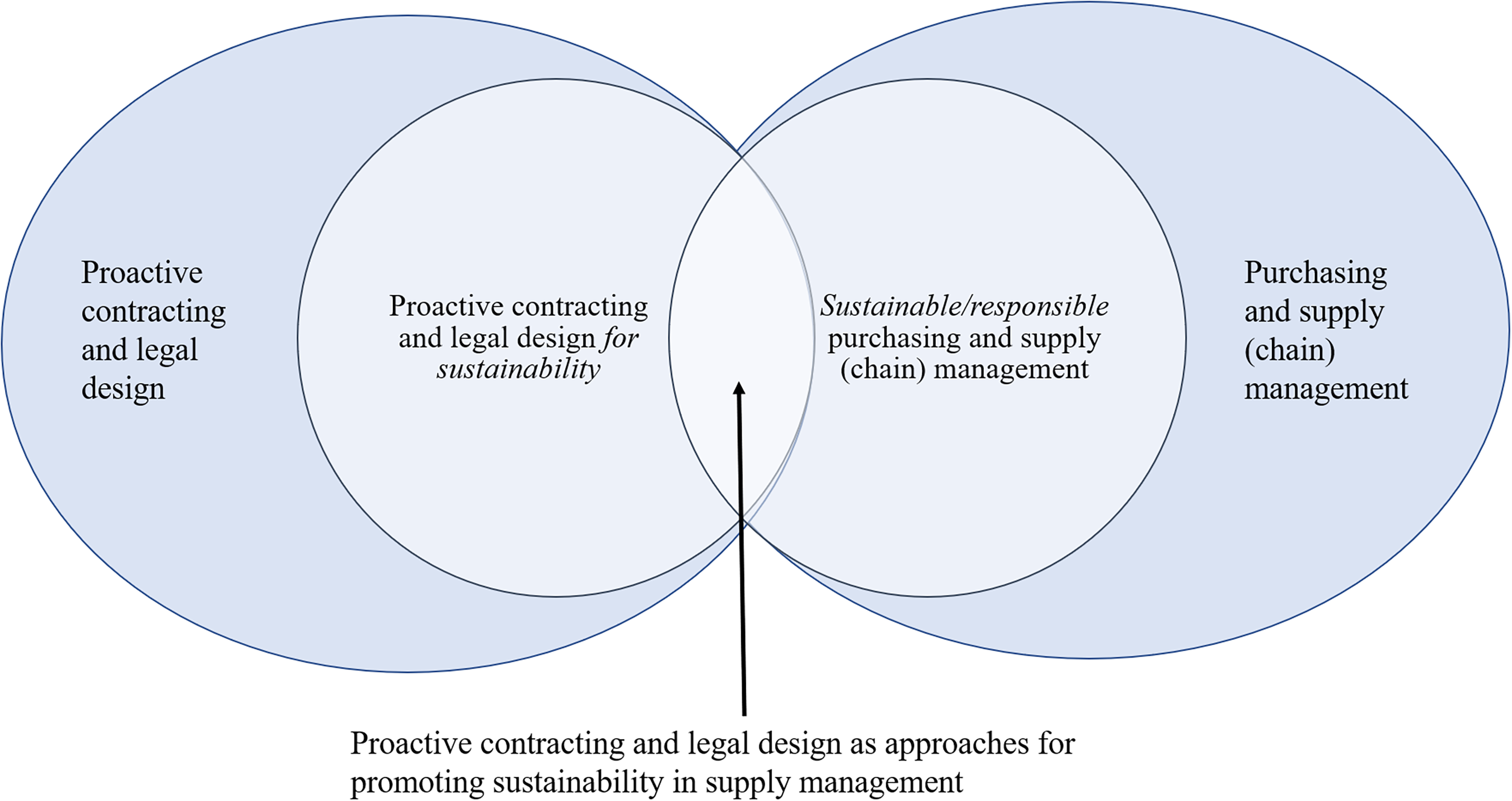
The Article's Positioning at the Intersection of Proactive Contracting and Legal Design and Purchasing and Supply (Chain) Management, Integrating Sustainability Outcomes.
Knowledge on Interorganizational and Interpersonal Relationships: A Jigsaw Puzzle
When studying a phenomenon, researchers bring to the table discourses, methods, and assumptions that stem from historical experience and institutional imperatives (among other things) that members of a particular discipline use to filter information with, in order to engage with “cutting-edge work” in their discipline. 30 In the big picture of sustainability, supply chains, contracts and contracting processes, researchers from different disciplines will have the same pieces in front of them, but will focus on different parts of the puzzle, and have different strategies for finding the next pieces that fit the part that they are interested in. Using this metaphor, we will now focus on some of the smaller parts and pieces of the big picture.
Formal Contract: Relational Governance
The proactive contracting and legal design approaches highlight interlinkages between a formal contract and relational governance. 31 Relational governance refers to the use of informal governance mechanisms, such as trust, flexibility, and solidarity. 32 They arise from shared values and agreed processes within a relationship and rely on the contracting parties to enforce them. 33 This means that instead of creating and supporting arms-length or adversarial relationships, contracts should take into account the relationship-specific aspects of exchange, promote trust, and encourage communication and collaboration. 34 Clear collaborative contract clauses aim to foster a strategic, trust-based partnership that goes beyond mere transactions and emphasizes communication, commitment, and information sharing. This approach is increasingly relevant in the global economy where production often involves complex value chains and networks. 35
The purchasing and supply chain management literature has extensively explored the use of formal (transactional) and informal (relational) governance mechanisms in buyer-supplier relationships, and authors have discussed whether these governance mechanisms are substitutes or complements in interorganizational relationships. 36 The mix of governance mechanisms (i.e. the simultaneous use of different mechanisms) has also been studied in different settings, using different parameters and performance outcomes, 37 while other authors conclude that the need to use extensive formal contracts depends on the circumstances. 38 However, Van der Valk, Lumineau and Wang argue that business management studies of interorganizational relationship contracting should pay more attention to contract dynamics and their interplay with relational and other governance mechanisms, as well as the link between contracts and their impact on performance. 39 The integration of the different types of mechanisms within a written contract, as proposed by the proactive contracting and legal design approaches, would need further exploration. At the same time, the supply chain setting brings nuances that would be beneficial to consider also in contract research and practice, such as the impact of incentives on the suppliers’ prioritization of work (when they have multiple contractual obligations to fulfill simultaneously), 40 or the impact of purchasing objectives on the use of different governance practices. 41
Holistic View of the Contract Lifecycle
The proactive contracting and legal design approaches emphasize the entire contract lifecycle, from planning to implementation, and regard contracts as processes. 42 Thus, in contrast to the classical view of contracts, the process is an equally important part of the agreement between the parties as the final output, since these phases, such as planning and prototyping, also contain binding and legally relevant elements. 43 Contracts should be designed as performance roadmaps that guide the actions and obligations of the parties involved. It is important for the parties to clearly define their interests and expectations in the early stages of negotiation to achieve successful contracts. 44 In addition, proactive contracting emphasizes that contract processes should be designed to support business processes. 45 In business practice contract management is a tool and method that enables the integration of contract and business processes, the control of all stages of the contract lifecycle, and the advocacy of legal design at different stages of the contract lifecycle. 46
While the purchasing and supply chain management literature acknowledges the role of the (written) contract in procurement and supplier relationship management, the focus is often on the process leading up to the formalization of the contract and the performance of the relationship rather than the business success as tied to the contract itself. There are some authors who make a clear distinction between the management and decisions involved in procuring a good or service, negotiating with the supplier, and drafting the formal contract. 47 The contractual process, that is, the formalization of what has been agreed, is then often described as the work of the company's legal department, which comes in at the end of the procurement process. However, authors of purchasing textbooks do outline aspects that are important to integrate into the supply contract, as well as guidelines for contract management (as part of supplier relationship management) from a purchasing perspective. 48
Multiprofessional Collaboration and User-Centricity
The proactive contracting approach also highlights the need for multiprofessional collaboration and user-centricity in contract design, 49 as different capabilities and types of information are needed when the contract is designed, implemented, and adapted to changing circumstances and the evolving business relationship. 50 Moreover, like proactive contracting, legal design requires multiprofessional collaboration, puts the users at the center, and focuses on “how information is presented, how processes are set up, and how policies are established.” 51
While the supply chain management function is often described as an integrative function aimed at enhancing alignment between functions within a company and across entities, the legal function and the users of contracts are not typically included in the functions to be integrated, and the role of lawyers in business management has remained unexplored. 52
Design Dimensions
In the context of contracts, legal design is the design of contract processes and the content, structure, language, and layout of contract documents. The aim is to develop the organization's contract processes to promote user-centered, understandable, and unambiguous contract documents that support the business as a whole. 53 Artificial Intelligence (AI) offers increasingly versatile and advanced tools for designing contract processes and contract documents. 54
Design science research methods have received some attention also in the purchasing and supply management (and related) literature, 55 but this stream of literature is still in its infancy. However, the articulation of contract provisions is one aspect of contract design that could have an impact on supplier–buyer relationships. For instance, the framing of performance incentives, specifically regarding the contractual clarity and the overall purpose of the contract, has been shown to influence behavioral and relational responses of suppliers in performance-based contracting. 56 Van der Valk, Lumineau, and Wang conclude that the conceptualization and operationalization of interorganizational relationships often builds on a simplified characterization of contracts, which calls for more research on distinct types of contracts, functions of contracts, and contract management. 57 They also identify a need for more research on the antecedents to and consequences of contract design and management. 58
The purchasing and supply chain management literature can also add nuance to the legal design literature. The increasingly international context in which buyers operate brings additional challenges for contract design and implementation, due to different languages, cultures, and legal systems. 59 The context in which the contract is designed can thus have an impact on its usability within the organization, and its success in terms of, for example, avoiding opportunism. 60
The Many Dimensions and Functions of Contracts
Proactive contracting and legal design approaches have two dimensions: preventive and promotive. The preventive dimension seeks to identify and prevent potential problems and minimize the impact of unavoidable risks. The promotive dimension, in turn, seeks to emphasize the positive, proactive dimensions of contracts by viewing them as tools for promoting business success, enhancing opportunities, and fostering collaboration and relationships. 61 Moreover, proactive contracting and legal design research recognizes that contracts have multiple functions. Contracts are not only legal tools but also management tools. This means that contracts serve as tools for coordinating and managing business; creating, allocating, and protecting value; minimizing and managing risks; and promoting relationships and collaboration. 62 More specifically, this means, inter alia, that contracts are tools for communication, for clearly defining the relationship between the parties, for protecting the rights of one or both parties, for coordinating tasks and responsibilities, for adapting the business relationship as needed over time, for creating and developing cooperation, and for encouraging and guiding companies to adopt more sustainable practices. 63 The purchasing and supply (chain) management literature has yet to recognize and explore the dimensions of contracts, and the full range of potential functions that contracts can have beyond control and coordination.
Adding Pieces to the Puzzle: Sustainability as a Supply Management Outcome
The importance of procurement practices in achieving sustainability has been acknowledged by several authors. 64 To strategically manage the number of long-term, short-term, and spot market relationships, the discipline of purchasing and supply (chain) management has provided tools for categorizing supply according to various criteria. The Kraljic Purchasing Portfolio Matrix 65 is among the most influential tools, and is still in use in companies, education, and research, 66 but there are also other approaches to categorizing supplies and suppliers. 67 Strategic items, for which the term “supply management” is traditionally used, are characterized by supply risk or difficulty (including the number of suppliers and the novelty or complexity of the product) and the importance of purchase (e.g. due to cost, value, or profitability). 68 These established purchasing practices have received their share of criticism; for instance, the Kraljic purchasing matrix has been argued to oversimplify the reality of sourcing and relationship management, and to lack consideration of environmental and social dimensions. 69
At the same time, the literature on sustainability in supply chains explores a wide range of practices that are used by companies to promote sustainability with their suppliers and beyond, including supplier performance evaluation, supplier collaboration, and resource allocation. 70 However, the transactional and relational governance practices seem to be used simultaneously by companies for multiple purchasing objectives; for instance, Scholten et al. found that process improvement is used in a transactional way to ensure security of supply through contractual clauses in delivery performance and cost-focused purchasing. 71 However, research also reports a lag in the implementation of responsible or sustainable purchasing practices by buyers, 72 and adverse impacts of buyer behavior on human rights and the environment remain a problem in global value chains. 73 There is therefore a need to further explore the integration of sustainability into supply management, contracting, and contracts.
Contracting and Sustainability
Legislation provides the legal framework for companies’ sustainable practices. However, the solutions to sustainability challenges that are currently provided by national legal systems may not spark systemic change. 74 The level and enforceability of legal protections for human rights, worker safety, and the environment vary across locations, and it has been argued that supply chain contracts have the potential to fill regulatory gaps and influence corporate behavior. 75 Complementing the CSRD, the Directive on Corporate Sustainability Due Diligence (CSDDD) 76 entered into force on July 25, 2024. The Directive relies heavily on contracts and contractual practices. Under the CSDDD, companies are required to seek contractual assurances from business partners to ensure compliance with the company's code of conduct and a prevention action plan. This includes requiring suppliers to seek corresponding assurances from their partners to the extent their activities are part of the company's chain of activities. 77 However, scholars have argued that the tools and related concepts, such as contractual assurances, are not clearly defined. In addition, it is unclear how the (power) imbalance between contractual assurances and the extension of contract terms and conditions throughout the value chain (contractual cascading) should be designed. 78 In practice, sustainability in contractual cascading has often remained uncertain. 79 Moreover, it is important to be aware of the imbalance in resources between companies. For example, compared to larger companies, SMEs may lack comprehensive knowledge of relevant legislation, face challenges in implementing sustainability practices, and struggle with monitoring, measuring, and reporting on their sustainability issues. 80
Contracts are a critical component of any strategy for establishing and maintaining responsible and sustainable supply chains. Although sustainability clauses are now a “standard feature” of contracts, their design may not necessarily contribute to the achievement of sustainability goals in practice and, in the worst cases, may even encourage human rights abuses. 81 For example, contract clauses that require suppliers to continuously comply with a buyer's code of conduct and to claim that they have no human rights problems may encourage suppliers to conceal abuses in order to avoid breach of contract. Similarly, clauses that allow buyers to terminate contracts for even minor problems, without offering redress or considering the buyer's contribution to those problems, unfairly shift all responsibility to suppliers and overlook crucial efforts to address human rights problems. 82
Sustainability clauses in contracts may also be too general, vague, and imprecise (in content and wording) to be considered binding. 83 In addition, some authors argue that procurement contracts in particular are often one-sidedly protective and that powerful parties use contracts to maximize commercial value, often at the social and economic expense of suppliers and workers. 84 This implies that the classical legal paradigm dominates in contracts, as mentioned above, and that the main function of contracts is often safeguarding. However, studies have identified the need for more equitable contracts. 85 Contracts should emphasize cooperation and the social dimension of the relationship. This means that they should be based on values such as reciprocity, mutual respect, trust, collaboration, loyalty, equity, and integrity. 86 These values underpin the relational objectives of contracts. In the context of sustainability, these relational objectives imply a commitment to shared responsibility. 87 There are also model contract clauses available, to help companies implement sustainable corporate policies. These include, for example, the American Bar Association’s Model Contract Clauses 88 and the forthcoming European Model Contract Clauses. 89 The drafters of the model clauses recognize the often-unequal power dynamics between buyers and suppliers. To address this, they include clauses to rebalance or share responsibility between the parties. However, many of these model clauses are written by lawyers for lawyers, and there is a need for more user-centric design to understand and implement the clauses. 90
Proactive Contracting and Legal Design for Promoting Sustainability in Global Supply Chains
Proactivity and collaboration are central to sustainable development and the identification and implementation of solutions consistent with sustainable development goals. 91 Moreover, in any activity based on social relations, there is space to apply design thinking on the path to social and environmental sustainability. 92 Several authors have also suggested the use of proactive legal tools to promote sustainability in global value chains. 93 Berger-Walliser et al. reiterate the inclusion of supplier obligations in individual supply contracts (e.g. sustainability contract clauses) and industry self-regulation (i.e. standards, codes of conduct, and labels) as possible proactive measures. 94 However, the success and real impact of the (possibly) unilateral implementation of these types of measures by buying firms has been questioned. 95
Supplier obligations and industry self-regulatory instruments are established business practices, but in the future companies may need to reconsider the use and content of sustainability clauses and codes of conduct to overcome their current drawbacks and truly achieve sustainability and resilience. For example, Koberg and Longoni suggest that supplier assessment should be accompanied by “a strategic initiative that involves collaboration with suppliers.” 96 Saloranta and Hurmerinta-Haanpää further suggest four ways in which proactive contracting can be used to promote sustainability in supply contracts: (1) change focus to shared responsibility and collaboration instead of one-sided safeguarding; (2) include promotive contract clauses that incentivize responsible and sustainable business practices; (3) engage end users in the contract design process, and; (4) prevent disputes. 97 These four approaches are intended to broaden the perspective of contracting for sustainability beyond the first tier of suppliers, and address issues related to contractual cascading of sustainability due diligence, shared responsibility and remediation. 98 Proactive contracting could thus address some of the problems related to asymmetric power structures in business-as-usual contracting.
To promote sustainability in supply contracts, the contract documents must be understandable, unambiguous, transparent, and implementable in day-to-day practice. The way in which sustainability-related clauses are framed in contracts is therefore crucial. It is important to avoid legalese or sustainabilitese: jargon that is meaningful only for a small group of experts. 99 Design-based methods provide tools for accessible and reliable sustainability information. They provide tools to strengthen organizational capabilities to develop sustainable, supportive cultures within organizations. 100 Such capabilities include the development of a path for effective and user-centered contracting processes and contract documents. This allows for understandable and actionable information, which in turn helps to overcome the communication challenges and facilitates the implementation, monitoring, and reporting requirements of the sustainability issues. 101
New technological solutions have the potential to help manage and ensure compliance with sustainability norms in supply chains. 102 The use of AI systems to achieve the Sustainable Development Goals has also been highlighted in the EU White Paper on Artificial Intelligence. 103 AI, with machine learning as a key component, has advanced rapidly and AI tools have become highly effective at processing and generating text. They have a significant potential for simplifying and summarizing complex legal text, interpreting contract clauses, personalizing text to users’ characteristics, comparing contracts with competitors’ contracts, and gathering information about actors in the supply chain. Language models, such as GPT-4, are particularly promising in this area. 104 In addition, tools such as OpenAI's DALL-E 2 can be used to clarify information through a variety of visual means. 105
Research Opportunities to Fill in the Gaps in the Jigsaw Puzzle
Researchers have called for multidisciplinary research on interorganizational contracting, due to fragmentation within and across disciplines and conceptual unclarity. 106 Roehrich et al. also identify a need to explore exchange governance in buyer–supplier relationships, 107 which is, to our knowledge, also underexplored in research on proactive contracting and legal design.
The need to include sustainability dimensions beyond the dyadic relationship has been well recognized in the purchasing and supply (chain) management literature, 108 but the increasing number of sustainability laws, regulations, and expectations from stakeholders highlight the need to accelerate research on this topic. The impact of the contracting process and contract design on the sustainability performance not only of the focal firms and their suppliers but of the entire supply chain thus appears to be a topic that needs attention.
To change contracting practices and capabilities—or even the mental model of what a contract is—requires time and effort within and across organizations. 109 Which suppliers, and even entire “arms” of the supply network, would it be strategically important to engage with, at least initially, in the proactive contracting and legal design approaches, especially to promote sustainability? Traditionally, strategic items were characterized by high complexity in the supply market (due to supply availability or logistics costs, among others) and high importance. 110 However, sustainability considerations change the criteria for determining the strategic relevance of procured items; for instance, Pagell et al. suggest that “[t]he key managerial issue will be differentiating between these situations [i.e., where investing in relationship-specific assets can have long-term advantages from a triple-bottom-line point-of-view (i.e. strategic commodity) versus no long-term advantages] because poor choices can lead to high levels of asset specificity in the wrong relationships and/or missed chances to invest in resources.” 111 Further research is needed on how to integrate proactive contracting and legal design into managing supplier relationships for sustainability outcomes, especially in an international context. 112 Another strategic issue is deciding when to change the purchasing strategy and the relationship governance mode over time as the relationship matures and contingencies change. 113
Interorganizational relationships also consist of multiple interfaces between individuals, teams, and organizations, but this fact constitutes a gap in research on the governance of interorganizational relationships. 114 The focus on user-centricity and multiprofessional engagement in the proactive contracting and legal design approaches could here provide valuable perspectives for advancing the research on the multiple levels of interfaces throughout the contract (or relationship) lifecycle.
Conclusions
The impact of sustainability regulations and expectations on the business functions of purchasing and supply chain management is remarkable. Companies must integrate environmental, social, and economic considerations not only in their operations but also in their relationships with suppliers and throughout their value chains. However, despite the recognition in the supply chain management literature that a company is no more sustainable than its supply chain, procurement practices have been slow to change and have continued to prioritize short-term cost benefits at the expense of long-term impacts on global sustainability. Contracts will play a key role in improving global sustainability as they are an important part of the “glue” that holds together the links and nodes in global supply chains. In addition, it has been argued that contracts have the potential to fill regulatory gaps and influence corporate behavior. The key question, however, is how to integrate sustainability mechanisms into supply contracts and contracting processes. Using a multidisciplinary approach, drawing on the literature on proactive contracting and legal design as well as procurement and supply chain management, the article discusses key elements at the intersection of these research streams, in light of the new sustainability requirements and expectations. The aim was to outline the links between elements of these different research streams, using the metaphor of parts and pieces of a “jigsaw puzzle,” the completion of which requires the efforts of researchers and practitioners in both fields. The article suggests avenues for further research, as the effort to build the complete jigsaw puzzle of knowledge at the intersection of purchasing and supply (chain) management and proactive contracting and legal design is only at its beginning.
Footnotes

Funding
The authors received no financial support for the research, authorship, and/or publication of this article.
Declaration of Interests
The authors declared no potential conflicts of interest with respect to the research, authorship, and/ or publication of this article.