



Abstract
The article discusses the proactive contracting and legal design approaches and their role in enhancing contract-based preparedness and supply resilience in the public sector. It focuses on the impact of the COVID-19 pandemic on public procurement and supply chains, mainly in the healthcare sector in Finland. The pandemic exposed the need to prepare for unconventional threats and emphasized the importance of effective supply chain management. However, the classical legal approach and competitive tender mentality have dominated public procurement processes and contracts, limiting resilience and flexibility. Proactive contracting and legal design see contracts as multifaceted tools for preventing problems and promoting business success, and relationships. The article discusses tensions at the intersections of public procurement, supply resilience, proactive contracting and legal design approaches, and opportunities for enhancing contract-based preparedness. We argue that proactive contracting and legal design can complement Finland's comprehensive security approach by developing an organization's contracting and resilience capabilities to enhance contract-based preparedness.
Keywords
Introduction
Events in recent years have shown how quickly our operating environment and security situation can change. The COVID-19 pandemic and its aftermath caused a severe global crisis. The exceptional increase in the demand for certain products and services, and the significant disruptions in supply chains, created new challenges for public purchasers. In the health care sector, demand surged for essential supplies, including personal protective equipment, vaccines and machines such as ventilators. As a result, there was a shortage of these items. The pandemic thus highlighted the need to prepare for unconventional threats, such as health crises and supply chain disruptions, and the importance of supply chain management. 1 Thus, to effectively prepare for future crises, it is important not only to evaluate past events but also to identify ways to improve agility and resilience. 2
Resilience refers both to the ability ‘to cope with shocks and to keep functioning in much the same kind of way’ and to the ability ‘to adapt and change, to reorganize, while coping with disturbance’. 3 Resiliency, thus, requires different practices and capabilities before, during and after a disaster occurs. 4 Securing supplies that are critical for the continued functioning of organizations and activities is essential once a disaster hits, 5 but it is equally important to mitigate the effects of a disaster by preparing for disruptions in the flows of goods and services in the procurement phase. 6 In this article, we will use the term supply resilience to highlight the buying organization's ability to secure supply before or after the occurrence of disruptions caused by extreme events. 7
Public actors' dependence on suppliers of critical goods and services is a result of multiple developments observed in the past decades: fragmentation of production, lengthening supply chains, focusing on core competences in the public sector and outsourcing the provision of services and supplies to the commercial sector. 8 In this paper, we use the term security of supply to describe the outsourced availability of critical supply and capacity in the civil sphere. 9 We use the experiences relating to the health care sector (mainly in Finland, with some references to health care sector procurement research at European and international level) as an illustrative environment to discuss security of supply in the context of public procurement. Finland has a long-standing tradition of organizing its security of supply and is considered a leading example of emergency supply and preparedness on a national level. 10 Although Finland was generally successful in safeguarding its essential supplies during the COVID-19 pandemic, it faced problems with the availability of protective equipment in healthcare. The pandemic highlighted shortcomings in contract-based preparedness in the health care and social welfare sector. It prompted the conclusion that more attention should be paid to the role and responsibilities private service providers have in preparedness. It also prompted conclusion that preparedness should be taken into account in the preparation of public procurement when deemed meaningful. 11
Similar to security of supply, the concept of contract-based preparedness does not have a precise, established definition. It is a market-based approach that relies on contracts between the public and private sectors. Contract-based preparedness was already growing in importance before the coronavirus crisis and, according to security of supply experts, the most likely development in the field of preparedness is an increase in public sector contract-based preparedness. 12 This article discusses the proactive contracting and legal design approaches and their role in enhancing contract-based preparedness and supply resilience within the public sector.
The structure of the article is as follows. First, it presents Finland's approach to security of supply, the role of public procurement in this setting, principles for continuity management and model clauses for contract-based preparedness, and shortcomings in the Finnish response to the COVID-19 crisis. Second, it introduces the proactive contracting and legal design approaches. Third, it discusses the tensions of integrating supply resilience, public procurement and the proactive contracting and legal design approaches, as well as the opportunities for enhancing contract-based preparedness. Fourth, it concludes that the proactive contracting and legal design approaches could be a complement to the Finnish approach to security of supply, and that the existing comprehensive approach to security of supply in Finland, together with the established network of cross-sectoral cooperation, provides a strong basis for initiating changes in contracting practices. Finally, concluding remarks, research limitations and suggestions for future research are presented.
Supply resilience and Finland's preparedness for the COVID-19 pandemic
The Finnish approach to security of supply
Traditionally, and still in a continental context, the concept security of supply is understood as ‘the availability of a given product, function or service’. 13 Finland has, however, already applied security of supply in a broader sense for a long time. 14 The focus of security of supply operations has shifted from supply of materials to ensuring the operating capability of critical infrastructure (such as the electrical grid, the water supply, transport routes, secure data communications and financial transactions). 15 Today, the purpose of security of supply is described as striving to maintain the vital functions of society even in the event of a major crisis or disruption. 16 The overarching goal, and the definition of security of supply, is stated in the Government Decision on the Objectives of Security of Supply as ‘the safeguarding of the critical production, services and infrastructure necessary for the livelihood of the population, the national economy and the national defense in cases of serious incidents and emergencies’. 17 The starting points for this work are ‘a stable public economy, a diverse industrial and other production base, a competitive national economy and functional international markets’. 18
The strength of the Finnish security of supply system comes from the effective cooperation between the public, private and third sectors. The National Emergency Supply Agency (NESA) is tasked with integrating the objectives and interests of both society and the business community, together with the sectors and pools of the National Emergency Supply Organization (NESO). 19 The sectors and pools maintain and develop security of supply and continuity management within a network of companies and organizations in their sector. This is a cooperative structure that broadly covers the value and supply chains relevant to security of supply and the key actors involved. 20 Extensive international cooperation is also considered important owing to international interdependencies and global value chains. 21
The role of public procurement in the Finnish security of supply system
Despite the role of pre-established sectors and pools in the Finnish security of supply system, the bulk of procurement of specific goods and services needed for maintaining the vital functions of society will not be done by the actors within the remit of the NESO. 22 Instead, contract-based preparedness lies in the hands of procurers within each organization. When outsourcing the availability of critical supply and capacity for the basic structures, services and related functions that are essential for maintaining the vital functions of society, some of the actors involved in procurement will inevitably be public sector organizations. These actors will need to comply with public procurement rules when procuring goods and services from external providers. 23
Public procurement in the European Union (EU) is governed by a set of laws and rules that aim to promote transparency, competition and efficiency in the procurement process. The main legal framework for public procurement in the EU is set out in the Public Procurement Directive. 24 The Public Procurement Directive establishes the procedures and principles for public procurement by states and contracting authorities. The objective of procedures of the Directive is to ensure that public contracts for goods, services and works are awarded in a transparent, competitive and non-discriminatory manner. 25 The underlying policy objectives are to ensure that suppliers have equal opportunities to participate in transparent public procurement processes and that public funds are used in the most efficient way. The Directive was incorporated into the national laws of Finland by the Public Procurement and Concession Contracts Act. 26 The purpose of the Act is that the national and municipal authorities, as well as other contracting entities mentioned in the Act, shall carry out their procurements and concession contracts by competitive tender in accordance with the Act. 27 From the bids submitted, the most economically advantageous one shall be selected. This means a bid at the lowest price, at the most affordable cost, or with the best price-quality ratio for the contracting entity. 28 The rules on public procurement cover different types of procedures available for awarding contracts, for example, the open procedure, restricted procedures, negotiated procedure and innovation partnerships. 29 The legislation also lays down rules on the preparation and publication of procurement notices, the selection and qualification of suppliers or contractors, the evaluation and award criteria, and the overall conduct of the procurement process.
When it comes to the public procurement contract, the regulation does not contain a comprehensive legal definition. Public procurement contracts are required to be made in written form 30 and the contract and its conditions must comply with the terms of the call for tenders. According to Directive 2014/24/EU, a contract must be concluded in writing and, for pecuniary interest, between one or more economic operators and one or more contracting authorities, and must provide for the execution of works, the supply of products or the provision of services. 31
Principles for continuity management and model clauses for contract-based preparedness
In Finland, business and public administrations have codeveloped recommendations for continuity management within a network of partner organizations and subcontractors, with an aim to maintain a suitable service level (SOPIVA). These recommendations aim to improve the resilience and continuity management of networks of different actors. 32 This implies, among other things, recognizing the importance of the networks of different actors, providing simple contract models and recommendations for continuity management, and encouraging operators to develop their own activities through continuity planning. The recommendations also contain four model clauses prepared in 2009 to facilitate the implementation of these recommendations in contracts. The clauses are divided as follows: binding subcontracting, binding partnership, non-binding subcontracting and non-binding partnership model. In a binding subcontracting model, the provider commits to fulfilling continuity recommendations, and in a binding partnership model both parties commit to the recommendations. In addition, the parties must provide the compliance report upon request. In the non-binding subcontracting model, the provider and in the non-binding partnership model, both parties acknowledge the recommendations, consider them and strive to comply with them when economically feasible. 33
In 2019, the Ministry of Social Affairs and Health published guidelines for the use of social and health care actors in contract-based preparedness. According to the guidelines, the general principles of contract-based preparedness and risk management in the event of disruption require organizations to consider the continuity of their own services and operations in all situations, including those involving partners and those where they fail to meet their obligations. In addition, threats, incidents and disruptions identified within the supply chain must be addressed. 34 In practical terms, the level of contract-based preparedness hinges on whether public purchasers include preparedness clauses in their contracts, the content of these clauses, the types of disruptions they are designed to address and the scenarios they cover. 35
Shortcomings in Finland's response to the COVID-19 crisis, and potential development scenarios
In April 2020, the European Commission issued a guidance on how to use the public procurement framework in the emergency situation related to the COVID-19, thus giving procurers green light to divert from the regular public procurement procedures – but only for a (short) time to fulfil the immediate needs in the extreme urgency situation caused by the spread of the disease. 36 In its reports on the security of supply and its safeguarding during the COVID-19 pandemic, the National Audit Office of Finland (NAOF) found that Finland had mainly succeeded well. The most significant problems were related to the availability of protective equipment in the health care sector during the early stages of the pandemic. The NAOF concludes that Finland did not have a national overview of the availability of medical supplies within its borders before the pandemic. 37 In its audit reports, the NAOF noted that shortcomings in the contract-based preparedness of health care and social welfare services were highlighted during the pandemic. 38 For example, the NAOF survey of hospital districts revealed that only 7% of the respondents had included preparedness clauses in their contracts and 50% planned to do so. 39 In addition, the disruptive situations mentioned in the contracts were related to operational continuity and the services rather than material preparedness. 40
The Finnish authorities' post-pandemic reports pointed out a lack of procurement capability among various units and actors. 41 For example, one of the key areas identified as requiring development was the improvement of skills in the procurement of protective equipment. 42 The NAOF also recommended the systematic consideration of contract-based preparedness in all procurement processes, in such a manner that ‘conditions related to preparedness are included in such procurement contracts where they are considered to be relevant when the procurement is planned’. 43
Looking towards the future, a scenario report published by the NESA in 2020 explored the permanent changes in the operating environment caused by the COVID-19 crisis and their impact on security of supply. The report also included findings from a scenario planning study, consisting of a questionnaire and supplementing interviews involving different groups of experts. The results of the study showed that the security of supply experts believed that an increase in contract-based preparedness in the public sector was the most likely development under the theme of preparedness. In contrast, however, respondents in the health sector were more sceptical than others about increasing contract-based preparedness. 44 Notably, compared to other respondents working in public administration, the security of supply experts also considered it to be a more likely development that the private sector will play a greater role in ensuring the continued operation of society. The report concludes by suggesting four scenarios, of which three scenarios explicitly emphasized the role of contract-based preparedness.
The proactive contracting and legal design approaches
Proactive contracting
According to the classical and neoclassical contract law 45 (hereinafter the classical view of contracts), 46 contracts are viewed as detailed arrangements that outline the obligations and rights of the parties involved, including safeguard clauses for protecting the parties' own interests in the event of conflicts. 47 The role of law and lawyers is highly dominant in contract drafting and contracts are seen primarily as legal instruments that prioritize legal objectives and interests. 48 Moreover, instead of seeing contracts as a continuous and evolving process throughout a business relationship, the classical legal view relies on contract documents. Thus, the significant limitation of the classical view of contracts is that it typically does not adequately consider non-legal elements and the broader social impact of contracts. 49
Proactive contracting is a multidisciplinary research stream that sees contracts as legal, economic, managerial and social artefacts. 50 Helena Haapio has defined proactive contracting as an approach ‘recognizing and making use of contracts and contracting processes as planning tools to guide and support the success of your business’. 51 She stated further that it ‘provides the support needed to identify opportunities in time to take advantage of them—and potential problems in time to take preventive action’. 52 Proactive contracting applies various theoretical and methodological approaches to the study of contracts and contracting, depending on the research questions. 53 The approach is influenced by theories from a wide range of disciplines, including law, organizational studies, management, economics, design and psychology. It recognizes the various functions of contracts and emphasizes that contracting and contracts are joint efforts of multi-professional collaboration. 54 Contracts therefore need to be both legally and operationally functional, that is, they need to be well-designed in order for them to serve the intended purposes effectively. In practice, this means applying design research and methodologies to the designing of contracts.
The proactive contracting approach has two dimensions: preventive and promotive. The preventive dimension has its theoretical roots in the preventive law movement introduced by Louis M. Brown in the 1950s. 55 The main idea behind the preventive law approach is to identify the causes of potential problems and prevent them. 56 The promotive dimension emphasizes the positive, proactive dimensions of contracts by viewing them as tools for promoting business success, enhancing opportunities and fostering collaboration and relationships. 57 The proactive contracting approach is also influenced by relational aspects of contracts, such as trust, flexibility and solidarity, 58 and highlights the link between a formal contract and relational governance. 59 Thus, the proactive contracting approach aligns with the ideas of relational contract theory but is more practice-oriented, providing practical tools for implementing the ideas of relationalists in the context of contract design. 60
While it is crucial that contracts are legally binding, it is important to recognize that they have multiple functions and that an emphasis on their legal function should not overshadow the other purposes. Contracts should also prevent problems from occurring, minimize the impact of risks that cannot be avoided and proactively promote business and cooperation. 61
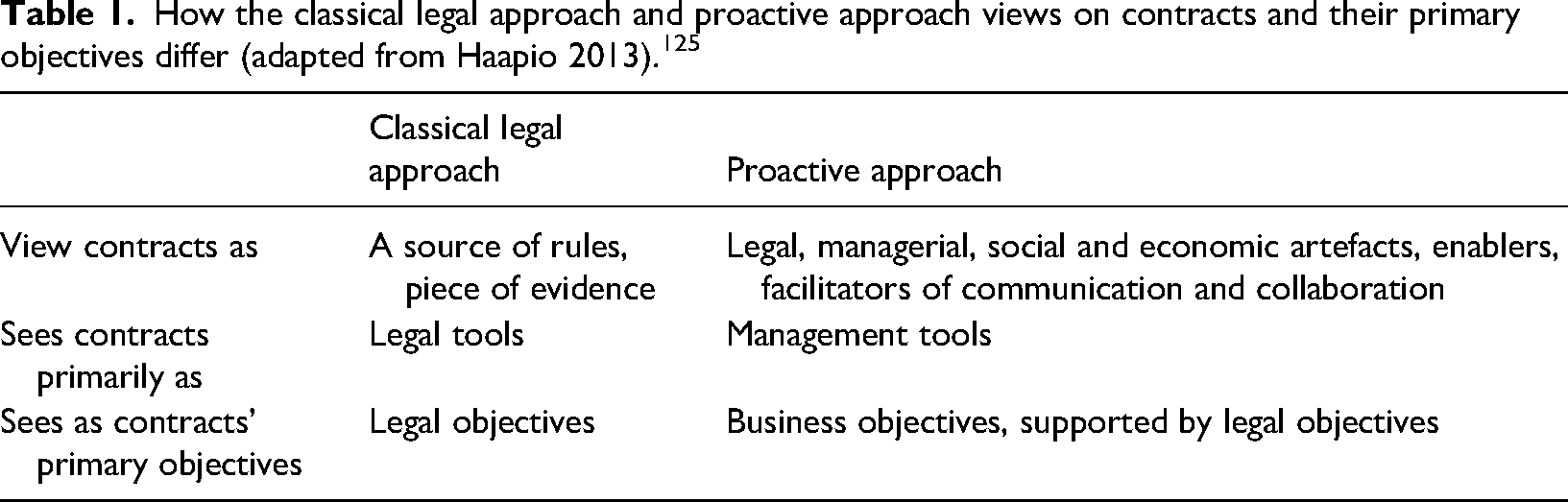
The following table (Table 1) summarizes the main differences between the classical legal approach and the proactive approach to contracts.
How the classical legal approach and proactive approach views on contracts and their primary objectives differ (adapted from Haapio 2013). 125
The role of design in the legal field
The definitions of design and design thinking vary depending on the discipline and the goals of design. 62 At its core, design thinking is a human-centred innovation process that applies design-based methods to problem-solving, discovering unmet needs and opportunities, and creating new solutions. 63 In the design process, the goal is to involve different actors and professionals, including users. 64 The view is that all actors, regardless of their expertise, are designers and can use design-based methods and tools. Over the past decades, design as an important strategic asset for an organization has also gained increasing recognition through its impact on public policies and services. 65
Legal design is an umbrella term that merges forward-looking legal thinking with design thinking and shares several basic assumptions with the problem-solving methodology of design thinking. 66 However, legal design goes beyond design thinking. It is more like design doing and applying design thinking to the real world by working in a design mode. 67 According to the Design Alliance – an interdisciplinary network of researchers and practitioners in law, design and other fields – legal design ‘applies human-centered design to the world of law to enable desirable outcomes and prevent the causes of problems from arising and developing into conflict and disputes’. 68 One of the pioneers of legal design, the lawyer and designer Margaret Hagan, defines legal design as ‘the application of human-centered design to the world of law, to make legal systems and services more human-centered, usable, and satisfying’. 69 Legal design has also been defined as ‘an interdisciplinary approach to apply human-centered design to prevent or solve legal problems’, 70 and as a problem-solving competency based on the cognitive styles and dynamics of design thinking involving ‘knowing, analyzing, synthesizing, and creating’ capacities. 71 Based on the various definitions, it can be summarized that legal design is a multidisciplinary, user-centred and proactive way of thinking, acting and solving problems in a legal domain, covering legal information, documents, legal services, processes and systems. 72 Figure 1 illustrates the sub-fields of legal design.
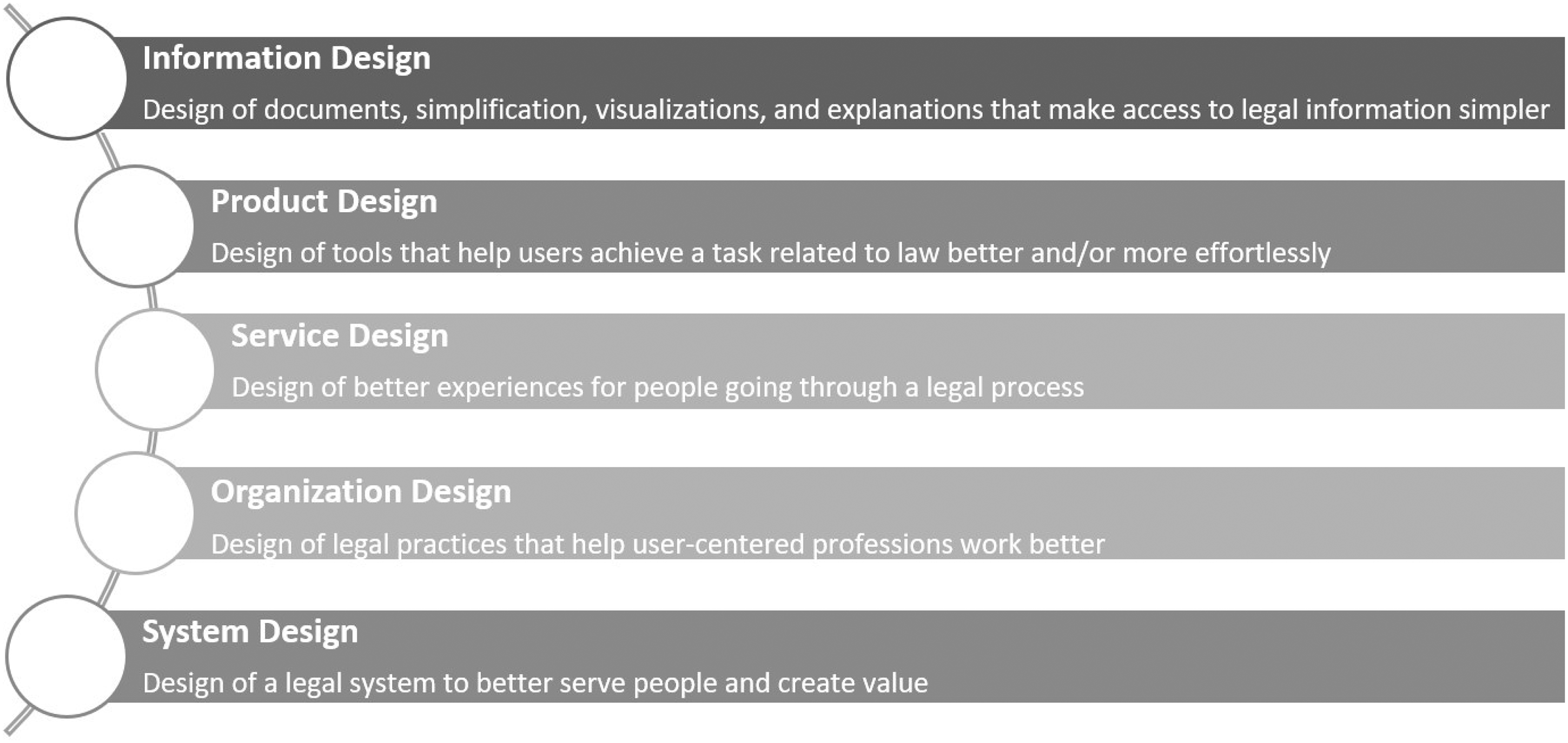
Conceptualization of the field of legal design (adapted from Hagan (n.d.); Passera 2017). 123
Tensions and opportunities at the intersections of public procurement, supply resilience and the proactive contracting and legal design approaches
In this section, we present the results of an analysis of the intersections of public procurement (focusing on the open and restricted public procurement procedures, which are commonly used), 73 supply resilience (with a focus towards the health care sector) and the proactive contracting and legal design approaches. It is based on literature from the areas, and represents a starting point for further analysis and research in this field.
Challenges in enhancing resilience through public procurement and the proactive contracting and legal design
The concept of resilience has been researched with increasing intensity in the past years, also within the literature streams focusing on purchasing and supply management. As noted above, we here use the term supply resilience to refer to the buying organization's ability to secure supply before or after occurrence of disruptions caused by extreme events. Public procurement in turn stands for the procedures and principles for procurement used by contracting authorities, and is a field in law as well as a literature stream in purchasing and supply management. Proactive contracting and legal design are uprising multidisciplinary streams of literature and practice that are receiving increased attention among lawyers. Figure 2 illustrates the tensions identified at the intersections of these areas. Each intersection, as well as the challenges when considering them jointly will be described next.
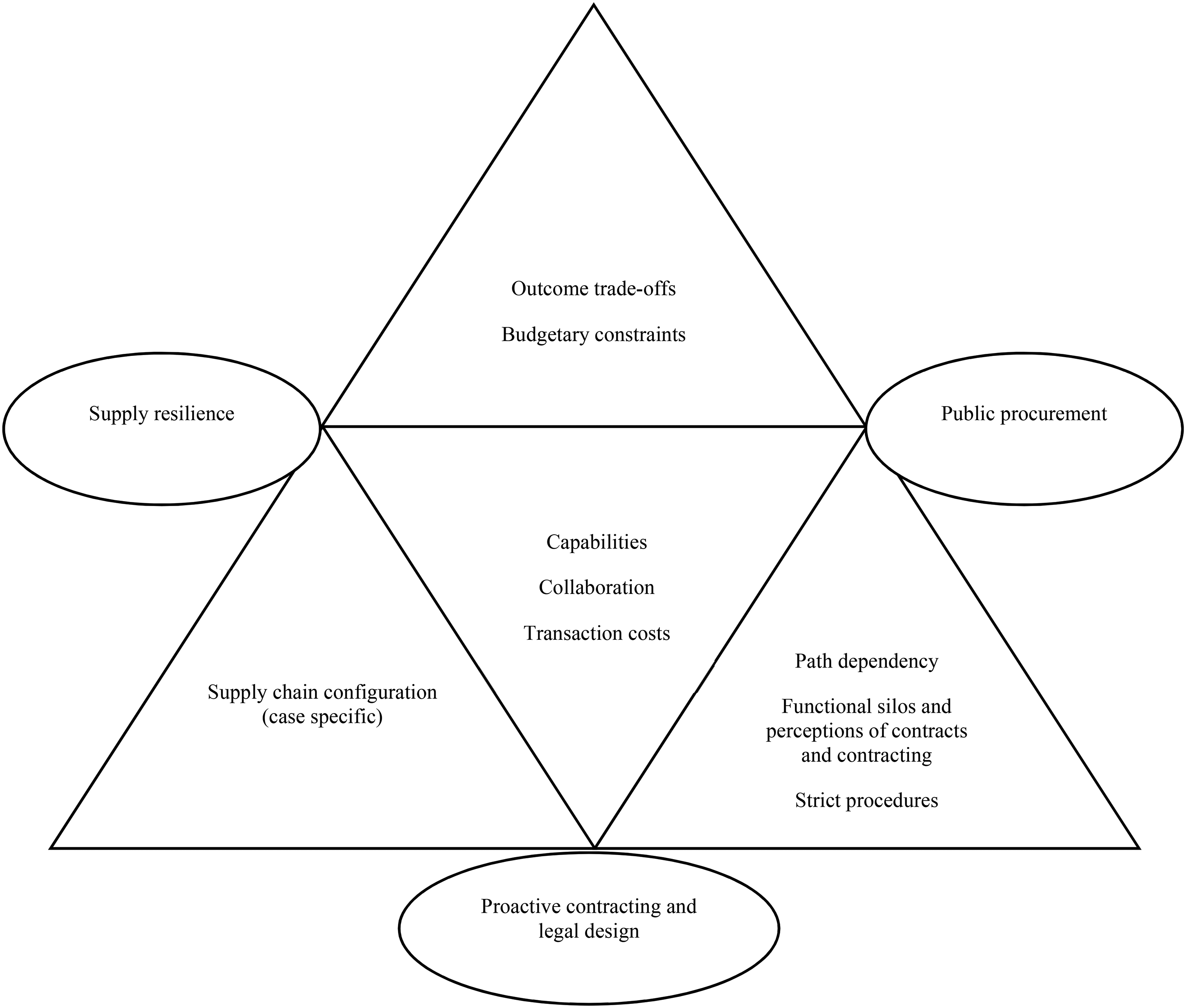
Tensions at the intersections of supply resilience, public procurement and proactive contracting and legal design (source: the authors). 124
Public procurement–supply resilience
Enhancing supply resilience (i.e. the buying organization's ability to secure supply before or after occurrence of disruptions caused by extreme events) through the regular open public procurement procedure reveals part of the constraining nature of public procurement when it comes to handling the unknown. First, the main objective of the EU public procurement rules is to ensure that suppliers have equal opportunities to participate in transparent public procurement processes and that public funds are used in the most efficient way. While some countries include provisions in their procurement legislation that allow or even promote the selection of national suppliers, 74 the EU promotes competition on the internal market and thus discourages the selection of suppliers based on their ‘nationality’. 75 Speed and certainty of delivery (as presumably provided by suppliers closer to the buyer) may thus be considered difficult to include as the procurement criteria, if perceived to be in conflict with the principles of non-discrimination and equal treatment. 76
Secondly, a major challenge for enhancing supply security in the public sector could be budgetary constraints. Jan Grumiller, Hannes Grohs and Werner Raza noted that ‘buyers of medical products – including public institutions as the most important buyers of medical products – rarely pay a premium for security of supply’. 77 Paying a premium for anything beyond what is defined as fulfilling the immediate needs, for example, for redundancy in the supply network, would require strategic decision-making and justifications for the use of public funds. 78 On the other hand, procuring during a crisis such as a pandemic also requires resources and incurs negotiation and contracting costs, and prices may be set by suppliers. 79
Supply resilience–proactive contracting and legal design
The specific context (sector, location, etc.) in which supply resilience is pursued may have implications for the proactive contracting and legal design approaches. In the health care sector, buyers may require a very large number and wide range of items to be able to provide the services to the final customers. 80 Part of the items are procured through wholesalers/distributors instead of directly from manufacturers, 81 which adds a tier in the supply chain, and in effect layer, in the flow of information that is relevant for integrating resilience and security of supply in the different phases of procurement (including contract management). 82 Lack of inventory visibility and distance to suppliers may add exposure to vulnerabilities in health care supply chains. 83 This setup, with many supply chain tiers, entails that neither procurer nor supplier (distributor) may have direct access to information regarding vulnerabilities, which has implications for the possibility to achieve supply resilience through the proactive contracting and legal design approaches. In other words, the configuration can inhibit the contract parties' ability to ‘identify opportunities in time to take advantage of them—and potential problems in time to take preventive action’. 84
Proactive contracting and legal design–public procurement
The phenomenon of path dependency is widely recognized in public management literature, both at the policy and organizational levels. 85 It refers to the statement ‘history matters’, which means that the future behaviour of an organization is constrained by history and routines. 86 This may imply a status quo bias, that is, a cognitive state involving a preference for the existing state of affairs. Changing the status quo may be perceived as risky or uncertain, and may require additional effort or resources. 87
A common problem in business contracting is the perception that contracts are merely legal documents disconnected from the actual business operations. However, this disconnection between contracts and the business is even more pronounced in the context of public procurement. 88 Due to legal and administrative control and command tradition, public procurement contracting tends to be perceived as a series of legal formalities that must be followed closely and regarded simply as a legal-based function. 89 Thus, public procurement is often seen as a system of competitive tendering rather than purchasing, where compliance with legal formalities tends to ignore the real purpose and objectives of procurement. Moreover, the challenge of strengthening the relational aspects of contracts, building trust and sharing information is compounded by the existence of a competitive tendering system. 90
Supply resilience–public procurement–proactive contracting and legal design
The most prominent tensions at the intersection of the three areas supply resilience, public procurement and proactive contracting and legal design considered here relate to collaboration, capabilities and transaction costs. The rules governing public procurement can become an obstacle to achieving resilience, by preventing close collaboration with suppliers (when using the open and restricted procedures). 91 The absence of inter-organizational integration is also an overall problem: Rakovska and Stratieva found that some hospitals' poor relationships with suppliers was a result of ‘the rather scarce information sharing, the absence of joint activities and knowledge transfer, short-term contracts, and multiple source procurement as a way to prevent stock-outs and to press suppliers to lower prices’. 92 Traditionally, the interaction between buyers and suppliers has been perceived as an arms-length and transactional process where regulation and culture are barriers to building long-term relationships and trust. 93 As a result, public procurement is often not recognized as contracting, and procurement contracts are not regarded as tools to promote collaboration between the parties and stakeholders. 94
Doing public procurement that achieves supply resilience through proactive contracting and legal design approaches is inhibited by lacking capabilities. Public organizations are typically multifaceted entities with centralized procurement expertise, while substance expertise is often dispersed throughout the organization. 95 Actors with different backgrounds and tasks look at the process from different angles, and often the idea of the contracting process recedes into disconnected details and the overall picture is lost. 96 Furthermore, in public procurement, there often appears to be a practical gap between contract drafting and procurement, and the actors who draft the contracts and make the deals are not the ones who implement them. 97 The role of legal counsels may also be too strong, resulting in procurement being carried out strictly in line with the law rather than based on procurement expertise and contracts being written in complex legal language that is difficult for laypeople to understand, 98 thus, not optimally facilitating successful procurement.
The increase or decrease of transaction costs is also a major challenge. Having a long-term provider may allow a degree of trust to develop, which arguably enables less expensive contract monitoring processes, but at the same time may limit market entry by competitors. 99 The most economically advantageous tender could include a wide range of criteria, including those that enhance security of supply and resilience, but operationalizing these criteria and allocating scores against them can be a very complex task, thus increasing transaction costs. 100 When procuring items with a new paradigm to contract and contracting (for enhancing resilience), as in using proactive contracting and legal design approaches, the first times will presumably involve increased ex-ante transaction costs for both procurer and suppliers. However, the approaches may reduce the ex-post transaction costs over time.
Opportunities for enhancing contract-based preparedness through proactive contracting and legal design approaches in public procurement
Being aware of the tensions described above, we consider the proactive contracting and legal design approaches new paradigms for contracts and contracting that could also promote the goal of achieving security of supply for public sector organizations. Traditional purchasing and supply management is primarily concerned with identifying and analysing problems that exist in the present world (problem focus). In contrast, design science has a more solution-oriented approach, with its focus on creating artefacts and solutions that can address these problems (solution focus) and shape a desirable future world. 101 This approach also differs from the analytical problem-solving approach employed by lawyers or business professionals. 102 The proactive contracting and legal design approaches thus provide methods and policies to depart from the path dependency of a public organization, and to develop the organization's procurement processes and contract documents to be more solution-oriented. Moreover, purchasing and supply management design provides tools for anticipating the future world and shaping the behaviour of stakeholders involved to meet the demands of change. 103
Legal design merges legal and design thinking and provides tools to design services, processes and systems within the legal domain (see Figure 1). Moreover, it provides tools to make legal communication simpler, more user-centred and more effective. In contracting, this means a shift from traditional contract drafting to contract design. It involves intentional and strategic development of contract processes and contract documents to enhance comprehension, and knowledge interactions, and foster collaboration within the contracting lifecycle. 104 By reducing information asymmetry, improving mutual understanding and increasing mutual trust, clear contracts facilitate the establishment of strong relationships. Thus, clear contracts also have a crucial role to play in driving forward the development of relational governance. 105 Information design plays a significant role in contracting by enhancing the effectiveness and efficiency of the contract processes and contract documents. By simplifying legal language, organizing information in a logical structure and using visual elements, such as icons, diagrams, charts, images and design patterns effectively, information design promotes clarity and accessibility. 106
When looking specifically into the context of contract-based preparedness in the public sector, organizations need to choose between possible resilience-enhancing practices, due to resource constraints. 107 Drawing from the holistic framework on supply chain resilience developed by Ali et al., 108 we suggest a few ways, as well as the more fundamental changes needed, to enhance contract-based preparedness (and ultimately, resilience) through the proactive contracting and legal design approaches in the different phases of public procurement. 109
For establishing needs and procurement strategy, the procurer would benefit from situation awareness, which could be based on continuity planning and risk mitigation (with the aim of avoiding procurement in haste after an actual disturbance occurs). The SOPIVA framework developed by the Finnish security of supply system could be useful, especially since it has been drafted jointly by the public administration and industry. However, the effectiveness and usefulness of the framework could be further enhanced by using a solution-oriented approach based on design thinking principles.
When designing the procurement process and contract documents, the procurer could use established connections to the supplier network in the market consultation phase and collaborate with these market actors in order to include relevant security of supply considerations in the process and contract design. It would also be essential to involve multiple professionals for defining the needs and deciding the procedure and how to evaluate bids – in addition to health care professionals and patients, also risk and disaster management knowledge should be represented in the procurement advisory team. 110
When advertising the public contract and subsequently evaluating the bids and bidders, security of supply criteria could be included in the evaluation to support the procurer's situation awareness and robustness. It should also not be forgotten that requiring suppliers to provide more information (regarding, e.g. the supplier network or inventory levels) or commit to the buying organization's possible future needs regarding available goods and capacity (e.g. by requiring certain inventory levels or delivery time), should correspond with incentives, so that the (business) success of both parties is ensured. When it comes to the contract management phase, collaboration aspects that increase visibility through the supply chain could be promoted with information sharing provisions in the contract, for example, regarding risks for disruptions in supply. In the contract itself, communication and knowledge sharing could be enhanced through design (simplification, plain language, visualization).
At a more fundamental level, the procuring organization (and suppliers) needs to develop their dynamic contracting and resilience capabilities: they need to develop their ability to anticipate disruptions, by involving multiple professionals, focusing on solutions, and considering the multiple functions of contracts and preventive and promotive dimensions of contracting in the public procurement process. They need to develop their abilities to adapt and respond to disruptions, by designing their organization's processes and documents from the perspectives of the sub-disciplines of legal design (information-, product-, service-, organization- and system design), while also respecting the limitations given by public procurement legislation (e.g. regarding the possibility to adapt product specifications). Finally, they need to develop abilities to recover and learn, by evaluating and redesigning throughout the contract life-cycle (in an iterative process). Learning could be enhanced by establishing processes for reflecting on past experiences, for learning from other procuring units and developing best practices, and by involving suppliers in the review of past contracts and contracting.
To start the process of changing existing practices, it is essential to view contracting as an integral part of business processes and to integrate it into all internal processes and operations of the organization. 111 In addition, it is important to enhance an organization's dynamic contracting capability by harnessing individual capabilities within the organization to design, maintain and manage contracting processes and contracts. 112 The integration of processes and operations together with the development of dynamic organizational capabilities enables the organization to effectively integrate, build and reconfigure competences and its overall resilience. 113 The change requires multiprofessional cooperation, effective communication and knowledge sharing. Individual skills, expertise and knowledge should be combined to enhance competences at different levels of the organization and to turn them into a functioning whole. Thus, the ownership of contracts is collective, and all the actors and stakeholders involved are responsible for them and have the right to contribute to discussions and decisions related to them. 114
Conclusions
Public procurement focuses on procedural issues and due to the legal and administrative control and command tradition, public procurement processes and contracts tend to be dominated by the classical legal approach. Furthermore, public procurement is seen as competitive tendering rather than purchasing and contracting. From a resilience perspective, procurement professionals are normally constrained by regulations, rules and norms that can hinder resilience, for example, by limiting close collaboration with suppliers and discouraging flexibility. The buyer–supplier relationships have traditionally been viewed as an arm's-length transaction where regulation and culture are barriers for building long-term relationships and trust.
We argue that taking a bird's eye view on public procurement exposes its nature as a complex social system comprising various interconnected subsystems. 115 Recognizing this complexity is crucial for ensuring that public procurement contracting is not only legally binding but also operationally effective and functional, thereby supporting successful procurement and enhancing contract-based preparedness. Moreover, we argue that a holistic view on resilience, encompassing capabilities and possible practices in the different phases of a disaster, 116 could aid public procurers in developing contract-based procurement (and enhanced resilience) in their own specific context.
The inclusion of disaster preparedness, response and recovery considerations in public procurement is argued to not only save money (compared to the costs of procuring in haste after a disaster strikes) but to also ensure that the principles of public procurement (effective public expenditure, competition, fairness, equal opportunities, transparency, etc.) are upheld in the process. 117 In this paper, we have presented the proactive contracting and legal design approaches as means to enhance contract-based preparedness. These approaches promote multiprofessional collaboration, effective communication and knowledge sharing among stakeholders, and provide methods and policies for developing public procurement processes and contract documents. We noted that this requires the development of organizations' contracting capability and resilience capabilities such as the ability to anticipate, adapt, respond, recover and learn. 118 This, in turn, may require organizations to rethink and change their procedures and processes, adapt their current practices, make organizational changes and even change their culture. 119
When it comes to Finland, the strength of its security of supply system is the effective cooperation between the public, private and third sectors. Although Finland was generally successful in safeguarding its security of supply during the COVID-19 pandemic, it faced problems with the availability of essential supplies in the health care sector. In their post-pandemic reports, Finnish authorities noted that the shortcomings of the contract-based preparedness of health care and social welfare services were highlighted during the pandemic. Moreover, they stated that public–private partnerships and contract-based preparedness need to be developed, specific sectoral competencies must be exploited further, and silos are to be avoided. In this article, we discussed how to foster security of supply in contract-based preparedness in the public sector, through the proactive contracting and legal design approaches. In our view, the Finnish comprehensive security approach, with its already established cross-sector networks of actors that cooperate to enhance security of supply for vital services, constitutes a basis for initiating changes in contracting practices that the proactive contracting and legal design approaches entail. 120 In other words, there are already practices of collaboration across the value chains for health care service provision, aimed at enhancing security of supply, which could be exploited further to enhance contract-based preparedness. For the organizations who procure products, services and works using public funds, and the companies who provide for their needs, we thus argue that the proactive contracting and legal design approaches would be a complement to the Finnish approach to security of supply that would enhance contract-based preparedness.
Limitations and future research
Proactive contracting and design research are practice-oriented research streams. They also involve a multidisciplinary and multi-method approach. When studying contracts and contracting in different business models, it is beneficial to complement the study of general contract law doctrines with empirical research. This approach allows for a practical perspective that goes beyond theoretical principles and enables a deeper analysis of the structures, characteristics and dynamics of contracting in different business models. This article focuses on contracts and contracting in the public sector from a conceptual perspective with an aim to start a discussion on how proactive contracting and design methods can be used in public procurement. To move forward, future research on the topic should be empirical and focus on public procurement contracts and contracting with the aim of enhancing security of supply (and consequently, resilience), from the perspective of proactive contracting and legal design. This could be done by both examining the current state of procurement, and then to use design thinking and action research to plan, make and evaluate changes in information, products, services, organizations and systems (see Figure 1), and in processes. This will help us to better understand how these methods can be applied in practice, and under what conditions.
Furthermore, one suggestion for future research is to focus on the proactive contracting and legal design approaches in public procurement, and study the actors involved from the theoretical perspective of dynamic capabilities, to develop propositions for conceptual advancement. This could be done for instance by first examining public buyers' ability to ‘sense and seize opportunities, as well as reconfigure when change occurs’. 121
At a regulatory level, the proactive contracting and legal design approaches could potentially be used as a lens when evaluating and reforming the laws on public procurement, especially when driven by a need to incorporate resilience as a policy goal. This would also be in line with the Opinion of the European Economic and Social Committee on ‘The proactive law approach: a further step towards better regulation at EU level’, and their recommendation that the legislator ‘should be concerned about producing operationally efficient rules that reflect real-life needs and are implemented in such a manner that the ultimate objectives of those rules are accomplished’. 122
Footnotes
Author's note
The author has moved to a new institution since completing the research. The new affiliation is Finnish Environment Institute Syke, Latokartanonkaari 11, 00790 Helsinki. E-mail:
Declaration of conflict of interests
The authors declared no potential conflicts of interest with respect to the research, authorship, and/or publication of this article.
Funding
The authors disclosed receipt of the following financial support for the research, authorship, and/or publication of this article: This article is a result of the research project LEXSECURE Law for Secure Supply: Internalizing the Crisis Exceptions funded by the Academy of Finland (2020–2023), decision: 338643 and 338644.
