



Abstract
The supply chain risk management literature differentiates between disruption risk that arises from supply disruptions to normal activities and recurrent risk that arises from problems in coordinating supply and demand in the absence of disruptions. Over the past decades, significant research has been carried out to better understand supply chain resilience, that is, the ability of a supply chain to mitigate disruptions. Supply chain efficiency, that is, the ability to mitigate recurrent risks in the absence of disruptions has been studied even longer. But only recently have the topics of efficiency and resilience been coupled in the supply chain literature. In this literature review, we focus on the intersection of supply chain resilience and supply chain efficiency. We provide a thematic overview of literature streams according to the structure of the underlying supply chains. We identify various gaps in the current literature including areas in multi-echelon and multi-product supply chain research. Furthermore, we consider dual-purpose and dedicated levers for building resilience. Dual-purpose levers are resources that are able to promote efficiency in a supply chain while enhancing resilience in expectation. By contrast, dedicated resilience levers are resources that are able to guarantee the resilience of a supply chain in the face of particular disruptions without benefiting the supply chain in the absence of disruptions. We call for more research to better understand the value of dual-purpose and dedicated resilience levers to overall supply chain performance.
Introduction
In the academic literature on operations management, the influence of disruptions on supply chains has been a crucial topic of study for many years. Researchers have explored various aspects of supply chain disruptions, including their causes, impacts, and strategies for mitigation. Recent major events such as COVID-19, geopolitical crises, volcanic eruptions in Iceland, and the Suez Canal blockage have further boosted the importance of the topic (Moshref-Javadi and Seshadri, 2024). Practitioners and academics alike are eager to formulate strategies that foster both resilient and cost-efficient supply chains (Sheffi and Rice, 2005). On the one hand, cost-efficiency may provide a significant competitive advantage in the absence of disruptions. On the other hand, a resilient supply chain may allow a firm to reliably supply products to their customers even in times of disruptions. Chopra et al. (2021) presented the concept of “commons” as resources shared across societies, businesses or even within businesses for increasing efficiency and resilience.
Numerous firms that produce high-value items recognize the importance of building resilient supply chains. For instance, for pharmaceutical companies, the cost of not being able to serve customer demand can be very high. This stems not only from the societal impact of not being able to reliably deliver life-saving drugs to patients but also from the cost of lost sales, which can be significant for biologic drugs. For such firms, investments in resilience in the form of inventory buffers are undeniably justified (Liu et al., 2016; Tomlin and Wang, 2011). The ongoing debate in the current literature revolves around whether incorporating such inventories is equally beneficial for firms with a lower cost of lost sales (Choi et al., 2023).
Many firms have good reasons for avoiding using costly resilience-enhancing levers such as buffer inventories. When margins are low, even a modest increase in supply chain operating costs may significantly reduce margins. Therefore, companies manufacturing more commoditized products with lower profit margins are often reluctant to adopt costly resilience-enhancing measures (Azouz, 2020). Further, firms often focus on a short-term horizon for creating shareholder value, whereas resilience investments often only pay off in the long term (Lücker and Seifert, 2017). In addition, firms usually struggle to estimate the likelihood of disruptions taking place, which increases the uncertainty of the value of resilience-enhancing levers (Simchi-Levi et al., 2015). There is also increasing evidence from behavioral research that suggests that some firms tend to underinvest in resilience (Goldschmidt et al., 2021). However, seeking to avoid these costs and myopically pursuing supply chain efficiency often comes at the cost of increased vulnerability in the future. For example, businesses in the UK supplying goods such as food, beer, petroleum, or clothes faced significant shortages during both the unforeseen pandemic and the planned post-Brexit period.
In our literature review, we analyze the current state of the field of disruption risk management. We characterize the models according to the supply chain structure and identify important research gaps. The models studied in the literature assume that a supply chain can be subject to disruptions at one or multiple locations. Optimal operational decisions are determined with a focus on resilience-enhancing levers such as inventory, emergency supply, supplier diversification, and flexibility. Most existing models do not explicitly consider the effect of these levers on supply chain efficiency, including the value of these measures for better meeting customer demand in the absence of disruptions. Nevertheless, some resilience-enhancing levers are able to simultaneously increase both the resilience and efficiency of supply chains (Chopra et al., 2021). We call such resilience-enhancing levers dual-purpose resources. For example, consider safety inventory, which is primarily used to protect a firm from stockouts when demand is uncertain. On the one hand, safety inventory helps to increase the efficiency of the supply chain in the absence of disruptions by better matching supply with demand. On the other hand, carrying safety inventory increases the resilience of the supply chain (in expectation) by providing some buffer against supply disruptions (Liu et al., 2016). Likewise, measures such as volume flexibility, reserve capacity, or expedited shipping are also dual-purpose resources as they provide benefits in the presence and absence of disruptions. Dual-purpose resources have also been studied in other areas of supply chain management. For example, improving product quality may be such a dual-purpose resource. According to consultancies, improved product quality provides additional benefits such as lower recall and warranty costs and as such may also enhance supply chain efficiency (Aragon et al., 2017). If proven beneficial, dual-purpose resilience levers could become attractive even for companies under significant cost pressure. Thus, we advocate for further research examining resilience-enhancing measures that considers the possibility of their dual usage.
In contrast to dual-purpose resources, we define dedicated levers as those resources and capabilities that are used to primarily mitigate disruption risk. Many firms aim to source critical components and raw-materials from at least two suppliers. While for some firms sourcing from two suppliers may be more expensive than sole-sourcing (due to lack of economies of scales, or increased management costs), firms find value in the increased resilience in their supply chain. Likewise, in the light of increasing political tension between the USA and China, many firms have diversified their supplier base by increasingly sourcing from India or Vietnam instead of solely relying on China.
Our literature review identifies research gaps on the use of dedicated and dual-purpose resources in a variety of settings, including multi-product and multi-echelon supply chains. We suggest further research directions particularly on the use of dual-purpose resources for building resilience and efficiency.
In Section 2, we outline the scope of the review. In Section 3, we discuss the use of dual-purpose and dedicated resources in supply chains. Section 4 provides a thematic overview of the field, in which we discuss dual-purpose resilience levers in different supply chain settings: (i) supplier-buyer supply chains, (ii) multi-echelon supply chains, and (iii) multi-product supply chains. In Section 5, we elaborate on novel research perspectives in the context of dual-purpose resilience levers. Finally, we provide concluding remarks.
The Scope of the Review
Supply chain efficiency, seen as a company’s ability to use resources, technologies, and expertise in order to minimize logistics and production costs and maximize profits in the absence of disruptions, has been attracting the attention of researchers and practitioners for more than 30 years. Indeed, a general search for articles on supply chain efficiency in the Web of Science database demonstrates a rise in the annual number of publications since 1991 and, therefore, increasing interest in the topic (see Figure 1). Starting in 1991 and into the 2000s, there were only a few publications per year. In 2021, around 1,800 articles were published on the topic and a similar number was reached in 2022 and 2023.
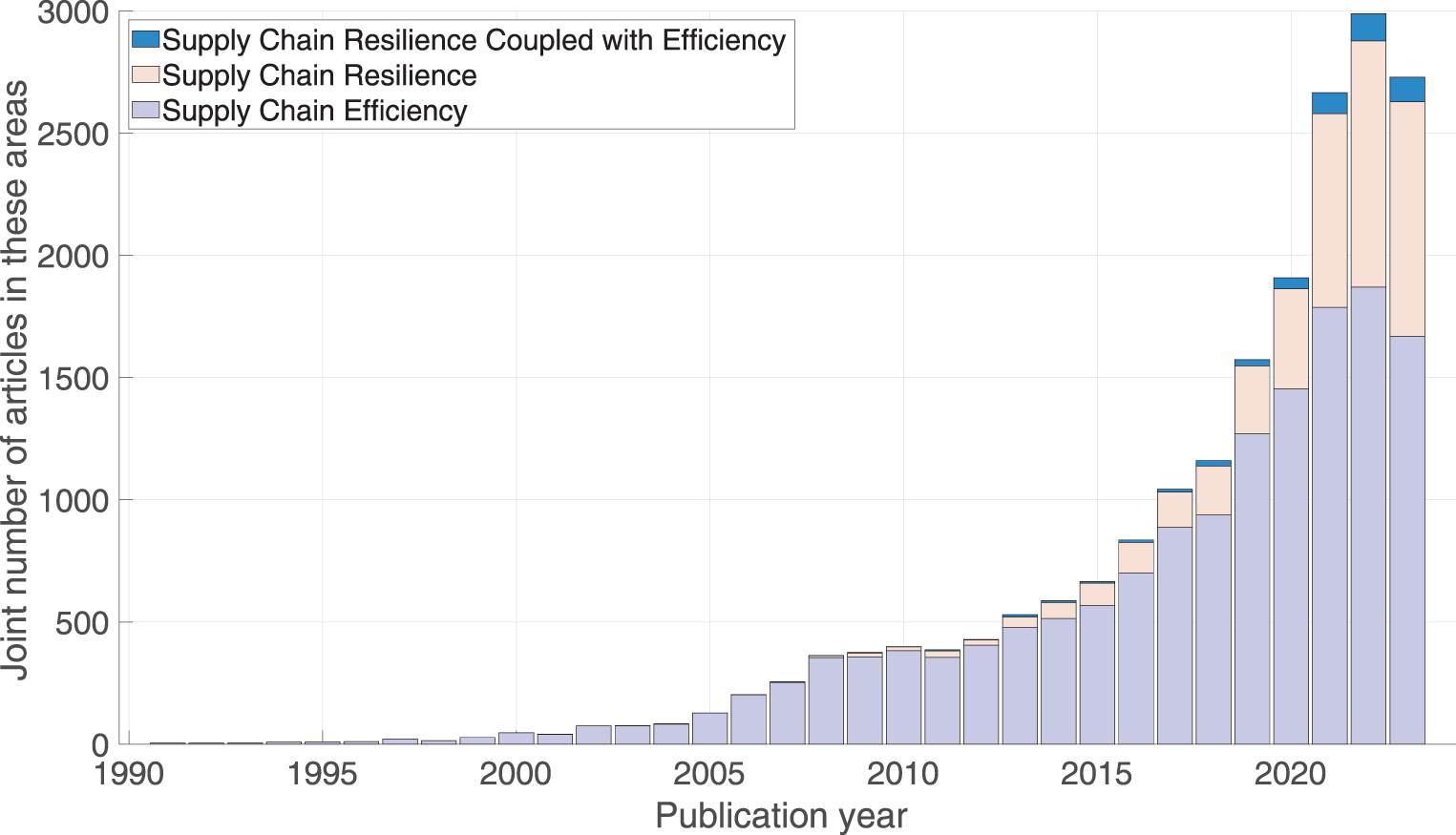
Supply chain resilience versus supply chain efficiency.
A similar pattern can be observed for the topic of supply chain resilience: Just a few articles were published in 2002, and more than 900 in 2023 (see Figure 1). In terms of top journals, a quick search in the Web of Science database reveals around 70 articles on resilience over the same period. Production and Operations Management journal, with 28 articles, had the highest number of publications. The next two in the list, with 26 and 15 articles, respectively, were the European Journal of Operational Research and Journal of Operations Management.
It was only in 2008, after the global financial crisis and its profound effects on supply chains worldwide, that researchers started to search for optimal patterns combining supply chain efficiency and supply chain resilience. Clearly, a long-term cost supplement aimed at minimizing losses after rare but damaging disruptions has not always been seen as the right way to maximize supply chain performance. This could explain why researchers and practitioners have only recently started to seek strategies to mitigate disruptions while maintaining supply chain efficiency.
In this article, we review papers that fall into the category of disruption risk management, that is, risks arising from disruptions to normal activities (Chopra et al., 2007; Kleindorfer and Saad, 2005). Such risks may arise from a variety of events, including the COVID-19 pandemic, natural disasters, strikes, and nuclear threats within supply chains (Vakharia and Yenipazarli, 2009; Wein et al., 2006). Disruptions interrupt the flow of goods in the supply chain for extended periods and as such have significant impact on the supply chain but occur typically with low probability (see, e.g., Federgruen and Yang, 2008; Goldschmidt et al., 2021; Simchi-Levi et al., 2015). The supply chain management literature explores various approaches to modeling the disruption risk. The most broadly used approach assumes that no products can be delivered to a customer from the disrupted firm during the disruption time. The duration of the disruption can be certain or uncertain, in which case it is often assumed to follow an exponential distribution. Other researchers assume that the loss caused by a supply disruption is random, whereby a certain percentage of the order can still be delivered and the delivered quantity depends on the order size. Also, random capacity models assume that the capacity is subject to disruptions. As a result, the delivered quantity is independent of the order size. Since COVID-19 occurred, a new literature stream has emerged where catastrophic disruptions are taken into account. Under catastrophic disruptions, even suppliers previously considered as perfectly reliable would not be able to supply goods to the customer/buyer for some time (Sodhi and Tang, 2021).
Recurrent risks are different from disruption risks as they usually arise from the problem of coordinating supply and demand in the absence of disruptions (Kleindorfer and Saad, 2005; Chopra et al., 2007). Typical examples of recurrent risks are demand uncertainty and supply uncertainty including shipment delays, quality issues with some components or simply a temporary machine break-down that arise in the absence of disruptions. We call a supply chain efficient if its resources are optimized to mitigate recurrent risk. On the other hand, we call a supply chain resilient if its resources are optimized to mitigate disruption risk. We use the notion of undisrupted times, referring to normal times when no supply chain disruption occurs, and disrupted times, referring to times when a disruption occurs.
In our review, we do not take into account the broad literature on the flow of information or funds in the supply chain (such as iFORM, cybersecurity, etc.). Instead, we focus on disruptions in the flow of goods at any stage of the supply chain that lead to potential revenue losses. Previous literature reviews include an article by Snyder et al. (2016), who study management science models for dealing with supply chain disruptions. The article primarily focuses on established risk mitigation strategies such as inventory and multi-sourcing. The literature review by Hosseini et al. (2019) focuses on quantitative resilience models and suggests which quantitative methods to use for different resilience levels. The literature review by Govindan et al. (2017) focuses on network design when dealing with uncertainty. Although their review explicitly includes disruptions in the analysis, the focus is more on the methodologies used. Finally, Tang (2006) and Ho et al. (2015) categorized earlier risk management literature, dating back to 2003 and before. The key contributions of our literature review are (i) the identification of several important gaps in the current literature with respect to multi-echelon and multi-product settings, (ii) the detailed classification of resilience-enhancing levers and their matching with supply chain characteristics, and (iii) suggesting avenues for future research, particularly on the use of dual-purpose resilience levers.
Pharmaceutical company Roche holds risk mitigation inventory (RMI) of high-margin, patented drugs for the protection against the risk of supply chain disruptions. Holding RMI allows the firm to ensure a continuous supply of its drugs to patients even in the event of a disruption (Lücker et al., 2021). Besides the high margin, patients often rely on these life-saving drugs as there is typically no alternative medicine available for them. While RMI helps with disruption risk mitigation, it does not provide any significant benefits in the absence of disruptions. Given precise data on the prevalence of certain medical conditions in a market, demand for the firm’s products can be well forecasted even for time horizons as long as 1–2 years because the firm can estimate how many patients are likely to need its drugs. Thus, carrying RMI does not necessarily help to increase the service level in undisrupted times and is likely to be a dedicated lever when demand uncertainty is low. While holding RMI is a dedicated resource for Roche, keeping inventory buffers may be a dual-purpose resource for other firms, particularly when demand uncertainty is high. We observe:
The classification of a resource as dedicated or dual-purpose depends on the business context, particularly the degree of demand and supply uncertainty.
Further, pharma companies often carry RMI only for innovative, patent-protected high-margin drugs. In contrast, a variety of drug shortages have been reported for generic drugs and vaccines where margins are low and dedicated resilience levers are often not used (McPhillips, 2024). We may state:
Dedicated resources are particularly useful for high-margin products whereas dual-purpose resources may add value for both lower and higher margin products.
Dedicated resilience levers provide a guaranteed level of resilience because the resources are designed to be used for no other purpose than protecting from supply disruptions. Such resources are valuable in supply chains that produce innovative products with high margins and low competition on price, especially if the loss-of-goodwill cost during a disruption is high compared to the cost of providing the dedicated resource. In these cases, having a guaranteed level of resilience as provided by dedicated resources is particularly helpful.
By contrast, if the products compete on price and their margins are relatively low, it may be sufficient to offer expected rather than guaranteed resilience. This can be provided by dual-purpose resilience levers. Dual-purpose resilience levers are resources provided for a combination of events (e.g., simultaneous disruptions and demand peaks as happened during the COVID-19 pandemic) and may not always be available for disruption risk mitigation. For example, safety inventory may not be available at all when a disruption occurs because demand might have been higher than expected just before the disruption occurs. Such resources are particularly helpful for supply chains that produce basic products (e.g., commodities) where cost-efficiency is a business driver. Dual-purpose resources allow supply chains to become somewhat resilient without sacrificing supply chain efficiency.
As another example, consider the procurement of semiconductors. Given the rapid pace of technological advancements and the complexity of the supply chain, the supply process is inherently volatile in the face of swift technological shifts. This supply uncertainty is exacerbated when the supplier is far away, making the coordination of the supply chain challenging, even during undisrupted times. Firms use safety inventory to buffer against such supply uncertainty during undisrupted times. Some measures such as sourcing from a local supplier rather than an offshore supplier may not only reduce the risk of supply disruptions, but also make the supply chain more cost-efficient because the supply of semiconductors may be less uncertain under nearshoring, even during undisrupted times. Thus, less safety inventory to buffer against the supply uncertainty may be needed. We can conclude that sourcing from a local, more reliable supplier may be a dual-purpose resource when supply uncertainty is high.
The use of dual-purpose resources in disruption-prone supply chains depends on the prevalence of demand and supply uncertainty (see Table 1): (i) in the absence of any supply uncertainty or demand uncertainty, no dual-purpose resources are used for risk mitigation; (ii) for products with low supply uncertainty and high demand uncertainty, dual-purpose resources are deployed; (iii) for products with high supply uncertainty and low demand uncertainty, dual-purpose resources are deployed where possible; (iv) for products with high supply uncertainty and high demand uncertainty, dual-purpose resources are used extensively.
Use of dual-purpose resources for low and high levels of demand/supply uncertainty in disruption-prone supply chains.
Low supply uncertainty and low demand uncertainty can cause firms to struggle to find resilience-enhancing resources that are also useful in undisrupted times. Examples include groceries, basic apparel, some food, oil, and gas.
Low supply uncertainty and high demand uncertainty might make it beneficial to use dual-purpose resources such as safety inventory and flexible supply sources; this not only builds resilience, but also provides benefits in the absence of disruptions. Examples include fashion apparel and computers.
High supply uncertainty and low demand uncertainty indicates that using resources that improve supply chain resilience may also improve supply chain efficiency. It is important, however, to acknowledge that measures that increase the reliability during undisrupted times do not always increase reliability during disrupted times. In the agricultural supply chain, for example, using pesticides might help increase the consistency of crop yields but the same pesticides might not protect from a disruption such as flooding. Thus, dual-purpose resources may not always be available. Examples include hydro-electric power and some food producers.
High supply uncertainty and high demand uncertainty indicates that the supply chain is exposed to high volatility and risks over both dimensions. Firms may find value in using dual-purpose resources extensively as they provide the flexibility to deal with disruption risk as well as supply and demand uncertainty. Examples include high-end computers, semiconductors, and telecom (Lee, 2002).
In the following section, we provide a detailed overview of contributions to the field of disruption risk management and highlight instances where resources are considered as dedicated or dual-purpose.
In this section, we review important contributions to the field of disruption risk management with a special focus on dedicated and dual-purpose resilience levers. After providing a broad overview of the topic, we divide articles into different categories according to the underlying supply chain structure. We start with (i) supplier–buyer settings with disruptions occurring only on the supplier side. Afterwards, we extend our analysis to (ii) multi-echelon supply chains where disruptions occur on more than one echelon, and (iii) multi-product supply chains. We identify various research gaps and advocate for a better understanding of how different resilience levers could fit to supply chain archetypes.
Numerous empirical studies underscore the significance of effectively handling the risk of disruptions within supply chains. A crucial insight of these papers is that neglecting potential disruptions can result in substantial costs. Nevertheless, these articles generally lack discussion on the optimal strategies for enhancing resilience in the supply chain. One of the earliest articles in our review is the empirical study by Hendricks and Singhal (2005). The authors find that supply chain disruptions are associated with a negative impact on the long-term performance of firms for up to two years after a disruption is announced. Compare also Hendricks and Singhal (2003, 2005, 2014) and Hendricks et al. (2020), which empirically identify negative impacts of supply chain disruptions using performance matrices. Additionally, Hendricks et al. (2009) identify, through an empirical study, operational measures that mitigate the negative effects of supply chain disruptions.
An important early contribution by Kleindorfer and Saad (2005) provides a conceptual framework that identifies, assesses, and mitigates disruption risks. The authors differentiate between operational risk (i.e., risks occurring regularly and repeatedly) and disruption risk (occurring more rarely but having a greater impact). Further, Craighead et al. (2007) discussed factors that influence the likelihood of disruptions occurring and their impact. Sodhi et al. (2012) highlighted that there is no common understanding of the definition of supply chain risk management. Based on their multi-method approach, the authors find that there is a lack of research on mitigation strategies. Subsequently, Cohen and Kouvelis (2021) extended the well-known Triple A framework to include the risk of disruption. Their Triple A & R framework characterizes key firm capabilities needed to cope with disruptions.
Choi et al. (2023) discussed the tension between resilient and cost-efficient supply chains in the context of just-in-time supply chains, which tend towards lower inventory levels. The authors provide suggestions on how to adapt just-in-time supply chains to include disruption risk. Furthermore, multiple scholars highlight the value of precise information about the likelihood of disruptions occurring and about their impact in terms of disruption length. For example, Lim et al. (2013) studied the impact of misestimating disruption probabilities. They show that underestimation of the disruption probability results in higher expected total costs than overestimation. Further, Mehrotra and Schmidt (2021) studied the value of better estimating the duration of supply chain disruptions. The authors find that for some products, better estimating the disruption length can be of significant value, whereas for other products, there is almost no value added in knowing the precise disruption length.
More recently, the concept of supply chain resilience has been analyzed with a theoretical lens as a multidimensional, dynamic system (Adobor and McMullen, 2018). Further, Wieland (2021) highlights the importance of studying supply chains as dynamic systems in order to improve our understanding of disruption risk. This is particularly important when identifying synergies from deploying various resilience levers jointly (Kumar and Park, 2019; Lücker et al., 2019; Namdar et al., 2022).
Supplier–Buyer Models
Studying disruptions in a supply chain that includes one or several suppliers and only one buyer has been a popular research setting in previous years. In these models, at least some of the suppliers are subject to disruptions, whereas the buyer is assumed to be free of disruption risk. If some suppliers are assumed never to be disrupted (i.e., they are perfectly reliable even during disrupted times), they tend to be more expensive than other (i.e., disruption-prone) suppliers. Further, the buyer could have access to emergency supply, for example, via volume flexibility with a backup supplier or through a spot market with ample supply. Other measures for building resilience include supplier diversification, insurance policies, measures to improve supplier reliability during disrupted times, and contracts that explicitly consider the likelihood of supply disruptions. Most of these measures are studied from the perspective of using resources to make the supply chain more resilient. Only some authors consider the effect of using such resources to improve both resilience and efficiency. Table 2 provides an overview of articles differentiating between the use of resources as either dedicated or dual-purpose.
Classification of resources for building resilience in the existing literature.
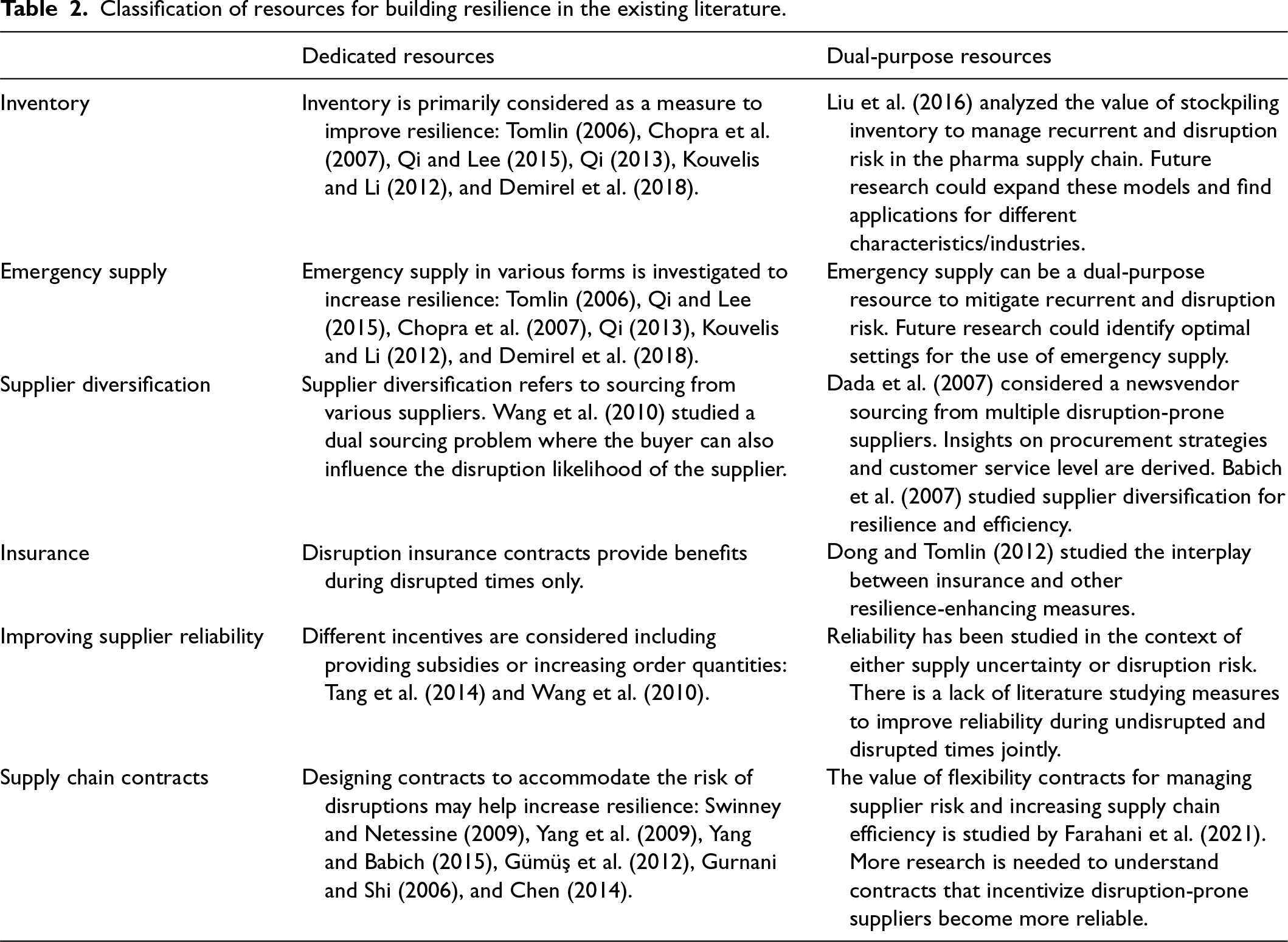
Classification of resources for building resilience in the existing literature.
One of the foundational articles in the stream of literature on supply chain resilience is by Tomlin (2006), who focuses on a setting in which a buyer can source from a disruption-prone supplier and another supplier that is never disrupted (and thus more expensive). The supplier that is assumed never to be disrupted has a reserve capacity or volume flexibility that allows the buyer to increase the order quantity up to a certain limit when the disruption-prone supplier is unavailable. The author finds that there is significant value in using the reserve capacity or volume flexibility if disruptions tend to be less frequent but long. By contrast, more frequent and shorter disruptions tend to be best mitigated by using dedicated inventory, sometimes referred to as RMI.
Following the work of Tomlin (2006), Chopra et al. (2007) studied a setting in which a buyer has access to a disruption-prone supplier and another supplier that is never disrupted, where the latter can offer quantity flexibility within bounds. The major finding of this article makes it possible to differentiate ordering strategies in the case of disruption risks and recurrent risks such as delays. In particular, the authors find that a firm should order more from the supplier that is never disrupted if disruption risk dominates recurrent risk, but order more from the cheaper but disruption-prone supplier if recurrent risk dominates disruption risk. In a setting with multiple suppliers, Dada et al. (2007) find that the buyer has an incentive to order larger quantities and to diversify the orders when there is a risk that the complete order quantity might be lost. Qi (2013) extends the work of Chopra et al. (2007) to incorporate the concept of a waiting time after a disruption. The waiting time allows the decision maker to distinguish between operational fluctuations and disruptions. The author studies optimal sourcing decisions and provides structural insights on optimal decision variables. Further research conducted by Qi and Lee (2015) studies expedited shipping as a valuable alternative to reserve capacity, when the cost of the latter is too high. In particular, the authors study the role of expedited shipping in the optimal risk mitigation strategy. Kouvelis and Li (2012) considered disruptions that may result in a delivery delay of the traded product. In order to mitigate a delivery delay, the firm can use disruption safety inventory or emergency sourcing. The authors find that disruption safety inventory and emergency sourcing are particularly helpful when the coefficient of variation in lead time uncertainty is high, as is the case with international shipping routes where transportation times are subject to significant variability.
Another emerging stream of literature interrelates the risk of supplier default with the popular practice of the buyer extending payment terms to suppliers (Seifert et al., 2013). Esenduran et al. (2022) studied such a setting and find that extending payment terms may backfire because the risk of supplier default may also increase with the extension of the payment term. Thus, to ensure an undisrupted supply of goods, payment terms should not be extended too much. Here, increasing supply chain efficiency might result in a reduction of the resilience of the supply chain.
Tang et al. (2014) studied a buyer–supplier setting in which the buyer provides incentives to the preferred supplier in order to reduce the likelihood of the supplier being disrupted. The authors elaborate on two different reliability-enhancing measures: (i) increasing the order quantity, since the larger order creates the promise of higher payments if the order is not disrupted, and (ii) providing subsidies to the supplier to reduce the likelihood of a disruption to occur. These measures are studied in both single-sourcing and dual-sourcing settings, both of which, among other measures, provide risk diversification benefits (see also the article by Wang et al., 2010, in which the authors quantify the value of making an effort to improve the reliability of the supplier during disrupted times).
Chopra et al. (2024) studied a disruption-prone sourcing setting where future demand depends on present sales. The authors find that placing anticipatory orders with a supplier is optimal when there is some probability that the supplier is disrupted. Placing anticipatory orders refers to moving part of an order to an earlier period in anticipation of a disruption. Interestingly, while these anticipatory orders are optimal when there is no demand uncertainty, they become more pronounced as demand uncertainty increases.
Dong and Tomlin (2012) elaborated on the role of insurance when the supplier is subject to disruptions. The authors find that insurance is not always a substitute for operational levers such as holding RMI or having access to a less disruption-prone supplier or reserve capacity. Indeed, insurance might complement the use of these operational measures, that is, increase the marginal value of the operational levers.
Importantly, the aforementioned articles primarily concentrate on understanding the cost of managing disruptions, while less attention is given to the use of these measures to enhance supply chain efficiency. Furthermore, a noteworthy body of literature utilizes game-theoretical models to extract insights into the strategic interactions between suppliers and buyers, also incorporating elements such as supplier competition and information asymmetry. These studies frequently explore the influence of resilience levers on supply chain efficiency, highlighting the need to strike a balance between them.
A number of papers consider the interaction between suppliers and a buyer as a strategic game. Some papers find that it is better to sacrifice some resilience for the purpose of maintaining or increasing efficiency. For example, Babich et al. (2007) studied a buyer that sources from competing suppliers. The authors consider a model in which the price-setting suppliers are leaders in a Stackelberg game. Allowing the disruption risks between suppliers to be correlated, the authors find that correlated default risk might decrease wholesale prices due to increased competition. Thus, the buyer might prefer to source from suppliers with correlated default risk, even though diversification benefits are reduced under correlated default risk. In other words, it might be better to sacrifice some resilience by sourcing from suppliers with correlated supply risk in order to gain more efficiency through a reduced wholesale price. The interaction between competing suppliers is also considered in a paper by Demirel et al. (2018). In contrast to the previous paper, the authors let the suppliers set the wholesale prices, contingent on the buyer’s sourcing strategy. Interestingly, the authors show that the buyer might be worse off when a backup supplier is used. In such settings, buyers are often better off with single sourcing than dual/multi-sourcing (with backup supplier).
Via the use of game theory, some papers study different types of contracts between suppliers and a buyer explicitly incorporating the risk of supply chain disruptions. For example, Swinney and Netessine (2009) study long- and short-term contracts between a supplier and a buyer. They find that the buyer often prefers long-term contracts when there is disruption risk (whereas short-term contracts are preferred in the absence of disruptions). Farahani et al. (2021) studied a procurement problem in which the disruption risk is shared between suppliers and a buyer through a flexibility contract. A key feature of such a flexibility contract is that suppliers are not obliged to deliver the full order when there is a supply disruption. Instead, there is a minimum delivery quantity that must be satisfied. The authors identify two competing effects of such flexibility contracts. First, when suppliers set the minimum delivery quantity, they might deliver fewer goods during a disruption than they would under a price-only contract. The supply chain surplus drops. However, having a flexibility contract allows suppliers to offer procured goods at a lower wholesale price, thus, increasing supply chain efficiency. It turns out that the second effect often dominates the first one. Therefore, flexibility contracts may help to increase the efficiency of the supply chain through lower wholesale prices, possibly at the cost of resilience.
Overall, the game theory based papers highlight that using some resilience-enhancing measures results in a trade-off between efficiency and resilience. The existing research indicates that the benefits of supply chain efficiency often outweigh the benefits of resilience. This statement is in line with our observation in the introduction that some firms operating in low-margin industries tend to find the costs of implementing resilience-enhancing measures excessive. For such firms, there is value in using dual-purpose resources for mitigating disruption risk.
Information Asymmetry
A broad stream of literature analyzes supplier–buyer settings with asymmetrical information diffusion. In these models, the buyer makes a decision while having only partial access to information on the performance of the supplier. The papers often use game theory models and/or study different supply contracts. Yang et al. (2009) studied a procurement problem in which a disruption-prone supplier has private information about its vulnerability, which can be either high or low. For any quantity not delivered to the buyer, the supplier either pays a penalty fee or uses expensive backup production. Using contract theory, the authors identify the optimal set of contracts that the buyer offers the supplier. This allows them to quantify the value of information to the buyer. Interestingly, the value of information may increase as the supplier’s reliability increases. This work was subsequently extended by Yang and Babich (2015) to include a second supplier to the buyer. Both suppliers are assumed to have private information about their disruption likelihood. The authors determine the value of letting a procurement service provider (PSP) perform the purchasing activity for the buyer. Although the PSP does not always add value for the buyer, it does add value when it is able to better guarantee supply as a result of diversifying orders across both suppliers (due to better access to information than the buyer).
A setting with two suppliers and one buyer is also studied by Gümüş et al. (2012). One supplier is assumed to be less prone to disruptions than the other. Information about the disruption probability is private and not disclosed to the buyer. The authors analyze the value of price and quantity (P&Q) guarantee contracts, which are often used when a supplier is prone to disruptions. Given the presence of a spot market, availability of supply is always guaranteed. The authors find that a P&Q contract helps the more disruption-prone supplier to better compete against the less disruption-prone supplier. Additionally, a P&Q contract might help the supplier to credibly signal its true vulnerability. The authors show that these benefits can in fact lead to reduced supply competition and thus to higher purchase prices for the buyer.
Gurnani and Shi (2006) studied a first-time interaction between a buyer and a supplier, in which the contract parameters have to be set despite uncertainty about the supplier’s disruption risk. In fact, the supplier and buyer might have different estimates of the probability of a disruption. The authors develop a Nash bargaining game and determine the optimal contract parameters. Specifically, they elaborate on the value of a down payment to the supplier and penalty costs for nondelivery. Chen (2014) extends this model to consider information asymmetry on the supplier’s belief and the verifiability of supply disruptions.
In the next section, we demonstrate that relatively little effort has been made to develop insights on coordinating multi-echelon supply chains subject to disruptions, even though existing research does highlight that multi-echelon supply chains are often misaligned. Also, only a few research articles study multi-product supply chains with an interaction (i.e., correlation or non-linear dependencies) between products.
Multi-Echelon Models
Multi-echelon supply chains typically involve a minimum of three levels, such as a manufacturer, supplier, and a second-tier supplier. Disruptions often affect at least two levels, with some studies exploring strategic interactions when only one firm experiences disruptions. This contrasts with the supplier–buyer models mentioned earlier, where disruptions were limited to suppliers.
Research articles, such as the work of Carvalho et al. (2021), emphasize the need to consider a supply chain holistically across various echelons. They highlight the importance of recognizing disruptions propagating both upstream and downstream along the supply chain. Notably, insights from Section 4.1, where disruptions occurred at only one echelon, do not necessarily carry over to multi-echelon supply chains.
Research on multi-echelon supply chains subject to disruptions centers on the following: (i) achieving alignment of the supply chain when different firms own different parts of the supply chain; (ii) studying the value of different resilience-building resources and where to position them in the supply chain; (iii) simulating complex supply chains to drive sensitivity insights. To date, most papers in these areas do not consider the dual-purpose nature of resilience-enhancing resources. For an overview of the multi-echelon literature with future research directions, see Table 3.
Classification of multi-echelon papers and future research directions.
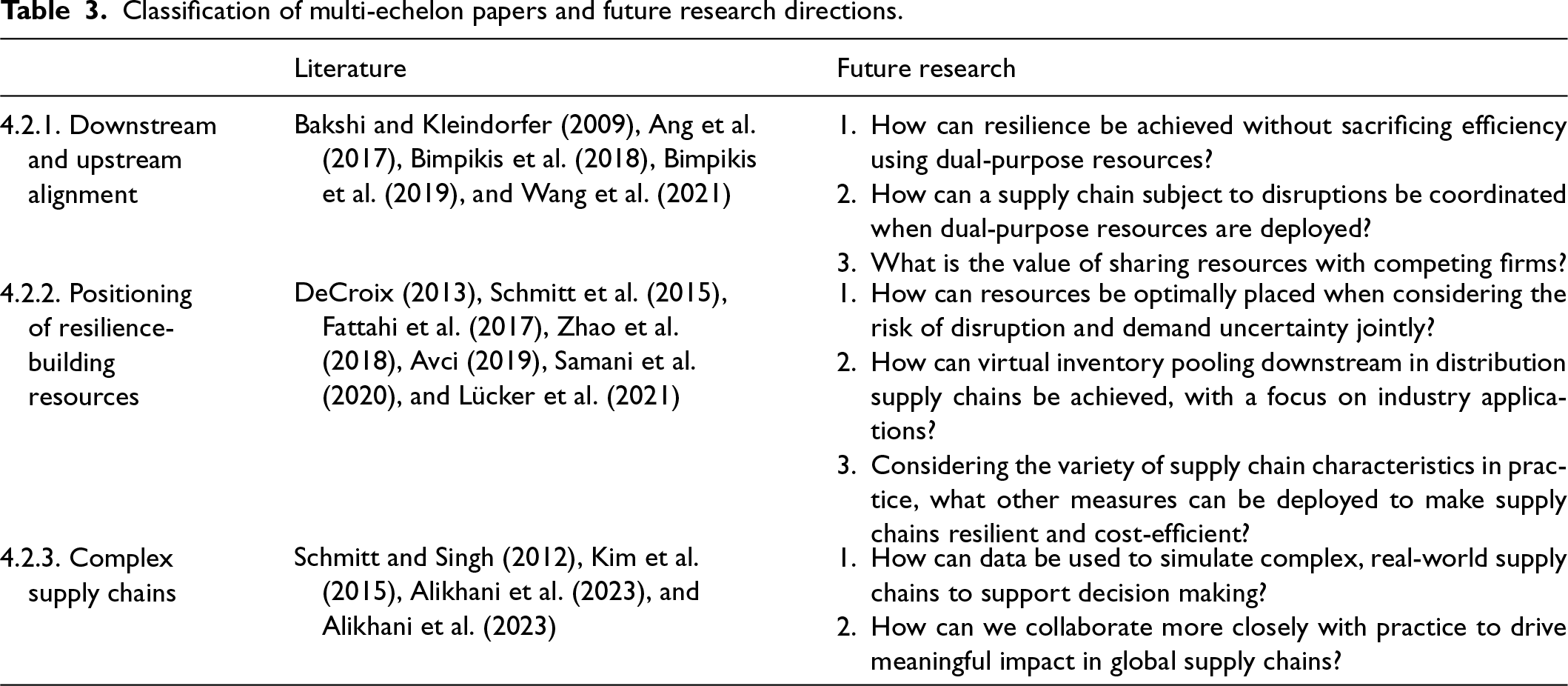
Classification of multi-echelon papers and future research directions.
In multi-echelon supply chains subject to disruptions, there is a key conflict: Downstream parties are not only affected when their own operations are disrupted; any disruption further upstream will obviously also affect their ability to meet customer demand if no risk mitigation levers are in place. The opposite does not necessarily hold true and, thus, upstream parties are typically less severely affected when a disruption occurs downstream. For example, a disruption at a retailer might not affect an upstream party at all as long as total demand for the final product does not change and customers purchase the final product at other, undisrupted retailers or through an online channel. Further, the profit margin of firms operating downstream, such as original equipment manufacturers (OEMs), is sometimes higher than that of upstream firms, such as raw material suppliers. Thus, downstream parties may be particularly exposed to disruptions in terms of both their likelihood and their impact due to the significant potential profit loss compared with upstream firms. Hence, downstream parties often find significant value in incentivizing upstream suppliers to become more resilient.
Bimpikis et al. (2018) showed that a multi-echelon supply chain subject to disruptions is generally not coordinated. To achieve coordination, a holistic approach, often going beyond supplier–buyer contracts, is needed (see also Wang et al., 2021). The authors call for more research to better understand what kinds of contracts might be helpful here. In light of this, the coordination of a multi-echelon supply chain subject to disruptions can be seen as an important and underrepresented research topic. Bimpikis et al. (2019) studied a multi-echelon supply chain subject to disruptions. A key feature of their model is that several firms at each echelon might compete against each other. They find that the number of firms in each echelon significantly affects the variation in output of the supply chain. They also provide insights regarding what motivates firms to enter a supply chain (i.e., to enter a market and compete with firms that already operate in a specific echelon), given the competitive landscape and the risk of disruption. The discussion of competition within an echelon is interesting as it raises the question of whether resources can be shared in an echelon, even among competing firms. This would allow the deployment of dual-purpose resources as they serve not only one firm but several firms. Such shared resources might also be offered by third parties that offer risk mitigation services to firms in the same echelon. Interestingly, financial service firms such as Benteler Trading offer inventory financing solutions to keep costs low.
Competition across echelons is studied by Bakshi and Kleindorfer (2009) who consider a model in which the level of vulnerability of the supplier is not known to the buyer (which is also subject to disruptions). Based on bargaining theory, the authors determine the suppliers’ and buyers’ level of risk mitigation investment. They find that cooperative behavior is more effective than competitive behavior.
Ang et al. (2017) studied a non-centralized three-stage supply chain where different sourcing decisions are analyzed alongside the use of inventory. Specifically, the authors analyze the effect of sourcing from a diamond-like supplier base where tier-two suppliers are shared by tier-one suppliers and are subject to disruptions. They find that the buyer experiences negative abnormal returns when the degree of shared tier-two suppliers is high. Further, the authors show that penalty contracts alleviate some coordination problems in such sourcing settings. This type of research is important because it helps us understand how to influence the reliability of suppliers further upstream in the supply chain beyond tier one. What other mechanisms or resources could be used to improve upstream reliability during disrupted times?
Given that the above articles do not consider the role of dual-purpose resources, future research should help to better understand how such contracts add value when disruption and recurrent risks are analyzed simultaneously.
Positioning of Resilience-Building Resources
The problem of where to hold resources in the supply chain to buffer against disruptions also arises in the vertically integrated supply chains in which one firm is the decision maker for the entire supply chain. Should buffer resources such as inventory be held upstream or downstream?
Existing research shows that holding a significant amount of inventory downstream in the supply chain often lowers the total cost when managing the risk of supply chain disruptions. This is because inventory held downstream can help buffer against supply disruptions happening both downstream and upstream (Lücker et al., 2021). While resilient supply chains tend to commit inventory downstream, cost-efficient supply chains tend to prefer pushing inventory as far upstream as possible because of lower inventory holding costs (Clark and Scarf, 1960). When a firm is primarily exposed to demand uncertainty (and not the risk of supply disruptions), a mismatch between supply and demand only materializes when an upstream operation runs out of stock because the demand is greater than the available inventory. Future research might determine the optimal quantity carried at each echelon when considering disruption risk and recurrent risks simultaneously. More research needs to be carried out to find ways to achieve a better alignment of efficiency and resilience in multi-echelon supply chains. These solutions might also involve other resilience levers such as reserve capacity or emergency sourcing and may be industry-specific.
A related important contribution to the multi-echelon supply chain literature is the risk diversification effect, which arises in distribution supply chains. Schmitt et al. (2015) considered a supply chain with one centralized warehouse and several local retailers in which all locations (the centralized warehouse and the local retailers) are subject to disruptions. The challenge is to determine where best to position inventory—at the centralized upstream warehouse or at the decentralized downstream retailers? When holding inventory upstream, all inventory is accumulated in the centralized warehouse. When holding inventory downstream, the inventory is split across all the retailers. The authors find that inventory is often held downstream in the local markets at optimality. The intuition is that disruptions tend to be more frequent downstream (because of the larger number of retailers, which are all prone to disruptions), but to have less impact because in the event of a disruption, only one retailer is disrupted while all other retailers can continue to serve customer demand. By contrast, upstream disruptions tend to occur less frequently (because there is only one location subject to disruptions) but have more impact because no supply can be shipped to the retailers and stockouts therefore occur in all markets. The risk diversification effect can be contrasted with the pooling effect (Eppen, 1979). When managing demand uncertainty in distribution supply chains, it is often optimal to pool inventory upstream at the centralized location so it can be sent to the downstream location where demand is higher than anticipated. Observe also that in this example, implementing supply chain resilience results in a loss of supply chain efficiency. While factoring disruptions into the design of a distribution supply chain results in carrying inventory in decentralized locations (risk diversification effect), ignoring disruptions results in carrying inventory centrally at optimality (pooling effect).
Future research could study the value of virtual pooling of downstream inventory, as illustrated by Nordstrom in its Los Angeles market (where goods can easily be transshipped from one store to another). In what distribution settings does virtual inventory sharing add value? What role do novel transportation modes play in achieving efficiency and resilience? In this context, we should acknowledge some papers that study the value of transshipment (or other forms of downstream inventory pooling) in distribution supply chains subject to disruptions: Alikhani et al. (2021), Avci (2019), Fattahi et al. (2017), Samani et al. (2020), Rudi et al. (2001) and Zhao et al. (2018). These papers highlight that the benefits of pooling inventory can be achieved by holding more inventory downstream. More research is needed to establish these benefits beyond distribution supply chains in practice.
DeCroix (2013) studies assembly supply chains subject to disruptions and provides a technique for computing optimal inventory ordering policies in an assembly supply chain with disruptions. Applying this technique, the author finds that sourcing from suppliers with long lead times (but lower costs) often helps to reduce the total cost. Further, cost savings can be achieved if disruption risks are correlated across upstream suppliers. This research highlights that resilience and efficiency are not always in opposition. Sourcing from upstream suppliers with long lead times where disruption risk is correlated does not necessarily result in a loss of supply chain efficiency in assembly supply chains.
Assembly supply chains merit further research. For example, given the large number of upstream components often needed for the assembly of the finished goods, would it be better to carry inventory upstream in component form or downstream in finished goods form? Also, could capacity sharing for the production of upstream components help increase resilience and efficiency? Finally, how can these solutions best be tailored to applications in practice?
Complex Supply Chains
Given the challenges related to modeling complex supply chains, scholars sometimes resort to numerical studies and simulations to draw insights.
Clearly, real-world supply chains often consist of a combination of serial, assembly and distribution supply chains. Such complex topologies are studied by Kim et al. (2015) who consider block-diagonal, scale-free, centralized and diagonal supply chains. Based on a graph-theory approach, the authors find that supply chain networks are particularly resilient if the nodes of the network follow a power law for the degree distribution. Generally, only very limited insight-driven research is available for complex supply chains subject to disruptions—likely due to the lack of data. Future research is necessary in this area to support companies in designing real-world solutions.
Schmitt and Singh (2012) performed a simulation study and elaborate on the importance of analyzing supply chain networks as a whole, instead of adopting a single-stage approach. They also find that firms in their setting should focus on minimizing the disruption time rather than the disruption frequency. In a similar spirit, Alikhani et al. (2023) studied an application in the retail sector in which the focus is on choosing a suitable combination of different resilience levers. Alikhani et al. (2023) studied a real-world supply chain subject to significant demand uncertainty and the risk of supply chain disruption using robust optimization coupled with extensive numerical studies. A key feature of their model is that they allow a firm to collaborate horizontally by sharing distribution centers. This horizontal collaboration helps the supply chain to become more cost-efficient and resilient. The authors quantify potential cost savings for the company involved.
Ideally, complex supply chains should be studied in collaboration with industrial partners, so that data from a firm can be leveraged and real impact can be achieved. Much of this research might use as input some of the findings developed using more stylized/theoretical models. Also, further empirical evidence on the propagation and mitigation of risk in complex multi-echelon supply chains would be welcome, although challenges related to finding suitable datasets prevail.
Multi-Product Supply Chains and Product Proliferation
Product proliferation has been used as a strategy to drive sales for a long time. General Motors used product differentiation to better compete with Ford, which offered only one color of its Model T. Recently, product proliferation has further accelerated due to advances in flexible production technology such as 3D printing and additive manufacturing, which make it possible to increase the speed of delivery of a product portfolio with high variety at reasonably low cost (LaCroix et al., 2023).
Clearly, product proliferation may make supply chains more vulnerable as more input material may be needed to produce the goods. The resilience of a supply chain would depend on product characteristics as well as supply chain characteristics: Are products substitutable or complementary? If margins are different, can the high margins products be preferred when there is limited supply? Besides volume flexibility, can one site produce a variety of different products or only one product?
Simchi-Levi et al. (2018) studied a setting where a production plant may have the flexibility to produce different products. The authors determine the joint value of such flexibility with inventory for protecting against supply chain disruptions. Using a two-stage stochastic optimization framework, the authors find that the inventory should consist of products with high demand variability when flexibility is low. An interesting feature of this work is that demand uncertainty is included in the model and, as such, flexibility and inventory are considered as dual-purpose levers. Saha et al. (2020) considered product substitution as a risk mitigation strategy. In their multi-product model, lack of supply due to a disruption can be mitigated by supplying a substitute product. The researchers quantify the value of product substitution in mitigating supply disruptions; future research could quantify the joint value of product substitution in mitigating disruption risk and recurrent risk by considering substitution effects as a dual-purpose lever.
Yaghoubi et al. (2020) provided a real-world example of a multi-product medical supply chain that is subject to supply disruptions and significant demand uncertainty. A key feature of the model is that it is rather complex, incorporating various parameters that arise in the platelet supply chain, such as perishability of the platelets, network design, and true demand pattern. While most insights are based on numerical analysis, the authors effectively design the network as a dual-purpose resource to cope with demand uncertainty and supply disruptions. More research in this direction could help drive insights into an optimal network design in a more general context (see also Samani and Hosseini-Motlagh, 2020 for a comparable analysis).
Overall, we believe that more research is needed to answer a number of questions: (i) What is the role of demand correlation between different products? (ii) How helpful is responsive pricing in dealing with disruptions in multi-product settings? (iii) How can efficiency and resilience be achieved using responsive pricing? (iv) What role can capacity sharing play across different product lines up- or downstream in the supply chain?
Research Perspectives and Future Research Directions
Dual-purpose resilience levers deserve special attention in future research. This is because dual-purpose resources not only help to build resilience but also have a positive effect on supply chain management in undisrupted times. This is, for example, highlighted by Liu et al. (2016), who elaborate on the dual-purpose of inventory, which supports companies in protecting against supply disruptions and increasing supply chain efficiency by increasing the service level. The authors quantify virtual inventory, which helps firms (e.g., pharmaceutical company J&J) to reduce costs by holding inventory for such a dual purpose. As for dual-purpose resources other than inventory, Fan et al. (2017) studied the value of flexible transportation modes with different speeds in a multi-echelon and multi-product supply chain subject to disruptions. Disruptions can be mitigated by changing the transportation mode of some products, that is, delivery can be accelerated in order to mitigate potential stockouts due to upstream disruptions. Interestingly, providing flexibility in the transportation mode also helps to deal with day-to-day glitches such as transportation delays, thus increasing supply chain efficiency. Similarly, Avci (2019) studies the value of (i) lateral transshipment and (ii) expedited shipping in a distribution network subject to disruptions. The author considers the effect of these two levers on both building resilience, measured in terms of conditional value-at-risk, and improving supply chain performance in the absence of disruptions, measured in terms of the service level. She finds that expedited shipping helps to build resilience and achieve a high service level in the absence of disruptions despite higher costs. By contrast, lateral transshipment helps to build resilience, but is less effective in keeping a high service level in the absence of disruptions.
The model considered by Timonina-Farkas and Seifert (2022) optimizes the use of resources for cost efficiency and resilience with a special emphasis on constructing a strategy, which can serve the decision-maker in both disrupted and undisrupted times. The authors take a bilevel view of supply chain management, which makes it possible to render production more predictable in the event of disruptions by driving costs and optimal schedules closer to the benchmark for each scenario considered. Importantly, each disruption scenario could produce a peak or trough in customer demand—the realized demand and even the demand distribution are, however, unknown to the decision maker at the moment when the production schedule needs to be fixed. On the theoretical side, two levels arise from the fact that optimal production needs to be adjusted in case of a disruption. This differs from the standard bilevel optimization framework, which requires two decision makers. In terms of optimal supply chain management strategies, the article considers disruptions of different sizes and, moreover, disruptions that may lead to an unknown distributional change: All this reduces the set of assumptions (e.g., no assumption about the change in demand) and makes the strategy implementation easier and more reliable.
Chopra et al. (2021) studied the value of dual-purpose resources, referred to as commons, for building resilience. The commons is a resource provided within a single company or by a third party (such as another firm or the government) to several firms. The authors argue that commons help to create multiple channels for the flow of information, products, or funds in a supply chain. In this way, dual-purpose resources not only help to build resilience but also to improve supply chain management in the absence of any disruptions. Thus, supply chain resilience can be achieved without significantly sacrificing supply chain efficiency. The authors argue that firms often create multiple channels for the three flows–information, product, and funds—to improve efficiency. Yet, it turns out that these multiple channels also create some resilience at low cost.
A few studies explicitly consider the value of flexibility in the context of managing disruptions. Sheffi (2005) highlights how firms can use various means of flexibility such as standardization, modular design, and collaborative relationships to enhance the resilience of an enterprise. Further, Sheffi and Rice (2005) argued that supply chain flexibility is a dual-purpose resource as it not only builds resilience but also helps to mitigate recurrent risks in the absence of disruptions. Saghafian and Van Oyen (2016) showed that even a little bit of flexibility can significantly help a firm deal with disruptions: “a little backup flexibility can go a long way” (p. 403).
Future Research Directions
More research is needed in order to better understand the value of dual-purpose resilience levers. We argue that there is a need to look at disruption risk and demand/supply uncertainty holistically. We believe that using dual-purpose resources is critical for building cost-efficient and resilient supply chains in industries where margins tend to be lower and competition is primarily on price.
Future research needs to answer the question about the types of products, market settings, and supply chain characteristics for which dual-purpose resources could be more valuable than dedicated risk mitigation strategies. This research direction is in line with Cohen et al. (2022), who call for more research on bespoke supply chain resilience. The authors highlight the importance of tailoring the supply chain resilience strategy to the specific supply chain and market characteristics.
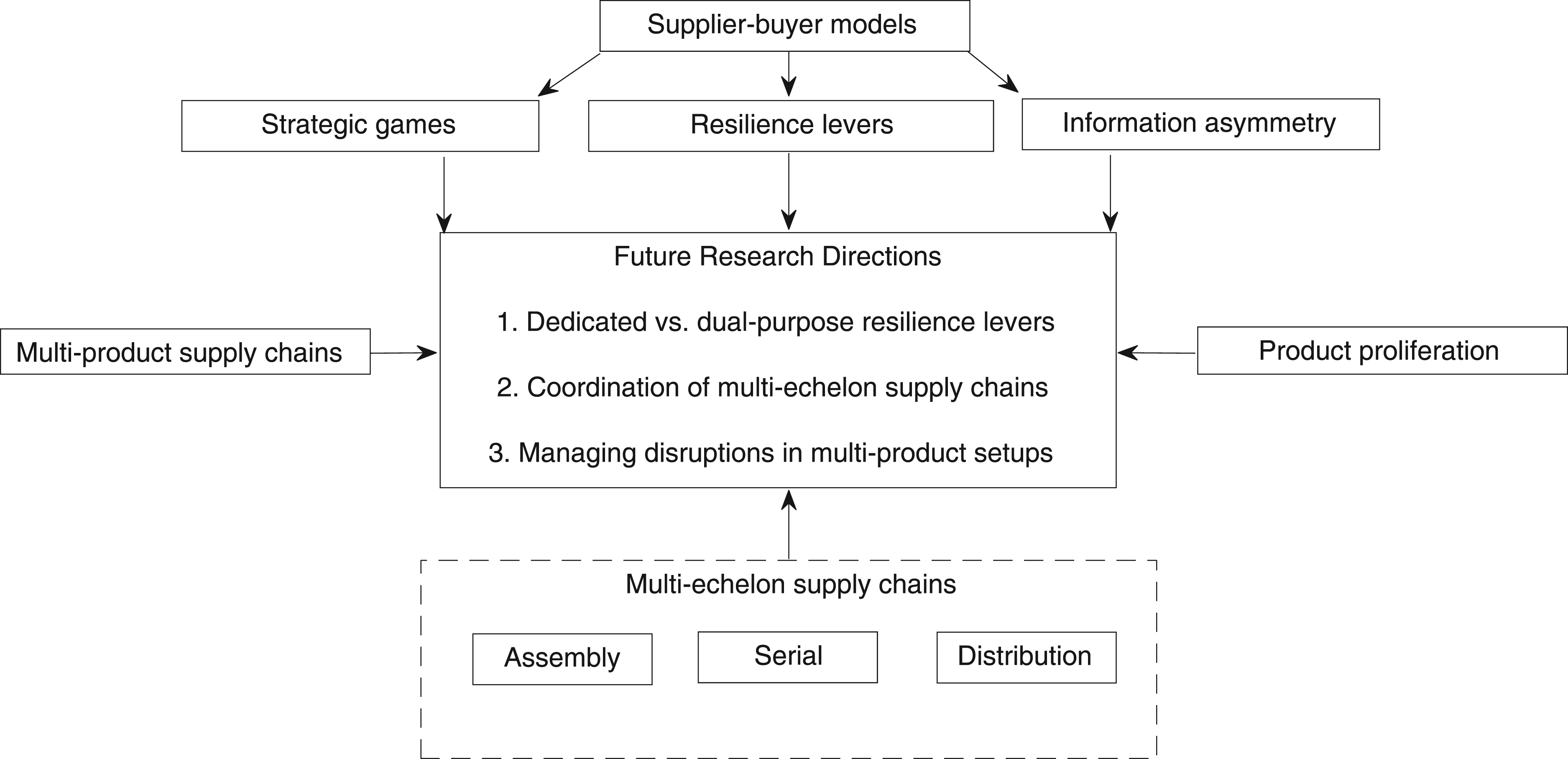
Key modeling questions and future research opportunities.
The literature review by Snyder et al. (2016) specifically looks at the risk mitigation strategies of sourcing flexibility and demand flexibility. These flexibility measures are studied in order to understand how they help build resilience. More research is needed to better understand how the different flexibility measures can provide dual benefits to supply chains, particularly considering the variety of supply chain settings encountered in practice.
A novel research domain would be to consider disruptions that influence future demand in the luxury segment. Timonina-Farkas and Seifert (2022) demonstrated that manufacturers with high brand value (e.g., watches of some particular brands, luxury goods, etc.) can avoid stockpiling additional inventories as a supply chain resilience mechanism. This becomes possible because of the low cost of backlog as clients tend to return for the goods even if the price increases. The low backlog cost is often supported by the use of marketing techniques, that increase the desire of customers to purchase a particular product. Coupled with optimal operations, such marketing strategies can help firms in the case of unprecedented disruptions, for example, making it optimal to postpone the sales rather than to hold inventories. These strategies have not received much attention in the academic literature to date. Nevertheless, they are already used in practice, for example, in collaborations between non-luxury and luxury brands such as Swatch and Omega, Swatch and Blancpain, Nike and Louis Vuitton. Considering the collaboration between Swatch and Omega, one can note that the shortage of a particular color pigment used in one of 11 models of Swatch and Omega MoonSwatches boosted the sales of all 11 models. By contrast, the latest Swatch and Blancpain collection did not experience such high demand as all the watches were available in stores and the sense of receiving a rare product was lower for some clients (Seifert et al., 2022).
Overall, we summarize the areas with significant potential for future research in Figure 2.
As one can observe, possible research directions include exploring supplier–buyer models through the lenses of strategic games, resilience levers, and information asymmetry. Focusing on dedicated versus dual-purpose resilience levers, one can aim to enhance the coordination of multi-echelon supply chains in the face of disruptions while taking benefits in undisrupted times into account. Additionally, managing disruptions in multi-product setups using marketing strategies can become a crucial research direction in the future.
The COVID-19 pandemic, geopolitical tensions, and other major events such as natural disasters have underscored supply chains’ vulnerability to disruptions and their need for resilience. To address the underlying industrial challenges, academic literature must move beyond traditional risk management approaches and adopt a more holistic view that is able to study resilience and efficiency jointly.
Our article provides a comprehensive review of academic literature at the intersection between supply chain resilience and efficiency. By classifying resilience measures as dual-purpose and dedicated levers, we highlight the critical role of dual-purpose resources, which are able to enhance resilience and also improve efficiency in supply chains. Furthermore, dual-purpose resources can be beneficial for dealing with recurrent risks, that is, they can support companies in the absence of major disruptions. This can be particularly valuable for firms facing significant cost pressures and demand uncertainty.
Our review identified several gaps in the current literature, which emphasizes the need for further research on the coordination of multi-echelon supply chains, the dynamics of multi-product supply chains, and the practical implications of dual-purpose resilience levers. Addressing these gaps is crucial for developing more robust and cost-effective supply chain strategies that can withstand various types of disruptions.
Future research should also focus on integrating theoretical models with empirical data to better understand the practical applications of these resilience strategies. Moreover, collaboration between academia and industry practitioners will be essential in refining these strategies to ensure they are both practical and effective in real-world scenarios.
Overall, the insights from this review underscore the importance of a balanced approach to supply chain management that prioritizes both resilience and efficiency. As global supply chains continue to face unprecedented challenges, the ability to swiftly adapt and maintain operations without compromising cost-effectiveness will be a key determinant of long-term success. If the academic understanding of the interplay between resilience and efficiency is advanced, supply chains will be better equipped to navigate the complexities of the modern global economy, ensuring they remain robust, adaptable, and capable of meeting the future disruptions.
Footnotes
Declaration of Conflicting Interests
The author(s) declared no potential conflicts of interest with respect to the research, authorship, and/or publication of this article.
Funding
The author(s) received no financial support for the research, authorship, and/or publication of this article.

How to cite this article
Lücker F, Timonina-Farkas A and Seifert RW (2024) Balancing Resilience and Efficiency: A Literature Review on Overcoming Supply Chain Disruptions. Production and Operations Management 34(6): 1495–1511.