




Abstract
Landscape sustainability aims to consistently provide long-term, landscape-specific ecosystem services. The concept of nature’s contributions to people (NCP), broader than that of ecosystem services, has sparked methodological controversy regarding the new assessment framework of NCP. Accordingly, for further exploration of the essence of landscape sustainability, a way forward in better assessing NCP that differs from previous assessments of ecosystem service is necessary. Five key issues for assessing NCP are summarized in this paper, including: 1) how to determine generalized or landscape-specific parameters; 2) how to identify different people’s needs from a landscape; 3) how to deal with the complexity of non-material NCP at landscape scale; 4) how to evaluate the relationship between different NCP from a landscape; and 5) how to assess landscape multifunctionality based on NCP. The way to deal with these key issues is discussed, including: determining generalized or landscape-specific parameters based on research targets; tracking nature’s contributions to different people’s needs considering spatial flow; forming new spatial data for non-material NCP; evaluating the relationship between different NCP depending on threshold of benefit; and assessing landscape multifunctionality based on the relations of NCP.
The importance of assessing nature’s contributions to people
Landscape sustainability is defined as the capacity of a landscape to consistently provide long-term, landscape-specific ecosystem services (ES) essential for maintaining and improving human well-being (Wu, 2013). The concept of nature’s contributions to people (NCP), highlighted by the Intergovernmental Science-Policy Platform on Biodiversity and Ecosystem Services (IPBES), encompasses both positive and negative contributions of living nature (diversity of organisms, ecosystems, and their associated ecological and evolutionary processes) to people’s quality of life (Diaz et al., 2018). Although most ES categories fit well within the generalizing 18-NCP classification, the NCP definition goes well beyond ES, since NCP counts as a contribution that depends on the societal contexts and hence varies between people (Hill et al., 2021). However, recent methods have led to different assessment frameworks that may produce incommensurable results, e.g. potential contributions of nature are much different from the realized contributions of nature (Brauman et al., 2020; Chaplin-Kramer et al., 2019; Liu et al., 2023; O’Connor et al., 2021), and the contextual perspective significantly contributes to the difficulties in assessing NCP. Since NCP is a broader concept than ES, methodological controversies arise regarding the assessment of NCP which differs from the assessment of ES (Hill et al., 2021), creating confusion in the understanding of the essence of landscape sustainability, which was previously defined in ES.
In this paper, five key issues to assess NCP in landscape sustainability were summarized (Figure 1). The five issues include 1) how to determine generalized or landscape-specific parameters; 2) how to identify different people’s needs in a landscape; 3) how to deal with the complexity of non-material NCP at landscape scale; 4) how to evaluate the relationship between different NCP from a landscape; and 5) how to assess landscape multifunctionality based on NCP.
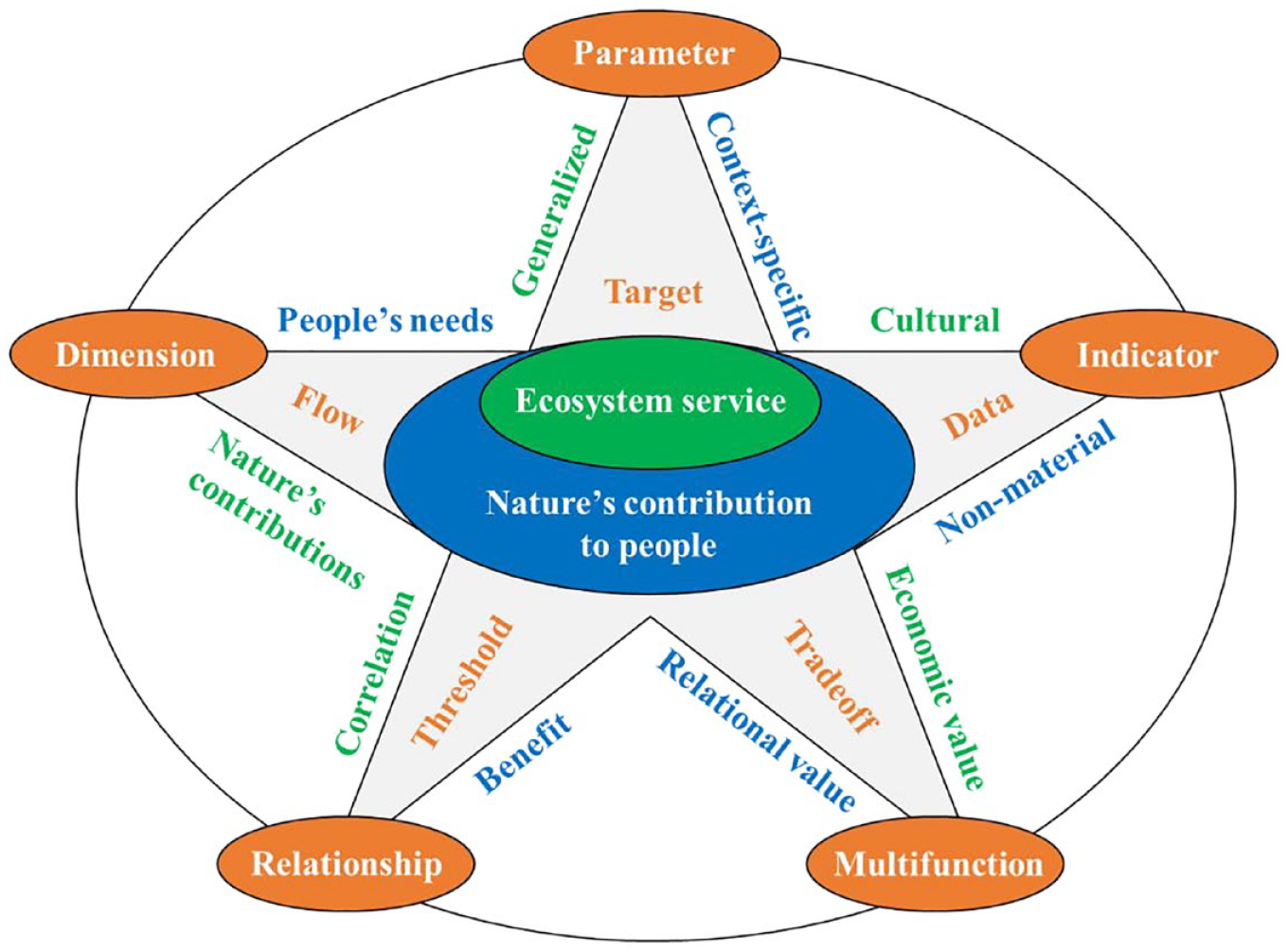
The five key issues (highlighted in orange) for assessing nature’s contribution to people (highlighted in blue) that differed from previous assessments on ecosystem services (highlighted in green) for landscape sustainability.
Relationships between nature’s contribution to people and landscape sustainability
To understand the relationships between different NCP and landscape sustainability, three questions have to be addressed. First, what are sustainable landscapes? Zhou et al. (2019) conducted a systematic review of 333 papers and found the sustainable landscape concept had been applied in five fields, including: community forestry/forest sustainability; people-nature relationships and problem-driven landscape management; landscape pattern and habitat conservation; the factors and indicators for assessing ecosystem services; the perception and evaluation of landscape benefits and services. Accordingly, sustainable landscape can be interpreted by environmental, social, or economic sciences based on the research context. Therefore, societal context should be highlighted in sustainable landscape planning and governance, which is the advantage of the NCP concept.
Second, how do landscape patterns impact NCP? The existing evidences provided cascade relationships between landscape pattern, ecosystem services and human wellbeing (Chen et al., 2022; Hu et al., 2022; Krsnik et al., 2023). However, people’s needs from a landscape have not been fully discussed, and a large number of case studies only consider the supply of ecosystem services from the landscape without a clear identification of the beneficiary. As people are capable of defining their own needs, the context-specific perspective of the impact of a landscape on certain NCP needs to be explored in the future.
Lastly, what are the goals for sustainable landscape management? As per the original definition, sustainable landscape management ensures uninterrupted provision of ecosystem services to support human wellbeing (Wu, 2013). Since sustainable landscape is place-based, local and indigenous knowledge plays an indispensable role in sustainable landscape planning and governance (Wu, 2021). Local knowledge on landscape management may depend on the context-specific relational value for different people from nature (Pascual et al., 2023). Thus, enhancing landscape multifunctionality means considering local context-specific NCP in sustainable landscape management, rather than simply selecting a management scheme with the highest provision of ecosystem services.
The 1st issue: How to determine generalized or landscape-specific parameters
The concept of NCP encompasses two perspectives: the generalizing perspective within the 18 categories of NCP, and context-specific perspective within the distinctive experiences or relationships perceived by different groups of people (Hill et al., 2021). To assess global trends in NCP, the generalizing perspective was mostly applied in recent global assessment (Chaplin-Kramer et al., 2022; Cimatti et al., 2023; Neugarten et al., 2024). To gain knowledge from local natural resource management, the context-specific perspective has unique value (Holmes and Jampijinpa, 2013; Newman et al., 2019). It is worth noting that the generalizing and context-specific perspectives are not dependent on scale, as a global-scale study can be context-specific and as a local-scale study can be generalizing, so that it is challenging to select appropriate parameters in assessing landscape sustainability.
When determining generalized or landscape-specific parameters, it is a reminder that culture is a lens for all NCP. Only if the research target involves performing comparative analyses of the status and trends of NCP across places and time periods, e.g. regulating NCP, generalized parameters are recommended as the unit of measurement as it is relatively easy to unify among different landscapes, regardless of whether the landscape is in America, Europe or China (Liu et al., 2023). While in most cases, the research target is related to people’s values, knowledge, and social norms regarding NCP, so that the landscape-specific essential roles of indigenous peoples and local communities should be highlighted (Levis et al., 2024). Moreover, nonmaterial contributions are often related to the material contributions (e.g. the social relationships from the coproduction of food) (Diaz et al., 2018), thus the landscape-specific parameters with unique subjective or psychological dimensions is also recommended in assessing material NCP.
The 2nd issue: How to identify different people’s needs in a landscape
The conceptual framework for calculating NCP effectively integrates nature’s contributions with people’s needs (Chaplin-Kramer et al., 2019). Similarly, the concept of ES promotes aligning supply with demand, although it treats them as separated indicators (Krsnik et al., 2023; Peng et al., 2023; Yin et al., 2021). Thus, an advantage of using the NCP framework in assessment is combining the supply and demand from nature to a single indicator. However, the operation is challenging in spatially explicit assessment when NCP are defined through people’s perceived needs. Based on the recognition that people are capable of defining their own needs, the existing methods for ES supply and demand are generally not suitable for NCP framing. However, the methods for spatially assessing different people’s needs on a landscape lag behind NCP research requirements.
The spatial flows from nature’s contributions to different people’s needs should be tracked. This flow can be conveyed by hydrological process, trade, migration and travelling. For example, driven by urbanization, citizens’ demand for water diversion has grown, so the changes in freshwater flow were significant and elevated the risk of flow reduction in the main stream of Dongjiang River, China (Shen and Liu, 2023); the perceived social value hotspots were not fully aligned with use patterns of road parking discovered by tracking diverse groups of backcountry visitors to a protected landscape in Alaska (Cai et al., 2023); the built environment is associated with fresh food accessibility in Shanghai City, indicating the close relationship between urban landscape planning and people’s needs for typical nature contributions conveyed by trading (Wang and Li, 2022). Given the limitation of fine-scale data on different people’s needs, a simplified way to investigate is mapping the population spatially exposed by the flow of nature’s contributions (Chaplin-Kramer et al., 2022; Chaplin-Kramer et al., 2019). However, the method is not suited for all NCP. For example, people’s need for ‘pollination and dispersal of seeds’ is more closely related to production rather than population. Accordingly, accounting for the fine-scale consumption of nature’s contributions from people in different groups is a recommended frontier, which could be essential data for assessing the quantity of flow, velocity of flow and stability of flow of NCP on a landscape.
The 3rd issue: How to deal with the complexity of non-material NCP at landscape scale
Non-material NCP reflects the influence of living nature’s effects on subjective or psychological aspects underpinning people’s quality of life, both individually and collectively (Diaz et al., 2018). The assessment of non-material NCP does not adhere to the supply and demand framework used in ES, it is more aptly assessed through bidirectional relationships between people and nature, viewing them as inseparable. For example, an assessment demonstrated a network of interactions and feedback between biodiversity and diverse indigenous peoples and local communities, suggesting the interconnectedness and interdependencies of the social-ecological system benefited from both biological and cultural diversities (Levis et al., 2024). In this assessment, non-material NCP played a key role in forming culturally important biodiversity, thereby motivating indigenous people to protect the landscape, while it cannot be interpreted by cultural ES due to its nature–culture dichotomy framework. However, it is still not clear what non-material NCP can be measured and what cannot easily or not be measured at all at landscape scale.
It requires creating new spatial data to assess non-material NCP at landscape scale. The different ES and NCP research tend to adopt different descriptive and qualitative methodologies, so that makes it difficult to undertake a systematic analysis across studies (Huynh et al., 2022). For spatial assessment, social big data with geographic information is necessary (Havinga et al., 2020), enabling the overlay of non-material NCP with other regulating and material NCP. For temporal assessment, long-term follow-up survey data is essential (Gagnon et al., 2023), so that the constant change of landscape-specific non-material NCP can be appreciated in a social-ecological system.
The 4th issue: How to evaluate the relationship between NCP from a landscape
Many of the 18 NCP categories were interlinked within specific cultural contexts (Diaz et al., 2018), and correlation cannot effectively provide the knowledge of relationship between different NCP required by people’s needs from a landscape. For example, a piece of evidence from urban-nature space showed that higher daily exposure to woodlands, but not grasslands, correlated with higher cognitive development scores and a lower risk of emotional and behavioral problems in adolescents (Maes et al., 2021). Woodlands typically store more carbon than grasslands, suggesting a synergetic relationship between ‘regulation of climate’ and ‘physical and psychological experiences’. While the former NCP provides global benefits for all human well-being, the latter provides context-specific benefits for specific groups. However, a mechanical explanation for a direct increase in the NCP ‘regulation of climate’ leading to an increase in the NCP ‘physical and psychological experiences’ is largely absent.
It is recommended that a threshold of benefit be identified when evaluating the relationship between different NCP from a landscape. As an extreme hypothesis, if artificial pollination is not allowed, crop pollination would then depend on the natural processes. Accordingly, the natural habitats surrounding the cultivated land would increase, and bring synergetic enhancement of several NCP besides ‘pollination and dispersal of seeds’, such as ‘habitat creation and maintenance’, ‘regulation of air quality’, ‘regulation of freshwater quality’, ‘formation, protection and decontamination of soils and sediments’ and ‘regulation of detrimental organisms and biological processes’. However, considering the total area of a landscape is fixed, this increase of natural habitats may occupy a number of croplands, so that threatens the total amount of ‘food and feed’ NCP. Considering food security, the extreme hypothesis cannot be true regardless of the number of synergetic relationships existing. This case serves as a reminder that the thresholds of benefit of the main NCP from a landscape should be identified (e.g. the landscape-specific material NCP for people’s subsistence). Based on the threshold perspective of planetary boundaries, Rasmussen et al. (2024) found environmental and social win-win outcomes from agricultural diversification strategies including livestock diversification, temporal crop diversification, soil conservation, noncrop diversification, and water conservation at landscape scale. Kong et al. (2023) found China’s cropland area threshold drove a large reclamation for cropland, which undermined gains in wildlife habitat, water retention, sandstorm prevention, carbon sequestration and soil retention by 113.8%, 63.4%, 52.5%, 29.0% and 10.2%, respectively. In other words, optimizing NCP relationships without considering the risk of exceeding the thresholds of the main NCP, or setting inappropriate threshold in landscape planning, would typically fail to provide effective practical guidance on sustainable landscape management.
The 5th issue: How to assess landscape multifunctionality based on NCP
A landscape can simultaneously generate multiple nature contributions, and people’s needs from these contributions are diverse among different groups (Li et al., 2023). However, high landscape multifunctionality among regulating, material and non-material NCP does not commonly exist. Quantitative evidence has shown that the potential priority areas for a set of non-material and regulating NCP in Europe rarely coincide spatially (O’Connor et al., 2021). Moreover, a significant difference between context-specific NCP assessment and previous ES assessment weakens the economic value. Relational value effectively captures the irreplaceability and incommensurability attributed to different NCP by different people. Consequently, it is not advisable to convert quantified NCP into monetary values for aggregation within the NCP framework. Accordingly, landscape multifunctionality based on NCP should not be interpreted solely as pursuing diversity, particularly within the same dimension, due to the interlinked relationships. Nor should it be construed as monetary value, given the inestimable relational value inherent in context-specific NCP.
Implementing multifunctional connected landscapes across the climate-biodiversity nexus and strengthening their protection and expansion through landscape restoration actions is possible (Pörtner et al., 2023). The NCP tradeoffs in assessing landscape multifunctionality should be detailed, including supply–demand, cost–benefit, global–local, and present–future tradeoffs (Liu et al., 2022). First, the NCP with high supply from nature’s contributions but low demand from people’s needs is not recommended to set priority in landscape multifunctionality assessment. Second, if enhancing multiple NCP comes at the cost of a vital, context-specific NCP, it is not recommended to assess landscape multifunctionality solely by the increased number of NCP. Third, the assessment target should be clearly distinguished between global and local landscape multifunctionality, as context-specific priority NCP are often overlooked in global assessments that utilize generalized data. Last, decision-making that not only depends on present landscape multifunctionality but also takes future migration of people into account and the uncertainty of cultural inheritance is highlighted to ensure long-term landscape sustainability.
Footnotes
Declaration of conflicting interests
The author declared no potential conflicts of interest with respect to the research, authorship, and/or publication of this article.
Funding
The author disclosed receipt of the following financial support for the research, authorship, and/or publication of this article: This work was supported by the National Natural Science Foundation of China (42041007) and the Fundamental Research Funds for the Central Universities of China.
