




Abstract
China is developing a new strategy to achieve harmony between nature and economic growth. In order to ensure the conformity of policies and actions in this new strategy, Chinese cities need tools to evaluate the change in nature and its contribution to human well-being. The rapid development of theories and methodologies in the valuation of nature provides many options. The potential of three frameworks — urban ecosystem services, nature’s contribution to people, and gross ecosystem products — for meeting Chinese cities’ needs was analyzed through a comprehensive literature review. The results show that the gross ecosystem products framework actively brings nature’s values into Chinese cities’ political agenda. The urban ecosystem services framework has been extensively used in scientific studies, while the nature’s contribution to people framework is gradually gaining researchers’ attention. The three frameworks complement each other due to their unique strengths in the social context of Chinese cities. Based on those discoveries, I recommend that Chinese cities adopt the three frameworks simultaneously to assess urban ecosystems and their contributions to residents’ well-being. To achieve this goal, I call for more studies to address the theoretical and methodological barriers to integrating the three frameworks.
Keywords
Introduction
The economic reform since 1978 has transformed China from an agrarian society into an industrial society. Although the reform has lifted 800 million people out of poverty (World bank and DRC, 2022) China has paid a hefty price for pursuing economic growth at the cost of the environment. Catastrophic impacts caused by environmental pollution, ecosystem degradation, and excessive extraction of resources have threatened to erase hard-earned social progress (Economy, 2007; Wang, 2004). China has responded to this environmental crisis by adopting a new development strategy — eco-civilization. The strategy aims to achieve harmony between economic growth and nature (Wei et al., 2021), or more specifically, the strategy emphasizes that nature shall no longer be sacrificed to achieve economic growth. Instead, nature shall be protected to achieve sustainable development.
The shifting attitude towards nature is well reflected in policies and actions taken by Chinese cities. New policies prioritize the long-term sustainability of ecosystems over short-term economic gains (Fan et al., 2019). Also, actions were taken by Chinese cities to repair and restore urban ecosystems, such as cleaning polluted air, restoring wetlands, and planting urban forests (Den Hartog, 2021; Meng et al., 2021; Yao et al., 2019). Along with the new development strategy, city governments no longer rely solely on the gross domestic product (GDP) to assess cities’ performance, instead they are now searching for new tools to measure the effectiveness of their policies and actions in conserving the ecosystem and its ability to support sustainable development.
The latest progress in valuing nature and its contribution to human well-being provides ample opportunities to meet Chinese cities’ needs. Urban ecosystem service (UES), nature’s contribution to people (NCP), and gross ecosystem products (GEP) are three representative frameworks developed in the field. The three frameworks have already been applied in Chinese cities to various degrees. However, all three frameworks are still evolving. The definitions of core concepts and methodologies are often subject to debate (Braat, 2018; Hao et al., 2022; Tan et al., 2020). Therefore, it is necessary to examine the applicability of the frameworks in Chinese cities. The conceptual content of the frameworks, their strengths and limitations, and their applications in Chinese cities were reviewed in this study. Based on the review, recommendations were given for implementing the frameworks in Chinese cities.
UES, NCP, GEP and their applications in Chinese cities
The UES framework and its applications
UES has the most extended history among the three frameworks. Bolund and Hunhammar (1999) attracted wide attention when they published the first UES study in an international journal. Their work was timely as urban ecosystems were typically not considered nature, so their contribution to human well-being was ignored (Faith, 2018). For example, the urban biome was not valued in Constanza et al.’s seminar paper on the value of the world's ecosystem services and natural capital (Costanza et al., 1997). However, in reality, the high population density of urban areas means that the value of services provided locally by urban ecosystems can be surprisingly high (Gómez-Baggethun and Barton, 2013). Since Blunder and Hunhammar, the valuation of ecosystem service (ES) in an urban context has developed from an open frontier in ES research (Gómez-Baggethun and Barton, 2013) to a field experiencing exponential growth (Kang et al., 2020).
While UES has been studied extensively, a universally accepted definition is still missing. Existing definitions can be classified into three categories. The first category defines UES as the benefits generated by ecosystems within the urban area, these ecosystems include parks, urban forests, gardens, lakes, and rivers (Bolund and Hunhammar, 1999). The second category defines UES as the benefits generated by natural and semi-natural structures in urban ecosystems, including peri-urban areas or hinterlands (Gómez-Baggethun and Barton, 2013; Luederitz et al., 2015). The third category explicitly acknowledges that human inputs and ecological structures in urban environments coproduce UES (Beichler et al., 2017). The first two categories are considered a ‘narrow notion of UES’, while the third category is considered a ‘broader notion of UES’ (Tan et al., 2020). The central argument among the two notions is: Should services generated with human inputs and artificial structures be counted as UES? If so, what type of services can be counted? Tan et al. (2020) tried to resolve this ambiguity by defining UES as ‘Aspects of ecosystems that are generated from natural capital in combination with human-derived capital and that contribute, directly or indirectly, to human well-being in urban areas’ (Page 7). This definition is by far the broadest definition of UES, which admits the role of human-derived capital in generating ES and involves ecosystems across the urban boundary.
Chinese scholars enthusiastically embrace the UES framework. A search of Web of Science using the topic word “urban ecosystem service” resulted in 163 papers published between 2007 and 2022, 36 (22%) of them from China. If the search was expanded to ES studies conducted in urban areas or cities, 1784 out of 4007 (i.e., 45%) papers were from China. Among the different categories of UES, regulating services are the most studied type in Chinese cities. The trend reflects Chinese cities’ keen interest in managing environmental problems such as air pollution and urban heat islands (Jim and Chen, 2008; Xu and Zhao, 2021; Yao et al., 2021). UES studies conducted by Chinese scholars mirror the ambiguity in concepts of UES. Most studies only consider benefits generated by ecological structures within urban areas (Jim and Chen, 2009; Xu and Zhao, 2021), while some include a wide range of services produced in urban areas, e.g., public services such as the provision of higher education (Yang et al., 2015). Despite being well received by researchers, the UES framework has never been mainstreamed in the policy-making process in Chinese cities. No city governments have programs to quantify UES regularly. Among the 22 national, ministry, and local standards on quantification methods of ES, none of them was designed for urban ecosystems (National Public Service Platform for Standards Information, 2022).
A general feature of the UES framework is the discrete and rigid ES categorizations and classifications (Table 1). The rigid classification reduces the danger of double counting and inaccurate valuation of these services and facilitates decision-making of a discrete number of actions (Kadykalo et al., 2019). Furthermore, the classification of ES and valuation methods have been extensively validated by research and practice. However, the framework was criticized for viewing ES as reflecting an objective biophysical reality and a lack of concern with equity, social diversity, and distribution (Ernstson and Sörlin, 2013). Social and public dimensions of UES approaches indeed were rarely mentioned in the UES literature (Kang et al., 2020). Therefore, the UES framework shares the same feature as many quantitative urban ecological methods, i.e., a reductionist approach is applied to integrate the natural and social sciences to understand human-dominated systems (Alberti et al., 2003).
Major groups and types of ecosystem services or nature’s contribution included in the three frameworks. The classification of urban ecosystem services is from TEEB (2011), the classification of gross ecosystem products is from Chinese Academy of Environmental Planning (CAEP) and Research Center for Eco-Environmental Sciences (RCEES), CAS (2020), and the classification of Nature’s contribution to people is from Díaz et al. (2018).
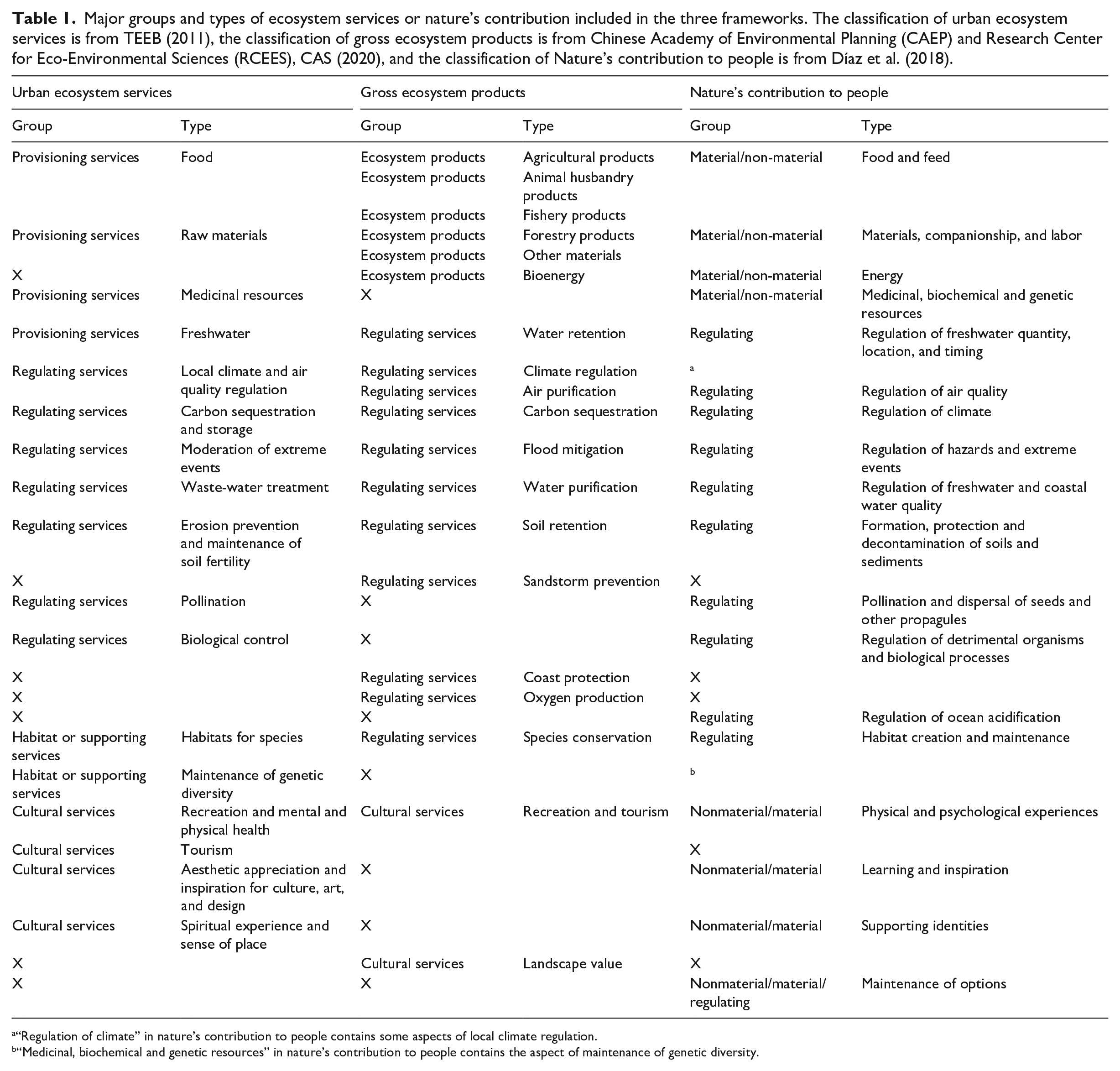
“Regulation of climate” in nature’s contribution to people contains some aspects of local climate regulation.
“Medicinal, biochemical and genetic resources” in nature’s contribution to people contains the aspect of maintenance of genetic diversity.
The NCP framework and its applications
The Intergovernmental Science-Policy Platform on Biodiversity and Ecosystem Services (IPBES) formalized the concept of NCP in 2017. NCP was defined as ‘All the positive contributions, or benefits, and occasionally negative contributions, losses or detriments, that people obtain from nature’ (Pascual et al., 2017) (Page 9). Based on the type of contribution they make to people’s quality of life, NCP can be organized into three partially overlapping groups: regulating, material, and nonmaterial (Díaz et al., 2018). The NCP concept emphasizes the importance of cultural context in valuation (Faith, 2018). It provides novel conceptualizations of people and nature relations by including diverse worldviews, context-specific perspectives, relational values, fuzzy and fluid reporting categories and groups, and inclusive language and framing (Kadykalo et al., 2019). NCP is promoted as a better alternative for ES (Díaz et al., 2018), but researchers generally consider the NCP framework as complementary to the ES framework (Dean et al., 2021; Pires et al., 2020)
The adoption of the NCP framework in China is still in its infancy stage. A few researchers explored the concept of NCP and associated quantification methods (Wu et al., 2022). Even fewer researchers used the NCP framework in their studies. These studies can be summarized into two groups. The first group only used the NCP’s classification of ecosystem services; for example, the potential contribution of nature, the realized contribution of nature, and environmental conditions were used to describe the recreational services in Qinghai-Tibet Plateau (Hou et al., 2022). The second group utilized the strength of the NCP framework, which is attention to the relational values of ecosystem services, cultural identity, and local knowledge. For example, using the framework, Liu et al. identified the difference between tourists’ and inhabitants’ willingness to pay for nature in the Tibetan Plateau (Liu et al., 2020). So far, the only application of the NCP framework in cities was limited to using the NCP’s classification (Zou et al., 2020). The adoption of the NCP framework by the government is also limited. As a member of IPBES, China contributed to writing the Global Assessment Report on Biodiversity and Ecosystem Services. However, no Chinese cities have adopted the NCP framework as of yet.
The NCP framework is well-positioned to analyze complex socio-ecological systems such as the urban ecosystem. The framework can facilitate a better understanding of the contribution provided by human-nature systems, which cannot be thoroughly analyzed and developed through the lens of the ES framework (Dean et al., 2021). Furthermore, the framework can meet the need to accommodate a greater diversity of values in the decision-making process (Ellis et al., 2019). Practices of the framework in cities in Australia, South Africa, and Colombia have attested to the strengths mentioned above (Pineda-Guerrero et al., 2021; Taylor et al., 2022; Wessels et al., 2021). However, the implementation of the NCP framework faces barriers such as lacking relevant data and methodologies. Policy uptake of study results also needs to be strengthened (Keller et al., 2018).
The GEP framework and its applications
The GEP framework has been developed domestically in China. Zhu (2012) first proposed to devise an indicator (i.e., GEP) to assess the ecosystem’s status, similar to the use of GDP to assess the economy. Ouyang and Zhu defined GEP as ‘the total value of ecosystem products and services for human welfare and sustainable development’ the following year (Ouyang et al., 2013) (Page 6349). The GEP framework has been gradually put together since then. GEP includes the economic values of ecosystem products, regulating services, and cultural services generated by ecosystems (Dolkar et al., 2017; Yin et al., 2021). Later, some GEP studies also adopted the classification of NCP, i.e., regulating services, material, and nonmaterial services (Ouyang et al., 2020; Zou et al., 2020). Seven types of ecosystems, including forest, wetland, grassland, desert, ocean, agricultural, and urban ecosystems, are included in the accounting. For the urban ecosystem, only the regulating and cultural services (or nonmaterial services) of urban green and blue spaces were included in the accounting (Deng et al., 2021; Yin et al., 2021; Zou et al., 2020).
The development of GEP in China enjoys strong government support. The National Development and Reform Commission of China and other related ministries jointly initiated a pilot program in 15 provinces and 23 cities. So far, more than 150 county-level pilot programs are in operation (Hao et al., 2022). These pilot programs prepare the governments for using GEP to evaluate their performances and assess the effectiveness of policies to sustain cross-regional flows of ES (Ouyang et al., 2020). GEP was also used in performance appraisals that determine the magnitude of ecological compensation (Jin et al., 2019). Some cities have already moved from the pilot stage to the operational stage, e.g., Shenzhen City and Lishui City.
Chinese scholars are increasingly adopting GEP into their studies. So far, most studies are on the national and regional scales (Dolkar et al., 2017; Liang et al., 2021; Ma et al., 2017; Ouyang et al., 2020), however, applications of the GEP framework in Chinese cities are increasing (Deng et al., 2021; Dong et al., 2019; Yin et al., 2021). These studies identified an overall increasing trend of GEP in Chinese cities. For example, GEP in Fuzhou increased by 13.8% between 2015 and 2018 (Deng et al., 2021). A similar trend was identified in ‘Chang-Zhu-Tan’ (CZT) urban agglomeration. GEP in this region increased by 85.7% between 2000 and 2015, with the value of ecotourism increasing by 2240.6% (Zou et al., 2020).
GEP is a practical accounting tool for benchmarking policies (Zou et al., 2020). The GEP framework is easy to implement as it primarily relies on official statistics. Also, the results are monetary values, which policymakers readily accept. Nevertheless, the GEP framework faces some conceptual and methodological challenges at its current stage. The GEP accounting system was criticized for its inconsistent understanding of the connotation and scope of ES and high uncertainty in physical and monetary values (Hao et al., 2022). For example, the accounting method mixed the economic outputs with the ecosystem products and did not discount the human inputs (Gao, 2020). Researchers have proposed ways to fix the accounting system, such as selecting indicators based on principles, eliminating input from human society, distinguishing the production area of services, and exploring the possibility of introducing accounting results into socio-economic applications (Zhang et al., 2022).
The complementary role of the three frameworks in Chinese cities
The three frameworks overlap with each other (Figure 1). Each of them has its unique strengths and limits. Buckley and Chauvenet (2021) suggested that: ‘Protocols to account for ecosystem services should therefore be scalable, to match political decisions, and modular, allowing for future adjustments’ (Page 188)’. The three frameworks can be used complementarily in Chinese cities to meet the suggestion.
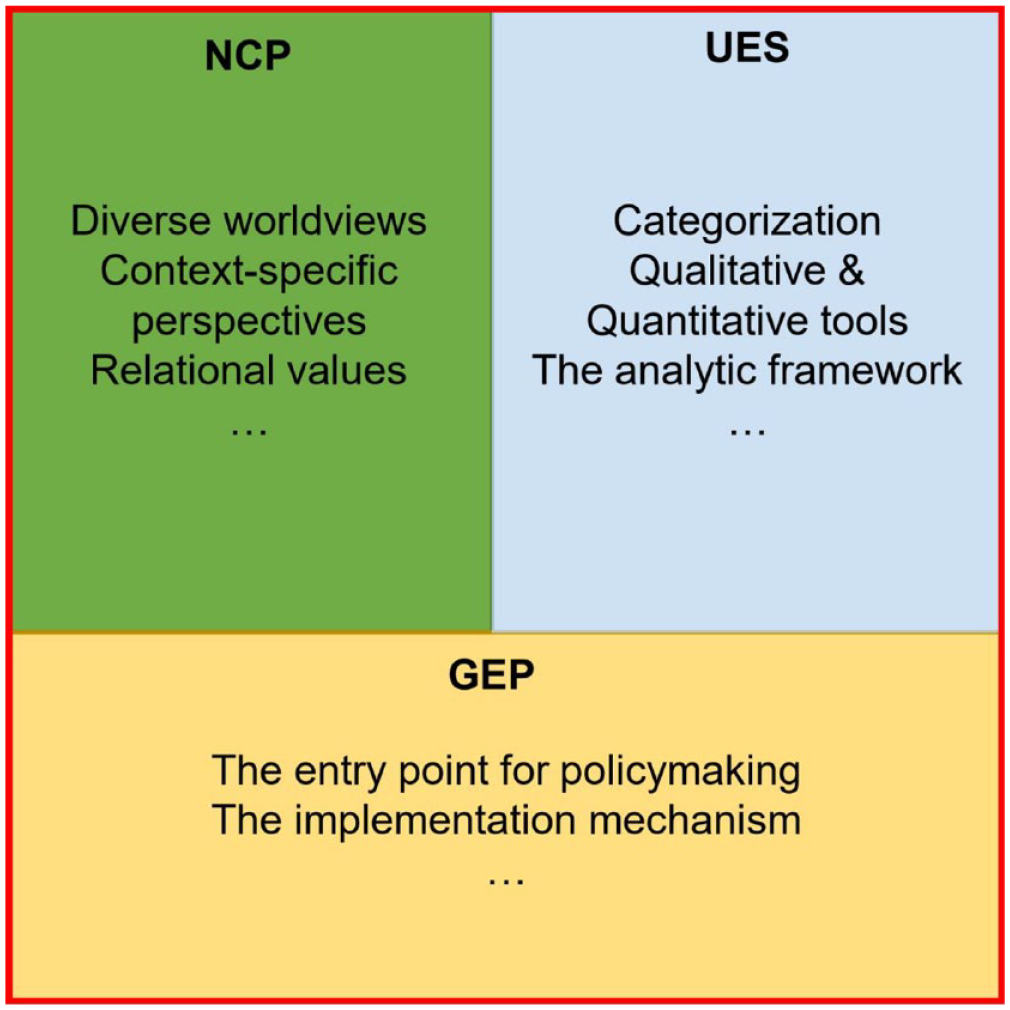
Conceptual relationships among the three frameworks for assessing ecosystem services and their values in an urban ecosystem (Red bound). NCP, UES, and GEP in the urban ecosystem.
The GEP framework has the support of the central government and cities are actively developing protocols for quantifying GEP. Although the current GEP accounting system has some limitations, it enables the inclusion of ecosystem services and their values into the political agenda. Ouyang et al. (2020) stated, ‘GEP can contribute to achieving important societal objectives, . . .by bringing the value of ecosystem services and trends in ecosystem assets into public and private sector decision-making and investment planning’ (Page 14596). This is an essential step to mainstream ecosystem services. Besides, using seven ecosystem types and official statistics in GEP accounting is very practical. First, the city or Shi (市) in China is an administrative unit below the province. A city typically contains both urban districts and rural counties. This administrative structure justifies the inclusion of the seven ecosystem types. Second, incorporating ecosystem services and their value in the policy-making process requires results based on reliable data. The official statistics are readily available and recognized by various government sectors. These features are essential for local governments' rapid adoption of the GEP framework.
While the GEP framework is instrumental to mainstream ecosystem services in Chinese cities, its simplified treatment of ES generated by urban ecosystems can complement the UES framework. Due to urban ecosystems' heterogeneous nature, detailed UES analyses are critical for planning and managing ecosystem services in urban areas. The UES framework is suitable for this purpose with its discrete and rigid ES categorizations and classifications and the well-tested biophysical models and economic approaches. In addition, the UES framework can separate human modification and inputs from nature’s contribution, which enhance the understanding of ecosystem service bundles and trade-offs (Beichler et al., 2017). Nevertheless, integrating the two frameworks requires that the existing UES approaches be further developed to be operational and standardized.
GEP and UES frameworks estimate the benefits humans can derive from biophysical processes. Policymakers can easily understand the values. However, there is a danger in viewing the value as objectively existing “out there”. Instead, the value is entangled in social and political processes (Ernstson, 2013). The NCP framework emphasizes the social aspects of ES, such as co-production, distribution of ecosystem services among different social groups, equity, and ethnic issues. Therefore, the NCP framework can be used complementarily to the GEP and UES frameworks to understand the social side of ecosystem services in Chinese cities, which is barely touched in current practices. Besides, the GEP and UES frameworks follow a human-centered philosophy in measuring the benefits of nature for humans. Separating human societies from the natural world is a western tradition that does not fit well with Chinese culture. The unity of man and nature is the fundamental proposition in Chinese philosophy. The NCP framework acknowledges diverse worldviews, context-specific perspectives, and relational values (Kadykalo et al., 2019). The framework can help Chinese cities to integrate the eco-civilization concept with the ES accounting process.
Applying the three frameworks simultaneously to assess the contribution of urban ecosystems to human well-being will undoubtedly face many challenges. A step-by-step approach is therefore needed. As the first step, more studies should be conducted to match the three frameworks with the needs of Chinese cities. For example, the three frameworks can be used for managing different dimensions of urban ecosystems, such as vegetation management and infrastructure planning. Secondly, the existing standards and guidelines of GEP can be examined to identify places where the UES and NCP frameworks can be incorporated. Furthermore, training and outreach activities must be carried out to improve people’s understanding of the three frameworks and facilitate their use.
Conclusion
Guided by a new development strategy, Chinese cities are looking for ways to assess urban ecosystems’ contributions to human well-being. The many concepts and methodologies generated from the vibrant research field on valuing nature can potentially meet this need. After examining the core concepts of the UES, GEP, and NCP frameworks and their current applications in Chinese cities, it becomes evident that each framework has unique strengths and limitations. Furthermore, the three frameworks are complementary to each other. The GEP framework leads the way to mainstream the concept of ecosystem services. The UES framework complements the GEP framework's application in urban areas by providing detailed methods for quantifying UES. The NCP framework provides means to explicitly consider the social aspect of ES, which is the weak point of the GEP and UES frameworks. On the other hand, the GEP framework provides a valuable vehicle for introducing the NCP framework into Chinese cities. In order to further incorporate the valuation of ecosystem services in the policy-making process in Chinese cities, the three frameworks should be adopted simultaneously. Future research can address the theoretical and methodological barriers to integrating the three frameworks. Due to the strong need, the prospect of achieving a breakthrough in research and practice on this topic is promising.
Footnotes
Declaration of conflicting interests
The author(s) declared no potential conflicts of interest with respect to the research, authorship, and/or publication of this article.
Funding
The author(s) disclosed receipt of the following financial support for the research, authorship, and/or publication of this article: This work was supported by the National Key R&D Program Intergovernmental Cooperation in International Science and Technology Innovation from the Ministry of Science and Technology of China (Grant no.2021YFE0193100)
