



Abstract
Water stress is intensifying under climate change, demographic growth, and socio-political pressures, raising urgent questions about how shared waters are governed. This article has a dual aim: to take stock of scholarship on water, conflict, and cooperation, and to frame the contributions of this Special Issue on “Water, Environment, and Security.” We combine a bibliometric mapping (2010–2024) with a thematic synthesis to trace field-level trends and recurring debates. The review highlights seven focal areas: power and hydro-hegemony; river-basin organizations; climate change framing on compound risks; environmental peacebuilding across scales; technological innovations; justice and equity; and the targeting of water in war. We show that conflict and cooperation frequently coexist and are mediated less by hydrology than by institutions, power relations, and inclusion. As a whole, the Special Issue advances this research agenda through diverse epistemologies and methods, conceptual frameworks, comparative and ethnographic studies, and large-N analyses, linking outcomes from households to basins. Looking ahead, we outline research frontiers in water research, including open hydrology data, justice-centered governance, war impacts, and translating transboundary commitments into local practice. Together, these insights point to pathways for more equitable, resilient cooperation over shared waters.
Keywords
1. Introduction
Clean, safe, and affordable access to water is critical for human security. Yet, water stress is already a defining global challenge. An estimated 4.4 billion people lack safe access to drinking water (Greenwood et al., 2024), a figure considerably higher than the latest United Nations Sustainable Development Goals (SDGs) monitoring number. UN projections suggest that by 2050 up to 5.7 billion people will live in countries under water stress (UN Water, 2024). Half of the world’s population already experiences highly volatile weather conditions, such as drought or flood, for at least 1 month each year (IPCC, 2022). These pressures have profound consequences: they undermine food production, constrain energy generation, and jeopardize public health (Bubeck et al., 2025; UN Water, 2024; UNECE, 2021).
Despite progress in expanding access to safe drinking water, billions remain without safe water access and inequalities persist. More than 160 million people, mostly in Sub-Saharan Africa, rely on rivers and lakes as their primary water source, while 844 million people spend over 30 minutes each day collecting water (UNICEF-WHO, 2017). Such challenges are not merely caused by a lack of technical capacity or deficient infrastructure. They reverberate across social, economic, and political domains. Water scarcity intersects with livelihoods, mobility, and development trajectories, often amplifying existing inequalities. Such scarcities have been commonly linked to conflicts, particularly in fragile settings where competition over limited resources heightens existing tensions. At the same time, water carries a pronounced geopolitical dimension: transboundary rivers and shared aquifers tie states together in relations of interdependence, shaping bargaining power, and sometimes leverage in international politics. This geopolitical dimension of water is increasingly reflected in water as a security concern in international debates.
This article has a dual objective: to provide an updated overview of scholarship on water, conflict, and cooperation, and to introduce the contributions of this special issue on “Water, Environment, and Security.” We synthesize existing research and highlight key debates, while the special issue advances the field with new data, perspectives, and conceptual approaches. Together, the contributions show how water governance research has evolved in response to global challenges and geopolitical tensions, and where it is heading. Here, we first survey the scholarly landscape through a bibliometric analysis, a thematic synthesis of recurring debates, and a review of influential works. The article then positions the Special Issue by showing how the contributions engage with these debates by bridging levels of analysis, and opening new directions for research. We conclude by looking ahead to emerging frontiers on water and peace.
1.1. From scarcity to (in)security
The mounting pressures of water scarcity and climate-induced hydrological change have spurred not only policy debates but also a rich body of scholarship on water sharing and governance. Early alarmist claims of looming “water wars” (Homer-Dixon, 1999; Starr, 1991) gradually gave way to systematic empirical research, which demonstrated that cooperation is far more prevalent than violent conflict over water (Bernauer & Böhmelt, 2020; Kåresdotter et al., 2023; Wolf, 1998, 2007; Yoffe et al., 2004; Zeitoun, 2020). This literature focusing on water cooperation has emphasized that water scarcity, while often a source of diplomatic and social tension, can also foster cooperative arrangements when states or communities recognize their mutual dependence on shared resources (Dinar, 2020; Sadoff & Grey, 2002; Swain, 2024).
An important contribution of the water cooperation literature is the fundamental shift from hydrological to governance aspects of water sharing. From this perspective, water is not only a physical resource but also a political object. Outcomes of interaction are shaped less by hydrology alone than by governance structures, institutional design, and underlying power relations (Fischhendler, 2008; Gerlak & Schmeier, 2016; Zeitoun & Mirumachi, 2008). Then, domestic politics add another layer: political discourses, stakeholder coalitions, and local governance arrangements influence whether international treaties translate into effective implementation (Krampe, 2016; Mirumachi, 2020). This complexity becomes even more apparent when examining interactions at different spatial and temporal scales. Even in the same basin, cooperation and conflict frequently coexist, depending on the scale, and timeframe of analysis (de Bruin et al., 2022; De Stefano et al., 2017; Link et al., 2016). The following section elaborates on a multi-scalar lens as one of the key analytical and theoretical approaches in the field.
1.2. Multi-level governance lens
Water governance is fundamentally multi-scalar, involving actors that range from international organizations to local communities. Each level brings distinct capacities, interests, and constraints, and their interactions shape how water stress can be addressed. At the international level, intergovernmental organizations and global frameworks such as the UN Watercourses Convention or the United Nations Economic Commission for Europe (UNECE). Water Convention establish normative ground rules, promote principles of equitable and reasonable use, and provide platforms for monitoring and dialogue (Rieu-Clarke et al., 2022; UNECE, 2021; Woodhouse & Muller, 2017). These actors and conventions are key because they set legal and normative baselines, especially where basin-wide treaties are absent, because they create incentives for states to align national practices with global norms.
At the transboundary basin level, river basin organizations (RBOs) and joint commissions offer institutional spaces for riparian states to exchange information, plan infrastructure, and negotiate allocation. Their importance lies in institutionalizing cooperation and reducing transaction costs in basins that might otherwise be sites of recurrent dispute (Gerlak & Schmeier, 2016; Schmeier, 2014). For example, the Senegal River Basin Development Organization (OMVS) has facilitated joint hydropower projects and equitable benefit-sharing despite political tensions among member states. Similarly, the Mekong River Commission has provided a platform for upstream and downstream states to engage in dialogue, though its effectiveness remains shaped by asymmetries in power and capacity (Mirumachi, 2020).
At the state or bilateral level, governments remain pivotal actors because they control financial resources, authorize agreements and projects, and shape conditions for domestic implementation. Their importance stems from territorial sovereignty and decisions on infrastructure and allocation, which can either enable or obstruct cooperative basin management (Conca, 2005; Fatch & Swatuk, 2018; Zeitoun & Mirumachi, 2008). A prominent example is the Indus Waters Treaty between India and Pakistan, which has endured through wars and political crises, underscoring the resilience of bilateral arrangements even under conditions of hostility (Swain, 2024; Wolf, 1998).
At the sub-state and local levels, municipalities, water user associations, and community groups play a central role in everyday water allocation, distribution, and conflict resolution. These actors are crucial because international and national agreements rarely succeed without local buy-in; moreover, they often carry the burden of implementing policies and maintaining existing infrastructure (Hughes & Mullin, 2016; Krampe, 2016; Mirumachi & Van Wyk, 2010). Local initiatives such as rotational water-sharing schemes in parts of South Asia or decentralized irrigation committees in Latin America illustrate how communities can craft practical arrangements that sustain cooperation during scarcity (Linh et al., 2025; Petrova & Rosvold, 2024; Wutich, 2024; Wutich et al., 2018).
The interactions across these levels are dynamic, potentially solving water allocation issues, but also sometimes conflictual. Global norms may be filtered through basin organizations before shaping national policies, while domestic politics can determine whether international treaties are ratified or effectively implemented. Conversely, local grievances, such as inequitable distribution or exclusion from decision-making, can undermine higher-level cooperation. Successful governance thus requires not only institutions at each scale but also coordination across them (Grech-Madin et al., 2018). A multi-level governance lens highlights that water security is not produced at any single level but emerges from the interplay of actors across scales (Albrecht & Gerlak, 2022; Asgari, 2021; Mehta, 2001). Recognizing these interdependencies provides a central theme for this article and the special issue: mapping how cooperation and contestation over water are shaped across international, basin, national, and local arenas.
2. The scholarly landscape
The literature on water, conflict, and cooperation has largely addressed a set of recurring themes that cut across scales and approaches. These debates not only frame how water governance is conceptualized but also reveal where empirical evidence is strong and where important gaps remain. Below, we highlight seven themes that stand out in recent research.
2.1. Power and hydro-hegemony
The hydro-hegemony framework has been central in shifting analysis from scarcity-driven explanations toward the political and power-laden dynamics of transboundary water governance (Zeitoun & Mirumachi, 2008). It highlights how dominant riparians leverage material power, bargaining advantage, and discursive control to shape outcomes, often embedding their preferences in treaties, infrastructure projects, or everyday practices (Hussein et al., 2023; Menga, 2015). This perspective has generated rich debates, with studies examining how upstream states exercise “structural power” through dams and diversions, while downstream actors may counter with international alliances or legal norms (Cascão & Zeitoun, 2010; Mirumachi, 2020). It is important to note that hegemony is not static: weaker riparians sometimes carve out room for agency, whether by mobilizing external support, reframing narratives, or exploiting interdependencies (Ali, 2025; Loodin, 2025; Loodin & Warner, 2022; Zeitoun et al., 2017). Hydro-hegemony as a framework has limited engagement with the multi-scalar dimensions or non-state sources of power in transboundary water interactions, which is a weakness in capturing the politics of scale (Hayat et al., 2022). Overall, this literature underscores that water sharing outcomes are rarely the product of hydrology alone but are mediated by asymmetries in power and the strategies actors deploy within them.
2.2. River-basin organizations
RBOs are often viewed as institutional solutions for states to manage shared water resources (Mitchell & Keilbach, 2001), yet evidence of their effectiveness in resolving international water disputes is mixed. There has been a rise of RBOs in terms of their numbers, and these organizations are diverse in mandate, scope, and size (Lautze et al., 2013). These institutional variations and different forms of cooperation are embedded in regional and historical contexts (Chapman et al., 2016; Janusz-Pawletta, 2015). Comparative studies show that while RBOs can facilitate trust-building, information exchange, and joint infrastructure projects, their authority is frequently constrained by shallow treaty provisions, limited compliance, or insufficient political support (Gerlak & Schmeier, 2016). By contrast, other basins illustrate how weak design, inadequate resources, or asymmetrical power relations reduce RBOs to technical coordinators rather than genuine governance bodies (Bouckaert et al., 2018; Tir & Stinnett, 2009). The literature thus underscores that institutional presence alone is not sufficient; effectiveness depends on design depth, resource capacity, and the broader political context.
2.3. Climate change and water governance
Climate change is frequently described in policy and scholarly debates as a “threat multiplier” (Goodman, 2024). The debates draw on various aspects of climate change to amplify existing vulnerabilities and intensify competition over water through more frequent and severe extremes such as droughts, floods, glacier retreat, and saltwater intrusion (IPCC, 2022). Yet, this framing has also been criticized for being overly deterministic, security-centric, and insufficiently attentive to context (Ide, 2018; Selby et al., 2017). Alternative approaches emphasize the complexity of climate–water interactions, pointing to compound hazards, feedback loops, and vicious cycles in which climate extremes intersect with governance failures, socioeconomic inequalities, and political instability (Adger et al., 2024; Buhaug & Von Uexkull, 2021; Kim & Garcia, 2023; Koubi, 2019; Tripathy et al., 2023). These perspectives underline that climate change does not dictate outcomes, but interacts with multiple drivers that can push dynamics toward either escalation or adaptation. Empirical research provides examples in both directions: severe droughts have been linked to heightened tensions in the Nile and Tigris-Euphrates basins, while in the Mekong and Senegal basins, climate variability has incentivized information-sharing and adaptive institutional reforms (De Stefano et al., 2017; Hussein et al., 2023; Turgul et al., 2024). Overall, the debate reflects an ongoing shift from deterministic security framings toward more nuanced analyses that capture how climate change interacts with other hazards to shape water governance outcomes.
2.4. Environmental peacebuilding
Contributions to this journal provide many excellent contributions to the emerging literature on environmental peacebuilding, which, among other things, argues how cooperative water management can generate broader dividends for trust, institution-building, and social cohesion (Conca, 2002; Ide et al., 2023; Krampe, 2017; Swain et al., 2023). Importantly, peacebuilding is not confined to interstate agreements. Local and national initiatives, such as community-based water-sharing schemes, participatory irrigation committees, or municipal investment in inclusive governance, are also central arenas for fostering stability (Bernauer & Böhmelt, 2020; Grech-Madin et al., 2018). This means that “peace dividends” of cooperation can manifest across scales, from interpersonal trust within communities to institutional resilience at the basin level. At the same time, critical perspectives caution against overly optimistic readings. Poorly designed projects risk reinforcing inequalities, depoliticizing conflict, or legitimizing exclusionary governance practices (Hussein et al., 2023; Zeitoun et al., 2014). This has shifted attention toward inclusive, conflict-sensitive approaches that address power asymmetries, social identities, and local needs. Recent work further links environmental peacebuilding to debates on justice and recognition, calling for approaches that foreground equity and plural knowledge systems rather than narrow technical fixes (Mirumachi & Van Wyk, 2010; Pacheco-Vega, 2020).
2.5. Technological innovations
In addition to the institutional and legal solutions, new technologies provide new biophysical or social-institutional opportunities for cooperation over transboundary water management. These new technologies are namely, desalination, remote sensing, satellite-based data sharing, and digital monitoring, which can shape negotiations and joint management. Desalination has become a major source of potable water in high-income countries in the Middle East, and affordability and availability of desalination have influenced incentives and strategies in shared water negotiations (Aviram et al., 2014; Katz, 2021). Water saving technologies can similarly influence water negotiations by reducing water stress in agricultural sections through water-saving agricultural practices. The optimization discussions concern transboundary basin levels as well as sub-national regions experiencing acute water stress (Hidayah et al., 2024). These technological innovations are particularly relevant in terms of the water-energy-food nexus, seeking co-benefits and measures to manage inter-connected risks across these sectors (Mooren et al., 2024).
Advancements in monitoring and modeling tools have significantly impacted water negotiations and disputes by providing negotiators and water governance institutions with new data and insights (ter Horst, Michailovsky, et al., 2023). Satellite-based remote sensing techniques are now widely used for estimating water levels and issuing transboundary flood warnings, reducing tensions around transboundary water risks where formal agreements are weak (Hassan et al., 2023; Motta & Koehler, 2025). In addition, forecasting techniques are increasingly being incorporated into efforts to predict future water flows in transboundary basins, moving beyond the traditional reliance on scenario-based analyses (Dong et al., 2024). While these technological advancements play a crucial role in reducing tensions and facilitating more informed decision-making, their effectiveness is limited without addressing the underlying issues of justice and equity in water governance (ter Horst, Srinivasan, et al., 2023). Indeed, technical solutions alone cannot resolve the complex socio-political dynamics surrounding transboundary water resources (Kim & Ahmad, 2025). This highlights the importance of ensuring fairness and inclusivity in governance structures to foster lasting cooperation.
2.6. Justice and equity
Justice has been a long tradition in analyzing inequality in water allocation and access, and scholars have gradually incorporated the justice framework in the intersection with transboundary water interactions. This emerging sub-field is rooted in the critical understanding that profound inequalities exist in access to water among individuals, households, social groups, and nations (Sultana, 2018). It delves into the drivers of these inequalities and examines sources of solidarity to address both their causes and consequences (Schlosberg, 2004). Marginalized groups often bear the heaviest burdens of water scarcity, being denied access to clean, sufficient, and affordable water (Perreault, 2014; Wilson et al., 2021). These groups typically include young women and children, residents in extractive resource frontiers, and indigenous communities, who are frequently underrepresented in transboundary water negotiations and governance (Anderson et al., 2023; Sultana, 2018). The denial of water, a fundamental human right, constitutes a grave injustice, and scholars have explored how water justice, in turn, influences and is influenced by transboundary water interactions (Tinti, 2023; Zeitoun et al., 2014). From a water justice perspective, contestation and conflict are deeply linked to issues of access and control (Zeitoun et al., 2017). Tensions often arise in response to the reallocation of water, new sharing arrangements, water infrastructure projects, or water-intensive extractive activities, each of which can provoke resistance (Joy et al., 2014). Injustice is heightened when procedural and substantive provisions fail to address concerns, yet justice perspectives remain underexplored in large-N, cross-case studies, leaving them with less clearly featured research on water cooperation and conflict.
2.7. War on water
Research has increasingly documented how armed conflict undermines water access through both direct and indirect pathways. A growing body of evidence shows that water infrastructure, such as dams, reservoirs, urban supply networks, and treatment plants, is often deliberately targeted or suffers collateral damage, despite legal protections under international humanitarian law (Schillinger, Özerol, Güven-Griemert, et al., 2020; Talhami & Zeitoun, 2020; Tignino, 2023; Zeitoun, 2023). The war in Ukraine has seen extensive attacks on dams and wastewater treatment facilities, echoing patterns observed in Iraq, Syria, and Yemen, where water systems became strategic targets (Shumilova et al., 2023; Sowers & Weinthal, 2021). Beyond destruction, conflicts impair functionality by diverting financial and human resources from system maintenance, disrupting power and supply chains, and forcing households to rely on informal providers such as tanker markets, with long-term consequences for groundwater depletion and sanitation (Schillinger, Özerol, & Heldeweg, et al., 2022; Vesco et al., 2025).
Indirect effects of war on water governance are equally damaging by posing long-term governance challenges. Post-conflict reconstruction of water systems is often slow, underfunded, or fragmented, leaving communities reliant on unsustainable coping strategies. While case-specific studies have proliferated, systematic comparative and longitudinal research remains rare (Krampe et al., 2025). This is critical for understanding how wartime disruptions reshape water institutions, ecosystems, and societal resilience over the long run. Addressing this gap is crucial if research is to inform not only humanitarian response but also peacebuilding and recovery strategies in conflict-affected regions.
3. General trends
Several reviews have already taken stock of the water–conflict–cooperation literature, from early syntheses challenging paradigms on water conflict (Gleditsch, 1998; Swain, 2004; Wolf, 2001) to more recent overviews (Bernauer & Böhmelt, 2020; Dinar, 2020; Hayat et al., 2022; Turgul et al., 2024). Here, we present a bibliometric review focusing explicitly on water conflict or water cooperation. Bibliometric mapping provides an overview of trends in how scholarly attention has grown, how it clusters across disciplines, and how it responds to global events and policy agendas. Our aim is not to capture the full conceptual debate or provide an exhaustive survey, but to offer a broad view of the field’s recent development, complementing qualitative reviews with quantitative publication evidence. To that end, we conducted a set of bibliographic searches to capture research on water cooperation and conflict published between 2010 and 2024. By starting in 2010, we highlight more recent developments in the field, particularly those emerging in the context of climate change, the SDGs, and renewed interest in water diplomacy. Searches were restricted to peer-reviewed research articles in English and to words in titles, abstracts, and keywords. We used both Scopus and Web of Science, but since the results were very similar, we present here the Scopus findings. Searches were conducted on September 9, 2025 using the following terms: For cooperation: (water OR groundwater OR river) W/5 (diplomacy OR diplomatic* OR negotiat* OR peacebuilding OR peacemaking OR agreement). For conflict: (water OR groundwater OR river) W/5 (war OR armed OR dispute OR conflict OR violen*).
The time-series data show a steady increase in research output over the past 15 years, with substantially more publications on conflict than on cooperation (Figure 1). Surges coincide with major global policy moments, including the 2015 adoption of the SDGs (especially SDG 6 on water, SDG 13 on climate, and SDG 16 on peace) and the 2015 Paris Agreement, both of which elevated water and climate security on policy and scholarly agendas. The post-2022 period also shows another marked rise, possibly linked to renewed attention to the war in Ukraine and the targeting of water infrastructure. This imbalance, where conflict receives disproportionate attention despite being a comparatively rare outcome, raises important questions for the field. We argue there is a need to study cooperative processes and peaceful interaction with equal rigor and quantity, so as to better understand not only how disputes emerge but also how cooperation is sustained, adapted, and scaled across levels of governance.
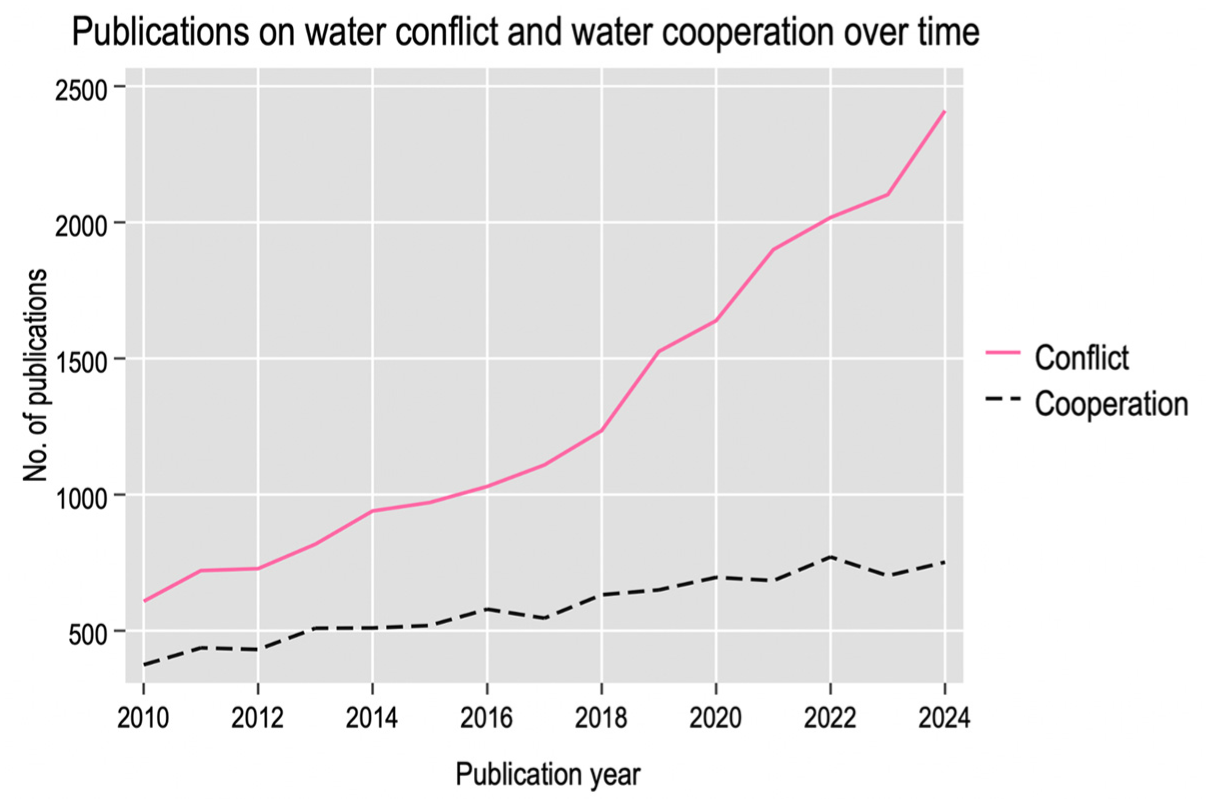
Number of publications on water conflict and water cooperation (2010–2024).
In addition to this growth in volume, the bibliometric mapping highlights the interdisciplinary character of the field. Water conflict and cooperation studies span environmental science, the social sciences, agricultural and earth sciences, law, and economics, among others (Figure 2a and b). For these figures, we use the subject areas as categorized in Scopus and focus on the top 10 disciplines. Conflict-related studies show somewhat more engagement from the humanities and social sciences, while cooperation research slightly draws more from engineering and technical research fields. This breadth underscores the diversity of approaches in the field, with different epistemic communities focusing on different aspects of the problem. This diversity also highlights a risk of fragmentation unless supported by harmonization efforts and interdisciplinary collaboration. Together, these trends confirm the expansion and diversification of water governance research.
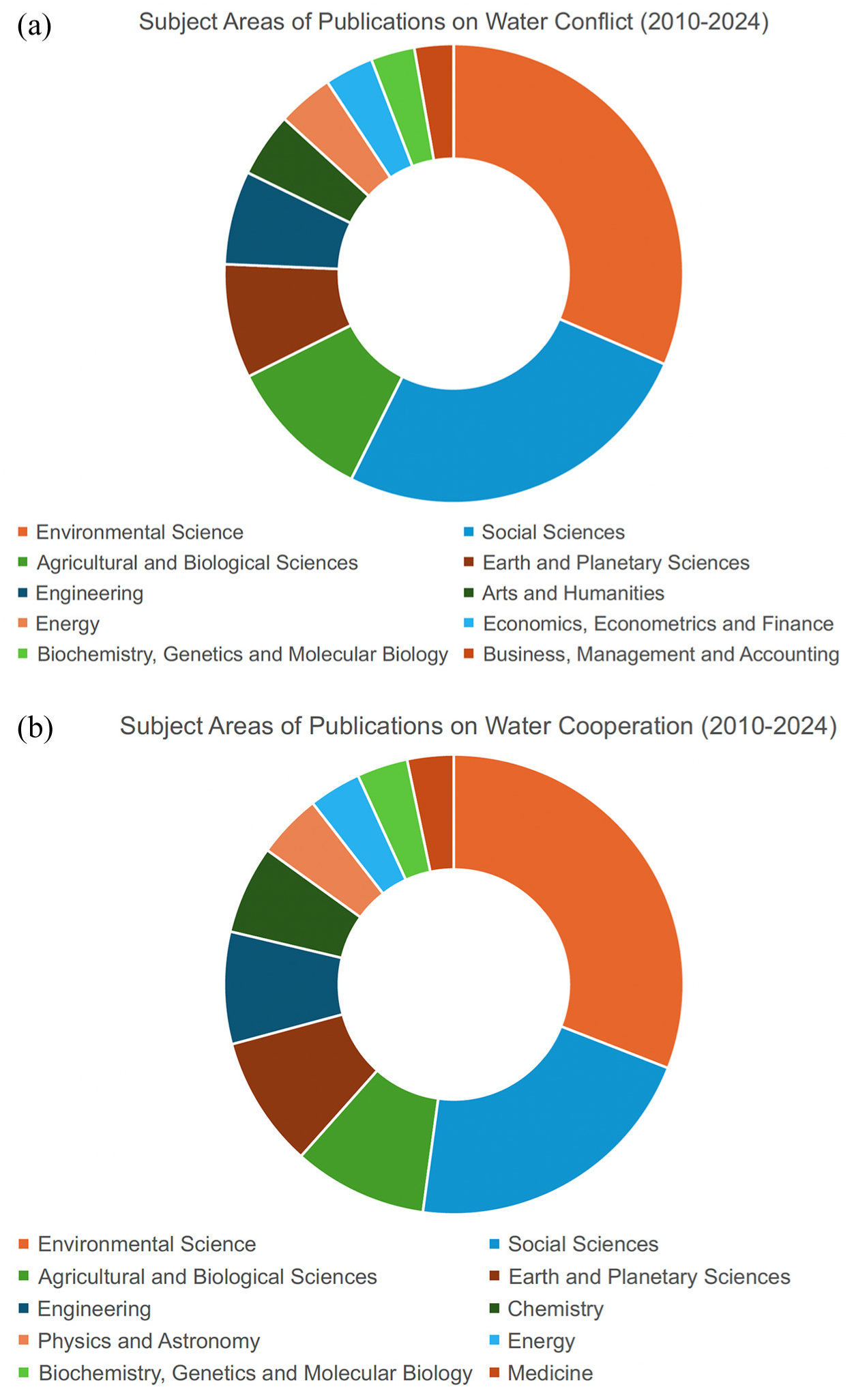
Subject areas (disciplines) of publication on water conflict and water cooperation.
While the bibliometric review provides a useful overview, it has clear limitations. Results are sensitive to search terms and search fields limited to titles, abstracts, and keywords. This method possibly privileges work that labels itself as “conflict” or “cooperation,” potentially overlooking nuanced findings embedded in related concepts such as governance, resilience, or adaptation. Bibliometric counts also cannot capture quality, influence, or theoretical depth. This mapping should thus be read as a broad indication of trends rather than a comprehensive inventory.
4. Positioning the contributions of the Special Issue
This special issue brings together contributions that examine the intersections of water, conflict, and cooperation, with particular attention to transboundary resources and climate change. The articles introduce new frameworks, concepts, and empirical analyses, spanning scales from community initiatives to interstate disputes and methods from fieldwork to large-N statistical studies. Together, they advance debates on water diplomacy, peacebuilding, and conflict management, while also offering applied insights for policy and practice. The collection highlights persistent challenges such as power asymmetries, water weaponization, and institutional fragility, but also points to opportunities for more just and resilient governance.
The contributions also adopt a wide spectrum of epistemological positions. Some take critical or interpretive stances, drawing on decolonial, political ecology, or relational peacebuilding perspectives to question dominant security- and data-driven framings. Others work within positivist traditions, applying statistical models, institutionalist frameworks, or typologies to produce generalizable insights. The Special Issue also includes studies that bridge these divides, adopting pragmatic approaches that combine conceptual reflection with policy utility. This diversity mirrors broader trends in water governance research, where critical, constructivist, and positivist traditions coexist and evolve in parallel. What is distinctive is the field’s openness to such plurality: contrasting epistemologies often share the same scholarly space, making it possible to value differences as well as common insights.
Building on this epistemological diversity, the contributions also display a wide variety of methodological choices and theoretical approaches. Some papers are conceptual and framework-building, offering new ways to theorize water–conflict links (Beames et al., 2025; Grech-Madin, 2025), or advancing critical lenses such as decolonial water diplomacy and justice-centered approaches (Nagheeby et al., 2025). Others ground their analysis in rich empirical material, for instance, through interviews and longitudinal case studies of peacebuilding practice (Peters et al., 2025). Large-N statistical designs add a different vantage point, using global or dyadic datasets to test hypotheses on hydrological dominance, institutional learning, or climate variability in border regions (Boyes & Lynch-Dombroski, 2025; Lee & Lee, 2025; Owsiak & Mitchell, 2025). Comparative institutional analysis bridges these traditions, showing how design features shape the effectiveness of basin-level organizations (Zawahri et al., 2025). As in the epistemological domain, this methodological plurality reflects a broader characteristic of water research: a field unusually open to multiple ways of knowing and investigating, where theoretical innovation often emerges precisely through the juxtaposition of contrasting approaches. There is a strong case to be made that understanding the links between water and peace requires exactly such diversity of perspectives, as no single method or theory can capture the full complexity of these dynamics.
A common theme across the Special Issue is the range of outcomes explored, which together illustrate the many ways water and peace intersect. Some contributions approach outcomes in normative terms, examining justice, equity, and recognition as essential dimensions of water diplomacy and cooperation (Nagheeby et al., 2025), while others focus on the relational dividends of cooperation, such as trust, agency, and shared responsibility (Peters et al., 2025). These perspectives contrast with the potential destructive uses of water in armed conflict, showing how it can be weaponized to inflict harm or gain leverage (Grech-Madin, 2025). A different set of studies takes an institutional lens, evaluating how RBOs and joint bodies manage disputes (Zawahri et al., 2025) and how states learn, or fail to learn, from past experiences with conflict management across issue areas (Owsiak & Mitchell, 2025). Yet, there is also a clear need to analyze the structural and environmental determinants of conflict, such as hydrological dominance within river networks (Boyes & Lynch-Dombroski, 2025) or effects from climate extremes (Lee & Lee, 2025), which help explain when disputes emerge or escalate. Taken together, the Special Issue shows that outcomes span a wide spectrum of water research: from justice and identity to trust and cooperation, from institutional effectiveness to instability and war. This diversity is not accidental but reflects the multiple entry points through which water and peace can be studied. Some approaches begin with the river itself, treating hydrology, basin networks, or water infrastructure as the central object of analysis. Others start from states and institutions, asking how governments and organizations negotiate, learn, or weaponize water in conflict. Still others focus on communities and individuals, tracing how cooperation or exclusion shapes lived experiences of peace and justice. Each entry point directs attention to a different dimension of outcome, and it is precisely the coexistence of these vantage points that gives water research its richness. By engaging these diverse perspectives side by side, the collection demonstrates how the risks and opportunities of water governance can only be fully understood when outcomes are conceived as interconnected processes that operate simultaneously across ecological, political, and social domains.
This collection also addresses several long-standing gaps in research on water, security, and governance. One set of contributions advances conceptual clarity where earlier work was fragmented or overstretched: new frameworks trace the indirect pathways from water disturbances to instability (Beames et al., 2025), develop a systematic typology of water weaponization (Grech-Madin, 2025), and specify how institutional design features shape the effectiveness of joint basin institutions (Zawahri et al., 2025). Another set moves beyond oversimplified dyadic and upstream–downstream models, whether by incorporating network approaches to capture hydrological dominance across basins (Boyes & Lynch-Dombroski, 2025) or by analyzing how states learn, or fail to learn, from past experiences in conflict management (Owsiak & Mitchell, 2025). A third cluster fills gaps in the treatment of environment–conflict linkages, sharpening the role of spatial precipitation variability in border disputes (Lee & Lee, 2025) and centering relational, human-level processes in environmental peacebuilding (Peters et al., 2025). Finally, the issue confronts the colonial legacies that continue to shape water diplomacy, calling for approaches grounded in justice, recognition, and plural epistemologies (Nagheeby et al., 2025). Taken together, these studies expand the field by challenging simplified narratives, offering novel conceptual and empirical tools, and situating water and peace research within broader social and political realities.
The contributions also differ markedly in their geographic orientation, which shapes the outcomes they highlight. Some focus on bilateral dynamics, such as community cooperation and state relations in Israel, Palestine, and Jordan (Peters et al., 2025), or within justice and decolonial perspectives (Nagheeby et al., 2025). Others adopt a comparative basin approach, examining institutions across the Euphrates–Tigris, Mekong, and Indus rivers (Zawahri et al., 2025), or analyzing conflict dynamics in Central Asia and the Middle East within broader hydrological networks (Boyes & Lynch-Dombroski, 2025). Several contributions extend the scope further, drawing on historical and contemporary cases from across the globe to conceptualize patterns of water weaponization (Grech-Madin, 2025) or to develop general frameworks linking water disturbances to political instability (Beames et al., 2025). Large-N statistical analyses likewise rely on global datasets of diplomatic disputes and precipitation anomalies (Lee & Lee, 2025; Owsiak & Mitchell, 2025). While the collection spans multiple world regions, coverage remains uneven, with some areas, such as Oceania or parts of sub-Saharan Africa, receiving little attention.
Policy has long been central to water and peace research, with many scholars engaging closely with practitioners. The contributions in this Special Issue continue this tradition in different ways: some directly address practice through frameworks for risk assessment, early warning, or institutional design, while others offer indirect guidance by showing how cooperation reshapes relationships, how justice considerations redefine diplomacy, or how structural factors influence conflict and cooperation. Together, they illustrate the multiple pathways through which research informs policy, from local governance to international law.
The collective value of the issue lies in advancing a more nuanced understanding of links between water, conflict, and cooperation. Moving beyond the reductive “water wars” narrative, the contributions clarify indirect pathways from water disturbances to instability, systematize how water can be weaponized, and identify institutional design features that foster effective basin governance. They also push methodological boundaries with network-based approaches and new datasets, while deepening insight into institutional and relational dynamics. Finally, they expand the field’s ethical and human-centered scope by foregrounding justice, identity, and lived experience. Together, these advances make the field more theoretically robust, methodologically innovative, and normatively attentive to the realities of a climate-stressed world.
5. Looking ahead
As the literature on water, conflict, and cooperation has advanced, it has also revealed blind spots and emerging frontiers. These should be seen not as isolated topics but as interconnected challenges shaped by ecological change, technological innovation, and shifting patterns of conflict.
One priority is groundwater. Despite providing nearly half of global freshwater withdrawals, aquifers remain marginal in research and diplomacy. Few formal agreements exist, monitoring is limited, and hydrological and political boundaries rarely align. Over-extraction and poor regulation have led to depletion in several regions, underscoring the need to assess whether river-based models can be adapted or whether new institutional innovations are required.
Digital transformations are also reshaping cooperation. Advances in remote sensing, machine learning, and digital twins promise to improve forecasting and risk management, potentially reducing uncertainty and fostering trust through shared data. Yet, they raise questions about data sovereignty, unequal technical capacity, and information control. Their political economy, whether they democratize knowledge or entrench asymmetries, requires closer scrutiny.
Justice and inclusion remain equally pressing. Women, indigenous peoples, and marginalized communities often bear disproportionate burdens of scarcity and exclusion from decision-making. Incorporating distributive, procedural, and recognitional justice is thus not only a normative imperative but also key to preventing cooperation from reproducing inequalities. This calls for greater engagement with feminist, indigenous, and Global South epistemologies, as well as methodological innovations that treat justice as a central analytical category.
The rapid expansion of desalination also raises new geopolitical questions. Especially in the Middle East and coastal Asia, desalination reduces dependence on contested freshwater but creates new vulnerabilities linked to energy, supply chains, and technology providers. The debate around the Water-Energy-Food nexus partly captures this interconnected vulnerability between water and energy, but not sufficiently. In addition, ecological risks through poor source-to-sea management need to be further addressed as this presents further complications in marine and coastal ecosystems. Water governance research has only begun to address these issues, leaving desalination geopolitics as a largely uncharted frontier.
Addressing these challenges will require methodological pluralism. The field has long been divided between large-N analysis and qualitative case studies, yet integration, combining satellite monitoring or treaty datasets with ethnography, surveys, or interviews, offers more comprehensive explanations of how cooperation and conflict unfold across scales. This also demands epistemological openness and collaboration, recognizing that different methods can complement.
There is also scope for deeper disciplinary integration. Socio-hydrology, with its focus on coupled human-water systems, has developed largely apart from peace and conflict research (Döring et al., 2024; Sivapalan et al., 2012), while ecological science has often been sidelined. Yet, biodiversity loss, ecosystem services, and planetary boundaries directly shape the durability of water governance. Bringing these perspectives into political analysis is vital if agreements are to be both viable and sustainable.
Substantive gaps also remain in wartime targeting of water. We lack a systematic understanding of how war reshapes water quality, ecosystems, and governance capacities over time. With organized violence again on the rise, it is crucial to examine how transboundary agreements hold under stress and how local governance adapts.
Taken together, these frontiers point to a research agenda that is interdisciplinary, methodologically pluralist, and practice-oriented. Advancing knowledge on technologies, justice, ecology, war, and governance across scales can enrich theory while supporting more equitable, resilient, and sustainable pathways for cooperation in an era of intensifying challenges. At the same time, future scholarship must strive to redress the imbalance in focus: while conflict has often been privileged as an object of study, cooperation remains the more frequent, yet understudied, outcome. Giving equal attention to how cooperation is forged, sustained, and scaled will be essential for building a knowledge base that not only diagnoses risks but also illuminates pathways to peace.
Equally important is strengthening research that evaluates policy initiatives and interventions. Systematic approaches, ranging from randomized controlled trials to longitudinal comparative studies, can assess what works, for whom, and under what conditions. Such evaluations help connect national frameworks to local realities, reveal which grassroots initiatives scale effectively, and provide international donors or regional organizations with evidence for more targeted support. Embedding rigorous evaluation in water governance research can therefore foster accountability, cross-border learning, and adaptive policymaking.
6. Conclusion
This analysis highlights both the urgency of water challenges and the opportunities for cooperation. Peaceful resolution of tensions is essential as water stress intensifies under climate change, demographic growth, and political instability. While scholarship shows cooperation is more common than violent conflict, research still leans heavily toward studying conflict rather than the many dimensions of cooperation. Moving beyond the binary view, this article underscores that conflict and cooperation often coexist and are shaped not by hydrology alone but by governance, institutions, power, and justice. This Special Issue contributes by advancing conceptual, methodological, and empirical depth. These aspect can broaden our understanding of how water interactions unfold across scales, from households to basins, and how governance intersects with peace and stability.
Several messages stand out. First, the field has moved past deterministic narratives, recognizing the complexity of water–conflict linkages and the importance of multi-level analysis. Second, its epistemological and methodological diversity is a strength, reflecting the multifaceted nature of water governance. Third, new frontiers demand attention: groundwater diplomacy, digital tools, justice and inclusion, desalination geopolitics, socio-hydrology, and ecological sustainability. At the same time, gaps remain in understanding how war affects water, how climate extremes reshape cooperation, and how international agreements translate into local practice.
As the world approaches the 2026 UN Water Conference and the mid-term review of the SDGs, the stakes are high. Achieving SDG 6 on water and sanitation will not be possible without engaging the conflict–cooperation dynamics that shape access and governance. Yet, the contributions in this issue show that progress is achievable: cooperation is resilient, new tools are emerging, and justice-oriented approaches are gaining ground. By embracing disciplinary diversity, methodological pluralism, and policy engagement, water governance scholarship can help chart more equitable and sustainable pathways in an era of intensifying pressures.
Footnotes
Funding
The authors disclosed receipt of the following financial support for the research, authorship, and/or publication of this article: SD acknowledges support by the Swedish Research Council (VR 2022-00183) and Riksbankens Jubileumsfond (M21-0002). KK acknowledges support by the Swedish Research Council (VR 2023-06496).
