



Abstract
Environmental cooperation is theorized to contribute to peacebuilding, but the complexity of how this linkage is realized for the people involved remains out of view. This article applies relational thinking—understanding individuals, systems, and concepts through their interconnectedness and mutual influence—to the field of environmental peacebuilding with the goal of contributing to theory building. This research focuses on nearly 30 years of EcoPeace Middle East’s environmental peacebuilding over shared waters in Israel, Jordan, and Palestine from 1994 to 2022. Based on interviews with 83 people involved in environmental peacebuilding programming, the analysis outlines the plurality of how participants perceive and practice their changing roles, responsibilities, and agency in relation to themselves, each other, and their shared environments. The findings are interpreted in three analytical categories: stagnation, shifts, and transformations. This research suggests that pathways from environmental cooperation to peacebuilding may not be tied as strongly to outcomes but the process of how they engage deeper relational networks of heterogeneous meaning making. We argue that the many voices of environmental cooperation together contribute to ongoing and nonlinear processes of peace and environmental sustainability even amid ongoing violence.
Keywords
1. Introduction
Environmental crises have long been recognized as having the potential to destabilize social and political systems and contribute to armed conflict (Black et al., 2022; Homer-Dixon, 1994) especially in places already rife with conflict risk factors (Ide et al., 2020; von Uexkull et al., 2016). The burgeoning field of environmental peacebuilding offers a linked narrative that environmental changes and challenges, particularly around shared resources like water, can also catalyze peacebuilding (Conca & Dabelko, 2002; Ide et al., 2021; Swain, 2016). Beyond resolving environmental conflicts, environmental peacebuilding has been posited as a tool to contribute to peacebuilding unrelated to the environmental conflict (Ali, 2011) through cross-border environmental cooperation (Maas et al., 2012).
These premises have been met with mixed empirical evidence about whether environmental peacebuilding efforts deliver environmental gains and whether these efforts or outcomes contribute to peacebuilding (Dresse et al., 2019; Ide, 2019; Johnson et al., 2021). This in part reflects challenges faced in evaluating the impacts of specific peacebuilding activities on peace (Lemon & Pinet, 2018; Woodrow & Chigas, 2011), and the impacts of environmentally focused efforts on sustainability (Environmental Law Institute, 2023). However, the weak evidence base also reflects the theoretical gaps that frame understanding of how environmental peacebuilding is actually meant deliver desired environmental and peacebuilding goals (Dresse et al., 2019). Theories of change typically hinge on intermediary indicators associated with environmental cooperation, like the signing of water-sharing agreements or achieving measurable gains in water quality, but such achievements are often considered atomistically, without situating them within the interlaced people, places, and processes involved in the underlying efforts.
The “relational turn” that foregrounds these deeper interrelationships in the fields of critical peace studies (e.g., Courtheyn, 2018; Davenport, 2018; Söderström et al., 2021; Strömbom & Bramsen, 2022) and environmental sustainability studies (e.g., Chan et al., 2016; Gould et al., 2023; Vásquez-Fernández & Ahenakew pii tai poo taa, 2020; West et al., 2020) has not yet taken hold in the field of environmental peacebuilding. Relationality refers to how individuals, groups, and entities shape and are shaped by their dynamic connections with broader systems, and highlights how identity, behavior, and meaning are constructed through networks of influence and interaction (Dépelteau, 2018; Earman, 1992; Emirbayer, 1997; Eyster et al., 2023; Holland et al., 1998; Latour, 2007). A relational lens may be particularly useful where the complex and enduring relationships between conflict and environmental degradation have the tendency to overshadow nonlinear, long-term, and ongoing processes of change toward peace and sustainability.
This article seeks to advance relational theory, practice, and evidence for environmental peacebuilding. We develop and apply a relational framework of analysis to the case of EcoPeace Middle East’s nearly 30 years of programming for environmental peacebuilding over shared waters in Israel, Jordan, and Palestine. The lead author collected and analyzed interviews in 2022 with 83 people engaged in programming to understand how their participation influenced their attitudes, beliefs, and behaviors in relation to themselves, “others,” and their shared environments. We find that participating in programming centered on environmental cooperation changed how people view their roles and responsibilities in different ways and to different extents, which the results articulate through categories of stagnation, shifts, and transformations. While the effects of the war in Gaza (2023–ongoing) on the prospects for environmental cooperation and peacebuilding occurred after the study period and are yet unknown, this research demonstrates that relationalities are shaped and disrupted but not annihilated by violence. The article concludes with recommendations for the field to better understand and support dynamic, distributed, and nonlinear struggles underpinning environmental peacebuilding.
2. Background
This background first provides an overview of the field of environmental peacebuilding, including an emphasis on mechanisms connecting environmental cooperation to peacebuilding, in Section 2.1. Section 2.2 establishes the concept of relationality, reviews how relationality has been advanced in peacebuilding and environmental sustainability literatures, and explores how relationality can be applied in the field of environmental peacebuilding to enhance understanding, practice, and an evidence base.
2.1. Moving from environmental cooperation to peacebuilding
Environmental peacebuilding encompasses the wide-reaching field of policy, practice, and scholarship on the environmental dimensions of peace and conflict. According to Ide et al., (2021, pp. 3–4), “Environmental peacebuilding comprises the multiple approaches and pathways by which the management of environmental issues is integrated in and can support conflict prevention, mitigation, resolution and recovery.” The concept has a proactive as well as reactive dimension: [It] grows out of a multi-disciplinary acknowledgement that a healthy environment is an essential part of conflict prevention. And it offers the opportunity to harness common resources and shared environmental challenges as a reason for cooperation, rather than a cause of division (Brown & Nicolucci-Altman, 2022, p. 8).
Interest in the peacebuilding potential of environmental cooperation emerged in the early 2000s in response to concerns about environmental conflict, which focused on how environmental scarcities can create grievances (e.g., Homer-Dixon, 1994; see also Conca & Dabelko, 2002). The environmental peacebuilding narrative challenges the deterministic slant of environmental security discourse but does not replace environmental conflict concerns; whether an environmental challenge leads to more conflict and violence or cooperation and peacebuilding depends on how people choose to take or avoid taking action (Peters, 2022).
Both as a body of research and a community of practice, environmental peacebuilding encompasses multiple strands, including the links between environmental change and violent conflict; the instrumental exploitation of ecological interdependencies to create dialogue, foster cooperation, and build trust; and the role of nominally positive environmental projects in triggering tensions or worsening structural violence. Efforts may be enacted in situations where the environment is entangled in the causes of conflict, as well as in conflicts where the environment is used as an entry point to influence broader politics (Dresse et al., 2019). Uniting these strands is the goal of setting in motion a virtuous cycle in which socio-ecological interdependencies become foundations for peaceful social and political relations (Conca & Wallace, 2013).
Theorized mechanisms by which such transformations toward a virtuous cycle may occur are diverse and include the creation of new forms of interdependence, the fostering of new norms, the deepening of transnational civil society, and the transformation of governmental institutions in the direction of greater transparency and democratic accountability (Conca, 2001). A recent meta-analysis of the case study literature by Johnson et al. (2021) identified five families of pathways, which they labeled economic development, institution building, trust and cooperation, sustainability, and enhanced knowledge. Of the 79 cases reviewed, 55 (70%) showed at least some positive effects on peace outcomes, which were defined as the absence of violence, shared identity, increased capabilities for peacemaking, or substantial integration. However, not all mechanisms contributing to each pathway were equally relevant or positive across cases, and there were also many cases that featured unintended consequences and negative ramifications.
The field of environmental peacebuilding has been the subject of various critiques and controversies, chief among which are the following:
Reliance on functionalist concepts of cooperation and social change, in which material gains are assumed to be sufficient to trigger complex ideological and identity-based transformations (Conca & Beevers, 2018);
Doubts raised about the transferability of insights across scales, ranging from broadly international/transnational dynamics to the highly localized (e.g., Morales-Muñoz et al., 2021);
An emphasis on intermediate outcomes, such as cooperation, increased dialogue, or social learning around knowledge-based cooperation, but with less attention to more direct measures of “peace” (e.g., Johnson et al., 2021);
Limited attention to structural dimensions of power, and the risk that environmental peacebuilding initiatives may normalize implicit forms of hegemony (Davis et al., 2023; Zeitoun et al., 2011); and
Tensions between the quest for standardized approaches and top-down formulae of interest to policy practitioners, and the contingent, case- and place-specific dynamics that mark both socio-ecological processes and conflict dynamics (e.g., Abrahams, 2020).
The present research is motivated by an additional concern: that the field has not engaged sufficiently at the human level, incorporating the experiences of those who purportedly practice peacebuilding through environmental cooperation. By extension, the relationships that create, sustain, and evolve theorized pathways to peace, as well as how these relationships are situated in specific place-based networks that produce meaning, have been underexamined. Exceptions include that interpersonal contact has been raised as a mechanism for improved natural resource governance to lead to peacebuilding (Krampe et al., 2021). However, contact theory (Allport, 1954) may afford limited insights due to its focus on individual-level identity and contact through structured encounters isolated from the social–political tensions of the “real world” (Bekerman, 2007; McKeown & Dixon, 2017), rather than situating these interactions and relationships in the broader, systemic, and place-based relational webs in which people live. Additionally, connections have not been made to peace psychology research, which examines cognition and behaviors associated with conflict and cooperation at individual, group, and systemic levels (Deutsch et al., 2006; Kelman, 2007), and social learning theory, which highlights the importance of understanding and engaging the relationships between programming and people’s experiences and perceptions (Medina et al., 2024).
2.2. Engaging the relational turns in critical peacebuilding and environmental sustainability studies
The concept of relationality has advanced the understanding of these deeper relationships in both peacebuilding and environmental sustainability literatures, and we argue that more rigorous understanding of human–human and human–environment relationships can advance theory and support a more robust evidence base for environmental peacebuilding. Foregrounding these “unseen” networks that (re)create meaning can help to explain why certain efforts do or do not parlay into broader societal impacts, regardless of whether they have delivered desired project outputs or intermediary outcomes. A relational lens provides “a much richer journey into the human relationship and the ways in which our own outlooks and actions in response to situations of war and violence are shaped not just by others but by the intersection of ourselves and others” (Moix, 2019, pp. 22–23). Peace has been explored relationally by scholars (e.g., Brigg 2018; Davenport, 2018; Goertz et al., 2016; Maddison, 2015; Oelsner, 2007) to elucidate relational webs of mutual influence (Aggestam et al., 2015) toward peace not as utopic but as “grudging coexistence” (Mac Ginty, 2014, p. 548).
Söderström et al. (2021, p. 496) outlined peace from a relational perspective as one that: …entails behavioral interaction that can be characterized as deliberation, non-domination, and cooperation between the actors in the dyad; the actors involved recognize and trust each other and believe that the relationship is either one between legitimate fellows or between friends.
These relationships are forged imperfectly in and through conflict, and not in its absence, which opens the empirical possibility for the coexistence of peace and war (Jarstad et al., 2019). Relational approaches also expand the varieties of peace (Jarstad et al., 2019) beyond the dichotomy of negative versus positive peace (Galtung, 1969) that is often instrumentalized in environmental peacebuilding research.
A relational lens lends further insights into how the environment may be leveraged for cooperation and peace beyond how the environment is typically framed as an external threat to be managed, a resource to be used, or a “natural” area to be protected. Environmental cooperation framed and pursued in these ways may create and reproduce the root causes of environmental harms and unsustainability, and miss opportunities to both pragmatically reorganize conflict (Özerdem & Mac Ginty, 2019) and transform it (Lederach, 2003). Critical environmental scholars have argued that the environment should be conceptualized in terms of its relational values rather than ones that are instrumental (i.e., the benefits the environment can bring to people) or intrinsic (i.e., the value of nature independent of people) (Chan et al., 2016; Deplazes-Zemp & Chapman, 2021; West et al., 2018). Relational thinking around the environment “opens the door for wider conversations about values” including the responsibility and respect that stems from coexistence (Gould et al., 2023, p. 7) and the inseparability of people from their environments (West et al., 2020). Chan et al. (2016) articulated these environmental relational values involving “the human collective” in terms of cultural identity, social cohesion, social responsibility, and moral responsibility, all of which also resonate with peacebuilding pathways.
Conceptualizations of agonistic peace honor ongoing conflict in the struggle toward normalized relations. From this perspective, peace is experienced where enemies are transformed not necessarily into friends but legitimate adversaries that contest their positions and ideas through political rather than violent means (Aggestam et al., 2015; Dryzek, 2005; Lehti & Romashov, 2022; Maddison, 2015; Mouffe, 2005). This is pursued through “pluralist agency” (Aggestam et al., 2015), including by engaging with multiple perspectives and experiences around environmental challenges, concerns, and disasters (Peters, 2025). Likewise, a relational lens has surfaced the potential for the environment to be a space for plural, mutually influencing, and contested sustainabilities rather than a unified or harmonious approach for a shared environmental goal (Rose & Cachelin, 2018). These perspectives doubly question the potential to take shared pathways toward shared environmental goals and, in doing so, arrive at a shared environmental peace—but they illuminate new potentials for environmental cooperation to contribute to the imperfect, everyday, and perpetual processes of “becoming” peace (Mac Ginty, 2021; Paffenholz, 2021; Torrent, 2021) in concert with “becoming” environmental sustainability (Whiteman & Kennedy, 2016).
A relational lens thus calls into question the benchmarks used to operationalize peace and measure progress toward it. While political security-related indicators like ceasefires and peace accords are often used to measure success in environmental peacebuilding, as they are in mainstream peacebuilding (critiqued by Firchow & Mac Ginty, 2017), formal peace processes often have little relevance or impact on people’s lives or sustaining peace (Mac Ginty, 2010). Likewise, environmental cooperation espoused in political agreements and arrangements may have little bearing on building or supporting an inclusive peace. Critical peace scholars have instead called for peace to be evaluated based on the perspectives of people and what is important to them in their everyday lives (Autesserre, 2021; Mac Ginty, 2021).
“Substantial integration” is another often-used indicator and ambition for environmental peacebuilding, but this may be neither achievable nor desirable. Ambitions for integration can encourage invisibilizing differences and excluding alternative narratives, which paradoxically can make transition into peace more fragile (Çelik, 2021). Scholars have long highlighted that inequitable environmental relations can reflect and encourage conflict even while seeming to improve aggregate sustainability, including the following:
Inequitable access to and ownership of natural resources (Moyo, 2005);
Trade-offs between goals, including between sustainability and justice (Ciplet & Harrison, 2020);
The exclusion of local groups, including Indigenous peoples, from decision-making around conservation projects, while expecting them to take responsibility for outcomes (Kohler & Brondízio, 2017);
The disproportionate negative impacts of environmental restoration and protection interventions experienced by marginalized groups (Camisani, 2018);
Poorly designed sustainability interventions that promote conflict dynamics (Hubert, 2021); and
Blaming the most marginalized groups for the creation and continuation of environmental harms (Skutsch & Turnhout, 2020).
Environmental cooperation, including claims that they deliver mutual benefits, cannot paint over these long-standing differences and power asymmetries, and they can hardly be expected to result in social integration. Grappling with divergent values, concerns, and interests is paramount to genuine cooperation and peacebuilding, and this article argues for the need to capture these for a more robust evidence base of environmental peacebuilding at the human level.
3. Methods
The goal of this research is to contribute to critical environmental peacebuilding theory. We apply the concept of relationality to deepen understanding of how engagement in programming may or may not have influenced participants’ attitudes, beliefs, and behaviors in relation to themselves, others, and their shared environments. In-depth interviews were selected as the most appropriate research tool to draw out how participants make sense of their roles, responsibilities, and agency within their social–environmental relationalities, and how these may or may not evolve through their engagement in environmental peacebuilding activities. By examining the “many voices” of participants, this study seeks to provide insight into the ways environmental cooperation fosters, sustains, or challenges evolving social–environmental relationalities, and offer deeper observations into how these may pluralistically contribute to peace. Because the data were collected in 2022, this case study is situated prior to the unprecedented levels of violence from October 7, 2023 that is ongoing at the time of writing. Future research is needed to assess the prospects for environmental cooperation and peacebuilding in this new era of relations.
The authors conducted a systematic thematic analysis of in-depth interview data collected by the lead author in September 2022 with 83 people engaged in EcoPeace’s programming from 1994 to 2022. In some ways, the EcoPeace experience is unique: EcoPeace has a distinctive organizational structure and prominent status in the field of environmental peacebuilding, and it is situated in a uniquely protracted and complex set of interrelated conflicts (see Section 3.1). However, both in spite of and because of this uniqueness, a focus on EcoPeace also brings specific advantages for this case study analysis to contribute to theory building. The multiplicity of efforts EcoPeace has undertaken over its long tenure enables looking at connectivity across specific projects and the multiple relationalities that unfold over time. Additionally, a large number of people have been involved, including some participants engaging in multiple projects, which supports more generalized conclusions beyond singular perspectives derived from specific activities (Turner et al., 2017). EcoPeace’s focus on transboundary water is shared by many practitioners and scholars (Ide et al., 2021), and, due to its prominence in the field, EcoPeace’s efforts have been emulated by others, including their low-politics approach (Aggestam, 2018; Ide, 2020). Finally, the setting of ongoing conflict, while unique, enables the study to step outside the post-conflict contexts that have dominated environmental peacebuilding studies to date. As such, this research argues that EcoPeace is a strong case from which to innovate conceptually for relational environmental peacebuilding, while also cautioning against using their experiences as a blueprint for research and practice elsewhere.
This research is situated within a broader research and education project on environmental peacebuilding in collaboration with EcoPeace. EcoPeace’s involvement in the present research was limited to guiding the selection of programs and interviewees and coordinating the logistics of the interviews and field visits, and they did not have access to any information from the interviews, including recordings, transcripts, or notes. The authors designed, investigated, analyzed, interpreted, and drafted this research independently of EcoPeace. However, nearly all interviewees were suggested by EcoPeace, though several supplementary interviews were undertaken with subjects not identified by EcoPeace. An atmosphere of fear and distrust common to conflict-affected contexts (Cohen & Arieli, 2011), the contested nature of environmental peacebuilding over water resources in the region (Aggestam & Sundell-Eklund, 2014), and the related lack of public records of participation made it logistically impossible to conduct non-purposive sampling methods and secure interviewee participation outside of EcoPeace’s involvement. EcoPeace’s involvement in the interviews as well as EcoPeace’s collaboration in the overall research and education project shaped the pool of interviewees and likely influenced what interviewees were willing to share, though strategies were undertaken to limit these effects (see Section 3.2).
3.1. Case study context
EcoPeace was launched in 1994 out of concern that environmental issues were not being incorporated into the Oslo Peace Process, beginning in 1993. At the time, a comprehensive peace agreement was assumed to be achievable, building on the momentum of the Israel–Jordan Peace Treaty in 1994. As the Israeli–Palestinian peace process fell apart and the Israeli–Jordanian peace became cold, EcoPeace adjusted its aims to include the imperative to foster cooperation and build peace through environmental initiatives. EcoPeace has a tripartite structure, with offices and co-directors based in Tel Aviv, Amman, and Ramallah operating under a unified mandate to coordinate cross-border projects at multiple institutional levels. This organizational structure is unique and situates the organization as transnational, national, and local. This provides an ideal case for relationality, as it embodies a dynamic structure in which nodes (country-level offices and employees) remain independent and locally rooted in their relationships with communities, but also continuously (re)negotiate shared goals and interdependencies across national, sociopolitical, and environmental boundaries.
The major conflicts in the region include the Israel–Palestine conflict, the Arab–Israeli conflict, and internal discord within each of the three countries. The paradigm of conflict has impeded genuine cooperation and led to a toxic mix of inaction and unilateral environmentalism, both creating and perpetuating environmental harm and destruction (Fischhendler et al., 2011; Kedem et al., 2024). For example, anti-normalization describes the pervasive sentiment against normalizing political relations, including resisting any form of cooperation, until the Israeli–Palestinian conflict is resolved (Winckler, 2021). While often attributed to the politics of Palestine and Jordan, Israeli politics arguably also falls under the umbrella of anti-normalization. Yet, even environmental cooperation comes with downsides where it has been argued that the Oslo process did little to overhaul the power asymmetries in water management between Israel and Palestine, and may have obscured these under a pretense of cooperation (Selby, 2003).
Conflicts and disputes over water and territory in the region are not the direct cause of these broader political conflicts, though they are entangled in them (Morag, 2001; Zeitoun, 2007). EcoPeace’s work addresses the region’s environmental crises of water scarcity and contamination, and related issues like the preservation of eco-cultural heritage. Critically, these issues spill across political borders but do not transcend them: overlapping environmental crises have largely been created by webs of conflict. This is a uniquely difficult case involving efforts to better share and manage scarce water resources while being embedded in protracted conflicts with crumbling and unwalked paths toward resolution coming from all sides. EcoPeace has sought not only to resolve water conflicts but also to engage in environmental cooperation as a low politics entry point to contribute to broader political peacebuilding. Nevertheless, EcoPeace itself has been regularly accused of normalization in part through depoliticizing their activities (McKee, 2018) and has been critiqued for “at once offering a possibility and its collapse” (Stamatopoulou-Robbins, 2018, p.392). The organization and broader context provide a test of why people choose to engage in their environmental peacebuilding programming despite personal risks participation engenders alongside persistent challenges, disagreements, and dissatisfactions.
3.2. Data collection, ethics, and storage
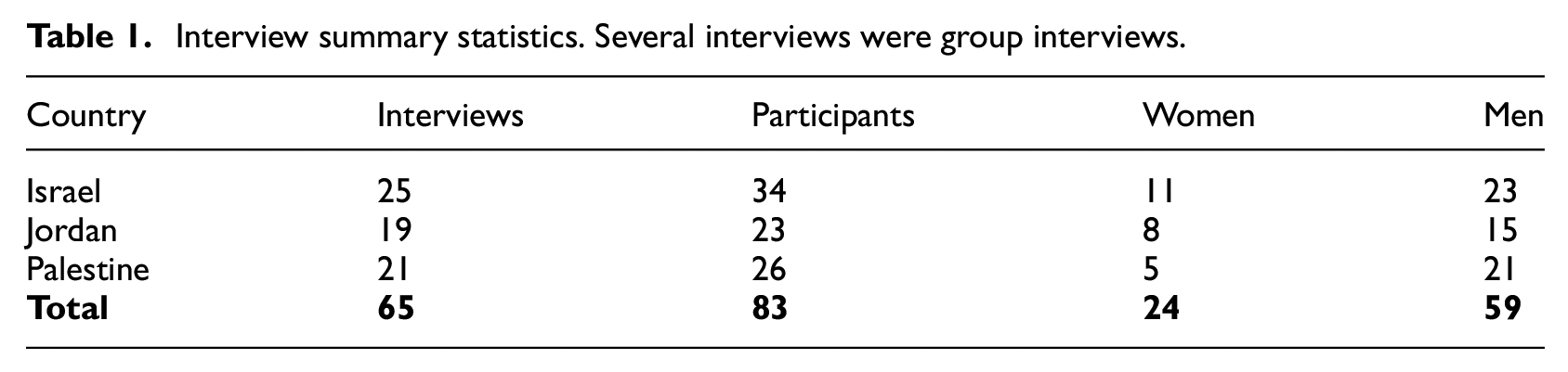
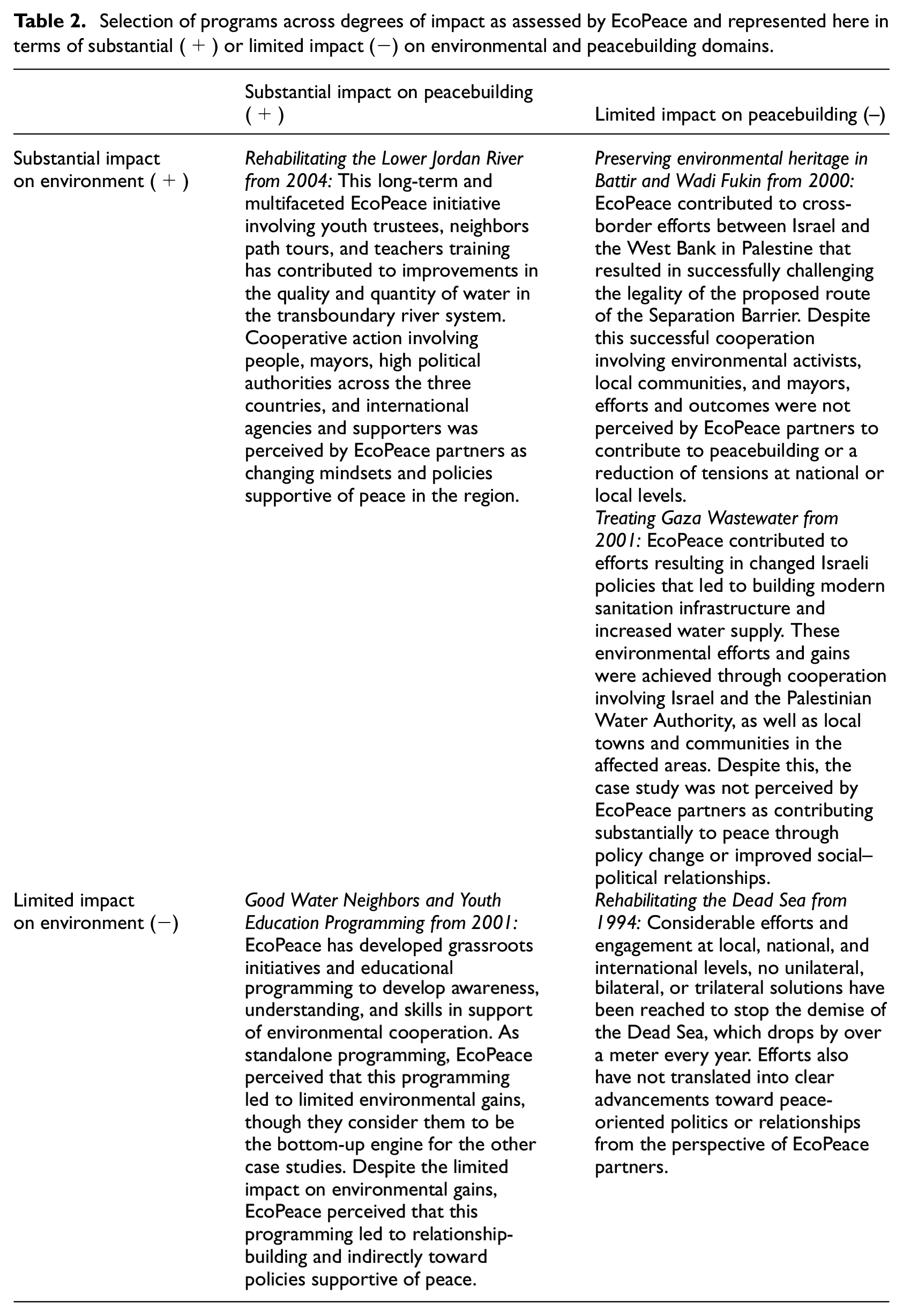
The lead author conducted 65 in-depth interviews with 83 people in Israel, Jordan, and Palestine (see Table 1). Interviewees were selected for inclusion in the study based on their engagement in one or more of five selected EcoPeace programs spanning the organization’s arc of programming over 28 years (1994–2022). The purpose of identifying multiple interventions was not to emphasize the impacts of specific interventions or validate their effectiveness, but to assess the synergistic effects of efforts and outcomes on participant attitudes, beliefs, and behaviors over time. These programs offered a range of environmental and peacebuilding outcomes, with the intention to sample across representative programming and not just perceived successes (see Table 2). This research also teases out how relational effects, in some cases, may occur in the absence of observable outcomes; for example, a participant has an experience irrespective of a project achieving an environmental or peacebuilding goal, and this research argues that these experiences are consequential for peacebuilding. The included programs have starting dates ranging from 1994 to 2004, and were all active as of 2022 due to their need to address ongoing and emergent challenges. They feature a combination of top-down programming, including direct advocacy with decision-makers at different levels of politics and international and transnational engagements, and bottom-up programming, including public awareness raising and grassroots initiatives.
Interview summary statistics. Several interviews were group interviews.
Selection of programs across degrees of impact as assessed by EcoPeace and represented here in terms of substantial (+) or limited impact (−) on environmental and peacebuilding domains.
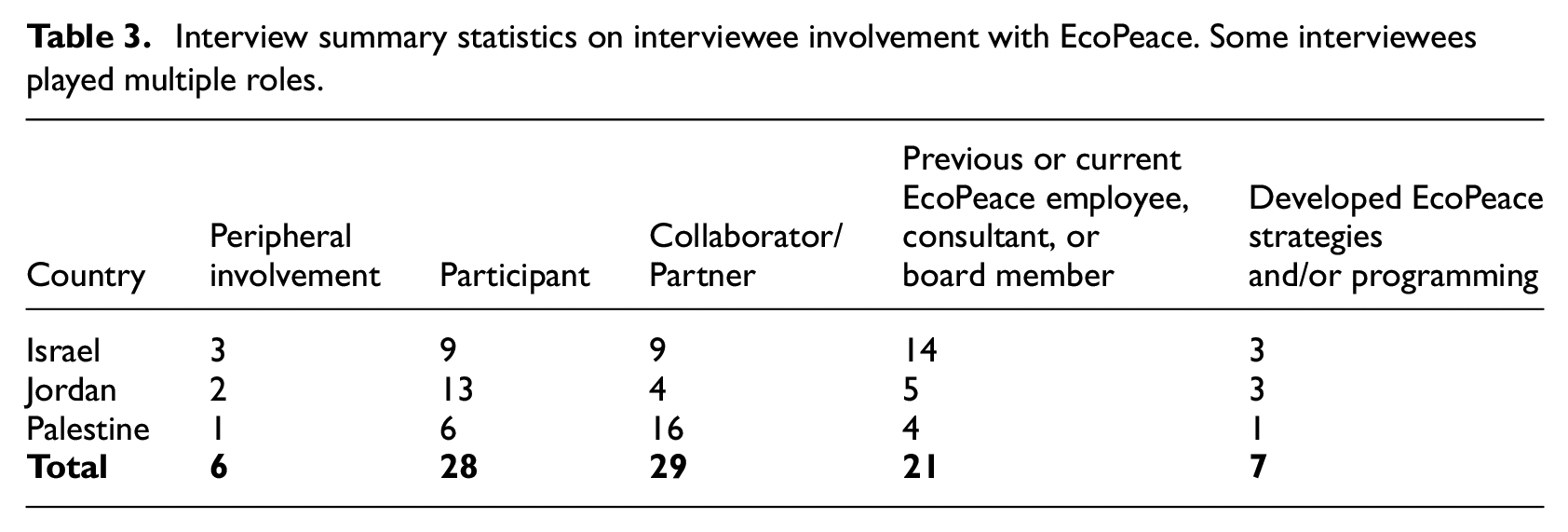
Interviewees were broadly representative of those who had engaged in the selected programming, including through multiple roles and degrees of involvement (see Table 3). Participants are not, however, representative of their broader societies, because participation in programming is self-selecting. As such, the interview data are inherently skewed, as they draw from those who choose to engage in EcoPeace programming and do not sample from the broader population that is not aware of programming or chooses not to engage. Likewise, the interpretation of the data is limited to the perspectives of those involved in programming and not how the broader population interprets or is affected by environmental peacebuilding efforts undertaken by others.
Interview summary statistics on interviewee involvement with EcoPeace. Some interviewees played multiple roles.
Interviews were conducted by the lead author in September 2022 over the course of 3 weeks, with 1 week spent in each country. Interviews were conducted in major urban hubs (e.g., Tel Aviv, Jerusalem, Ramallah, and Amman) as well as diverse sites of cross-border initiatives and distal engagement in multiple rural and urban locations. Most were individual interviews, with several small group interviews. All interviewees provided written and verbal informed consent. Interviews lasted approximately 60 to 90 min and were conducted in various sites, including offices, project sites, public locations like cafes, and the teleconferencing platform Zoom. Most interviews were conducted in English, but some were interpreted from Hebrew or Arabic by an EcoPeace employee who agreed to confidentiality. Most interviews were audio recorded, but a few interviewees declined permission to audio record. In all cases, the lead author also took detailed notes, including pauses in speech, shifts in emotional tone, and other nonverbal signals. All audio recordings, transcripts, and field notes were anonymized with codes, made confidential, and stored in password-protected cloud storage. The impacts of EcoPeace involvement on data quality were managed by assuring interviewee anonymity and explaining that no raw data or personally identifiable data would be shared with EcoPeace at any time, and many interviewees offered critical and divergent perspectives based on this understanding.
The interviews followed a semi-structured guide to allow for tailored questioning based on interviewee experiences while maintaining comparability across interviews. The questions focused on creating an enabling conversation for interviewees to share meaningful experiences and perceptions in their own words and situated within their everyday relationalities (Della Porta, 2014; Knott et al., 2022; Soss, 2015) to elicit “the webs of meaning that people weave and within which they are suspended” (Tavory, 2020, p. 454). Detailed follow-up questions were utilized to probe for clear examples of changes in attitudes, beliefs, and behaviors in both ordinary and particularly challenging times, such as periods of heightened violence, as well as pursuing questions about complementary topics as a means of adding depth and confidence about the congruence of data. The lead author avoided using potentially loaded terms such as “peace” or “environmental peacebuilding” and instead adopted the terminology used by the interviewee. The interviewer employed trauma-informed and conflict-sensitive techniques, including pacing interviewees while they retold traumatic experiences, summarizing responses for the interviewee to validate, and encouraging agency (e.g., Brounéus, 2011; Howe, 2022; Winfield, 2022). While self-reported narratives are not direct proxies for past or future behavior, previous research has found that there is a strong correlation between what people say and their action tendencies (Vaisey, 2014).
3.3. Thematic analysis
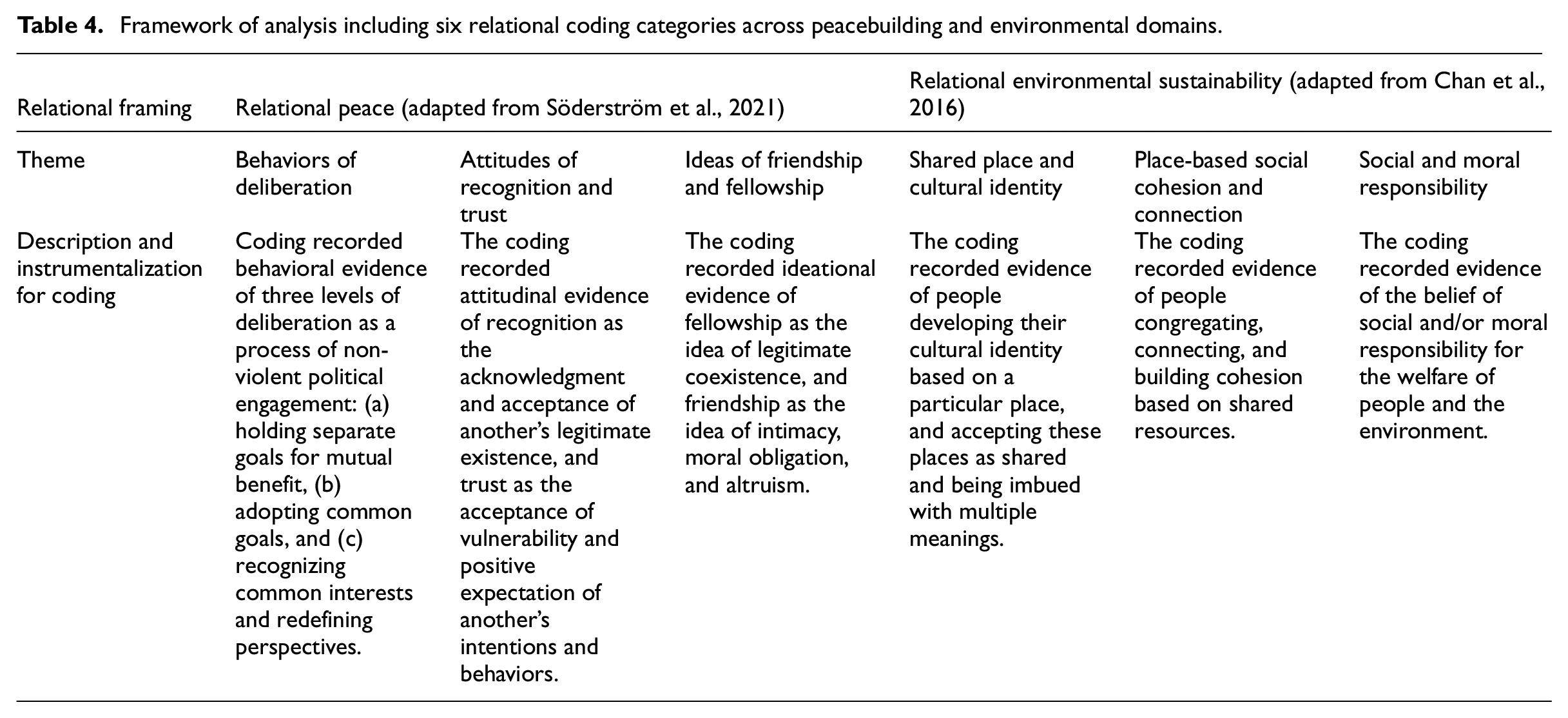
The interviews produced a qualitative dataset that was analyzed and interpreted through thematic analysis, an approach to identify, analyze, and interpret data by clustering content into common ideas and recurrent concepts (Braun & Clarke, 2006). The interview data were first deductively coded along six relational categories adapted from Söderström et al. (2021) and Chan et al. (2016) (see Table 4) to produce a relational data layer. Integrating relational peace and environmental sustainability categories provided a broad relational framework for environmental peacebuilding. The coding categories were not mutually exclusive, but they were devised to capture how participants’ diverse—and at times divergent—interests across peace and the environment may have co-evolved through their experiences in programming.
Framework of analysis including six relational coding categories across peacebuilding and environmental domains.
Coding was conducted at the utterance level, which refers to breaking down data into units of speech, such as sentences, phrases, or even individual words, that express ideas, thoughts, and experiences, and interpreting them contextually. In doing so, interviewee perspectives and experiences were not collapsed into a singular category or theme to characterize an individual. This was particularly important for a relational analysis that does not view an individual person as the unit, but takes into consideration how a single person engages in multiple relationalities based on the situation, context, and other frames of reference.
The second analytical step was to derive themes inductively from the relational data layer, which featured overlaps across categories. The themes were developed around common perspectives and experiences, as well as outlying or contradictory statements to avoid artificially smoothing over the data (Braun & Clarke, 2006). The results section of this paper presents these themes in italics and includes relevant codes for all statements in the footnotes which are sorted alphanumerically to signify where the interviews took place: I signifies Israel, J signifies Jordan, and P signifies Palestine.
Finally, the third step was to interpret and organize these themes into three relational clusters encapsulating the degree of change that a participant described experiencing in terms of their roles, responsibilities, and agency. The interviewees broadly did not distinguish between water conflicts and the broader social–political conflicts in which they were enmeshed, so the results do not attempt to differentiate between these. However, clear differences between environmental cooperation and peacebuilding were expressed, so the presentation of the results focused on disambiguating lived experiences of environmental cooperation and the extent to which these linked to peacebuilding. We clustered and presented the results in three categories: (a) relational stagnation, where existing relationships related to conflict and environmental degradation remained entrenched, (b) relational shifts, where relationships between people and their environments began to take on new dimensions but were not fundamentally altered, and (c) relational transformations, where relationships between people and their environments took on new meanings and patterns related to peace and environmental sustainability.
4. Results
The results present recurring relational themes that interviewees articulated around their changing roles, responsibilities, and agency, giving specific form and substance to the relational clusters of stagnation, shifts, and transformations.
4.1. Relational stagnation
The zero-sum conflict paradigm has created the region’s water crisis: Many interviewees described that the region is dominated by a zero-sum conflict mindset, where people would rather see their own interests suffer than “the other side” make any gains. 1 This pervasive political and public attitude has engendered a refusal to engage in cross-border water cooperation, even when it is in the best self-interest of all sides to do so. Decades of non-cooperation have contributed to the water crisis, which interviewees most commonly described instrumentally in terms of water scarcity 2 ; equitable access to water 3 ; water quality, wastewater management, and sanitation 4 ; and, to a lesser degree, climate change, 5 the economy and economic development, 6 human health, 7 and agriculture and agrotourism. 8
There is growing recognition of the need to cooperate over sharing—and not just shared—water resources: Multiple interviewees explained that the severity and urgency of the water crisis are pushing some public officials to recognize that environmental cooperation and coordination is necessary. 9 Some interviewees referred to EcoPeace’s “Water Cannot Wait” initiative, which urges that water issues should not fall prey to the politics of non-cooperation in the absence of a formal peace. 10 For example, cooperation is needed to decide where and how to treat polluted water 11 as well as for environmental preservation and protection 12 amidst impermanent but securitized borders. In light of this, a Palestinian water sector official explained: “[Water] should be…the biggest source of cooperation [between the countries],” 13 but a Jordanian EcoPeace employee claimed: “[Most people] would rather have no [Lower Jordan] river than work with the enemy.” 14
Existing forms of cooperation over water are often forced and antagonistic: Several interviewees described that the little existing formal water cooperation reproduces conflict relationships and is not undertaken willingly, including that “cooperation is not really a choice” 15 and that “it is forced on us by gun”. 16 A wastewater treatment manager in Israel at the border with the West Bank claimed that “there would be no cooperation” 17 if there was any other way to solve these problems, especially given the perception shared by a few interviewees that the “other side” engages intentionally in environmental neglect and violence. 18 An interviewee working in a Palestinian ministry who had engaged with programming described their suspicion that some of the Israelis who engaged in water cooperation did so as “illegal settlers…to confiscate the rights of [the Palestinian] people”. 19 A Palestinian interviewee shared their perception that water cooperation may play into the ways Israel benefits from an endless war with no end goal, 20 and a Jordanian interviewee commented that they believed Israel engages in water cooperation to prevent Jordanian and Palestinian collapse only as a way of perpetuating the status quo. 21
Existing structures of cooperation reflect and reproduce conflict relationships: Multiple interviewees explained that existing cooperation reflected hard power asymmetries, including de facto unilateral decision-making in the Israeli–Palestinian Joint Water Committee and asymmetric water sharing provisions in the Jordan–Israel Peace Treaty. 22 Even emergent processes of cooperation that seem more genuine on the surface were sometimes negatively perceived as being motivated by charity on behalf of the other side rather than engaging as equal partners. 23 Nominal cooperation was described explicitly by some interviewees as generating grievances. 24 These sentiments were not just held in political spaces but also trickled down into impacting people’s everyday realities. For example, some Palestinian and Jordanian farmers and other members of the public can see that their Israeli neighbors enjoy a greater share of water, including that they have more greenery and greater agricultural yields, and relative deprivation has contributed to interpersonal cross-border violence between neighbors. 25
4.2. Relational shifts
Different approaches to the status quo of cooperation are needed to produce different outcomes: Many participants described that EcoPeace programming supported a relational shift for people to act in their own self-interest rather than against it, and to accept that the other side will also enjoy the material benefits of environmental cooperation. Interviewees described that their sense of responsibility and interests began to shift as their awareness of environmental issues, causes, impacts, and agency grew. These first steps were taken often in the context of highly imperfect structures for cooperation, and several interviewees emphasized that more constructive cooperation is needed to yield improved social and environmental outcomes. 26 Ongoing EcoPeace intervention was often mentioned as a key ingredient to initiate and sustain these shifts.
Assurances and trust-building support the first steps toward cooperation: Actively engaging in practices of cooperation and not just abstractly recognizing cooperation as a necessity was impeded by long histories and ongoing experiences of antagonism, violence, mistrust, and prejudice. Several participants described that even in the context of building more constructive cooperation, it was often approached adversarially. A Palestinian academic explained, “Each side is trying to get as much of what they need without sacrificing as much as possible.”
27
This mindset reflects a fear of being “a sucker”
28
by compromising too much. A Jordanian interviewee expressed that compromising too much or not enough can both result in negative outcomes: “[You cannot be] too smooth that they will squeeze you or very hard so that you will be broken.”
29
Interviewees expressed that EcoPeace intervened in this “game of trust”
30
on actionable issues.
31
For example, EcoPeace served as an intermediary to deliver messages when one or multiple sides did not want a formal meeting, disseminated factual information about both challenges and solutions, and helped to identify shared interests and opportunities for mutual gain—all to encourage the uptake of cooperative solutions.
32
An Israeli interviewee working in high politics explained: “It’s a win/win, and sometimes a win/win/win [between Israel, Jordan, and Palestine] and there are a lot of potential things we can do that will improve the quality of life on both sides.”
33
Some of this fledgling cooperation takes place but is not publicized. For example, a Jordanian water official shared that large-scale cross-border water sharing is done to avoid humanitarian catastrophe especially in drought periods, but is carried out secretly to avoid public and political scrutiny in the context of anti-normalization and non-cooperation. 34
Underlying interests can intersect with social responsibility for peace: Several interviewees noted that, irrespective of public rhetoric, their main underlying interest was to put an end to war, violence, and suffering and that environmental cooperation provided a more accessible route to exercise agency for peace. 35 Peace was described instrumentally as a necessary condition to prevent further harm and to enable societal advancement. For example, an interviewee in the Jordanian water ministry explained, “No one wants war. It hurts everyone…This is why politicians come to the negotiation table [to cooperate on water issues].” 36 Some interviewees—especially those engaged in longer-term grassroots programming—expressed that cooperation designed around emerging shared environmental values and interests facilitated non-antagonistic connections to each other. 37
Increased points of non-judgmental contact come with sharpened awareness of harms and inequities: Being in a shared space for cooperation provided participants with informal platforms to share their knowledge and experiences. 38 Several participants from Jordan and Palestine commented that people were not generally aware of how much environmental issues impacted their own daily lives, or the power they had to address those issues. 39 Increased awareness by Jordanians and Palestinians of the depths of the water crisis in humanitarian terms can, in one interviewee’s words, “create a little bit of tension or definitely anger, frustration, or, you know, negative feelings toward Israel.” 40 However, EcoPeace programming encouraged participants to shift away from a culture of blame and instead toward empathetic understanding of the environmental dimensions of the conflict paradigm as a whole. The same interviewee described: “The starting point of EcoPeace is unveiling the situation and presenting it as it is without passing any judgment or condemnation.” 41
Participants accept their share of responsibility for co-creating environmental problems: Fostering understanding without blame moved some interviewees away from a perpetrator–victim mentality and toward one of taking shared responsibility in co-creating environmental problems. For example, EcoPeace cross-border workshops provided spaces for Israeli participants to learn about how a history of unilateral action toward water mismanagement has disproportionately impacted the ability of Palestinians and Jordanians to meet their basic needs,
42
and Palestinian and Jordanian participants learned that there were Israelis who did not wish to perpetuate this.
43
A Jewish-Israeli interviewee in the agricultural industry explained: “The main problem dealing with this is the water here is part of the Zionist ethos making the ‘desert bloom,’ building the national water carrier, drying up the swamps, all these things that are wrong, and they realize many years later that they made a lot of really bad decisions in terms of the environment.”
44
Connections were facilitated in these spaces of difference, and several interviewees described that they began to view each other and cooperation in a more positive light 45 and could begin to build limited trust. 46
Taking shared responsibility for problems can parlay into taking shared responsibility for solutions: Approximately half the interviewees expressed that they realized that they have the social responsibility to develop and implement solutions. An interviewee explained, “The program helped us realize that we all have a responsibility to the environment and come up with solutions and to have our voice heard.”
47
Interviewees described these solutions in terms of addressing daily issues and livelihoods,
48
as well as to preserve natural resources for future generations
49
with benefits for local communities on all sides.
50
This sense of responsibility is fostered through agency around values and not obligations imposed by policies. A Palestinian teacher described how their students began to change their attitudes and behaviors: “They change their behavior because it is something coming from inside, not outside, not because of punishment. They believe that it’s their environment. They should keep it clean.”
51
Interviewees described the importance of preserving their place-based cultural heritage and identities 52 and restoring the “originality of the place” 53 even when these values contradicted other political goals and impasses. An Israeli participant who grew up in a kibbutz community shared that there has been a disconnect between cultural values around the environment and taking action on these: "For too many years we’ve turned our back [to]…the importance of the Jordan River to the region on a…cultural level.” 54
Shared environmental values can awaken and strengthen existing positive relationships: An interviewee explained how surfacing deeper environmental values fostered intergroup connections: “There is common ground to be found concerning the history of Israeli and Palestinian people.”
55
A shared sense of place connected to both environmental and cultural history was expressed especially by interviewees engaged in cooperation in Battir to protect the ancient agricultural terraces and irrigation system from being destroyed by the separation wall.
56
Interviewees described being “able to tap into those old relationships” from previous times of increased contact and back and forth movement, saying “we had so much in common…it was very natural to work together.
57
The shared interest and ensuing cooperation fostered a local cross-border mentality that people were on the same side against the politics of separation rather than opposing each other.
58
An elected official in the area explained: "People want to conserve this land. There’s a difference between politicians and the people…We made the celebration before the court to show them that the Israeli is inside Battir with Palestinian, with Europeans, with Americans from all over the world. They are dancing and making celebrations together.”
59
However, this mentality of partnership in this case was incomplete and still in flux. For example, the same interviewee described that although they have not maintained close cross-border relationships, they welcome Israelis to visit the area and enjoy their shared eco-cultural heritage site, but later in the interview described that Israelis in the area are viewed with suspicion. 60 An EcoPeace employee working on broader educational programming similarly explained: “We don’t have to be friends. We have this common interest [working on water challenges].” 61
Engaging in cooperation can foster interpersonal fellowship: Despite such reservations, multiple interviewees expressed that planned cross-border contact and mediated interactions laid a new foundation for interpersonal relationships.
62
An interviewee explained that spending face-to-face time together challenged their preconceptions and helped them realize that people on the other side can be “very kind people”
63
with whom they share common goals and positive intentions.
64
Several interviewees, mostly involved in educational programming, shared that these realizations helped them shed stereotypes or changed how they perceived their counterparts. In some cases, these relationships extended beyond the scope of official programming, including those who stayed in personal contact
65
and shared their experiences in their broader social circles. For example, an interviewee who had participated in EcoPeace’s youth trustee program explained: “Get to talk to someone at face level, play cards with them, and chat and relax with them is really going to change the perspective for a lot of these people. They’re going to come home to their families and extended families and tell them about that.”
66
Relational shifts can be tentative and in flux: Relational shifts were often fluid, and some were set back during escalations of cross-border violence 67 and others in anticipation of the violence they would be likely to encounter during their mandatory service in the Israeli military, for example. 68 Several participants specifically noted that they were reluctant to share with their family, friends, or community that they made connections with “the enemy” or that they engaged in EcoPeace programming at all out of fear of social punishment. 69 Building peace-oriented relationships and resisting conflict-oriented relationships both take time and practice, and several participants who depended on EcoPeace platforms for cross-border connections noted that they wished that there was more time and opportunities to engage in sustained cooperation. 70 An interviewee expressed that building friendships with people was difficult because of the sporadic nature of their interaction with people on the other side: “[You] can’t just make friends, because you can’t see or talk to them,” and noted that long-distance friendships tended to lose their meaning without face-to-face interactions. 71
4.3. Relational transformations
The environment can be leveraged as a tool for transformation: Some interviewees described that engaging in cooperation opened the door to develop fundamentally different relationships, including with their environments. Relational transformations were most often expressed by interviewees engaged with long-term EcoPeace educational programming and community engagement work, as well as enduring cross-border platforms like the young professionals program and regional forum. EcoPeace’s programming often did not take explicit conflict transformation approaches out of concern that doing so would potentially lose sight of cooperation, lose participants, or lose political tolerance in the process, 72 but it nevertheless supported these journeys of transformation undertaken through agency. In part, this was initiated by cooperation building momentum toward the belief that tangible and incremental solutions are possible; it is not a hopeless situation with only problems, 73 but a situation where even “small changes can lead to big differences.” 74 Some interviewees expressed that they began to view their counterparts as part of “a big family” 75 coalesced by EcoPeace, and as true partners for change. 76
Taking care of the environment can expand a sense of togetherness: Approximately half the participants commented on how environmental cooperation enabled social cohesion (i.e., a relationship of unification), including that it can be a “turning point in bringing people together.”
77
Some interviewees described that connecting on environmental issues gave them a new perspective on how to live harmoniously through ongoing mutual care for the environment.
78
An Israeli interviewee from the agricultural sector illustrated the need for not only ongoing political but also social cooperation by explaining that farmers need to engage in cross-border cooperation with other farmers to address day-to-day challenges around water scarcity, pollinators, and pests: “They don’t stop at the border…because you have the same problem because you’re in the same area.”
79
Several interviewees referenced EcoPeace’s “Water Has No Borders” campaign.
80
Another interviewee explained the need to expand understanding of water rights based on a mentality of cohesion, playing on the divisive “River to the Sea” rhetoric: “You have to get beyond this idea that there’s Israeli water and Palestinian water. All the water that exists between the river and the sea belongs to all the people who live between the river and the sea. And you can’t put a national flag on water. It belongs to everyone, and everyone has the same right to that water.”
81
Social and environmental relationships are intertwined: For some interviewees, social and environmental connections became increasingly intertwined through awareness and action; for example, a Palestinian teacher in Jenin described: “Everyone is connected. We share the same planet; we share the same region. [We] always have the same concern (water)…I belong to the planet more. I understand the meaning of the land.”
82
A small number of interviewees associated their sense of moral responsibility to be environmental stewards with their religious beliefs, which parlayed into interfaith cross-border relationships.
83
For example, a Muslim Jordanian interviewee engaged in EcoPeace’s interfaith workshops said: “Water is one of the most important components of Islam. When we pray, we wash, we have to be clean…From water we make everything living. Water is life…God gives us water not only to live, but to reserve it [and] take care of it.”
84
Connecting to their faith brought new meaning to water issues in addition to depoliticizing cooperation. For example, a former EcoPeace staff member described: “If we talk about Islam…We want to protect our earth, not [focus] on political issues. We should work together to protect our land.” 85 The interviewee went on to describe that EcoPeace’s interfaith workshops make participants feel like “a good person” for engaging in cooperative action to protect and rehabilitate water resources that are seen as holy across the three major Abrahamic religions 86 even when doing so runs counter to the prevailing politics of non-cooperation. 87 Shared moral values around religion may also open the door for genuine friendships to develop. The same participant discussed that interfaith engagements with a Jordanian counterpart as the basis for a friendship: “[He] is not a colleague on the Jordanian side. He is really a friend. We can see him here a lot, mostly once a month. He comes to visit [us], not just us [to visit him].” 88
Connection can lead to perceptions of universalism amidst differences: The mutual recognition of the rights of the other to exist and access shared resources was referenced by many interviewees. 89 Several interviewees expressed that water belongs to everyone 90 and that “it’s the same story” regardless of which side of the border people live on. 91 Recognition of shared humanity was seen as important, 92 but multiple interviewees on all sides situated this within the need to recognize that impacts of environmental harm and initiatives are not equally or equitably distributed. 93 This recognition was tied closely with trust: all interviewees who felt they had developed trust also demonstrated behaviors of recognition, which often entailed changing their relationship with themselves and their relational belief systems.
Sustained engagement can form the basis and platform for friendships: Sustained engagement and changing relational identities enabled some interviewees to get to know each other on deeper levels, which at times led to close friendships and genuine trust.
94
An Israeli interviewee explained that barriers began to melt away over time: “It is a feeling that I can’t describe. You hear about all the bad things. All the terror, all the fear, all the rage. And you meet people, and you talk together, and you build trust…I have Palestinian friends. One of them is considered like a brother…We love each other. I trust him and he trusts me…Before you’ve got fears because you don’t know each side, you’ve got fears so you don’t trust. But when you get to know, even the differences, but when you know we’re all human beings you get trust, and then it’s like ‘you wanna hug?’ because you see your fears, and what used to be your fears is your best friend and if you cooperate with each other good things will happen.”
95
Another interviewee described that cross-border friendships can stand the test of time, including that a working group still keeps in touch as friends 12 years after initial programming concluded 96 . Some interviewees also explicitly mentioned discussing these connections and friendships with their social circles despite knowing that they may face negative repercussions in the context of anti-normalization and anti-cooperation, because they felt that their experience of connection was important to share. 97
Transformation depends on effecting change: Some interviewees expressed the salience of a future orientation on transforming a region often fixated on the past. A Palestinian interviewee explained: “If we fail to resolve the conflict at the political level then we must transform it. The transformation, in my sense, creating a new environment and the new conditions…we need to bring in new burdens. We need to bring in new ideas.”
98
An Israeli interviewee referenced the significance of EcoPeace’s proposal for the Green New Deal as one designed to foster formal interdependence based on the exchange of desalinated water and solar energy resources: “They need to consider the possibility of developing a certain level of dependency on another country…It’s a conscious choice to deepen dependency… It’s a mindset. You have to cross a certain threshold to believe that this could work. But you have to be willing to take a risk.”
99
A Palestinian academic described that water cooperation and conflict resolution represent a “new paradigm”, because they entail that Palestinians “recognize Israel, and we recognize Israel and you know, taking 78% of Palestine’s land…so this is not easy…this is emotional and sentimental.”
100
A community worker in Israel partnering with EcoPeace explained, “People don’t make peace out of love for each other, but out of fear or urgent need…We all have scars from all the wars and the hatred…and what we’ve been taught…you have to rise up and make a change.”
101
5. Discussion
The many voices of environmental cooperation presented in the results within the categories of relational stagnation, shifts, and transformations represent the pluralism of how interviewees interpreted their relational experiences and formed meaning from them. These clusters are not exclusive or linear in their progression, but they coexist and represent how even the same environmental peacebuilding programming can stimulate a multiplicity of diverse and divergent changes. This aligns with broader relational thinking about how “being” results from a combination of doing and what people imagine they are doing (e.g., Holland et al., 1998). We argue that experiences and interpretations of environmental cooperation matter alongside any material benefits delivered through programming, as participants engage in the process of embodying peace and environmental sustainability.
One key finding from the relational analysis is that environmental cooperation is connected to both conflict and peacebuilding processes. Conflict is sustained not only by the widely recognized problems of divergent interests and identities, but also by how environmental cooperation is structured and experienced. Sentiments of coerced cooperation were expressed by some participants in all three countries, but these perceptions manifested differently depending on how they were situated regarding realist power over relationships. For example, some Jordanians and Palestinians expressed that not cooperating with Israel would only result in losing even more access to water and causing more suffering for people, and some Israelis expressed the perception that they were forced into cross-border cooperation due to specific situations of environmental harm they suspected were intentionally wielded. Benefits derived from environmental cooperation embedded in the relational stagnation cluster would not likely extend to warming relations and building peace, but they may avoid the creation of further environmental destruction associated with new suffering and grievances.
Interviewee perspectives in the clusters of relational shifts and transformations also expressed urgency for environmental cooperation, but they were perceived through a lens of increased agency in more constructivist power with and power to relationships. Some participants found sources of agency through their existing belief and value systems, which also provided inroads for more constructive connections and cross-collective agencies. Some went on to describe experiencing the transformative effects of experimenting with more diffuse forms of power as relational and abundant (Tuck, 2015). This finding highlights that environmental cooperation produces more than material benefits (or lack thereof); the process of environmental cooperation can constrict and/or expand spaces for agency and power with relationships even within overarching structures of domination and asymmetry.
A second key finding is that change derives not only from identifying shared interests or changing perceptions of “the other”—which are not novel in the literature—but also from a changed understanding of responsibilities. This is clearly demonstrated in the analytical cluster of relational shifts, in which new understandings of both culpability for environmental problems and duties toward solutions were recurring themes. Because solutions to environmental challenges require genuine and sustained cooperation, some participants expressed that this responsibility extended to reevaluating their roles and relationships within broader conflict-oriented relationalities. This included grappling with the necessity to affect change in their in-group relationalities to produce less harm toward others and their shared environments. Environmental cooperation may play a role in peacebuilding through surfacing the tensions between identifying with or accepting the prevailing politics, and identifying with an emergent movement of environmental stewardship through deeper senses and sources of responsibility. These findings are also tempered with the fraught nature of what “shared responsibility” means and how it can be instrumentalized to revictimize those with the least power (Selby, 2013), and taking shared responsibility may come under constraints in different contexts where transnational actors control water.
Engaging stagnating relationships through environmental cooperation may paradoxically contribute to a more inclusive approach to programming that meets participants and institutions where they are rather than implicitly requiring them to already have an interest in peace. For example, a participant’s beliefs about their moral responsibility to stop environmental destruction (a dimension of relational environmental sustainability) may represent an entry point for environmental cooperation, and, especially over time, their participation in programming may ultimately shape their attitudes about the right for their cross-border partners to coexist (a dimension of relational peace). Engagement due to the urgency of environmental crisis and the perceived need for cross-border water cooperation may thus open the door to engage wider relationalities and for participants’ relationalities to evolve; this finding supports observations of ethically ambiguous and nuanced ways in which people exert critical forms of agency in peacebuilding (Richmond & Mitchell, 2011). The dark side of this inclusive approach that includes participants without much (initial) interest in peace and engages their other interests and motivations is that this may detract from a more idealized and politicized peace agenda (McKee, 2018; Stamatopoulou-Robbins, 2018).
A third key finding draws on how people navigate powerful systems habituated to conflict but increasingly demand for something better than what is. The clusters of relational shifts and transformations both show that creating new relationalities also implies experimenting with resisting or breaking ties with existing systems of harm. While this was a profoundly positive experience for some interviewees, it was not undertaken lightly and at times required confronting and reinterpreting personal experiences and intergenerational traumas. Some were motivated by the possibility offered by new and not-yet-imagined forms of agentic interdependence, while others noted tapping into deeper values including their sense of place—a specific location imbued with meaning—predating centuries of conflict in the region. Regardless of how they are anchored, these “emergent wholes” can be fragile, linking to other relational thinking (e.g., West et al., 2020), and are challenged especially by cycles of escalated violence and fear. Further, these inclinations toward peace may not find appropriate platforms of mechanisms to sustain and expand impacts within broader relationalities—this sentiment of was underscored with multiple participants sharing that they wished there were more initiatives in which they could engage.
The most recent cycle of violence escalated on 7 October 2023 and is unprecedented in its severity. While the study period for this research was from 1994 to 2022, previous spikes and the ongoing nature of violence have been noted to challenge and disrupt relational peace in the region (Ben-Shmuel & Halle, 2023), but not annihilate all relationships built. Some participants may leave, but many end up continuing to engage in programming or the relationships they have built even as they contend with cycles of withdrawal and dissonance, as has been identified by other research on environmental peacebuilding in the region (Ben Shmuel & Halle, 2023). An independent evaluation commissioned by EcoPeace conducted in May–June 2024 indicated that participants made and sustained relationships even during the Israel–Hamas War, suggesting that emergent relationships forged through environmental peacebuilding are not fleeting. However, this does not mean that relationalities are forged or sustained easily; one example of the active work that goes into this is that the EcoPeace principles met in Cyprus for group healing in the current cycle of violence. This research highlights the ways in which cooperation and peace emerge out of conflict, even while the conflict paradigm in the region seeks absolute separation of people and the possibilities for peace that they can build in shared environments.
6. Conclusion
This research applied the concept of relationality to draw out the complex process of nearly 30 years of EcoPeace programming around environmental cooperation and peacebuilding over shared waters in Israel, Jordan, and Palestine. This research advanced our goal of developing relational environmental peacebuilding theory by building on advancements in critical peacebuilding and environmental sustainability literature. The findings articulated the diverse experiences and perceptions of participants engaged in environmental cooperation within three clusters as follows: relational stagnation, shifts, and transformations. These many voices of environmental cooperation engage diverse roles, responsibility, and agency that coexist and can be complementary or seemingly incompatible.
This research contributes to the growing evidence base and recognition of environmental peacebuilding as a tool to build imperfect peace and environmental sustainability. We offer several recommendations to advance the scholarship and practice of relational environmental peacebuilding:
1. Refocus on environmental cooperation as a pathway to peace and not just out of war: This research urges a more holistic consideration of the relationships between the environment and peace, including the potential for environmental concerns and crises to link with peace in ways that are not just the reverse of environmental conflict pathways. Rather than prioritizing approaches aligning with short-term gains or longer transformations, environmental peacebuilding can take a malleable approach to work through ongoing experiences rather than achievements of environmental cooperation. Environmental cooperation offers novel entry points into peacebuilding, and more critical research should focus on ways to facilitate the diverse and evolving varieties of peace emerging from conflict.
2. Expand the relational evidence base for environmental peacebuilding: Research should consider not only interpersonal and intergroup relationships, but also how they mutually influence systemic relational webs (i.e., networks of relationships) through environmental cooperation. The evaluation and documentation of evidence for environmental peacebuilding pathways should include relationality as a feature capturing cross-connections between pathways, noting that relationalities can be created through material outcomes or in their absence.
3. Integrate relational thinking into evidence gathering, monitoring, and evaluation: This research recommends adopting more nuanced, process-oriented, and context-specific indicators that capture qualitative changes in the relational dynamics between people and systems related to environmental cooperation, conflict, and peace, including when they are co-occurring and -evolving. These insights can be overlooked when relying on isolated benchmarks of “success” evaluated from detached observations, rather than engaged processes that produce meaning and action. Relational changes may occur even in the absence of observable outcomes, and in-depth qualitative data collection and analysis are essential to filling these gaps in understanding.
This research emphasizes the utility of building agonistic rather than unified practices, and emphasizing processes of becoming over being to strengthen the links from environmental cooperation to peacebuilding. The many voices of this research shared many stories, which overlapped in ways highlighting that there is not an Israeli, Jordanian, or Palestinian perspective. Conflict is not totalizing, and it can connect in unexpected ways even while it divides. Environmental cooperation can bring more than peace actors and institutions to the table to engage a wider spectrum of values, interests, and goals in imperfect settings and ongoing violence. In doing so, it may be particularly well-suited to work toward agonistic peace as “an alternative both to apolitical normalisation and antagonistic anti-normalisation” (Aggestam et al., 2015, p. 1749). The need both to address the existential urgency of emergent environmental crises and to manage natural resources over the long term may initiate and sustain the momentum to de-securitize divisions and reimagine differences as diversity in a process that is always left undone (Courtheyn, 2018; Kueffer et al., 2019; Whiteman & Kennedy, 2016). The present research represents a step toward documenting the many voices and deeper relationalities that resist and disrupt these cycles of violence through environmental cooperation.
Footnotes
Acknowledgements
The authors wish to express gratitude to EcoPeace Middle East, especially Gidon Bromberg, Rana Qaimari, and Abed Rahman Sultan, whose partnership made this research possible in the ongoing struggle for peace in and between Israel, Palestine, and Jordan. The authors acknowledge Jordan O’Connell, Kait Pena, Ty Terlaak, and Lily Wong for their support processing interview data.
Author contributions
Laura E. R. Peters: Funding acquisition, Project administration, Research supervision, Conceptualization, Methodology, Investigation and data collection, Data curation, Data analysis, Writing – original draft, Writing – review & editing. Ken Conca: Writing – original draft, Writing – review & editing. Aaron T. Wolf: Writing – review & editing. Ari Lippi: Data curation, Data analysis, Writing – review & editing. Jamon Van Den Hoek: Funding acquisition, Project administration, Writing – review & editing.
Funding
The author(s) disclosed receipt of the following financial support for the research, authorship, and/or publication of this article: This research was supported by a United States Institute of Peace grant on Environment, Conflict, and Peacebuilding.
Ethical considerations
The study met the exemption criteria of the Institutional Review Board of American University under University Protocol #: IRB-2023-64.
Consent to participate
Interviewees received prior written information sheets, which were reviewed orally at the start of each interview, and participants provided verbal informed consent.
Statements and declarations
Not applicable.

Data availability statement
Original interview data for the research is confidential and not made publicly available.