



Abstract
Armed conflicts in Ukraine and Gaza are very visible reminders of the severe negative impacts that armed conflicts have on the environment. Yet, despite knowledge of singular environmental issues and specific country contexts, the magnitude, temporal, and multiscalar impact of armed conflict on broader environmental performance has not been quantified. This knowledge gap limits the ability to design broad and targeted measures of environmental protection during armed conflict as well as rehabilitation in the post-conflict period. Here, we conduct the first global study on the environmental impacts of armed conflict. Our analysis shows that countries with an armed conflict have a significantly worse environmental performance. Armed conflict length and severity are both negatively affecting the environmental performance of countries. Even after an armed conflict ends, countries need about 20 to 30 years to recover in terms of environmental performance. This finding is particularly concerning when considering the risk of conflict recurrence due to environmental stress and bad natural resource management. Taken together, this demonstrates the urgency of measures to protect the environment during armed conflicts and in post-conflict settings.
Introduction
Armed conflicts can have substantial negative effects on countries’ ecological systems. On the one hand, there are direct impacts on the environment, for instance, the targeting of environmentally sensitive industries (such as refineries and nuclear power plants) and water and energy infrastructure (Weinthal & Sowers, 2019), as well as the contamination due to weapons and remnants of armed conflicts. The use of Agent Orange during the Vietnam War is one example of the intentional direct targeting of the environment during military combat that has long-term ecological as well as public health impacts (Dwyer & Flesch-Janys, 1995; Stellman et al., 2003; Westing, 2012). In many armed conflicts, the release of heavy metals into soil and water has been linked to severe health consequences, including cancer and an increase in antimicrobial resistance (Bazzi et al., 2020; Hamad et al., 2019; Méndez & Zapata-Rivera, 2021). During NATO’s 1999 intervention in the war in Kosovo, contamination through advanced weapon systems in the form of depleted uranium had significant effects on the local population (United Nations Environment Programme [UNEP], 2001). More recently, Russian attacks on Ukrainian energy infrastructure, as in the case of the Kakhovka Dam and the Zaporizhzhia nuclear power plant, illustrate the severe environmental impacts and risks of war (Fedchenko, 2023; Vyshnevskyi et al., 2023). Following the explosion at the Kakhovka Dam, for instance, levels of copper, arsenic, and oil contamination increased significantly in the surrounding water bodies and soils (Vyshnevskyi et al., 2023).
On the other hand, there are less visible indirect effects of armed conflict on land, water, and natural resources. Armed conflicts can trigger behavioral changes that, in turn, affect land use patterns (Unruh & Williams, 2013) and maritime resource exploitation (Hendrix & Glaser, 2011). This is, for instance, the case when shorter time horizons are adapted due to high levels of uncertainty and livelihood insecurity. In countries with ongoing armed conflicts, governments also frequently lack the resources and territorial control to implement environmental policies (Jama et al., 2020). Using remote sensing, several studies have found significant changes in land use due to wars, among others in the Caucasus (Baumann et al., 2014), Syria (Dinc & Eklund, 2024), and Iraq (Beygi Heidarlou et al., 2020; Eklund et al., 2017). Internal displacement and a lack of governance capacity may result in environmental impact beyond the combat zone (Reuveny, 2007). Finally, armed conflicts—in the form of active combat as well as the simple maintenance and training of armed forces—contribute to carbon emissions. This is particularly the case for large-scale, heavily mechanized armed conflicts like those in the Ukraine or Gaza. While military emissions are incredibly difficult to assess accurately due to a lack of comprehensive data, some studies estimate an impact in the range of 1% to 5% of global emissions, which however remain generally exempt from emission tracking (Rajaeifar et al., 2022).
Past research has documented the direct and indirect effects of armed conflict on the environment (Shumilova et al., 2023; Solokha et al., 2023; Westing, 1976, 1984, 2012), including on water (Tignino & Kebebew, 2022; Weinthal & Sowers, 2019; Zeitoun & Talhami, 2017), fish stocks (Hendrix & Glaser, 2011), land and soil health (Baumann et al., 2014; Certini et al., 2013; Eklund et al., 2017; Hamad et al., 2019; Mhanna et al., 2023; Van Meirvenne et al., 2008), and biodiversity (Daskin & Pringle, 2018; Hernández et al., 2022).
Despite significant progress in understanding the environmental impacts of armed conflict, critical uncertainties remain. Existing knowledge is largely derived from case studies focused on individual countries or specific environmental harms, leaving broader patterns and mechanisms insufficiently explored. While it is often assumed—and may seem intuitive—that armed conflict negatively impacts the environment, there is a surprising lack of comprehensive, comparative analyses assessing the magnitude, multiscalar dynamics, and temporal trajectories of these effects on countries’ overall environmental performance. Filling this gap is not merely of academic interest but has substantial policy implications, particularly for designing interventions that mitigate long-term environmental degradation in post-conflict settings. Protecting the environment, including during armed conflict, is key to achieving sustainable development, to improving human security, and to support peacebuilding (Krampe et al., 2021). Furthermore, environmental degradation can be one of the drivers of armed conflict risks, hence potentially creating vicious cycles (Buhaug & von Uexkull, 2021).
Research design
This study employs data from spatially and temporally explicit databases to quantify the impact of armed conflict incidence and intensity since 1946 on environmental performance from 2006 to 2020. 1
Dependent variable: Environmental impact
Data on environmental impact are obtained from the Yale Center for Environmental Law and Policy Environmental Performance Index (EPI) (Emerson & Levy, 2011; Hsu & Zomer, 2014; Wendling et al., 2020). These data rate 180 countries annually concerning policies and achievements regarding the protection of human environmental health (EH) and maintaining ecological vitality (EV), as identified by issue categories of air quality, sanitation and drinking water, heavy metals, waste management, biodiversity and habitat, ecosystem services, fisheries, climate change, pollution emissions, agriculture, and water resources. EPI provides a data- and evidence-based indicator of environmental management that facilitates performance tracking and accountability of decision-makers. The EPI is well suited for cross-country observational comparisons but has shortcomings in studying temporal trends due to changes in the underlying composition of EPI across versions. We address these issues in our modeling strategy and our analysis employs data with a largely consistent methodology for every year 2006 to 2016, 2018, and 2020; n = 2,332.
Although we have no reasons to expect systematic bias from the presence of armed conflict exposure and the in-house recalibrations of weights for different dimensions of the EPI index, we want to ensure comparability across cases and isolate the environmental dimension from other negative confounds caused by war. For that reason, our dependent variable is the residual EPI λ which is calculated as the distance between the reported value E1,t and a predicted value E2, t as described below. Focusing on the residual means that we explicitly measure how environmental performance deviates from the levels that could be expected from the institutional, political, and societal context.
Calculation of direct environmental impact from conflict
Armed conflicts correlate with negative societal features that subsequently may also negatively influence environmental protection—an indirect effect. Post-conflict countries often lack democracy, functioning institutions, and societal cohesion in addition to destroyed infrastructure, economy, and human capital (Boyle, 2014; Collier et al., 2008; Mross et al., 2022). Similarly, the risk of armed conflict is pronounced in contexts with some unique environmental challenges, such as low gross domestic product (GDP), reliance on agriculture, and size (Dellink et al., 2017; Hegre et al., 2021). To address this imbalance and the temporal heterogeneity of EPI data, our analysis focuses on the residual EPI, that is, the annualized rates of the observed EPI divergence from the predicted value for each country. We calculate predicted values on the sample of countries with conflict exposure = 0 and then estimate the predicted E2 for the full sample.
Following a systematic overview of peer-reviewed publications, databases, reports, and other literature, we identified clusters of predictor variables that correlate with EPI: geography, governance, and economic and social development. Geographic factors include land area, forest area %, population size, and population density obtained from World Development Indicators (World Bank, 2021). We obtain political regime-type variables in the form of the polyarchy index, liberal democracy index, participatory democracy index, deliberative democracy index, egalitarian democracy index, and percent of the population with suffrage from the Varieties of Democracy (v-dem) version 11.1 (Coppedge et al., 2021). Further governance functions are captured by freedom of expression and alternative sources of information, freedom of association, respect for civil liberties, civil society participation in the policy process, accountability index, rule-of-law index, and corruption performance index from the same source. Finally, we also include information about the economy in the form of GDP/capita, GINI coefficient, foreign direct investment of GDP, agriculture share of GDP, oil share of GDP, minerals share of GDP, coal share of GDP, as well as state social policy health expenditure per capita, and electric power consumption per capita from World Development Indicators.
In the first stage, we ensured that no variables with a collinearity at the cutoff of 0.7 were included 1 before running a series of regressions containing all possible combinations of the covariates (Dormann et al., 2013; Luchman, 2014). Our initial estimation of 16,384 regressions contains only variables without any multicollinearity issues, with the models ranked on the Akaike information criterion corrected for small sample size (AICc), calculating the relative variable importance (RVI) of each covariate by summing AICc weighs across all models that included the given variable (Arnold, 2010). We then iteratively combined alternative variables as part of an additional 11 series of estimations (each consisting of 1,024 regressions) containing all possible combinations of covariates to identify the model with the best fit for explaining environmental performance for countries with no conflict exposure. The best model contains the following variables: participatory democracy index, corruption index, landsize, forest%, population (ln), gdp/capita, oilshare of GDP, and mineralshare of GDP.
Independent variable: Conflict exposure
Data on armed conflict are taken from UCDP Armed Conflict Dataset version 20.1 which covers from 1946 to 2020 (Pettersson et al., 2021). According to the definitions of the Uppsala Conflict Data Program, an armed conflict is defined as a contested incompatibility that concerns government and/or territory where the use of armed force between two parties, of which at least one is the government of a state, results in at least 25 battle-related deaths in one calendar year. A conflict is considered terminated when it does not fulfill these criteria for at least one calendar year (Kreutz, 2010). Between 1946 and 2020, there are a total of 292 armed conflicts active in 159 locations (i.e., countries or colonial territories), underlying n = 2,700 country-year observations from 2006 to 2020.
Our analysis presents the results of the effect of conflict on the environment in three ways. First, we use information about the duration in years that a country has been consistently in armed conflict, second, the duration in years since a country last was in armed conflict, and, most prominently, we calculate a measure of conflict exposure. To estimate the negative impact of conflict on society, we calculate conflict exposure as an additive combination of incidence and severity. Conflict incidence is the sum of the number of active conflicts in a country during the preceding 20 years, while severity is the average number of battle-related fatalities (in thousands) from these conflicts for the same time period. For the analyses of the long-term effect of conflict, we use the conflict exposure value from the final year of the active conflict as our indicator. Figure 1 shows the global distribution of conflict exposure during the years of our study, 2006–2020
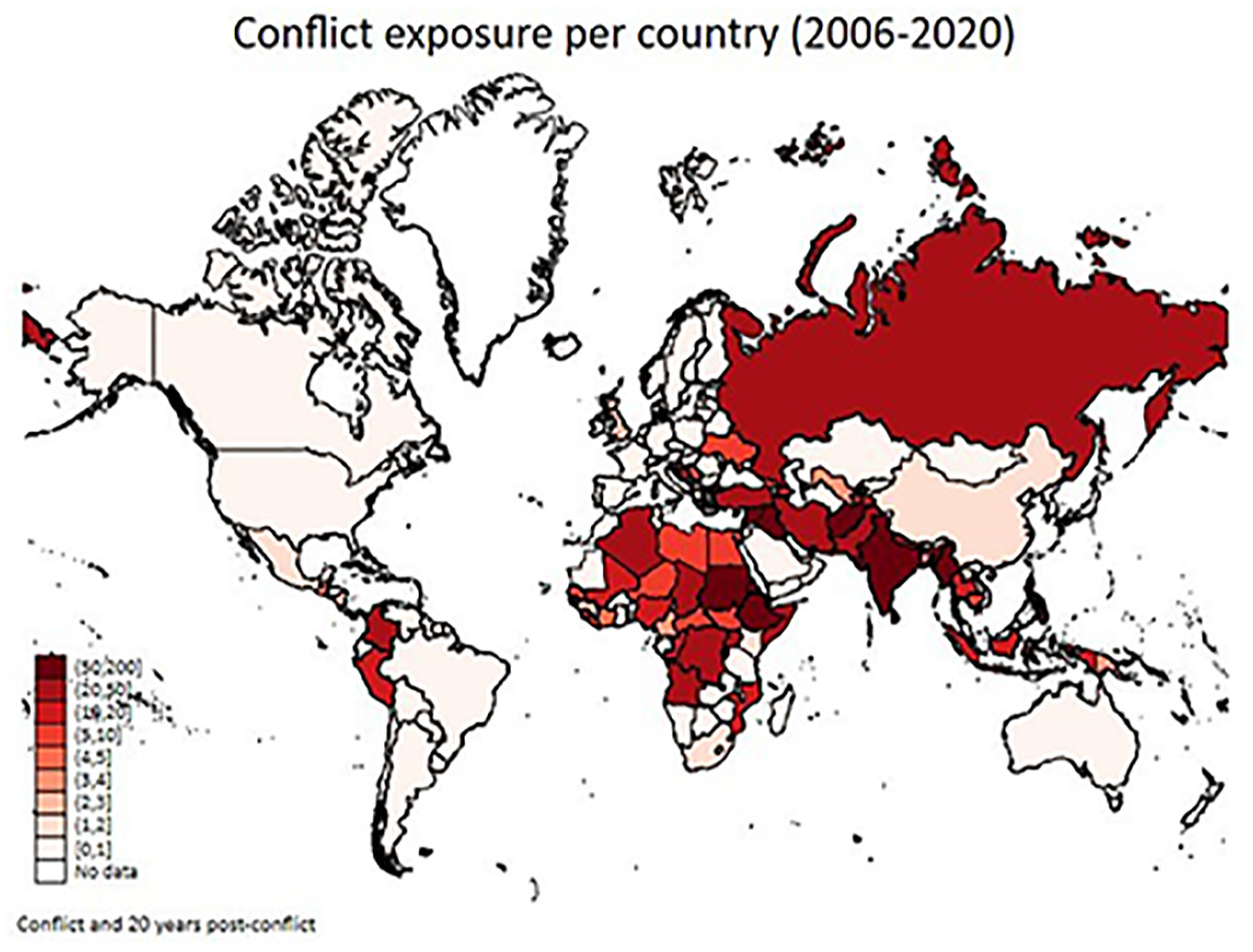
Conflict and post-conflict countries, 2006–2020.
Statistical method
To further account for the recognized unobserved temporal uncertainty in the EPI, we estimate linear regressions with fixed effects:

where Y is the outcome (EPI), X is a matrix of conflict exposure and other confounds, t is the year of the observation, i is the country, and u is the error term. All estimations include the same parameters as were used to create the predicted EPI and also as controls (participatory democracy index, corruption index, landsize, forest%, population (ln), gdp/capita, oilshare of GDP, and mineralshare of GDP). Residuals were visually checked for nonlinear relationships, and Hausman tests indicated no systematic correlation endogeneity in predictor variables. Alternative estimation included the use of two-level regressions with the temporal dimension represented as random intercepts, but where the slopes, or variable effects, are assumed constant across all countries.
Results
Our analysis focuses on the years 2006–2020 to ensure high-quality data are available. The results indicate that countries’ environmental performance declines significantly during armed conflicts in the time period. Using a general EPI that combines data on various measures of environmental protection and pollution, we find a clear negative relationship between countries’ experience of armed conflict and their environmental performance.
At the aggregate level, we find that the mean EPI for countries with ongoing armed conflict the 2006–2020 is 12% lower (−7.93 ± 2.62) relative to peaceful countries at the time. However, this average negative effect hides substantial variation both among countries in conflict and peace. Moving from a simple dichotomous measure of conflict to our indicator of conflict exposure, we find that the scale of environmental impact corresponds with armed conflict severity. Figure 2 illustrates the adverse impacts of conflict on environmental performance in the countries most exposed to conflict.
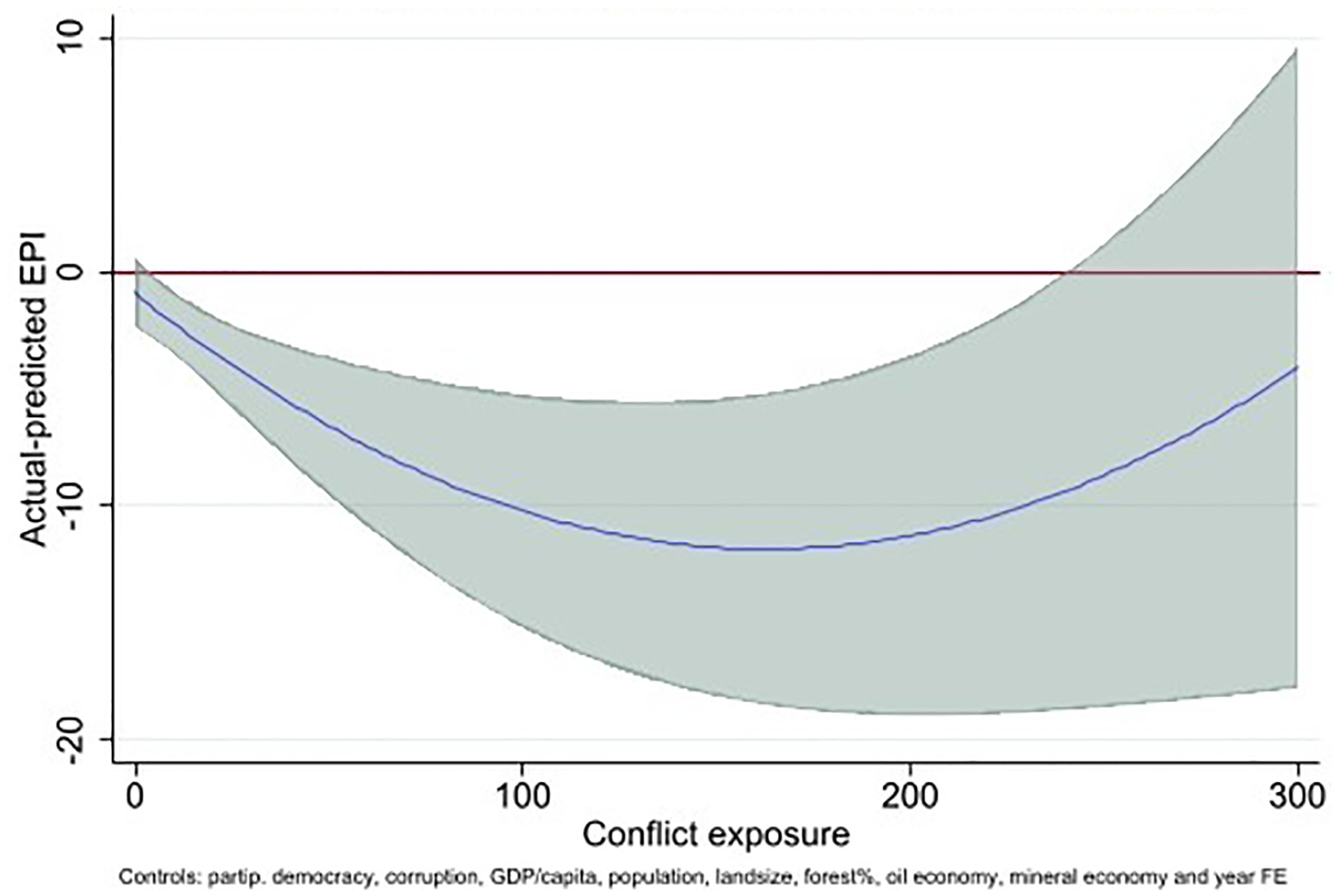
Effects of conflict on EPI beyond indirect effects, 2006–2020.
Figure 2 presents the severity of conflict exposure relating to the negative impact on countries’ EPI. To isolate the direct effect of conflict on EPI from indirect effects through reduced governance capacity, we report the parameter estimates for the λ difference in actual EPI with the predicted EPI (E1 − E2). Variables used for estimating the predicted value are regime type, corruption, GDP/capita, population, land size, forest cover, oil share of GDP, minerals share of GDP, and year fixed effects. Those variables are also included as controls in the estimation.
To illustrate the immediate effect of conflict on country EPI, Figure 3 shows the pattern of EPI for the subset of countries where a new conflict started during 2006–2020 after at least some period of sustained peace. To identify these, we selected the countries with at least 10 years without conflict followed by at least 2 years of conflict incidence within the sample period. An alternative analysis of these cases and a larger sample (n = 20) that incorporated countries with either slightly shorter pre-conflict peace periods (>5 years) or less subsequent conflict periods (1 year) or both, with sharp regression discontinuity design provide substantively similar results about the immediate negative effects on conflict on EPI.
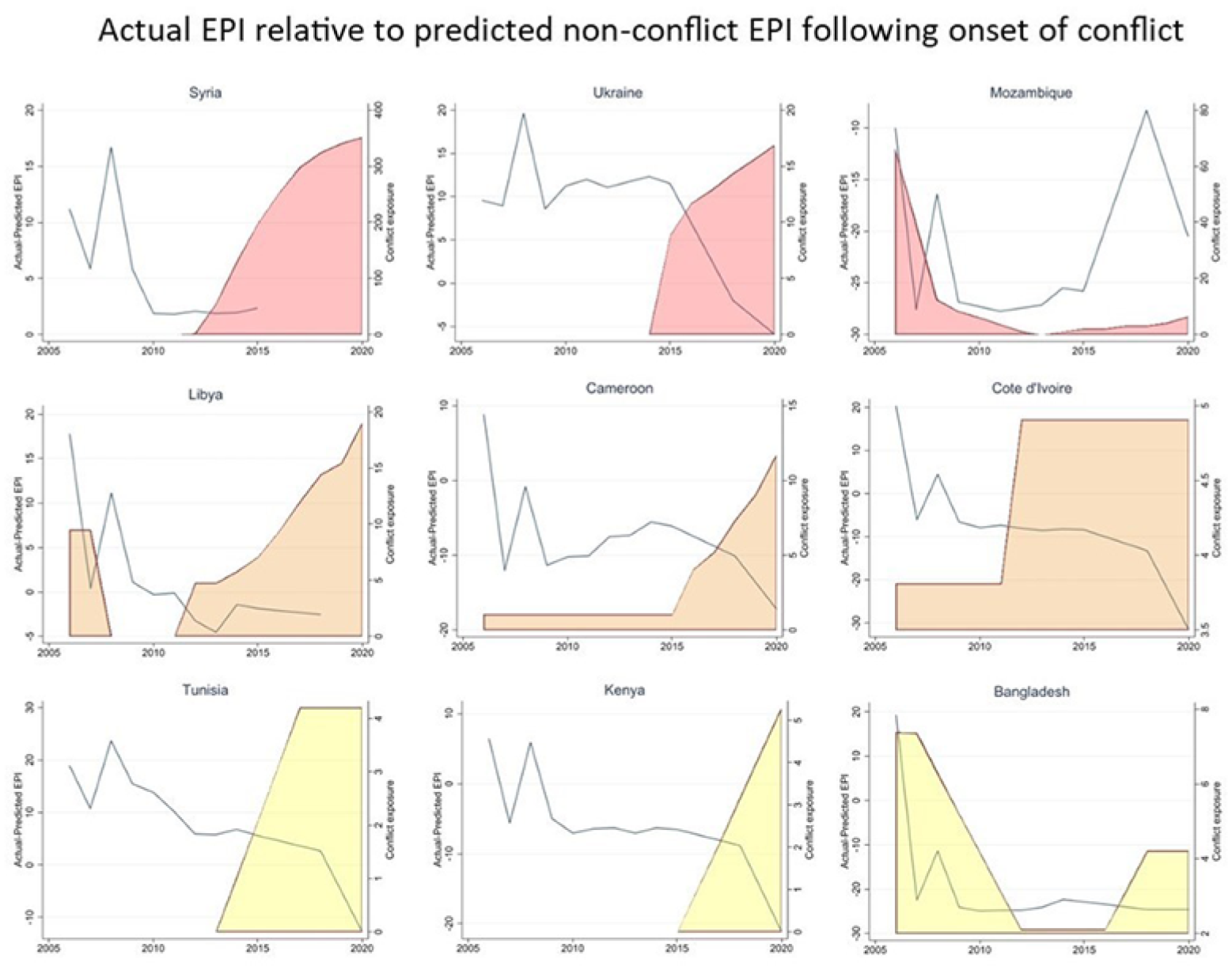
The impact of armed conflict on environmental performance.
Finally, Figure 4 indicates the long-term effects of armed conflict on EPI. A snapshot of the situation in 2020 (A) shows how post-conflict countries suffer from worse EPI than the global average, while recovery is substantially more possible in situations of limited conflict exposure (B) than when destruction is more substantial (C). We find that the negative effect of armed conflict on the environment is not just immediate but also often long term. For countries that only achieved peace in the last 20 years, the mean EPI relative is almost 15% worse than for countries with longer peace (−9.97 ± 1.84), indicating a long-term lingering negative effect of armed conflict on environmental performance (Figure 4).
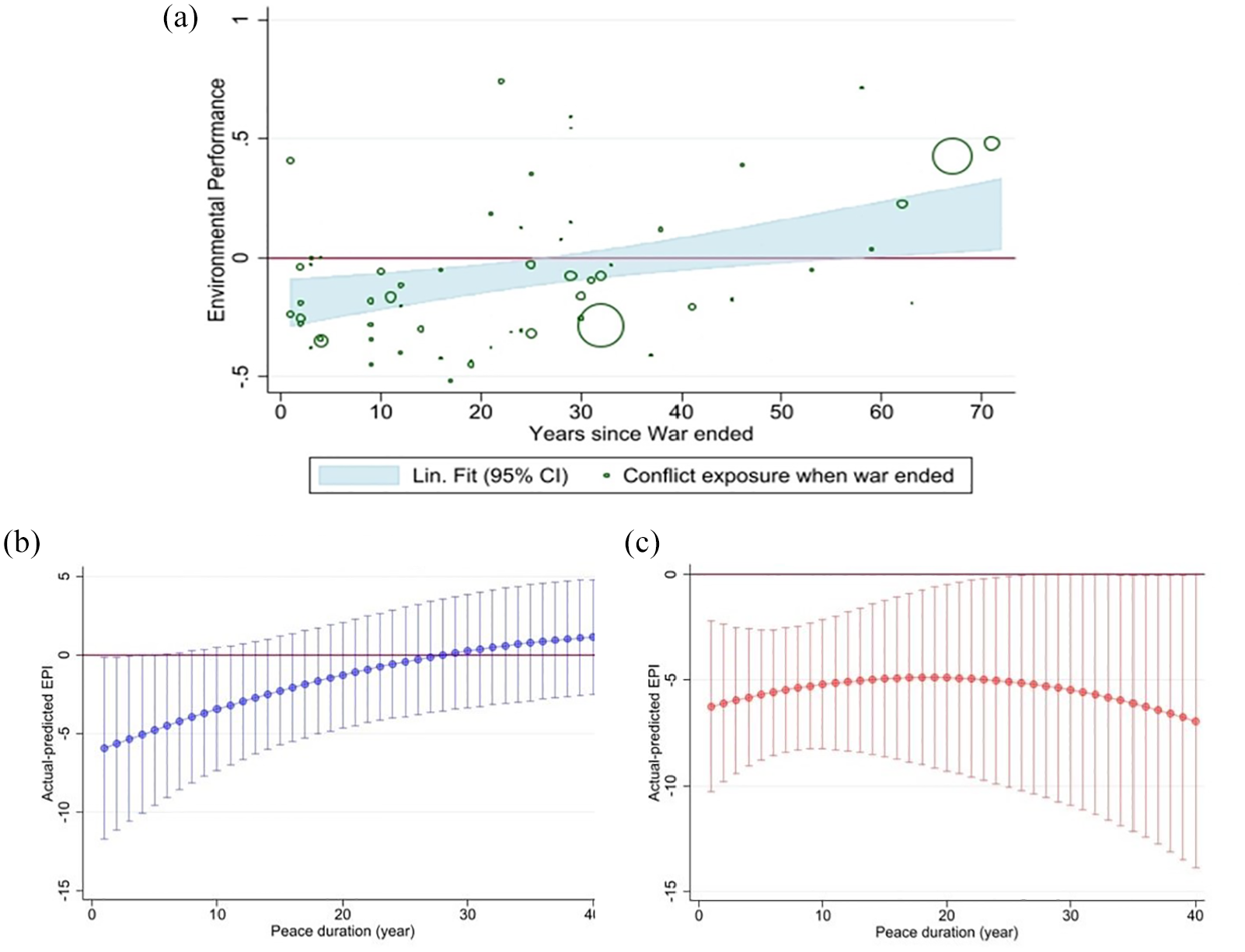
Environmental recovery after the end of the conflict. (a) EPI is relative to the global average for all post-conflict countries in the world in 2020, including the duration since the end of the conflict. The size of the plot indicates the level of conflict exposure at the end of the conflict. (b) Time to recovery relative to predicted EPI for countries with the lowest decile of conflict exposure. (c) Time to recovery to predicted EPI for countries suffering the highest decile of conflict exposure. For b and c, y-axis = 0 indicates predicted EPI = actual EPI.
Our findings further indicate that conflict exposure is key because longer and more severe conflicts (involving more armed actors) have a more destructive effect than brief, peripheral fighting. Based purely on the “recovery” in the form of post-conflict periods for cases that ended in 2006–2020, we can see that the worst conflict cases need 20 to 30 years to “catch up” to a normal EPI. These cases are as follows: Algeria, Angola, Colombia, the Democratic Republic of Congo, Ethiopia, Sri Lanka, Sudan, Turkey, and Uganda. Many other long and/or intense armed conflicts did not end or even emerged during this period (e.g., India, Philippines, Syria, Ukraine).
This is in line with expectations that low-intensity, short-term conflicts remain spatially local and do also not appear to impact the environmental governance capability of affected states. Hence, while there might not be an immediate environmental dividend from peace agreements, this again highlights the environmental benefits of managing conflicts peacefully before they turn into high-intensity, long-lasting armed struggles.
Discussion
Our study significantly advances existing work by demonstrating that armed conflict does not just affect environmental quality in certain domains (e.g., water, land, biodiversity) and specific countries (e.g., Colombia, Syria, Ukraine), but that armed conflict reduces performance globally and across different environmental indicators. The long-term negative environmental performance, our analysis discovered even decades after the end of armed conflict, suggests a combination of direct and indirect effects. The size of the direct negative effect through environmental (infrastructure) destruction and the release of toxic substances during armed conflict is difficult to quantify and potentially limited to specific locations. They still can have longer-term effects, for instance, if pollution persists in soil and water for decades, or if the destruction of sewage infrastructure continues to undermine local water quality (Stellman et al., 2003; UNEP, 2001; Weinthal & Sowers, 2019). For instance, copper concentrations in World War I combat zones continue till today to be significantly higher because of the shelling (Van Meirvenne et al., 2008).
Furthermore, existing studies have shown that EPI is negatively correlated with nondemocratic regimes, low economic and institutional capacity, and low levels of human development. These factors are all adversely affected by armed conflicts (Mercier et al., 2020). We, therefore, expect that armed conflicts have strong negative effects on EPI through indirect effects, namely by undermining the political and societal institutions responsible for protecting the environment and implementing regulations. In some contexts, internal displacement can also have long-term environmental impacts, for instance, if migrants settle permanently in sensitive ecosystems of which they have limited knowledge (Swain & Krampe, 2011; Wiederkehr et al., 2022).
The long-term, adverse environmental impacts of war further point to issues related to the post-conflict recovery process. Military CO2 emissions tend to remain high several years after large-scale armed conflicts as the state needs to retain a robust military presence to deal with breakaway or newly emerging rebel groups, or due to fears that international tensions will rise again (Collier & Hoeffler, 2006). This effect is also present in states neighboring armed conflict that increase military expenditure (Phillips, 2015). However, it is also important to consider that economic downturns caused by armed conflicts may lead to reduced industrial activity and, consequently, lower carbon emissions. While our study highlights increased emissions from military activities, future research should explore the extent to which reduced economic activity offsets these emissions (Malytska et al., 2024).
To secure livelihoods and revive the economy, governments as well as international peacebuilding actors can be tempted to relax environmental standards and attract pollution-intense industries (Kostić et al., 2012). Indeed, economic activity is a strong driver of environmental degradation (Bradshaw & Di Minin, 2019). In Kosovo, the international community focused on refurbishing lignite power plants to aid economic recovery, with tremendous detrimental environmental consequences (Kostić et al., 2012; United Nations Development Programme, 2007). Studies have also pointed out that in Colombia, some forest areas were off-limits for logging, agriculture, and gold mining due to widespread insecurity, and because the rebels protected them as hideouts. After the 2016 peace agreement, deforestation in these areas increased rapidly (Murillo-Sandoval et al., 2021). Other countries have utilized their natural resource wealth to fund post-conflict economic recovery, for instance, by mining tantalite in Liberia and Sierra Leone (Ankenbrand et al., 2021). Such extraction often has significant environmental impacts (and also fuels local discontent).
This is concerning because the mismanagement of natural resources is linked to an increased risk of armed conflict (Buhaug & von Uexkull, 2021). Already in the final phase of the armed conflict—during peace talks—fighting often concentrates on natural resources (Hinkkainen & Kreutz, 2019). The importance of these resources continued after the conflict ended. Some of the worst cases of conflict impact environmental performance, such as Angola, Colombia, the Democratic Republic of Congo, Ethiopia, Sri Lanka, Sudan, and Uganda (Figure 3) are hosting critical minerals and other high-value natural resources, which have all been linked to conflict onset and conflict recurrence (Ali et al., 2017; Ross, 2015). In addition, emerging compounding pressures such as climate change and renewable resource scarcity can further increase the risk of armed conflict in the absence of adequate governance responses (Ide, 2015; Kim & Garcia, 2023; Mach et al., 2019).
Apart from highlighting the importance of preventing the onset and escalation of armed conflicts, our study also demonstrates that inclusive and sustainable environmental management is key in post-conflict peacebuilding and recovery processes. The severity of the decrease in environmental performance in high conflict exposure countries, moreover, highlights the importance of adequate resource environmental policies in conflict-affected states. To date, international environmental actors, including major international funding mechanisms, often prioritize stable contexts which can limit attention to countries with high conflict exposure. Considering the findings of this study, local authorities, national governments, and international donors need to mobilize resources for dealing with conflict-related environmental damage. This can include a reduction of military CO2 emissions, reforestation, biodiversity management in destroyed areas, safely disposing, removing the toxic remains of war (ammunition, chemicals, etc.), and rebuilding crucial environmental infrastructure.
In addition, measures are required to manage natural resource use and extraction and to establish environmental guidelines and monitoring mechanisms. Any such measures taken should be inclusive and conflict-sensitive. In the past, government restrictions on water use or forest access as well as a regulation of small-scale and artisanal mining have resulted in protests and even violence (Ide, 2020). Likewise, economic growth and livelihood provision will be a priority for many governments in the aftermath of armed conflicts. The international community can support a way out of this emerging dilemma by providing incentives for conflict-sensitive “green recovery,” for instance, in the form of solar power or ecotourism (Gilmore & Buhaug, 2021).
Finally, the negative long-term effect of conflict on the environment may also provide a new explanation for the debate about how climate change may increase the risk of armed conflict (Ide, 2023). Conflict scholars have established that post-conflict countries are at greater risk of suffering a relapse of warfare, compared to new armed conflicts erupting in a previously peaceful society (Buhaug & von Uexkull, 2021; Kreutz, 2024). Adverse climate impacts can amplify the long-lasting environmental stresses resulting from previous armed conflict, hence increasing socio-environmental stressors in regions already at high risk of seeing armed conflict (re-)surface. Understanding this double vulnerability to climate change and armed conflict is a key task for future research.
Conclusion
Our analysis demonstrates that armed conflict has a strong negative impact on a county’s environmental performance. Even after the end of the conflict, this effect persists for around 20 to 30 years, indicating that particularly high-intensity, long-lasting armed conflicts have very persistent environmental impacts. Taken together, these findings indicate the importance of including measures to manage natural resources and the environment in conflict management and peacebuilding efforts. This not only provides cooperation opportunities between former conflict parties (Ide et al., 2021; Krampe et al., 2021) but also improves environmental performance which, in turn, increases the chance for sustained peace. Managing both the direct impacts of fighting and the indirect effects on socio-political institutions during and after armed conflicts is one essential component of broader peacebuilding efforts (Krampe et al., 2024).
Footnotes
Acknowledgements
An earlier version was presented at Stockholm University. We are specifically grateful for comments from Andreas Duit and Marie-Therese Gustafsson.
Funding
The author(s) disclosed receipt of the following financial support for the research, authorship, and/or publication of this article: Kreutz acknowledges funding from Riksbankens Jubileumsfond programme Societies at Risk, M21-0002, and Swedish Research Council project Secondary Mobilization, 2020-02368.

Data availability statement
Supplemental material
Supplemental material for this article is available online.