




Abstract
This paper advances prior research on renewable energy policy analysis through the empirical validation of a comprehensive analytical framework. Building on earlier work, which established the framework via a systematic literature review, this study incorporates expert validation and applies the framework to the national context of Aotearoa New Zealand, as well as Norway, Estonia, Brazil, India, and Nigeria. The first phase comprised semi-structured interviews with international energy policy experts, generating 100 factors across seven thematic domains and refining the original framework through the inclusion of cross-cutting elements. The second phase applied the validated framework to Aotearoa New Zealand's renewable energy policy landscape, identifying strong institutional coordination and social acceptance alongside persistent financial, technical, and environmental constraints. The findings confirm that the five foundational domains — coherent institutional arrangements, resilient financial mechanisms, inclusive social processes and efficient technical capabilities and environmentally sustainable practices — remain conceptually robust, while the added cross-cutting themes strengthen the analytical framework.
Introduction
Renewable energy policy development is shaped by a wide range of institutional, environmental, socio-cultural, financial, and technical determinants. These factors have been examined across multiple academic disciplines, often resulting in fragmented insights. Socio-technical transition studies emphasise the co-evolution of technologies, institutions, and social practices, illustrating how innovation can disrupt established energy systems (Geels, 2002; Geels et al., 2017; Markard et al., 2012). Political economy research highlights the role of incumbent interests, lobbying, and state intervention in shaping the pace and direction of energy transitions (Baker et al., 2014; Meckling et al., 2017). Complementing these perspectives, institutional analyses underscore the importance of governance arrangements, regulatory coherence, and state–market interactions (Jacobsson and Lauber, 2006; Kern and Howlett, 2009; White and Leining, 2021).
Economic and financial scholarship focuses on investment security, market design, and mechanisms for risk mitigation (Eyraud et al., 2013; Polzin et al., 2015). In parallel, socio-cultural research demonstrates that public acceptance, social legitimacy, and considerations of energy justice materially influence policy outcomes (Carley and Konisky, 2020; Sovacool and Dworkin, 2015; Walker and Devine-Wright, 2008). Technical and environmental studies address challenges related to intermittency, infrastructure upgrades, and system integration. Comparative lessons were drawn from wind integration in Poland and large-scale renewable deployment in Germany (Hirth and Ziegenhagen, 2015; Igliński et al., 2016).
While these perspectives provide valuable insights, they often examine individual dimensions in isolation. This limits their usefulness for comprehensive and comparative policy analysis. To address this fragmentation, Mirza et al. (2024a) undertook a detailed synthesis of the renewable energy policy literature. That study analysed a broad body of peer-reviewed and policy sources to develop a multi-dimensional renewable energy policy framework. Five core domains shaping renewable energy development were identified, and the absence of empirical validation of such frameworks was highlighted as a key limitation in the literature.
The present paper responds directly to this limitation. It empirically validates the framework using primary qualitative data from expert interviews and applies the refined framework to an in-depth national case study of Aotearoa New Zealand. This sequential research design ensures continuity with the earlier review while advancing the framework from conceptual synthesis to applied policy analysis.
Mirza et al. (2024a) employed a hybrid inductive–deductive thematic review of academic and grey literature, identifying five overarching domains—Institutional, Environmental, Financial, Socio-cultural, and Technical—and 144 associated factors. The resulting framework provides a holistic conceptual basis for both academic analysis and policy design, while explicitly recognising the need for empirical validation and real-world application.
Accordingly, this study pursues two objectives. First, it validates the framework developed by Mirza et al. (2024a) using expert insights. Second, it demonstrates the framework's applicability through its use in a national policy context. In doing so, the study addresses the following research questions:
To what extent do expert perspectives validate or refine the themes and factors identified by Mirza et al. (2024a)? How do the validated domains and factors interact when applied to the Aotearoa New Zealand context? In what ways can the framework support policy analysis, and what implications arise for renewable energy policymaking?
Through this approach, the study makes three contributions. First, it provides empirical validation of a multi-dimensional renewable energy policy framework, strengthening its robustness for future research and policy use. Second, it demonstrates the framework's analytical value through application to a national case study, showing how complex policy environments can be systematically structured. Third, it offers methodological and comparative insights for researchers and policymakers, including guidance on applying and adapting the framework across different governance contexts.
For consistency, the term “Aotearoa New Zealand” is used throughout the manuscript, including the main text, tables, figures, and supplementary materials. This reflects both common usage in contemporary energy policy research and the socio-cultural context of the case study.
Research gap and contribution
While a growing body of literature has proposed multi-dimensional frameworks to analyse renewable energy policy environments, most remain conceptually derived and insufficiently validated through primary empirical evidence. In particular, there is a lack of studies that systematically validate such frameworks using expert insights from policymakers, regulators, and industry practitioners. Furthermore there is lack of studies that apply the refined frameworks as diagnostic tools in real-world national contexts. Although Mirza et al. (2024) addressed the conceptual gap by developing an integrative renewable energy policy framework through an extensive literature review, the framework's empirical robustness and practical applicability remained untested. This study addresses this second-order gap by validating the framework through semi-structured expert interviews. It then applies the finalised framework to an in-depth national case study of Aotearoa New Zealand, thereby advancing the framework from conceptual synthesis to applied policy analysis.
Methodology
The expansion of renewable energy requires a policy framework that is both comprehensive and contextually sensitive. Mirza et al. (2024a) addressed this need by developing a multidimensional framework that identifies the factors shaping renewable energy policy design and implementation. That study synthesised evidence through an extensive thematic analysis of academic literature and identified five interdependent domains— Institutional, Environmental, Financial, Socio-cultural, and Technical —alongside 144 associated factors influencing renewable energy development. Its principal contribution was the construction of a coherent conceptual framework capturing the multiple drivers of renewable energy deployment.
While the literature-derived framework offered conceptual clarity, two limitations remained. First, empirical examination was required to assess whether expert perspectives align with the themes and factors identified in the literature. Second, the framework's practical value needed to be demonstrated through application to a real-world policy setting, as the usefulness of a conceptual framework ultimately depends on its capacity to inform policy analysis.
These limitations were addressed through a two-stage research design. The first stage validated and refined the framework using semi-structured interviews with 20 international experts. Participants were drawn from a wide range of sectors, including energy policy, infrastructure planning, industry, academia and research institutions, government, and civil society. The second stage applied the validated framework to an in-depth case study of Aotearoa New Zealand, complemented by a cross-country comparative analysis involving five countries from diverse socio-economic contexts. This case study enabled assessment of the framework's analytical utility within a mature yet evolving energy policy environment. Taken together, the approach integrates conceptual analysis with empirical grounding (Kern and Howlett, 2009; Sovacool and Dworkin, 2015).
Stage 1: Validation through expert interviews
Sampling and participants
Expert participants were selected using purposive sampling to ensure representation across energy policy, system operations, industry, academia, and civil society. Selection criteria included: (i) direct involvement in renewable energy policy development, regulation, or implementation; (ii) recognised expertise demonstrated through publications, leadership roles, or consultancy experience; and (iii) regional diversity to enable cross-context comparison.
Potential participants were identified through targeted keyword searches (e.g., “renewable energy policy experts”, “energy transition researchers”, “renewable energy industry leaders”, and “renewable energy programme directors”), as well as outreach to relevant organisations. Invitations were distributed by email, and participation was entirely voluntary. In accordance with Te Herenga Waka Victoria University of Wellington Ethics Committee guidance, participant identities were not disclosed to organisations, ensuring participation free from employer influence. Figure 1 illustrates the expert selection process, while Figure 2 presents the sectoral distribution of participants.
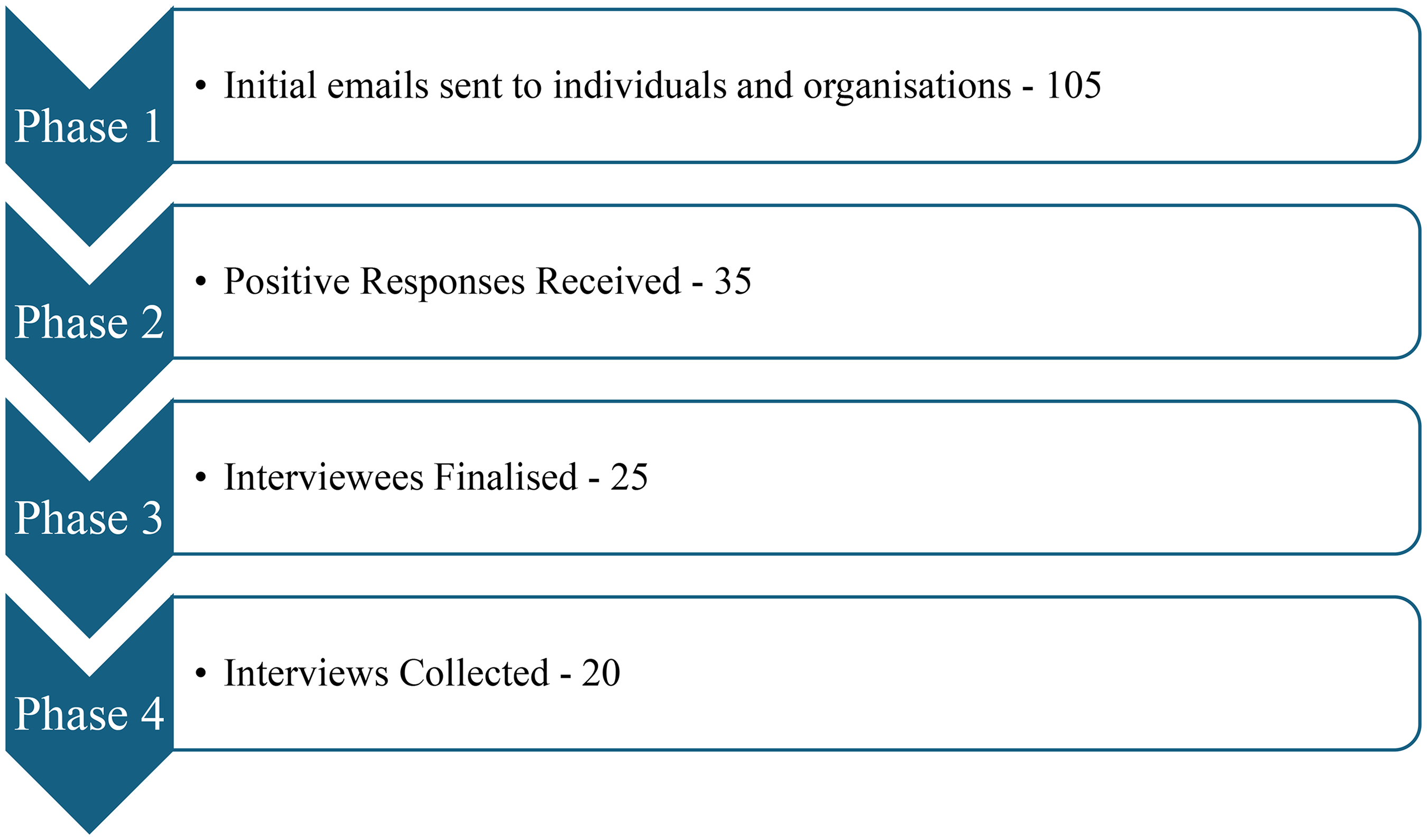
Visual overview of expert selection.

Sectoral classification of experts.
Data collection
Semi-structured interviews were conducted, each lasting approximately 45–60 min. Participants responded orally to eight open-ended questions that were provided in advance. A semi-structured format was selected because it is well suited to eliciting perceptions while allowing participants to focus on issues of personal relevance, thereby facilitating the expression of diverse viewpoints (Cridland et al., 2015).
All participants were asked the same core questions, organised around the key thematic domains of the framework. Follow-up questions were posed where necessary in response to individual comments. Participants were free to respond briefly or in detail and could decline to answer any question. The interviewer retained flexibility to seek clarification or elaboration where appropriate.
The interview questions were piloted internally and refined iteratively to reduce ambiguity, inappropriate wording, and potential researcher bias (Kallio et al., 2016). With participants’ consent, all interviews were audio- and/or video-recorded and transcribed verbatim for analysis.
Data analysis, validity, and limitations
The methodological approach adopted in this study follows the qualitative research design previously employed by the authors in an earlier paper published in Renewable Energies (Mirza et al., 2024b). That study used semi-structured expert interviews to elicit practitioner perspectives on energy policy development and governance. Building on this established approach, the present paper uses expert interviews to empirically validate and refine a previously developed renewable energy policy framework. The refined framework is then applied to a national case study.
The study adopts a sequential qualitative research design comprising three analytical stages.
First, the initial framework developed in Mirza et al. (2024a) was used as the analytical baseline. This literature-derived framework identified five core policy domains influencing renewable energy development.
Second, semi-structured expert interviews were conducted to empirically validate the framework. Interview data were systematically coded to assess the relevance, completeness, and practical salience of the framework's domains and underlying factors. This stage enabled the identification of reinforcing, missing, or overlapping elements, leading to refinement and finalisation of the framework.
Third, the finalised framework was applied to an in-depth national case study of Aotearoa New Zealand. The framework was used as a diagnostic tool to evaluate alignment between existing renewable energy policies and the empirically validated factors, thereby demonstrating its applicability in a real-world policy context.
A hybrid deductive–inductive thematic approach was employed in the analysis of interview transcripts. Deductive coding mapped interview data to the pre-existing themes and factors identified in the literature-derived framework, while inductive coding enabled the identification of novel factors. NVivo software was used to support data organisation and analysis. Consistent with guidance for exploratory research, particular attention was paid to construct and internal validity (Yin, 2014).
Construct validity
Three strategies were adopted to strengthen construct validity.
First, a comprehensive database of coded interview transcripts was developed, as interview data constituted the primary empirical source for the study. In accordance with ethics approval requirements, anonymised and edited versions of transcripts are provided, as disclosure of certain information could risk interviewee identification due to the candid nature of responses.
Second, a clear chain of evidence was established, with edited and coded transcripts included as supplementary material to enhance transparency and analytical traceability.
Third, independent inductive coding was undertaken without reference to the predefined themes, ensuring that emergent concepts were not constrained by prior theoretical assumptions and thereby mitigating potential author bias.
Internal validity
Internal validity was assessed primarily through thematic convergence across interviews with experts from diverse institutional backgrounds. When similar themes emerged independently from experts in different sectors, these points of convergence served as internal corroboration of identified factors. Importantly, convergence arose organically through inductive coding rather than being imposed during analysis. This approach aligns with established practice in renewable energy policy research, where hybrid inductive–deductive analysis supports both analytical rigour and openness to emergent insights (Fereday and Muir-Cochrane, 2006; Mirza et al., 2024b).
To enhance robustness and minimise single-source bias, triangulation was undertaken across interview data, policy documents, and statistical sources. Reflexivity was maintained by documenting coding decisions and researcher assumptions. Nevertheless, limitations remain, including a modest sample size and potential regional concentration of expert perspectives.
Stage 2: Application to a national case study
Case study selection
Aotearoa New Zealand was selected as the national case study for three principal reasons. Firstly, the country possesses one of the highest proportions of renewable electricity generation globally (85.5%), offering an advanced context in which to test the framework (MBIE, 2025). Secondly, despite the high renewable electricity penetration, Aotearoa New Zealand has not yet substantially increased the renewable share of total primary energy consumption (TPEC) nor fully decarbonised sectors such as transport, process heat, and agriculture. This context enables assessment of the framework's capacity to capture complex and persistent transition challenges. Thirdly, the case builds directly on previous research by Mirza et al. (2024b), providing continuity and comparative analytical depth.
Data sources
The case study drew on triangulated data, including:
Government policy documents (e.g., Emissions Reduction Plan 2022; MBIE Energy Strategy 2022) (MBIE, 2022a, 2022b); Official statistics from the Ministry of Business, Innovation and Employment (MBIE), Energy Efficiency and Conservation Authority (EECA), and the International Energy Agency (IEA); Regulatory texts, notably the Resource Management Act 1991 (RMA) (MFE, 1991) and subsequent legislative reforms; and Grey literature, including consultancy reports, parliamentary inquiries, and submissions.
Analytical procedure
The validated framework was operationalised by systematically mapping Aotearoa New Zealand's renewable energy policy landscape against its thematic domains and associated factors. Evidence was coded to evaluate alignment, identify strengths and weaknesses, and detect policy gaps. Interdependencies across domains were also examined, including the ways in which strengths in certain themes may be moderated or undermined by challenges in others.
Results
Stage 1: Validation through expert interviews
The interviews generated 100 initial codes, subsequently organised into seven themes: institutional, financial, socio-cultural, technical, environmental, political, and cross-cutting systemic challenges. These themes confirmed the framework developed by Mirza et al. (2024a), while also revealing areas requiring refinement.
Experts consistently emphasised policy inconsistency, regulatory delays, and insufficient inter-agency coordination within the institutional domain. They also highlighted the importance of democratic accountability, public participation, and decentralisation in renewable energy governance. Within the financial domain, concerns centred on high upfront capital costs, limited long-term purchasing mechanisms, and the volatility of incentive structures, though emerging opportunities via green investment vehicles were also noted.
The socio-cultural domain underscored community acceptance and indigenous equality considerations, with interviewees highlighting the need to respect indigenous rights, ensure equitable benefit-sharing, and advance energy justice. Technical challenges largely echoed established literature on grid integration, storage, and intermittency, while adding heightened emphasis on development urgency and whole-system sustainability. Environmental concerns reflected issues of land-use conflict, biodiversity impacts, and resource depletion, alongside the need for clearer end-of-life management and recycling strategies for renewable technologies. Factor frequency tables are presented in the supplementary material.
Overall, expert interviews provided empirical support for the majority of the 144 factors identified in the original review, while also prompting refinement. Certain factors were merged to avoid redundancy (e.g., decentralisation and public participation), whereas others were elevated in prominence (e.g., indigenous rights and social equality).
The validation process resulted in a refined framework retaining the five foundational thematic domains— Institutional, Environmental, Financial, Socio-cultural, and Technical —while incorporating enhanced cross-cutting considerations such as urgency, sustainability, political dynamics, and electoral cycle effects. The socio-cultural domain was notably strengthened, particularly with respect to indigenous rights and justice. The refined structure of the validated framework is presented in Tables S1 to S5 in the supplementary material section.
Stage 2: Application to Aotearoa New Zealand
Applying the validated framework to Aotearoa New Zealand revealed a mature renewable electricity sector, alongside persistent decarbonisation challenges in transport, industrial process heat, and agriculture. The comparison with the framework identified strong institutional coordination and a supportive investment environment, yet also highlighted policy instability across electoral cycles, market-design gaps in relation to risk management, and an under-developed allied industrial base. Socio-cultural strengths included community- and Māori-focused initiatives. However, several of these were time-limited or subsequently discontinued, raising concerns regarding long-term reliability. From a technical perspective, grid expansion and planning were advancing, although permitting and connection delays continue to act as constraints.
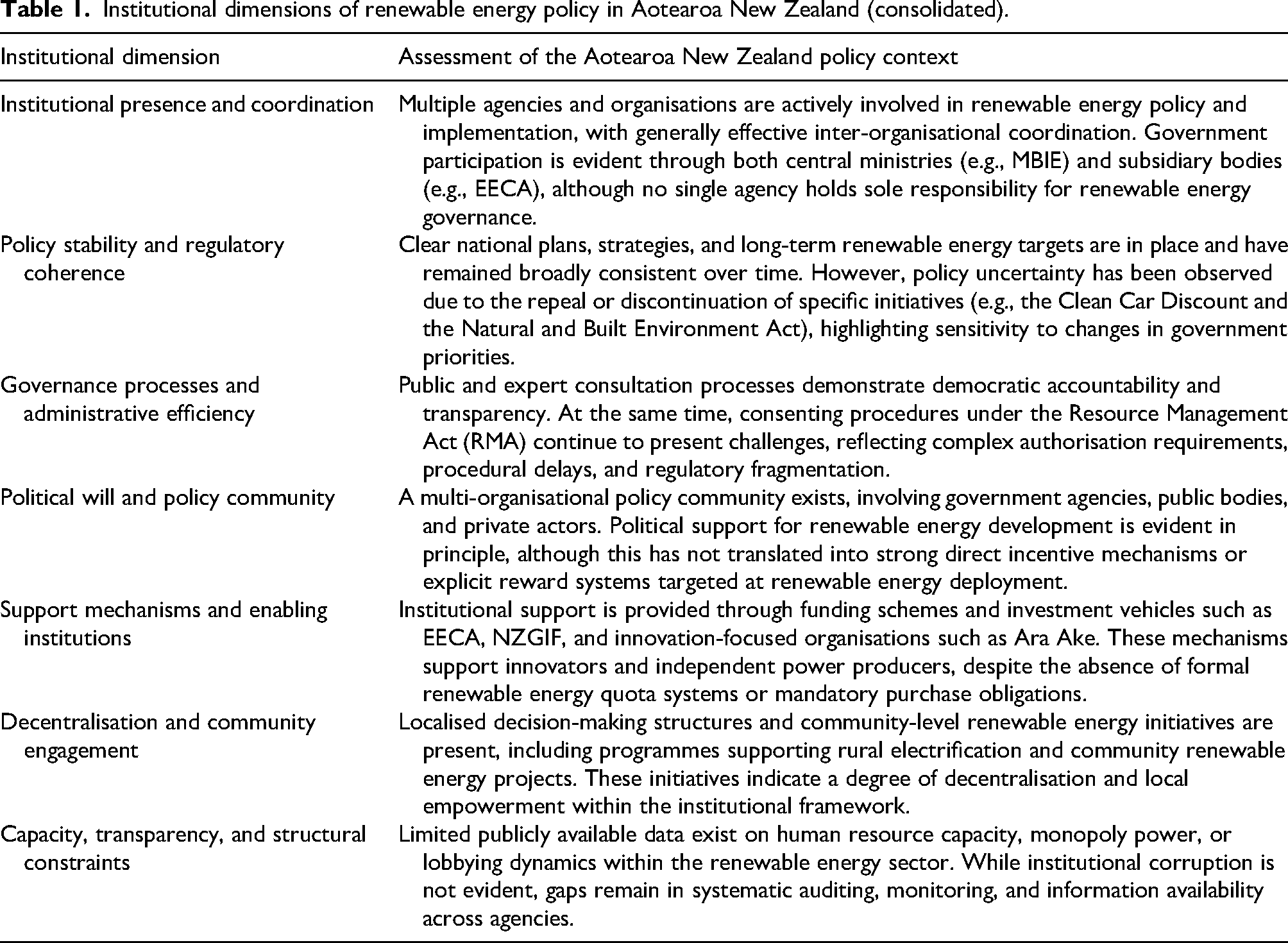
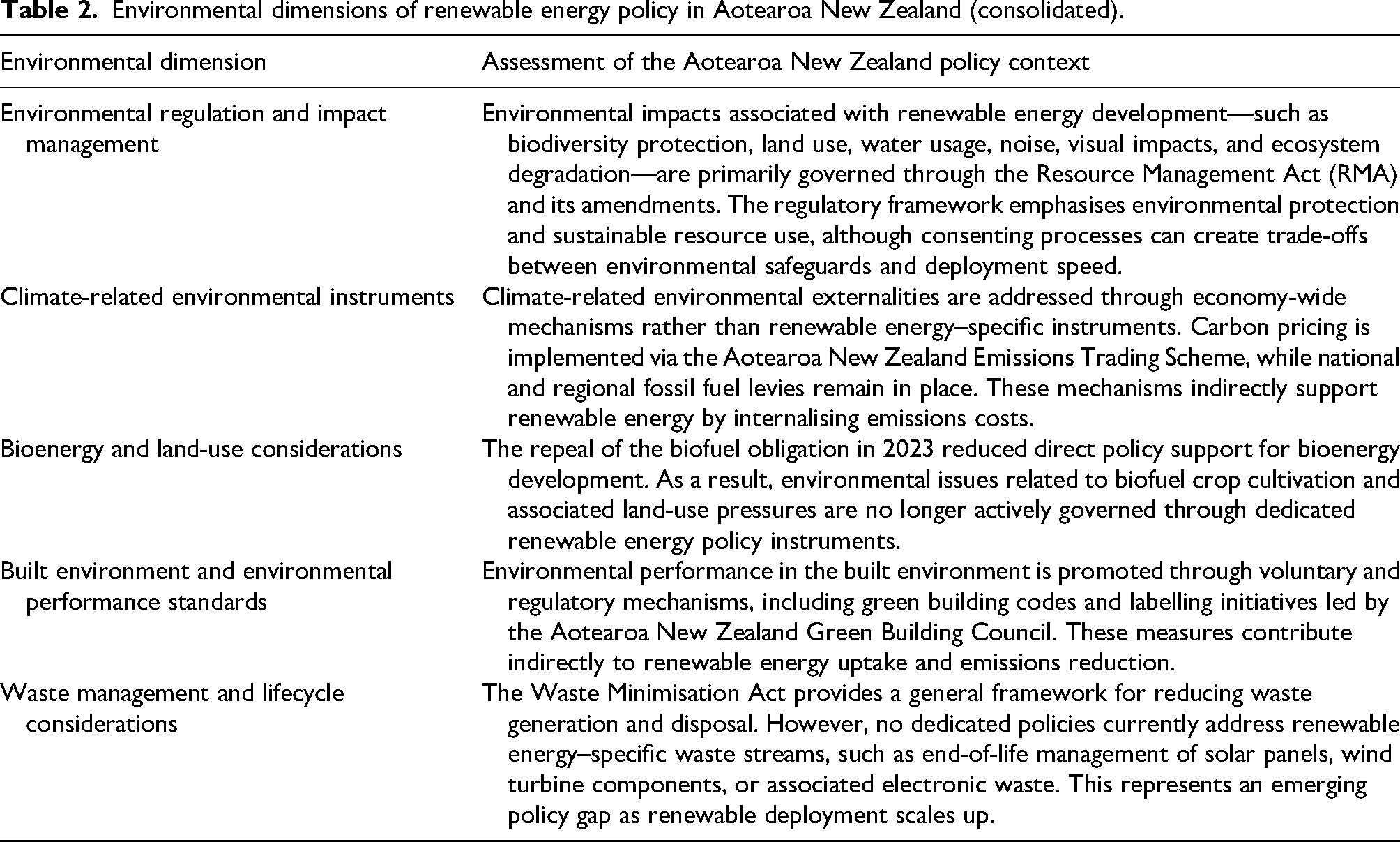
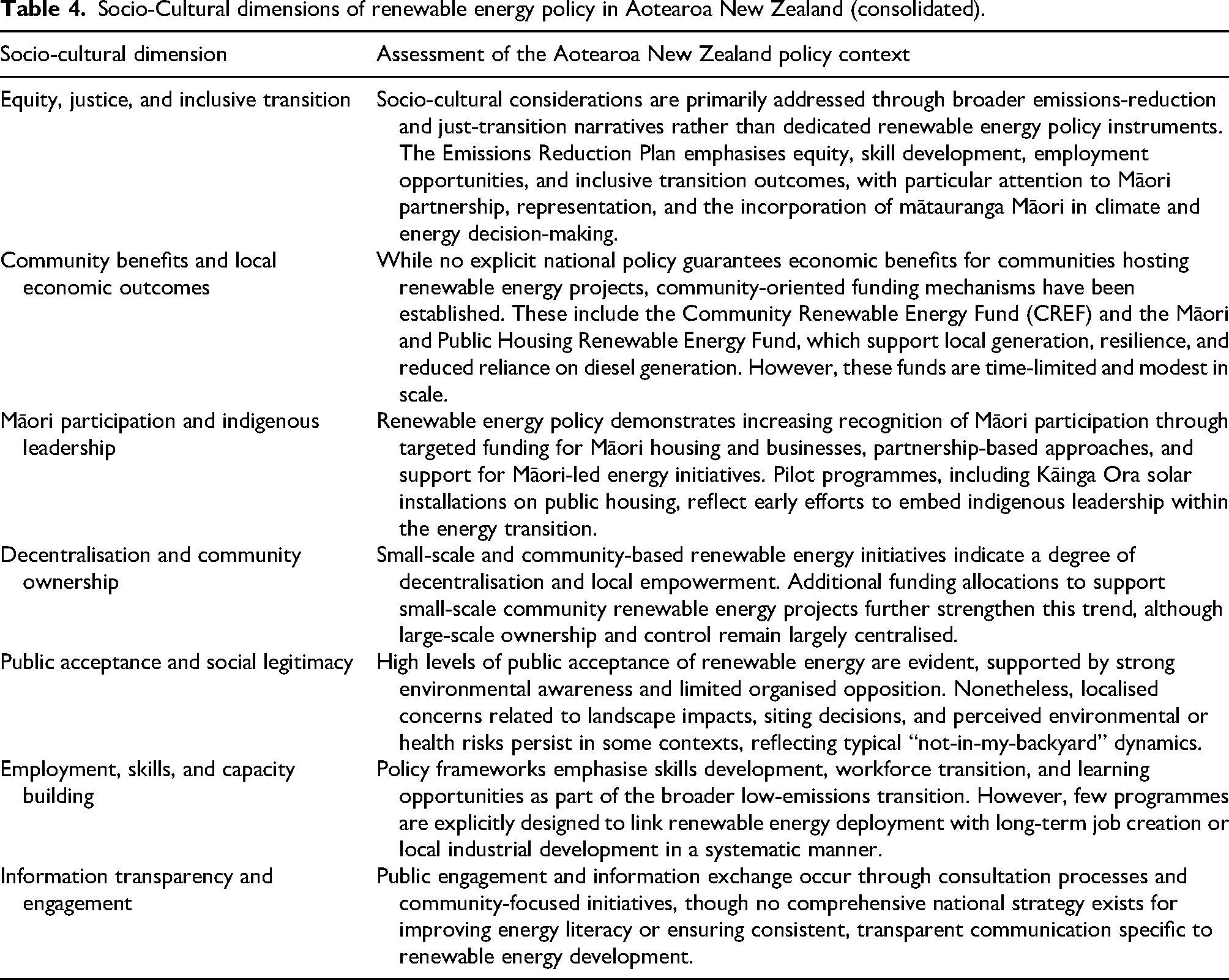
The major features of Aotearoa New Zealand's renewable-energy policy landscape were evaluated against the refined framework, with the consolidated observations presented in Tables 1 to 5. These tables offer a detailed examination of the country's renewable-energy policy space, each highlighting factors and challenges associated with renewable-energy development. The elements of the refined framework served as a comprehensive basis for assessing Aotearoa New Zealand's capacity to achieve its renewable energy objectives. The purpose of presenting the tables by domain is to maintain traceability between the validated framework and the case study evidence. The full factor level mapping and qualitative synthesis are provided in the supplementary material, whilst Tables 1–5 retain only the consolidated results required to interpret the Aotearoa New Zealand application of the framework.
Institutional dimensions of renewable energy policy in Aotearoa New Zealand (consolidated).
Environmental dimensions of renewable energy policy in Aotearoa New Zealand (consolidated).
Financial dimensions of renewable energy policy in Aotearoa New Zealand (consolidated).

Socio-Cultural dimensions of renewable energy policy in Aotearoa New Zealand (consolidated).
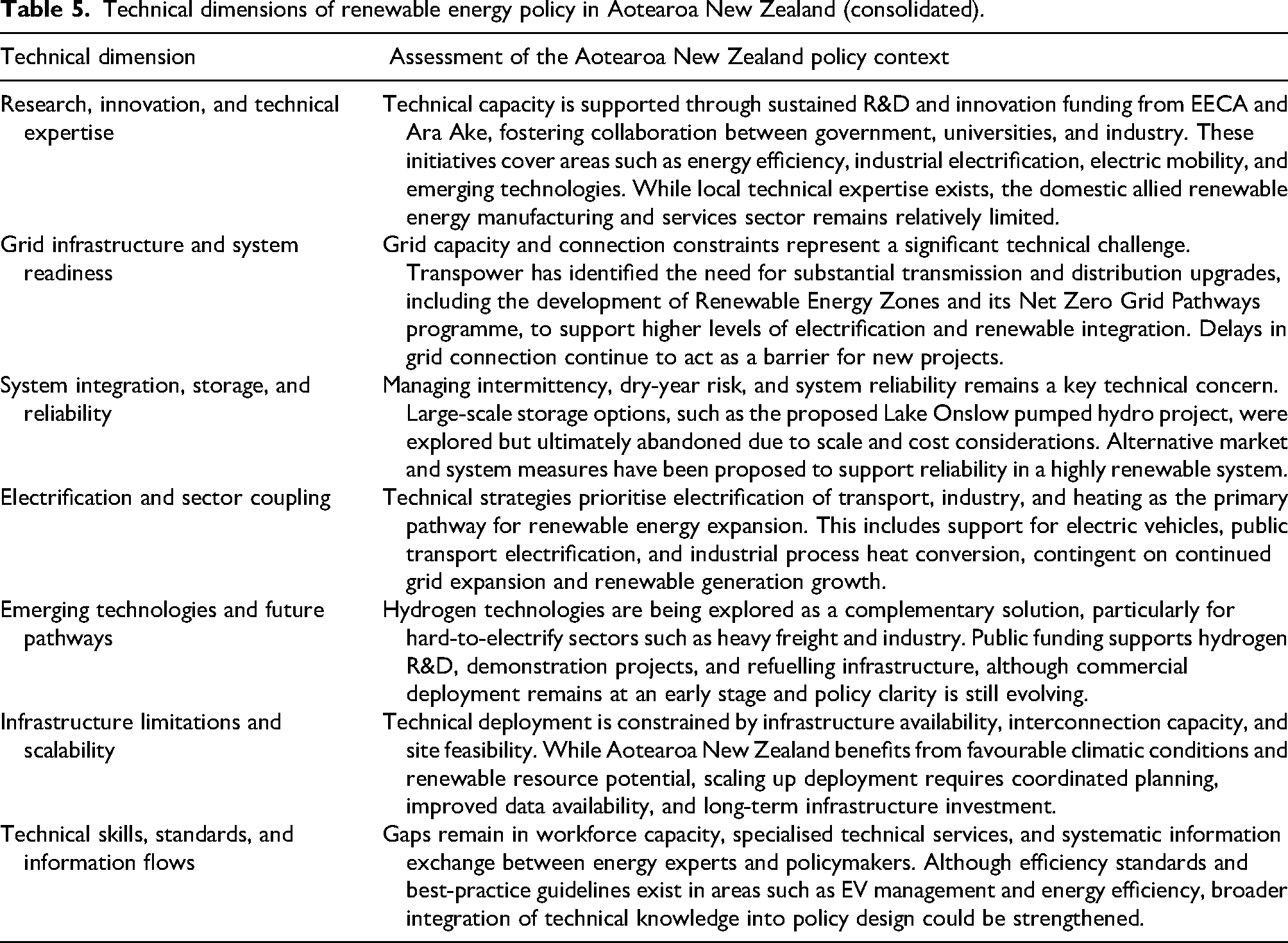
Technical dimensions of renewable energy policy in Aotearoa New Zealand (consolidated).
The renewable energy policies of Aotearoa New Zealand display strong alignment with key institutional factors identified in the framework. The country's substantial renewables penetration, particularly within electricity generation, reflects ambitious yet attainable objectives. Although no single ministry holds exclusive responsibility for renewable energy, coordinated action across multiple agencies is evident under a cohesive strategic direction. This inter-organisational coordination is exemplified in the Emissions Reduction Plan (ERP), which integrates policy targets and recommendations from relevant bodies, including the Ministry of Business, Innovation and Employment (MBIE), the Ministry for the Environment (MfE), and the Energy Efficiency and Conservation Authority (EECA). Multiple organisations actively participate in renewable energy development programmes under the ERP; for instance, the energy and industry component is led jointly by the Minister of Energy and Resources and MBIE's Chief Executive. Significant collaboration between government and private actors is also apparent, with examples including New Zealand Green Investment Finance (NZGIF) funding for solarZero, Solagri Energy, Lodestone Energy, and Eastland Generation (NZGIF, 2023). However, solarZero filed for bankruptcy in November 2024, which illustrated the financial and market design vulnerabilities that persist within Aotearoa New Zealand's distributed renewable energy sector. Despite strong public acceptance and institutional support, the firm faced unsustainable operating losses and high capital demands, exacerbated by the absence of stable long-term revenue mechanisms and limited market incentives for distributed generation. The case highlights persistent financial and technical bottlenecks in the sector, reinforcing the framework's finding that supportive institutions alone are insufficient without durable financing tools and coherent market design.
While barriers such as weak government involvement, limited democratic accountability, or insufficient information transparency are not prominent in Aotearoa New Zealand, certain policy inconsistencies are observable (see Table 1). These typically correspond with transitions between governments, as illustrated by the discontinuation of initiatives such as the Clean Car Discount, the Lake Onslow Project, the suspension of the GIDI (Government Investment in Decarbonising Industry) Fund, and reduced allocations to MBIE's energy portfolio, which may constrain the community renewable energy fund. Despite such fluctuations, overarching strategies and targets have remained broadly consistent, signalling a sustained commitment to renewable energy development.
Financially, the country's policies emphasise grants and funding mechanisms for renewable energy projects, as outlined in Table 3. Organisations such as EECA and NZGIF play central roles by offering co-funding, capital-recycling mechanisms, financial guarantees, and support for private capital mobilisation. These mechanisms generally fund only a portion of total project costs. Additional support takes the form of equity investments, low-interest loans, and debt instruments. However, Aotearoa New Zealand does not employ government-mandated feed-in tariffs or renewable portfolio standards for independent power producers, instead maintaining a market-oriented buy-back approach. As the country progresses towards a 100 per cent renewable electricity target, the Market Development Advisory Group (MDAG) has examined financial-market implications, recommending streamlined consent procedures for renewable projects and increased investment in network upgrades. Nevertheless, challenges persist in relation to pricing accuracy, availability of risk-management instruments, and market competition. Socio-economic dimensions are addressed through community-focused renewable and housing initiatives prioritised by MBIE to enhance affordability and energy security.
Substantial non-government support also exists, with partnerships between organisations such as Ara Ake and Empower Energy, Kāinga Ora, and electricity distribution businesses facilitating innovation and co-funding. However, as of 2024, no explicit government policy aims to expand employment in the renewable energy sector, although investment and assistance for workers and firms engaged in the energy transition is planned (see Table 4). This approach emphasises sectoral decarbonisation through improved energy efficiency, technological modernisation, and demand reduction rather than the expansion of renewable supply industries. A notable gap remains in the development of allied renewable-energy industrial capacity, which could support future employment opportunities.
Given the country's already high renewable-electricity penetration, future priorities should focus on electrification and renewable-energy deployment across other energy-consuming sectors. The framework indicates that electrification of transport, agriculture, and heating represents an appropriate strategic pathway, and strong policy alignment is observable in Table 5. Government agencies have placed particular emphasis on energy efficiency, innovation, and scaling grid-connected solar projects. However, ongoing challenges in market integration and infrastructure development remain, with current ambitions requiring an estimated NZD $27–$37 billion in investment by 2050 to support demand-side flexibility, energy storage, and generation capacity (MDAG, 2023).
Overall, Aotearoa New Zealand's renewable energy policy aligns well with the major themes of the framework. Policy coordination among government agencies is strong and supported by ambitious renewable-energy targets, particularly within the electricity sector. Despite intermittent policy adjustments driven by political cycles, the overarching commitment to renewable-energy objectives remains firm. Financial support is characterised by grants and public-private financing mechanisms, although direct government investment and fiscal instruments such as feed-in tariffs are absent. Ongoing challenges include market integration, pricing accuracy, risk-management structures, and competitive dynamics; nonetheless, socio-economic issues are being addressed through community-oriented initiatives. Future priorities include extending renewable-energy deployment beyond the electricity sector into transport, agriculture, and heating, supported by improvements in infrastructure and market systems. Although policy alignment with the framework is strong, it is predominantly conceptual rather than consistently operationalised through explicit policy mechanisms.
In conclusion, the comparison of Aotearoa New Zealand's renewable energy policies with the developed framework confirmed strong alignment with the framework's core factors. No country-specific elements emerged that would necessitate refinement of the framework, while the framework successfully captured all observed drivers and barriers within the national policy context. This comparative evaluation, coupled with the framework's responsiveness to contextual dynamics, provides preliminary validation of its applicability in real-world settings.
Discussion
The two-stage analysis—framework validation through expert interviews and its application to Aotearoa New Zealand—demonstrates both the robustness and adaptability of the proposed renewable-energy policy framework. The results confirm that the five core themes identified in the framework remain comprehensive, while the addition of urgency, sustainability, and energy justice as cross-cutting dimensions reflects real-world complexities.
In this study, validation refers to the empirical testing of the previously published framework against expert interview data, supported by construct and internal validity checks, followed by verification through national and comparative case study application.
The interview process extended the conceptual foundation established by Mirza et al. (2024a), subjecting literature-derived factors to expert evaluation. Expert feedback confirmed that the framework captured the principal drivers of renewable-energy deployment, whilst emphasising additional considerations such as political stability, participatory decision-making, and Indigenous equity. These insights align with transition-studies literature emphasising co-evolution between institutional and socio-technical systems (Geels et al., 2017; Markard et al., 2012), yet the framework contributes a structured and codified set of influential factors.
While the expert interviews provided robust qualitative validation of the framework, the study has some limitations. The sample size, although appropriate for qualitative validation, does not aim for statistical representativeness. In addition, while the experts interviewed reflect diverse institutional and professional backgrounds, regional representation within Aotearoa New Zealand is not uniform. These limitations do not undermine the study's objectives, which focus on framework validation rather than generalisation, but they do highlight opportunities for future research involving larger samples or broader geographic coverage.
Application of the framework to Aotearoa New Zealand revealed a system characterised by institutional maturity but uneven sectoral penetration. Institutional and socio-cultural alignment was strong, reflecting coherent governance structures and broad public support. However, financial and technical dimensions exposed structural vulnerabilities, including limited long-term price-certainty mechanisms and network ‘bottlenecks’ constraining electrification. Environmental alignment was comparatively weaker due to lengthy consent processes and limited end-of-life standards for renewable installations.
Figure 3 provides a comparative illustration of Aotearoa New Zealand's alignment with the validated renewable-energy policy framework across the five core themes. The weighing scale (0–5) reflects a qualitative analysis of the evidence drawn from the case study analysis and thematic assessments presented in Tables 6–10. Socio-cultural alignment is the strongest of all domains (4.5), underpinned by broad public support for renewable energy, targeted community and Māori-led initiatives, and the prominence of equity and participation within transition planning. Institutional alignment is high (4), supported by coherent governance, clear national targets and strong interagency coordination, although tempered by policy discontinuity and consenting complexity. Financial alignment is moderate (3.5), reflecting robust public co-funding mechanisms alongside notable gaps in long-term risk mitigation tools and market incentives. Technical alignment (3.75) captures Aotearoa New Zealand's high renewable-electricity penetration and ongoing grid-upgrade programmes, offset by storage constraints and network bottlenecks. Environmental alignment is comparatively lower (3.25), shaped by siting issues, biodiversity considerations and limited recycling provisions for renewable technologies. Overall, the radar profile illustrates a policy landscape with strong institutional and social and governance foundations. However, there is persistent financial, technical and environmental constraints that must be addressed to support renewable energy deployment.
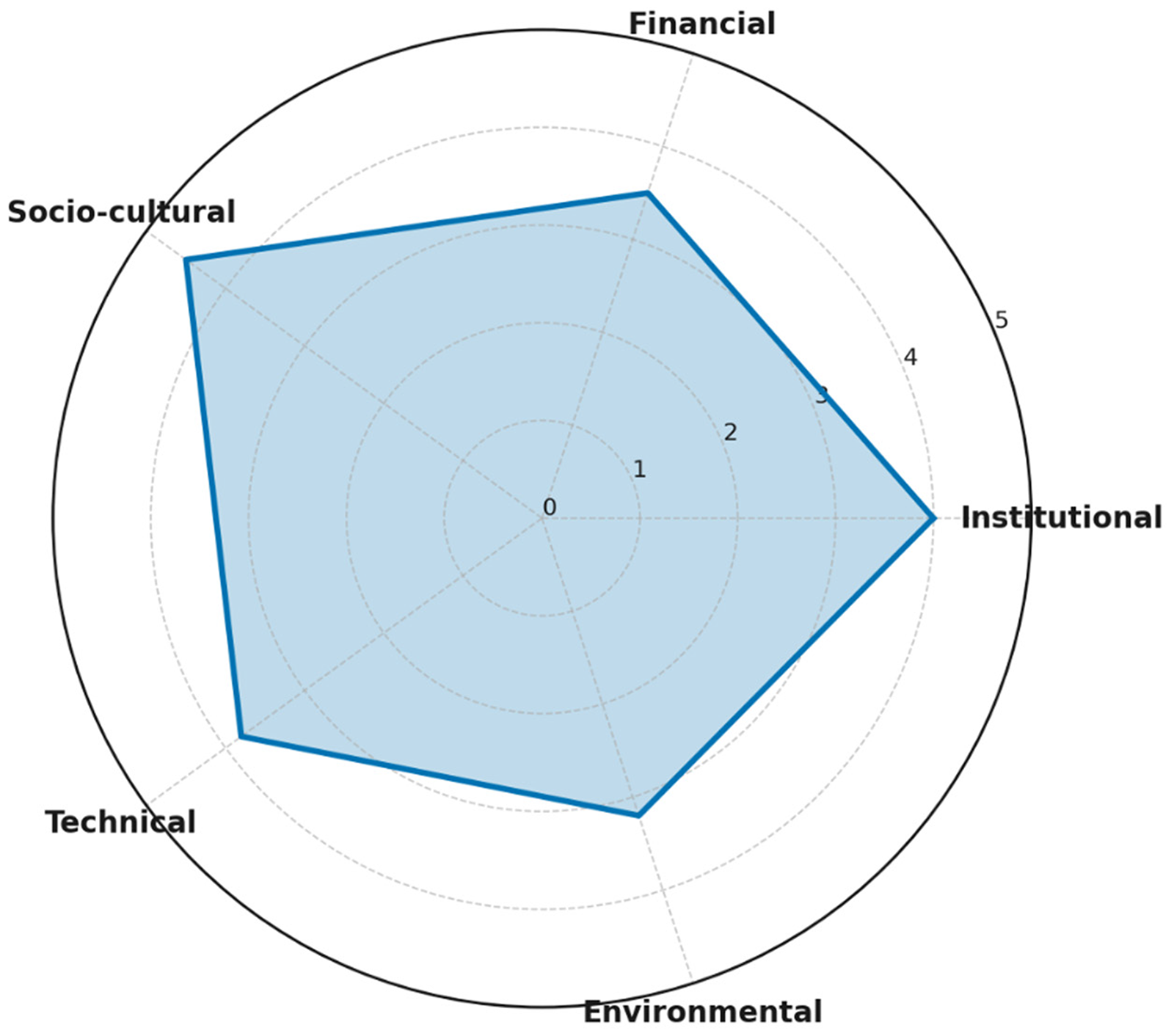
Alignment of Aotearoa New Zealand's renewable energy policies with the policy framework.
The emergence of “urgency” as a cross-cutting factor highlights recognition that transition timelines are tightening. Accelerated consenting, durable long-term policy targets, and institutional resilience are therefore essential. Sustainability extends beyond carbon mitigation to encompass system resilience and circular-economy considerations, underscoring the necessity of explicit recycling standards. The prominence of justice and equity, particularly regarding Indigenous and community participation, reinforces the importance of social legitimacy in enabling technical success.
The framework, therefore, functions effectively as both a diagnostic and comparative tool. Diagnostically, it identifies strengths, weaknesses, and inter-domain interactions. Comparatively, it provides a structure for cross-national analysis adaptable to different political-economic and development contexts, demonstrating utility for both high-income and emerging economies. Specifically, Tables 18–41 in the Supplementary Material, illustrate the application of the framework on multiple cross-context case studies from all socio-economic backgrounds, including Norway, Estonia, Brazil, India, and Nigeria.
Study limitations
This study has limitations that should be acknowledged. First, the empirical validation of the framework is based on a purposive sample of expert interviews rather than a large or statistically representative population. While this approach is consistent with qualitative research aimed at theory validation and refinement, it necessarily limits the generalisability of findings. Second, a part of the expert sample is geographically concentrated, reflecting the study's focus on Aotearoa New Zealand and the practical constraints of access to domain-specific expertise. Although this regional concentration enhances contextual depth and policy relevance, it may not fully capture perspectives from jurisdictions with different institutional or market structures. To mitigate these limitations, the study employs triangulation through document analysis and applies the validated framework across multiple national case studies, strengthening analytical robustness. Future research could extend this work by applying the framework to additional country contexts or by integrating complementary quantitative assessments.
Conclusion
This study extends earlier research by empirically validating and operationalising a comprehensive framework for renewable energy policy analysis. Building on the conceptual foundations established by Mirza et al. (2024a) and following the methodological precedent set by Mirza et al. (2024b), it integrates expert perspectives with empirical evidence, mostly from Aotearoa New Zealand but also from other countries, to produce a robust and adaptable analytical tool.
Taken together, the findings demonstrate that renewable-energy transitions cannot be understood through technological or economic considerations alone. They depend upon coherent institutional arrangements, resilient financial mechanisms, inclusive social processes, and environmentally sustainable practices. The validated framework therefore offers a structured basis for cross-national comparison and a decision-support resource for policymakers engaged in energy-system transformation.
In this respect, the study makes three principal contributions to scholarship on renewable-energy policy. First, it bridges the gap between theoretical development and empirical validation by advancing a framework grounded in both the academic literature and expert judgement. Secondly, it operationalises a comparative analytical tool suitable for application across diverse policy contexts, thereby responding to calls within energy-policy research for measurable and systematic evaluation mechanisms. Thirdly, it incorporates justice, urgency, and sustainability as cross-cutting dimensions, thereby situating technical and financial decision-making within wider societal imperatives. Future research could extend this framework to multi-country comparative studies or employ quantitative scoring approaches to correlate domain performance using real-world indicators.
Supplemental Material
sj-docx-1-ren-10.1177_27533735261426909 - Supplemental material for Validation and application of a multi-dimensional framework for renewable energy policy development
Supplemental material, sj-docx-1-ren-10.1177_27533735261426909 for Validation and application of a multi-dimensional framework for renewable energy policy development by Zuhaib Tayar Mirza, Alan Brent, Timothy Anderson and Jeff Seadon in Renewable Energies
Supplemental Material
sj-docx-2-ren-10.1177_27533735261426909 - Supplemental material for Validation and application of a multi-dimensional framework for renewable energy policy development
Supplemental material, sj-docx-2-ren-10.1177_27533735261426909 for Validation and application of a multi-dimensional framework for renewable energy policy development by Zuhaib Tayar Mirza, Alan Brent, Timothy Anderson and Jeff Seadon in Renewable Energies
Footnotes

Funding
The research was supported by the Chair in Sustainable Energy Systems in the Wellington Faculty of Science and Engineering and the Doctoral Scholarship programme of Te Herenga Waka Victoria University of Wellington.
Chair in Sustainable Energy Systems,
Declaration of conflicting interests
The authors declared no potential conflicts of interest with respect to the research, authorship, and/or publication of this article.
Supplemental material
Supplemental material for this article is available online.
Author Biographies
References
Supplementary Material
Please find the following supplemental material available below.
For Open Access articles published under a Creative Commons License, all supplemental material carries the same license as the article it is associated with.
For non-Open Access articles published, all supplemental material carries a non-exclusive license, and permission requests for re-use of supplemental material or any part of supplemental material shall be sent directly to the copyright owner as specified in the copyright notice associated with the article.
