



Abstract
Pathway programs are widely recognised for widening participation (WP) of non-traditional students (NTS) in higher education (HE), yet little attention has been given to how these programs widen the capabilities and aspirations of NTS within the Australian HE context. Drawing on the concept of ‘widening capabilities’ (Gale, 2015; Walker, 2012), this study explores how an Australian university’s pathway programs help NTS overcome challenges, build confidence, and engage with HE in ways that align with their values and aspirations. Using a qualitative research approach, this study is based on interviews with 15 NTS who either discontinued or continued a sub-bachelor pathway program at an Australian university. The findings illustrate how pedagogies and curricula of these pathway programs widen capabilities of NTS to function by fostering personal growth and reflective learning. These insights contribute to broader equity debate, showing that pathway programs advance both access and outcomes, moving beyond a narrow focus on attainment to recognise success as both progression in HE and the development of valued capabilities.
Keywords
Introduction
The global expansion of tertiary education has transformed higher education (HE) from an elite system to one characterised by mass access, particularly in OECD countries (Kabir and Ahmed, 2024; Marginson, 2016; Trow, 2007). Holmegaard et al. (2017) trace key milestones in widening access to HE in Europe, including Denmark’s 1949 reforms, the Bologna Process of 2003, and England’s 2003 White Paper on higher education. Similarly, Schuetze and Slowey (2002) document this shift across ten countries, noting a dramatic increase in enrolments starting in the late 1980s. Widening participation (WP) has since become a significant policy focus in many Western countries, aiming to increase university access for traditionally underrepresented groups who continue to face systemic inequalities within the education system (Jones et al., 2025).
In Australia, the 2008 Bradley Review (Bradley et al., 2008) set ambitious targets for WP, aiming to increase the bachelor’s degree completion rate among 25 to 34-year-olds from 32% to 40% by 2025, and to boost participation by low socioeconomic status (SES) students from 15% to 20% (Australian Government, 2009). Wheelahan (2012) describes these goals as marking the third major expansion phase of Australian HE, following the establishment of new universities and advanced education colleges post-World War II and their integration into universities during the 1980s. Each phase emphasised vocational outcomes, reflecting the evolving role of HE as both a skill-building and equity-driven enterprise.
Efforts to WP in Australia, however, predate the Bradley Review. As Gale and McNamee (1995) document, WP initiatives can be traced back to the 1970s, when the federal Government abolished university fees to address educational inequities. Gale and Parker (2014) highlight the steady drive to broaden access over several decades, culminating in the 2000 HE quality assurance framework, which resulted in a 400,000-student increase in enrolments from 2000 to 2009 (Shah et al., 2011). Thus, the Bradley Review built upon, rather than initiated, a long history of WP efforts aimed at supporting non-traditional students (NTS) in Australia. Future targets are set in the Australian Universities Accord (Australian Government, 2023), which calls for a tertiary attainment target of 80% by 2050, and increasing the proportion of university-educated Australians aged 25–34 from 45% currently to 55%. Similarly, Jackson et al. (2023) note an increase in the use of alternative pathways by many equity groups, suggesting that this confirms the widening of participation in HE through alternative pathways.
The WP agenda has played a key role in creating and developing alternative pathways to HE, now commonly offered across Australian universities. These pathways include bridging courses, preparatory programs, foundation studies, enabling programs, and articulation pathways, which can operate in very different ways. However, they are usually designed to enable students without traditional entry qualifications to access HE. These students are often referred to as ‘non-traditional students’ (NTS); however, the use of this term can be inconsistent, often failing to convey a clear or functional concept (Chung et al., 2014). NTS is often identified as individuals whose educational biographies include widening paths to HE, alternative entry routes, and a need for flexible study modes (Jarvis, 2021; Schuetze and Slowey, 2002). NTS tend to be less prepared for university than traditional students, face a higher risk of non-completion, and have higher attrition rates, particularly among those with lower university entry scores (Kemp and Norton, 2014). Consequently, HE institutions need to engage in systemic and structural changes to accommodate NTS rather than expecting students to conform to traditional institutional requirements (Gale and Parker, 2014). Moreover, addressing the cultural and economic hierarchies between academic institutions (Read et al., 2003: p. 275) and social justice and equity (Jarvis, 2021; Nevill and Rhodes, 2004) not only fosters access to HE but also supports completion of degrees.
A pressing question, therefore, is how Australia’s pathway programs can further enhance students’ capabilities – not only increasing enrolments but also ensuring academic success and personal growth. While much of the literature focuses on pathways as tools for widening participation, less attention has been paid to how these programs widen the capabilities and aspirations of NTS in the Australian HE context. Drawing on Walker’s (2012) and Gale’s (2015) insights on the idea of ‘widening capabilities’ (WC) – understood as expanding students’ opportunities to develop valued skills, identities, and aspirations beyond narrow measures of attainment – this study explores how pathway programs can address past challenges, build students’ confidence, and enable them to engage with HE in ways that align with their values and aspirations. This dual emphasis on equity recognises that access and outcomes must be considered together (Enchikova et al., 2024), while avoiding the reduction of success to attainment alone. As Gutiérrez (2008) cautions, a sole focus on attainment risks a ‘gap-gazing’ fetish that obscures the structural and cultural barriers shaping students’ experiences. These capabilities are particularly critical for NTS, especially those from low-SES backgrounds who may lack the cultural capital of their peers (Gale, 2015).
This paper seeks to understand how two pathway programs, and their pedagogies and curricula, navigate NTS capabilities and aspirations and support them in developing the skills and reflective practices necessary to thrive in HE. In particular, this paper analyses the experiences of 15 NTS in these pathway programs to demonstrate how pedagogies and curricula can foster growth, reflective learning, and resilience, even for those who do not complete them, thereby challenging traditional notions of student retention. By reframing retention through the lens of both academic success and broader equity, the paper contributes to ongoing debates about how WP programs can simultaneously address systemic inequality and support individual flourishing. In doing so, the paper aims to examine how pathway programs in Australian HE widen students’ capabilities and aspirations of NTS, and in what ways do these benefits extend beyond student retention and completion of pathway programs?
Following this introduction, we critically examine WP initiatives in Australia and discuss how WC address traditional WP models’ limitations while challenging deficit-based perspectives. The subsequent section delves into how curriculum and pedagogy can support NTS by fostering WC to function. We then present a discussion of the methodological approach used in this study. Finally, we analyse interview transcripts to explore how pathway programs help NTS navigate their capabilities and aspirations, build their confidence, and persist in HE through personal and professional growth and reflective learning.
Widening participation
While pathway programs have successfully contributed to widening participation in HE in Australia since the 1970s, they may carry unintended consequences for students if they find these pathways unaligned with their goals. This can be especially problematic for students who enrol but lack meaningful engagement, making the decision potentially costly. Gale (2015) critiques the Australian Government’s social inclusion and WP policies, suggesting they lack what Mills (1959, cited in Gale, 2015) calls the ‘sociological imagination’ necessary for qualifying equity. By the idea of ‘sociological imagination’, Gale (2015) refers to understanding the importance of recognising the dual nature of social reality, which encompasses both private troubles (e.g. aspiration of NTS) within one’s immediate environment and broader public issues rooted in social-cultural inequality. He argues that these WP policies primarily focused on addressing students’ educational disadvantages while neglecting the systemic and institutional factors that create these challenges. As a result, such policies perpetuate a ‘deficit’ view on individuals who do not engage in HE, limiting disadvantaged groups’ freedom to not only pursue their desired futures but also to shape their own aspirations and choices.
Gale and Hodge (2014) further critique Australia’s approach to social inclusion, calling for a ‘just imaginary’ that avoids deficit perspectives of NTS, especially those from low-SES backgrounds. They highlight how the Australian Government’s WP policies have framed aspirations by emphasising the need for students from low-SES backgrounds to develop awareness and motivation regarding the long-term benefits of HE (Australian Government, 2009). These policies also focus on helping students expand their expectations of engaging in HE, broadening their perceptions of what is possible, and providing support to turn aspirations into actionable steps (Australian Government, 2023). Gale and Hodge (2014) question the presumption that HE inherently benefits these students and the long-term viability of current inclusion strategies, challenging the effectiveness and ethics of how ‘aspiration’ is defined and promoted in WP agendas.
In response to these concerns, Gale (2015) draws on Sen’s concept of ‘capabilities’, which refers to the substantive freedoms to achieve and become what one has reason to value. He argues that a more equitable agenda for HE expansion should not focus solely on increasing access but should also seek to redefine and enhance understandings of the capabilities of disadvantaged students. Citing (Bowden and Doughney, 2010), Gale (2015) points out that many low-SES students aspire to attend university, irrespective of whether they live in urban or rural areas. Instead of being an ‘aspiration gap’, Gale suggests the issue lies in a ‘navigational capacity’ – the ability to manoeuvre through HE’s structural complexities – which is often limited for low-SES students due to their lack of connections and experiences that help them succeed. This calls attention to the importance of avoiding deficit discourses in WP agendas and fostering students’ abilities to navigate educational systems.
Some other scholars also advocate for a shift from WP to WC. For example, Garratt (2011) proposes that the WP discourse often centres on participation as an end rather than on developing the capability to succeed and thrive in HE. Drawing on Sen’s (1992) capabilities approach, Garratt also emphasises the importance of enabling students to ‘be’ and ‘do’ – to pursue lives they have reason to value – by focusing on their actual ‘functionings’ rather than merely their inclusion in HE. This approach highlights equality as the ability to participate meaningfully and with confidence. By focusing on WC, institutions can support students not only in entering HE but in thriving within it by cultivating skills, knowledge, and self-assurance essential to meaningful participation.
The discussion above underscores the importance of shifting the focus from mere participation to ‘widening capabilities’, which broadens the goals of HE. By widening capabilities, we refer to the approach that empowers students to navigate their educational journeys and succeed on their own terms, aligning educational structures with their personal values and aspirations. In this paper, we stress the significance of ‘widening capabilities’ as essential for achieving true inclusivity in HE. WC include equipping students with the resources and skills in a program necessary to foster autonomy, self-determination, and resilience. Ultimately, this effort aims to create a transformative and equitable educational experience that enhances students’ ability to persist and thrive in HE.
Curriculum and pedagogies, and widening capabilities to function
Capability is functioning where individuals actively realise their potential to achieve what they value (Nussbaum, 2011). In HE, expanding students’ capabilities to function requires curriculum and pedagogical approaches that empower them to attain the things they deem important. Achieving true inclusivity through these means is complex and requires considerable teacher dedication, alongside adaptation of appropriate pedagogical practices (Sakata, 2021). Nevill and Rhodes (2004) argue that retention should be reframed as an educational issue, asserting that addressing it through curriculum and pedagogy can improve students’ academic and social integration. Similarly, Walker (2008) identifies pedagogical barriers as significant obstacles to WP, warning that a lack of inclusivity in teaching and learning can compromise students’ educational experiences. Walker argues that inequalities in access to knowledge and opportunities increase without equitable pedagogy, leading to disparities that impact students’ success.
Effectively designed curricula and pedagogy are thus essential for supporting NTS’s work in the WC to function effectively. For instance, Turner et al. (2017) found that first-year students disengaged from study skills modules when they perceived these skills as irrelevant. They concluded that making the purpose of such skills explicit could help students recognise their value, underscoring how structured, relevant pedagogies contribute to academic development by integrating meaningful skills into students’ broader educational journey. Crozier et al. (2010) examined how curriculum structure supports or hinders WP, comparing ‘loose’ and ‘strong’ pedagogical frameworks at two institutions. They observed that ‘loose’ framing, which emphasises flexibility, could leave students – especially those lacking cultural capital – feeling unsupported, while ’strong’ framing, characterised by clear expectations, fostered confidence and independence. This comparison highlights that an effectively framed curriculum is not just about content clarity but about cultivating students’ capabilities and confidence, which are crucial for their long-term success in higher education.
Beyond enrolment, inclusivity requires addressing and restructuring practices that may inadvertently alienate or exclude NTS. A curriculum emphasising power, knowledge, and agency allows students to engage in critical thinking as part of WP. Larmar and Lodge (2014: 99) advocate cultivating ‘metacognitive capital’, defined as ‘the learning and knowledge acquisition capacities and resources that students bring to the learning context’, to improve retention. They argue that students who lack these skills are at a higher risk of withdrawing from their studies early in their HE journey. By encouraging students to understand and apply critical thinking, educators help them engage with their learning journey more meaningfully – a strategy aligned with Turner et al. (2017) and Crozier et al.’s (2010) emphasis on structured support as vital to WP.
Walker (2008, 2010, 2012) thus calls for an expanded view of WP, reframing it as ‘widening capabilities’. The WC approach encourages students to become ‘strong evaluators’ who make informed, meaningful educational and life choices. Walker’s perspective requires a curriculum that imparts knowledge and promotes equality by engaging students in reflective, discerning learning experiences. It also enables students to build evaluative skills essential for personal and professional growth. Building on this, Case et al. (2010) provide some guidance on WC, suggesting that fostering capabilities requires encouraging students to explore new intellectual territories while providing supportive structures. They stress that teachers must acknowledge their positional power and complex relations of power in the teaching-learning process and create a learning environment where students exercise autonomy. Thus, curriculum in pathway programs needs to engage with ideas of power, challenge students in a supported context, provide students with flexibility and control, and make use of effective pedagogy. Thus, teaching NTS within WP frameworks requires a teacher-intensive approach with a solid commitment to personalised support, tutoring, and coaching. This is Walker’s vision of a curriculum that nurtures students’ critical thinking and self-assessment skills.
This paper analyses how teaching-learning processes support the WC of NTS to function and how this, in turn, fosters meaningful and sustained engagement in their subsequent HE journeys. The subsequent sections outline the
Research context and methodology
This article presents findings from a larger research project conducted in 2020 at an Australian University, referred to by the pseudonym ‘the University of Aus’. As part of this project, data were collected through surveys, focus group discussions, and interviews. This paper draws on interviews with 15 NTS participants – 14 who discontinued and one who continued – enrolled in two pathway programs: the Associate Degree of Arts and the Associate Degree of Education. The interviews were conducted between September and October 2020. Of the participants, eleven were enrolled in the Associate Degree of Arts and four in the Associate Degree of Education, with program commencements ranging from 2015 to 2019.
The University of Aus has a long history of offering diverse pathway programs for students who do not gain direct entry into university. Following the Bradley Review (2008), its regional campus received significant funding from the Australian Government’s Structural Adjustment Fund Scheme. The university’s funding application aimed to establish a unique pathway model that emphasises a new partnership between the university and TAFE (Technical and Further Education) institutions (Gale et al., 2013). The curriculum integrated multiple disciplines, including arts, education, business, life sciences, and health, enabling on-campus students to transition smoothly into their target degrees while TAFE students completed diplomas with recognised credit pathways. Gale et al. (2013) argue that the University of Aus’s sub-bachelor pathway programs primarily focus on widening participation, particularly in regional areas, through partnerships with TAFE institutions.
Since 2010, the university’s primary sub-bachelor pathway program for domestic students has evolved in response to the widening participation agenda. In 2012, the interdisciplinary associate degree program was relocated to the Faculty of Arts and Education, and by 2015, two new associate degrees replaced the initial offering. Currently, the university offers the Associate Degree of Arts and the Associate Degree of Education, which guarantee entry into bachelor’s degree programs upon successful completion. These programs, supported by Commonwealth-Supported Places (CSP), combine targeted bachelor-level units with foundational academic support. Thus, the University of Aus’s sub-bachelor pathway offerings reflect the competing demands of widening participation/social equity and economic imperatives (Wilkins and Burke, 2013).
The associate degrees consist of 16 units, completed over 2 years (four units per trimester, two trimesters per year), with part-time study and summer trimester options available. Students typically begin with four foundation units in communication, digital literacy, teamwork, and critical thinking. These units are deliberately distinct from standard bachelor-level offerings: seminars are capped at 20 students (compared to 30 in other Arts and Education units), include three contact hours per week, embed assessment activities into seminars, and provide opportunities for draft feedback. Lectures, seminars, and online platforms explicitly introduce students to higher education practices and support services, including academic mentors, librarians, and writing support.
Progression and credit differ between these two programs. Associate Degree of Education students can transfer up to 12 credit points into the Bachelor of Education (Primary), but the program’s structure leaves no space to credit the four foundation units. In contrast, Associate Degree of Arts students are more likely to transition into a bachelor’s program after their first year, with the flexibility to carry forward all units as credit (subject to course rules). This enables the completion of both the Associate Degree of Arts and bachelor’s degrees within 3 years, or the exit from the associate degree and entry into the pathway bachelor’s degree, still completing the total within 3 years.
Upon reviewing the academic biographies of participants in the pathway programs, we found that they transitioned into various programs within and beyond the University of Aus. Of the 14 students who discontinued their associate degrees, three are currently enrolled in bachelor’s programs at the University of Aus, including Arts, Arts/Commerce, and Nursing, but have not yet completed their degrees. Seven went on to complete a bachelor’s degree, with one later enrolling in an additional program. Their completed degrees included the Bachelor of Education in Primary (3 students), the Bachelor of Arts (3 students), and the Bachelor of Criminology (1 student). Four discontinued students were no longer enrolled at the University of Aus, although one had continued studying at another institution.
Taken together, the interview participants illustrate the varied trajectories of NTS engaged in pathway programs. These included: NTS who completely discontinued their studies entirely without entering a bachelor program; (b) NTS who discontinued the associate degree but currently enrolled in bachelor programs at the University of Aus; (c) NTS who discontinued and transferred to another university; (d) NTS who discontinued the associate degree, transitioned into a bachelor degree and successfully graduated (with one pursuing further study); and (e) NTS who is remained enrolled in an associate degree at the time of interview.
Summary of Participants.
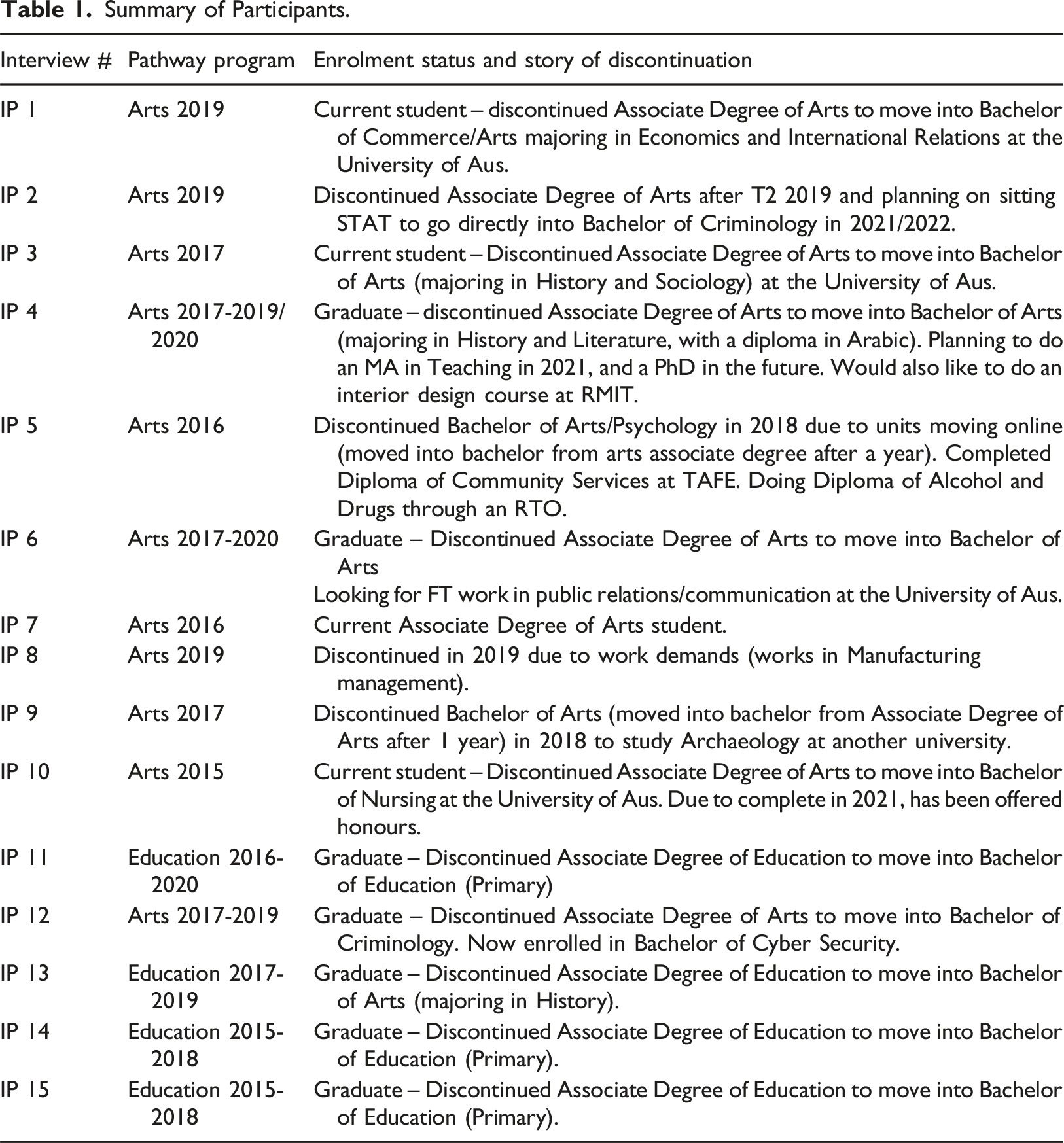
We used a thematic analysis of the data (Braun and Clarke, 2021) and identified the participants as ‘IP#’ to denote ‘Interview Participant’ and their corresponding number throughout the analysis. Thematic analysis is an analytical tool that enables researchers to search for recurring words or themes within a text (Patton, 2014). We adopted this approach to identify ideas, statements, and concepts in the transcripts related to these pathway programs and their impact on student capabilities, allowing us to develop specific themes (Prior, 2016).
Initially, we generated themes by categorising and organising the data topically. As part of this process, we identified recurring themes relating to capabilities and aspirations across the transcribed data. These were not direct quotes from participants but rather researcher-generated codes that synthesised participants’ experiences into concise expressions, such as ‘pathway programs help guide NTS in pursuing their aspirations’, ‘students enhance their personal and professional growth during their studies’, and ‘students apply their learning in current studies’. These codes captured how participants described their experiences and outcomes in the pathway programs.
From these codes, we constructed broader themes. For example, the code ‘pathway programs help NTS navigate aspirations in HE’ was not intended to suggest that programs themselves actively ‘navigate’, but rather that the structure, curriculum, and pedagogical support within the programs shaped how students articulated, developed, and pursued their aspirations. To illustrate, one participant noted: ‘I didn’t have enough marks to be in my desired course, so for me, this was a pathway to getting to the Bachelor of Arts’. This type of statement informed our coding and subsequently supported the theme ‘pathway programs help NTS expand capabilities and aspirations in higher education’.
In this sense, the theme reflects our interpretation of how pathway program features and practices mediate students’ capabilities and aspirations (e.g. addressing past academic challenges, building confidence, and creating accessibility) and widen their capabilities to function (e.g. personal growth, reflective learning). Thus, the process of analysis moved from participants’ individual accounts to coded expressions, and finally to higher-level themes that capture the dynamic relationship between pathway program design and students’ evolving educational trajectories.
Findings
In the following themes, we analyse NTS experiences in two pathway programs, focusing on how critical thinking, metacognitive development, and meaningful learning were nurtured to build confidence in their abilities. Significantly, even for students who discontinued their associate degrees, these elements contributed to a transformative educational experience that broadened their capabilities and supported their persistence in higher education. Many participants reported that the skills and confidence gained through the pathway programs enabled them to transition successfully into bachelor’s degrees at the University of Aus or at other institutions.
First, we demonstrate how pathway programs shaped NTS capabilities and aspirations in higher education. By this, we mean that the programs supported students in addressing past academic challenges, building confidence, creating accessible entry points into bachelor-level study, and engaging with HE in ways aligned with their own values and goals. We then explore how these programs extend beyond merely providing access for NTS, actively enhancing their ability to succeed by fostering personal growth and reflective learning.
Pathway programs help NTS expand capabilities and aspirations in higher education
This theme highlights the transformative potential of pathway programs in enabling NTS with aspirations within HE. In this analysis, we demonstrate how pathway programs navigate individual students’ capabilities and aspirations by (a) addressing their past academic challenges, building confidence, and creating accessible pathways and (b) fostering engagement with HE in a way that aligns with what they value and what they want to be and do.
First, pathway programs play a crucial role in supporting individual NTS by addressing their academic challenges, social and structural barriers, and aspirations. These programs help build students’ confidence, enabling them to succeed in HE. As Gale (2015) argues, and as our study confirms, many NTS face significant academic and personal obstacles that prevent them from directly entering HE. However, students viewed the University of Aus’s pathway programs as essential to gain confidence and overcome these barriers. Our analysis highlights explicitly that these programs provide NTS with a critical opportunity to access HE, even in the face of challenges such as low academic scores, long gaps in education, and incomplete secondary schooling. For instance, two students explained how pathway programs allowed them to pursue their desired bachelor’s degrees despite not meeting the initial entry requirements: ‘I didn’t have enough marks to be in my desired course, so for me, this was a pathway to getting to the Bachelor of Arts’. (IP6) ‘I applied to go straight into the bachelor, but because I didn't take school very seriously, my entrance score wasn’t high enough’. (IP15)
Some students highlighted the difficulty of returning to education after a significant time away. However, they noted that the pathway program helped them overcome these obstacles, enabling them to thrive in HE. For example, a mature-aged participant who left school early but is now interested in archaeology shared, ‘I left school 30 plus years ago and without VCE. The other universities just wouldn’t take me in, even as a mature-aged student. [The University of Aus] was the one who said, “Look, we reckon that you can come in [through] an associate degree”’ (IP 9).
The analysis has also shown that some participants experienced social barriers, such as cultural and gender-related challenges, that delayed their entry into HE. However, for one student, the pathway program played a crucial role in helping her build confidence and move forward with her educational journey: Well, it’s something I’ve always wanted to do from being little, because we didn't have the opportunities in the UK. When I was growing up, girls didn't do that sort of stuff. … I worked in a clothing factory to put [my husband] through uni. And then the kids grew up, and I thought, you know, after they’d all gone, that was it. I was divorced. I thought, ‘Right, it's my turn now’. (IP3)
For this participant, the pathway program represented a long-awaited opportunity to prioritise her own education and aspirations. Similarly, another participant spoke of struggles with addiction that had impacted their opportunities to access HE: I always wanted to go to university, and I never had the opportunity when I was a bit younger. So I decided, I was 29 [and] before I know it, I’ll be 50 I wish I had done it. … I always had trouble in the past with addiction, like addiction have played a big part in my life up until about 2015. And I just wanted to go to university, get an education and see where it took me. (IP5)
Second, the analysis has also revealed that pathway programs enable students to engage with higher education in ways that align with their personal values and aspirations for success. These findings resonate with Garratt’s (2011) interpretation of Sen’s (1992) capabilities approach, which emphasises that empowerment involves enabling individuals to pursue lives they have reason to value rather than focusing solely on their inclusion in higher education. Our analysis of interview transcripts has found that many students initially viewed these programs as merely a means to access higher education. For example, one of the students commented, I didn’t complete high school: I dropped at the end of year 10. To be perfectly honest, I don’t even know if I passed year 10: I just kind of left and went on my way. I worked and travelled and did a whole bunch of other things, and then decided I wanted more. (IP12)
Over time, however, many students reframed this access regarding their personal goals, using the programs as a stepping stone to pursue bachelor’s degrees that aligned with their interests and ambitions. One key example of this is how high-performing students used the opportunities to transition early into their desired bachelor’s programs, a reward for their academic achievements in the associate degree. As one participant explained: I had, I think, a WAM of 90 in that year. So [they] offered for me to jump into my bachelor’s degree a bit early, which was amazing, because that's what I wanted from the beginning. So yeah, and then I obviously took that and ran with it. (IP4)
Several participants highlighted the unique appeal of associate degrees, which, as Gale (2015) describes, can, when framed as a pathway, enhance students’ navigational capabilities by addressing structural complexities. These pathway programs were seen as instrumental in helping participants achieve their long-term goals. For instance, one participant noted how the University of Aus’s pathway programs reduced structural barriers through the fast-tracking option: ‘It was an interesting way for me to sort of get into what I needed to do in the end for my end goal; I didn’t actually see anywhere else that I could do something like this’ (IP14).
Another participant commented on preferring a pathway as well as the fast-track process, for it offered: I thought rather than sitting the STAT-test to go straight into a degree, I would do a pathway. And then it also got my attention when it said that you would Fast Track your degree, so you would only have to do three instead of the four years. (IP2)
The above statement highlights a key feature of the Associate Degree of Arts pathway, enabling students to earn a bachelor’s degree in a shorter timeframe. As outlined in the research context and methodology section, progression and credit transfer arrangements differ between the two associate degree programs. Students in the Associate Degree of Arts can transition into a bachelor’s program after their first year and have all completed units credited towards their bachelor’s degrees. This flexibility allows NTS to complete both the Associate Degree of Arts and their chosen bachelor’s degree within a total of 3 years or exit after 1 year and still finish the bachelor’s degree within the same time frame. Significantly, even students who do not complete the associate degree can benefit from these opportunities, using the pathway as a stepping stone to HE.
For this participant, the fast-track process within the arts pathway program aligned with his values and aspirations, enabling him to pursue his goals within higher education. Similarly, the speed and integrated structure of the program resonated with another participant: I just ended up at the University of Aus because the associate degree seemed like it was the best option in terms of getting me where I wanted to be in the quickest way and getting me involved in kind of the university life straightaway: that was a massive kind of benefit from it. (IP12)
In short, this analysis revealed that students primarily enrol in the University of Aus’s associate degrees as pathways to bachelor’s degrees or HE in general. While this aligns with the program’s purpose, the findings underscore its significant impact. For many students, the associate degree provides an opportunity to overcome past academic challenges, build confidence, and engage with education. Despite facing barriers such as incomplete schooling, long gaps since their last study, and doubts about their academic abilities, NTS leveraged these programs to pursue what they valued and to reimagine their futures in HE. The analysis also showed that even when students did not complete the associate degrees, the pathway programs served as a critical stepping stone to HE for many. In the next section, we analyse how students’ WC to functioning through personal and professional growth and reflective learning during their pathway programs.
Widening capabilities of NTS to functioning through ‘personal and professional growth’ and reflective learning
As outlined in the methodology section, nearly all interview participants had discontinued their associate degrees, with one still enrolled in the program. While most of these students discontinued the pathway programs, they developed the capabilities to function in achieving the things they valued. In the context of the capability approach, Sen (2003: 8) defines a ‘capability set’ as an individual’s freedom to achieve various combinations of functioning, which refers to the actual achievements or actions an individual can realise. It is crucial to assist students in widening their capabilities to function in university learning (Nussbaum, 2000; Walker, 2010, 2012). For instance, Walker (2010) explains that capability represents potential functioning, such as a student’s ability to actively participate in peer discussions in a classroom because they value this engagement. In this theme, we demonstrate how, despite discontinuing their pathway programs, these students expanded their capabilities to function or achieve various functioning combinations in significant ways by: (1) fostering personal and professional growth, developing critical thinking skills, and exploring new intellectual territories through pathway programs and (2) engaging in reflective and discerning learning experiences that enriched their overall higher education journey.
First, our analysis has shown that all participants recognised the pathway widening their capabilities to function by fostering both professional and personal growth and enabling success in their desired degrees. Participants commented specifically on how the curriculum and pedagogical strategies within the pathway programs enabled them to engage effectively with learning. These included teacher-intensive approaches in foundational units, active participation in classroom activities, guided feedback, and structured opportunities to develop transferable skills. For example, one participant observed how these units differed from standard electives, highlighting the personalised support and practical guidance provided: I did feel like the tutors and the lecturers were very hands on, I could definitely see the difference between those units and my electives. There was a lot more explanation of things, explanation of terms, basic information about how a university ran outside of those units as well. So you could get the sense that they cared a lot about their students. [There was] a lot more on guiding them and still being independent adult learners, but trying to facilitate our growth as much as possible in that environment. (IP12)
Another student who discontinued an associate degree to move into a Bachelor of Education (Primary) also reflected on how teaching-learning processes of pathway programs continued to benefit them: A lot of the things came in quite handy when I was doing placements while I was doing the Bachelor of Education. There were things that we were shown and taught and used and I was able to use that with the students. And also, with some of the staff members because it's understandable that they are busy teaching a lot of the resources that they use, and the ones that they are used to using or familiar with, and being able to then introduce some of these things to other staff members was fantastic. And things that I sort of got to know and took for granted because of the way that we were taught. It was nice to be able to then pass that on to other people who've never seen these things before. So yeah, there's lots of things that I've used both inside and outside. … The skills that I'll have forever, they're tucked away in there, and I'll never forget them. They're, they've been invaluable. (IP14)
The above statement highlights how students developed their sense of agency and applied this in their professional lives. This learning experience not only challenged them but also provided flexibility, control, and the opportunity to incorporate effective pedagogical practices into their professional endeavour.
Many scholars argue that teaching NTS within WP frameworks requires significant teacher dedication and adaptation of tailored pedagogical practices. This approach demands a teacher-intensive approach characterised by a strong commitment to personalised support, tutoring, and coaching (Sakata, 2021). Our analysis has shown that the educators teaching foundation units at The University of Aus employed teacher-intensive strategies, encouraging active student participation in classroom activities, providing constructive feedback, and fostering strong teacher-student relationships. As a result, participants noted that the pedagogy used in these foundation units promoted their growth, thereby widening their capabilities to function.
Further, our analysis of the interviews has found that participants believed critical thinking was one of the key learning areas they developed during their studies in various foundation units within the pathway programs, thereby enhancing their widening capabilities to function (Case et al., 2010; Turner et al., 2017). For example, a student who discontinued their associate degree to move into the Bachelor of Arts noted, …[critical thinking] was probably the most beneficial for the rest of my study at [The University of Aus] because critical thinking [is] basically what university is about. … All of these subjects required reading and anytime you read, if you look at it through a lens of critical thinking, you can really decipher what's true and false and you can get more out of each thing that you try to read. (IP13)
The interviews have also shown that some participants felt that their learning in critical thinking helped them explore new intellectual territories and adopt a broader way of thinking, thereby widening their capabilities to function. For instance, another participant, who moved early into the Bachelor of Arts from the pathway program, and then discontinued to study Archaeology at another institution, commented, Actually, the general critical thinking and questioning everything. It's a bit tiring, actually, I could easily go back to the other way of thinking. Once you've opened the door, I find it's really hard to shut it, isn't it so? So I would have to say that would probably be the one that's really had knock-on effects throughout my life. (IP9)
Second, our analysis of the interviews has found that widening capabilities extend beyond merely understanding the curriculum content and employing effective teaching pedagogies. While most students discontinued their programs for various reasons, such as health issues, financial constraints, or opportunities to transfer to their desired course, participants still viewed the pathway programs as instrumental in expanding their capabilities to function. In the pathway programs, core foundation units run by the pathway programs team were central to capability development, while other units were standard electives taken alongside. Participants recognised these core foundation units as essential in preparing for long-term success in higher education, with curriculum clarity and effective teaching methods serving as supportive elements in this process (Walker, 2008, 2010, 2012).
The analysis has also shown that students enhanced their capabilities to function by engaging in what Walker (2008, 2010) describes as reflective and discerning learning. For example, one participant who transitioned from the Associate Degree of Arts to a Bachelor of Criminology at the University of Aus highlighted how the foundational units in the associate degree fostered critical reflection and discerning learning: I remember sitting in one of those classrooms, they've got a piece of writing up on the board and we're picking out what's wrong with it; that active learning, that engagement with that, that still helps me now with how I write things. Even though I'm not writing essays anymore, it still comes in with how I engage with the content or even just, those units help just everyday life. I think even just learning about fake news. I remember that three years ago, and it's so relevant still to this day. So those units are really about teaching you stuff for life as well, as daggy as that sounds, it's true. (IP12)
The above statement emphasises the importance of engaging in reflective and discerning learning experiences within pathway programs, highlighting their long-term value beyond academic settings. The participant recalls specific instances of active learning, such as analysing writing for errors, which provided a practical framework for developing critical thinking and transferable skills. These experiences improved their academic writing and influenced how they interact with content in daily life, demonstrating the lasting impact of reflective learning. This type of engagement empowers students to assess information and apply their learning meaningfully. A recommendation based on this analysis is that pathways programs should continue to prioritise these foundation units, as they provide the essential scaffolding for widening capabilities.
Such reflective and discerning learning significantly contributed to students’ continued success in higher education. Specifically, the interview analysis revealed that participants recognised the transferability of skills developed in their pathway programs to their ongoing studies across various disciplines. For instance, one graduate highlighted the importance of the public speaking skills acquired during the associate degree in achieving success in their current studies: The public speaking was a good thing. I'd never really had to do a lot of public speaking. So, getting up in front of the class and having to present assignments and things. That was the start of it. And then I had to use that skill throughout university to get my degree. (IP13)
In summary, this analysis has demonstrated that despite discontinuing their pathway programs at different stages, students significantly expanded their capabilities to function. They achieved this by fostering professional and personal growth, developing critical thinking skills, and exploring new intellectual territories through various units offered in the pathway programs. This analysis has also shown that their engagement in reflective and discerning learning experiences enriched their overall higher education journey. By emphasising active participation and the relevance of learning to broader life contexts, such programs cultivate discernment – the ability to evaluate and apply knowledge critically. This learning aligns with Walker’s (2008) concept of reflective and discerning learning, where students actively connect their learning to their values and aspirations, thus enhancing their capability to function in both academic and everyday settings.
Conclusion
In this article, we critically examined the transformative role of university pathway programs in fostering the WC of NTS, even for those who discontinue these programs. Drawing on students’ experiences at an Australian University, the study demonstrated that these programs extend beyond providing academic access. At the same time, the findings also showed that pathway programs play a direct role in supporting academic success, not only by developing confidence and personal growth, but also by equipping students with the foundational knowledge, skills, and strategies necessary to progress and succeed in subsequent bachelor’s degrees. These pathway programs fostered critical thinking, personal development, and transferable skills that equip students for long-term success in HE. Participants consistently emphasised the value of foundational units in building confidence, independence, and essential academic skills such as essay writing, communication, and critical analysis. Such attributes proved critical for students when transitioning into bachelor’s studies, helping them meet academic demands and persist with their degrees. These attributes not only helped students navigate academic challenges but also contributed significantly to their professional and personal growth.
The analysis highlighted the importance of aligning pathway programs with students’ values and aspirations. Pathway programs can lack what Mills (1959 cited in Gale, 2015) describes as a ‘sociological imagination’, perpetuating a deficit perspective that assumes access to higher education alone benefits NTS. This view overlooks the diverse structural challenges these students may have faced in their previous educational experiences. In this instance, such structural barriers included low ATAR scores, long gaps between school and higher education, and competing social or cultural responsibilities, all of which shaped their educational journeys. Scholars such as Gale (2015), Gale and Hodge (2014), and Garratt (2011), drawing on Sen’s capabilities approach, have emphasised the need to address these barriers and reimagine educational pathways to enhance students’ capabilities. Our findings revealed that while many participants encountered significant academic, social, and personal obstacles prior to enrolling, these programs enabled them to reimagine their futures. Beyond inclusion, these programs can foster ‘navigational capabilities’, empowering students to overcome challenges and thrive in higher education. Flexible and fast-tracking options were particularly valuable for some participants, as they simplified the journey toward achieving educational aspirations. These included credit arrangements in the Associate Degree of Arts, the possibility of completing both an associate and bachelor’s degree within 3 years, or the option to exit the associate degree early and transfer into a bachelor’s degree upon meeting the entry requirements.
Our analysis also revealed how the teaching and learning process, as well as the curriculum design, of the pathway programs play a crucial role in supporting students in widening their capabilities to achieve various combinations of functioning (Nussbaum, 2000; Walker, 2010). It has been shown that students widen their capabilities to function by fostering professional and personal growth, developing a sense of agency and critical thinking skills, exploring new intellectual territories and engaging in reflective and discerning learning experiences that enriched their overall HE journey. Reflective and discerning learning emerged as a key component of pathway programs, enabling students to connect their learning to their values and aspirations, thus enhancing their capability to function in both academic and everyday settings.
A key insight from this research revolves around the definition of ‘retention’. The Group of Eight Australia (2017) emphasises that while university-level programs can benefit students in many ways, completing a degree is essential for entering fields requiring professional accreditation and fully reaping the advantages of an undergraduate education. Our study found that although most of the 15 students interviewed had discontinued their associate degrees, they subsequently actively pursued their desired bachelor’s degrees. Some had already completed their target degrees, while others were still in progress at the time of our research. In this sense, some students who are technically categorised as ‘discontinued’ from the pathway program should instead be viewed as having progressed within higher education. This reframing highlights that the pathway model itself may need to be reimagined, rather than interpreting these students as dropouts, their trajectories should be understood as successful progression and retention in HE.
Consequently, these findings challenge the conventional view of retention in Australian HE, as these individuals were still making strides toward obtaining their bachelor’s qualifications despite being categorised as discontinued students in the pathway programs. This also highlights the importance of framing success and equity in multidimensional ways, moving beyond retention and completion as the only indicators, and recognising how pathway programs can advance educational equity by addressing both academic outcomes and broader capabilities (Enchikova et al., 2024). In this regard, the study also aligns with Gutiérrez’s (2008) call to avoid an overemphasis on attainment or ‘achievement gaps’, showing instead how pathways support students’ holistic development and aspirations.
This analysis has highlighted the need to expand our focus beyond mere program access and completion to consider a broader perspective that prioritises enhancing students’ capabilities. Pathway programs should be designed to equip students with essential knowledge, skills, and capabilities, enabling them to succeed in higher education and beyond, rather than simply guiding them to access and finish a pathway degree. Future pathway policy and practice should therefore balance the dual goals of supporting academic achievement and widening broader capabilities, recognising that both are essential for equity and long-term success (see also Hannon, Faas and O’Sullivan, 2017; Enchikova et al., 2024; Gutiérrez, 2008).
Footnotes
Declaration of conflicting interests
The author(s) declared the following potential conflicts of interest with respect to the research, authorship, and/or publication of this article: Emma Charlton has been teaching at University of Aus in the field of alternative pathways since 2011, and currently directs University of Aus’s primary education pathways course – The Associate Degree of Education – which was part of the pilot accreditation process, and was accredited by the Victorian Institute of Teaching in early 2022 (Victorian Institute of Teaching, 2024). Ariful Haq Kabir has also taught in the foundation units of the Associate Degree of Education at University of Aus.
Funding
The authors disclosed receipt of the following financial support for the research, authorship, and/or publication of this article: This study is supported by Deakin University; the authors received HEPPP funds (project number HAE-20-031).
