



Abstract
The pervasive socioeconomic inequalities that exist in relation to higher education participation within the UK are notably prominent amongst the most selective, ‘elite’ universities, and could become wider still following the Covid-19 pandemic. This case study privileges the accounts of 11 young people from low socio-economic status (SES) backgrounds who were directly affected by the pandemic during their final year at school (Year 13) and who had all taken in part in outreach programmes that specifically aimed to improve access to such top universities in England. Through in-depth phenomenological interviews, this provides insight into the educational and life journeys of these individuals, including their experiences of the pandemic and their interactions with outreach programmes, helping to understand the influence they perceived these to have on their choices, aspirations and trajectories. Findings highlight barriers and challenges that could influence the demand for higher education, some which were amplified by the pandemic. These included issues related to individuals’ personal/home circumstances, finance, the schools they attended, but also issues associated with fit and belonging that have been shown to deter many low SES students from applying to top universities.
Introduction
The Covid-19 pandemic has caused unprecedented disruption for students and educational institutions globally (Viner et al., 2020). This holds true in the United Kingdom (UK) where nationwide lockdowns resulted in numerous changes, including: the temporary closures of schools, colleges and universities, a shift to online ‘remote’ learning and the cancellation of many students’ final examinations (Raven, 2020). Evidence has started to emerge suggesting that the pandemic and such changes have disproportionately affected some groups more than others (Atherton, 2020; Montacute and Holt-White, 2020). These groups include students of low socioeconomic status (SES) backgrounds who prior to the pandemic were already more likely to be educationally disadvantaged than students from more affluent backgrounds (Hutchinson et al., 2020; Van Lancker and Parolin, 2020).
Indeed, many challenges have been found to be more problematic amongst students from low SES backgrounds during the pandemic, including issues associated with students’ living arrangements, and matters related to the lower levels of access learners have to space, and resources (i.e. internet and digital equipment) needed to engage with online study/digital learning (EEF, 2020; Montacute and Holt-White, 2020; UNESCO, 2020). Concerns have also been raised about the differential levels of support/guidance available to students from different types of schools, especially from low performing schools, and at home, particularly to those low SES students with parents/carers whose own levels of education are limited (Atherton, 2020; Carr, 2020; Montacute, 2020; Rayment-Pickard, 2020; Van Lancker and Parolin, 2020).
Such challenges may help to explain findings from the Education Endowment Foundation (EEF, 2020) indicating that the pandemic has disproportionately affected the learning of students from lower SES backgrounds and will widen pre-existing in socioeconomic gaps in attainment. This could, in turn, widen the socioeconomic gaps that exist in relation to higher education (HE) participation, as students’ trajectories to HE are largely, and often uniquely, dependent on their school-level academic qualifications (Crawford, 2014; Thiele et al., 2015). However, due to the national lockdown in 2020 and 2021, the final exams of students, typically in Year 13 of secondary schooling, were cancelled and their trajectories to HE were based on entirely different systems of grade prediction (Kippin and Cairney, 2021).
In brief, the initial model that was devised to calculate students’ grades, and replace final examinations in 2020 within the UK, used historic school performance data to adjust teachers guided predictions of students’ likely attainment (known as centre assessed grades in England). However, this methodology was found to be biased, as it benefitted independent schools and pupils the most, while poor performing schools, which disadvantaged pupils are more likely to attend, were marked down the most harshly (Luckin, 2020). Due to these biases, it was subsequently decided that the grades predicted by teachers based on guided assessments (i.e. centre assessed grades) or mock exams could also be used to determine admissions to HE in England (Kippin and Cairney, 2021).
These methods of grade prediction were not considered particularly accurate or unbiased either (Campbell et al., 2019), and still benefitted independent schools the most. It should thus be acknowledged that some students from more affluent backgrounds appeared to have ‘reaped the greatest rewards’ from unusual changes to assessment during the Covid-19 pandemic (Lee, 2020), with independent/private schools seeing the greatest increase in the proportion of students getting the highest grades. However, more students from all backgrounds, including low SES backgrounds, met the terms of their conditional requirements for HE with these new methods than on their original exam results (Universities and Colleges Admissions Service [UCAS], 2020a, 2020b). Consequently, more students from all backgrounds went to HE than ever before, despite the pandemic.
Though some progress was made in improving the rates of progression to HE for low SES groups, they were still approximately two times less likely to go to HE and five times less likely to go to the most selective, high-tariff Universities (i.e. Russell Group and Oxbridge) than their more affluent peers (UCAS, 2020b). Furthermore, the pandemic and accompanying challenges, related to the school closures and the cancellation of final exams, may still have affected the educational trajectories and choices of these low SES students in other ways and could affect those progressing to HE once they get there. At present, the reality of this is unclear as there is sparse research regarding the experiences and choices of low SES students themselves during the Covid-19 pandemic, and these could vary widely amongst different cohorts and contexts.
As such, the intersectionality literature (Collins and Bilge, 2020) amply describes how individuals’ background characteristics (e.g. ethnicity, gender and SES) can overlap to form multiple systems of disadvantage that may interact and differentially shape individuals’ choices, including their motivations for applying to HE. Moreover, recent studies have highlighted the need to consider intersectional differences in relation to inequalities of Covid-19, as the challenges and structural inequalities affecting different ‘low SES’ groups with overlapping characteristics have been particularly severe for some, including perhaps most notably those of Black, Asian and Minority Ethnic (BAME) groups in the UK (Cristoffersen, 2022). Although we use the term ‘low SES’ in this study, we recognise that this is not one homogenous group, and the researchers wished to capture variations in the perspectives and experiences of a group of students who shared similar characteristics related to SES, but who also came from different ethnic backgrounds.
The widening participation context and evidence
Research examining the experiences of low SES students, and the implications of the pandemic on their choices and educational trajectories is needed for society, governments and educational institutions to understand and mitigate the impacts of the pandemic. Furthermore, research in this field could be crucial for informing ‘Widening Participation’ (WP) policies and measures aimed at reducing disparities in students’ outcomes. Over the past twenty years, WP policies and measures within the UK have focussed strongly on improving access to higher education (HE) for low SES students, who have historically been underrepresented within HE (Hayton and Bengry-Howell, 2016). In more recent years, the focus of WP policies has been expanded in recognition that disparities persist in students’ outcomes beyond the point of entry to HE (OfS, 2019; Kaye, 2020).
As such, HE Institutions (HEIs) in England that wish to charge full uncapped tuition fees are currently required by HE regulators (the Office for Students [OfS]) to implement measures aimed at improving equality of opportunity for low SES and other underrepresented groups to not only access but also succeed in and progress from HE (OfS, 2019). Moreover, HEIs have also faced increasing pressure from HE regulators, such as the OfS, to demonstrate impacts and justify expenditure on their WP efforts, which have commonly included outreach programmes and activities (Robinson and Salvestrini, 2020).
In particular, the OfS (2019) have favoured the use of quantitative approaches, experimental and quasi-experimental designs (e.g. randomised control trials), on the basis that they provide greater certainty that impacts are real (Homer and Thiele, 2022). There is, however, also a need for evidence, which looks at the experiences and choices of students, as well as the barriers and challenges they are facing to understand the effectiveness of initiatives within the dynamic contexts and social setting within which they are intrinsically attached. Such evidence is needed now to respond to the new situation effectively, as the pandemic poses new barriers and challenges that could affect the relative merits of the interventions being delivered, and which have created a need for these to be re-examined and appraised in relation to individuals’ educational trajectories.
This study seeks to provide such evidence by examining the experiences, choices and concerns of a group of low SES students who were directly affected by the pandemic during their final year of studies (Year 13) and who had all taken in part in WP outreach programmes delivered by a high-tariff Russell Group university in England. Specifically, these outreach programmes all shared a focus on improving access to such top HEIs, which has been a major aspect of WP policy, given the prominent inequalities that exist amongst these ‘elite’ HEIs, and the added advantages and financial rewards that attending these can bring (Jerrim, 2021). Many high-tariff HEIs across the UK offer outreach programmes like these to encourage prospective students from underrepresented backgrounds to apply for a place at their university (and/or top HEIs more generally), providing them extra opportunities and forms of support they may not have otherwise had, and which could be particularly crucial in the context of the pandemic.
Such WP programmes can vary widely in nature but are often aimed at young people from low SES backgrounds who have achieved highly at schools, based on a recognition that participation in HE, and especially top HEIs is highly dependent on prior attainment. Moreover, they often comprise multiple elements, such as university visits, residentials and mentoring that have traditionally been delivered in a face-to-face capacity by university staff and students (Austin, 2021). As with the majority of education providers during the Covid-19 period, the university delivering WP and outreach programmes moved their provision online in early 2020, then to blended learning towards the end of the year, followed by an easing of pandemic restrictions to move back to face-to-face learning (Homer, 2022). Thus, the students who took part in this study found the majority of their interactions moved to online, with some experiencing face-to-face activities before the pandemic restrictions started in early 2020.
In examining the experiences and educational trajectories of these students, this research sought to explore the forms of support and elements of outreach programmes that they felt were needed and helpful for achieving their aims and ambitions against the backdrop of Covid-19. One such element that has become increasingly common as a mode of support for young people on WP programmes is tutoring. This usually consists of a one-to-one intervention, where school-aged students receive additional support related to the curriculum they study over a sustained period of time (Ömeroğulları et al., 2020).
The students who took part in this study were able to receive tutoring as part of their programmes, with the aspiration that this may help improve their grades so they could enrol at university. Importantly, students who enrol at university after taking part in programmes are also often eligible for additional financial support, such as bursaries or scholarships. These financial support bursaries are intended to mitigate financial barriers associated with going to HE for students from underrepresented social and demographic groups (Callendar and Wilkinson, 2013) However, the influence financial support bursaries have on students’ choices with regard to participation in HE are not clear and could now vary due to the pandemic and the added economic challenges this has presented (Kaye, 2020). As part of this research will seek to also explore what importance students place on this monetary support, and whether it is a deciding factor in them accessing HE provision (Kaye, 2020).
Participants
Descriptive breakdown of participants’ background characteristics by sex, ethnicity and additional contextual information.
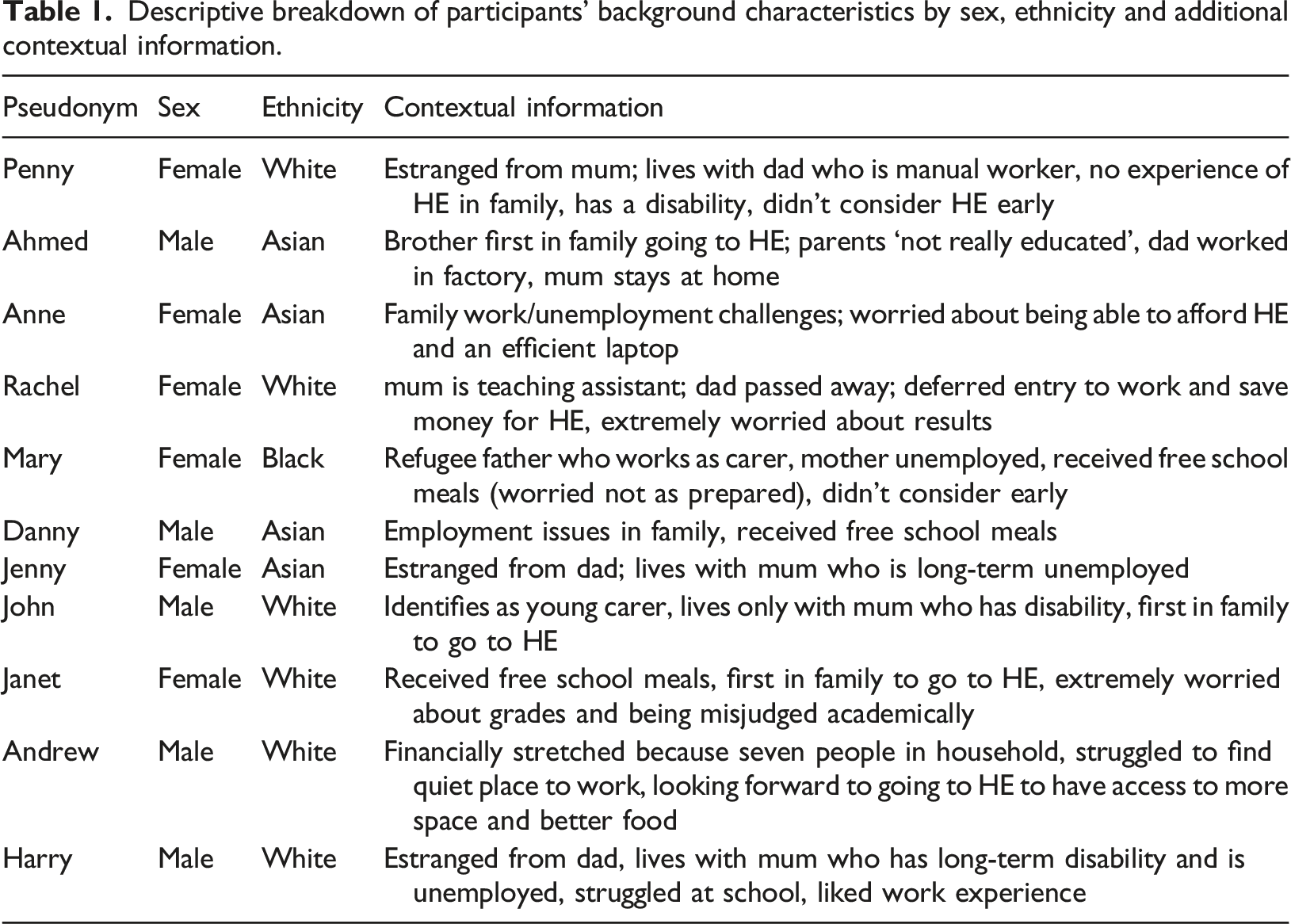
Students fulfilled criteria used to assess disadvantage for participation in these WP programmes, they were considered eligible for participation in this study. Previous studies have similarly used these area-based and individual measures to assess SES (Hatt et al., 2005; Katz et al., 2007; Harrison and Hatt, 2010; Stephens et al., 2015).
This project was granted ethical approval from the University Ethics Committee (BSREC 145/19–20) in June 2020.
Method
The study used in-depth interviews, which are the most dominant method for data collection in phenomenological research, to elicit individuals’ personal stories and develop an understanding of their lived experiences (Bevan, 2014; Creswell, 2007). Other studies into the UK student experience during the Covid-19 pandemic have predominately been quantitative (Office for National Statistics, 2020; Holt-White and Cullinane, 2021) and based on university students. Studies have been conducted during the pandemic, but these were based on non-UK students (Palaza, 2022; Collado-Boira et al., 2020). This research project utilised a phenomenological approach to ‘bring out the originary of personal experience’ (Patočka, 1998: p. 97) of a specific group of young people, who were on the cusp of post-compulsory education. Phenomenology was deemed as an appropriate methodology as it ‘aims not for generalizability but to shed light on the world as experienced by the individuals studied’ (Shaw and Anderson, 2018: p.222).
The interviews were semi-structured, to ensure a degree of comparability across the interviews, whilst also allowing for additional themes and meaning to flow from participants, which is at the centre of phenomenological research (Kvale, 1996; Miles and Huberman, 1994). The interview schedule was structured into three main parts, containing twelve open-ended questions and a number of supplementary questions.
The method of interviewing was informed by Bevan’s (2014) structured phenomenological interviewing approach, which is based on the phenomenological theory of Husserl and Carr (1970). The main focus of this phenomenological interviewing approach is one of accurately describing and thematising experience by employing descriptive and structural questioning to contextualise experience (by asking participants to describe schools, experiences within schools and home context), apprehend phenomena (by inviting participants to tell their story and discuss experiences with outreach) and then clarify the meaning of phenomenon/experiences (reflect and interpret their experiences, the forms of support participants considered necessary and helpful).
Procedure
Dates and times for interviews were confirmed with students and interviews were conducted over telephone or video call (depending on individual preference) in the weeks leading up to exam results day in August 2020. Face-to-face interviews were initially planned for this research project, but were discounted due to the on-going Covid-19 pandemic and the changing government advice. Before initiating interviews, participants were given participant information leaflets, and asked for informed consent via email. It was explained that interviews would last approximately an hour, and would be recorded, but that participants would not be identifiable.
Data analysis
The researchers read all interview transcripts and wrote summaries for each participant to provide a holistic review of their experiences, and diverse contexts. The transcripts and field notes were then uploaded to NVivo (Bazeley and Richards, 2000), a qualitative data management software programme. Thematic analysis was used as this can be applied to phenomenological research by working to both reflect reality, and to unpick or unravel the surface of reality (Attride-Stirling, 2001; Fereday and Muir-Cochrane, 2006). Themes were identified at a latent or interpretative level, focussing on the significance of patterns, and their broader meanings and implications (Braun and Clarke, 2006). In turn, an inductive or ‘bottom up’ analytic approach to thematic analysis was used whereby analysis was guided by the themes that emerged from the data, rather than by prior theoretical accounts. This approach is consistent with the overall method of analysing phenomena in the phenomenological tradition, which is reflective in nature (Ricœur, 1967; Von Eckartsberg, 1986).
Results
The participants who took part in this research were asked to talk through their educational and life journeys, particularly in relation to their interaction with post-16 outreach programme(s) and their experiences of the pandemic. Through thematic analysis, two main latent themes were identified: ‘Awareness of self’ and ‘Expectations and Perspicacity’. Each of these themes are discussed alongside evidence from the wider literature.
Awareness of self
The first theme ‘awareness of self’ provides insights into aspects of individuals’ identities which relate to how they see themselves and how they perceive others see and/or react to them (Ellemers et al., 1999). The awareness individuals have of themselves, their successes, and possible shortcomings (Martincová et al., 2021) can play an integral role in enabling individuals to imagine what may happen in the future, influencing the choices they make to avoid problems or to take advantage of opportunities (Leary, 2007).
Many of the participants discussed being aware that they were ‘different’ from others, due to environmental cues, personal characteristics and social situations which were associated with their socioeconomic backgrounds, but this awareness often happened at different junctures in their lives. For example, in his narrative Harry, discussed how from an early age social comparisons influenced his awareness of himself as the ‘poor kid’: “I think the thing that really made me aware is comparing myself to other kids. I mean, like going to school, I was the one that would have like a hole in my shoe. I wouldn’t bring a jumper, I didn't have bags.”
In turn, Rachel describes becoming progressively more aware of her family’s financial challenges as she got older: “As I grew up, growing up, you like learn about financing and sort of different situations people are in and it's like, oh, okay, there's a reason that we were eating like this. There is a reason that people, close family, and friends were buying us meals, sometimes and shopping, there is a reason why dad is not (at) work. There's a reason why sometimes mum says she's not hungry, but she probably is.”
When reflecting on her experiences, Rachel described feeling that her family’s socioeconomic circumstances had made her ‘respect money more than others’ and influenced her decision to take a gap year rather than going directly to HE: “Because I want to be able to earn enough money to live off, and also have my maintenance loan…And when I got my own job, it was like okay, every month I'm going to save, and now I've lost my job because of coronavirus.”
Though Rachael was the only participant who was deterred from going to HE straightaway due to financial factors, many others also discussed financial concerns associated with going to HE which in many cases had been heightened by the pandemic. Mary, who came from a refugee family, and whose parents were both unemployed, describes her concerns about some of these issues as follows: “Some bursaries which I wanted to apply for have been cancelled and I think it will be harder for me to find a part time job at university which I will need to support me with living costs.”
Like Mary, several other participants emphasised the importance of financial support bursaries to cover costs, along with loans and part-time work, and some including, Rachael and Ahmed, discussed taking bursaries into account when deciding which university to attend, as the bursaries offered by HEIs/WP programmes vary. However, some participants, including John, who identified as a young carer for his mother, worried that bursaries and loans might not be sufficient to be able to afford HE, and expressed concerns about ‘impending cuts’ in the amount of money (government benefits) but also support/care that would be available for his mothers in his absence.
Jenny also described concerns about going to university and leaving her mother alone but due to a different set of challenges with mental health, domestic violence and financial hardship that she felt could be more problematic in her absence and with the pandemic/lockdown. She describes some of these challenges as follows: “When I was younger, there was domestic abuse, not towards me, but towards my mum, which is what prompted the divorce but since they had a shared house, there were a lot of legal problems involved with that and, mum couldn’t afford, paying for the house. And then as a result, my mum, suffered from depression and she quit her job.”
Jenny explained that though her peers and most teachers were not aware of the difficulties she faced at home, she had not always been to ‘hide’ their impacts, recounting, for example, an experience of feeling acutely embarrassed at ‘struggling to tell the time when I was in Year Three and feeling really bad about that’. Despite perceiving that her academic performance differentiated her negatively from an early age, Jenny explained that it wasn’t until secondary school when her home life became somewhat more stable that she started to devote her efforts on her studies, emphasising her motivation ‘to just get back on track, so me and my mum can just generally do better’.
Other participants also gave examples of situations and experiences that had made them aware of their academic abilities/behaviours as differentiating characteristics, though in several cases, positively. For example, Andrew and John both felt that some of the subjects were ‘easier’ for them; Danny felt that they were more focused on studying from an early age; and Mary felt that they had always had an ‘ambition’ to move onto university. In contrast there were a few, who like Jenny, did not start focussing on their studies until much later, including Harry: “I was not the best kid necessarily. And then it got to about the end of Year 10 when I realised I have to actually start like focusing if I want to get anywhere. So like, it was difficult in our schools, you didn't really get the support to make the good decisions, I think.”
The ways in which Harry and others (e.g. Mary, Jenny) reflected on their behaviours and performance in school may echo DiGregorio and Liston (2022) findings, that ‘self-reflection has a positive effect on academic growth’. Moreover, the disposition for self-improvement that participants commonly discussed may also reflect a utilitarian awareness of achievement and offer a form of resilience which may allow students to thrive under challenging circumstances (Gayles, 2005). As such, many students frequently emphasised their own self-reliance and determination to ‘succeed’ and had been used to studying independently even prior to the lockdown. Some of these individuals appeared to downplay the significance of the school closures including Harry who described periods of truancy prior to lockdown due to a challenging school environment that had ‘made things difficult anyways’.
Some individuals felt extremely frustrated with the levels of support and online provision (e.g. Penny and Anne) they received from schools during the lockdown and who worried they would not be as ‘prepared as others going to uni’ (Mary). Several participants reflected on how WP outreach programmes had helped to mitigate these issues during the crisis. For instance, a few described the tutoring they received as part of a programme as being particularly helpful in dealing with ‘uncertainty’ (Harry), with Penny explaining that ‘just knowing that there is support there is helpful’. In turn, Penny who received tutoring as part of a programme also noted: ‘I would have had major gaps in my knowledge if I wasn’t part of the programme’.
Expectations and perspicacity
The second theme expectations and perspicacity centres on individuals’ choices and future orientations, and the role of outreach as a factor in influencing these. To clarify here, the concept of ‘expectations’ shares a similar focus on future orientations to ‘aspirations’, whereby both involve individuals envisaging potential outcomes that have meaning to them (Harrison and Waller, 2017). However, while aspirations are considered to reflect individuals’ hopes and dreams about the future Khattab (2018), expectations are considered to relate to what they actually believe will happen, requiring a level of perspicacity to estimate the likelihood of future events occurring.
The aspiration to attend university had started very early for some participants (e.g. John, Mary and Danny), who had usually been encouraged by at least one teacher and/or parent. Although there were a couple of participants who felt they had not seen university as a viable option until later stages of secondary school (e.g. Harry and Jenny), nearly all had decided to go to university prior to taking part in the post-16 outreach programmes. However, many described their participation in these programmes as influential when deciding to attend ‘top universities’ specifically. For example, Ahmed described how taking part in a programme influenced his decision to go to one such university as follows: “I think it has broadened my horizons in higher education, because I would never have thought of the prospect of attending a top Russell Group university like that. And because the programme targeted students from low socioeconomic backgrounds it made me think, it is for people like me.”
Like Ahmed, several other participants expressed beliefs about not having considered top HEIs a possibility and/or not seeing these as being for ‘people like them’ (e.g. Mary and Rachel). Past studies have reported that many working-class students do not consider applying to top HEIs, as they do not imagine themselves attending such institutions and/or fitting in there, even with the appropriate qualifications (Byrom, 2009; Nieuwenhuis, et al., 2019). The ‘Theory of Possible Selves’ (Markus and Nurius, 1986) posits that the visions of future selves individuals construct in their heads (termed ‘like-to be selves’ or ‘like-to-avoid selves’) can have powerful effects on behaviour, through social cultural contexts, social comparisons and normative values that make some adult outcomes more desirable, and expectable/probable than others.
Drawing on this theory, Harrison (2018) argued that planned outreach interventions, which allow students to envision and assess different prospects, can influence choices by expanding the ‘palette’ of future possible selves they initially derive through social contexts. One of the ways in which outreach programmes may do this and enable individuals to envisage going to top HEIs is by offering them opportunities to see and meet other people from ‘similar sorts of background’ (Mary) within these contexts. Several participants discussed the importance of this, including Anne who felt that going to visit a top HEI through a programme and seeing ‘more minorities than you would expect’ had helped at least to a degree, alleviate her concerns about not belonging there.
Although some, including Mary still worried about ‘fitting in and findings friends going into it’, she and many others spoke frequently about the encouragement, support and reassurance they received from staff on programmes as being helpful in dealing with uncertainties (e.g. Harry, Andrew and Anne). Jenny felt that her potential had not always been recognised by others, including her teachers, she was relatively optimistic that she would be able to achieve her aspiration of going to an Oxbridge university due to her high prior attainment. Some participants were far less optimistic than Jenny, including Janet who felt that her potential had not been recognised by teachers, partly due to her levels of active engagement in class: “They might think, because I didn’t put my hand up. I did not know the answers. But I just, I’m not a confident person so that’s why I didn’t put my hand up. The people that are more confident, the teachers might assume they would get higher grades.”
The low expectations from teachers that Janet alludes to in this statement are not uncommon amongst low SES group and may be reflected in the underestimated predicted grades students from lower SES backgrounds tend to receive compared to more affluent students from independent schools (Thiele et al., 2017). Other participants (e.g. Harry, Anne and Rachel) also had concerns about being misjudged academically by teachers, due to their behaviours at school, including their perceived lack of involvement in class, but also their attendance, or the peer groups they associated. Moreover, they worried that as a result they would not do well following the cancellation of their final exams, regardless of their actions or prior hard work.
Anne, for example, questioned whether she had been ‘working hard for nothing’ and Rachel describes feeling like ‘sitting ducks just waiting for results that aren’t even gonna reflect us.’ Furthermore, a few participants described feeling unmotivated to continue studying after exams were cancelled, sharing Janet’s view that it was ‘pointless, because we’re not having exams, they don’t count’.
Although a lack of control and uncertainty were common sentiments amongst most participants, not all were unmotivated to continue studying after exams were cancelled, nor did they all feel that they would be negatively impacted by the cancellation of exams per se. John explains this as follows: “I feel positive about my own position, as in mock exams I was excelling the standards of my offer. I feel negative about the exam board’s adjustment of centre assessment grades according to historical data, which naturally is stacked against me, being from a struggling school.”
John’s positive views about his own position may be reflective of his own high self-efficacy beliefs, which are defined as people’s beliefs of their capabilities to successfully execute a specific task or achieve a specific goal (Harrison, 2018; Bandura, 1986). Self-efficacy beliefs have been shown to influence individuals’ choices, efforts, perseverance in different tasks and outcomes, including attainment and HE participation (Trautwein and Ludtke, 2009; Caprara et al., 2011). Other participants who like John were optimistic about their future prospects (e.g. Penny, Mary and Jenny), also appeared to have high academic self-efficacy, often emphasising their hard work and prior attainment as having positive impacts. In turn, some elements of outreach programmes also appeared helpful in reinforcing individuals’ beliefs about their academic abilities.
For example, both Ahmed and Penny felt that taking part in tutoring through a programme had helped improve their grades with subjects they found challenging-which may be a way of actively demonstrating to individuals their potential for more success and their ability to influence outcomes (Watkins, 2010). Furthermore, Danny and Mary both took part in work experience placements during their outreach programmes, which they felt they could not have achieved on their own and which both felt helped to affirm their choices for the future. As explained by Mary: ‘for me, it was work experience because I don’t think I ever would have had like formal work experience without the programme’. Such elements of outreach, which support individuals in learning how to attain what they want, can provide a motivational impetus, offering individuals opportunities to not only meet potential role models but also encouraging them to reflect on what they want from the future and how to get there (Waller, 2014 cited in Harrison, 2018).
Concluding remarks and implications
By examining the educational journeys, choices and concerns of a group of low SES individuals who had taken part in WP programmes, and who were directly affected by the pandemic in their final year of secondary school, this study captures a range of challenges, and enablers, that they perceived as influential, affecting their choices and outcomes at critical times. Though HE participation data were not available for all participants, and would have been helpful, it was possible to ascertain that most participants were admitted to the top HEIs they aspired to attend (n = 8). However, it is important to keep in mind that the students in this study represent a selected minority of low SES students and that the challenges they discussed could negatively affect many others who do not progress to HE or top HEIs despite having the academic potential.
Some challenges related to individuals’ personal/home circumstances, health/mental health, finance and the schools they attended, and had been amplified by the Covid-19 pandemic but these affected individuals, their expectations, beliefs and dispositions in different ways. Findings suggest ways that outreach programmes may influence choices and outcomes, helping to mitigate, at least in part, some of the potential barriers/challenges that drive disparities within the HE system. One way in which these maybe influential is by enabling low SES to envision top HEIs, which some had not considered as being for people like them, as a plausible but also desirable option.
There are many elements to this, which go beyond a simple deficit model of ‘raising aspirations’ that endures in both national and institutional policy-despite extensive critique (Rainford, 2021). Put simply, raising aspirations alone is not enough and is unlikely to be effectual if these are detached from individuals’ academic/social realities, and they do not have the grades or knowledge to achieve these (Harrison, 2018). As such, though all students in this study had high aspirations and were considered high achievers, their expectations (in terms of their beliefs of achieving their aspirations) varied, affecting aspects of their behaviours that could influence their future outcomes.
There were ways in which outreach programmes appeared to help in these respects, reinforcing individuals’ future expectations and self-beliefs by offering support, reassurance to individuals. The outreach programmes offered by the university were diverse in nature, but essentially offered practical interventions such as tutoring and mentoring. These interventions were interspersed with residential activities, regular contact with the university, and short-term tasks which supported self-reflection. Practical aspects of interventions like these were also considered particularly valuable by many during the pandemic, in helping to deal with uncertainties and covering areas of the curriculum they had found challenging. However, these programmes only reach a small proportion of targeted low SES students and are also limited in their capacity to address the continuing challenges low SES students may face in ‘fitting in’ at elite HEIs (Manstead, 2018).
The young people who took part in this study were unique as they had studied under conditions few others had ever experienced. Comparisons to other groups who were not part of the research cannot be drawn, as these young people speak for themselves at this snapshot in time. However, the overwhelming majority of the students felt that the WP programmes had supported them in a myriad of ways. As can be seen from the successful admission to Russell Group universities for many of the participants of this study, it could be inferred that the WP programme(s) had a positive impact on their lives and learning. However, it would be useful to continue this thread of research by expanding the number of participants and tracking them from an earlier stage in their educational journeys, coupled with exploration of the impact of the pandemic on students learning losses.
Broader changes and forms of support are therefore required to address these issues and other challenges that persist for these groups across the whole student lifecycle from pre-entry to graduation. For instance, universities could focus on enhanced transition programmes for young people who have studied during the pandemic, coupled with peer mentoring when students arrive, alongside specific bursaries targeted at supporting those who need computer or access to the internet. Alongside these practical suggestions, the authors of this paper also advocate for further research to better understand the longer-term impacts of the Covid-19 crisis which could be crucial for mitigating the challenges and educational disparities that this may pose, and possibly exacerbate. Qualitative approaches, such as phenomenology, which enable students’ voices to take centre, offer considerable benefits in these regards, helping to understand the challenges, and forms of support young people think are needed as they navigate through the post-pandemic world.
Footnotes
Acknowledgements
We would like to thank young people who took part in this research for their honesty and commitment.
Declaration of conflicting interests
The author(s) declared no potential conflicts of interest with respect to the research, authorship, and/or publication of this article.
Funding
The author(s) received no financial support for the research, authorship, and/or publication of this article.
