



Abstract
School outreach programs are a significant tool for engaging with under-represented students within higher education. However, understanding outreach success can be challenging, particularly regarding whether lasting impacts are made. Using qualitative survey methods, we investigated the impact of an outreach program designed to introduce year 9 and 10 students from under-represented schools to university settings in Australia. The study explored participants’ reflections of the program seven to 10 years after their attendance. We discuss three main outcomes: (1) learning about university, (2) experiencing a socially and intellectually rewarding environment, and (3) increased motivation for completing final years of schooling. Most participants understood the program to be a valuable form of personal development, regardless of their higher education pathways. Our findings, centred on what participants deemed memorable and significant, offering insights for the design of future programs, particularly in catering for students with a range of levels of understandings about universities and pathways into them.
Introduction
For some time, Australian universities have been mandated to redress structural inequalities in higher education (HE) access and participation for under-represented groups, including for low socioeconomic status (LSES) and Rural, Regional and Remote students (DEET, 1990), many of whom are also first in family (FIF) to attend university (Patfield et al., 2021). Outreach programs are an important approach for increasing HE participation and access for such groups and are diverse in their formats, objectives and geographical contexts (Ferrier et al., 2008). While a range of methods exist for understanding outreach effectiveness the collection of data are usually either: (1) immediate post-program, upon student completion of an outreach program, or, (2) subsequent enrolment into a university (Addi-Raccah and Israelashvili, 2014). There is limited research evaluating outreach programs over different time points of students’ educational and employment pathways.
In this study, we re-engaged with the participants of an outreach program which served students from under-represented schools, seven to 10 years after their attendance. We were interested in exploring outreach participants’ memories from the program and what they understood as its impacts on their post-school pathways. In contributing to understandings of outreach success, we join others in problematising the evaluation of outreach effectiveness through what Harrison and Waller (2017, p. 81) call the ‘reductionist doctrine of “evidence-based practice”’. Rather, the outreach program under consideration is understood as an event in the process of (possible) student identity formation (Sica et al., 2017). In our analysis, we attempt to glean the meanings attached to the program in participants’ narratives, as they are reflected on this, in relation with participants’ experiences of (current) education and employment and their place in the world today. As such, we incorporate some of the ‘messiness’ that young people encounter in their post-school decision-making, as they are ‘buffeted by myriad experiences and influences – some planned, but many accidental’ (Harrison and Waller, 2017, p. 83). As such, through our reengagement with participants after a significant period of time, it is our aim to provide insights into the usefulness of outreach programs but also to contribute to debates about how success is framed and constructed.
Firstly, we introduce the context of widening participation within Australia and the role of outreach programs within it, highlighting different approaches to defining and measuring success. Following a description of the qualitative methodology we employed, we present our findings, contextualised within current trends in outreach program design and evaluation.
Widening participation and outreach responses
Universities have long been tasked with implementing national policy efforts to reduce inequities to HE, such as the equity framework provided in ‘A Fair Chance for All’ (DEET, 1990). School outreach programs have emerged as a significant tool for engaging with under-represented students within higher education. Given the complex interplay of factors that result in higher education inequalities, such programs take many forms and cater to different communities (Bennett, 2018). Common components of outreach programs are academic enrichment activities, attending university for multiple-day trips, open days and bridging courses (Ferrier et al., 2008), sometimes for specific disciplines (e.g. Millar et al., 2019). Most programs focus on secondary school populations, with the aim of improving students’ interest in higher education and providing resources on pathways to enrolment (Bennett et al., 2015). Although the need for outreach is typically understood as a mechanism for ‘raising aspiration’, others argue that this framing places responsibility on students themselves to find solutions to society-wide educational inequalities (Gale and Parker, 2015). Here, we align with the latter position; the task at hand is less so to change students (i.e. generate aspirations) but to make university cultures less exclusionary (O’Shea et al., 2016), so that students can fulfil their aspirations. First in family (FIF) students may experience university as a ‘foreign country’ or ‘ivory tower’, complete with its own language, culture, and processes (May et al., 2016: 397-398). Thus, to allow students to explore their interests in HE, outreach programs for disadvantaged groups must also take up the task of reducing cultural barriers.
While outreach programs are an effective and essential lever for increasing diversity in access to university (Bennett, 2018; Bennett et al., 2015; Pitman and Koshy, 2014; Sadler et al., 2018; Walton and Carrillo-Higueras, 2019), ascertaining outreach effectiveness is difficult. Due to the range of factors that may influence students’ post-school pathways, it is ‘almost impossible’ to isolate and measure exact outreach program impacts (Pitman and Koshy, 2014: p. 20). In response, evaluation tools and outreach design are continually being reassessed (e.g. Prieto-Rodriguez, 2020; Walton and Carillo-Higueras, 2019). Of particular significance to our study is as follows: (1) timing of evaluation, and ultimately, (2) interrogating what is considered ‘impactful’ or ‘success’ in the broader HE landscape. It is not possible for most providers to carry out longitudinal research, due to the short-term nature of funding cycles (Bennett, 2018). Although some outreach programs are designed to run over several terms or even years (NCSEHE, 2013), the lack of studies evaluating outreach which follows students’ long-term pathways contradicts the recent policy emphasis on measuring widening participation initiatives longitudinally (Bennett, 2018).
Two studies which have taken longitudinal approaches have produced rather different interpretations of the effectiveness of outreach programs. In their Australian study, Zacharias and Mitchell (2020) posit that outreach operates as ‘virtuous circle’ of widening participation activities: demystification leads to attitude change, bolstering skill development and then informs decision-making towards applying for university. Addi-Raccah and Israelashvili’s (2014) research also highlights that outreach participation positively correlates with higher education engagement. Yet, they opt to take a broader, more pessimistic, view on how success of outreach programs should be evaluated. They argue that outreach programs do not typically reach those most in need, and that guiding a small number to university ‘serves as a social mechanism that preserves the prevailing social order’ (ibid, p. 126).
In our study, we have found Bennett’s ‘what matters’ approach (2018) useful in working with such tensions. This approach is intended to be used flexibly, and in conjunction with a variety of methodologies in evaluation research. It is positioned as a challenge to one-size-fits-all approaches for program design and evaluation that do not capture the context or complexity of underrepresented students’ lived experiences or rely on post program feedback. Because we discovered it during the analysis phase of the research, we have drawn selectively from Bennett’s guide (2018, pp. 531–533) for developing programs for underrepresented students, which sets out principles for designing initiatives that account for the specific contexts in which they take place. The approach encourages equity researchers to engage with sociostructural inequalities by valuing differences in how students are contextually positioned within wider social, economic, political, and relational forces that afford… opportunities or challenges (Bennett, 2018: pp. 524–525).
In both our reading of the data, and interpreting the significance of our analysis, the ‘what matters’ framing has provided a perspective that both recognises structural inequities while bolstering a strengths-based analysis. We acknowledge that higher education reproduces inequities (Addi-Raccah and Israelashvili, 2014), but our study – which centres the values and understandings of the outreach participants – attempts to show disadvantaged students as critical agents in shifting structural issues. In addition, we have tried to attend to the ‘differential experiences and relationships within the [outreach program] and the external factors that impact participants’ (Bennett 2018: p. 529). External factors may include being first in family or experiencing financial disadvantage, but in our case, also encompasses the life developments that have occurred in the many years between the outreach program and evaluation of it. From their current perspective, seven to 10 years later, have the diverse needs of outreach participants been met, as they have changed over time? Thus, the research questions guiding the research are as follows. In what ways did attendance at an outreach program (The Summer School outreach Program) influence secondary school students in their post-school decision making? What aspects of the program design do participants believe were most useful, or, ‘matter’ most?
Methodology
In this section, we first provide an outline of the (historical) program that we are investigating 1 . Following this, we outline our qualitative approach to answer the research questions, including the data collection tools and our approach analysis.
Design and aims of the summer school outreach program
The Summer School outreach Program (SSP) was offered from 2011 to 2014 by the Melbourne Graduate School of Education, University of Melbourne 2 , an elite Australian university. In total, 479 Year 9 and 10 students participated. Outer metropolitan Melbourne and regional Victorian schools were drawn from the ‘Access Melbourne’ under-represented school list. Each school determined their own methods for selecting 10 students, such as teachers identifying students, a ballot system and students self-selecting to participate. This, one to two week-long on-campus program, offered experiences of lectures, tutorials and science practicals, as well as learning opportunities set within various historical collections and museums. There were tours of residential college/s, career sessions and access pathway information. Rural and regional students were provided with accommodation near to the campus.
Students’ assessments of the program, captured via exit surveys, were very positive. For instance: 88% claimed they were more interested in studying at university as a result of attending and 90% said they would recommend the program to others. Whilst these self-assessments suggest that attending the SSP may have impacted on attendees’ connection to higher education, we wanted to investigate whether participants’ assessments of the program might have changed, depending on their eventual post-school trajectories. We hoped that taking a qualitative approach with a temporal dimension might offer a form of evaluation which understands effectiveness in relation to the myriad of educational, employment and personal experiences attendees had since undertaken. This aim – to attempt to account for the complexity of a range of post-school trajectories – also aligned well with the ‘what matters’ approach that we brought to our analysis. By returning to participants 7–10 years after their engagement in the program, we have been able to include in our analysis something of students’ shifting self-understandings of their imagined futures (Holt, 2012). We were interested in pursuing a more nuanced understanding of students’ outcomes of the program, beyond the extremely positive exit survey feedback.
Method and sample
To address the research questions, an online survey was designed to explore post-school pathways of the participants. In addition to providing feedback on the SSP, the survey provided opportunities for respondents to share their personal circumstances and experiences, such as their employment and education choices. Participants were asked questions on the following areas: their motivations for attending the SSP and recollections about the program, such as what they found memorable and most/least beneficial. Participants were also asked about their post-school pathways and whether they thought that participating in the SSP might have influenced any of their post-school decision-making.
Post school pathways of research participants.
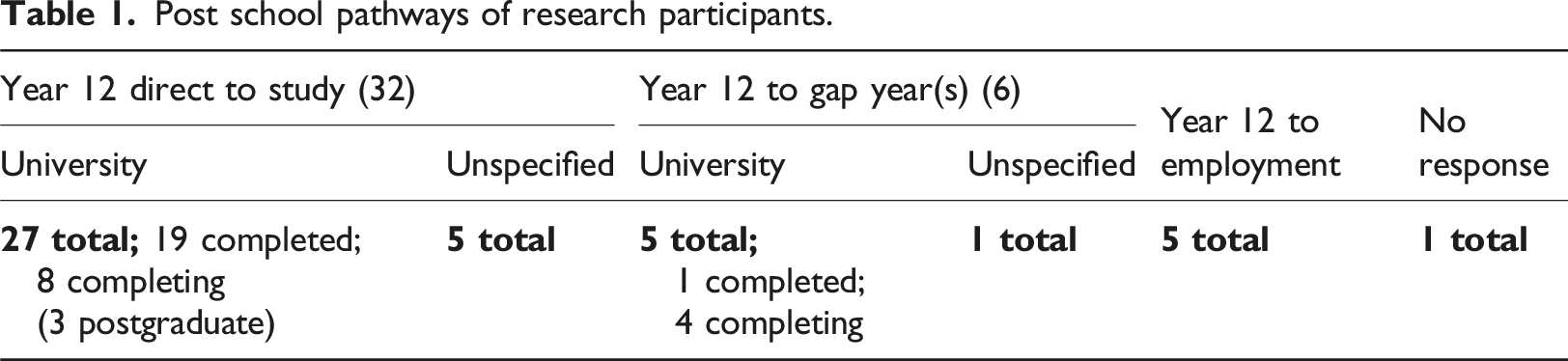
Respondents predominantly attended urban schools with 10 based at rural/regional schools. The sample was ethnically diverse; 2 participants were Aboriginal, and 15 respondents noted heritage to a range of countries, including Malaysia, Indonesia, Vietnam, Philippines, Albania, China, Russia, Italy, Sri Lanka, Tonga, Samoa, Iraq and Saudi Arabia.
Data analysis was carried out by all three authors and occurred in two stages. Firstly, inductive coding and a frequency count was conducted (Miles and Huberman, 1994) to aid in developing initial themes, noting such tallies can be a useful tool to support qualitative data analysis (Maxwell, 2010). Secondly, to deepen our analysis of the initial themes, we read and interpreted recursively, coming back to the question of ‘what matters to participants?’, attempting to capture both similarities and variances between the responses.
Analysis: Participants’ perspectives on the impacts of the summer school
Although over 70% of respondents reported that they benefited from the program, our aim was to better understand what underpins such assessments, which are ‘often invisible and taken-for-granted aspects and relationships [but are] important contextual conditions that combine to produce impact’ (Bennett, 2018: p. 530). Our analysis is organised via three overarching outcomes of the program. We begin by investigating the range of motivations, expectations and needs the SSP attendees had about learning more about university options and exploring whether they felt the program had met their expectations. We then discuss two further themes; these were the social aspects of the program, and motivation to try harder in school. Direct quotes from participants are indicated in italic script. (1) Learning about university pathways and life as a university student
We asked respondents to tell us about their motivations for attending the SSP. We provided a list of possible responses to rank, but also invited participants to explain their choices, and also added an option to detail an ‘other’ response. Unsurprisingly, learning about university, was the most highly ranked motivation for attending with 42% of respondents selecting this as their top reason and 33% selecting it as their second reason (see Figure 1). Top three ranked reasons for attending the summer school program.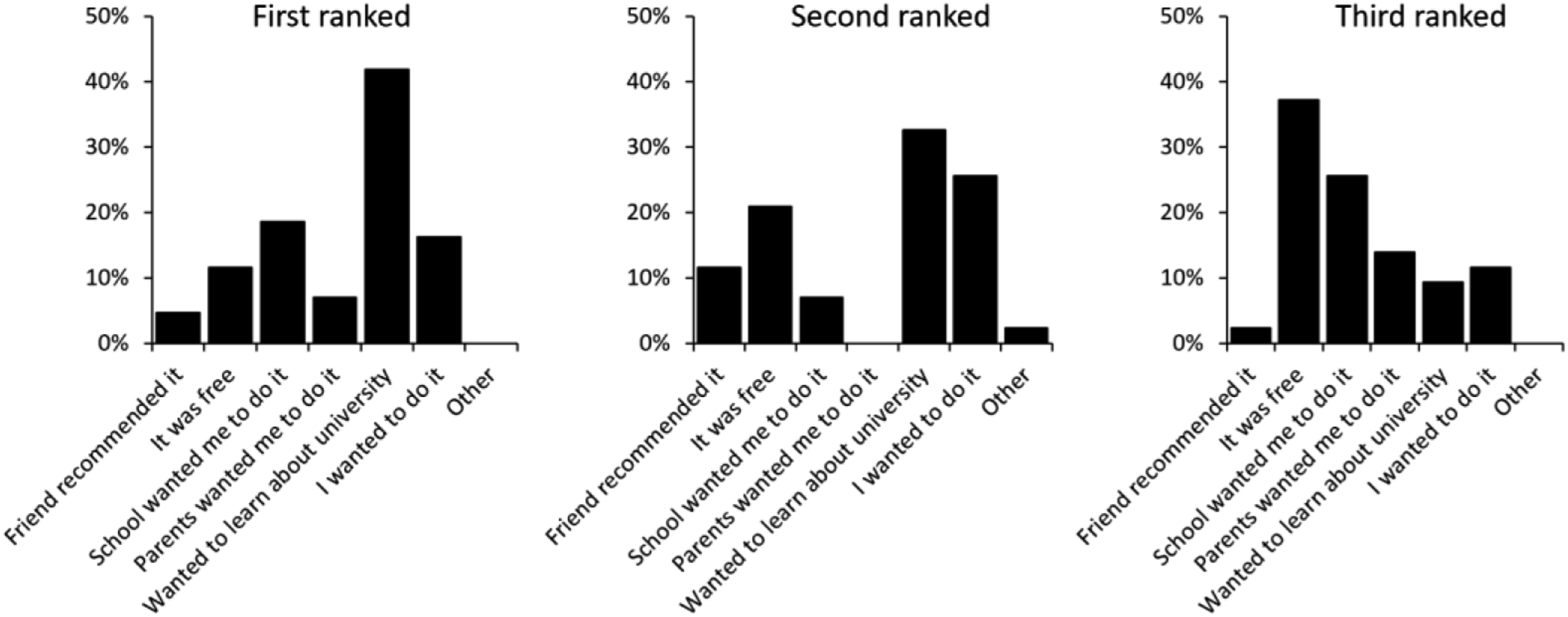
Another highly ranked response was ‘I wanted to do it’, with the associated commentary providing insights into what aspects of ‘learning about university’ outreach participants hoped to gain. For instance, some participants used the SSP to gain information in a potentially confusing time of life: • I wasn’t sure what I even wanted to pursue in life. • To learn about life after high school. • To see what life had to offer when high school ended.
Others were more strategic and claimed they attended to bolster future work and educational opportunities: • Would look good on my resume and for university. • The certificate we got was helpful when applying for jobs. • Seemed like a fun way to get out of my comfort zone. • I wanted to be the smart kid and have an edge on the uni game.
The benefits of listing the SSP on a resume, or the personal development gains from being pushed out of one’s comfort zone, could be leveraged for the outreach participants who had access to cultural knowledges around credentialism and employability (see Groves et al., 2023). Therefore, the program served multiple purposes for students with a range of knowledges on what higher education might offer them. Some had naturalised the idea that in the competitive environment of university one must seek an ‘edge on the uni game’ (as above), and others were feeling much less sure of what post-school life held, and whether university would play a role in it.
As is indicated above, the responses we got from this question afforded a view of the differing levels of familiarity students had with university, which affected which aspects of the program were useful. To summarise some of these differences, we created a schema, characterising three different relations to university pathways that we observed.
The first of these was a ‘new to university’ group, who claimed that the possibilities of university pathways were largely brought about by attending the SSP. A key outcome of the program was to demystify aspects of university, which, for some, had the effect of ‘sowing the seed of university as a positive and achievable option’ (NCSEHE, 2013: p. 5). The SSP provided a level of familiarity to help build confidence and assist participants to feel less anxious about attending university. For instance: • Before attending the summer school, I had not thought University was an option for me. • University wasn’t a large topic previously at my high school. • I had no understanding of university, what it was like or what the expectations and experience was until summer school. • I didn’t really know much about university life beforehand. • The program opened my eyes about university and made it seem much less scary.
Despite the ‘massification’ of HE for low socio-economic background (LSEB) students, university often remains outside their cultural worldview (Scull and Cuthill, 2010). Albeit to a lower degree in Australia than other Anglophone countries, parental education levels remain a strong predictor of access to higher education (Jerrim and Vignoles, 2015). This is relevant to our participant cohort, of which half were FIF to attend university; and for 80% of participants, attending the SSP was their first visit to a university campus.
The second group were ‘learning to access university’, who were drawn towards university but were unfamiliar with what HE studies involved and how to access them. Their university trajectory had not yet gathered ‘momentum’, but there had obviously been an extant ‘gravity’ towards it (France and Threadgold, 2016). This group reported that they gained practical understanding on how to progress, such as the different approaches to learning they experienced at university, as well as assistance in understanding study options and pathways. • It helped me find answers about Uni that if that program wasn’t made accessible to me, I wouldn’t have found the answers I was looking for. • No-one in my family had attended University and I wanted to be the first, and this was a great introduction.
• I wanted to know what being a uni student felt like!
• It allowed me to see what the University atmosphere was like. • This way I was able to get a feel of what I was getting myself into. As a first-generation immigrant it was all new to me. • I was in year eight (I think) and didn’t know much about how uni worked, and the program helped me learn a lot about it and simulated what it would be like to study at university.
For students unfamiliar with universities, or perhaps without role models, the program was able to solidify a growing affinity towards university, and to provide a connection to university that participants could build on. For this group, the SSP allowed participants to craft a concept of ‘university’ that was meaningful to them as a step towards opening possible entry pathways (see also May et al., 2016).
Lastly, a third set of participants understood themselves to be on a university track. While there was still apprehension detectable within the third group, there appeared greater clarity around university pathways being a suitable option, and the SSP then operated to confirm pathways. • It confirmed that I wanted to attend university. • I was already certain I wanted to go to university. • Experiencing the classes and structure influenced my decisions in selecting a university and subjects.
Within this group there was a subset who specified that the SSP was a driver for them to pursue studies at the University of Melbourne.
• It was a glimpse into unimelb [that] eventually was the driver for me to enrol into unimelb
• Made me want to go to Unimelb
• It solidified my interest in University and gave me the opportunity to know if Melbourne was a University I would be happy to attend.
International evidence suggests that many LSEBS students opt for less prestigious universities, even if they achieve high grades at school (Campbell et al., 2019). For those who do aim for prestigious universities, Reay et al. (2009, p. 1105) contends that such working-class students who attend are likely to have already begun learning the ‘classically middle-class academic dispositions’ needed for their studies during their schooling. This may well have been the case for some of those who attended the SSP. However, LSEBS make up a relatively small proportion of enrolments at Australia’s most prestigious universities (Devlin et al., 2023), and it is therefore significant that the SSP was a factor for some participants in making a lasting connection with this elite university. (2) A socially and intellectually rewarding environment
One of the questions we asked was, ‘what do you remember most about the Summer School? Many of the responses pointed to the social aspects of being part of the program rather than specifying the range of activities that were offered. For some, the value attributed to making connections with other students in the SSP is related to a sense of not belonging at school. • Summer school showed me that I wasn’t alone and that there were others interested in the same things as me when it comes to study and general. • It is very easy to separate from your peers when your interests and aspirations are different. Very easy to feel lonely. • I wasn’t alone in being nerdy and interested in studies and science.
For FIF students, aspiring to take the less-worn path towards HE may come with ‘hidden costs’, such as social isolation (Sennett and Cobb, 1973) and a perception within home communities of dreaming ‘above one’s station’ (Lawler, 1999). Potentially, then the SSP acted as one ‘event’ in the process of developing a self-narrative around being the ‘type’ of person who goes to university (Holt, 2012), which was brought on by meeting other like-minded students.
Other participants emphasised the benefits of socialising and meeting students from other schools and having a positive experience within a friendly environment. • Meeting people from new schools but realising they were very similar to me. • I also got to meet many new people from all sorts of places, and though I haven’t been able to keep up with them after all these years I am grateful to have met them all. • I think this Summer School was good, and I did enjoy myself and make connections with people I never would have otherwise. • I also got to meet students from all around Victoria, which was interesting to see how our lives differ. • It gave a fun, exciting safe space (around people I knew) to see what University could be like and to meet new people that don’t necessarily have a lot in common with.
Whilst learning about university life was important, social elements, particularly interacting with peers from multiple schools, seemed to enhance students’ engagement with the program. Given that LSEB students tend to be less socially integrated in university environments (Rubin, 2012: pp. 431-432), this finding is more significant than it might at first seem. Having a sense of community at university is correlated with academic success, and peer social interaction is a site of information sharing, or, ‘information-related capital’ (Mishra, 2020). Whilst acknowledging that the ultimate responsibility for creating inclusive cultures for people of all class backgrounds lies with universities (O’Shea et al., 2018), the SSP perhaps provided an environment in which participants could practice academic socialising and networking, thereby creating positive associations with university.
Adjacent to the social aspects of the program was participants’ appreciation for exposure to different learning environments and new ways of learning. • It was the first time I was in such a stimulating environment. • It was the first time I was in a judgement-free learning environment and the topics were catered towards our interests. • I wasn’t sure what I even wanted to pursue in life. I had no idea about what studying would entail and it was an amazing experience I couldn’t dream of replicating. • The different classes, the overall experience and getting to try new things and learn new skills. • How independent and inspired I felt.
• Experiencing Uni life and the community on campus
As the comments show, attending the program provided opportunities for students to move ‘outside’ their usual school environment, to interact with other students from a variety of schools and to experience different and stimulating learning experiences. (3) Increased motivation for final years of schooling
The final theme we discuss is particularly pertinent to our research design, in which we have invited respondents to assess the role of the SSP in their lives, many years after taking part. More than half of the participants reported that the SSP had a positive impact on their decision to study at university, but some emphasised that it was a catalyst to successfully complete Year 12 School Certificate, as illustrated in the following participant quotes. • It made me want to pursue further studies after high school. • Inspired me to work hard and get the results I needed to enrol into The University of Melbourne (And I did!).
• Made me want to study
• Overall, it was a great experience, I became more confident in what to expect at uni and it truly inspired me to do well in my [Year 12 School Certificate] subjects.
Through the SSP, and their subsequent emotional investments in the university setting, it re-energised some students towards their school studies. Similarly, some participants reported that the SSP activities – which ran for one to two week-long blocks – were significant in developing a sense of connection to specific disciplines; for example, learning about more complex science things was interesting to me and experiencing the classes and structure influenced my decisions in selecting a university and subjects.
It was positive that for some participants the SSP helped to solidify post-school goals linking efforts within school to pathways beyond. However, there were different views on the timing of the SSP for Year 9 and 10 students, in relation to school and post-school pathways. For instance: • I think it was a great experience, however, it may have been more helpful in my VCE [Year 12 School Certificate] years as a way to help decide what I might like to study. • I think because I went when I was at the start of high school it did not make a difference the time I decided where I wanted to go post school.
While the earlier timing worked for some, it did not for others, underscoring the point that, ‘initiatives achieve impact [only] in relation to participants’ histories and wider social relationships’ (Bennett, 2018). Nevertheless, participants’ retrospective reflections on the SSP in relation to a range of school and post-school experiences give weight to the benefits of participating in the program. The SSP has come to hold a place in some students’ narratives as being crucial to informing their educational trajectories.
Discussion
Our aim was to investigate the experiences of participants of an outreach program 7–10 years following their attendance, including which aspects were most useful both at the time and in relation to their shifting post-school contexts and trajectories. We showed that attending students had differing relationships to university life and preparedness, and this affected which aspects of the program they found most useful. For some, the desire for a life that included a university education became sedimented into a wish to aim for the particular, elite, university within which the program took place, or a specific discipline, and collecting information became important. Others gained from a sense of belonging through enjoying other’s company and learning together. These memories were brought to mind to help build motivation for post-school goals when school became challenging.
Outreach effectiveness is known to be difficult to measure longitudinally, as a range of factors that affect success will change over time (Pitman and Koshy, 2014). Our study presents a rare perspective, as we were able to look beyond immediate post-program evaluations to consider reflections on the aspects of the program that were most significant or memorable, in concert with participants’ actual pathways. In the remainder of this section, we discuss the significance of our findings in more detail, contextualising our interpretations with the ‘what matters’ approach. We close by considering implications for program design and present ideas for further research.
Firstly, the importance of learning the culture of university was confirmed to have mattered to participants, as one participant articulated ‘It was a unique and independent experience that enabled personal growth and an exposure that seemed like a peak behind the curtain’. For some participants, there was a strength of conviction around being exposed to ‘university expectations’. Although our analysis indicates the SSP was useful for the majority of participants, in line with Addi-Raccah and Israelashvili’s (2014) findings, it is likely that those from the ‘new to university’ and ‘learning to access university’ groups benefited more. Nonetheless, it spurred on some participants who were likely already on a university track, to aim for a ‘top’ university, providing insight to life as a university student and/or assisted to clarify pathways and career opportunities. An element of the program design that proved beneficial was the prioritisation of relatively prosaic aspects of university life. Participants reported that learning about what a university looks and feels like was as, or more, important as specific enrolment and course information for some. Such elements of the program factored into participants’ decision making about their post-school decision-making. Our findings therefore reinforce the importance of demystifying university through key experiential activities within the program design (Dollinger et al., 2020).
Responding to Addi-Raccah and Israelashvili’s (2014) study, in many ways, the SSP asked students from low SES backgrounds to ‘adapt themselves to the habits of the more affluent groups’ (ibid, p. 127), and could therefore be seen as maintaining unequal social relations. However, we take a broad view on what counts as outreach success, positing that our retrospective participant responses indicate, there is not always a linear or direct route to improving young people’s educational engagement, but rather the pathway to doing so may have diversions, ‘twists’ or ‘turns’ through a range of other areas, which may seem unrelated, but which are actually related to how young people narrate their own experience of changed educational engagement. (Meltzer et al., 2020: p. 556)
We have proposed, for example, that the social aspects of the program were important to participants, which may reinforce the value of building community, including with peers in educational trajectories, and through outreach programs (e.g. Barney and Williams, 2021; Geagea and MacCallum, 2020; Scull and Cuthill, 2010). Our data similarly show that simply having fun, meeting other students and being exposed to new ideas were important to participants. Enjoying social interactions and exploring the university through fun activities can also be linked to changes to student self-concept, towards realising that HE is achievable (Bennett et al., 2015: p.46), or of creating an emotional connection with the university setting.
Outcomes such as gaining confidence, or a sense of belonging may be difficult to measure but are important to report on. Doing so better acknowledges the processes at play as relational, highlighting students’ agential and selective engagements, according to their needs. Secondly, reporting on what matters in the context of students’ complex lives can disrupt policymaking which values decontextualising quantitative methods over centring what matters to students (Bennett and Lumb, 2019). Whilst we acknowledge that students who responded were more likely to have had a positive experience, their perspectives are useful in understanding the various ways that outreach programs can have impact. Indeed, we followed up this survey study with interviews to delve further into participant experience and this is the focus of future papers.
We finish with a suggestion – that more research is needed at different time points in young people’s lives to provide insights into the role of outreach programs in the context of non-linear education and employment trajectories. This would push against tendencies to measure success narrowly (Allen, 2020) and would provide insights into how outreach may benefit participants both within and outside university settings.
Footnotes
Author contributions
All authors contributed to the study conception and design. Material preparation, data collection and analysis were performed by Rhonda Di Biase, Maree Martinussen, and Ann Osman. The first draft of the manuscript was written by Rhonda Di Biase and Maree Martinussen. All authors commented on previous versions of the manuscript. All authors have read and approved the final manuscript.
Declaration of conflicting interests
The authors declared no potential conflicts of interest with respect to the research, authorship, and/or publication of this article.
Funding
The authors disclosed receipt of the following financial support for the research, authorship, and/or publication of this article: This study was funded by internal funding from the Faculty of Education, The University of Melbourne, Researcher Development Award, 2021.
Ethical Approval
The questionnaire and methodology for this study was approved by the Human Research Ethics committee of The University of Melbourne (Ethics approval number: 2021-20,814-18,579-3).
