



Abstract
When an interpreter mediates a call from the public to a police force control room (FCR), the partnership established between the interpreter and the call-handler is critical to the caller’s ability to be understood and supported. Using Davies and Harré’s Positioning Theory, this study investigates different approaches to the establishment of relationships and identities during the opening phases of a non-emergency police video relay services (VRS) call. The data consist of four simulated VRS-interpreted calls to a Police Scotland FCR and focus group reflections. This article describes two opening approaches to interpreter-mediated communication, namely the emergent approach, where rights and duties are established and reviewed, and the process-driven approach, which focuses on the completion of tasks. The emergent approach demonstrates the benefits of establishing consent and the multiple roles that are collectively performed, whereas a process-driven approach during the opening phase of a call does not train callers how to participate in a 101VRS call. The findings emphasise the need for trainers and policymakers to support interpreters in handling their auxiliary role as first call receiver.
Keywords
1. Introduction
In the UK, around 10 police forces have introduced a bespoke regional non-emergency video relay service (101VRS) (Skinner et al., 2021). The intention is to deliver new ways for the UK police to engage with citizens who use British Sign Language (BSL) (see Figure 1). Although the technology offers a practical and logistical solution to a social problem, how people use the technology for a specific purpose requires close inspection.
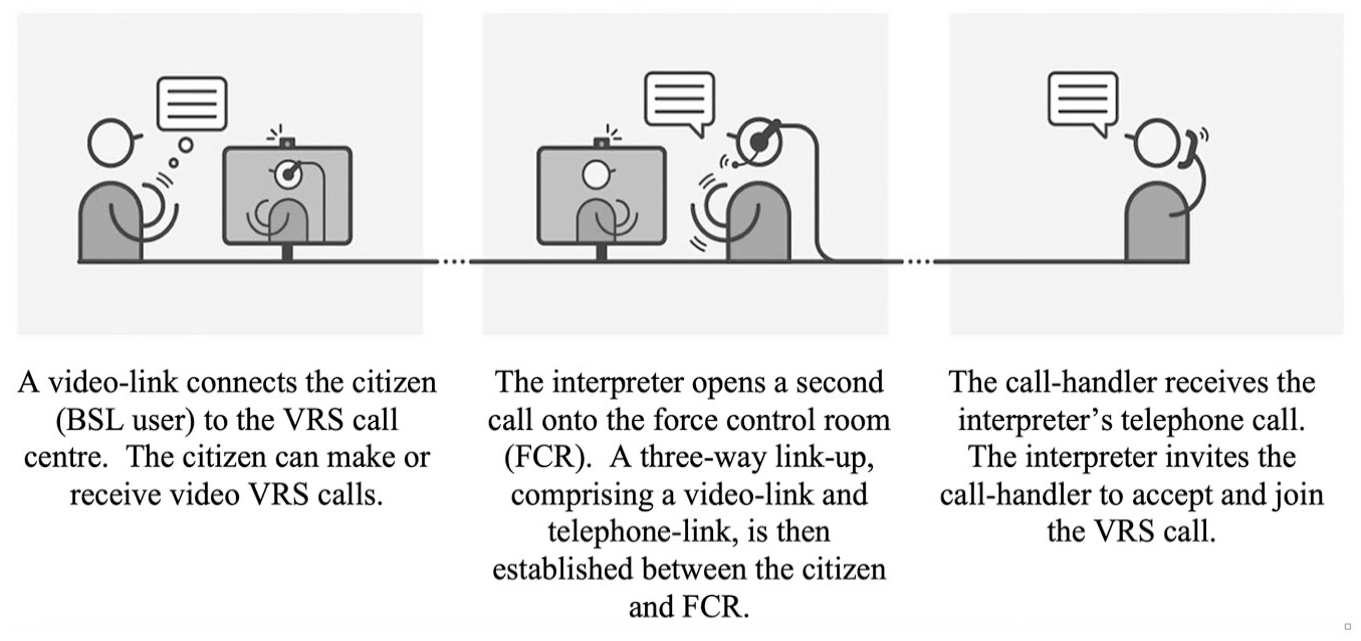
101VRS.
There are no UK policies or scripts that guide VRS interpreters on how to occupy their auxiliary role or how the VRS call should be co-managed with UK police call-handlers. This means interpreters, who are first call receivers in VRS services, are responsible for determining in what way a caller is introduced to the platform, and how the call is transferred to the force control room (FCR). The opening phase is possibly the most influential stage, where success or failure to understand respective rights and duties can affect how interpreters and call-handlers collectively work together to field an unannounced video call from a deaf person.
This descriptive study presents data from three VRS non-emergency calls. The selected data come from the author’s doctoral research (Skinner, 2020) and provide useful insights into how interpreters promote and sustain a cooperative venture to interpreter-mediated communication and define the limits of VRS platforms (Turner, 2007). Based on the findings of this study, it is argued that VRS interpreters need to be granted powers enabling them to produce a variety of co-positioning arrangements. With such powers, VRS interpreters can negotiate shared rights and duties with the call-handler. This approach appears to benefit people who are unfamiliar with each other and do not share a group understanding of how to participate in a VRS call. The alternative is a functional focus, which is defined as a process-driven approach to communication. Interpreters who display a process-driven approach in the opening phases of the call risk promoting the idea that they can field any call with minimal involvement. In the conclusions, it is argued that the process-driven approach for public service VRS calls can only be sustained when actors have a clear understanding of their collective rights and duties.
2. The FCR
The FCR is a vital part of the UK’s policing in terms of communicating with the public and responding to crime or disorder (HM Inspectorate of Constabulary in Scotland [HMICS], 2015). 1 The call-handler’s role is to expediently and professionally record incidents, to investigate and resolve enquiries, and to gather sufficient details to conduct a risk assessment (Lumsden & Black, 2017; Stafford, 2017). Emergency and non-emergency telephone interactions can become challenging when the familiarity between interlocutors is low and neither party has a shared epistemic stance (Gerwing, 2015). Epistemic stance refers to the shared visual reference informing or supporting meaning-making in communication. For these reasons, the call-handler will seek to control the citizen’s story-telling to expediently evaluate the citizen’s needs (Stafford, 2016, 2017; Tracy, 1997). To secure public confidence in police helplines, the obligation to develop multiple-discourse framing strategies lies with the call-handler. These strategies need to be effective at handling conflicting interactional frames to redirect the caller’s attention towards revealing information that benefits the call-handler assessment.
Since the concept of VRS calling is relatively new, call-handlers have yet to familiarise themselves with this form of communication. For example, turn-taking needs to occur between three people using different types of technology (Warnicke & Plejert, 2012). The call-handler also relies on a third party (the VRS interpreter) to deliver, in full, another person’s story, their emotional undertone, level of understanding, and perspective. It is not yet clear how much work is required to enable the call-handler to understand both the citizen’s and the VRS interpreter’s epistemic stance.
Spoken language interpreters, who are called upon to facilitate emergency calls to an FCR, have been known to occupy a broader role, one that involves devising routine questions and only conveying key details based on the citizen’s answers (Amato, 2017, 2020). Amato (2020, p. 6) viewed the broader role as goal-driven, that is, to expedite the call as efficiently as possible. In these examples, the call-handler, on realising they have received a call from an individual who comes from another spoken language background, initiates a conference call with the interpreting service. The call-handler has consented to, and is aware of, their involvement in an interpreter-mediated telephone-conference call. In these examples, the interpreter is not burdened with announcing their involvement and can move quickly to assisting with the call.
When the caller is deaf, their video call cannot be routed directly to the FCR. Instead, the citizen’s video call must be routed to a VRS platform, whose personnel will then relay the call via a direct telephone link to the FCR. An outcome of this VRS–Police partnership is how the VRS interpreter functions as the auxiliary service, whereby the interpreter is afforded significant professional autonomy, assuming the role of first call receiver and call manager (Skinner et al., 2021). The level of interpreter involvement and visibility (Merlini, 2009) described in this study is potentially greater than in VRS services, such as the US national VRS, funded by the Federal Communications Commission (FCC) (Alley, 2019).
3. Managing VRS calls
The majority of calls to a VRS service are initiated by a deaf person (Turner et al., 2017). How a VRS interpreter receives and transfers the call varies. The issue for interpreters working in VRS is how to remain in their core role, namely interpreting and coordinating other people’s talk, when there are interactive issues caused by what Warnicke and Plejert (2016) define as “knowledge asymmetries” and “technical (linguistic) asymmetries.” The VRS platform combines two types of technology, thus creating epistemological differences in how communication is experienced. The deaf participant has a shared visual communication channel with the interpreter, while the hearing participant has an audio connection. There is therefore no direct link between the deaf and hearing participant. Second, the hearing person who receives the VRS call is less knowledgeable about VRS and signed languages, and unfamiliar with how to participate in the triadic interaction (Napier et al., 2017, 2018; Warnicke & Plejert, 2016). Although an explanation is often afforded to the hearing participant, it is difficult for the hearing receiver to conceptualise the VRS platform. Therefore, an inexperienced and uninformed hearing call receiver can potentially cause greater confusion and communication difficulties.
Napier et al. (2018) found that there were two approaches among interpreters with how calls from a deaf person were handled and transferred to an unprepared hearing call. The first is to use their interactive powers (Mason & Ren, 2012) by offering a call-management role and to lead with introducing the VRS to the hearing call receiver. Interpreters viewed themselves as being more knowledgeable because they have accumulated professional experience of how to introduce the service to an unprepared hearing call. The second approach is to follow the deaf caller’s lead.
The rationale for following the lead from the deaf person was to acknowledge their right to manage their call and to avoid asserting dominance over the deaf caller, who is from an oppressed minority. This approach to communication means that the deaf caller determines and directs the interpreter in how to proceed repairing or resolving interactive troubles. The risk attached to this approach is that the hearing call receiver must be prepared to wait during extended periods of silence, until an interpretation has been completed. For this, interpreters need to develop call-management techniques conforming to these ideals, for example, avoiding prolonged periods of silence by verbalising hesitations and hedges, even if they do not necessarily exist, or making the deaf caller aware of interactive issues, such as conflict of turns, or the hearing call receiver’s discomfort or confusion (Napier et al., 2018). The data reported in this study shed light on how interpreters should embrace their multiple roles, including working with the roles displayed by others.
4. Positioning theory
Positioning theory (Davies & Harré, 1990) provides a self-hood account to how people jointly construct identities for themselves and others by charting the changing patterns of rights and duties, or moral order, between interlocuters. Harré (2012) summarises rights as “what you (or they) must do for me,” and duties as “what I must do for you (or them)” (p. 197).
An actor’s right to contribute to interactions, and the duties placed on them, will not always be equal; therefore, a critical aspect is understanding the moral capacity (the rights and duties) each actor holds and the range of moral orders (broad or narrow) that are available to each interlocutor. This is especially true in a policing context, where rights and duties are inherently asymmetrical. The right to speak, the right to explain, and the right to manage the interaction, each adds a layer of complexity.
According to Harré et al. (2009, pp. 7–8), positioning theory is concerned with three fundamental interconnected aspects of interpersonal encounters:
Rights and duties are distributed among people in changing patterns as they engage in performing particular actions. These patterns are themselves the product of higher-order acts of positioning, through which rights and duties to ascribe or resist positions are distributed.
Such actions are the meaningful components of storylines. Any encounter might develop along more than one storyline and support more than one storyline evolving simultaneously.
The meanings of people’s actions are social acts. The illocutionary force of any human action, if it has one, as interpreted by the local community, determines its place in a storyline and is mutually thereby determined. Any action might carry one or more such meaning.
These three elements mutually determine one another. “The position—the presumptions of rights and duties—influences the meaning given to certain speech [communication] acts, while the position and the speech [communication] acts influence and are influenced by the storyline” (Van Langenhove, 2017, p. 9).
One standout value in following a positioning analysis is how the investigator is encouraged to consider the contributions made by all the actors, as opposed to solely focusing on what the interpreter brings to the interaction (Mason, 2009). Warnicke and Plejert (2016) used a positioning analysis to describe the VRS interpreter’s interactional power, but did not go as far as describing the institutional powers (Mason & Ren, 2012) or what could be construed as “consumer powers” that coexist within these VRS calls. This study therefore returns to the subject of VRS calls by considering how each actor enacts interactive management techniques and the outcomes of these communicative acts.
5. Method
The study was carried out in collaboration with Police Scotland and SignVideo’s Scottish branch. SignVideo is a privately owned UK VRS company. Both organisations provided support, with access to their facilities and staff to develop the simulated 101VRS calls and to carry out data collection. We could also access SignVideo’s platform to make and record the 101VRS calls.
Ethical approval from Heriot-Watt University was received on 9 February 2018. An informal proposal submitted to Police Scotland’s organisational development team was approved in November 2018. Participants were informed of their right to withdraw from the project before, during, or following the simulation.
5.1 Research design
For an evidence-based study interested in how people from different social groups interact with one another, we would have preferred to access authentic data. However, accessing unedited, authentic recordings of VRS calls to an FCR is problematic, owing to data protection and foreseeing when a VRS call is likely to happen. While it was not possible to document real-life encounters, this study has sought to design and stage naturalistic interactions by focusing on conducting procedural matters, such as a call to report an incident.
Simulating face-to-face or remote interpreter-mediated encounters has been used by interpreting scholars because of practical and ethical challenges with accessing authentic data. Actors or professionals from different language backgrounds are recruited and primed (e.g., with a script or storyline) to create interactive stimuli, with the goal of analysing the interpreter’s decision-making and handling of content (Braun & Taylor, 2012; Napier, 2012; Shift Project, 2017). In this study, however, call-handlers were not primed about the nature or VRS arrangement of the call. Only the deaf participants were primed and asked to report a fictional event. The information provided by the deaf person included a mixture of real life (e.g., name and address details) and fictional (the policing matter) content.
The simulations placed the call-handler and interpreter in contexts where a standard institutional task had to be administered. The call-handlers who participated in this study all commented on the realistic experience. One call-handler in her post-simulation focus group thought she was handling a genuine call, as seen in Extract 1, which supports the authenticity of the experience.
[T]o be honest, at one point I did—I did think I am taking a normal call, rather than a scheduled one, it did seem like a genuine call to me—it didn’t come across to me as being staged or anything like that. So it was a pretty genuine experience.
All four VRS calls were recorded. The recording contains the video link between the deaf caller and interpreter, and the audio connection between the call-handler and interpreter. Table 1 provides a summary of each call.
101VRS Summary and Pseudonyms.
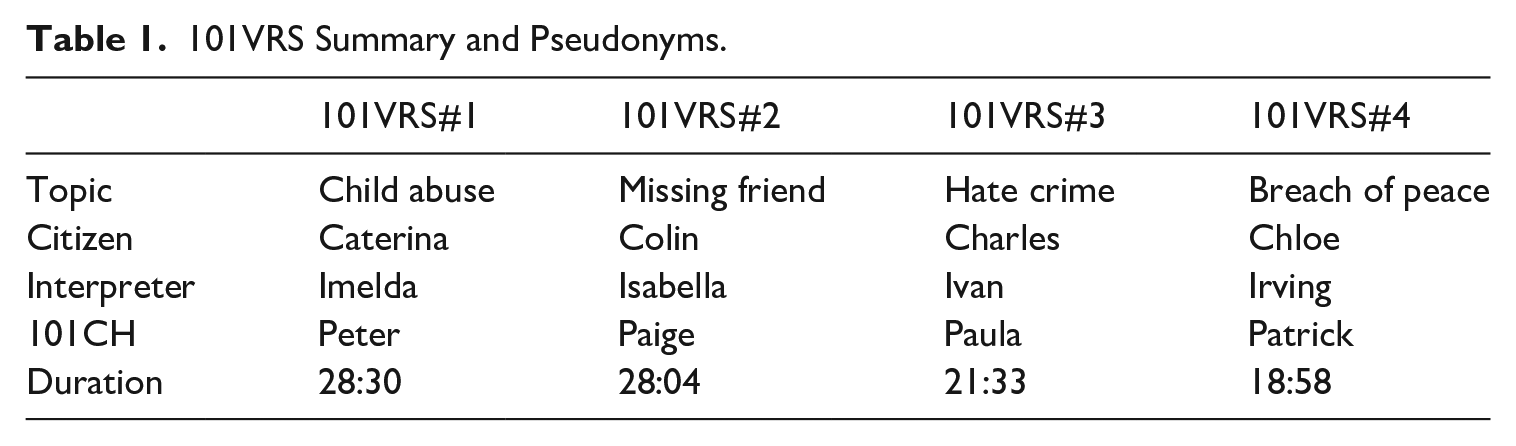
To be critical of the call-handler’s and interpreter’s positioning moves, it was necessary to strip away the level of direction or scripting given. The call-handlers and interpreters were provided with no instructions on how to behave. Of interest were how respective roles were communicated and understood, how interactive issues that appeared to prevent a specific task or communicative act from progressing were resolved, and how expectations were managed.
Each simulated call was immediately followed by a post-simulation, semi-structured focus group. The focus group session involved the interpreter, the call-handler, the deaf person, and an expert consultant from Police Scotland. All calls were recorded in audio and video format. Prior to their 101VRS call, participants were made aware of their involvement in a doctoral research project, which outlined participation in a non-emergency call and post-simulation focus group.
5.2 Participants
The participant recruitment process was managed and agreed upon in collaboration with the partner organisations. In total, 10 deaf people, recommended by the SignVideo Scottish branch, were purposively approached for this study. Four expressed an interest in becoming involved. Further checks were carried out either through email communication (written English with embedded BSL videos) or through video calls (in BSL), to confirm the participant’s willingness and comfort with participating in a police-related VRS call (Table 1).
For the deaf participants, their involvement required specific care, as their contributions demanded a personal contribution rather than a professional one as was the case for the police and interpreters. The simulations relied on their willingness to supply a mixture of real-world personal information (e.g., name, age, address) with fictional content (supplied by the researcher). Their contributions were intended to function as interactive stimuli. It was explained, in BSL and written English, how this personal information would later be removed or substituted with fictional content.
All participants were informed of the audio–video recording requirement and the need to use such materials for analytical purposes. Additional consent was sought to use images, still, or motion for dissemination purposes. The compensation of deaf and interpreter participants followed the INVOLVE (2016) guidelines for participation in social research. 2 The deaf participants and interpreters were compensated with a £20 electronic gift card as a token of appreciation for their time and involvement. The police participants were not offered any form of financial compensation, as their participation was during work time.
5.3 Analysis
All the simulated calls and focus group sessions were recorded, and transcribed or translated into English by the lead researcher, who as a native BSL and English user could access the data unaided. The horizontal transcription format was followed for this study. The horizontal approach is credited with providing a fluid and visual means of following the turn-taking interaction between three participants (Napier et al., 2018). Each participant occupies a column, and the reader can trace the chronological flow of the interaction along the vertical axis.
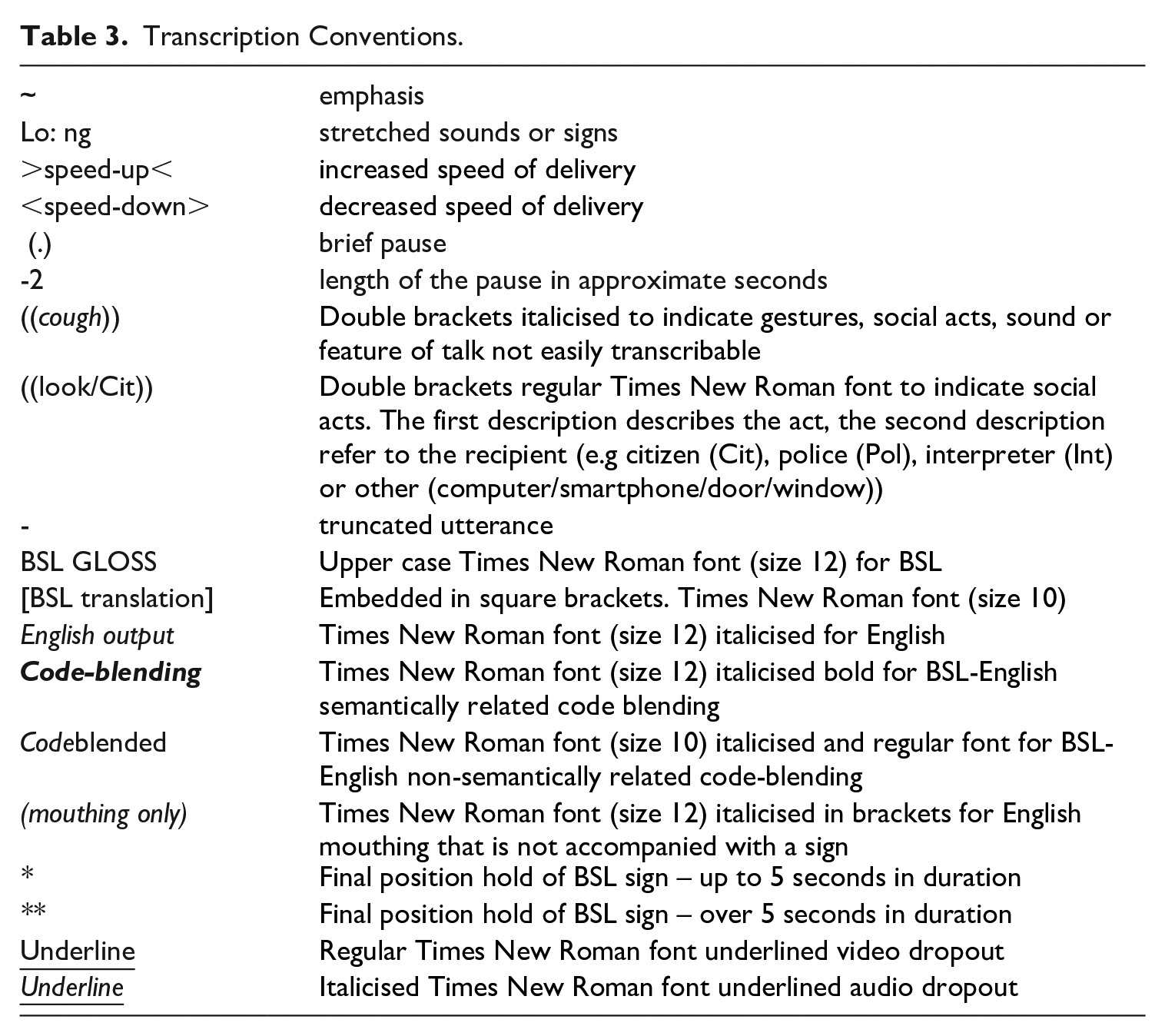
Transcription and translation conventions are provided in Appendix. To validate the English translations of the BSL, two qualified NRCPD-registered BSL/English interpreters were invited to self-select and review four extracts.
Participant’s positioning moves were coded and analysed using ELAN, a multimedia annotation tool (Figure 2).
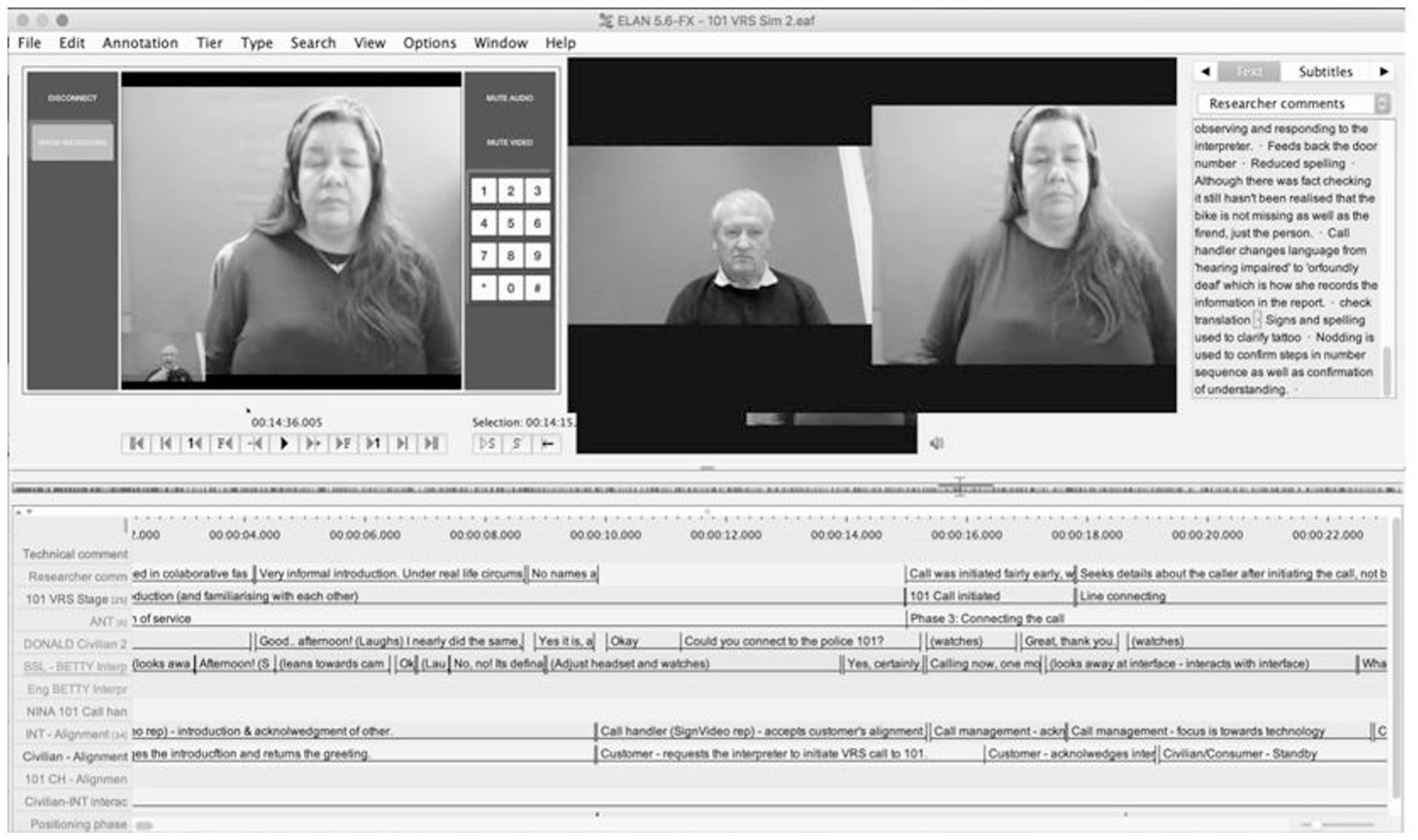
ELAN Screengrab.
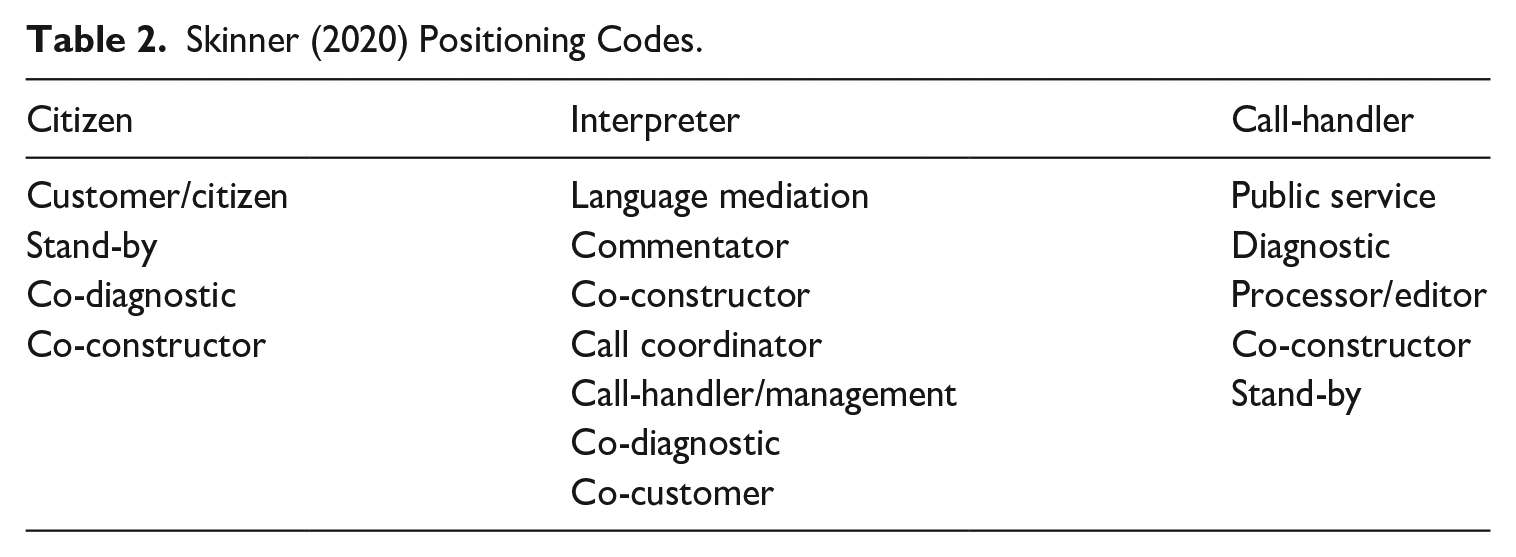
To code each participant’s moves from one type of approach to another, Skinner’s (2020) normative order model was followed. Skinner’s model was inspired by Merlini’s (2009) “cultural mediator’s model,” but includes the multiroles performed by all of the participants. Each normative order is understood by defining and describing the changing patterns of rights and duties between interlocutors (Table 2).
Skinner (2020) Positioning Codes.
The completed ELAN tiers functioned as a supplementary canvas to be reviewed alongside the digital audio–video recordings. ELAN was selected as the preferred and primary analytical source, so that researchers were able to observe the interactions as they were experienced.
Focus groups were organised after the simulations to provide access to participants’ reflections, concepts, and concerns that inform the positioning analysis (Hale & Napier, 2013). Participants were encouraged to verbalise their decision-making and their reactions to the displayed behaviours of others. The analysis of the focus group data was purposeful and inductive, following the principles of content analysis (Wilkinson, 1998, 1999). In the first instance, participants’ reflections were mapped to specific or general events observed in the VRS call. When incorporating participant comments into the discussion, it is explained whether these comments directly relate to the reported events or were general in nature. Other more general reflections about the challenges of VRS, such as hypothetical concerns or issues based on experience, were still categorised. These broader issues illustrated the values or priorities individuals may have about their participation in a VRS call.
A limitation of the focus group was the dependence on participants’ ability to recall aspects of their own experience. Since the researcher was not present during the VRS calls, and the focus groups happened immediately after the call, the researcher was not able to independently identify issues that warranted further exploration.
6. Results
The data presented in this article focus on three of the four VRS calls. Skinner (2020) summarises the non-emergency VRS calls as consisting of five typical phases:
Phase 1: Initiating the VRS call
Citizen interacts with designated webpage. 3
The platform allocates the call to the next available interpreter (the citizen is on stand-by).
Phase 2: VRS opening
The interpreter notified of the incoming call.
Opening and introduction of SignVideo service (optional).
The interpreter initiates the 101 call.
Phase 3: 101 opening and introduction
The 101 call-handler (101CH) allocates the incoming call.
Opening and introduction of 101 service.
Q&A sequence about the SignVideo service (optional).
Phase 4: 101 Assessment (led by the 101CH and mediated by the interpreter)
Q&A sequence about the caller.
Q&A about the incident.
Phase 5: 101 closing (led by the 101CH and mediated by the interpreter)
The 101CH explains their report to the caller.
The 101CH explains the next steps to the caller and seek consent.
Close.
This article reports on Phases 1–3.
6.1 Initiating the VRS call (Phase 1)
The first phase of the analysis considers how the opening begins with the web interface. The web interface is fictional and based on an actual example of a police force VRS webpage. As Figure 3 shows, the police force and VRS are presented as a joint partnership and places the caller as the customer.
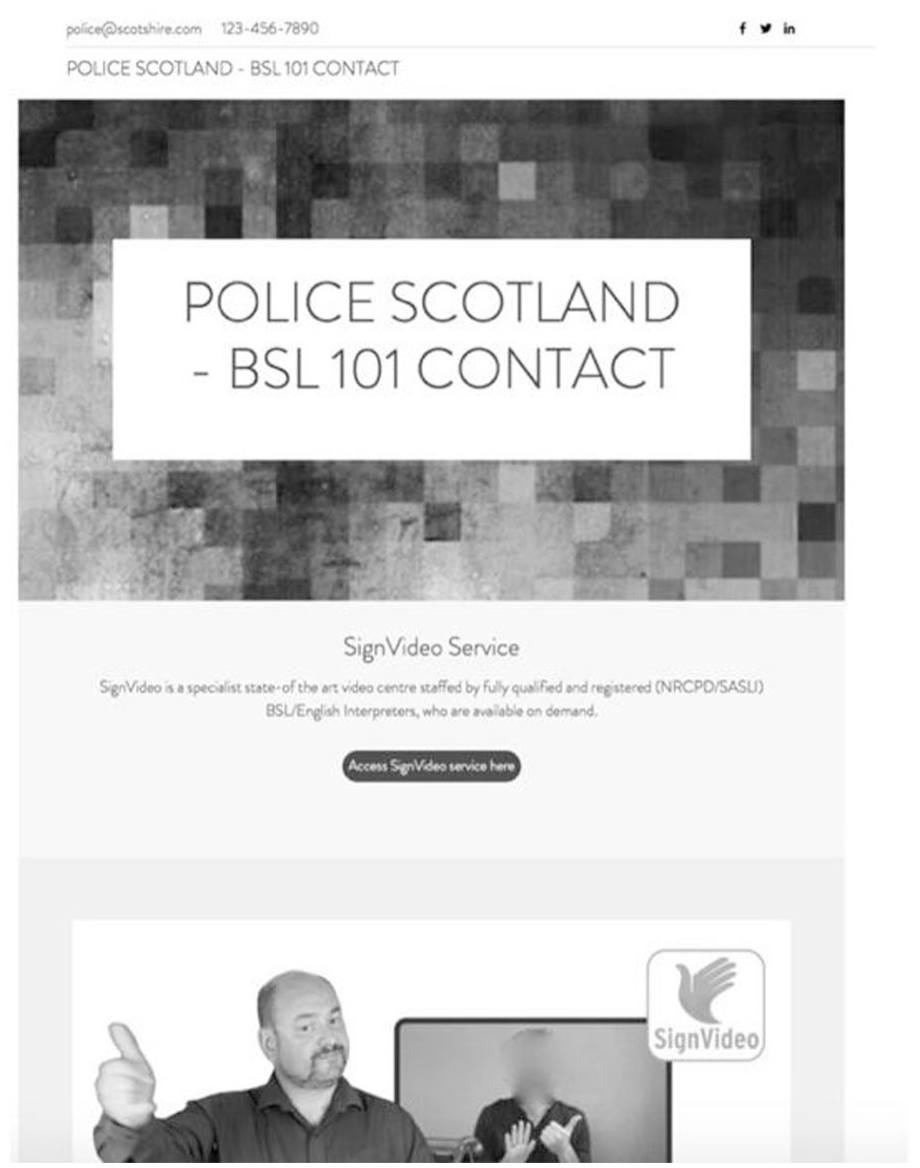
Police Scotland—SignVideo Webpage.
The results of this study suggest that the reality is somewhat different to the message promoted on this website. In the following sections, it will become apparent that the 101CH has minimal awareness of their formal partnership with the VRS provider. This is possibly due to the low frequency of VRS calls to the FCR, and the lack of experience in participating in VRS interactions (Skinner et al., 2021). The interpreter, who is routinely the first point of contact between the public and FCR, will need to consider how much effort is needed to mitigate this lack of knowledge by occupying a broader role, one that includes guiding others and functioning as the co-provider of the platform.
The analysis first examines how the 101VRS dyadic openings were negotiated, that is, who had the capacity to assume certain positions and whether these positions were accepted or challenged. What takes place in these opening phases characterises subsequent stages of the call, for example, how the call is transferred onto the 101 helpline.
6.1.1 101VRS#1 opening (Caterina and Imelda)
Caterina (the citizen) had previous experience of VRS, but had never used the service to contact the police. Imelda (the interpreter who answered the call) was an experienced VRS interpreter who had handled authentic 101 non-emergency calls in the past. Extract 2 is the transcription of how Caterina’s call was received by Imelda. In the extract, technical difficulties impacted on the exchange of personal details (underlined in Rows 2–4). 4 The video distortion persisted throughout the call. How Imelda managed the technical interference is also discussed.
101VRS#1 “Would you like to call Police Scotland?”.
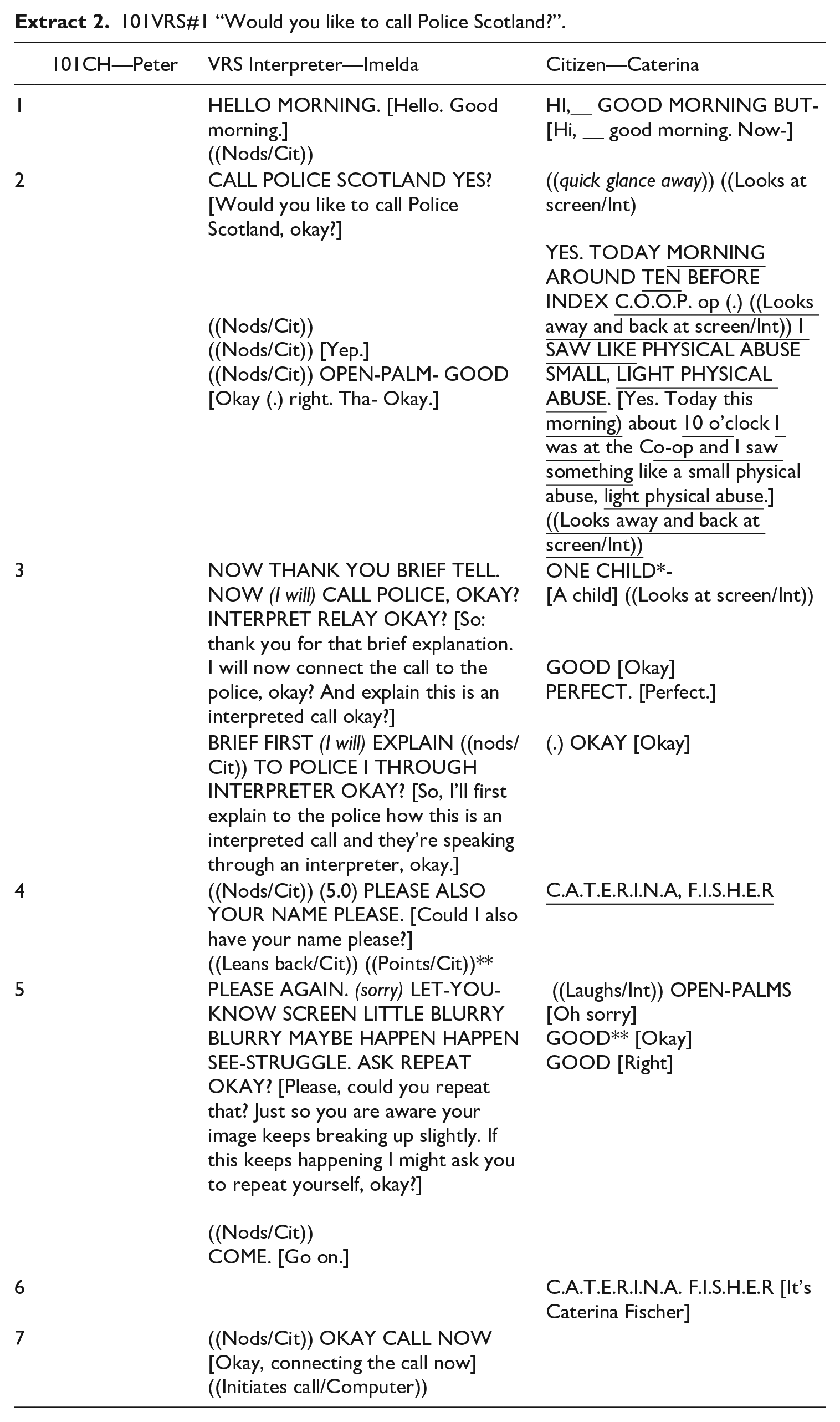
In the opening sequence, Imelda assumed a broad role of that included co-provider. This co-provider role can be observed when she assumed responsibility for welcoming and receiving the caller (Rows 1 and 2) and as someone who will lead with transferring the VRS call (Row 3). Imelda’s function as co-provider of the service focused on managing expectations, such as establishing and explaining her auxiliary role. Imelda does not engage in a dyadic interaction with Caterina to learn about the purpose of Caterina’s 101VRS call. In Rows 4 and 5, Imelda shows more flexibility when seeking personal details about the caller.
This extract shows how the co-provider role can be separated into three parts. The first is invested in managing the expectations of others when using the on-demand remote interpreting service. The second is concerned with learning about specific details about the callers (e.g., name, role, or location). The third part is knowing more about the purpose of the call. Imelda focused on managing Caterina’s expectations and retrieved specific personal details. Imelda stopped short from asking Caterina to explain why she is calling the police. Imelda’s actions did not seem to recognise how Caterina was already disclosing details about the event. Caterina can be seen to stop mid-sentence (Row 3) and switch to an accountative position, following Imelda’s directions.
Imelda’s and Caterina’s approach to establishing rights and duties is contrasted with two other examples, 101VRS#3 and 101VRS#4.
6.1.2 101VRS#3 opening (Charles and Ivan)
Charles (the citizen) has had experience in using VRS platforms but was making his first 101VRS call. Ivan (the interpreter) was an experienced interpreter who had recently joined the VRS service. Extract 3 consists of two rows because of the quick response in connecting the incoming video call to the 101 service.
101VRS#3 “Right, can you call the police?”.
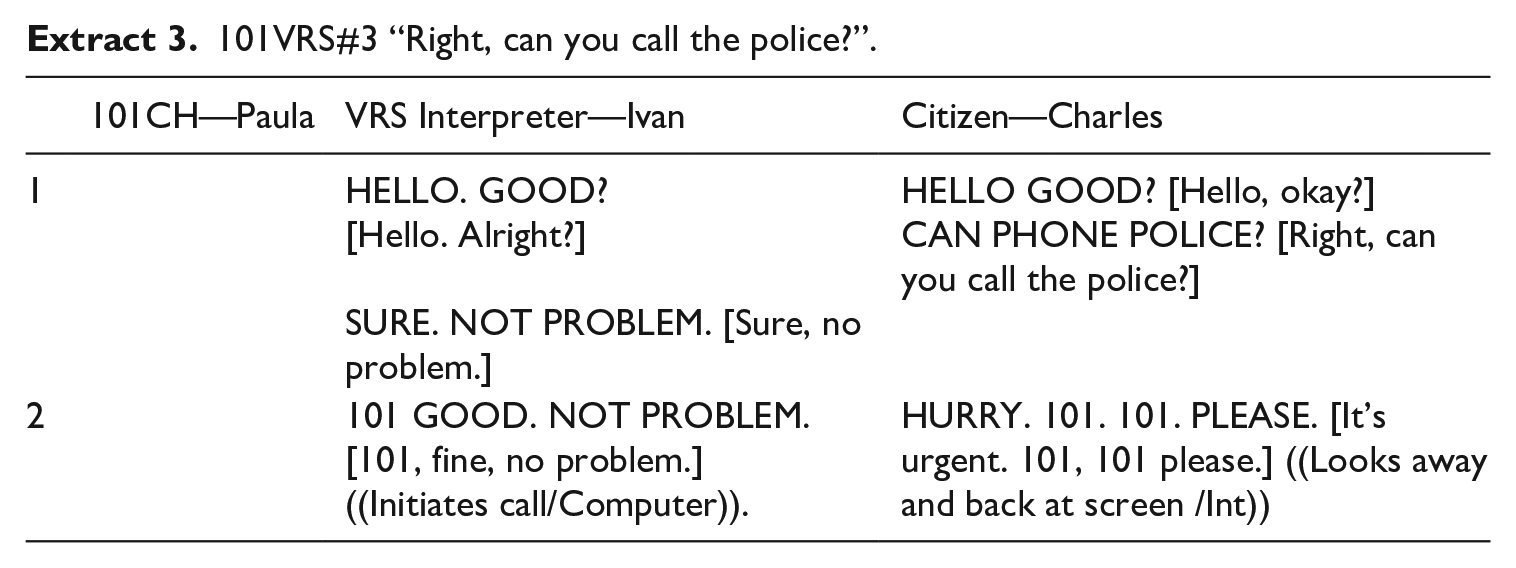
Charles assumed full control of his call by making his first positioning move a deliberate other-positioning move (Row 1). “Hello, okay? Right, can you call the police? It’s urgent. 101, 101 please.” Charles’ first positioning move contains neither an explanation nor an invitation for Ivan to respond. Charles appears to follow a process-driven approach to the VRS call, expecting Ivan’s subsequent move to be of a performative nature, for example, to initiate the call (perlocutionary act) (Row 2). This opening approach presents Ivan with an interactive ultimatum: to comply with, or to disrupt, Charles’ request.
Ivan does not assert his moral capacity as 101CH or call management nor does he dispense advice or manage expectations of how to collectively participate in a VRS call. Neither does he request personal information from Charles. The absence of background information about the call and caller created problems later when the call was transferred to the 101 service.
6.1.3 101VRS#4 opening (Chloe and Irving)
Chloe (the citizen) is an experienced user of interpreting services. Irving (the interpreter) is an experienced interpreter and joined the SignVideo service a few years earlier. Extract 4 shows how Chloe wanted to have her call transferred to the 101 service as expediently as possible.
101VRS#4 “There is a deaf person on the line, okay?”.
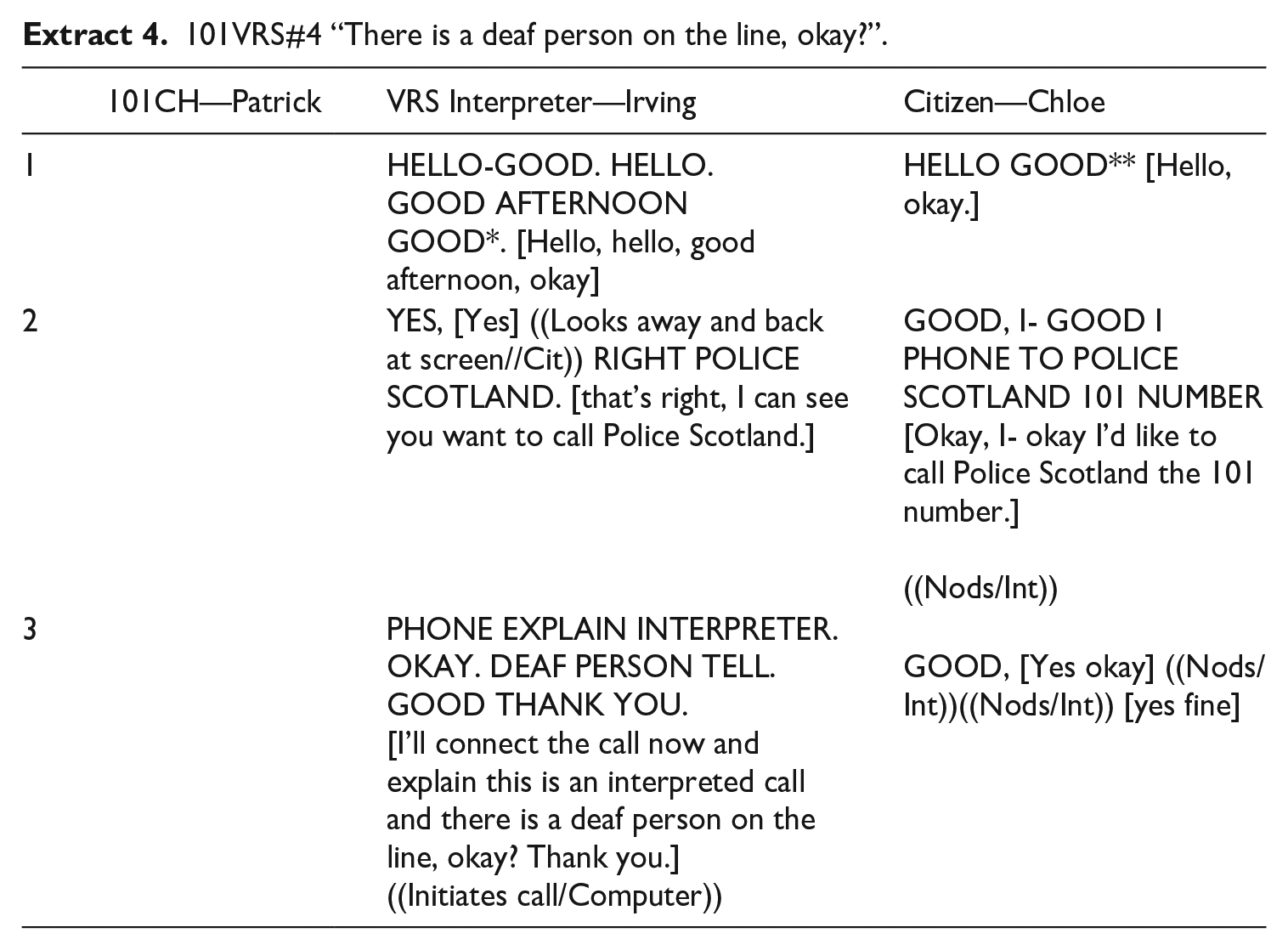
Chloe’s approach resembled Charles’ (Extract 3). She directed Irving to contact Police Scotland 101 helpline (Row 2). Unlike Ivan, Irving negotiated Chloe’s demands to include his own need, which was time and space to prepare the 101CH for the interpreted nature of the call. This subtle task-orientated re-positioning move restored Irving’s right to control and lead with the transfer of the incoming call. Irving waits for Chloe’s consent before progressing, thus securing his earlier re-positioning move. By re-assuming control, Irving could frame and manage the next stage of the 101VRS call.
6.2 Summary of VRS opening
The three opening phases of the VRS calls involved the establishment of identities between the citizen and interpreter. Distinguishing the interpreter’s moral capacity to act in ways that support their ability to provide a service from the observed communicative acts, we see how the interpreters were selective regarding what types of task positioning moves were created. The interpreters generally focused on promoting performative positioning moves, for example, transferring the call as expediently as possible, as opposed to accountive moves such as “tell me about the purpose of your call?” The focus on performative positioning (e.g., agreeing to the citizen’s request) resulted in greater expediency in transferring the call.
It could be argued that it was the interpreter’s moral duty to greet the incoming call and lead on transferring the call to the 101 service. Imelda (101VRS#1) and Irving (101VRS#4) demonstrated that interpreters can and do have the capacity to engage and create some conversation, and to undertake call management actions. Imelda sought Caterina’s name and directed Caterina to repeat the spelling of her name owing to technological interference. Irving showed that he had the capacity to carefully manage and redirect Chloe’s opening approach. Irving also secured Chloe’s consent to lead with transferring the call. Yet, neither Imelda nor Irving asked questions about the purpose of the call but limited their involvement to emulate the telephone experience, possibly to avoid any further delay in transferring the call. This could explain why all three interpreters did not solicit detailed information from their respective callers and instead appeared to focus on being expedient. This approach is defined as “process-driven,” where the rights and duties of actors are concentrated towards completing tasks. The interactive partners place greater value on being efficient and functional.
Ivan imitated Charles’ process-driven approach. Charles did not seek to engage with Ivan other than to request that his call be transferred quickly to the 101 helpline. Like Imelda and Irving, Ivan had the moral capacity to reframe Charles’ demands, but did not produce such a move. Instead, he transferred Charles’ call to the 101 service immediately, leaving himself no opportunity to engage with Charles. Calls to the non-emergency service have been known to include emergency 999 calls (Skinner et al., 2021). The interpreter’s motivation to transfer the call with minimal delay could be based on a misplaced assumption. The issue here is that Charles’ other positioning appeared to be intentional to restrict Ivan’s positioning to what Merlini (2009) describes as the “detached translator”—someone, that is, only responsible for attending linguistic mediation. Once an interpreter accepts a restrictive way of being early on, it can be problematic to shift their rights and duties to a collaborative position, such as co-provider or provider of the service. To do so, it requires a renegotiation of behaviours and expectations. To shift to a collaborative arrangement would require an explanation for the change, which would have to be communicated in a way that obtains agreement from all, without unnecessarily disrupting or prolonging the citizen’s stated need to reach the 101 service. This endeavour has further challenges when managing two interactive partners across two types of media.
6.3 Handover to 101
The analysis for the second round of introductions (Phase 3) again examines how these initial 101VRS openings were managed, who had the capacity to assume certain positions, and whether these positions were accepted or challenged. The transfer of the call from SignVideo to the FCR presented a new dynamic. The VRS call was straddled across two types of media, creating an asymmetry of both technology and knowledge (Warnicke & Plejert, 2016).
Prior to this point, the interpreter and citizen had either implicitly or explicitly acknowledged the need to contact a 101 service via an interpreter. This mutual acknowledgement had yet to include the 101CH. This created two types of epistemic differences: One that had been established (citizen and interpreter), and one yet to be established (citizen–interpreter–101CH). How the 101CH is invited into this arrangement—including the explanation of the VRS configuration—matters. Either the interpreter or the citizen will assume responsibility to introduce the 101CH, and each will approach this description in different ways. The call may struggle to progress if the 101CH has not conceptually grasped the VRS configuration.
In a real-world context, it is highly possible that the 101CH will have no awareness of the VRS service or how to interact via an interpreter or with someone who is deaf and uses BSL. It is therefore necessary for other participants to guide the 101CH to understand these specific features as part of learning what kind of moral and personal duty should be assumed for the 101VRS call. The 101CH’s understanding is required for them to appreciate how to work with an interpreter, for example, knowing when to speak or to wait, knowing how to frame complex questions, and appreciating that the voice heard is the interpreter’s voice and therefore anything uttered is likely to be an interpreted response.
6.3.1 101VRS#1 Handover (Imelda and Peter)
Compared to Imelda’s opening with Caterina, Imelda can be seen to assume a broader range of positions. Imelda operated as the provider of the service, involved translator and co-provider of the service within a short timeframe. She handled the dual connection using code-blending, speaking, and partially signing. Code-blending during the handover phase of a VRS call has consistently been observed in VRS studies in the US (Marks, 2015), Sweden (Warnicke & Plejert, 2012, 2016), and internationally (Napier et al., 2018). The use of code-blending was strategic, including Caterina in Imelda’s management of the handover.
101VRS#1 “Line ringing.”
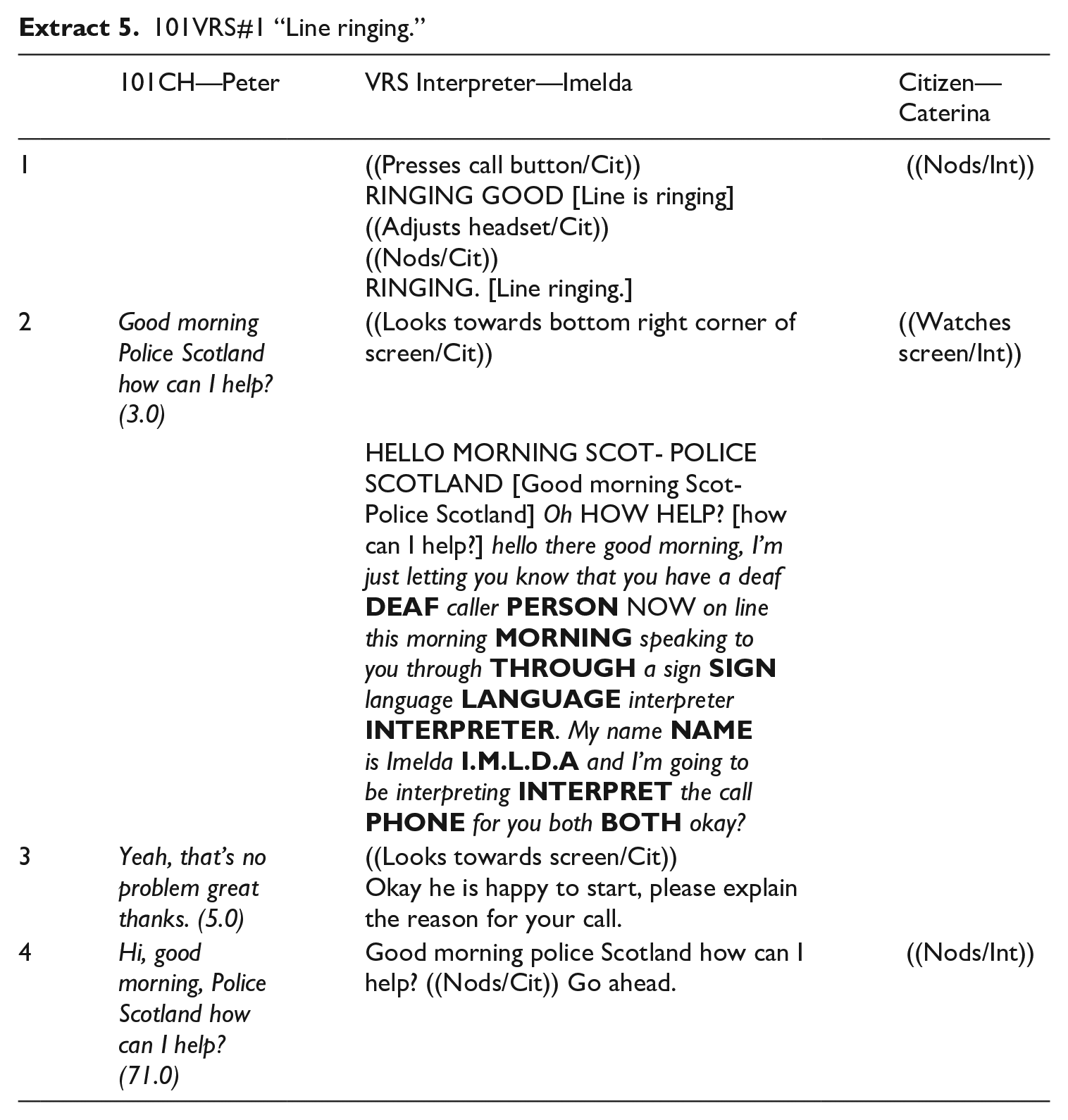
Imelda’s opening social and task positioning move placed Peter as the “learner.” Imelda supplied a description of the service, which was delivered in a paced and measured style (Row 2). Peter could not directly see the VRS configuration and appeared to be aware of his need to listen and learn about the shared epistemic stance between Imelda and Caterina. Peter consented to the VRS arrangement (Row 3) and followed with his routine introduction, understanding that it would be interpreted by Imelda (Row 4). Peter did not ask if it was okay to begin speaking; he somehow recognised that it was his turn to speak and moved straight into introducing the call.
There were silent pauses of 3–5 s between Imelda and Peter’s interactive turns, which did not appear to unsettle Peter’s approach to managing the call. Peter was not able to see Imelda or Caterina actively signing to each other during these transitions. In fact, after Peter’s initial introduction (Row 4), he did not speak for another 71 s. Peter stepped back and let the call unfold until he was clear it was his turn to speak. This approach to communication from the police is what can be defined as emergent practices, where space and time is afforded to the citizen and interpreter to collectively retell a story. At this early stage, Peter’s emergent position was about learning how to place himself in the call. The benefit of this emergent style meant Imelda was not pressured to tend to Peter’s needs, but free to concentrate on how to retell Caterina’s story.
In the post-simulation focus group, Peter explained that he would typically stand back and allow callers to speak for lengthy periods and deliberately not interrupt the caller. By doing this, the caller was given space to recall details about their complaint or request. Peter was aware that it could take time for callers to explain what they needed. He was also mindful of the need for Imelda and Caterina to hold side discussions in BSL. Peter appeared to trust Imelda to be working with him, to retrieve essential details for Caterina’s call. Peter later explained how his concern was to structure his questions by avoiding lengthy or conflated sentences and to remember what questions to ask once it was his turn to speak.
6.3.2 101VRS#3 Handover (Ivan and Paula)
Earlier, Charles had assumed control of his call by instructing Ivan to call the police “Right, can you call the police?” Charles’ instruction established a functional relationship with Ivan. Extract 6 is lengthier than the two other examples owing to the confusion of Paula’s, and the need to clarify who was speaking and how the VRS call was to be facilitated. Extract 6 begins when Paula joined the call. Paula has handled calls from deaf people in the past, including text-relay calls (the UK service is known as type-talk) and more recently, a call from a deaf citizen who communicated via their hearing work colleague, who spoke on the deaf person’s behalf and communicated with his colleague via lip-reading.
101VRS#3 “We’re through, it’s a lady.”
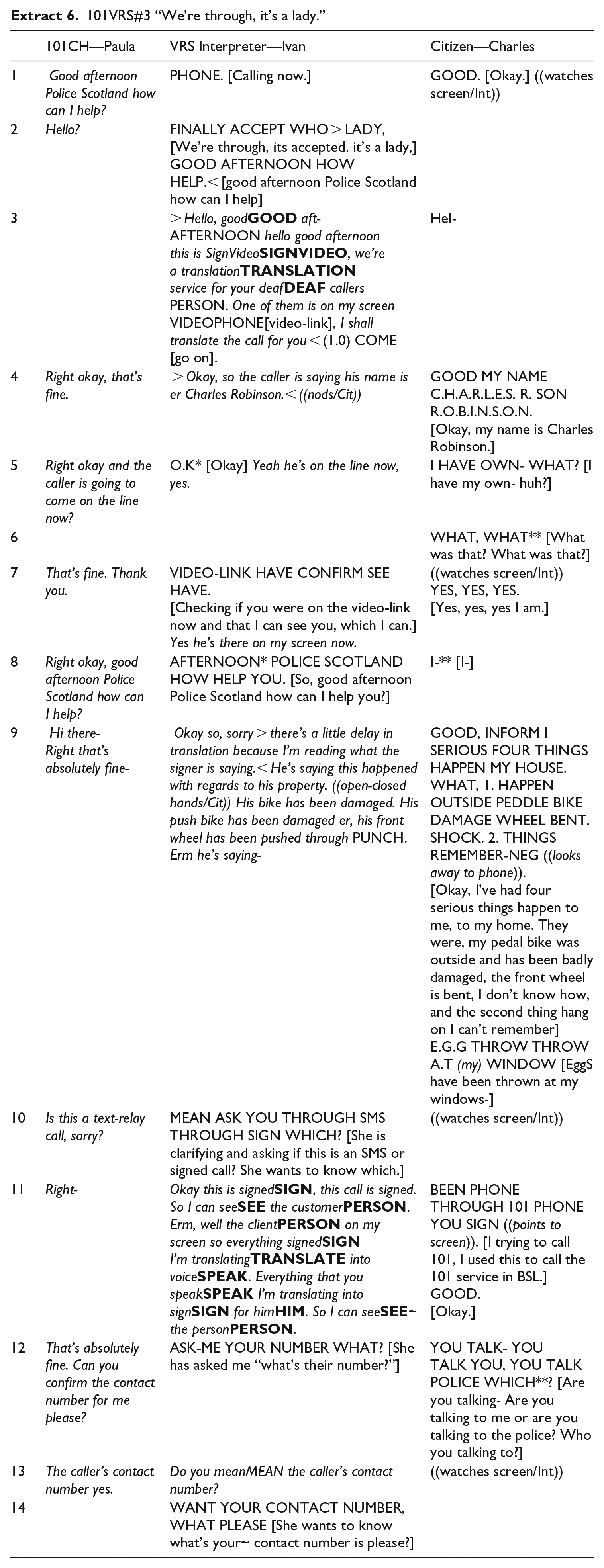
Ivan’s focus was on ensuring others were made aware of knowledge asymmetries. Ivan also described his service as a “translation service” and stated that he can see the person on his screen. The speed of delivery and time taken to explain the service was rushed in comparison to Imelda or Irving. Ivan also assumed a partial social and task positioning move by directing the next turn to Charles without Paula’s knowledge or consent (Row 3). Ivan’s sanctioning of turns was disrupted by Paula’s accountive positioning move (Row 5) “Right, okay, and the caller is going to come on the line now?” Ivan was expecting Paula to assume a performative positioning move, as listener to Charles’ storytelling. Since Paula had not consented to the interactive turn, nor fully understood her shared rights and duties, she was unable to assume the type of position that allowed the call to progress onto the next episode. Paula’s request for clarification remained tied to the previous episode, establishing and introducing the VRS service.
Paula’s confusion further complicated the flow of the call. She was expecting to hear another person’s voice (Charles’) and asked if the caller was coming on the line (Row 5). Next, Paula sought a second clarification to determine the type of telecommunication relay service facilitating the call: “is this a text-relay call? Sorry” (Row 10). Her confusion could have come from Ivan’s “
Looking at how Ivan tried to manage the opening, his first objective was to persuade Paula to move into her formal position by stating “yes he is on the line.” Ivan’s re-positioning move was unsuccessful, as conceptually Paula was asking for further guidance (Rows 5 and 10). Throughout this interaction, Ivan committed himself to a process-driven approach, favouring expediency and the detached translator mode. Ivan appeared reluctant to assume a more involved position, for example, directly managing Charles’ and Paula’s expectations. This restrained behaviour may have been an outcome of Charles’ projected self-other positioning, which is discussed below.
In the post-call discussion, Paula explained her initial confusion because of her recent experience in assisting a deaf person where a work colleague facilitated parts of the call. Paula explained how she interacted directly with the hearing work colleague, and the deaf person participated by lip-reading the work colleague. Paula found this past experience to be more “fluid.” She explained that the colleague was familiar with the deaf person and was able to explain aspects of the incident without having to relay her questions in full. Based on this recent experience, her expectations clashed with the reality of the current simulation. Ivan and Charles were unfamiliar to each other; furthermore, Ivan did not have the moral capacity to speak on Charles’ behalf.
Unsure of the current circumstances, Paula could also be seen to favour the process-driven approach. She appeared to be less interested in Charles’ story and safety, and did not pick up on (or follow through) Charles’ distressed account of vandalism and destruction (Row 9). To do so would allow the 101 interactions to emerge through the citizen’s account.
On reflection, Ivan felt that the opening of the call could have been handled differently had he taken more time to explain the configuration and concept of the service, which he did manage later in the call. Ivan recognised how the flow of the call improved once he focused on communicating his current circumstances, his practical epistemology. Once Paula understood the environment and context in which Ivan and Charles were communicating with one another, she could conceptualise her rights and duties in the broader context. This also saw Paula modifies her approach by demonstrating her ability to work with another professional and vocalise concerns for Charles’ safety.
Charles explained that he felt an extra burden in managing and monitoring the interpreter’s performance because he was unfamiliar with the interpreter. He sought to control how Ivan operated by manipulating how Ivan facilitated his call. Charles described watching the interpreter’s lips closely and monitoring what was being conveyed to the 101CH. This cautious approach to managing the interpreter was based on past experiences where matters reported to the police had been incorrectly interpreted.
Finally, unlike other citizen participants, Charles was confused by Ivan’s code-blending strategy and questioned who Ivan was speaking to (Row 12). The opening of the call was problematic at every turn, and Charles’ confusion with Ivan’s use of code-blending may have been an outcome of the poor call management and not the use of code-blending. As the call progressed, Charles did not object to Ivan’s strategic use of code-blending.
6.3.3 101VRS#4—Handover (Irving and Patrick)
Patrick, who answered the 101VRS call, had never received an interpreted call before. Like Peter (101VRS#1), Patrick quickly recognised his rights and duties, and how to adjust his call handling approach.
101VRS#4 “Would you like my address details?”.
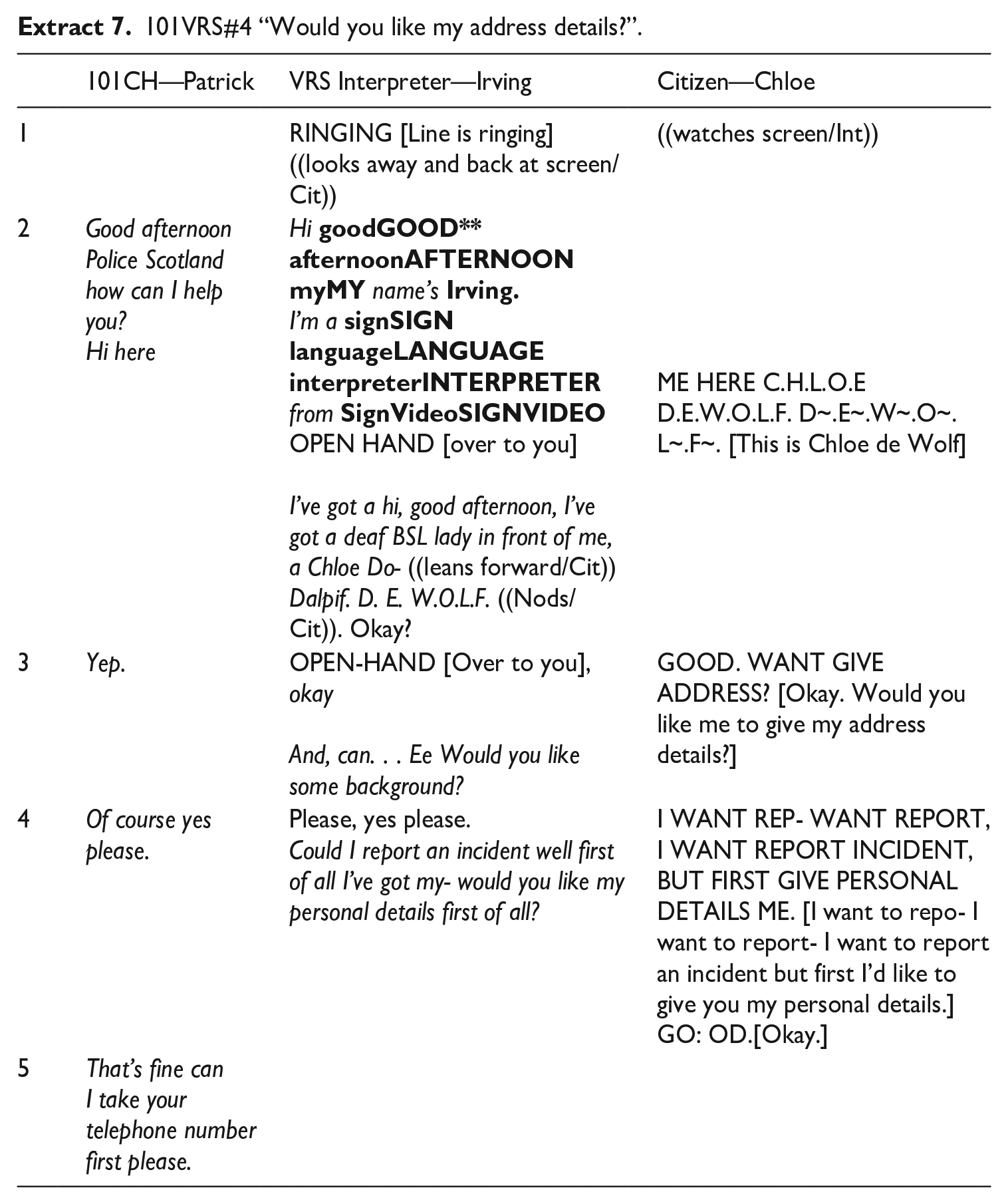
Like Imelda, Irving used code-blending strategies to simultaneously explain the service to the 101CH, thus placing Chloe in “observer” position. Irving’s social positioning move sought to prepare Patrick for the interpreted nature of the call by indicating the caller’s deafness and language use as “sign language” (Row 2). These were clues passed on to Patrick in the hope that he understood that this was an atypical call. Unlike Imelda, Irving did not provide space for Patrick to confirm his understanding of the VRS service. Instead, he sanctioned Chloe to take the next turn without consulting Patrick. Without audio or visual clues, Patrick had no knowledge that the interpreter had produced a task positioning move that requires his cooperation.
Unlike other citizen callers in this study, Chloe deliberately self-positioned, assuming a proactive and pragmatic approach towards her introduction. She anticipated the call handling process by offering her personal details first before discussing the incident (Row 3). She also detected Irving’s interpretation error when he said, “Would you like some background?” (Row 3). Her Scottish sign for ADDRESS resembles a sign for BACKGROUND. Instead of overtly correcting Irving’s mistake, Chloe incorporated Irving’s interpretation error into her next response (Row 4): “I would like to report an incident, but first I’d like to give you my personal details.” The decision not to correct but to rework Irving’s misinterpretation is another example where the caller manipulates how the interpreter functions. Chloe was not intentionally seeking to restrict the interpreters’ moral field, as was Charles, but to discreetly modify her own rights and duties, becoming Irving’s collaborator without disrupting or alerting Irving to his error.
Throughout her call, Chloe preempted the questions that Patrick was likely to ask, taking a proactive stance regarding how her needs were documented. In the post-simulation discussion, Chloe acknowledged that she was mindful of her language use, how she articulated her signs and communicated via a 2D format. Not only did Chloe reflect on the production of her signs but she also explained how she monitored Irving’s understanding. Chloe thought it is necessary to work with the interpreter, to enable them to render her story. Chloe’s reflections are an underreported example of the ways in which the lay person, the caller, actively contributes to the co-venture by monitoring and assisting the interpreter.
6.4 Summary of handover
When receiving a 101VRS call, the 101CHs find themselves in the unusual position of learning two sets of epistemologies: the interpreter’s and the citizen’s. This disrupts and challenges how a 101CH assesses and moves forward to control the interaction. A process-driven approach from interpreters does not fully prepare the 101CH for the types of rights and duties expected of them. The interpreter appears unreceptive to interventions from a 101CH who may ask questions about the VRS configuration or caller. An emergent approach to communication means that time afforded participants to establish the collective rights and duties. This approach to communication was not atypical for call-handlers. The call-handlers who participated in this study had become versed at dealing with epistemic differences, and working with citizens to retell and piece together their story without being able to see the citizen’s reality. Regardless of audiological status or language background, citizens do not always communicate well, and to overcome issues around remote communication, call-handlers afford people time to explain their needs, identify lines of enquiries, reconfirm their understanding of the citizen’s matter, and discuss how the police can respond. This step-by-step approach to understanding the caller’s story and communicating police procedures not only benefitted the caller but the interpreter as well. By the interpreters extending the emergent approach, they created space to call on others, the caller, or call-handler to form a preferred other-position or co-positioning arrangement. The establishment of co-positions means different actors establish a unified, mutually shared, and understood set of rights and duties.
7. Discussion and conclusion
This study focused on how rights and duties were established during the opening phases of a VRS call. Positioning theory was applied to this study because it encouraged the investigator to consider the contributions made by each participant. This study therefore gave equal focus to the contributions made by deaf callers and police call-handlers, and described whether and how each participant supported a co-venture approach to interpreter-mediated communication.
Deaf callers were seen to enter their calls with preconceived ideas of how to work with an interpreter and how to use the platform. One citizen viewed the interpreter as a tool for communication (Kauling, 2021) and sought to restrict the interpreter’s moral order, promoting a process-driven communicative approach. In the other two examples, the citizens negotiated with the interpreter and consented to their owning a broader role. These findings reinforce the argument that citizens can and do influence interpreters into ways of being.
Another way how the deaf signers contributed to the co-venture was through their switching of moral orders, from reporting their need to supporting how interpreters rendered their message. This supporting role was achieved by monitoring and responding to interpreters’ use of code-blending, or by skillfully monitoring the interpreter’s lip-pattern when using vocabulary that is regionally specific. The multiple roles played by deaf signers are an understudied subject—in contrast to the attention afforded the interpreter or public service provider (e.g., doctors, police officers, or teachers). It is recommended that further attention be given to studying the strategies and expectations that deaf callers bring to VRS interactions, and how interpreters can respond appropriately.
As shown in the data, all three interpreters performed social task positioning moves that slowed down the interaction, for example, explaining the VRS service and their duty to interpret the call. The interpreters appeared reluctant to undertake a more visible and involved role, for example, to discuss with the caller the purpose of the call. Information gathering is part of the co-venture approach to interpreter-mediated communication. In one case, the emphasis on being expedient resulted in the call-handler failing to conceptualise their moral order. Such a process-driven approach means that the citizen and call-handler take on more responsibility for ensuring successful communication, which ultimately means that the deaf caller has to make a greater effort to make the system meaningful to them. The findings of this study suggest that more discussion is needed to identify how interpreters can better function as first call receivers, and how they manage the expectations of others while collective rights and duties are being negotiated. Part of this consideration needs to include how VRS interpreters work with (or guide) others who display different ideas of their own involvement in interpreter-mediated communication.
The call-handlers in this study were versed at dealing with people who struggle to convey to another what they know or can see in their own epistemic reality. This direction shift in policing added a relevant and interesting angle to analysing the performance of call-handlers with regard to their shared responsibility for making interpreter-mediated communication possible. How procedural justice changed the dynamics of interpreter-mediated police-citizen interactions is not known. The recent introduction of 101VRS in the UK presented a practical incentive to begin exploring the subject. According to Goodman-Delahunty and Howes (2019), extending the principles of procedural justice to include both the interpreter and citizen creates better cooperative conditions for communication. This was seen in two out of the three calls in this study. Two call-handlers regularly considered how their use of language and approach to managing the call affected the interpreter. While this study focused on how call-handlers work with interpreters, there are also issues in how frontline services adapt standard police procedures that need to be explored. What happens when a call-handler dispenses generic advice that is not suited to a deaf person, or does not consider future communication issues once the call has ended? Further research is needed to look at how these broader institutional challenges are managed and resolved. Often the burden is on interpreters, who must weigh-up the cost of becoming involved (or not), advocating deaf people’s right to receive parity of service beyond the VRS call.
The argument supporting an emergent approach to VRS interactions poses problems for VRS for emergency calls, for which being expedient and process-driven is expected. The call-handlers’ and interpreters’ ignorance about the citizen’s emergency, and the time required to establish a collective moral order, can create unwanted delays and burdens on citizen to explain their communication needs. While VRS may work for non-emergency calls, where time is negotiable, it is recommended that emergency services explore either the creation of a three-way video emergency service, where call-handlers can instantly see that they are part of a video-mediated interpreted call, or of a direct BSL video emergency helpline.
By focusing on standard police procedures and understanding what works and why, we can identify how VRS services could be used to increase citizen access to other areas of frontline police services. The process-driven approach in the opening stages of the call suggests that interpreters can field any call with minimal involvement. This ideology runs counter to the co-venture idea which interpreting scholars have been advocating since the early work of Roy (2000) and Wadensjö (1998). This study/article demonstrates the importance of recognising how VRS interpreters need to retain and develop strategies that promote their own broader role and ways of adapting and working with the multiple roles performed by others.
Footnotes
Appendix
Transcription Conventions.
| ~ | emphasis |
| Lo: ng | stretched sounds or signs |
| >speed-up< | increased speed of delivery |
| <speed-down> | decreased speed of delivery |
| (.) | brief pause |
| -2 | length of the pause in approximate seconds |
| ((cough)) | Double brackets italicised to indicate gestures, social acts, sound or feature of talk not easily transcribable |
| ((look/Cit)) | Double brackets regular Times New Roman font to indicate social acts. The first description describes the act, the second description refer to the recipient (e.g citizen (Cit), police (Pol), interpreter (Int) or other (computer/smartphone/door/window)) |
| - | truncated utterance |
| BSL GLOSS | Upper case Times New Roman font (size 12) for BSL |
| [BSL translation] | Embedded in square brackets. Times New Roman font (size 10) |
| English output | Times New Roman font (size 12) italicised for English |
|
|
Times New Roman font (size 12) italicised bold for BSL-English semantically related code blending |
| Codeblended | Times New Roman font (size 10) italicised and regular font for BSL-English non-semantically related code-blending |
| (mouthing only) | Times New Roman font (size 12) italicised in brackets for English mouthing that is not accompanied with a sign |
| * | Final position hold of BSL sign – up to 5 seconds in duration |
| ** | Final position hold of BSL sign – over 5 seconds in duration |
|
|
Regular Times New Roman font underlined video dropout |
|
|
Italicised Times New Roman font underlined audio dropout |
Declaration of conflicting interests
The author(s) declared no potential conflicts of interest with respect to the research, authorship, and/or publication of this article.
Funding
The author(s) received no financial support for the research, authorship, and/or publication of this article.